

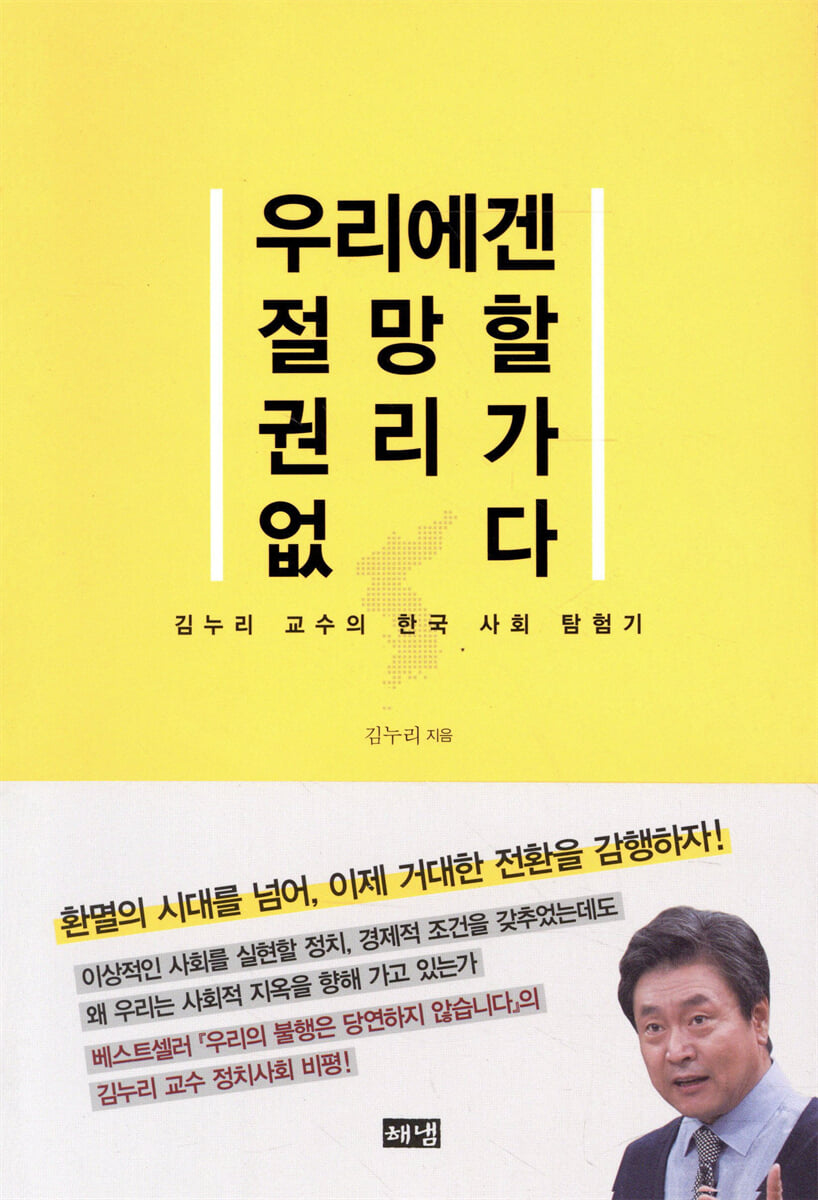
We have no right to despair
 |
Description
Book Introduction
Why We Are Moving More and More Towards Social Hell Beyond the age of disillusionment, let us now embark on a great transformation! A book that lifts the curtain of deception that has dominated Korean society and presents a blueprint for reform! Professor Kim Nu-ri of the German Language and Literature Department at Chung-Ang University, who has been confronting the true face of our society with profound introspection and delving into the path forward for us, is publishing a collection of political and social critiques. This book, which compiles columns and contributions serialized in the Hankyoreh's "Reading the World" from 2013 to 2020, is more than just a collection of columns; it is also a historical record that faithfully captures the bitter landscape and trajectory of South Korean politics and society, which have rapidly changed over the past seven years. Having created a sensation through three lectures on JTBC's "Different Class" and the bestseller "Our Misfortune Is Not Natural," he seeks to once again call for a "great transformation" by revisiting the fundamental contradictions and ills of our society and proposing alternatives. |
- You can preview some of the book's contents.
Preview
index
Introduction | To overcome the era of disillusionment
Prologue | Post-Corona, in the Face of a Collapsing World
Chapter 1: South Korea Trapped in a Massive Deception
Anxiety: The Hidden Ruler of Korean Society
rude society
Bystander society
A society that kneels
slave democracy
The 2 million candlelight vigils' mandate is "regime change."
Candles in the square must burn in the field of life.
The Age of Lies
Democracy without democrats
Let's practice democracy!
“Can I freely criticize the president?”
Dual sexual morality and the birth of a monster
Thinking of the military
Masked democracy
Beyond total catastrophe
Chapter 2: Looking back to go forward
The most beautiful 'stumbling block' in the world
Auschwitz made today's Germany.
The unresolved past will inevitably return.
The Brandt government and the Moon Jae-in government
The 50th Anniversary of the '68 Revolution and Korea's Special Path
Germany's 68 generation and Korea's 86 generation
The Country of Gunter Grass
The problem isn't plagiarism.
A place more horrifying than Park Jong-cheol's torture chamber
100 Years of the Republic of Korea: A History Without Liquidation
Chapter 3: There is no future in the land of depressed children.
The education revolution can no longer be delayed.
Beyond the class society based on academic background
Land of Happy Teenagers
Allow teenagers to participate in politics
If sixteen year olds had the right to vote
Education in a country hosting a million refugees
Who's Afraid of 18-Year-Old Voting Rights?
Korean sex education was dismissed
Competition, another name for barbarism
Lee Kang-in's "Brothers Who Didn't Play"
The answer to college entrance exams is not reform, but abolition.
The answer to college entrance exams is not reform, but abolition.
The new 100 years of the Republic of Korea, with new education
Chapter 4: The Trampled 'Hall of Intellect'
Joo Hyun-woo, Kim Ye-seul, and the death of the university
Death of the University and a Desperate Society
A country that provides tuition and living expenses
Korean universities occupied by capital
Newspaper University Evaluations and the Colonization of Universities
The "employment-focused university" theory insults scholarship and intellect.
Are universities subordinate to corporations?
Faust's Bargain at University
The Part-Time Lecturer Problem: It's Time for Professors to Take Action
When young people take action, they change the world.
Now it's time to reveal the "academic blacklist."
Korean educators, unite!
Concerns about the conservatism of universities
University reform is the starting point of social reform.
May the 50th anniversary of the '68 Revolution become the first year of university democratization.
Chapter 5: The Distorted Politics of the Lesser Evils
South Korea's oligarchy must end now.
Excuses for Conservatives
The rightward shift in Korean politics has crossed the danger line.
Market liberalism expelled from the German parliament
A strategy to nurture the populace is more frightening than controlling the media.
Public broadcasting has become a trap for democracy.
Korean broadcasting is an enemy of democracy.
An Era of Great Transformation: Conditions for Social Reform
The biggest evil in Korean society is the election law.
What is the identity of the Democratic Party?
The Candlelight Spirit and the Democratic Party's Self-Denial
The historical significance of the April 15 general election
Chapter 6: A Bold Transition Towards a Peaceful Community
From the American Dream to the European Dream
The main enemy of Korean democracy is the Cold War system.
The North Korean Nuclear Crisis and Ryu Hyun-jin's Pitching Schedule
It's time to declare the "Moon Jae-in Doctrine."
The Dignity of Korea as a 'Global Star'
Three reasons to pay attention to Germany
Chancellor Merkel's advice
German unification and two pastors
Concerns about the Germanization of Europe
Unification through absorption is a myth
Peace in Northeast Asia is in our hands
Thinking about Northeast Asia from a borderless Europe
What Merkel's election victory means
Thinking of America
Is true reconciliation possible between Korea and Japan?
The Paradox of Unification and the End of the Cold War
A new era of peace where national reason has awakened
A change in US-North Korea relations will usher in an era of unification.
Epilogue | Lifeism, Beyond Capitalism, Towards Life
Prologue | Post-Corona, in the Face of a Collapsing World
Chapter 1: South Korea Trapped in a Massive Deception
Anxiety: The Hidden Ruler of Korean Society
rude society
Bystander society
A society that kneels
slave democracy
The 2 million candlelight vigils' mandate is "regime change."
Candles in the square must burn in the field of life.
The Age of Lies
Democracy without democrats
Let's practice democracy!
“Can I freely criticize the president?”
Dual sexual morality and the birth of a monster
Thinking of the military
Masked democracy
Beyond total catastrophe
Chapter 2: Looking back to go forward
The most beautiful 'stumbling block' in the world
Auschwitz made today's Germany.
The unresolved past will inevitably return.
The Brandt government and the Moon Jae-in government
The 50th Anniversary of the '68 Revolution and Korea's Special Path
Germany's 68 generation and Korea's 86 generation
The Country of Gunter Grass
The problem isn't plagiarism.
A place more horrifying than Park Jong-cheol's torture chamber
100 Years of the Republic of Korea: A History Without Liquidation
Chapter 3: There is no future in the land of depressed children.
The education revolution can no longer be delayed.
Beyond the class society based on academic background
Land of Happy Teenagers
Allow teenagers to participate in politics
If sixteen year olds had the right to vote
Education in a country hosting a million refugees
Who's Afraid of 18-Year-Old Voting Rights?
Korean sex education was dismissed
Competition, another name for barbarism
Lee Kang-in's "Brothers Who Didn't Play"
The answer to college entrance exams is not reform, but abolition.
The answer to college entrance exams is not reform, but abolition.
The new 100 years of the Republic of Korea, with new education
Chapter 4: The Trampled 'Hall of Intellect'
Joo Hyun-woo, Kim Ye-seul, and the death of the university
Death of the University and a Desperate Society
A country that provides tuition and living expenses
Korean universities occupied by capital
Newspaper University Evaluations and the Colonization of Universities
The "employment-focused university" theory insults scholarship and intellect.
Are universities subordinate to corporations?
Faust's Bargain at University
The Part-Time Lecturer Problem: It's Time for Professors to Take Action
When young people take action, they change the world.
Now it's time to reveal the "academic blacklist."
Korean educators, unite!
Concerns about the conservatism of universities
University reform is the starting point of social reform.
May the 50th anniversary of the '68 Revolution become the first year of university democratization.
Chapter 5: The Distorted Politics of the Lesser Evils
South Korea's oligarchy must end now.
Excuses for Conservatives
The rightward shift in Korean politics has crossed the danger line.
Market liberalism expelled from the German parliament
A strategy to nurture the populace is more frightening than controlling the media.
Public broadcasting has become a trap for democracy.
Korean broadcasting is an enemy of democracy.
An Era of Great Transformation: Conditions for Social Reform
The biggest evil in Korean society is the election law.
What is the identity of the Democratic Party?
The Candlelight Spirit and the Democratic Party's Self-Denial
The historical significance of the April 15 general election
Chapter 6: A Bold Transition Towards a Peaceful Community
From the American Dream to the European Dream
The main enemy of Korean democracy is the Cold War system.
The North Korean Nuclear Crisis and Ryu Hyun-jin's Pitching Schedule
It's time to declare the "Moon Jae-in Doctrine."
The Dignity of Korea as a 'Global Star'
Three reasons to pay attention to Germany
Chancellor Merkel's advice
German unification and two pastors
Concerns about the Germanization of Europe
Unification through absorption is a myth
Peace in Northeast Asia is in our hands
Thinking about Northeast Asia from a borderless Europe
What Merkel's election victory means
Thinking of America
Is true reconciliation possible between Korea and Japan?
The Paradox of Unification and the End of the Cold War
A new era of peace where national reason has awakened
A change in US-North Korea relations will usher in an era of unification.
Epilogue | Lifeism, Beyond Capitalism, Towards Life
Detailed image
.jpg)
Into the book
“To overcome the era of disillusionment”
I don't believe the historian's words that 'history is the footsteps of the victors.'
In a profound sense, history is the trajectory of battles well fought.
As someone once said, perhaps “history progresses through the frustration of idealists.”
So, we have to fight losing battles too.
Perhaps it is thanks to those who have fought losing battles that this world has not become a complete hell.
History, made through true fighting, has preserved hope.
With this faith, we must cross the land of disillusionment together.
Even if you fall and break, you must get up again and move forward toward the place you dreamed of.
In the past century, this country and this people have suffered tremendous pain and sacrifice.
We, who owe a debt to history, have no right to despair.
To speak of hope without easily giving in to despair, to not be lost between utopia and melancholy? I believe this is the minimum ethics we must possess as we live in this age of disillusionment.
---From the "Preface"
Professor Kim Nu-ri's exploration of Korean society, written with poignant reflection and sharp language.
A world is collapsing.
Many things we took for granted become unfamiliar, and many things we thought were solid are shaken.
Things we believed to be eternal are falling apart helplessly.
Fear grips the ruins.
The fear that we might not be able to control this world is the true nature of the terror that is sweeping over us.
I can't see the future.
An era is coming to an end.
American hegemony is waning, and the era of capitalism is declining.
Neoliberalism is dying, and Western dominance is coming to an end.
Materialism and the ideology of competition are being questioned.
As the old generation rapidly disappears, there is no vision for a new era.
We are going through an uneasy transition period.
---From "Prologue_Post-Corona, in the Face of a Collapsing World"
Just as Kafka's novel "The Metamorphosis" allegorically exposed the essence of modern life as a "bug-like" existence, this incident dramatically shows that the lives of Koreans are like walking on thin ice, clinging to the edge of a cliff.
Korean society is a place where even those with excellent conditions and who have successfully adapted can fall into an endless abyss with just one wrong step or one wrong hand.
Anxiety is the fundamental force that drives Korean society, and it is the hidden ruler that controls and manages society.
Anxiety domesticates, exhausts, and enslaves humans.
Anxiety maintains and reinforces inhumane systems, and blocks and hinders transformation.
Anxiety deepens and becomes routine in the logic of endless competition.
And so, finally, anxiety kills life.
---From "Chapter 1: South Korea Trapped in a Great Deception: 'Anxiety, the Hidden Ruler of Korean Society'"
The essence of the MeToo movement is not the 'dirty desires of bad people,' but the distorted sexual culture of an immature society.
The problem is that they are not exceptional villains, but rather characters who typically embody the pathology of society as the 'kings of that world.'
The problem with 'the pathology of normality' (Erich Fromm) is that these are the people who typically embody it.
The problem is the ‘pathology of normality’ (Erich Fromm).
To break this, a great transformation comparable to the Cultural Revolution is needed.
I hope that the MeToo movement will become a catalyst for a huge transformation that will change the anachronistic and hypocritical sexual culture of this country.
---From "Chapter 1: The Republic of Korea Trapped in a Great Deception: 'Dual Sexual Morality and the Birth of a Monster'"
The artist who started planting brass plates on the street was Gunther Demnig.
His goal is to “return the ‘names’ of the victims who were called by numbers and murdered to the last places where they lived as free people.”
He named this small memorial stone, which is made of a brass plate attached to a stone measuring 10 centimeters in length, width, and height, Stolperstein.
In Korean, it is 'stumbling block'.
No one has yet stumbled over this stumbling block.
Because the ground was dug and planted.
But there is probably no German who has not stumbled over this stumbling block.
Because they have to face their terrible past every day.
---From "Looking Back to Go Forward Chapter 2_'The World's Most Beautiful 'Stumbling Block'"
“I don’t have the confidence to push my child into this hell.”
I was talking to five female graduate students about the declining birth rate.
This was the answer one student gave when everyone was surprised to hear that he would not have children and asked why.
The conversation continued endlessly about the educational environment that forces children into suffocating competition from an early age, and the pain, hurt, frustration, and anger they experience.
I was left speechless by the question, “Is it possible for a child to grow up to be a normal human being in this society?”
---From "Chapter 3: There is no future in the land of depressed children_'Beyond the class society based on academic background'"
The reason why educational reform in Korea has not been successful is not because of the lack of thoroughness of the reform, but because the direction and goals of the reform were wrong.
'Reform' that encourages more heated competition in the name of 'fairness' is not an improvement, but a deterioration.
Educational reform must begin with these fundamental questions: What kind of society do we want to live in? What kind of people do we want our children to become?
We must now break away from this society of endless competition and obsession with academic background.
We must create schools where children feel happy.
We must change the principles of education from ‘exclusion through competition’ to ‘inclusion through solidarity.’
We must move toward a society where all children can fully realize their potential.
Abolishing the college entrance exam is the first step.
---From "Chapter 3: There is no future in the land of depressed children_'The answer is not reform but abolition of the college entrance exam 2'"
Today, Korean universities have become a dumping ground for deep-rooted evils, where all the contradictions of society are accumulated.
Rather than expanding equal opportunity, universities have degenerated into channels for legitimizing the inheritance of wealth and status; rather than embodying social justice, they have become institutions that represent the interests of the privileged; and they have degenerated into organizations that pursue profit over truth.
No wonder there is even criticism that “Korean universities are democratic” (Kim Jong-young).
It is absurd to talk about social reform while neglecting universities that have come to this point.
Universities, as the highest academic institutions, are institutions that produce discourses that define the nation's identity and the direction of society. Therefore, the Moon Jae-in administration, born from the revolutionary spirit of the times to create a "new nation," should make university reform the starting point of social reform.
---From "Chapter 4: The Trampled 'Hall of Intellect' - 'University Reform is the Starting Point of Social Reform'"
While it is important to achieve democratization of broadcasting, it is more important to prevent the democratization of broadcasting.
The regime's control of the media undermines fair reporting, but the total entertainment aspect of broadcasting silences the public's consciousness.
We depoliticize ourselves every day, succumbing to the soft allure of entertainment while we recline comfortably on our sofas.
Thus, despite the widespread strife and the material and institutional conditions for social change already in place, the absurd reality of a lack of action in achieving social change persists.
The ‘organized power of the awakened citizens’ is not being unleashed.
---From "Chapter 5: The Distorted Politics of the Lesser Evils: 'A Strategy to Fool the People, More Dreadful Than Controlling the Media'"
The political structure in which the successor party of the military dictatorship and the guardian party of the capitalist dictatorship permanently rule through a winner-take-all electoral system is the fundamental cause of today's 'Korean tragedy.'
In this sense, the current election law is the worst of the worst.
This is a fundamental evil that makes it impossible to eradicate corruption, and it is a core evil that blocks change and reform.
The election law turns the political landscape into a playground for reactionaries and conservatives, blocks the emergence of new political forces, and stifles the vibrant political imagination of the younger generation.
Without a revision of the election law, the oligarchy of the two major parties cannot be overcome, and fundamental social change cannot be expected.
---From "Chapter 5: The Distorted Politics of the Lesser Evils: 'The Greatest Evil in Korean Society is the Election Law'"
The Cold War system that has oppressed the Korean Peninsula for the past 70 years has deformed Korean society and crippled Koreans.
The distortion of Korean politics into a reactionary, conservative oligarchy, the distortion of the Korean economy into a chaebol dictatorship, the corruption of Korean culture into a violent military culture, and the sickening authoritarian nature of the Korean people all trace their roots back to the Cold War.
Only when the Cold War system ends can Korean society become normal and Koreans become normal people.
---From "Chapter 6: A Bold Transition Towards a Peace Community: The Paradox of Unification and the End of the Cold War"
The post-corona era will now be an era of great transformation.
If humanity is to survive, everything must change.
We must transition from a market-centered society to a human-centered society, from a competitive society to a solidarity society, from a neoliberal state to a welfare state, from human domination of nature to coexistence of humans and nature, and from meritocracy to dignocracy.
One thing is clear.
The fact is that the system that has ruled the world until now will no longer work.
Reflections on capitalism and humanity raise fundamental questions about whether capitalism is truly a sustainable system.
This is because capitalism destroys humanity, which is the condition of human dignity, destroys society, which is the condition of human survival, and destroys nature, which is the condition of human life.
I don't believe the historian's words that 'history is the footsteps of the victors.'
In a profound sense, history is the trajectory of battles well fought.
As someone once said, perhaps “history progresses through the frustration of idealists.”
So, we have to fight losing battles too.
Perhaps it is thanks to those who have fought losing battles that this world has not become a complete hell.
History, made through true fighting, has preserved hope.
With this faith, we must cross the land of disillusionment together.
Even if you fall and break, you must get up again and move forward toward the place you dreamed of.
In the past century, this country and this people have suffered tremendous pain and sacrifice.
We, who owe a debt to history, have no right to despair.
To speak of hope without easily giving in to despair, to not be lost between utopia and melancholy? I believe this is the minimum ethics we must possess as we live in this age of disillusionment.
---From the "Preface"
Professor Kim Nu-ri's exploration of Korean society, written with poignant reflection and sharp language.
A world is collapsing.
Many things we took for granted become unfamiliar, and many things we thought were solid are shaken.
Things we believed to be eternal are falling apart helplessly.
Fear grips the ruins.
The fear that we might not be able to control this world is the true nature of the terror that is sweeping over us.
I can't see the future.
An era is coming to an end.
American hegemony is waning, and the era of capitalism is declining.
Neoliberalism is dying, and Western dominance is coming to an end.
Materialism and the ideology of competition are being questioned.
As the old generation rapidly disappears, there is no vision for a new era.
We are going through an uneasy transition period.
---From "Prologue_Post-Corona, in the Face of a Collapsing World"
Just as Kafka's novel "The Metamorphosis" allegorically exposed the essence of modern life as a "bug-like" existence, this incident dramatically shows that the lives of Koreans are like walking on thin ice, clinging to the edge of a cliff.
Korean society is a place where even those with excellent conditions and who have successfully adapted can fall into an endless abyss with just one wrong step or one wrong hand.
Anxiety is the fundamental force that drives Korean society, and it is the hidden ruler that controls and manages society.
Anxiety domesticates, exhausts, and enslaves humans.
Anxiety maintains and reinforces inhumane systems, and blocks and hinders transformation.
Anxiety deepens and becomes routine in the logic of endless competition.
And so, finally, anxiety kills life.
---From "Chapter 1: South Korea Trapped in a Great Deception: 'Anxiety, the Hidden Ruler of Korean Society'"
The essence of the MeToo movement is not the 'dirty desires of bad people,' but the distorted sexual culture of an immature society.
The problem is that they are not exceptional villains, but rather characters who typically embody the pathology of society as the 'kings of that world.'
The problem with 'the pathology of normality' (Erich Fromm) is that these are the people who typically embody it.
The problem is the ‘pathology of normality’ (Erich Fromm).
To break this, a great transformation comparable to the Cultural Revolution is needed.
I hope that the MeToo movement will become a catalyst for a huge transformation that will change the anachronistic and hypocritical sexual culture of this country.
---From "Chapter 1: The Republic of Korea Trapped in a Great Deception: 'Dual Sexual Morality and the Birth of a Monster'"
The artist who started planting brass plates on the street was Gunther Demnig.
His goal is to “return the ‘names’ of the victims who were called by numbers and murdered to the last places where they lived as free people.”
He named this small memorial stone, which is made of a brass plate attached to a stone measuring 10 centimeters in length, width, and height, Stolperstein.
In Korean, it is 'stumbling block'.
No one has yet stumbled over this stumbling block.
Because the ground was dug and planted.
But there is probably no German who has not stumbled over this stumbling block.
Because they have to face their terrible past every day.
---From "Looking Back to Go Forward Chapter 2_'The World's Most Beautiful 'Stumbling Block'"
“I don’t have the confidence to push my child into this hell.”
I was talking to five female graduate students about the declining birth rate.
This was the answer one student gave when everyone was surprised to hear that he would not have children and asked why.
The conversation continued endlessly about the educational environment that forces children into suffocating competition from an early age, and the pain, hurt, frustration, and anger they experience.
I was left speechless by the question, “Is it possible for a child to grow up to be a normal human being in this society?”
---From "Chapter 3: There is no future in the land of depressed children_'Beyond the class society based on academic background'"
The reason why educational reform in Korea has not been successful is not because of the lack of thoroughness of the reform, but because the direction and goals of the reform were wrong.
'Reform' that encourages more heated competition in the name of 'fairness' is not an improvement, but a deterioration.
Educational reform must begin with these fundamental questions: What kind of society do we want to live in? What kind of people do we want our children to become?
We must now break away from this society of endless competition and obsession with academic background.
We must create schools where children feel happy.
We must change the principles of education from ‘exclusion through competition’ to ‘inclusion through solidarity.’
We must move toward a society where all children can fully realize their potential.
Abolishing the college entrance exam is the first step.
---From "Chapter 3: There is no future in the land of depressed children_'The answer is not reform but abolition of the college entrance exam 2'"
Today, Korean universities have become a dumping ground for deep-rooted evils, where all the contradictions of society are accumulated.
Rather than expanding equal opportunity, universities have degenerated into channels for legitimizing the inheritance of wealth and status; rather than embodying social justice, they have become institutions that represent the interests of the privileged; and they have degenerated into organizations that pursue profit over truth.
No wonder there is even criticism that “Korean universities are democratic” (Kim Jong-young).
It is absurd to talk about social reform while neglecting universities that have come to this point.
Universities, as the highest academic institutions, are institutions that produce discourses that define the nation's identity and the direction of society. Therefore, the Moon Jae-in administration, born from the revolutionary spirit of the times to create a "new nation," should make university reform the starting point of social reform.
---From "Chapter 4: The Trampled 'Hall of Intellect' - 'University Reform is the Starting Point of Social Reform'"
While it is important to achieve democratization of broadcasting, it is more important to prevent the democratization of broadcasting.
The regime's control of the media undermines fair reporting, but the total entertainment aspect of broadcasting silences the public's consciousness.
We depoliticize ourselves every day, succumbing to the soft allure of entertainment while we recline comfortably on our sofas.
Thus, despite the widespread strife and the material and institutional conditions for social change already in place, the absurd reality of a lack of action in achieving social change persists.
The ‘organized power of the awakened citizens’ is not being unleashed.
---From "Chapter 5: The Distorted Politics of the Lesser Evils: 'A Strategy to Fool the People, More Dreadful Than Controlling the Media'"
The political structure in which the successor party of the military dictatorship and the guardian party of the capitalist dictatorship permanently rule through a winner-take-all electoral system is the fundamental cause of today's 'Korean tragedy.'
In this sense, the current election law is the worst of the worst.
This is a fundamental evil that makes it impossible to eradicate corruption, and it is a core evil that blocks change and reform.
The election law turns the political landscape into a playground for reactionaries and conservatives, blocks the emergence of new political forces, and stifles the vibrant political imagination of the younger generation.
Without a revision of the election law, the oligarchy of the two major parties cannot be overcome, and fundamental social change cannot be expected.
---From "Chapter 5: The Distorted Politics of the Lesser Evils: 'The Greatest Evil in Korean Society is the Election Law'"
The Cold War system that has oppressed the Korean Peninsula for the past 70 years has deformed Korean society and crippled Koreans.
The distortion of Korean politics into a reactionary, conservative oligarchy, the distortion of the Korean economy into a chaebol dictatorship, the corruption of Korean culture into a violent military culture, and the sickening authoritarian nature of the Korean people all trace their roots back to the Cold War.
Only when the Cold War system ends can Korean society become normal and Koreans become normal people.
---From "Chapter 6: A Bold Transition Towards a Peace Community: The Paradox of Unification and the End of the Cold War"
The post-corona era will now be an era of great transformation.
If humanity is to survive, everything must change.
We must transition from a market-centered society to a human-centered society, from a competitive society to a solidarity society, from a neoliberal state to a welfare state, from human domination of nature to coexistence of humans and nature, and from meritocracy to dignocracy.
One thing is clear.
The fact is that the system that has ruled the world until now will no longer work.
Reflections on capitalism and humanity raise fundamental questions about whether capitalism is truly a sustainable system.
This is because capitalism destroys humanity, which is the condition of human dignity, destroys society, which is the condition of human survival, and destroys nature, which is the condition of human life.
---From "Epilogue_'Lifeism, Beyond Capitalism to Life'"
Publisher's Review
An intellectual journey that explores the contradictions and limitations of the "mysterious country" of South Korea.
From the early days of the Park Geun-hye administration through the Candlelight Revolution and into the fourth year of the Moon Jae-in administration, articles covering major issues in Korean politics, society, economy, and international relations are permeated by one poignant question.
“Why does a country that has achieved both a moving democracy and astonishing economic growth, admired by the entire world, have the world’s worst indicators in suicide rates, working hours, inequality, industrial accident fatality rates, gender discrimination, and birth rates?
“We have all the institutional and material conditions to realize an ideal society, so why are we heading further and further toward social hell?”
This book, a record of Professor Kim Nu-ri's intense intellectual journey to find the answer to that question, categorizes each article into six themes and organizes them as follows.
Beginning with [Prologue], which explores the prospects for the post-corona era, Chapter 1, “South Korea Trapped in a Great Deception,” examines the pathology of Korean society and its roots.
Chapter 2, “Looking Back to Go Forward,” addresses the issues of history, culture, and coming to terms with the past.
In particular, by comparing it with the case of Germany, which is called a 'historical nation (Geschichtsnation),' the author traces how the absence of liquidation of the past has deformed Korean society.
Chapter 3, “There is no future for a country of depressed children,” addresses the issue of education, a chronic problem in our society.
Chapter 4, “The Trampled ‘Hall of Intellect,’” criticizes the reality facing universities and explores ways to overcome the crisis facing universities, recognizing that the “death of universities” is the fundamental cause of Korean society’s descent into Hell Joseon.
Chapter 5, “The Distorted Politics of the Lesser Evils,” examines the greatness and limitations of Korean democracy, its flawed political landscape, and its distorted political system, comparing them to the German case, and explores the possibilities for political reform.
Chapter 6, “A Bold Transition Towards a Peace Community,” contains articles on peace issues between North and South Korea surrounding the Korean Peninsula, the current situation and future of Northeast Asia, and international relations.
Finally, I propose 'lifism' to overcome the evils of capitalism and move toward a world that respects life, survival, and the value of living.
A new century for the Republic of Korea, a country where human life, survival, and existence are respected!
Professor Kim Nu-ri states that the seven-year process of writing the column was, in a word, “a task of uncovering the ‘huge deception’ that permeates every area of Korean society.”
According to him, Korean society seems to have achieved democracy through a series of democratization revolutions, but behind it, undemocratic daily life is deeply rooted, and with reactionary and conservative political forces monopolizing the National Assembly for decades, there has been no room for 'progressive progress' and 'productive debate', and although 'fairness' is emphasized, in reality, the logic of capitalist competition is threatening true freedom and equality.
The survival cliff is that steep, and social chaos and disparity are reaching extremes.
Nevertheless, the author urges, “Do not speak of hope too easily, but do not fall into despair too easily.”
We still have limitless potential, as evidenced by the remarkable civic consciousness reaffirmed during the candlelight revolution and the COVID-19 pandemic, and the growing influence of our culture.
The title of the book, “We Have No Right to Despair,” is ultimately a phrase that reminds us that we have the responsibility, role, and right to create a new country and a different life.
Unfortunately, most of the social conflicts and limitations discussed in the book are still ongoing.
This is also the reason why the writings from that time were included despite the long time difference.
So, the book has a deep meaning as a negative example for a changed tomorrow.
At a time of great change, including the post-COVID-19 global transformation and the presidential election, Professor Kim Nu-ri emphasizes the need to overcome past disillusionment and move toward a self-reliant, welfare, and ecological nation where the dignity of each individual and nation is respected.
If the old ways no longer work and this can't continue, it will provide an opportunity to actively explore the direction and methods of transition.
From the early days of the Park Geun-hye administration through the Candlelight Revolution and into the fourth year of the Moon Jae-in administration, articles covering major issues in Korean politics, society, economy, and international relations are permeated by one poignant question.
“Why does a country that has achieved both a moving democracy and astonishing economic growth, admired by the entire world, have the world’s worst indicators in suicide rates, working hours, inequality, industrial accident fatality rates, gender discrimination, and birth rates?
“We have all the institutional and material conditions to realize an ideal society, so why are we heading further and further toward social hell?”
This book, a record of Professor Kim Nu-ri's intense intellectual journey to find the answer to that question, categorizes each article into six themes and organizes them as follows.
Beginning with [Prologue], which explores the prospects for the post-corona era, Chapter 1, “South Korea Trapped in a Great Deception,” examines the pathology of Korean society and its roots.
Chapter 2, “Looking Back to Go Forward,” addresses the issues of history, culture, and coming to terms with the past.
In particular, by comparing it with the case of Germany, which is called a 'historical nation (Geschichtsnation),' the author traces how the absence of liquidation of the past has deformed Korean society.
Chapter 3, “There is no future for a country of depressed children,” addresses the issue of education, a chronic problem in our society.
Chapter 4, “The Trampled ‘Hall of Intellect,’” criticizes the reality facing universities and explores ways to overcome the crisis facing universities, recognizing that the “death of universities” is the fundamental cause of Korean society’s descent into Hell Joseon.
Chapter 5, “The Distorted Politics of the Lesser Evils,” examines the greatness and limitations of Korean democracy, its flawed political landscape, and its distorted political system, comparing them to the German case, and explores the possibilities for political reform.
Chapter 6, “A Bold Transition Towards a Peace Community,” contains articles on peace issues between North and South Korea surrounding the Korean Peninsula, the current situation and future of Northeast Asia, and international relations.
Finally, I propose 'lifism' to overcome the evils of capitalism and move toward a world that respects life, survival, and the value of living.
A new century for the Republic of Korea, a country where human life, survival, and existence are respected!
Professor Kim Nu-ri states that the seven-year process of writing the column was, in a word, “a task of uncovering the ‘huge deception’ that permeates every area of Korean society.”
According to him, Korean society seems to have achieved democracy through a series of democratization revolutions, but behind it, undemocratic daily life is deeply rooted, and with reactionary and conservative political forces monopolizing the National Assembly for decades, there has been no room for 'progressive progress' and 'productive debate', and although 'fairness' is emphasized, in reality, the logic of capitalist competition is threatening true freedom and equality.
The survival cliff is that steep, and social chaos and disparity are reaching extremes.
Nevertheless, the author urges, “Do not speak of hope too easily, but do not fall into despair too easily.”
We still have limitless potential, as evidenced by the remarkable civic consciousness reaffirmed during the candlelight revolution and the COVID-19 pandemic, and the growing influence of our culture.
The title of the book, “We Have No Right to Despair,” is ultimately a phrase that reminds us that we have the responsibility, role, and right to create a new country and a different life.
Unfortunately, most of the social conflicts and limitations discussed in the book are still ongoing.
This is also the reason why the writings from that time were included despite the long time difference.
So, the book has a deep meaning as a negative example for a changed tomorrow.
At a time of great change, including the post-COVID-19 global transformation and the presidential election, Professor Kim Nu-ri emphasizes the need to overcome past disillusionment and move toward a self-reliant, welfare, and ecological nation where the dignity of each individual and nation is respected.
If the old ways no longer work and this can't continue, it will provide an opportunity to actively explore the direction and methods of transition.
GOODS SPECIFICS
- Publication date: October 18, 2021
- Page count, weight, size: 320 pages | 410g | 140*207*30mm
- ISBN13: 9791167140111
- ISBN10: 1167140117
You may also like
카테고리
korean


korean

![GQ KOREA Mark (Monthly): December [2025]](http://librairie.coreenne.fr/cdn/shop/files/8ef265dbbfbf186523ed75ba7319009d.jpg?v=1765340328&width=3840)


