

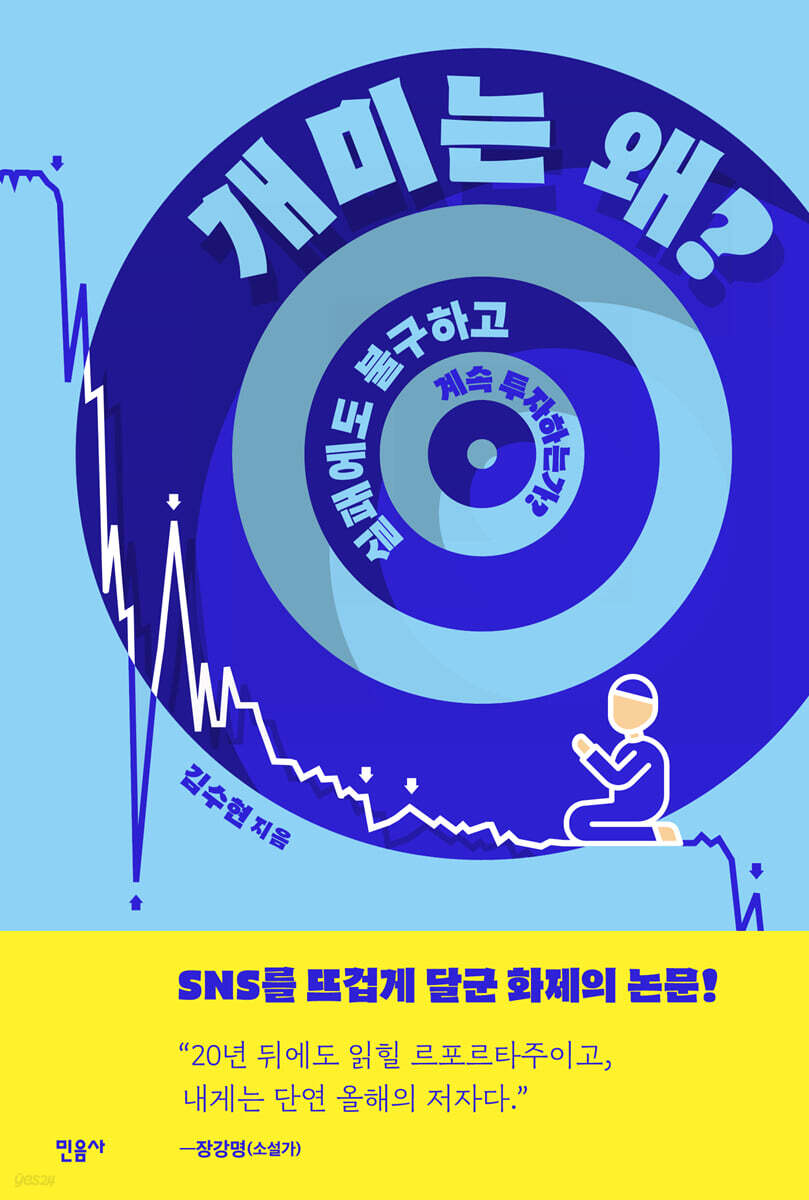
Why do ants keep investing despite failure?
 |
Description
Book Introduction
|
Must-read books before investing in stocks
"Why Do Ants Keep Investing Despite Failure?" (hereafter "Why Do Ants") is a different voice that cracks the narrative of individual investors, which is full of success myths. The author, who was pursuing a master's degree in anthropology, entered a trading room in Seoul and wrote this vivid record and original report based on in-depth interviews with individual professional investors he met there. The title of this report is a question that everyone is curious about but no one has asked. Why do individual professional investors continue to invest despite losses? To answer this question, the following questions must be addressed. What kind of backgrounds do people have to become individual professional investors, also known as ants? How do ants lose money and why do they not stop investing despite failure and end up caught in a losing streak? The Ten Commandments of Trading Principles posted on the desks of those in the trading room, the Investor's Guide to Mindfulness, the vivid experiences of those interviewed, various stock statistics, and popular online memes answer the endless questions one after another. However, this book does not look at the failures of individual investors solely at the individual level. Rather, by recontextualizing it in the society they belong to, we take a head-on and comprehensive look at the concepts and beliefs about stock investment that the ant group has internalized, through the sociocultural structure that reproduces the inherent cognitive and psychological tendencies of humans to invest and the socio-cultural structure that makes it worthwhile to invest. This careful observation and shrewd analysis of the intense, complex, empty, and contradictory chain of desires that revolves around stocks offers a balanced perspective on the human portrait wrought by today's financial age. At the same time, it provides a basis for sharply examining the truth of the propositions our society has internalized about stocks. The most honest narrative of desire and frustration in Korean society in the 2020s unfolds now. |
- You can preview some of the book's contents.
Preview
index
Entering 7
Character Introduction 26
32 Stock Terms in This Book
Introduction: Why Do Individual Investors Continue to Invest Despite Failure? 36
Chapter 1: "Pick Small, Pay Small, and Blow It All in One Go!": The 3 Steps to Failing Personal Investing 61
1. The Sweet Taste of Money in the First Round: Beginner's Luck 56
2 The Mirage of Success Created by Bias and Funding 60
"Everything Will Be Okay": Overconfidence Bias 61
"The answer is set, you just have to answer": Confirmation Bias 68
3 Entering the Path of 'Johnber': Crying and 'Riding the Water' 72
"The Water Riding Technique Trap": The Bias of Immersion 72
"Why You Should Leave the Cutting Off of Losses to Others": The Disposition Effect 79
4 The Structure of Psychology's Inevitable Defeat 84
Chapter 2: Dreams for a Livelihood, Hope in Stocks 103
1. Socioeconomic Characteristics of Individual Professional Investors 106
2 The Birth of the Dream of Being a "Professional Individual Investor" 113
Our Employee Stock Ownership System and the IMF Foreign Exchange Crisis 113
Dreaming of Personal Investing 119
Creating Your Own Investment Philosophy 132
3 'Moon Song' Father's Only Option 144
The Mirage of 'Economic Freedom' 162
Chapter 3: Ant Trading Room User Manual 179
1. A Middle-Aged Man's "Room of His Own" in Early Retirement 182
2 Negative attention from those around you, relationship breakdown 188
3 The Rise and Fall of the Royal Trading House 199
Emergence and Heyday199
Causes of Decline: Long-Term Box Rights and Derivatives Market Regulations 203
4 Changes in Daily Life 212
A Space for Active Communication and Comfort (2007–2014) 213
Space of Tension and Conflict (2015–present) 226
Chapter 4: Insight and Faith 245
1 Insights into Financial Markets 248
"The gates of heaven open once or twice every decade!" 248
There is no happy ending 259
Even a 70% success rate can fail. 264
Operations are everywhere 266
2 Ants' Response Strategy 278
Counter-exploitation of operational forces 278
Internalization of Ascetic Values 284
Establishing Trading Principles: Mastering the Mind 289
3 Investing is a Drug 293
Failure is the Mother of Hope: Language That Hides Pain 294
The Addictiveness of Investing: A Life Devastated 301
Epilogue 319
Appendix_ Individual Investors Meet Economic Anthropology 341
Character Introduction 26
32 Stock Terms in This Book
Introduction: Why Do Individual Investors Continue to Invest Despite Failure? 36
Chapter 1: "Pick Small, Pay Small, and Blow It All in One Go!": The 3 Steps to Failing Personal Investing 61
1. The Sweet Taste of Money in the First Round: Beginner's Luck 56
2 The Mirage of Success Created by Bias and Funding 60
"Everything Will Be Okay": Overconfidence Bias 61
"The answer is set, you just have to answer": Confirmation Bias 68
3 Entering the Path of 'Johnber': Crying and 'Riding the Water' 72
"The Water Riding Technique Trap": The Bias of Immersion 72
"Why You Should Leave the Cutting Off of Losses to Others": The Disposition Effect 79
4 The Structure of Psychology's Inevitable Defeat 84
Chapter 2: Dreams for a Livelihood, Hope in Stocks 103
1. Socioeconomic Characteristics of Individual Professional Investors 106
2 The Birth of the Dream of Being a "Professional Individual Investor" 113
Our Employee Stock Ownership System and the IMF Foreign Exchange Crisis 113
Dreaming of Personal Investing 119
Creating Your Own Investment Philosophy 132
3 'Moon Song' Father's Only Option 144
The Mirage of 'Economic Freedom' 162
Chapter 3: Ant Trading Room User Manual 179
1. A Middle-Aged Man's "Room of His Own" in Early Retirement 182
2 Negative attention from those around you, relationship breakdown 188
3 The Rise and Fall of the Royal Trading House 199
Emergence and Heyday199
Causes of Decline: Long-Term Box Rights and Derivatives Market Regulations 203
4 Changes in Daily Life 212
A Space for Active Communication and Comfort (2007–2014) 213
Space of Tension and Conflict (2015–present) 226
Chapter 4: Insight and Faith 245
1 Insights into Financial Markets 248
"The gates of heaven open once or twice every decade!" 248
There is no happy ending 259
Even a 70% success rate can fail. 264
Operations are everywhere 266
2 Ants' Response Strategy 278
Counter-exploitation of operational forces 278
Internalization of Ascetic Values 284
Establishing Trading Principles: Mastering the Mind 289
3 Investing is a Drug 293
Failure is the Mother of Hope: Language That Hides Pain 294
The Addictiveness of Investing: A Life Devastated 301
Epilogue 319
Appendix_ Individual Investors Meet Economic Anthropology 341
Into the book
This book is, on a small scale, the story of a professional individual investor at Roalmaemaebang, but on a broader scale, it is the story of all of us, the Donghak ants of Korea in 2021, and at the same time, my own story.
So, I can understand to some extent how readers might feel resistance when they hear skeptical stories about the success or failure of individual investors.
After the paper was published online, I read a comment that said, “The author wrote it in a biased way, collecting examples that only suit his taste.” But in fact, my taste is the exact opposite.
I, too, had a hard time swallowing and digesting the bitter truth: "More individual investors lose money than you might think."
But the reality is that no one talks about the bitter truth behind investing that individual investors don't want to know about.
Amidst the rapidly expanding trend of individual investment, the proposition that "anyone can succeed in stock investment if they study and work hard" is accepted as an axiom without any verification.
Media such as books, newspapers, broadcasts, YouTube, and social media are competing to discover and report on specific methodologies related to stocks and financial investment.
Then, regardless of age or gender, (old) readers are eager to learn and internalize it.
Even when conducting on-site surveys in the trading room, the 5060 middle-aged and older generation was at the center, but in just one or two years, the trend has expanded to include the 2030 youth generation.
Investing is no longer confined to the realm of financial investment, but has established itself as a source of joy for modern people and an essential area of self-development and training.
How perilous it is that, in a world where stock investing has become something "something to be worked hard for," risk has been transformed into something "something to be taken for granted." Risk is no longer understood as risk itself, but is transformed into another name for "opportunity," potentially bringing greater profits.
While the possibility of losing money exists theoretically, it's a dangerous thought: "It won't happen to me." It's frightening that today's financial discourse, including stocks, is all about promotions aimed at attracting more investors and generating more money.
This is overly optimistic about the stock market and giving investors hope for a bright future.
The balance of discourse has been broken.
Especially after the COVID-19 pandemic in 2020, when many individual investors made a lot of money in a short period of time, the negative perception of financial investment that had remained in our society underwent a huge shift.
If you don't invest in stocks, you're considered a fool or a lazy person who doesn't take chances.
Voices warning of the risks and addiction of investing are a minority opinion.
But as the stock market adage suggests, there are no eternal bulls or bears in this market, no eternal winners or losers.
As the current composite index shows, the higher the peak of the mountain, the deeper the valley.
We must wake up from the sweet yet dangerous rhetoric of a 'stock-recommending society' that consists only of voices saying 'you must do it' and 'you can earn money.'
There is also a need to critically reflect on the overall social atmosphere that takes investment risks for granted.
This is because the responsibility for losses and failures ultimately falls on the individual investor who diligently studied investment and put into practice what he or she learned, not on the 'recommender'.
(syncopation)
I'm cautious that this book might be read as a simple pessimistic argument, aimed at proving that "individual investors fail" or "don't invest in stocks."
(If so, it is all due to my shortcomings.) I know that it is difficult to generalize the poor investment performance of trading rooms, which are characterized by many full-time investors who make a living through short-term trading, to all investors in Korea.
And isn't it true that simply saving your paycheck isn't enough to buy a house, get married, or raise children? The meaning of stocks and investments in modern life is far more complex and multifaceted than simply dismissing them as a less glamorous means of making money.
Fact-checking how many of the total investors failed and how much they lost doesn't seem to be very important.
However, I hope that investors in Roalmaemaebang will be able to reflect on their own investments by examining the interpretation and narrative of this system, which forces them to continuously take risks and take on challenges.
And, if I may be a little greedy, I hope this book can provide a little bit of balance in a world overflowing with economics and management books that only highlight the bright side and positive functions of investing.
So, I hope that we can raise awareness of the abnormally uniform investment views that are prevalent in our society.
I hope this perspective will help young investors, especially those entering the stock market after the COVID-19 pandemic, who have come to feel the extraordinary market as part of their daily lives, to invest more carefully.
Additionally, if there are readers who have avoided investing in stocks or derivatives, viewing them as a manifestation of excessive personal greed, speculation, or gambling addiction, I hope this book will provide an opportunity to gain a broader understanding of stock investors through the socioeconomic context in which the lives of the people who entered the Roal Trading Room are situated.
So, I can understand to some extent how readers might feel resistance when they hear skeptical stories about the success or failure of individual investors.
After the paper was published online, I read a comment that said, “The author wrote it in a biased way, collecting examples that only suit his taste.” But in fact, my taste is the exact opposite.
I, too, had a hard time swallowing and digesting the bitter truth: "More individual investors lose money than you might think."
But the reality is that no one talks about the bitter truth behind investing that individual investors don't want to know about.
Amidst the rapidly expanding trend of individual investment, the proposition that "anyone can succeed in stock investment if they study and work hard" is accepted as an axiom without any verification.
Media such as books, newspapers, broadcasts, YouTube, and social media are competing to discover and report on specific methodologies related to stocks and financial investment.
Then, regardless of age or gender, (old) readers are eager to learn and internalize it.
Even when conducting on-site surveys in the trading room, the 5060 middle-aged and older generation was at the center, but in just one or two years, the trend has expanded to include the 2030 youth generation.
Investing is no longer confined to the realm of financial investment, but has established itself as a source of joy for modern people and an essential area of self-development and training.
How perilous it is that, in a world where stock investing has become something "something to be worked hard for," risk has been transformed into something "something to be taken for granted." Risk is no longer understood as risk itself, but is transformed into another name for "opportunity," potentially bringing greater profits.
While the possibility of losing money exists theoretically, it's a dangerous thought: "It won't happen to me." It's frightening that today's financial discourse, including stocks, is all about promotions aimed at attracting more investors and generating more money.
This is overly optimistic about the stock market and giving investors hope for a bright future.
The balance of discourse has been broken.
Especially after the COVID-19 pandemic in 2020, when many individual investors made a lot of money in a short period of time, the negative perception of financial investment that had remained in our society underwent a huge shift.
If you don't invest in stocks, you're considered a fool or a lazy person who doesn't take chances.
Voices warning of the risks and addiction of investing are a minority opinion.
But as the stock market adage suggests, there are no eternal bulls or bears in this market, no eternal winners or losers.
As the current composite index shows, the higher the peak of the mountain, the deeper the valley.
We must wake up from the sweet yet dangerous rhetoric of a 'stock-recommending society' that consists only of voices saying 'you must do it' and 'you can earn money.'
There is also a need to critically reflect on the overall social atmosphere that takes investment risks for granted.
This is because the responsibility for losses and failures ultimately falls on the individual investor who diligently studied investment and put into practice what he or she learned, not on the 'recommender'.
(syncopation)
I'm cautious that this book might be read as a simple pessimistic argument, aimed at proving that "individual investors fail" or "don't invest in stocks."
(If so, it is all due to my shortcomings.) I know that it is difficult to generalize the poor investment performance of trading rooms, which are characterized by many full-time investors who make a living through short-term trading, to all investors in Korea.
And isn't it true that simply saving your paycheck isn't enough to buy a house, get married, or raise children? The meaning of stocks and investments in modern life is far more complex and multifaceted than simply dismissing them as a less glamorous means of making money.
Fact-checking how many of the total investors failed and how much they lost doesn't seem to be very important.
However, I hope that investors in Roalmaemaebang will be able to reflect on their own investments by examining the interpretation and narrative of this system, which forces them to continuously take risks and take on challenges.
And, if I may be a little greedy, I hope this book can provide a little bit of balance in a world overflowing with economics and management books that only highlight the bright side and positive functions of investing.
So, I hope that we can raise awareness of the abnormally uniform investment views that are prevalent in our society.
I hope this perspective will help young investors, especially those entering the stock market after the COVID-19 pandemic, who have come to feel the extraordinary market as part of their daily lives, to invest more carefully.
Additionally, if there are readers who have avoided investing in stocks or derivatives, viewing them as a manifestation of excessive personal greed, speculation, or gambling addiction, I hope this book will provide an opportunity to gain a broader understanding of stock investors through the socioeconomic context in which the lives of the people who entered the Roal Trading Room are situated.
--- From "Entering"
Publisher's Review
Bitcoin, stocks, futures options... University student stock clubs have long become a common sight, and stock terms like "jonber" and "loss cut" have become so commonplace that no one wonders about their origins.
In today's world, where anyone can easily buy and sell stocks thanks to rapid digitalization, it's harder to find someone who doesn't invest in stocks than someone who does.
We are now in the era of 9 million individual stock investors.
Stocks are no longer the preserve of the few.
We are sometimes defined as investment humans who reside in the microcosm of stocks within the macrocosm of the economy.
Individual investors face institutional, foreign, and individual investors every day, trading stocks and derivatives, and living in a fierce battleground of 'competing' for profits.
But despite the popularization of this intense field, our questions about stocks converge at best to one thing:
“So what stocks are good these days?” There is one more thing.
"So how much did you make?" In the world of stocks, individual investors are perceived first and foremost as a tag of returns, before they are perceived as individuals.
In a world of extreme dichotomies where only blue and red exist, individual investors are all too easily reduced to numbers like returns.
Our inquiry into the rapidly growing number of individual investors is infinitely poor and utterly pathetic.
"Why Do Ants Keep Investing Despite Failure?" (hereafter "Why Do Ants") is a different voice that cracks the narrative of individual investors, which is full of success myths.
The author, who was a master's student in anthropology, entered a trading room in Seoul and wrote this vivid record and original report based on in-depth interviews with individual professional investors he met there. The title of this report is a question that everyone is curious about but no one has asked.
Why do individual professional investors continue to invest despite losses? To answer this question, the following questions must be addressed.
What kind of backgrounds do people have to become individual professional investors, also known as ants?
How do ants lose money and why do they not stop investing despite failure and end up caught in a losing streak?
The Ten Commandments of Trading Principles posted on the desks of those in the trading room, the Investor's Guide to Mindfulness, the vivid experiences of those interviewed, various stock statistics, and popular online memes answer the endless questions one after another.
However, this book does not look at the failures of individual investors solely at the individual level.
Rather, by recontextualizing it in the society they belong to, we take a head-on and comprehensive look at the concepts and beliefs about stock investment that the ant group has internalized, through the sociocultural structure that reproduces the inherent cognitive and psychological tendencies of humans to invest and the socio-cultural structure that makes it worthwhile to invest.
This careful observation and shrewd analysis of the intense, complex, empty, and contradictory chain of desires that revolves around stocks offers a balanced perspective on the human portrait wrought by today's financial age.
At the same time, it provides a basis for sharply examining the truth of the propositions our society has internalized about stocks.
The most honest narrative of desire and frustration in Korean society in the 2020s unfolds now.
■ The joys and sorrows of an ant
Stock investment is a mirror that reflects the invisible beliefs and ideas of humans.
At the same time, it is also a genre that most dramatically reveals human imperfection in that it shows that what is intended does not always happen as desired.
In this book, the author argues that it is most important to ask, listen, and ponder the meaning of a person's investment motivations, dreams, beliefs, daily life, the alignment and discrepancy between plans and practices, and the joys and sorrows that arise from them.
To this end, the author realistically conveys the sweet and bitter experiences of investment that individual investors experience while investing in stocks through in-depth interviews with individual investors who have entered the trading room.
Why do we fail to put into practice the principles of loss-cutting, which can be considered the fundamentals of investment, and yet continue to suffer losses?
Why would a manager who has been running a trading room for over a decade consider it something that should not be invested in?
The cognitive and psychological perspectives on why "individual investors" fail, such as confirmation bias, immersion bias, and overconfidence bias, provide a unique perspective on the true minds of individual investors, as well as a framework for understanding and viewing those minds.
■ The history of stocks in Korea, the history of our neighbors' stocks
There are many stories of success in stocks.
However, it is difficult to find stories of failure in stocks.
This book seeks to shed light on the shadows of stocks, rather than the bright lights, and provide a balanced discourse on stocks, a field brimming with success stories.
This book, based on a personal stock history that has never been heard anywhere else, is also a report on the post-retirement life of a middle-aged man with a liberal arts degree from a university, a so-called "Moon Song" middle-aged man, to whom most individual professional investors belong.
The trading room functions as a 'room of one's own', and stocks are seen as a means of making a living that can be attempted relatively easily.
Meanwhile, this book, which traces back to the beginning of the full-scale development of individual investment in Korea, is also a history of the Korean stock market, examining the sociocultural background that facilitated individual stock investment.
The macro and micro histories of stocks intersect as the socioeconomic history of the rise of individual stock investment in Korean society intersects with the life histories of individual investors.
■ The origins of belief and hope for 'economic freedom'
Although the main interviewees of "Why Ants" are men in their 40s to 60s, the author also analyzes the recent surge in young investors.
This book traces the origins of the belief and hope for "economic freedom," a modern-day dream, through the changing landscape surrounding stock investment, including the generational differences in perception stemming from the investment views of the middle-aged generation, which adhere to the rule of "cutting losses," and the younger generation, which prioritizes "holding on."
Furthermore, we find the driving force that keeps us investing in the tricks of language, such as “failure is the mother of success” and “tuition,” which regard pain as a necessary process accompanying success.
By cleverly analyzing the financial and economic customs of Korean society, the process of analyzing the hidden aspects of society that encourage investment in everyday life looks at stocks from a social perspective.
What impact will this contradiction have on the community—wanting an end to the coronavirus while also hoping the stock price of the COVID-19 diagnostic kits I bought doesn't fall?
It provides various perspectives on stocks, not only as a means of capital but also as a medium of contradictions that bring about rifts in the community.
In today's world, where anyone can easily buy and sell stocks thanks to rapid digitalization, it's harder to find someone who doesn't invest in stocks than someone who does.
We are now in the era of 9 million individual stock investors.
Stocks are no longer the preserve of the few.
We are sometimes defined as investment humans who reside in the microcosm of stocks within the macrocosm of the economy.
Individual investors face institutional, foreign, and individual investors every day, trading stocks and derivatives, and living in a fierce battleground of 'competing' for profits.
But despite the popularization of this intense field, our questions about stocks converge at best to one thing:
“So what stocks are good these days?” There is one more thing.
"So how much did you make?" In the world of stocks, individual investors are perceived first and foremost as a tag of returns, before they are perceived as individuals.
In a world of extreme dichotomies where only blue and red exist, individual investors are all too easily reduced to numbers like returns.
Our inquiry into the rapidly growing number of individual investors is infinitely poor and utterly pathetic.
"Why Do Ants Keep Investing Despite Failure?" (hereafter "Why Do Ants") is a different voice that cracks the narrative of individual investors, which is full of success myths.
The author, who was a master's student in anthropology, entered a trading room in Seoul and wrote this vivid record and original report based on in-depth interviews with individual professional investors he met there. The title of this report is a question that everyone is curious about but no one has asked.
Why do individual professional investors continue to invest despite losses? To answer this question, the following questions must be addressed.
What kind of backgrounds do people have to become individual professional investors, also known as ants?
How do ants lose money and why do they not stop investing despite failure and end up caught in a losing streak?
The Ten Commandments of Trading Principles posted on the desks of those in the trading room, the Investor's Guide to Mindfulness, the vivid experiences of those interviewed, various stock statistics, and popular online memes answer the endless questions one after another.
However, this book does not look at the failures of individual investors solely at the individual level.
Rather, by recontextualizing it in the society they belong to, we take a head-on and comprehensive look at the concepts and beliefs about stock investment that the ant group has internalized, through the sociocultural structure that reproduces the inherent cognitive and psychological tendencies of humans to invest and the socio-cultural structure that makes it worthwhile to invest.
This careful observation and shrewd analysis of the intense, complex, empty, and contradictory chain of desires that revolves around stocks offers a balanced perspective on the human portrait wrought by today's financial age.
At the same time, it provides a basis for sharply examining the truth of the propositions our society has internalized about stocks.
The most honest narrative of desire and frustration in Korean society in the 2020s unfolds now.
■ The joys and sorrows of an ant
Stock investment is a mirror that reflects the invisible beliefs and ideas of humans.
At the same time, it is also a genre that most dramatically reveals human imperfection in that it shows that what is intended does not always happen as desired.
In this book, the author argues that it is most important to ask, listen, and ponder the meaning of a person's investment motivations, dreams, beliefs, daily life, the alignment and discrepancy between plans and practices, and the joys and sorrows that arise from them.
To this end, the author realistically conveys the sweet and bitter experiences of investment that individual investors experience while investing in stocks through in-depth interviews with individual investors who have entered the trading room.
Why do we fail to put into practice the principles of loss-cutting, which can be considered the fundamentals of investment, and yet continue to suffer losses?
Why would a manager who has been running a trading room for over a decade consider it something that should not be invested in?
The cognitive and psychological perspectives on why "individual investors" fail, such as confirmation bias, immersion bias, and overconfidence bias, provide a unique perspective on the true minds of individual investors, as well as a framework for understanding and viewing those minds.
■ The history of stocks in Korea, the history of our neighbors' stocks
There are many stories of success in stocks.
However, it is difficult to find stories of failure in stocks.
This book seeks to shed light on the shadows of stocks, rather than the bright lights, and provide a balanced discourse on stocks, a field brimming with success stories.
This book, based on a personal stock history that has never been heard anywhere else, is also a report on the post-retirement life of a middle-aged man with a liberal arts degree from a university, a so-called "Moon Song" middle-aged man, to whom most individual professional investors belong.
The trading room functions as a 'room of one's own', and stocks are seen as a means of making a living that can be attempted relatively easily.
Meanwhile, this book, which traces back to the beginning of the full-scale development of individual investment in Korea, is also a history of the Korean stock market, examining the sociocultural background that facilitated individual stock investment.
The macro and micro histories of stocks intersect as the socioeconomic history of the rise of individual stock investment in Korean society intersects with the life histories of individual investors.
■ The origins of belief and hope for 'economic freedom'
Although the main interviewees of "Why Ants" are men in their 40s to 60s, the author also analyzes the recent surge in young investors.
This book traces the origins of the belief and hope for "economic freedom," a modern-day dream, through the changing landscape surrounding stock investment, including the generational differences in perception stemming from the investment views of the middle-aged generation, which adhere to the rule of "cutting losses," and the younger generation, which prioritizes "holding on."
Furthermore, we find the driving force that keeps us investing in the tricks of language, such as “failure is the mother of success” and “tuition,” which regard pain as a necessary process accompanying success.
By cleverly analyzing the financial and economic customs of Korean society, the process of analyzing the hidden aspects of society that encourage investment in everyday life looks at stocks from a social perspective.
What impact will this contradiction have on the community—wanting an end to the coronavirus while also hoping the stock price of the COVID-19 diagnostic kits I bought doesn't fall?
It provides various perspectives on stocks, not only as a means of capital but also as a medium of contradictions that bring about rifts in the community.
GOODS SPECIFICS
- Date of issue: September 3, 2021
- Format: Paperback book binding method guide
- Page count, weight, size: 352 pages | 422g | 135*200*30mm
- ISBN13: 9788937444678
- ISBN10: 8937444674
You may also like
카테고리
korean


korean

![GQ KOREA Mark (Monthly): December [2025]](http://librairie.coreenne.fr/cdn/shop/files/8ef265dbbfbf186523ed75ba7319009d.jpg?v=1765340328&width=3840)


