

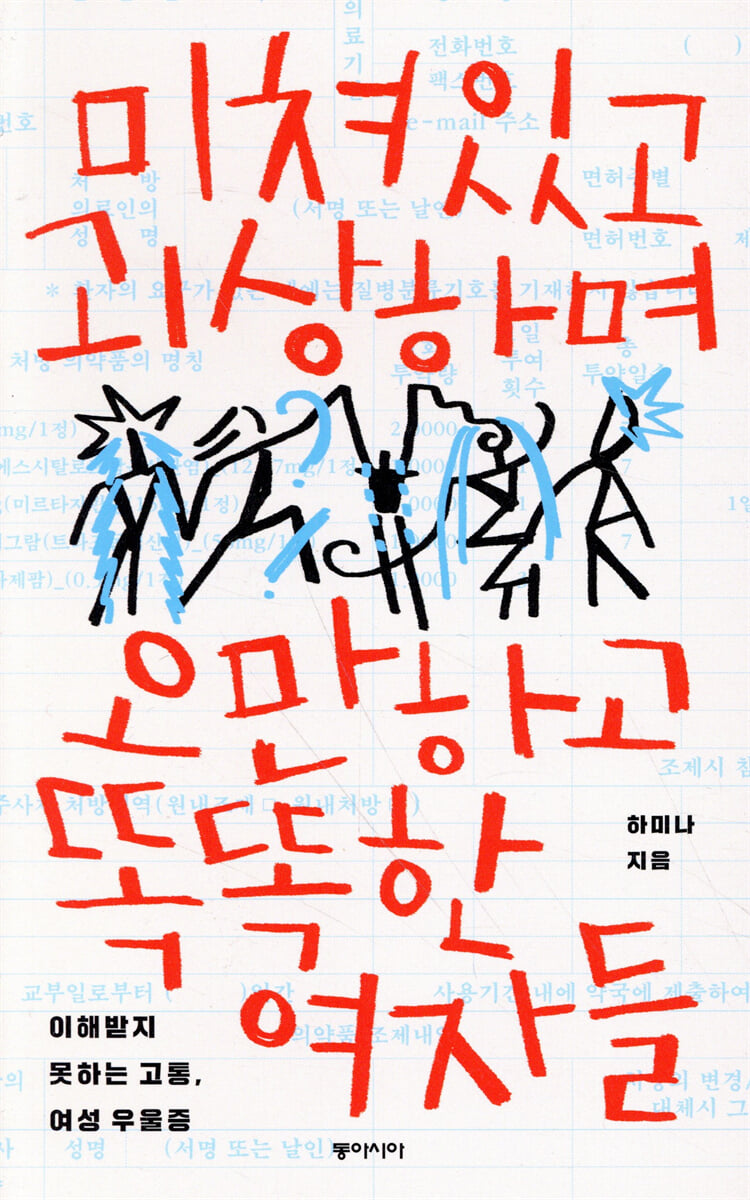
Crazy, weird, arrogant, and smart women
 |
Description
Book Introduction
Beyond disease and stigma, a most intense and tender exploration of shared depression.
Gathering fragments of anxiety and depression
Rewriting 'Depression' in the Language of Women in 2030
From 2003 to 2020, Korea consistently had the highest suicide rate among OECD countries, except for one year in 2017.
Among them, 'depression' has been pointed out as a cause of suicide and has been consistently called out as a social problem.
In particular, there has been a recent surge in the number of women in their 20s and 30s being diagnosed with mental illness, and the rising suicide rate among women in their 20s has been the subject of intense reporting.
As the number of people visiting psychiatrists increases, essays written by people diagnosed with mental illnesses, including depression, are being published one after another.
The stories of those who accepted illness as a part of life and lived with it, rather than seeing it as something to be eliminated or denied, presented a different perspective on illness.
In this flow, author Hamina came to have the following awareness of the problem.
Every illness narrative is valuable in its own right, but when depression is constantly framed as a single person's experience, regardless of how it's presented, it becomes difficult to examine the social and historical context surrounding the illness.
When depression is seen only as an individual's suffering, its interpretation inevitably becomes immersed in the individual's circumstances and characteristics.
Why are women in their 20s and 30s so depressed? As someone diagnosed with bipolar II disorder (manic depression), the author gathers the stories of women in their 20s and 30s who suffer from depression, seeking to answer the many questions surrounding depression through her own personal experiences.
Because after being diagnosed with bipolar disorder and living with it, I realized that it is not an individual problem.
Some uncomfortable experiences I had in a psychiatric clinic, the violence against women I encountered while working in the women's movement group 'Femidangdang' and the frequent moments of anger, helplessness, and depression I felt while fighting against it, the knowledge of psychiatry I studied while writing my master's thesis on 'depression measurement tools', and the stories I gathered through close communication with 31 interviewees.
All of this work, which took two years, was compiled into one book.
"Crazy, Weird, Arrogant, and Smart Women" redefines the pain called "depression" in the language of those affected.
By restoring fragmented pieces of depression into a shared experience, we create a social space where depression can be discussed publicly, and present a new approach that allows us to interpret depression from a more equal perspective.
American poet and essayist Anne Boyer said, “The history of disease is not the history of medicine, but the history of the world.”
Author Hamina writes a new history of women's suffering beyond medical illness and social stigma.
"Crazy, Weird, Arrogant, and Smart Women," a fierce and thoughtful defense of the history of pain and violence testified by women, will serve as "a starting point for changing the culture of understanding pain," as Kim Hee-kyung recommends.
Gathering fragments of anxiety and depression
Rewriting 'Depression' in the Language of Women in 2030
From 2003 to 2020, Korea consistently had the highest suicide rate among OECD countries, except for one year in 2017.
Among them, 'depression' has been pointed out as a cause of suicide and has been consistently called out as a social problem.
In particular, there has been a recent surge in the number of women in their 20s and 30s being diagnosed with mental illness, and the rising suicide rate among women in their 20s has been the subject of intense reporting.
As the number of people visiting psychiatrists increases, essays written by people diagnosed with mental illnesses, including depression, are being published one after another.
The stories of those who accepted illness as a part of life and lived with it, rather than seeing it as something to be eliminated or denied, presented a different perspective on illness.
In this flow, author Hamina came to have the following awareness of the problem.
Every illness narrative is valuable in its own right, but when depression is constantly framed as a single person's experience, regardless of how it's presented, it becomes difficult to examine the social and historical context surrounding the illness.
When depression is seen only as an individual's suffering, its interpretation inevitably becomes immersed in the individual's circumstances and characteristics.
Why are women in their 20s and 30s so depressed? As someone diagnosed with bipolar II disorder (manic depression), the author gathers the stories of women in their 20s and 30s who suffer from depression, seeking to answer the many questions surrounding depression through her own personal experiences.
Because after being diagnosed with bipolar disorder and living with it, I realized that it is not an individual problem.
Some uncomfortable experiences I had in a psychiatric clinic, the violence against women I encountered while working in the women's movement group 'Femidangdang' and the frequent moments of anger, helplessness, and depression I felt while fighting against it, the knowledge of psychiatry I studied while writing my master's thesis on 'depression measurement tools', and the stories I gathered through close communication with 31 interviewees.
All of this work, which took two years, was compiled into one book.
"Crazy, Weird, Arrogant, and Smart Women" redefines the pain called "depression" in the language of those affected.
By restoring fragmented pieces of depression into a shared experience, we create a social space where depression can be discussed publicly, and present a new approach that allows us to interpret depression from a more equal perspective.
American poet and essayist Anne Boyer said, “The history of disease is not the history of medicine, but the history of the world.”
Author Hamina writes a new history of women's suffering beyond medical illness and social stigma.
"Crazy, Weird, Arrogant, and Smart Women," a fierce and thoughtful defense of the history of pain and violence testified by women, will serve as "a starting point for changing the culture of understanding pain," as Kim Hee-kyung recommends.
- You can preview some of the book's contents.
Preview
index
Prologue: A Story About Depression
Part 1.
Does my pain have a name?
Chapter 1.
Joke - Doctors don't believe women.
TMJ Disorders, Mostly Female Patients | Rise, Develop, Turn, and Female Hormones | Body Problems? Mind Problems? | The History of Crazy Women | The History of Hysteria and Misogyny | The Pain No One Believes
Chapter 2.
Diagnosis - I think it fits the description of depression.
A world that exists differently depending on how you understand it | A syndrome across diverse cultures | A very American illness: depression | Depression self-assessment test: Is a score of 21 or higher depressive? | Unique emotions that can't be contained in a single diagnosis | The power of a diagnosis is immense | Medicalization? Pharmacization? Whatever it is, if it's an acknowledgment of suffering | Liberation and oppression, our story of diagnosis
Chapter 3.
Treatment - Is Depression a Disease or Not?
The History of Drugs | Selling Depression | Two Streams of Psychiatry: Dynamic Psychiatry and Biological Psychiatry | Whom Does Psychiatry Pathologize? | "Writing" Can Be Therapeutic | Women Participating in Therapy as Experts in Their Own Bodies | Spiritual Beings
Part 2.
Can you live without dying or being depressed?
Chapter 4.
Family - I thought it was my job to protect my mom.
From a childhood I can't remember: Depression was a survival strategy | Living as a good daughter who knew how to do things on her own | Hating and understanding her mother at the same time | Is maternal love possible without leaving scars? | Proving my usefulness within the family | Loving families are rare.
Chapter 5.
Love - In my eyes, it's all a rope
In my eyes, everything is a rope | Is this a father? | Women in need of care | I was supposed to be the protector | Can love be salvation?
Chapter 6.
Society - They're like a school of sharks attacking poor and vulnerable women.
Between the life I want and the life society forces upon me | People who can't get sick from 9 to 6 | I was afraid to ask my mom and dad for money | Am I worthy of being poor? | Too many women become sexually vulnerable because of poverty | I experienced sexual harassment as if it were nothing | Am I too sensitive? | Poverty makes us afraid of reciprocity | Moving forward in love, family, and society
Part 3.
If I could change the ending of the story
Chapter 7.
Suicide - Are you really saying that people don't think about wanting to die?
The awkwardness of talking about suicide | The pitfalls of saying "suicide after depression" | The many forms of suicide | The saying that life is better even if you roll in shit | Suicide as social murder | So what can we do? | And those left behind
Chapter 8.
Care - It's not hard to help when each person's burden is reduced.
Patients as Subjects of Care | The Illness Remains Even After Organizing the Narrative | The Story of Dabin and Wooyong | Between Guardian and Watcher | Can Control Not Become Domination? | The Weight of Caring for Others | Feminist Party as a Community of Care
Chapter 9.
Recovery - When I am weak, it is when I am strongest.
The Road to Recovery | Women Who Changed the Ending of Stories | Can Hurt Become Self-Esteem?
Epilogue: Our story has just begun.
Recommendation
main
Part 1.
Does my pain have a name?
Chapter 1.
Joke - Doctors don't believe women.
TMJ Disorders, Mostly Female Patients | Rise, Develop, Turn, and Female Hormones | Body Problems? Mind Problems? | The History of Crazy Women | The History of Hysteria and Misogyny | The Pain No One Believes
Chapter 2.
Diagnosis - I think it fits the description of depression.
A world that exists differently depending on how you understand it | A syndrome across diverse cultures | A very American illness: depression | Depression self-assessment test: Is a score of 21 or higher depressive? | Unique emotions that can't be contained in a single diagnosis | The power of a diagnosis is immense | Medicalization? Pharmacization? Whatever it is, if it's an acknowledgment of suffering | Liberation and oppression, our story of diagnosis
Chapter 3.
Treatment - Is Depression a Disease or Not?
The History of Drugs | Selling Depression | Two Streams of Psychiatry: Dynamic Psychiatry and Biological Psychiatry | Whom Does Psychiatry Pathologize? | "Writing" Can Be Therapeutic | Women Participating in Therapy as Experts in Their Own Bodies | Spiritual Beings
Part 2.
Can you live without dying or being depressed?
Chapter 4.
Family - I thought it was my job to protect my mom.
From a childhood I can't remember: Depression was a survival strategy | Living as a good daughter who knew how to do things on her own | Hating and understanding her mother at the same time | Is maternal love possible without leaving scars? | Proving my usefulness within the family | Loving families are rare.
Chapter 5.
Love - In my eyes, it's all a rope
In my eyes, everything is a rope | Is this a father? | Women in need of care | I was supposed to be the protector | Can love be salvation?
Chapter 6.
Society - They're like a school of sharks attacking poor and vulnerable women.
Between the life I want and the life society forces upon me | People who can't get sick from 9 to 6 | I was afraid to ask my mom and dad for money | Am I worthy of being poor? | Too many women become sexually vulnerable because of poverty | I experienced sexual harassment as if it were nothing | Am I too sensitive? | Poverty makes us afraid of reciprocity | Moving forward in love, family, and society
Part 3.
If I could change the ending of the story
Chapter 7.
Suicide - Are you really saying that people don't think about wanting to die?
The awkwardness of talking about suicide | The pitfalls of saying "suicide after depression" | The many forms of suicide | The saying that life is better even if you roll in shit | Suicide as social murder | So what can we do? | And those left behind
Chapter 8.
Care - It's not hard to help when each person's burden is reduced.
Patients as Subjects of Care | The Illness Remains Even After Organizing the Narrative | The Story of Dabin and Wooyong | Between Guardian and Watcher | Can Control Not Become Domination? | The Weight of Caring for Others | Feminist Party as a Community of Care
Chapter 9.
Recovery - When I am weak, it is when I am strongest.
The Road to Recovery | Women Who Changed the Ending of Stories | Can Hurt Become Self-Esteem?
Epilogue: Our story has just begun.
Recommendation
main
Detailed image

Publisher's Review
How did women's depression become a 'disease'?
How does the world perceive someone's suffering?
“We must first believe in our own suffering.”
'Women with depression' have long been the subject of one-sided treatment and analysis.
Author Hamina rebels against this long-standing one-way relationship and, as a "woman suffering from depression," delves into the history of the vast medical knowledge that has been created about "depression."
As with all knowledge, psychiatry, including depression, was created and constructed within a specific social context.
"Crazy, Weird, Arrogant, and Smart Women" begins by reexamining "hysteria," the root of somatoform disorders that often accompany depression.
The etymology of the disease 'hysteria', which mostly affected female patients, is 'uterus'.
In ancient Egyptian texts, it is written that “a disease of a woman who presents with symptoms of paralysis and complains of a physical illness or whose cause cannot be found” was diagnosed as “starvation of the uterus.”
Jean-Martin Charcot, who opened the door to the academic discipline of psychiatry, and Sigmund Freud, the founder of psychoanalysis, also explored the causes of hysteria, but to them, female patients were nothing more than 'material' for research.
They 'did not believe' in the women's suffering.
Part 1 of "Crazy, Weird, Arrogant, and Smart Women" begins with the history of psychiatry and gradually points out that the system for diagnosing, measuring, and treating depression is engraved with the stereotypes of white men who were capitalists, experts, and producers of knowledge.
So how does modern medicine, which is expected to be objective and rational, explain depression in women? Psychiatry textbooks point to hormones as the cause of female depression.
Women, unlike men, have menstrual cycles that follow hormonal changes, so their mood swings are more severe.
This explanatory approach erases the specific sociocultural context in which women experience depression.
Women become vulnerable, less able to manage their emotions, and find it difficult to understand the context surrounding their suffering beyond medical explanations.
Author Hamina points out that hormones are not a sufficient answer, and that diseases with high prevalence among socially vulnerable groups, including women, are not properly addressed within modern medicine, and in this situation, depression and anxiety can arise due to not receiving a proper diagnosis.
He argues that there are still sufferings in the world that are not properly discussed, that are dismissed as jokes and silenced.
Examining women's depression is about giving a name to a pain that has been overlooked in our society and creating a new community for a pain that has had no place.
From whose perspective and in what way should we look into whose pain?
"Crazy, Weird, Arrogant, and Smart Women" is a monumental first work that condenses my attempt to answer these questions in solidarity with those affected by the disease and as a researcher.
As an actor, not a patient, as a subject, not an object
An attempt to turn our experiences into knowledge
There is nothing about us without us
The depressed women in "Crazy, Weird, Arrogant, and Smart Women" are the ones who work harder than anyone else to interpret their experiences and create their own narratives.
Author Hamina illuminates how people accept and recover from illness.
Women are more aware than anyone of the limitations of medical resources and utilize them appropriately, participating in treatment as experts in their own bodies.
This book shares the interviewees' diverse treatment experiences, ranging from the most popular drug treatments to religious, shamanistic, and psychoanalytic counseling, and revives the subjectivity of female patients, who were previously portrayed as mere "objects" of depression research and treatment.
When the interviewees' illness narratives come together, the story of "Sai" stands out.
The author begins with the statement, "If we lack the resources to interpret our suffering, it must be rewritten, recounted, and discovered by us." He then structurally examines the background of depression experienced by women in their 20s and 30s in Korean society, a topic that has not been sufficiently addressed in clinical settings.
In Part 2, the causes of depression that the parties have been tracking are divided into “family,” “love,” and “society.”
The women that author Hamina met “have worked harder than necessary since childhood to prove their usefulness in order to protect their mothers within the patriarchal family system,” and “women who were driven out by their families or friends entered into relationships with male lovers as a lifeline to receive the care they needed immediately, but in many cases, they suffered physical and mental violence from them and became isolated.”
Furthermore, they are “placed in a structure that makes them poor and vulnerable between the norms imposed by society and the values they pursue themselves, and they become ‘targets’ of this society and are exposed to sexual violence,” and they fall into “a sense of isolation and helplessness in a society that does not provide compensation.”
If the background and context in which women had to face suffering are similar, it should be discussed in a broader context beyond the personal narratives of each individual.
As the interviewee said, “The victim did not commit suicide, but in fact, it was murder committed by her hands,” women’s depression has been treated as a personal problem, but it is clearly a social phenomenon.
Approaching the pain of depression through the social resources contained in "Crazy, Weird, Arrogant, and Smart Women" will enable healing and recovery in a way never before possible.
Constantly exploring between life and death
Inventing new communities and caring relationships
Women who change the ending of the story
Author Hamina says we should learn from the stories of women who look deeply into their own pain.
In a society where “we discard vulnerability from our daily lives and consider it a nuisance,” I propose that we start over from pain and completely change the way we live.
Part 3 shows the struggles and difficulties faced by women living with depression as they struggle to find their way to recovery.
Interviewees constantly try and try again to find resources to explain their suffering, to escape from it, and to help others who are suffering.
After a period where I thought “death was the most logical choice,” I began to seriously contemplate why I had to live.
Even though she is crushed by the burden of having to care for her sick lover alone, she stays in the caregiving field and wavers when faced with various choices, but does not run away.
Caring for a lover who suffers from severe depression to the point of being unable to control himself, they create a new language to help him express his pain in a more diverse way, and they constantly communicate and care for each other so that care doesn't become unmanageable.
These are the people who reflect on their relationships with others more diligently than anyone else and move forward.
How can we help those on the border between life and death? (Chapter 7.
(Suicide) How can we become willing to care for ourselves and others? (Chapter 8.
(Chapter 9. Care) Can I create a new driving force that leads me, without condoning or denying the wounds of the past?
(Recovery〉) Author Hamina adds and answers questions like the above to their stories, and turns the stories of women who are changing the ending of their lives into knowledge.
This book provides social and scientific resources about depression, helping people with depression define and understand their condition for themselves, rather than relying solely on the traditional "doctor-patient" relationship.
She argues that as more women write their own stories and as our society champions those stories, a more equitable perspective on understanding suffering can be established.
"Crazy, Weird, Arrogant, and Smart Women" is not a report written by a researcher in a laboratory, nor is it a memoir containing the experiences of individual patients.
This book, which explores depression in the most accurate language possible, connecting the fragments of its existence, will serve as a passionate declaration for building a life together after illness.
How does the world perceive someone's suffering?
“We must first believe in our own suffering.”
'Women with depression' have long been the subject of one-sided treatment and analysis.
Author Hamina rebels against this long-standing one-way relationship and, as a "woman suffering from depression," delves into the history of the vast medical knowledge that has been created about "depression."
As with all knowledge, psychiatry, including depression, was created and constructed within a specific social context.
"Crazy, Weird, Arrogant, and Smart Women" begins by reexamining "hysteria," the root of somatoform disorders that often accompany depression.
The etymology of the disease 'hysteria', which mostly affected female patients, is 'uterus'.
In ancient Egyptian texts, it is written that “a disease of a woman who presents with symptoms of paralysis and complains of a physical illness or whose cause cannot be found” was diagnosed as “starvation of the uterus.”
Jean-Martin Charcot, who opened the door to the academic discipline of psychiatry, and Sigmund Freud, the founder of psychoanalysis, also explored the causes of hysteria, but to them, female patients were nothing more than 'material' for research.
They 'did not believe' in the women's suffering.
Part 1 of "Crazy, Weird, Arrogant, and Smart Women" begins with the history of psychiatry and gradually points out that the system for diagnosing, measuring, and treating depression is engraved with the stereotypes of white men who were capitalists, experts, and producers of knowledge.
So how does modern medicine, which is expected to be objective and rational, explain depression in women? Psychiatry textbooks point to hormones as the cause of female depression.
Women, unlike men, have menstrual cycles that follow hormonal changes, so their mood swings are more severe.
This explanatory approach erases the specific sociocultural context in which women experience depression.
Women become vulnerable, less able to manage their emotions, and find it difficult to understand the context surrounding their suffering beyond medical explanations.
Author Hamina points out that hormones are not a sufficient answer, and that diseases with high prevalence among socially vulnerable groups, including women, are not properly addressed within modern medicine, and in this situation, depression and anxiety can arise due to not receiving a proper diagnosis.
He argues that there are still sufferings in the world that are not properly discussed, that are dismissed as jokes and silenced.
Examining women's depression is about giving a name to a pain that has been overlooked in our society and creating a new community for a pain that has had no place.
From whose perspective and in what way should we look into whose pain?
"Crazy, Weird, Arrogant, and Smart Women" is a monumental first work that condenses my attempt to answer these questions in solidarity with those affected by the disease and as a researcher.
As an actor, not a patient, as a subject, not an object
An attempt to turn our experiences into knowledge
There is nothing about us without us
The depressed women in "Crazy, Weird, Arrogant, and Smart Women" are the ones who work harder than anyone else to interpret their experiences and create their own narratives.
Author Hamina illuminates how people accept and recover from illness.
Women are more aware than anyone of the limitations of medical resources and utilize them appropriately, participating in treatment as experts in their own bodies.
This book shares the interviewees' diverse treatment experiences, ranging from the most popular drug treatments to religious, shamanistic, and psychoanalytic counseling, and revives the subjectivity of female patients, who were previously portrayed as mere "objects" of depression research and treatment.
When the interviewees' illness narratives come together, the story of "Sai" stands out.
The author begins with the statement, "If we lack the resources to interpret our suffering, it must be rewritten, recounted, and discovered by us." He then structurally examines the background of depression experienced by women in their 20s and 30s in Korean society, a topic that has not been sufficiently addressed in clinical settings.
In Part 2, the causes of depression that the parties have been tracking are divided into “family,” “love,” and “society.”
The women that author Hamina met “have worked harder than necessary since childhood to prove their usefulness in order to protect their mothers within the patriarchal family system,” and “women who were driven out by their families or friends entered into relationships with male lovers as a lifeline to receive the care they needed immediately, but in many cases, they suffered physical and mental violence from them and became isolated.”
Furthermore, they are “placed in a structure that makes them poor and vulnerable between the norms imposed by society and the values they pursue themselves, and they become ‘targets’ of this society and are exposed to sexual violence,” and they fall into “a sense of isolation and helplessness in a society that does not provide compensation.”
If the background and context in which women had to face suffering are similar, it should be discussed in a broader context beyond the personal narratives of each individual.
As the interviewee said, “The victim did not commit suicide, but in fact, it was murder committed by her hands,” women’s depression has been treated as a personal problem, but it is clearly a social phenomenon.
Approaching the pain of depression through the social resources contained in "Crazy, Weird, Arrogant, and Smart Women" will enable healing and recovery in a way never before possible.
Constantly exploring between life and death
Inventing new communities and caring relationships
Women who change the ending of the story
Author Hamina says we should learn from the stories of women who look deeply into their own pain.
In a society where “we discard vulnerability from our daily lives and consider it a nuisance,” I propose that we start over from pain and completely change the way we live.
Part 3 shows the struggles and difficulties faced by women living with depression as they struggle to find their way to recovery.
Interviewees constantly try and try again to find resources to explain their suffering, to escape from it, and to help others who are suffering.
After a period where I thought “death was the most logical choice,” I began to seriously contemplate why I had to live.
Even though she is crushed by the burden of having to care for her sick lover alone, she stays in the caregiving field and wavers when faced with various choices, but does not run away.
Caring for a lover who suffers from severe depression to the point of being unable to control himself, they create a new language to help him express his pain in a more diverse way, and they constantly communicate and care for each other so that care doesn't become unmanageable.
These are the people who reflect on their relationships with others more diligently than anyone else and move forward.
How can we help those on the border between life and death? (Chapter 7.
(Suicide) How can we become willing to care for ourselves and others? (Chapter 8.
(Chapter 9. Care) Can I create a new driving force that leads me, without condoning or denying the wounds of the past?
(Recovery〉) Author Hamina adds and answers questions like the above to their stories, and turns the stories of women who are changing the ending of their lives into knowledge.
This book provides social and scientific resources about depression, helping people with depression define and understand their condition for themselves, rather than relying solely on the traditional "doctor-patient" relationship.
She argues that as more women write their own stories and as our society champions those stories, a more equitable perspective on understanding suffering can be established.
"Crazy, Weird, Arrogant, and Smart Women" is not a report written by a researcher in a laboratory, nor is it a memoir containing the experiences of individual patients.
This book, which explores depression in the most accurate language possible, connecting the fragments of its existence, will serve as a passionate declaration for building a life together after illness.
GOODS SPECIFICS
- Publication date: September 15, 2021
- Page count, weight, size: 332 pages | 506g | 135*215*30mm
- ISBN13: 9788962623871
- ISBN10: 8962623870
You may also like
카테고리
korean


korean

![GQ KOREA Mark (Monthly): December [2025]](http://librairie.coreenne.fr/cdn/shop/files/8ef265dbbfbf186523ed75ba7319009d.jpg?v=1765340328&width=3840)


