

Song of the Prophet
 |
Description
Book Introduction
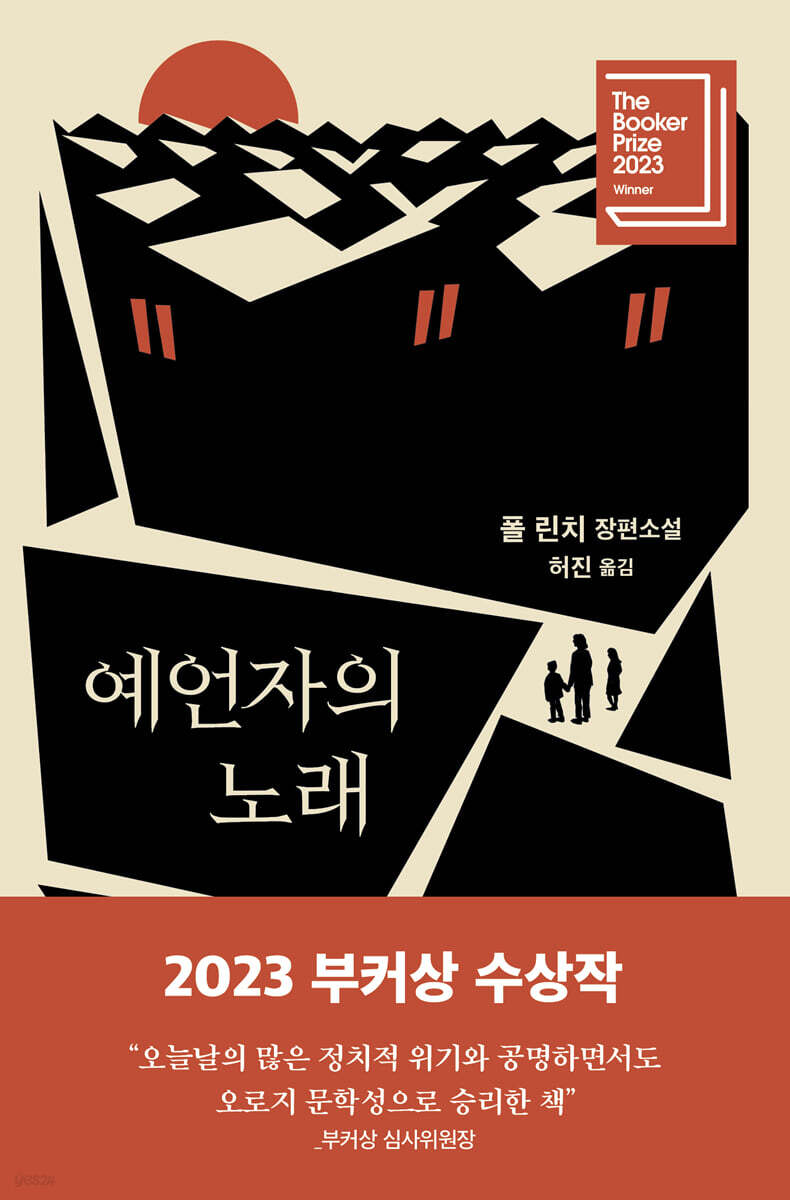
2023 Booker Prize Winner “While resonating with many of today’s political crises, “A book that triumphed solely on its literary merit” _Booker Prize judges The 2023 Booker Prize winner, Song of the Prophets, will be published. It is the story of a family struggling to survive in Ireland, which has been swept up in totalitarianism. As the author revealed, “the apparent indifference toward Syrian refugees” was what prompted him to write, and he created a poignant novel by subverting obvious reality with fiction. The Booker Prize judges explained the reason for the selection, saying, “It depicts the reality of state violence and displacement without any hesitation,” adding, “It is a book that resonates with many of today’s political crises, yet triumphs solely through its literary quality.” From repetitive motifs and intentional omissions to the elimination of quotation marks and paragraph breaks, the author boldly attempts to physically engage readers within the text. By vividly conveying the protagonist's pain and suffering, the author translates the tragedy of a huge system into a personal dimension. What we are witnessing is a painful realization that the end of countless individuals is not a harbinger of a greater chaos, like the end of the world. This is a book whose resonance grows stronger amidst the worsening domestic and international situation. |
- You can preview some of the book's contents.
Preview
index
Song of the Prophet
Translator's Note
Translator's Note
Detailed image
Into the book
This reflexive guilt that everyone feels when the police come to their home.
Ben begins to squirm in her arms, and the older plainclothes officer on her right looks at the child and his expression softens, so she turns to him and answers.
(...) Irish looks at her phone, picks it up, sends a message to Larry with hesitant hands, and soon finds herself standing by the window again, looking outside.
I don't feel like going out into the garden anymore, some of that darkness has entered the house.
Are you asking me to prove that my actions weren't rebellion? Yes, that's correct, Mr. Stack.
But how can you prove it wasn't rebellion when I was just doing my job as a union member, exercising my constitutional rights? That's up to you, Mr. Stack, unless we decide further investigation is necessary. In that case, it's not up to you. We'll decide.
Tell Larry to be careful of those guys, the GNSB. There was a week of noise when the National United Party replaced the Special Investigation Unit with the GNSB as soon as they came to power, but it soon died down. It must have been suppressed. We've never had a secret police in our country before.
As Irish walks towards the break room, Rohit Singh looks up from his monitor and blocks her view. He's on the phone but he's talking to her with his eyes. Unable to read her expression, Irish shrugs and curls his lower lip into a sad expression that's almost familiar.
Just then, someone called my name and I turned my head to see Alice Dilly coming out of the office with a hesitant expression.
Irish, don't you watch the news?
Irish looks around at the faces that surround her, faces that suffer from dizziness as they gaze into the abyss, all the same people, all clothed and naked, soiled and pure, proud and shameful, disloyal and faithful, all here for love.
Sooner or later, the suffering will become too great for the fear, and when people's fears subside, this regime will also fall.
Ben begins to squirm in her arms, and the older plainclothes officer on her right looks at the child and his expression softens, so she turns to him and answers.
(...) Irish looks at her phone, picks it up, sends a message to Larry with hesitant hands, and soon finds herself standing by the window again, looking outside.
I don't feel like going out into the garden anymore, some of that darkness has entered the house.
Are you asking me to prove that my actions weren't rebellion? Yes, that's correct, Mr. Stack.
But how can you prove it wasn't rebellion when I was just doing my job as a union member, exercising my constitutional rights? That's up to you, Mr. Stack, unless we decide further investigation is necessary. In that case, it's not up to you. We'll decide.
Tell Larry to be careful of those guys, the GNSB. There was a week of noise when the National United Party replaced the Special Investigation Unit with the GNSB as soon as they came to power, but it soon died down. It must have been suppressed. We've never had a secret police in our country before.
As Irish walks towards the break room, Rohit Singh looks up from his monitor and blocks her view. He's on the phone but he's talking to her with his eyes. Unable to read her expression, Irish shrugs and curls his lower lip into a sad expression that's almost familiar.
Just then, someone called my name and I turned my head to see Alice Dilly coming out of the office with a hesitant expression.
Irish, don't you watch the news?
Irish looks around at the faces that surround her, faces that suffer from dizziness as they gaze into the abyss, all the same people, all clothed and naked, soiled and pure, proud and shameful, disloyal and faithful, all here for love.
Sooner or later, the suffering will become too great for the fear, and when people's fears subside, this regime will also fall.
--- From the text
Publisher's Review
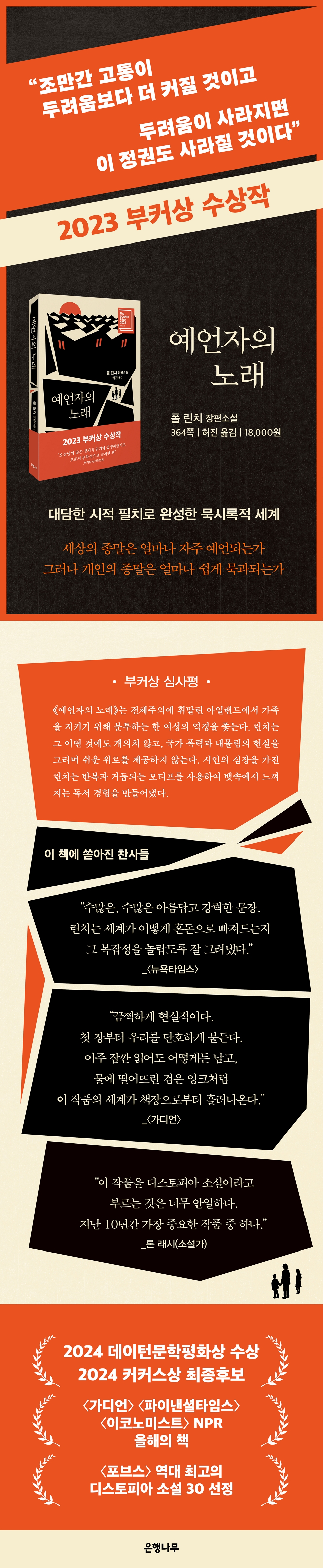
“Sooner or later the pain will be greater than the fear,
“When fear disappears, this regime will disappear.”
In Ireland, swept by totalitarianism, one woman's choices to protect her family.
One day, a plainclothes police officer comes to the house of the main character, Irish.
They search for her husband, a teacher's union member, and try to calm his anxiety by telling him that nothing is wrong, but soon he is arrested.
All her efforts to meet with a lawyer, to protest against the illegal detention, all go to waste, and when she opens her eyes, she finds herself in the middle of a totalitarian country with her four children.
A father whose dementia is worsening day by day, an eldest son who has received a notice of conscription into the military, and a youngest son whose passport is being refused.
In a life where she cannot choose between running away or waiting, what answer will she find?
Winner of the 2023 Booker Prize and 2024 Dayton Literary Peace Prize
A poignant novel that overturns obvious reality into fiction.
Paul Lynch, a writer who has been praised as “the light leading the Irish literary renaissance” ([New York Journal of Books]), has focused on the lives of foreigners and the dispossessed through works such as Red Morning Sky, his first work dealing with the lives of migrant workers who met tragic deaths during the cholera pandemic, and Grace, the story of a girl who survived the Irish famine.
He also reveals that the 2023 Booker Prize-winning novel, Song of the Prophet, which made his name known worldwide, originated from 'Western society's apparent indifference to the Syrian civil war'.
And he moved the entire story stage to Ireland and completed a poignant novel.
By releasing the obvious reality of some place into the most fictional space, this work itself delivers a powerful message.
“This book is an attempt at radical empathy.”
Poetic tone and literary devices that trap the reader within the sentence
“To better understand a problem, you have to experience it firsthand.
That's why I wanted to deepen the dystopia by introducing a high degree of realism.
“I wanted to increase the level of immersion so that readers would not only know the problem but also feel it themselves after finishing the book.” - From the author’s Booker Prize interview
The author describes the book as an attempt at radical empathy.
To achieve this, he incorporated various devices, such as repetitive motifs and intentional omissions, into restrained poetic sentences.
For example, the true nature of political unrest is not specifically mentioned, but it gradually creeps into the protagonist's life, like a light next door that was on yesterday but won't turn on today, or a coworker who won't show up today.
The author also literally ties the reader into the sentences through a formal attempt to eliminate quotation marks and paragraphs and to continue connecting sentences with commas.
As readers read the sentence, “The protagonist has no time to breathe, no moment of respite in his nightmare” ([Guardian]), they also vividly experience the protagonist’s pain and agony.
The author's explanation that "this book is not political but metaphysical" and the Booker Prize judges' assessment that "it resonates with political issues while achieving success solely through literary merit" are meant to reflect this attempt to translate the tragedy of a large system into a personal experience.
How often is the end of the world predicted?
But how easily is the end of the individual overlooked?
A timely work amidst the worsening domestic and international situation
In this way, by enabling 'radical empathy' for the tragedy of an individual, the author powerfully reminds us that the wars and disasters we anxiously view as harbingers of great chaos are in fact already the end of countless individuals.
Amidst the worsening global situation, including Russia's unending war in Ukraine, the spread of Israeli airstrikes, and the growing right-wing shift worldwide, this work has become more timely and meaningful since its publication than when it was written.
Moreover, for domestic readers, the overlapping scenes of modern history will leave a lasting impression.
“When fear disappears, this regime will disappear.”
In Ireland, swept by totalitarianism, one woman's choices to protect her family.
One day, a plainclothes police officer comes to the house of the main character, Irish.
They search for her husband, a teacher's union member, and try to calm his anxiety by telling him that nothing is wrong, but soon he is arrested.
All her efforts to meet with a lawyer, to protest against the illegal detention, all go to waste, and when she opens her eyes, she finds herself in the middle of a totalitarian country with her four children.
A father whose dementia is worsening day by day, an eldest son who has received a notice of conscription into the military, and a youngest son whose passport is being refused.
In a life where she cannot choose between running away or waiting, what answer will she find?
Winner of the 2023 Booker Prize and 2024 Dayton Literary Peace Prize
A poignant novel that overturns obvious reality into fiction.
Paul Lynch, a writer who has been praised as “the light leading the Irish literary renaissance” ([New York Journal of Books]), has focused on the lives of foreigners and the dispossessed through works such as Red Morning Sky, his first work dealing with the lives of migrant workers who met tragic deaths during the cholera pandemic, and Grace, the story of a girl who survived the Irish famine.
He also reveals that the 2023 Booker Prize-winning novel, Song of the Prophet, which made his name known worldwide, originated from 'Western society's apparent indifference to the Syrian civil war'.
And he moved the entire story stage to Ireland and completed a poignant novel.
By releasing the obvious reality of some place into the most fictional space, this work itself delivers a powerful message.
“This book is an attempt at radical empathy.”
Poetic tone and literary devices that trap the reader within the sentence
“To better understand a problem, you have to experience it firsthand.
That's why I wanted to deepen the dystopia by introducing a high degree of realism.
“I wanted to increase the level of immersion so that readers would not only know the problem but also feel it themselves after finishing the book.” - From the author’s Booker Prize interview
The author describes the book as an attempt at radical empathy.
To achieve this, he incorporated various devices, such as repetitive motifs and intentional omissions, into restrained poetic sentences.
For example, the true nature of political unrest is not specifically mentioned, but it gradually creeps into the protagonist's life, like a light next door that was on yesterday but won't turn on today, or a coworker who won't show up today.
The author also literally ties the reader into the sentences through a formal attempt to eliminate quotation marks and paragraphs and to continue connecting sentences with commas.
As readers read the sentence, “The protagonist has no time to breathe, no moment of respite in his nightmare” ([Guardian]), they also vividly experience the protagonist’s pain and agony.
The author's explanation that "this book is not political but metaphysical" and the Booker Prize judges' assessment that "it resonates with political issues while achieving success solely through literary merit" are meant to reflect this attempt to translate the tragedy of a large system into a personal experience.
How often is the end of the world predicted?
But how easily is the end of the individual overlooked?
A timely work amidst the worsening domestic and international situation
In this way, by enabling 'radical empathy' for the tragedy of an individual, the author powerfully reminds us that the wars and disasters we anxiously view as harbingers of great chaos are in fact already the end of countless individuals.
Amidst the worsening global situation, including Russia's unending war in Ukraine, the spread of Israeli airstrikes, and the growing right-wing shift worldwide, this work has become more timely and meaningful since its publication than when it was written.
Moreover, for domestic readers, the overlapping scenes of modern history will leave a lasting impression.
GOODS SPECIFICS
- Date of issue: November 20, 2024
- Page count, weight, size: 364 pages | 458g | 130*190*22mm
- ISBN13: 9791167374929
- ISBN10: 1167374924
You may also like
카테고리
korean


korean

![GQ KOREA Mark (Monthly): December [2025]](http://librairie.coreenne.fr/cdn/shop/files/8ef265dbbfbf186523ed75ba7319009d.jpg?v=1765340328&width=3840)


