

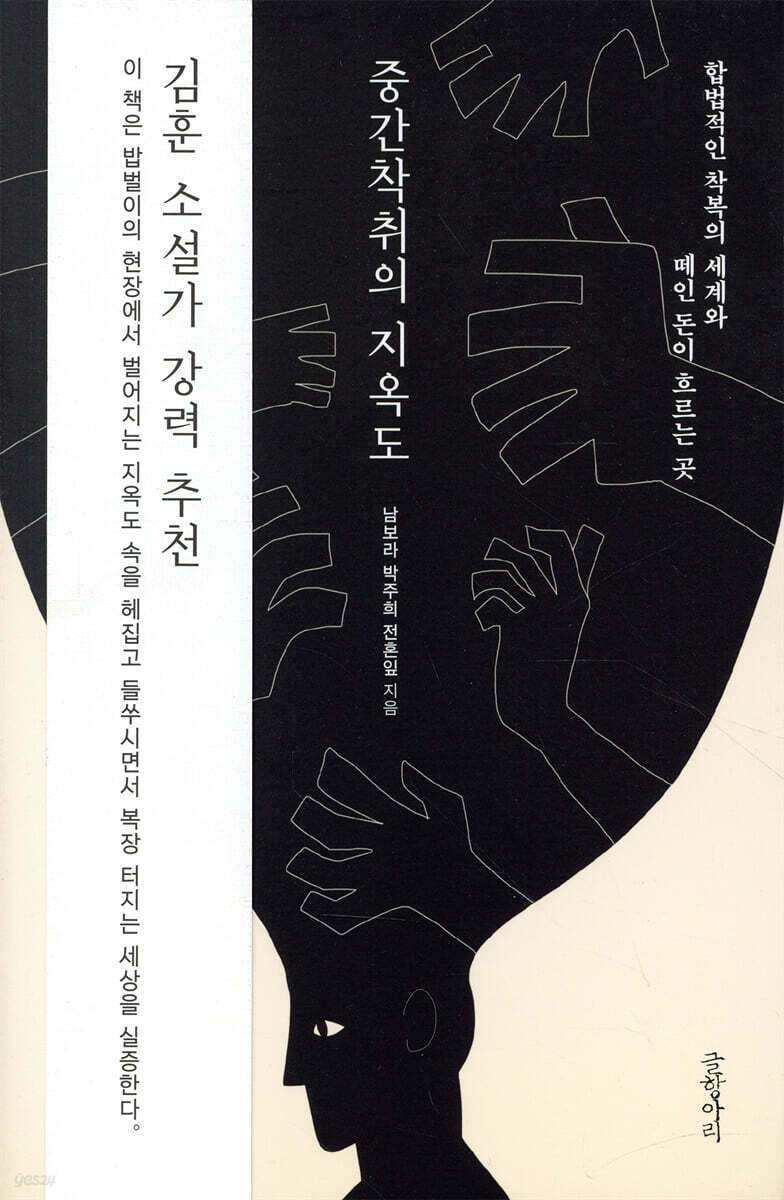
Hell of middleman exploitation
 |
Description
Book Introduction
- A word from MD
-
The dire reality of indirect labor in South KoreaHow would you feel if someone continuously stole your hard-earned wages? Over 3 million workers in South Korea are indirectly employed.
This book exposes the unfairness of indirect employment, which is ubiquitous in our society, through interviews with 100 indirectly employed workers, including security guards, cleaners, and office assistants.
August 13, 2021. Social and Political PD Son Min-gyu
3.46 million indirectly employed workers were defrauded
The moment someone intervenes between the user and the worker
Exploitation is inevitable!
A book has been published that is like a painful mural of our time, depicting the most vicious exploitative structure of the capitalist system in the greatest detail and breadth.
This is the 『Hell of Intermediate Exploitation』.
This book is a record of the reality captured through interviews with 100 indirectly employed workers by the Hankook Ilbo Minority Team.
This book began with the following question:
“You are a hard worker.
You get paid in exchange for your blood, sweat, and tears.
But what if someone were to constantly steal tens or even hundreds of thousands of won from you?” Reporters who caught wind of this chronic problem decided to ask indirect workers at the bottom of the labor market about ‘middleman exploitation’ and unfold the hellish map.
The moment someone intervenes between the user and the worker
Exploitation is inevitable!
A book has been published that is like a painful mural of our time, depicting the most vicious exploitative structure of the capitalist system in the greatest detail and breadth.
This is the 『Hell of Intermediate Exploitation』.
This book is a record of the reality captured through interviews with 100 indirectly employed workers by the Hankook Ilbo Minority Team.
This book began with the following question:
“You are a hard worker.
You get paid in exchange for your blood, sweat, and tears.
But what if someone were to constantly steal tens or even hundreds of thousands of won from you?” Reporters who caught wind of this chronic problem decided to ask indirect workers at the bottom of the labor market about ‘middleman exploitation’ and unfold the hellish map.
- You can preview some of the book's contents.
Preview
index
preface
Part 1 Legal Exploitation, Service
1.
The day I interviewed Ji-seon
2.
Ji-seon and Yong-gyun
3.
You're saying it's not illegal?
4.
The joys and sorrows of raising the minimum wage
5.
Volunteering during break time
6.
May I ask about your salary?
7.
The lie called 'management fee'
8.
Obituaries and dismissals
9.
There are leeches everywhere
10.
The screams of a bank security guard
The Story of 100 People Who Had Their Labor Stolen
Part 2: Where the Money Flows
1.
Full-time and contract workers at service companies
2.
Gave me my salary and then took it away
3.
Health and safety are more important than anything else
4.
'Double Exploitation' Technology
5.
Annual leave allowance I didn't even know existed
5.
A place where 'ghosts' wander
7.
The Dilemma of Judgment for Workers
8.
Where do CEOs' billion-dollar salaries come from?
9.
Subcontractor Representatives: Who Are They?
10.
The greed of the original contractor
11.
Why the head office wants indirect employment
12.
A barbaric society where the weak exploit the weak
Part 3: Evolving Exploitation
1.
Seoyeon of 2020 envies Miss Kim of 1998.
2.
The Birth of a Dispatch Method That Doesn't Live Up to Its Name
3.
“There are plenty of people out there who can do the job, even if you’re not here.”
4.
Our company suddenly disappeared.
5.
Who is the 'real' boss?
6.
Indirect workers are everywhere.
7.
Exploitation flows lower
8.
Seonhee and Gisun on a strange platform
9.
You're taking half the fare?
Part 4: The Journey to Change the Law
1.
Where the mail points
2.
History of Failure
3.
cruel words, review
4.
Ministry of Employment and Labor and the Federation of Korean Industries
5.
nevertheless
Part 1 Legal Exploitation, Service
1.
The day I interviewed Ji-seon
2.
Ji-seon and Yong-gyun
3.
You're saying it's not illegal?
4.
The joys and sorrows of raising the minimum wage
5.
Volunteering during break time
6.
May I ask about your salary?
7.
The lie called 'management fee'
8.
Obituaries and dismissals
9.
There are leeches everywhere
10.
The screams of a bank security guard
The Story of 100 People Who Had Their Labor Stolen
Part 2: Where the Money Flows
1.
Full-time and contract workers at service companies
2.
Gave me my salary and then took it away
3.
Health and safety are more important than anything else
4.
'Double Exploitation' Technology
5.
Annual leave allowance I didn't even know existed
5.
A place where 'ghosts' wander
7.
The Dilemma of Judgment for Workers
8.
Where do CEOs' billion-dollar salaries come from?
9.
Subcontractor Representatives: Who Are They?
10.
The greed of the original contractor
11.
Why the head office wants indirect employment
12.
A barbaric society where the weak exploit the weak
Part 3: Evolving Exploitation
1.
Seoyeon of 2020 envies Miss Kim of 1998.
2.
The Birth of a Dispatch Method That Doesn't Live Up to Its Name
3.
“There are plenty of people out there who can do the job, even if you’re not here.”
4.
Our company suddenly disappeared.
5.
Who is the 'real' boss?
6.
Indirect workers are everywhere.
7.
Exploitation flows lower
8.
Seonhee and Gisun on a strange platform
9.
You're taking half the fare?
Part 4: The Journey to Change the Law
1.
Where the mail points
2.
History of Failure
3.
cruel words, review
4.
Ministry of Employment and Labor and the Federation of Korean Industries
5.
nevertheless
Into the book
The apartment security guards didn't have a single fan in their guard post, so they had to fix fans that residents had thrown away.
Gloves are provided one pair per month, but in the fall when we have to rake a lot of fallen leaves, holes quickly appear in our fingers, so we asked for two pairs, but were refused.
Logistics center workers carrying beer cases under the blazing sun asked a service provider to install shade, but were also turned down.
Bank security guards, who come into contact with hundreds of customers a day, haven't received a single mask from their contractor in over a year since the COVID-19 pandemic began.
The management fee that the company claims includes money to buy the minimum supplies necessary for work, but the workers actually received nothing.
The service company they belonged to was also located far away from their workplace, and the work was done only among the workers.
The distance between the service provider and the worker was as great as the physical distance.
This is because most service companies neglect their workers and turn a blind eye to them.
That's why workers are angry at service companies for "sitting still and making money."
--- p.57
There were also cases where part of the wages were directly embezzled.
Mr. Yoo Jae-young joined a subcontractor of a steel company in 2012.
(…) The president of this company was a person who did not hesitate when it came to middleman exploitation.
Mr. Jaeyoung explained the situation at the beginning of his employment in as much detail as possible.
“It was my first payday.
Older seniors would return part of their salaries to the company in cash.
“I was curious about the situation, so I asked my seniors what was going on.” This company was exploiting its employees by paying them wages and then taking some of it back in cash.
“For example, out of my monthly salary of 3.5 million won after tax, I would cough up 800,000 won.
“After listening to what my seniors said, I found out that they were returning between 300,000 won and 900,000 won to the company.”
--- p.108
In the waste collection industry, safety shoes and work clothes are directly related to the safety of workers.
“You might ask why safety shoes are needed to collect waste.
But we get on and off the collection truck dozens, hundreds of times a day.
If you do this, the soles of your shoes will wear out faster than regular shoes.
When working in this state, you often slip.
It's especially worse on rainy days.
Sometimes you fall from a vehicle.
So, safety shoes should be replaced immediately when the soles wear out.
If left unattended, it can lead to a major accident.
“The reason the head office gives us money to buy new safety shoes about twice a year is to prevent these types of accidents, but our company buys us one pair every two to three years.”
--- p.115
The system was such that dispatch and service companies would stick to indirectly employed workers like leeches, stealing their wages, and if they ever complained, they would simply fire them through negotiations with the head office.
Actually, it's not even a legal dismissal.
Termination of a service contract such as dispatch, subcontracting, or consignment is not legally considered dismissal.
Subcontracted workers, such as cleaners and security guards, who are not protected by the Labor Standards Act, which restricts dismissal, are very easily laid off.
It is a system as solid as a brick that has operated until our society became a hell of middleman exploitation.
Gloves are provided one pair per month, but in the fall when we have to rake a lot of fallen leaves, holes quickly appear in our fingers, so we asked for two pairs, but were refused.
Logistics center workers carrying beer cases under the blazing sun asked a service provider to install shade, but were also turned down.
Bank security guards, who come into contact with hundreds of customers a day, haven't received a single mask from their contractor in over a year since the COVID-19 pandemic began.
The management fee that the company claims includes money to buy the minimum supplies necessary for work, but the workers actually received nothing.
The service company they belonged to was also located far away from their workplace, and the work was done only among the workers.
The distance between the service provider and the worker was as great as the physical distance.
This is because most service companies neglect their workers and turn a blind eye to them.
That's why workers are angry at service companies for "sitting still and making money."
--- p.57
There were also cases where part of the wages were directly embezzled.
Mr. Yoo Jae-young joined a subcontractor of a steel company in 2012.
(…) The president of this company was a person who did not hesitate when it came to middleman exploitation.
Mr. Jaeyoung explained the situation at the beginning of his employment in as much detail as possible.
“It was my first payday.
Older seniors would return part of their salaries to the company in cash.
“I was curious about the situation, so I asked my seniors what was going on.” This company was exploiting its employees by paying them wages and then taking some of it back in cash.
“For example, out of my monthly salary of 3.5 million won after tax, I would cough up 800,000 won.
“After listening to what my seniors said, I found out that they were returning between 300,000 won and 900,000 won to the company.”
--- p.108
In the waste collection industry, safety shoes and work clothes are directly related to the safety of workers.
“You might ask why safety shoes are needed to collect waste.
But we get on and off the collection truck dozens, hundreds of times a day.
If you do this, the soles of your shoes will wear out faster than regular shoes.
When working in this state, you often slip.
It's especially worse on rainy days.
Sometimes you fall from a vehicle.
So, safety shoes should be replaced immediately when the soles wear out.
If left unattended, it can lead to a major accident.
“The reason the head office gives us money to buy new safety shoes about twice a year is to prevent these types of accidents, but our company buys us one pair every two to three years.”
--- p.115
The system was such that dispatch and service companies would stick to indirectly employed workers like leeches, stealing their wages, and if they ever complained, they would simply fire them through negotiations with the head office.
Actually, it's not even a legal dismissal.
Termination of a service contract such as dispatch, subcontracting, or consignment is not legally considered dismissal.
Subcontracted workers, such as cleaners and security guards, who are not protected by the Labor Standards Act, which restricts dismissal, are very easily laid off.
It is a system as solid as a brick that has operated until our society became a hell of middleman exploitation.
--- p.216
Publisher's Review
Labor hours that are not converted into monetary value
The lives of indirectly employed workers, the people whose deaths we encounter at least once a day, are the subject of this book.
When death becomes visible, the spotlight shines on them, but in the workplace, their presence is minimal compared to their role, and the wages they receive are also meager.
Even if the minimum wage rises every year, their monthly salary remains stuck at around 1 million won.
Another characteristic of these workers is that those with 1 year of experience and those with 10 years of experience are not treated much differently.
The reason why the increasing skill level of workers over time cannot be converted into monetary value is because of the pyramid structure of 'worker-subcontractor-prime contractor'.
Thus, the authors focus solely on the labor-capital world associated with 'intermediate exploitation'.
First, we interviewed a total of 100 indirectly employed workers.
The first thing I checked with them was their payslip.
After reviewing the specifications, we obtained the subcontractor's 'Contracting Cost Calculation Details' and analyzed whether direct labor costs were properly paid as labor costs.
As the pieces of numerous data were pieced together, a picture of massive exploitation was revealed.
Exploitation was inevitable when someone intervened between the employer and the worker.
It is estimated that some of the subcontractor CEOs who only deal with people without any special skills earn around 2 billion won per year.
There is nothing wrong with a CEO earning a high income.
The problem is that some of the representative's income is believed to come from intermediary exploitation.
It was revealed that many subcontractors do not pay the full amount of direct labor costs that should be returned to workers, but only pay 47-61% (normally 72-73% should be used for labor costs).
In other words, 39-53% of the labor costs that should have been paid to workers were embezzled, and most of this money ended up in the pockets of subcontractor representatives.
How much do 3.46 million indirectly employed workers earn?
Of the 100 indirectly employed workers interviewed by the authors, 86 worked full-time and were paid monthly.
However, half of them, 43 people, had a monthly salary in the 1 million won range.
Kim Mi-yeon, a dispatched office assistant working at a mid-sized company, received 1.62 million won, Choi Yong-il, a cleaner at the National Maritime Museum, received 1.63 million won, and Park Seon-ho, a parking attendant at the same museum, received 1.8 million won.
Apartment security guard Koo Ja-hyeok received 1.69 million won, call center counselors at the Korea Student Aid Foundation received 1.7 million won, IT developer Lee Min-jun, who had just started his career, received 1.72 million won, and Park Min-hyeon, who was dispatched to an automobile parts manufacturing plant, received 1.8 million won.
It is difficult enough for them to endure being paid a minimum wage, but the fact that their careers remain stagnant even as they accumulate years of experience robs them of any hope for the future.
'If I work steadily, my salary will increase' is a hope for the future that almost all workers have.
However, Jae-young Yoo, who joined a subcontractor of a steel company in 2012, is still working for 2.4 million won per month, 10 years later.
This is because I am paying 800,000 won to the subcontractor representative every month.
His 30s are ending just like when he started.
The monthly salary of bank security guard Kang Ji-seon, who has been working for 10 years, has only increased by 590,000 won over 10 years, to 1.91 million won.
The monthly salary of Jin-Hong Lee, a railway station worker with 14 years of experience, increased by 640,000 won over 14 years to 1.64 million won.
All counselors at the Korea Student Aid Foundation's call center received 1.7 million won, regardless of whether they had 10 years of experience or 1 year.
It's a common sight in the world of indirect employment for a new employee to receive the same salary as an experienced employee with 30 years of experience.
Why the minimum wage is rising but salaries aren't
July 2017 was the most exciting time for indirectly employed workers like Yeom Hee-jeong, who works at the Korea Student Aid Foundation's call center.
There were many grounds for interpreting the omen positively.
The government's Minimum Wage Committee set the minimum wage for 2018 at 7,530 won, a whopping 16.4% increase and the largest increase ever.
It seemed that newly inaugurated President Moon Jae-in's campaign promise of "zero irregular workers in the public sector" was gradually coming true.
Heejung, who was receiving a monthly salary of 1.71 million won that year, expected her salary to naturally increase in 2018.
But when I actually received it, the statement was a bit strange.
In 2017, meal allowance (100,000 won) and overtime allowance (11,000 won) were paid, and the total amount was 111,000 won.
However, in 2018, the two items were suddenly combined, reducing the amount to 104,000 won.
It wasn't something I could just pass over by saying, "It's only about 7,000 won."
Every year, when the minimum wage is raised, other salary items are reduced.
Heejung's monthly salary amount from 2018 to 2021 remained unchanged.
As salary increases occur, position allowances and incentives disappear, and the total salary is tied up.
The explanation from the scholarship foundation, which is the original requester, was as follows.
“As of January 2020, we have raised counselors’ wages by an average of 2.9%.” This was the first time counselors had heard this news.
When the consultants stepped forward to find out the truth, the contractor confessed that they had lied by saying that “the contract fee was frozen.”
And then he nailed it down with the following words:
“Even so, we are currently paying more than the minimum wage, so we cannot raise it any further.”
Where the stolen money flows
This book didn't just cover workers.
We obtained information from subcontractors and the general contractor, and also spoke to officials from these companies.
This is dealt with in detail in Part 2, where the unit suddenly jumps from 1 to 2 million won to hundreds of millions of won, vividly showing how large a scale the money taken from individual workers is heading to.
The amount is far beyond expectations, and it is understandable why companies collect tens of thousands or hundreds of thousands of won from workers, sometimes illegally, and sometimes legally, but without any good intentions.
Case 1: Hyundai Steel's subcontractor, Company H
It is estimated that the head of a subcontractor of Hyundai Steel earns an annual income of 2 billion won.
This figure was calculated through recordings of labor-management council meetings.
This company's contracting fee in September 2020 was 950 million won.
Based on this amount, the company representative's income is estimated.
First, 15% of the legal costs and management costs are deducted from the contract fee.
Again, if you subtract the workers' labor costs from here, the remainder is the company's (representative's) net profit.
The problem is that some of the representative's income appears to be the result of intermediary exploitation.
Case 2: KORAIL Networks
KORAIL Networks is a subsidiary of Korea Railroad Corporation, and is entrusted by KORAIL to perform parking management, ticket sales, and station operation.
To use an analogy, KORAIL is the general contractor and KORAIL Networks is the subcontractor.
The average annual salary of the executive director of KORAIL Networks over the past five years has exceeded 100 million won.
In comparison, the employees' monthly salaries are the lowest among public institutions under the Ministry of Land, Infrastructure and Transport.
The monthly base salary of safety manager (shift supervisor) Kim Ho-seong in 2020 was approximately 1.7 million won (including overtime pay for night shifts, it ranges from 1.9 million won to 2 million won).
This is equivalent to 44% of the parent company's regular employees.
When workers raised concerns about this, the commission fee increased significantly in 2020, creating conditions for raising employees' wages.
However, KORAIL Networks has not yet applied the market wage rate.
Case 3: Radiation management service provider S
The CEO of Company S is estimated to have an annual income of over 2 billion won.
Park Young-soo, who is in charge of radiation safety management at this company, said, “I receive 3 million won (after tax) per month, but the amount of intermediary exploitation is as much as 7 million won.”
The claim is that the company takes an amount that is twice the monthly salary under the pretext of management fees.
This company receives 120 million won per person per year from Korea Hydro & Nuclear Power.
At this time, the unit price of the service is composed of first, direct labor costs (KRW 50 million), second, miscellaneous expenses such as office operation (KRW 55 million), and third, technology fees used for research or technology development related to radiation safety (KRW 21 million).
However, Youngsu says he is skeptical about whether the service provider is using the expenses and technology fees for the intended purpose.
This is because it is not reasonable to believe that Korea Hydro & Nuclear Power provides almost all of the equipment and that the cost per person is 55 million won.
Youngsu says the service provider provides little support.
Novel, creative, and shameless exploitative schemes
The word 'poop thug' is widely used among construction day laborers.
Mr. Choi Ki-young also gave 70,000 won to the team leader every day as a poop collector. His daily wage was 130,000 won, but his actual employment contract states that it was 200,000 won.
The team leader who carries him around and does electrical work takes 70,000 won from his team members every day, which is a chronic method of middleman exploitation.
In the construction industry, it is estimated that a team leader with five or six team members earns 10 to 20 million won per month.
Closing a business under false pretenses is also a common tactic.
Representatives of subcontractors are closing down their businesses under false pretenses to avoid converting workers to regular employees or to obstruct union activities.
Usually, a company that has closed down under false pretenses changes its name and establishes a new company to continue its business operations.
The problem is that workers at companies that have closed down under false pretenses are not receiving severance pay or overdue wages.
On paper, the company they belonged to has disappeared, but this type of fake closure is accompanied by exploitation.
Mr. Shim Hyeon-woo, who works as a subcontractor for Hyundai Motor Company, has changed his company three times in 18 years.
When my first company went out of business, I had unpaid wages that I still haven't received, and from my second company, I haven't received my severance pay.
He said, “Each time the company changed, the company representative changed as well, but the actual owner was always the president of the first company.”
His first company president worked as a director in his second company, a director in his third company, and a manager in his fourth company.
The latter part of the book delves into a more fundamental structural analysis, examining how subcontractors, too, are not free from the prime contractor at the top of the pyramid, exploiting workers by squeezing their wages.
Those who held key executive positions in large corporations often become presidents of subcontractors who receive work from large corporations after retirement.
And these people fill each other's pockets through a close relationship with the head office, but the more this happens, the more the workers' pockets become empty.
The lives of indirectly employed workers, the people whose deaths we encounter at least once a day, are the subject of this book.
When death becomes visible, the spotlight shines on them, but in the workplace, their presence is minimal compared to their role, and the wages they receive are also meager.
Even if the minimum wage rises every year, their monthly salary remains stuck at around 1 million won.
Another characteristic of these workers is that those with 1 year of experience and those with 10 years of experience are not treated much differently.
The reason why the increasing skill level of workers over time cannot be converted into monetary value is because of the pyramid structure of 'worker-subcontractor-prime contractor'.
Thus, the authors focus solely on the labor-capital world associated with 'intermediate exploitation'.
First, we interviewed a total of 100 indirectly employed workers.
The first thing I checked with them was their payslip.
After reviewing the specifications, we obtained the subcontractor's 'Contracting Cost Calculation Details' and analyzed whether direct labor costs were properly paid as labor costs.
As the pieces of numerous data were pieced together, a picture of massive exploitation was revealed.
Exploitation was inevitable when someone intervened between the employer and the worker.
It is estimated that some of the subcontractor CEOs who only deal with people without any special skills earn around 2 billion won per year.
There is nothing wrong with a CEO earning a high income.
The problem is that some of the representative's income is believed to come from intermediary exploitation.
It was revealed that many subcontractors do not pay the full amount of direct labor costs that should be returned to workers, but only pay 47-61% (normally 72-73% should be used for labor costs).
In other words, 39-53% of the labor costs that should have been paid to workers were embezzled, and most of this money ended up in the pockets of subcontractor representatives.
How much do 3.46 million indirectly employed workers earn?
Of the 100 indirectly employed workers interviewed by the authors, 86 worked full-time and were paid monthly.
However, half of them, 43 people, had a monthly salary in the 1 million won range.
Kim Mi-yeon, a dispatched office assistant working at a mid-sized company, received 1.62 million won, Choi Yong-il, a cleaner at the National Maritime Museum, received 1.63 million won, and Park Seon-ho, a parking attendant at the same museum, received 1.8 million won.
Apartment security guard Koo Ja-hyeok received 1.69 million won, call center counselors at the Korea Student Aid Foundation received 1.7 million won, IT developer Lee Min-jun, who had just started his career, received 1.72 million won, and Park Min-hyeon, who was dispatched to an automobile parts manufacturing plant, received 1.8 million won.
It is difficult enough for them to endure being paid a minimum wage, but the fact that their careers remain stagnant even as they accumulate years of experience robs them of any hope for the future.
'If I work steadily, my salary will increase' is a hope for the future that almost all workers have.
However, Jae-young Yoo, who joined a subcontractor of a steel company in 2012, is still working for 2.4 million won per month, 10 years later.
This is because I am paying 800,000 won to the subcontractor representative every month.
His 30s are ending just like when he started.
The monthly salary of bank security guard Kang Ji-seon, who has been working for 10 years, has only increased by 590,000 won over 10 years, to 1.91 million won.
The monthly salary of Jin-Hong Lee, a railway station worker with 14 years of experience, increased by 640,000 won over 14 years to 1.64 million won.
All counselors at the Korea Student Aid Foundation's call center received 1.7 million won, regardless of whether they had 10 years of experience or 1 year.
It's a common sight in the world of indirect employment for a new employee to receive the same salary as an experienced employee with 30 years of experience.
Why the minimum wage is rising but salaries aren't
July 2017 was the most exciting time for indirectly employed workers like Yeom Hee-jeong, who works at the Korea Student Aid Foundation's call center.
There were many grounds for interpreting the omen positively.
The government's Minimum Wage Committee set the minimum wage for 2018 at 7,530 won, a whopping 16.4% increase and the largest increase ever.
It seemed that newly inaugurated President Moon Jae-in's campaign promise of "zero irregular workers in the public sector" was gradually coming true.
Heejung, who was receiving a monthly salary of 1.71 million won that year, expected her salary to naturally increase in 2018.
But when I actually received it, the statement was a bit strange.
In 2017, meal allowance (100,000 won) and overtime allowance (11,000 won) were paid, and the total amount was 111,000 won.
However, in 2018, the two items were suddenly combined, reducing the amount to 104,000 won.
It wasn't something I could just pass over by saying, "It's only about 7,000 won."
Every year, when the minimum wage is raised, other salary items are reduced.
Heejung's monthly salary amount from 2018 to 2021 remained unchanged.
As salary increases occur, position allowances and incentives disappear, and the total salary is tied up.
The explanation from the scholarship foundation, which is the original requester, was as follows.
“As of January 2020, we have raised counselors’ wages by an average of 2.9%.” This was the first time counselors had heard this news.
When the consultants stepped forward to find out the truth, the contractor confessed that they had lied by saying that “the contract fee was frozen.”
And then he nailed it down with the following words:
“Even so, we are currently paying more than the minimum wage, so we cannot raise it any further.”
Where the stolen money flows
This book didn't just cover workers.
We obtained information from subcontractors and the general contractor, and also spoke to officials from these companies.
This is dealt with in detail in Part 2, where the unit suddenly jumps from 1 to 2 million won to hundreds of millions of won, vividly showing how large a scale the money taken from individual workers is heading to.
The amount is far beyond expectations, and it is understandable why companies collect tens of thousands or hundreds of thousands of won from workers, sometimes illegally, and sometimes legally, but without any good intentions.
Case 1: Hyundai Steel's subcontractor, Company H
It is estimated that the head of a subcontractor of Hyundai Steel earns an annual income of 2 billion won.
This figure was calculated through recordings of labor-management council meetings.
This company's contracting fee in September 2020 was 950 million won.
Based on this amount, the company representative's income is estimated.
First, 15% of the legal costs and management costs are deducted from the contract fee.
Again, if you subtract the workers' labor costs from here, the remainder is the company's (representative's) net profit.
The problem is that some of the representative's income appears to be the result of intermediary exploitation.
Case 2: KORAIL Networks
KORAIL Networks is a subsidiary of Korea Railroad Corporation, and is entrusted by KORAIL to perform parking management, ticket sales, and station operation.
To use an analogy, KORAIL is the general contractor and KORAIL Networks is the subcontractor.
The average annual salary of the executive director of KORAIL Networks over the past five years has exceeded 100 million won.
In comparison, the employees' monthly salaries are the lowest among public institutions under the Ministry of Land, Infrastructure and Transport.
The monthly base salary of safety manager (shift supervisor) Kim Ho-seong in 2020 was approximately 1.7 million won (including overtime pay for night shifts, it ranges from 1.9 million won to 2 million won).
This is equivalent to 44% of the parent company's regular employees.
When workers raised concerns about this, the commission fee increased significantly in 2020, creating conditions for raising employees' wages.
However, KORAIL Networks has not yet applied the market wage rate.
Case 3: Radiation management service provider S
The CEO of Company S is estimated to have an annual income of over 2 billion won.
Park Young-soo, who is in charge of radiation safety management at this company, said, “I receive 3 million won (after tax) per month, but the amount of intermediary exploitation is as much as 7 million won.”
The claim is that the company takes an amount that is twice the monthly salary under the pretext of management fees.
This company receives 120 million won per person per year from Korea Hydro & Nuclear Power.
At this time, the unit price of the service is composed of first, direct labor costs (KRW 50 million), second, miscellaneous expenses such as office operation (KRW 55 million), and third, technology fees used for research or technology development related to radiation safety (KRW 21 million).
However, Youngsu says he is skeptical about whether the service provider is using the expenses and technology fees for the intended purpose.
This is because it is not reasonable to believe that Korea Hydro & Nuclear Power provides almost all of the equipment and that the cost per person is 55 million won.
Youngsu says the service provider provides little support.
Novel, creative, and shameless exploitative schemes
The word 'poop thug' is widely used among construction day laborers.
Mr. Choi Ki-young also gave 70,000 won to the team leader every day as a poop collector. His daily wage was 130,000 won, but his actual employment contract states that it was 200,000 won.
The team leader who carries him around and does electrical work takes 70,000 won from his team members every day, which is a chronic method of middleman exploitation.
In the construction industry, it is estimated that a team leader with five or six team members earns 10 to 20 million won per month.
Closing a business under false pretenses is also a common tactic.
Representatives of subcontractors are closing down their businesses under false pretenses to avoid converting workers to regular employees or to obstruct union activities.
Usually, a company that has closed down under false pretenses changes its name and establishes a new company to continue its business operations.
The problem is that workers at companies that have closed down under false pretenses are not receiving severance pay or overdue wages.
On paper, the company they belonged to has disappeared, but this type of fake closure is accompanied by exploitation.
Mr. Shim Hyeon-woo, who works as a subcontractor for Hyundai Motor Company, has changed his company three times in 18 years.
When my first company went out of business, I had unpaid wages that I still haven't received, and from my second company, I haven't received my severance pay.
He said, “Each time the company changed, the company representative changed as well, but the actual owner was always the president of the first company.”
His first company president worked as a director in his second company, a director in his third company, and a manager in his fourth company.
The latter part of the book delves into a more fundamental structural analysis, examining how subcontractors, too, are not free from the prime contractor at the top of the pyramid, exploiting workers by squeezing their wages.
Those who held key executive positions in large corporations often become presidents of subcontractors who receive work from large corporations after retirement.
And these people fill each other's pockets through a close relationship with the head office, but the more this happens, the more the workers' pockets become empty.
GOODS SPECIFICS
- Date of issue: August 12, 2021
- Page count, weight, size: 280 pages | 406g | 135*205*20mm
- ISBN13: 9788967359393
- ISBN10: 896735939X
You may also like
카테고리
korean


korean

![GQ KOREA Mark (Monthly): December [2025]](http://librairie.coreenne.fr/cdn/shop/files/8ef265dbbfbf186523ed75ba7319009d.jpg?v=1765340328&width=3840)


