

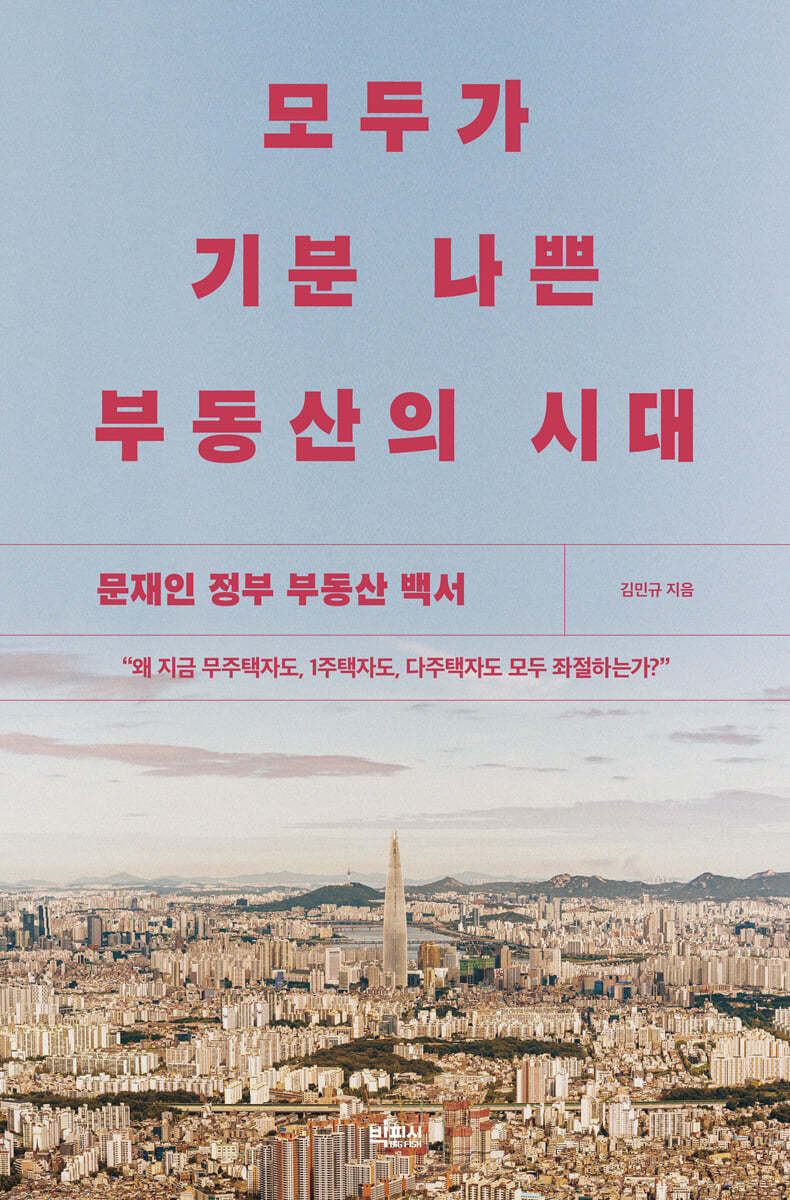
The era of real estate that makes everyone feel bad
 |
Description
Book Introduction
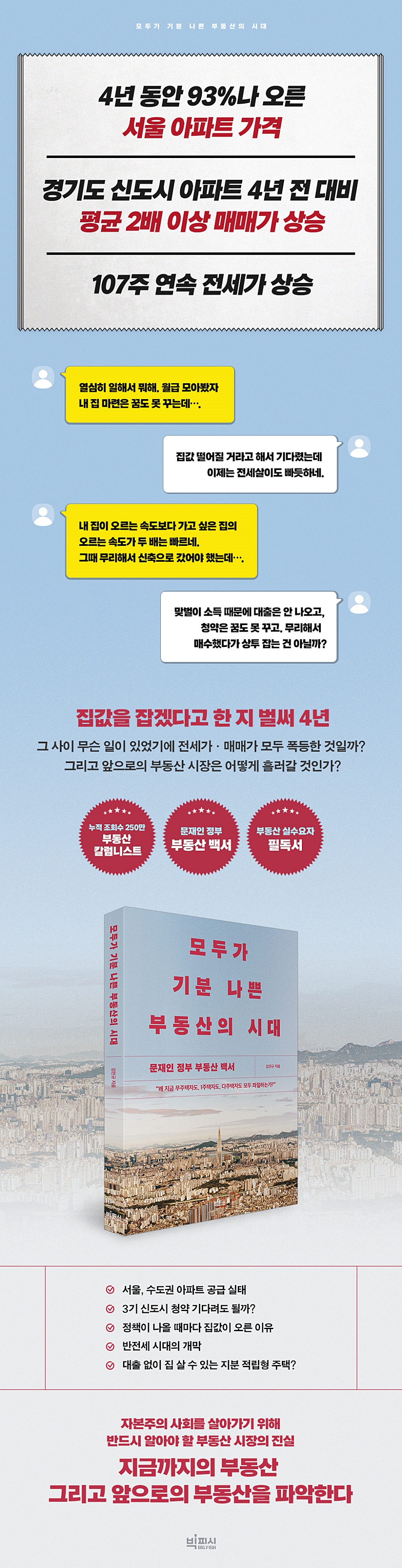
The Truth About the Real Estate Market: Essential Knowledge for Living in a Capitalist Society Since the Moon Jae-in administration's first real estate policy was announced on June 19, 2017, a total of 26 policies have been implemented over the past four years. But unfortunately, as everyone in the country can see, the results are not that good. The median price of an apartment in Seoul, which was 606 million won in May 2017 when the Moon Jae-in administration took office, has now reached 1 billion won, and the price of an apartment in Gangnam, which was in the low to mid 1 billion won range at the time, is now 3 billion won, making it not surprising. This is not limited to just downtown Seoul, as the prices of apartments in new towns in Gyeonggi Province have more than doubled compared to four years ago, and even the jeonse prices, which had been showing a slower increase compared to the sale prices, have risen rapidly in a short period of time since last year, becoming a major social problem. It's already been four years since they said they would control housing prices. What happened in the meantime to make everyone—homeless, single-homeowners, and multi-homeowners—so angry? And what will the real estate market look like going forward? |
- You can preview some of the book's contents.
Preview
index
[Prologue] Why did Gangnam apartments go from 1 billion won to 3 billion won?
Chapter 1.
Ultimately, the problem is the apartment
Will it go up by 50 million won or 100 million won?
Trauma from failed real estate policies
Is there enough supply?
The birth of new demand
[Key Contents of the August 2, 2017 Measures]
The opening of the lottery sales
60 billion won in cash accumulated at the site of uncontracted goods
For those leaving Seoul because of housing prices
Chapter 2.
Last chance to buy a house
A hole in the ceiling of a Gangnam apartment
A market where prices push up
Re-examination of supply through the 3rd new city
[Key Contents of the September 13, 2018 Measures]
Since I can't get a loan, I'm making a gap investment.
If taxes are raised, we will have to sell our houses.
A season when everyone feels bad
Chapter 3.
The era of 1 billion won apartments has begun.
A small ball shot by Newtown
[Key Contents of the December 16, 2019 Measures]
A look from Seoul to the metropolitan area
The more speculative the market, the more likely it is to buy.
Too much stock has been locked up
The sin of trusting in policies and systems
The unreasonableness of the three rental laws
The house I want is an ordinary apartment, not a rental house.
The Paradox of Regulation
Chapter 4.
Real estate in the future
Should I wait for the 3rd new town subscription?
Expectations for large-scale supply
Equity-based housing? Equity-based non-homeownership
When the public and private sectors work together to achieve results
Another savior to solve future housing problems
[Epilogue] Realistic Goals for Homeownership
Chapter 1.
Ultimately, the problem is the apartment
Will it go up by 50 million won or 100 million won?
Trauma from failed real estate policies
Is there enough supply?
The birth of new demand
[Key Contents of the August 2, 2017 Measures]
The opening of the lottery sales
60 billion won in cash accumulated at the site of uncontracted goods
For those leaving Seoul because of housing prices
Chapter 2.
Last chance to buy a house
A hole in the ceiling of a Gangnam apartment
A market where prices push up
Re-examination of supply through the 3rd new city
[Key Contents of the September 13, 2018 Measures]
Since I can't get a loan, I'm making a gap investment.
If taxes are raised, we will have to sell our houses.
A season when everyone feels bad
Chapter 3.
The era of 1 billion won apartments has begun.
A small ball shot by Newtown
[Key Contents of the December 16, 2019 Measures]
A look from Seoul to the metropolitan area
The more speculative the market, the more likely it is to buy.
Too much stock has been locked up
The sin of trusting in policies and systems
The unreasonableness of the three rental laws
The house I want is an ordinary apartment, not a rental house.
The Paradox of Regulation
Chapter 4.
Real estate in the future
Should I wait for the 3rd new town subscription?
Expectations for large-scale supply
Equity-based housing? Equity-based non-homeownership
When the public and private sectors work together to achieve results
Another savior to solve future housing problems
[Epilogue] Realistic Goals for Homeownership
Detailed image
Into the book
There was no social consensus on giving priority to lottery subscription to veteran homeless people with 12 years or more of experience.
I've never heard a reasonable explanation why 9 years is not allowed and 12 years is allowed.
People slowly began to realize that I had no chance of winning.
In particular, complaints began to erupt among single- or two-person households with few dependents and those in their 30s who had not been homeowners for a short period of time.
The political world could not ignore public opinion, so they expanded the scope of special supplies for newlyweds.
For example, the newlywed requirement, which was previously 5 years, was increased to 7 years, and the monthly income standard was raised to a maximum of 160% in the case of dual-income couples.
Now, there are even voices calling for increasing the allocation of housing for single-person households and first-time subscribers.
But then, since the amount of store inventory would decrease again, someone was bound to be dissatisfied again.
Is there a golden rule here? Ultimately, subscriptions are fueled by the expectation of winning.
Prioritizing through artificial allocation is unlikely to satisfy anyone.
Rather, it only leads to disputes over differences in quantity.
All of this is ultimately related to gains and losses. In the current structure, where economic benefits in the hundreds of millions of won are guaranteed when a subscription is won due to abnormal control of the sale price, it is inevitable that a select few will continue to monopolize the profits.
And here, countless people who were left out and excluded, in other words, those who were not selected with a score of 50 or less, completely gave up on their dreams of subscription and started rushing into the real estate market to buy the houses they could get their hands on.
It was the beginning of the so-called 'cheongmupisa (buying a subscription at a premium)' era.
---From "60 billion won in cash collected at the site of uncontracted goods"
When the average price of houses in Seoul rose by 200 million won in just one year, the desperation of people who thought, "If this continues, I really won't be able to buy a house," manifested itself in so-called gap investment.
In the summer of 2018, the percentage of people in Seoul who purchased a house using a jeonse deposit reached a whopping 59.6%.
But in fact, in some ways, this was natural and expected.
At that time, the jeonse rate for apartments in Seoul was still over 70%, which meant that one could purchase a house with a jeonse deposit for just 30% of the house price.
However, after the 8.2 measures, loan regulations were strengthened, so even for those without a home, loans were limited to 40% of the home price, and one had to have at least 70% of the home price to purchase a home. Therefore, so-called gap investment was a more advantageous means of purchasing a home in situations where financing was limited.
(…) But can we conclude that a person without a home who bought a house like this is a gap speculator? (…) I wonder if we can conclude that the desire of a person without a home to buy a house in the best area possible, even if it means using all available loans and getting help from their parents, is speculation.
Moreover, it is true that in the end, more demand was concentrated on expensive houses and prices rose quickly, so advice to take it slow and steady was meaningless.
Nevertheless, the act of buying a house by taking out a loan was branded as speculative.
Regardless, people were looking for real estate with the sole intention of having their names listed on the register of real estate.
---From "I'm making gap investments because I can't get a loan"
A house in Jamsil that used to be worth 1.3 billion won has now surpassed 2 billion won. Who could possibly buy that house? How many people can afford that kind of cash? Let's consider this.
A few years ago, when even Mapo Raemian Prugio was not attracting people's attention, there was a couple who took out a loan of 300 million won and moved into an 84㎡ Mapo Raemian Prugio apartment worth around 800 million won.
Although paying off a loan principal and interest of over 1 million won per month was certainly not something I wanted to do, I decided that it was a good location for a dual-income family, living in a new house and commuting to work in Yeouido or Gwanghwamun.
But after living there for 5-6 years, I have almost paid off the 300 million won loan principal that seemed like a long time ago, and when I looked around, I heard that they are talking about 1.8 billion won for the house price.
His net worth, which was around 400 million won just a few years ago, has more than tripled.
What will this couple do now? Their children are growing up and entering middle school, and they want to move to a better school district. With another mortgage, it's no longer a stretch to jump to a neighborhood worth 2 billion won.
So who can afford this Mapo Raemian Prugio? It's someone who bought a new home at a price level a level below.
(…) A house is bought by selling a house, and the secret to a million dollar house is hidden in the price difference between houses.
People's hearts are one, and everyone wants to have a new home and live in a more comfortable environment.
But as opportunities to acquire such homes disappear, prices are bound to rise. The most expensive homes rise, and the next most expensive homes follow suit, causing less expensive homes to also rise in price.
In this atmosphere, house prices are formed by each other, and the process of securing the legitimacy of each price is repeated.
---From "The Little Ball Launched by Newtown"
When I look at my friends who are getting married now, I feel lost and frustrated.
There are quite a few people who have saved 100 to 200 million won, but they have nowhere to spend that money.
(…) Then is there no way? No.
I couldn't start in Seoul either.
In the past year or two, there have definitely been new houses in Gyeonggi-do that are worth 300-400 million won and have transportation facilities that rival those of Seoul.
At that time, the rent for those houses was around 300 million won each.
Now? The most recent actual transaction price has exceeded 600 million won.
If you took out a loan of 200 million won and bought a house for 350 million won, it will now be worth 600 million won. If you paid off 50 million won of the loan in the meantime, your assets will have increased by 300 million won.
The essence is simple.
You need to have seed money.
It would be better if you could somehow make 100 million won and even 200 million won.
If you live with your parents and start working in your late 20s and save all the money you earn, it is not impossible to earn 100 million won.
And you have to set realistic goals and find ways to achieve them.
No matter how much you look at the price of a house in Gangnam worth 1 billion won or 2 billion won, it doesn't help at all.
Within an hour of work, as close to a subway station as possible, preferably new, and located near other houses.
If you move into a place like that, you have to work hard to earn money and reduce your debt.
And the next step can be explored within a realistic scope.
People who already own a home may think they can just sit back and earn money for it, but that's not true.
We have all gone through the same path.
I've never heard a reasonable explanation why 9 years is not allowed and 12 years is allowed.
People slowly began to realize that I had no chance of winning.
In particular, complaints began to erupt among single- or two-person households with few dependents and those in their 30s who had not been homeowners for a short period of time.
The political world could not ignore public opinion, so they expanded the scope of special supplies for newlyweds.
For example, the newlywed requirement, which was previously 5 years, was increased to 7 years, and the monthly income standard was raised to a maximum of 160% in the case of dual-income couples.
Now, there are even voices calling for increasing the allocation of housing for single-person households and first-time subscribers.
But then, since the amount of store inventory would decrease again, someone was bound to be dissatisfied again.
Is there a golden rule here? Ultimately, subscriptions are fueled by the expectation of winning.
Prioritizing through artificial allocation is unlikely to satisfy anyone.
Rather, it only leads to disputes over differences in quantity.
All of this is ultimately related to gains and losses. In the current structure, where economic benefits in the hundreds of millions of won are guaranteed when a subscription is won due to abnormal control of the sale price, it is inevitable that a select few will continue to monopolize the profits.
And here, countless people who were left out and excluded, in other words, those who were not selected with a score of 50 or less, completely gave up on their dreams of subscription and started rushing into the real estate market to buy the houses they could get their hands on.
It was the beginning of the so-called 'cheongmupisa (buying a subscription at a premium)' era.
---From "60 billion won in cash collected at the site of uncontracted goods"
When the average price of houses in Seoul rose by 200 million won in just one year, the desperation of people who thought, "If this continues, I really won't be able to buy a house," manifested itself in so-called gap investment.
In the summer of 2018, the percentage of people in Seoul who purchased a house using a jeonse deposit reached a whopping 59.6%.
But in fact, in some ways, this was natural and expected.
At that time, the jeonse rate for apartments in Seoul was still over 70%, which meant that one could purchase a house with a jeonse deposit for just 30% of the house price.
However, after the 8.2 measures, loan regulations were strengthened, so even for those without a home, loans were limited to 40% of the home price, and one had to have at least 70% of the home price to purchase a home. Therefore, so-called gap investment was a more advantageous means of purchasing a home in situations where financing was limited.
(…) But can we conclude that a person without a home who bought a house like this is a gap speculator? (…) I wonder if we can conclude that the desire of a person without a home to buy a house in the best area possible, even if it means using all available loans and getting help from their parents, is speculation.
Moreover, it is true that in the end, more demand was concentrated on expensive houses and prices rose quickly, so advice to take it slow and steady was meaningless.
Nevertheless, the act of buying a house by taking out a loan was branded as speculative.
Regardless, people were looking for real estate with the sole intention of having their names listed on the register of real estate.
---From "I'm making gap investments because I can't get a loan"
A house in Jamsil that used to be worth 1.3 billion won has now surpassed 2 billion won. Who could possibly buy that house? How many people can afford that kind of cash? Let's consider this.
A few years ago, when even Mapo Raemian Prugio was not attracting people's attention, there was a couple who took out a loan of 300 million won and moved into an 84㎡ Mapo Raemian Prugio apartment worth around 800 million won.
Although paying off a loan principal and interest of over 1 million won per month was certainly not something I wanted to do, I decided that it was a good location for a dual-income family, living in a new house and commuting to work in Yeouido or Gwanghwamun.
But after living there for 5-6 years, I have almost paid off the 300 million won loan principal that seemed like a long time ago, and when I looked around, I heard that they are talking about 1.8 billion won for the house price.
His net worth, which was around 400 million won just a few years ago, has more than tripled.
What will this couple do now? Their children are growing up and entering middle school, and they want to move to a better school district. With another mortgage, it's no longer a stretch to jump to a neighborhood worth 2 billion won.
So who can afford this Mapo Raemian Prugio? It's someone who bought a new home at a price level a level below.
(…) A house is bought by selling a house, and the secret to a million dollar house is hidden in the price difference between houses.
People's hearts are one, and everyone wants to have a new home and live in a more comfortable environment.
But as opportunities to acquire such homes disappear, prices are bound to rise. The most expensive homes rise, and the next most expensive homes follow suit, causing less expensive homes to also rise in price.
In this atmosphere, house prices are formed by each other, and the process of securing the legitimacy of each price is repeated.
---From "The Little Ball Launched by Newtown"
When I look at my friends who are getting married now, I feel lost and frustrated.
There are quite a few people who have saved 100 to 200 million won, but they have nowhere to spend that money.
(…) Then is there no way? No.
I couldn't start in Seoul either.
In the past year or two, there have definitely been new houses in Gyeonggi-do that are worth 300-400 million won and have transportation facilities that rival those of Seoul.
At that time, the rent for those houses was around 300 million won each.
Now? The most recent actual transaction price has exceeded 600 million won.
If you took out a loan of 200 million won and bought a house for 350 million won, it will now be worth 600 million won. If you paid off 50 million won of the loan in the meantime, your assets will have increased by 300 million won.
The essence is simple.
You need to have seed money.
It would be better if you could somehow make 100 million won and even 200 million won.
If you live with your parents and start working in your late 20s and save all the money you earn, it is not impossible to earn 100 million won.
And you have to set realistic goals and find ways to achieve them.
No matter how much you look at the price of a house in Gangnam worth 1 billion won or 2 billion won, it doesn't help at all.
Within an hour of work, as close to a subway station as possible, preferably new, and located near other houses.
If you move into a place like that, you have to work hard to earn money and reduce your debt.
And the next step can be explored within a realistic scope.
People who already own a home may think they can just sit back and earn money for it, but that's not true.
We have all gone through the same path.
---From "Realistic Goals for Owning a Home"
Publisher's Review
A detailed record of the real estate policy development process over the past four years.
Moon Jae-in Administration's Real Estate White Paper
Why are people without homes, people with one home, and people with multiple homes all angry now?
Since some time ago, wherever people gather, real estate is always a topic of conversation.
Wherever I went, all I could hear was how much the price of a certain apartment had gone up and how much money someone had made.
Housing prices have skyrocketed over the past four years, making it difficult for earned income to keep up, and the days of diligently saving up to buy a new apartment in your 40s are now a thing of the past.
With house prices rising like this, someone should be happy, but looking around, it doesn't seem like that's the case.
The most frustrated people right now are, by far, the homeless.
In the past, you could buy a house if you wanted to, but now it is common for the price to rise by 100-200 million won, and some houses have gone up by 300-400 million won, making it impossible to buy one.
The thought of waiting a little longer always leads to disappointment, and it seems like things won't get any better.
What about single-home owners? It seems like the houses I want to move into are disappearing at twice the rate of appreciation.
I kept hearing regrets like, 'I should have pushed myself to go for a 30-pyeong apartment back then,' or 'I should have just spent 100 million won more and gone for a new one.'
So, would multi-homeowners be happy? They'd love to sell their homes and realize the profits at the right time, but with no way to do so, they can only wait and see, hoping that time will somehow resolve itself.
However, since he has been designated as a national traitor, he cannot express his displeasure and just quietly pays taxes and watches the situation.
Will the ordinary dream of ordinary people, 'owning a home', become possible in the future?
There is no single reason for the rise in housing prices.
But what is clear is that each of the 26 government policies introduced had unintended and erroneous effects on the market.
Furthermore, because so many policies were announced repeatedly in such a short period of time, they were patched together without sufficient review or social consensus, and eventually, conflicts arose between each system or regulation.
Meanwhile, the public's disappointment only grew as the self-contradictory words and actions, the "hypocrisy" behavior, and the gaffes of those in charge of deciding housing policy continued to increase.
At a certain point, government regulations crossed the threshold, and no matter how many new regulations were introduced, they had no effect, and market participants even started to look for detours as if to ridicule them.
However, for each individual, real estate is not simply a matter of making money.
We spend our entire lives striving to accumulate capital through economic activity and thereby secure housing stability.
Just because you've purchased your first home doesn't mean your worries are over. As children are born and raised, and your standard of living improves with the amount of hard work you do, you begin to feel a thirst for better housing.
Moving from a small house to a larger one, to a place closer to the city center with convenient living conditions, and even to a new house if possible are common desires of ordinary people, and these desires go beyond speculative expectations or the desire to realize profits.
Even in terms of securing a more stable living environment, the housing issue must be a top priority.
Unfortunately, however, the burden of home ownership has become much heavier in recent years, and the wealth gap between those who own a home and those who don't has widened to the point where earned income is no longer enough to keep up with the gap.
The bare minimum to address real estate issues at an individual level.
"The Age of Real Estate That Makes Everyone Feel Bad" is a book that meticulously records the development of real estate policies over the past four years.
This was written with the hope that we would look back on what aspects of past policies were wrong and what side effects they caused, and avoid repeating the same mistakes in the future.
Also, rather than simply listing the contents of the policy, I wanted to record vivid stories from each period as a participant and witness in the market over the past four years.
Moreover, by examining how each person perceived the policy's meaning and showed differences in their positions, we attempted to point out that the real estate problem is one that can never be solved simply through idealistic goals or justifications.
Furthermore, I wanted to leave behind clues for our society to find more desirable real estate solutions.
Policies have a direct impact on individuals' lives.
In particular, the real estate issue cannot be ignored or taken lightly because it directly targets the housing where we live.
However, so many policies have been introduced over a not-so-short period of time, and the effects on the market have accumulated, that even understanding the process accurately has become difficult and burdensome.
"The Age of Real Estate, Where Everyone Feels Bad" is a record of the world viewed from an ordinary perspective, free from political bias, and was written to help ordinary people understand and interpret the reality of real estate issues.
I also wanted to use the past as a lesson to focus on how to view and respond to policies from an individual's perspective.
Through this, I hope that in a world where absurd new words like "sudden beggar" are rampant, we will not be left out and will help prepare for a better tomorrow.
Moon Jae-in Administration's Real Estate White Paper
Why are people without homes, people with one home, and people with multiple homes all angry now?
Since some time ago, wherever people gather, real estate is always a topic of conversation.
Wherever I went, all I could hear was how much the price of a certain apartment had gone up and how much money someone had made.
Housing prices have skyrocketed over the past four years, making it difficult for earned income to keep up, and the days of diligently saving up to buy a new apartment in your 40s are now a thing of the past.
With house prices rising like this, someone should be happy, but looking around, it doesn't seem like that's the case.
The most frustrated people right now are, by far, the homeless.
In the past, you could buy a house if you wanted to, but now it is common for the price to rise by 100-200 million won, and some houses have gone up by 300-400 million won, making it impossible to buy one.
The thought of waiting a little longer always leads to disappointment, and it seems like things won't get any better.
What about single-home owners? It seems like the houses I want to move into are disappearing at twice the rate of appreciation.
I kept hearing regrets like, 'I should have pushed myself to go for a 30-pyeong apartment back then,' or 'I should have just spent 100 million won more and gone for a new one.'
So, would multi-homeowners be happy? They'd love to sell their homes and realize the profits at the right time, but with no way to do so, they can only wait and see, hoping that time will somehow resolve itself.
However, since he has been designated as a national traitor, he cannot express his displeasure and just quietly pays taxes and watches the situation.
Will the ordinary dream of ordinary people, 'owning a home', become possible in the future?
There is no single reason for the rise in housing prices.
But what is clear is that each of the 26 government policies introduced had unintended and erroneous effects on the market.
Furthermore, because so many policies were announced repeatedly in such a short period of time, they were patched together without sufficient review or social consensus, and eventually, conflicts arose between each system or regulation.
Meanwhile, the public's disappointment only grew as the self-contradictory words and actions, the "hypocrisy" behavior, and the gaffes of those in charge of deciding housing policy continued to increase.
At a certain point, government regulations crossed the threshold, and no matter how many new regulations were introduced, they had no effect, and market participants even started to look for detours as if to ridicule them.
However, for each individual, real estate is not simply a matter of making money.
We spend our entire lives striving to accumulate capital through economic activity and thereby secure housing stability.
Just because you've purchased your first home doesn't mean your worries are over. As children are born and raised, and your standard of living improves with the amount of hard work you do, you begin to feel a thirst for better housing.
Moving from a small house to a larger one, to a place closer to the city center with convenient living conditions, and even to a new house if possible are common desires of ordinary people, and these desires go beyond speculative expectations or the desire to realize profits.
Even in terms of securing a more stable living environment, the housing issue must be a top priority.
Unfortunately, however, the burden of home ownership has become much heavier in recent years, and the wealth gap between those who own a home and those who don't has widened to the point where earned income is no longer enough to keep up with the gap.
The bare minimum to address real estate issues at an individual level.
"The Age of Real Estate That Makes Everyone Feel Bad" is a book that meticulously records the development of real estate policies over the past four years.
This was written with the hope that we would look back on what aspects of past policies were wrong and what side effects they caused, and avoid repeating the same mistakes in the future.
Also, rather than simply listing the contents of the policy, I wanted to record vivid stories from each period as a participant and witness in the market over the past four years.
Moreover, by examining how each person perceived the policy's meaning and showed differences in their positions, we attempted to point out that the real estate problem is one that can never be solved simply through idealistic goals or justifications.
Furthermore, I wanted to leave behind clues for our society to find more desirable real estate solutions.
Policies have a direct impact on individuals' lives.
In particular, the real estate issue cannot be ignored or taken lightly because it directly targets the housing where we live.
However, so many policies have been introduced over a not-so-short period of time, and the effects on the market have accumulated, that even understanding the process accurately has become difficult and burdensome.
"The Age of Real Estate, Where Everyone Feels Bad" is a record of the world viewed from an ordinary perspective, free from political bias, and was written to help ordinary people understand and interpret the reality of real estate issues.
I also wanted to use the past as a lesson to focus on how to view and respond to policies from an individual's perspective.
Through this, I hope that in a world where absurd new words like "sudden beggar" are rampant, we will not be left out and will help prepare for a better tomorrow.
GOODS SPECIFICS
- Date of issue: August 11, 2021
- Page count, weight, size: 236 pages | 394g | 145*220*14mm
- ISBN13: 9791191825022
- ISBN10: 1191825027
You may also like
카테고리
korean


korean

![GQ KOREA Mark (Monthly): December [2025]](http://librairie.coreenne.fr/cdn/shop/files/8ef265dbbfbf186523ed75ba7319009d.jpg?v=1765340328&width=3840)


