

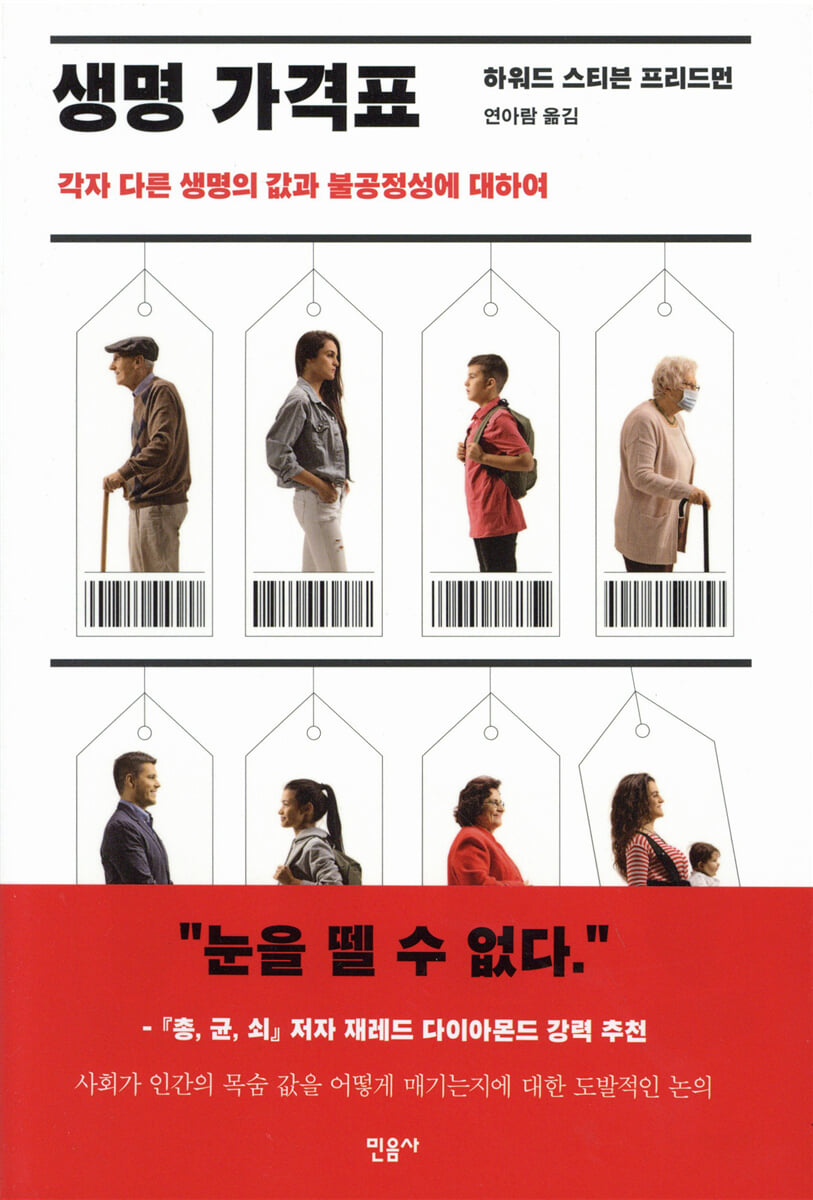
Life Price List
 |
Description
Book Introduction
"Guns, Germs, and Steel" by Jared Diamond: "A must-read." A provocative and timely discussion of how society values human life. How much is your life worth? Why were the public and media attention so disparate regarding the two college students who died around the same time (the Han River and Pyeongtaek Port incidents)? Last spring, during the peak of the COVID-19 pandemic, what age group did Italian medical professionals abandon when hospital beds were overflowing? How was Japan's decision to release radioactive contaminated water made? What is the basis for calculating our insurance premiums? Why did the compensation received by the families of 9/11 victims vary by up to 30 times? The answers to all these questions lie in the 'Price List of Life'. In a capitalist society, everything has a price. It's an inconvenient truth, so we don't say it out loud, but the same goes for human life. Howard Steven Friedman, a renowned statistician and health economist who served as chief data modeler for key UN programs at the United Nations Population Fund, delves into the uncomfortable but unavoidable core issue of modern society: “measuring the value of human life” in his book, “The Price of Life.” |
- You can preview some of the book's contents.
Preview
index
Chapter 1: Money or Life? 10
Chapter 2: The Day the Twin Towers Collapsed 18
Chapter 3: There Is No "Equality Before the Law" 54
Chapter 4: Does the Price of Life Determine Tap Water Quality? 86
Chapter 5: Do Corporations Maximize Profits at the Cost of Human Life? 118
Chapter 6: I Want to Die Like My Grandfather 152
Chapter 7: The Price of Life and Quality of Life 172
Chapter 8: Can I Have a Child? 206
Chapter 9: The Broken Calculator 234
Chapter 10: What Should We Do Now? 264
Chapter 2: The Day the Twin Towers Collapsed 18
Chapter 3: There Is No "Equality Before the Law" 54
Chapter 4: Does the Price of Life Determine Tap Water Quality? 86
Chapter 5: Do Corporations Maximize Profits at the Cost of Human Life? 118
Chapter 6: I Want to Die Like My Grandfather 152
Chapter 7: The Price of Life and Quality of Life 172
Chapter 8: Can I Have a Child? 206
Chapter 9: The Broken Calculator 234
Chapter 10: What Should We Do Now? 264
Into the book
The calculation method devised by Feinberg for the 9/11 Victim Compensation Fund was a combination of non-economic value, dependent value, and economic value.
The non-economic value was set at the same amount of $250,000 for all victims.
The dependent value was applied equally to all dependents.
For example, if the victim had a spouse, an additional $100,000 was added, and for each additional dependent, an additional $100,000 was added.
Because economic value was determined based on the victim's income, the resulting values varied widely.
This value was calculated by calculating the victim's expected lifetime income, various allowances, and other benefits, and then adjusting it to the victim's effective tax rate.
This calculation included information about the victim's age, the number of years remaining until retirement, and the expected increase in income.
The difference between the lowest and highest compensation amounts was very large.
Some victims were valued at nearly 30 times the lives of other victims.
--- p.25
Even in the criminal justice system, the law explicitly values the lives of police officers and other government officials.
Moreover, while it is explicitly stated that it does not consider the victim's gender, race, social status, or criminal record, in reality, discrimination is made based on such factors.
Although American law may state that everyone is equally protected by the law, statistics show that prosecutorial decisions regarding charges and indictments, as well as sentencing, vary depending on who the victim and the perpetrator are.
--- p.84
Problems that significantly increase the risk of accidents, injuries, and deaths are serious issues that can determine the fate of an automobile company.
So how much must the risk increase before a company takes action like a recall? If every defect and problem required a recall, no auto company could survive.
One way for companies to make informed decisions is to conduct a cost-benefit analysis to compare the net present value of at least two scenarios.
In the above case, the two scenarios are recalling the structurally defective vehicle or leaving the problem unaddressed and paying the settlement fee and fines later.
--- p.121
A look at the labor market can help us understand how money and time are exchanged in human lives.
Compensation for labor is crucial to the discussion about the price tag of life.
Because income is a key factor in determining the monetary value of a life in civil litigation, it also played a crucial role in the 9/11 Victim Compensation Fund.
--- p.137
Unlike other types of life price lists we've seen so far, fairness doesn't play a significant role in determining prices in life insurance.
There are several reasons for this.
First, the price tag of life insurance is determined by the consumer.
Second, life insurance is a competitive market.
Third, the value of life insurance is based on the risk of death.
Finally, companies that sell life insurance are not motivated by concerns about fairness and have no obligation to ensure that their products are sold fairly.
--- p.153
How should we fairly determine the order of organ transplant recipients? Are some lives more valuable than others? Should younger people receive transplants before older people? Should the expected length of healthy lifespan extended by an organ transplant influence the order of recipients or the importance of life? Should a corporate CEO receive priority over a former sports star, a school janitor, or a migrant farm worker? If a ninety-year-old Nobel Prize winner with terminal dementia and a fifteen-year-old student with developmental problems are both waiting for the same organ transplant, who should society prioritize?
--- p.203
Although few couples conduct a formal financial analysis of the costs of raising a child, those who decide to have a child consciously consider the expected costs of having and raising a child.
Viewing the decision to have children as a simple financial calculation, like the cost-benefit analysis a business performs, is not only narrow-minded but also disconnected from the realities of deciding to become a parent.
But let's take a step back from the emotional and evolutionary motivations of having children and consider the financial aspects of parenthood.
...
Studies have shown that it costs about $250,000 for a middle-class American family to raise a child until the age of 18, but the actual amount varies greatly.
This estimate does not include other expenses that may arise after your child turns 18, such as college tuition, wedding expenses, or assistance with purchasing a car or house.
For most families, having a child is a decision with a negative net present value.
--- p.208
The media attention and donations raised after the accident only poured into little Jessica, who was facing certain death, and not into the countless other children who were in similar danger but were not known to the public.
The clear fact that Jessica's life was in immediate danger was also crucial in sparking public interest, as humans tend to value certain outcomes over uncertain ones....
Conversely, little is known about the millions of children who die in accidents around the world.
The public's mixed reaction to the millions of other children who lost their lives that same year is an example of what we call "identification bias."
People are usually more concerned about risks concentrated in specific individuals than about risks that occur to many people in various places.
The non-economic value was set at the same amount of $250,000 for all victims.
The dependent value was applied equally to all dependents.
For example, if the victim had a spouse, an additional $100,000 was added, and for each additional dependent, an additional $100,000 was added.
Because economic value was determined based on the victim's income, the resulting values varied widely.
This value was calculated by calculating the victim's expected lifetime income, various allowances, and other benefits, and then adjusting it to the victim's effective tax rate.
This calculation included information about the victim's age, the number of years remaining until retirement, and the expected increase in income.
The difference between the lowest and highest compensation amounts was very large.
Some victims were valued at nearly 30 times the lives of other victims.
--- p.25
Even in the criminal justice system, the law explicitly values the lives of police officers and other government officials.
Moreover, while it is explicitly stated that it does not consider the victim's gender, race, social status, or criminal record, in reality, discrimination is made based on such factors.
Although American law may state that everyone is equally protected by the law, statistics show that prosecutorial decisions regarding charges and indictments, as well as sentencing, vary depending on who the victim and the perpetrator are.
--- p.84
Problems that significantly increase the risk of accidents, injuries, and deaths are serious issues that can determine the fate of an automobile company.
So how much must the risk increase before a company takes action like a recall? If every defect and problem required a recall, no auto company could survive.
One way for companies to make informed decisions is to conduct a cost-benefit analysis to compare the net present value of at least two scenarios.
In the above case, the two scenarios are recalling the structurally defective vehicle or leaving the problem unaddressed and paying the settlement fee and fines later.
--- p.121
A look at the labor market can help us understand how money and time are exchanged in human lives.
Compensation for labor is crucial to the discussion about the price tag of life.
Because income is a key factor in determining the monetary value of a life in civil litigation, it also played a crucial role in the 9/11 Victim Compensation Fund.
--- p.137
Unlike other types of life price lists we've seen so far, fairness doesn't play a significant role in determining prices in life insurance.
There are several reasons for this.
First, the price tag of life insurance is determined by the consumer.
Second, life insurance is a competitive market.
Third, the value of life insurance is based on the risk of death.
Finally, companies that sell life insurance are not motivated by concerns about fairness and have no obligation to ensure that their products are sold fairly.
--- p.153
How should we fairly determine the order of organ transplant recipients? Are some lives more valuable than others? Should younger people receive transplants before older people? Should the expected length of healthy lifespan extended by an organ transplant influence the order of recipients or the importance of life? Should a corporate CEO receive priority over a former sports star, a school janitor, or a migrant farm worker? If a ninety-year-old Nobel Prize winner with terminal dementia and a fifteen-year-old student with developmental problems are both waiting for the same organ transplant, who should society prioritize?
--- p.203
Although few couples conduct a formal financial analysis of the costs of raising a child, those who decide to have a child consciously consider the expected costs of having and raising a child.
Viewing the decision to have children as a simple financial calculation, like the cost-benefit analysis a business performs, is not only narrow-minded but also disconnected from the realities of deciding to become a parent.
But let's take a step back from the emotional and evolutionary motivations of having children and consider the financial aspects of parenthood.
...
Studies have shown that it costs about $250,000 for a middle-class American family to raise a child until the age of 18, but the actual amount varies greatly.
This estimate does not include other expenses that may arise after your child turns 18, such as college tuition, wedding expenses, or assistance with purchasing a car or house.
For most families, having a child is a decision with a negative net present value.
--- p.208
The media attention and donations raised after the accident only poured into little Jessica, who was facing certain death, and not into the countless other children who were in similar danger but were not known to the public.
The clear fact that Jessica's life was in immediate danger was also crucial in sparking public interest, as humans tend to value certain outcomes over uncertain ones....
Conversely, little is known about the millions of children who die in accidents around the world.
The public's mixed reaction to the millions of other children who lost their lives that same year is an example of what we call "identification bias."
People are usually more concerned about risks concentrated in specific individuals than about risks that occur to many people in various places.
--- p.237
Publisher's Review
"Guns, Germs, and Steel" by Jared Diamond: "A must-read."
A provocative and timely discussion of how society values human life.
How much is your life worth?
Why were the public and media attention so disparate regarding the two college students who died around the same time (the Han River and Pyeongtaek Port incidents)? Last spring, during the peak of the COVID-19 pandemic, what age group did Italian medical professionals abandon when hospital beds were overflowing?
How was Japan's decision to release radioactive contaminated water made? What is the basis for calculating our insurance premiums? Why did the compensation received by the families of 9/11 victims vary by up to 30 times?
The answers to all these questions lie in the 'Price List of Life'.
In a capitalist society, everything has a price.
It's an inconvenient truth, so we don't say it out loud, but the same goes for human life.
Howard Steven Friedman, a renowned statistician and health economist who served as chief data modeler for key UN programs at the United Nations Population Fund, delves into the uncomfortable but unavoidable core issue of modern society: “measuring the value of human life” in his book, “The Price of Life.”
He said, “Our lives have a price tag from the moment we are born until the moment we die.
“Given that these prices are not always fair and that there is considerable inequity in the price tag of life, we need to understand how these valuations and the value systems behind them affect our lives,” he says.
This book takes a pragmatic approach, focusing on how life is valued in the real world and the consequences and limitations of those methods.
Life is constantly being priced—in court decisions, in all medical decisions, including organ transplant priorities, in childcare costs, in corporate pollutant policies, in insurance and compensation payments—yet few understand how it's calculated or what it entails.
Although it may not be apparent on the surface, all actors in society, including individuals, families, businesses, and governments, routinely place a price on life, and this has a profound impact on all aspects of life, including the economy, policy and law, and health and safety.
That price tag on life is often unfair and heavily influenced by gender, race, ethnicity, and cultural biases, often resulting in the lives of the young being valued over the old, the rich over the poor, locals over foreigners, and family over strangers.
This is a serious problem, as those with lower prices are exposed to more risks without access to institutional protections.
This book uses examples from various fields to explain that (1) human lives are routinely priced, (2) these price tags have a profound impact on our lives, (3) these price tags are neither transparent nor fair, and (4) this injustice is a serious problem because those with low price tags are less protected by society and are exposed to greater risks than those with high price tags.
How we put a price on life reveals quite a bit about our society's perceptions of priorities and fairness.
Readers of this book will understand how our society puts a price on human life, why it's crucial to understand how it's calculated, and gain the power to challenge the system.
A provocative and timely discussion of how society values human life.
How much is your life worth?
Why were the public and media attention so disparate regarding the two college students who died around the same time (the Han River and Pyeongtaek Port incidents)? Last spring, during the peak of the COVID-19 pandemic, what age group did Italian medical professionals abandon when hospital beds were overflowing?
How was Japan's decision to release radioactive contaminated water made? What is the basis for calculating our insurance premiums? Why did the compensation received by the families of 9/11 victims vary by up to 30 times?
The answers to all these questions lie in the 'Price List of Life'.
In a capitalist society, everything has a price.
It's an inconvenient truth, so we don't say it out loud, but the same goes for human life.
Howard Steven Friedman, a renowned statistician and health economist who served as chief data modeler for key UN programs at the United Nations Population Fund, delves into the uncomfortable but unavoidable core issue of modern society: “measuring the value of human life” in his book, “The Price of Life.”
He said, “Our lives have a price tag from the moment we are born until the moment we die.
“Given that these prices are not always fair and that there is considerable inequity in the price tag of life, we need to understand how these valuations and the value systems behind them affect our lives,” he says.
This book takes a pragmatic approach, focusing on how life is valued in the real world and the consequences and limitations of those methods.
Life is constantly being priced—in court decisions, in all medical decisions, including organ transplant priorities, in childcare costs, in corporate pollutant policies, in insurance and compensation payments—yet few understand how it's calculated or what it entails.
Although it may not be apparent on the surface, all actors in society, including individuals, families, businesses, and governments, routinely place a price on life, and this has a profound impact on all aspects of life, including the economy, policy and law, and health and safety.
That price tag on life is often unfair and heavily influenced by gender, race, ethnicity, and cultural biases, often resulting in the lives of the young being valued over the old, the rich over the poor, locals over foreigners, and family over strangers.
This is a serious problem, as those with lower prices are exposed to more risks without access to institutional protections.
This book uses examples from various fields to explain that (1) human lives are routinely priced, (2) these price tags have a profound impact on our lives, (3) these price tags are neither transparent nor fair, and (4) this injustice is a serious problem because those with low price tags are less protected by society and are exposed to greater risks than those with high price tags.
How we put a price on life reveals quite a bit about our society's perceptions of priorities and fairness.
Readers of this book will understand how our society puts a price on human life, why it's crucial to understand how it's calculated, and gain the power to challenge the system.
GOODS SPECIFICS
- Date of issue: August 3, 2021
- Page count, weight, size: 328 pages | 544g | 145*215*30mm
- ISBN13: 9788937419317
- ISBN10: 8937419319
You may also like
카테고리
korean


korean

![GQ KOREA Mark (Monthly): December [2025]](http://librairie.coreenne.fr/cdn/shop/files/8ef265dbbfbf186523ed75ba7319009d.jpg?v=1765340328&width=3840)


