

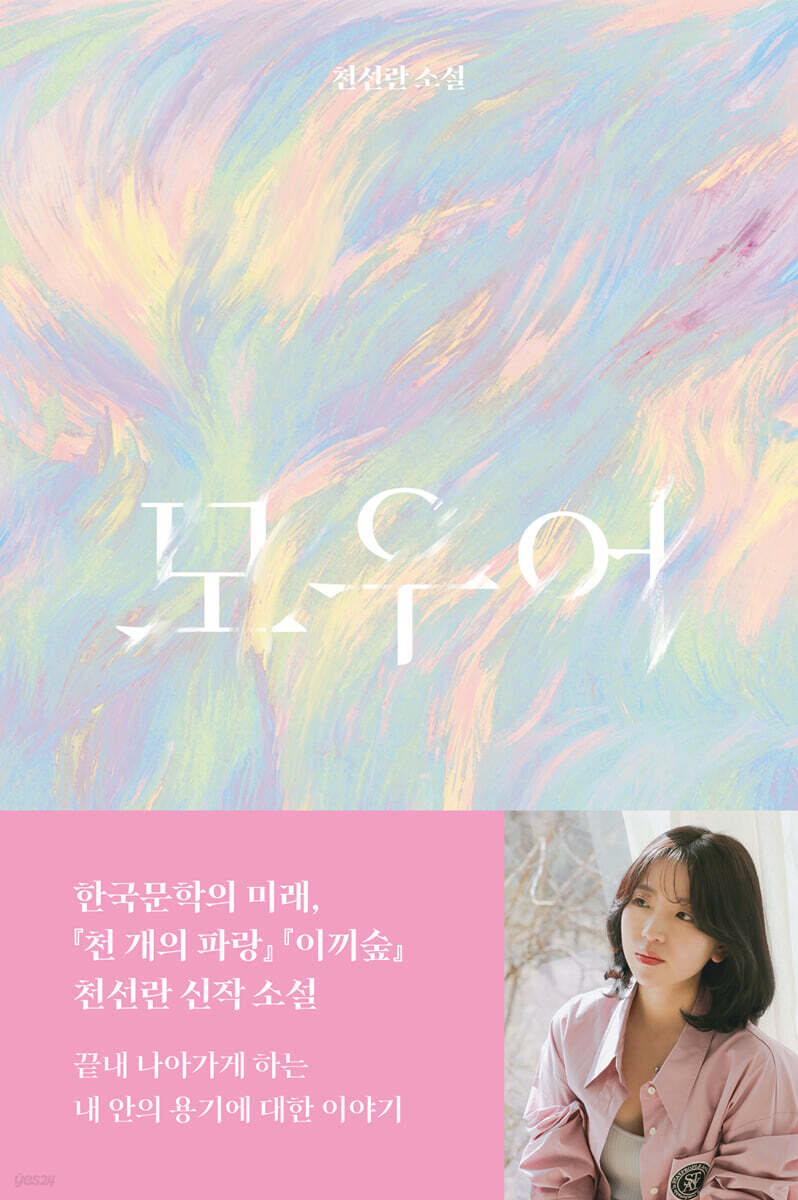
Mower
 |
Description
Book Introduction
“You create the world by constantly imagining and imagining. A perfect world where there is nothing to fear. That's how you create the universe, here. Then this place will become real.” To make it go forward A story about the courage within me The future of Korean literature, A Thousand Blues and Moss Forest, new novels by Cheon Seon-ran Writer Cheon Seon-ran, who emerged like a comet in 2019 by winning the grand prize for the Korean Science Fiction Literature Award for her novel “A Thousand Blues,” is creating a dazzling future for Korean science fiction. He publishes his third collection of novels. Cheon Seon-ran is a writer who has actively shared her thoughts on this world and era with readers through the publication of full-length novels such as “The Savior Who Comes at Night” and “Nine,” short story collections “A Certain Material’s Love” and “Noland,” the serial novel “Moss Forest,” and the short story “Rang and My Desert.” The reason he was selected as the 'Young Writer Who Will Lead the Future of Korean Literature in 2022' by readers may not be unrelated to this. He also announced the surprising and welcome news of a multi-million dollar advance contract with Penguin Random House (for "A Thousand Blues") earlier this year, and is expected to become a writer who actively responds to the ever-higher status of Korean literature and the fervent interest of international readers. "Mower" is a collection of short stories published two years after "Noland" and contains eight short stories written between 2020 and 2024, including two unpublished works. This collection of short stories illuminates a diverse range of beings, from children deployed to suppress aliens, to teenagers with extraordinary abilities, to undertaker androids, to humans and non-human animals living in a post-apocalyptic world. It captures the lonely, yet faint, yet passionate inner lives of those struggling to save lost beings. The characters of Cheon Seon-ran, faced with extreme circumstances, continue to move forward despite their sorrow and loss. I believe the earnestness contained in this collection of short stories will provide important clues to how this courage is born and displayed. |
- You can preview some of the book's contents.
Preview
index
Lake that doesn't freeze
Mower
Children of Beyond
Bone Records
Surfbeat
The apple said
The gap between lips and names
Kushruk
Author's Note
Mower
Children of Beyond
Bone Records
Surfbeat
The apple said
The gap between lips and names
Kushruk
Author's Note
Into the book
She once chewed off the earlobe of a child she loved so much that she would have given her own heart to him.
All she could chew on was an earlobe.
Because of the memories of holding hands too many times, kissing backs and shoulders countless times, and washing between toes.
The earlobe she swallowed with difficulty remained inside her for a long time, and was finally digested when she pledged to become the watchman of this place.
---From "The Lake That Never Freezes"
If I had known that affection would leave such a deep scar, I wouldn't have hugged you so carelessly.
Every place he hugged was in a state of low-temperature burns.
Flesh that has been cooked for a long time at low temperatures cannot recover or regenerate.
It is the only burn in this glacier that does not heal.
That's what it means to be touched by someone's kindness.
Living in the snowy mountains, embracing a burned body.
---From "The Lake That Never Freezes"
Humans now distinguish between childhood and adulthood by their minds, not their bodies.
As we pass through childhood and enter adulthood, the human spirit feels a sense of responsibility to protect the weak and young.
That feeling is a sign of adulthood.
---From "Mower"
Feel it.
The moment emotions become language, they become simple and flat.
Nature and we become separated, and we try to name, define, and categorize everything.
We're going to hit a wall.
If you don't tell me, I won't know.
Language is easily distorted and broken down.
---From "Mower"
- Someone said this about beauty.
Momi pointed to the butterfly shadow that Lovis had created.
- Identity, where all butterflies appear the same in shadow.
And pointed to Lovis's hand.
- But in the end, the difference is that they are not the same butterfly.
Finally, he grabbed Lovis' hand and put it down.
- And the impossibility that this butterfly could never be real.
That's beauty.
Talking about the same, different, and impossible.
---From "The Record of Bones"
Let's talk.
Should I open my mouth?
I will call you affectionately, just as you did.
Should I just say I love you right away?
But no matter how vivid it is, it is still a dream.
If it wasn't a dream, I would have told you.
The next chapter of this world, our ending, how we will meet again, the reason you don't have to cry.
---From "Children Beyond"
Memories that cannot find an exit are trapped in a maze, starving, and attack new memories that come in.
And eat or be eaten.
The eaten memories grow into parts of the body, and the memories become monsters within the maze.
It wanders through the maze, devouring both good and bad memories indiscriminately, and occasionally destroys the path. At such times, humans shudder at the memories that have been horribly transformed, and are consumed by memories whose original form is unknown.
---From "The Difference Between Lips and Names"
“I decided to meet my sister.”
"where?"
Balak asked back.
“……A place without fear.”
---From "Kushruk"
Stars that could not be seen from outside shone and the cube glowed softly.
Enlil gazed at the shapes carved into the surface.
If viewed individually, they were pictures, but it was likely that they were cuneiform letters that contained meaning.
Similar shapes were arranged in a repeated manner, with slight variations.
I saw things like fishbones with heads, constellations, signs and symbols, and things that resembled Greek.
Even if it's unfamiliar, there are rules.
Every letter must have a rule.
To find that rule, you have to imagine and imagine again.
I'm imagining my mother's feelings.
If you frown, I guess you're feeling uncomfortable somewhere.
All she could chew on was an earlobe.
Because of the memories of holding hands too many times, kissing backs and shoulders countless times, and washing between toes.
The earlobe she swallowed with difficulty remained inside her for a long time, and was finally digested when she pledged to become the watchman of this place.
---From "The Lake That Never Freezes"
If I had known that affection would leave such a deep scar, I wouldn't have hugged you so carelessly.
Every place he hugged was in a state of low-temperature burns.
Flesh that has been cooked for a long time at low temperatures cannot recover or regenerate.
It is the only burn in this glacier that does not heal.
That's what it means to be touched by someone's kindness.
Living in the snowy mountains, embracing a burned body.
---From "The Lake That Never Freezes"
Humans now distinguish between childhood and adulthood by their minds, not their bodies.
As we pass through childhood and enter adulthood, the human spirit feels a sense of responsibility to protect the weak and young.
That feeling is a sign of adulthood.
---From "Mower"
Feel it.
The moment emotions become language, they become simple and flat.
Nature and we become separated, and we try to name, define, and categorize everything.
We're going to hit a wall.
If you don't tell me, I won't know.
Language is easily distorted and broken down.
---From "Mower"
- Someone said this about beauty.
Momi pointed to the butterfly shadow that Lovis had created.
- Identity, where all butterflies appear the same in shadow.
And pointed to Lovis's hand.
- But in the end, the difference is that they are not the same butterfly.
Finally, he grabbed Lovis' hand and put it down.
- And the impossibility that this butterfly could never be real.
That's beauty.
Talking about the same, different, and impossible.
---From "The Record of Bones"
Let's talk.
Should I open my mouth?
I will call you affectionately, just as you did.
Should I just say I love you right away?
But no matter how vivid it is, it is still a dream.
If it wasn't a dream, I would have told you.
The next chapter of this world, our ending, how we will meet again, the reason you don't have to cry.
---From "Children Beyond"
Memories that cannot find an exit are trapped in a maze, starving, and attack new memories that come in.
And eat or be eaten.
The eaten memories grow into parts of the body, and the memories become monsters within the maze.
It wanders through the maze, devouring both good and bad memories indiscriminately, and occasionally destroys the path. At such times, humans shudder at the memories that have been horribly transformed, and are consumed by memories whose original form is unknown.
---From "The Difference Between Lips and Names"
“I decided to meet my sister.”
"where?"
Balak asked back.
“……A place without fear.”
---From "Kushruk"
Stars that could not be seen from outside shone and the cube glowed softly.
Enlil gazed at the shapes carved into the surface.
If viewed individually, they were pictures, but it was likely that they were cuneiform letters that contained meaning.
Similar shapes were arranged in a repeated manner, with slight variations.
I saw things like fishbones with heads, constellations, signs and symbols, and things that resembled Greek.
Even if it's unfamiliar, there are rules.
Every letter must have a rule.
To find that rule, you have to imagine and imagine again.
I'm imagining my mother's feelings.
If you frown, I guess you're feeling uncomfortable somewhere.
---From "Kushruk"
Publisher's Review
“I can’t refuse.
Because the body cannot refuse.
“If your heart tells you to do it.”
"The Unfrozen Lake," which is placed at the front of the collection, depicts the world after it has frozen solid.
Into her desolate daily life, where she had no expectations of life, appears a child named Yaja, holding the dried-up heart of her precious friend in her arms.
'Yamja' goes a long way towards the 'lake that never freezes' in order to give his friend's heart to his soul.
"Do you believe stories can change the world?" Yaza's innocent yet poignant question prompts her to unearth forgotten memories, one by one... Could there be a lake that never freezes on this frozen Earth? What might the belief in such a lake make possible?
The short story that follows, and the title piece, "Mower," depicts a world where language has disappeared.
In some distant future, humans evolved to abandon language, believing that all of humanity's greed, distrust, and hatred were due to the order/disorder created by language.
“When human language, when humans with language, began to name everything, we became forever strangers to this ecosystem.”
After that, humans began to communicate using 'phonemes', or in other words, words that came to mind, and when speaking, they only pronounce syllables without any rules.
Humans who no longer define time with language do not age. One day, 'Chou', who lived in such a world, rescued an abandoned baby and named him 'Mou'.
'Mou' reacted to 'sounds' rather than 'sounds', which would be something that does not fit in this world. Mou, who was curious about what 'language' is, a combination of 'sound' and 'meaning', is, is eventually driven to heresy.
Mom, I'm not dead, I'm just starting to flow.
Time is passing in my body.
Mom, I feel this time.
It's very thin.
More than a spider's web.
I'm going to get wrinkles.
It's a mark left by the passage of time.
(…) I heard the sound of language.
I feel the time created by language.
_From "Mower"
A new species of humankind who abandoned language and lived only with their senses, feeling all the sins of the previous human race, and 'Mou' who appeared between them.
Was language truly a tool and evil practice that led humanity to its own destruction? What was the "sound of language" that Mou had just heard?
Could it be possible that the name 'Chowu' had no meaning in the first place?
Meanwhile, in this collection of short stories, characters who have lost someone close to them stand out.
In "The Unfrozen Lake" as well as "Kushruk", which mainly deals with the mind uploading system, the narrator is Enlil, whose sister was evaporated from the neural network.
Those who willingly evaporate into a “world of their own making,” a world “without uncertainty,” make the sentence in the novel, “Just because something isn’t real doesn’t mean it’s fake,” meaningful.
After 'Enlil' imagines and imagines his sister again, he discovers the existence of 'Kushruk (box)', and the "our own rules" engraved on it allow him to meet his sister in a virtual world.
Enlil's older sister, who was an archaeologist in real life, was a person who dug into the past, a person who cared for her mother who was as dry as a relic, and a person who protected the young Enlil.
Enlil “constantly imagines and imagines” his sister, who had no choice but to live in the present, stuck in the past amidst the layers of obligations imposed on her.
For Enlil, that must have been the way he chose to love.
A “perfect world with nothing to fear” where “the hour and minute hands, which were in disarray, all move normally.”
When we finally find our sister's back there, we are convinced.
“Just because it’s not real doesn’t mean it’s fake.
“What matters is how close it is to the truth.”
The two women in "The Difference Between Lips and Names," 'Na' and 'Jumi', also lost someone close to them a long time ago.
‘I’ am living as a perpetrator of an unwanted crime, having been subjected to ‘consciousness transfer’.
When 'Na', who was lying down after being attacked by the enemy, is saved by 'Jumi', a medical student, the two have a deep influence on each other's lives.
“I keep getting lost and worrying about the possibility that the perpetrator or the victim might be my older sister.
“My choices change depending on where I place my sister,” says Jumi. How will she accept the miserable image of her sister in her memories that has followed her throughout her life?
Will I eventually undergo a consciousness transfer chip removal surgery that will erase even my last precious memory?
What memories should I keep or let go of?
Meanwhile, in "Children Beyond" and "Record of Bones," characters who were sent outside of Earth appear.
In the case of "Children Beyond," small children were needed to suppress the alien beings.
Adults believe that the children's sacrifice is inevitable and that they must win the war and create a better future, so they send the children on an alien spaceship.
Those children died in reality, but they woke up 'beyond' it, "because they passed through the gateway of death when they were children and woke up from the program.
“Because I returned to reality having been deprived of the opportunity to become an adult,” I remain a child even as time passes.
A world 'beyond' where only children live.
“If just one adult comes, we will have to worship that adult as a god.
When two adults come, we will be on guard to please them.
When three adults come, we will have to work.
“If more adults come, the misfortune will repeat itself.” _From “Children Beyond”
"Bone Records" is impressive for its special friendship between the undertaker android 'Rovis' and the hospital's janitor 'Momi'.
The imagination of an android that measures human life and death through a dead body is in line with the thoughtful beings in Cheon Seon-ran's works.
Are the things we don't want to forget, the things we loved enough to carve into our bodies, the things that remain on our bodies the longest and keep the human body bound to life?
Lovis thought as he looked at the vivid tattoos left on the old man's body.
The Lovis circuit is designed to raise such questions.
So Robis questions everything.
The end of all questions is calculation.
And that was the most basic attitude that an android practicing salt should have.
Counting the dead, counting those left behind.
_From "The Record of Bones"
When 'Momi', who was at the end of her life, dies, 'Rovis' takes charge of the funeral of 'Momi', who had no relatives.
“I say that one day we will know the universe, be free in the universe, and be able to travel the universe.
But that hasn't been achieved yet, and instead, they're trying to conquer space, and they still can't make a single proper gesture in space.
But I still believe.
Humans will one day roam the universe.
"Momi" used to say, "Like this butterfly," and "Rovis" remembers that the scars from a childhood burn have haunted him throughout his life, and decides that he cannot send "Momi" to the crematorium, so he runs out of the hospital for the first time to send her body into space.
“If Robbie had a heart, he would have called this an impulse.”
The fantastical nature of "Surf Beat" and "The Apple Said" is extraordinary.
"Surf Beat" tells the story of identity exploration and growth of teenage "Midas" who have the ability to breathe underwater, see in the dark, and pass through walls.
After losing someone precious to them as the choices they made to save each other go awry, the story unfolds captivatingly as they come to terms with and decide to use their abilities, which were used unethically by adults, on their own.
"The Apple Said" is the darkest work in this collection, in which 'I', who suffers from the trauma of being a victim of crime, and her Thai friend 'Chompu' unravel the unknowability of reality in their own language.
The strange phenomenon of the apples in the apple orchard having unique patterns and seeming to speak to the two people intertwines with the Thai words that 'Chompu' taught 'me', words meaning 'to seep in, to be sucked in, to become one', and leads to an ending where the vibrations of the earth can be felt.
May we be each other's salvation,
With this heart that will never end
May you become a watchman in a dangerous world.
The world of Cheon Seon-ran is not one where outstanding individuals undertake noble challenges against the backdrop of a vast universe.
It's more like a struggle to endure and accept a world distorted by humans, a world where violence and beauty are mixed.
Nevertheless, humans have hearts.
With a heart that cherishes each other, a heart that desperately clings to each other so as not to lose each other.
Those hearts call forth courage they never knew they had, and the modest characters of Cheon Seon-ran hold onto that courage and act as their hearts dictate.
Rather than a narrative about overcoming a bitter reality, it shows that there is one person who understands and remembers each other.
Cheon Seon-ran introduces us to characters who are willing to become watchmen in this dangerous world.
Knowing these people might make you feel a little less lonely on the edge of having to endure it alone.
“In a world where some become heroes, some hide, some protect, and some suddenly disappear, leaving behind only their names.” (From the Author’s Note)
Because the body cannot refuse.
“If your heart tells you to do it.”
"The Unfrozen Lake," which is placed at the front of the collection, depicts the world after it has frozen solid.
Into her desolate daily life, where she had no expectations of life, appears a child named Yaja, holding the dried-up heart of her precious friend in her arms.
'Yamja' goes a long way towards the 'lake that never freezes' in order to give his friend's heart to his soul.
"Do you believe stories can change the world?" Yaza's innocent yet poignant question prompts her to unearth forgotten memories, one by one... Could there be a lake that never freezes on this frozen Earth? What might the belief in such a lake make possible?
The short story that follows, and the title piece, "Mower," depicts a world where language has disappeared.
In some distant future, humans evolved to abandon language, believing that all of humanity's greed, distrust, and hatred were due to the order/disorder created by language.
“When human language, when humans with language, began to name everything, we became forever strangers to this ecosystem.”
After that, humans began to communicate using 'phonemes', or in other words, words that came to mind, and when speaking, they only pronounce syllables without any rules.
Humans who no longer define time with language do not age. One day, 'Chou', who lived in such a world, rescued an abandoned baby and named him 'Mou'.
'Mou' reacted to 'sounds' rather than 'sounds', which would be something that does not fit in this world. Mou, who was curious about what 'language' is, a combination of 'sound' and 'meaning', is, is eventually driven to heresy.
Mom, I'm not dead, I'm just starting to flow.
Time is passing in my body.
Mom, I feel this time.
It's very thin.
More than a spider's web.
I'm going to get wrinkles.
It's a mark left by the passage of time.
(…) I heard the sound of language.
I feel the time created by language.
_From "Mower"
A new species of humankind who abandoned language and lived only with their senses, feeling all the sins of the previous human race, and 'Mou' who appeared between them.
Was language truly a tool and evil practice that led humanity to its own destruction? What was the "sound of language" that Mou had just heard?
Could it be possible that the name 'Chowu' had no meaning in the first place?
Meanwhile, in this collection of short stories, characters who have lost someone close to them stand out.
In "The Unfrozen Lake" as well as "Kushruk", which mainly deals with the mind uploading system, the narrator is Enlil, whose sister was evaporated from the neural network.
Those who willingly evaporate into a “world of their own making,” a world “without uncertainty,” make the sentence in the novel, “Just because something isn’t real doesn’t mean it’s fake,” meaningful.
After 'Enlil' imagines and imagines his sister again, he discovers the existence of 'Kushruk (box)', and the "our own rules" engraved on it allow him to meet his sister in a virtual world.
Enlil's older sister, who was an archaeologist in real life, was a person who dug into the past, a person who cared for her mother who was as dry as a relic, and a person who protected the young Enlil.
Enlil “constantly imagines and imagines” his sister, who had no choice but to live in the present, stuck in the past amidst the layers of obligations imposed on her.
For Enlil, that must have been the way he chose to love.
A “perfect world with nothing to fear” where “the hour and minute hands, which were in disarray, all move normally.”
When we finally find our sister's back there, we are convinced.
“Just because it’s not real doesn’t mean it’s fake.
“What matters is how close it is to the truth.”
The two women in "The Difference Between Lips and Names," 'Na' and 'Jumi', also lost someone close to them a long time ago.
‘I’ am living as a perpetrator of an unwanted crime, having been subjected to ‘consciousness transfer’.
When 'Na', who was lying down after being attacked by the enemy, is saved by 'Jumi', a medical student, the two have a deep influence on each other's lives.
“I keep getting lost and worrying about the possibility that the perpetrator or the victim might be my older sister.
“My choices change depending on where I place my sister,” says Jumi. How will she accept the miserable image of her sister in her memories that has followed her throughout her life?
Will I eventually undergo a consciousness transfer chip removal surgery that will erase even my last precious memory?
What memories should I keep or let go of?
Meanwhile, in "Children Beyond" and "Record of Bones," characters who were sent outside of Earth appear.
In the case of "Children Beyond," small children were needed to suppress the alien beings.
Adults believe that the children's sacrifice is inevitable and that they must win the war and create a better future, so they send the children on an alien spaceship.
Those children died in reality, but they woke up 'beyond' it, "because they passed through the gateway of death when they were children and woke up from the program.
“Because I returned to reality having been deprived of the opportunity to become an adult,” I remain a child even as time passes.
A world 'beyond' where only children live.
“If just one adult comes, we will have to worship that adult as a god.
When two adults come, we will be on guard to please them.
When three adults come, we will have to work.
“If more adults come, the misfortune will repeat itself.” _From “Children Beyond”
"Bone Records" is impressive for its special friendship between the undertaker android 'Rovis' and the hospital's janitor 'Momi'.
The imagination of an android that measures human life and death through a dead body is in line with the thoughtful beings in Cheon Seon-ran's works.
Are the things we don't want to forget, the things we loved enough to carve into our bodies, the things that remain on our bodies the longest and keep the human body bound to life?
Lovis thought as he looked at the vivid tattoos left on the old man's body.
The Lovis circuit is designed to raise such questions.
So Robis questions everything.
The end of all questions is calculation.
And that was the most basic attitude that an android practicing salt should have.
Counting the dead, counting those left behind.
_From "The Record of Bones"
When 'Momi', who was at the end of her life, dies, 'Rovis' takes charge of the funeral of 'Momi', who had no relatives.
“I say that one day we will know the universe, be free in the universe, and be able to travel the universe.
But that hasn't been achieved yet, and instead, they're trying to conquer space, and they still can't make a single proper gesture in space.
But I still believe.
Humans will one day roam the universe.
"Momi" used to say, "Like this butterfly," and "Rovis" remembers that the scars from a childhood burn have haunted him throughout his life, and decides that he cannot send "Momi" to the crematorium, so he runs out of the hospital for the first time to send her body into space.
“If Robbie had a heart, he would have called this an impulse.”
The fantastical nature of "Surf Beat" and "The Apple Said" is extraordinary.
"Surf Beat" tells the story of identity exploration and growth of teenage "Midas" who have the ability to breathe underwater, see in the dark, and pass through walls.
After losing someone precious to them as the choices they made to save each other go awry, the story unfolds captivatingly as they come to terms with and decide to use their abilities, which were used unethically by adults, on their own.
"The Apple Said" is the darkest work in this collection, in which 'I', who suffers from the trauma of being a victim of crime, and her Thai friend 'Chompu' unravel the unknowability of reality in their own language.
The strange phenomenon of the apples in the apple orchard having unique patterns and seeming to speak to the two people intertwines with the Thai words that 'Chompu' taught 'me', words meaning 'to seep in, to be sucked in, to become one', and leads to an ending where the vibrations of the earth can be felt.
May we be each other's salvation,
With this heart that will never end
May you become a watchman in a dangerous world.
The world of Cheon Seon-ran is not one where outstanding individuals undertake noble challenges against the backdrop of a vast universe.
It's more like a struggle to endure and accept a world distorted by humans, a world where violence and beauty are mixed.
Nevertheless, humans have hearts.
With a heart that cherishes each other, a heart that desperately clings to each other so as not to lose each other.
Those hearts call forth courage they never knew they had, and the modest characters of Cheon Seon-ran hold onto that courage and act as their hearts dictate.
Rather than a narrative about overcoming a bitter reality, it shows that there is one person who understands and remembers each other.
Cheon Seon-ran introduces us to characters who are willing to become watchmen in this dangerous world.
Knowing these people might make you feel a little less lonely on the edge of having to endure it alone.
“In a world where some become heroes, some hide, some protect, and some suddenly disappear, leaving behind only their names.” (From the Author’s Note)
GOODS SPECIFICS
- Date of issue: November 15, 2024
- Page count, weight, size: 324 pages | 133*200*30mm
- ISBN13: 9791141601447
- ISBN10: 1141601443
You may also like
카테고리
korean


korean

![GQ KOREA Mark (Monthly): December [2025]](http://librairie.coreenne.fr/cdn/shop/files/8ef265dbbfbf186523ed75ba7319009d.jpg?v=1765340328&width=3840)


