

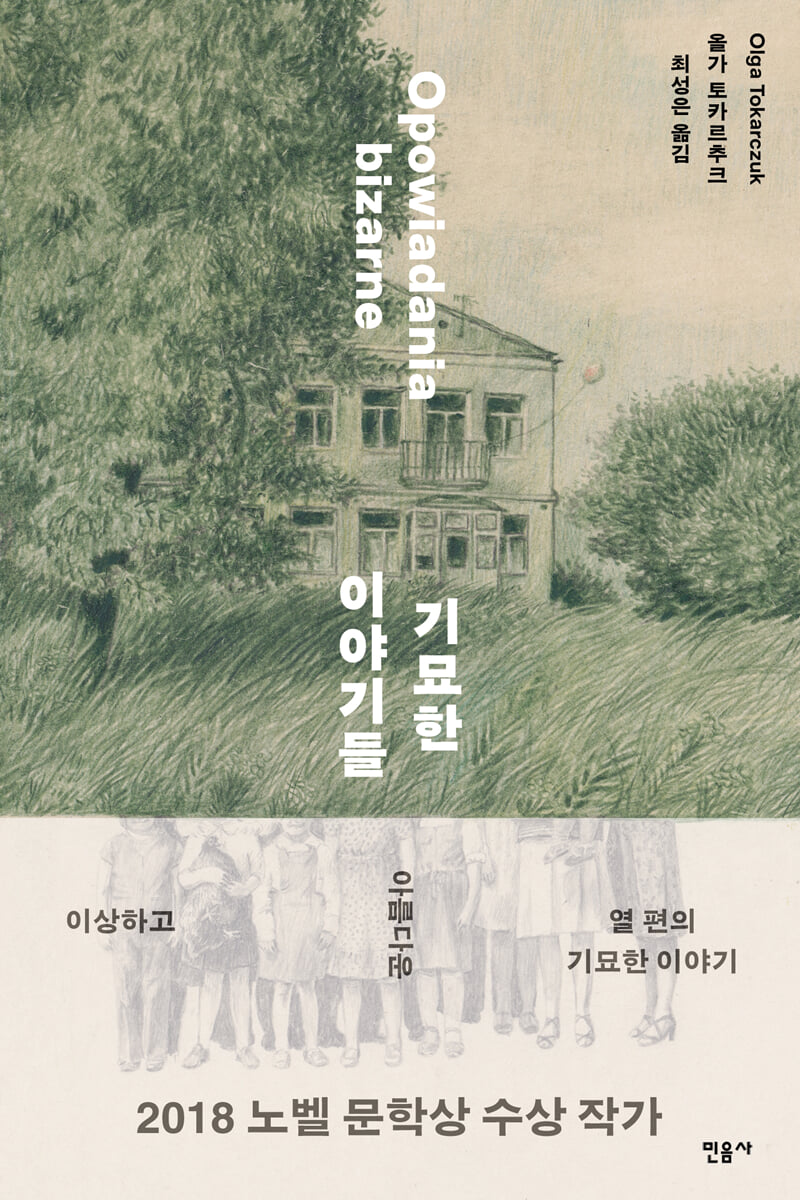
Strange Stories
 |
Description
Book Introduction
The first Korean short story collection by 2018 Nobel Prize in Literature winner Olga Tokarczuk Ten Strange, Beautiful, and Terrifying Stories An invitation from the bizarre and unique world of Tokarczuk! “We are still chimpanzees, hedgehogs, and larches. (……) What separates us from one another is only a small chasm, a tiny crack in our existence. Unus mundus. “Because the world is one.” ― Olga Tokarczuk Nobel Prize-winning author Olga Tokarczuk's first short story collection in Korea The world is getting stranger and stranger! The first Korean short story collection, 『Strange Stories』(2018), by Olga Tokarczuk, the 2018 Nobel Prize in Literature winner and one of the most ingenious and extraordinary storytellers of our time, has been published by Minumsa. This is Olga Tokarczuk's first collection of short stories in fourteen years since The Last Stories (2004), and contains a total of ten short stories. Tokarczuk, who has repeatedly attempted new things by introducing the micro-narrative technique of listing short stories in long novels such as 『The Wanderers』, 『Old Times』, and 『House of Day, House of Night』, fully demonstrates his side as a ‘short story master’ in this collection of short stories. Set in Volhynia during the Swedish invasion, modern-day Poland and the Netherlands, Switzerland, China, and a futuristic virtual space, the author blurs the lines between reality and fantasy, the familiar and the strange, pulling us out of our comfort zones and into a world of strangeness and originality. As literary critic Camille Boigny has noted, Strange Tales is a more interesting book when read with the multidimensional relationships in mind, expanding the concept as a single book rather than savoring each story separately. As Tokarczuk has often emphasized, “our stories can call upon one another in an infinite number of ways, and the protagonists within them can also relate to one another in any number of ways” (The Affectionate Narrator, pp. 361-362). Finding the connections between how each episode is subtly related with the common denominator of 'strangeness' will be another pleasure to gain from reading this book. As the title clearly suggests, the central theme of this book is ‘strangeness.’ Tokarczuk has consistently emphasized that the new calling of literature is to break away from the mainstream and consciously explore perspectives that have not been universally accepted, and to display "eccentricity" armed with original and eccentric ideas. By experimenting with new forms and literary experiments with each new work, Tokarczuk is often called a genre in his own right. This is why he is often called 'the most original and extraordinary storyteller of our time.' The author's literary perspective, which values eccentricity and strives for decentralization, is the foundation of his ability to constantly experiment with new genres and take on challenges rather than borrowing familiar formats. In this collection of novels, the uncanny serves as a tool to deconstruct the reality we have taken for granted and reveal the irrational and surreal elements embedded within it. At first glance, it may seem far removed from reality, but at some point, it approaches us as a plausible story, providing an opportunity to reflect on all the contradictions we face in reality. The moment you step into a strange and mysterious world led by Tokarczuk, you realize how vast the unknown is beyond our perception, and how insignificant human understanding is in comparison. Furthermore, you come to accept the absurdity of life and expand your horizons to a world beyond logic and reason. |
- You can preview some of the book's contents.
Preview
index
Passenger 7
Green Kids 12
Canned food 48
Seam 59
Visit 74
True Story 96
Heart 116
Transphugium 137
All Adults' Mountain 168
Human Feast Day Calendar 220
Translator's Note 274
Green Kids 12
Canned food 48
Seam 59
Visit 74
True Story 96
Heart 116
Transphugium 137
All Adults' Mountain 168
Human Feast Day Calendar 220
Translator's Note 274
Detailed image

Into the book
“The person you see now does not exist because you are looking at him, but because he is looking at you.”
--- p.11
“Their dreams had a shared quality, in that when one person dreamed something, the other person ‘sees’ it in their head.
Thanks to this, they never have a moment to be bored.
They lose a lot of weight in winter, so when warm spring days come, they all climb to the treetops and expose their pale bodies to the moonlight all day long until their skin turns a healthy green.
They also have their own way of communicating with animals, as they do not eat meat or hunt, so animals become their friends and help them.
“Even animals tell their own stories, so they must be wise people who know nature well.”
--- p.43
"Where shall I go? Where shall I go? Into the infinite circle at the end of the world, beyond the shadows of leaves, beyond the slivers of light, into the eternal shadows."
--- p.46
“Create! And live! This is the key combination.
“I don’t need any other propositions.”
--- p.83
“Wild world.
A place without humans.
We cannot see it because we are human.
We have voluntarily separated ourselves from it, and now we must change ourselves to return to it.
I can't see what I'm not included in.
We are trapped in our own prison.
It's a paradox.
Humans always look only at themselves.
This is an interesting cognitive perspective, but it is also a fatal error in evolution.”
--- p.144
“Western people are convinced that they are dramatically and significantly different from other people and other beings.
They think they are special and tragic.
They speak of despair and loneliness, of being 'thrown into existence,' and of reacting hysterically to everything.
He also enjoys causing himself pain.
It's a dramatic exaggeration of simple differences.
Why do we so easily assume that the gap between us and the world is more significant and meaningful than the gap between other beings? Do you feel it? Why is the gap between you and that larch more profound and philosophical than the gap between that larch and that woodpecker over there?
“Because I am human.”
The woman answered without hesitation.
--- p.146-147
“Transformation never comes from mechanical differences.
The same goes for Transphugium.
It emphasizes the similarity.
From an evolutionary perspective, we are still chimpanzees, hedgehogs, and larches.
We have all this within us, and we can bring it out at any time.
The gap that separates us from them is not insurmountable.
What separates us from one another is only a small chasm, a tiny crack in our existence.
Unus mundus.
“Because the world is one.”
--- pp.147-148
“This is what the woman saw.
A raft floated down the lake from the Transphugium building.
In fact, it was closer to a pedestal.
The remotely controlled raft drifted steadily toward the inaccessible side of the lake, a place called the "heart."
At first they could only see the movement of the raft and the swaying of the water, but as the sky grew brighter and its reflection on the water surface, they could see her clearly.
A beast standing still like a statue with its head bowed.
It was a wolf.
The beast looked at them for a moment, then disappeared into the darkness.”
--- p.167
“Someday, soon, I too will be dismantled by some hand into every element of my body, and everything that made me will return to its place.
“This is the ultimate recycling.”
--- p.203
“Older women have a remarkable ability to cover the world with stories, as if they were a giant fabric.
“The presence of the other nuns, silently absorbed in trivial matters, made them feel like guarantors of truth, accountants of time.”
--- p.204
“I asked him to stop for a moment, then approached the tomb in astonishment.
I expected it to be a pile of sun-dried remains, skin, and bones, but a closer look revealed a completely different sight.
There were twisted, half-digested-looking plastic bags, shopping bags with the bold logos of famous brands, strings and rubber bands, lids, and small disposable cups.
No organic digestive fluid could withstand the highly sophisticated chemicals created by humans.
The cows that swallowed the garbage were unable to digest it and kept it in their stomachs.
That's all that's left of the cows.
The cow's body is quickly eaten by insects and predators.
Only the eternal remains.
“It’s just trash.”
--- p.214
“Clara?”
Finally, I whispered so quietly that I could barely hear.
I hesitated for a moment, then took the child's hand and placed it on my forehead.
But the girl wasn't surprised at all.
After a few seconds, she understood what I was saying and caressed my eyes and ears.
Then he placed both hands over my heart.
Right there, where I needed her touch most.
--- p.219
“He came into the world at the moment when everyone needed him most.
It was when the plastic disaster destroyed not only homes, factories, hospitals, but even some concepts.
It was war that completed the stage of destruction.
When the satellites fell, they looked like shells or knives aimed at Earth.
People could not come up with words, and since they had no words, they could not use them, and so they could not describe the parts of the world that were fading into nothingness.
There was no way to explain it, so I didn't think about it, and because I didn't think about it, I forgot about it.
It was a simple way to train oneself in non-existence, in non-existence.
--- pp.232-233
If the world was made for humans, why do we feel overwhelmed by it? Why do natural things feel fearful or shameful? How can we know what is right and what is wrong? Where does our inherently harsh judgment come from? Why is the world so full of want? Why is there always a shortage of food, money, and happiness? Why do cruel acts occur? There's absolutely no rational reason for them.
Why can we see ourselves as strangers? Are the eyes that see and the eyes that are seen the same? Who are we, and where do we come from? Who is Monodikos? Is Monodikos a good being? If so, why is he so weak, allowing everything to happen to him? Has the world we live in been saved?
--- p.234-235
“The whole world is built on this order.
The order that he is immortal and that his death is never final.
It just happens for no reason.
If there were no Monodicos, chaos would rule the world.
It happened once before, and no one wants that time to come back.
“To live a peaceful life, you have to sacrifice something.”
--- p.11
“Their dreams had a shared quality, in that when one person dreamed something, the other person ‘sees’ it in their head.
Thanks to this, they never have a moment to be bored.
They lose a lot of weight in winter, so when warm spring days come, they all climb to the treetops and expose their pale bodies to the moonlight all day long until their skin turns a healthy green.
They also have their own way of communicating with animals, as they do not eat meat or hunt, so animals become their friends and help them.
“Even animals tell their own stories, so they must be wise people who know nature well.”
--- p.43
"Where shall I go? Where shall I go? Into the infinite circle at the end of the world, beyond the shadows of leaves, beyond the slivers of light, into the eternal shadows."
--- p.46
“Create! And live! This is the key combination.
“I don’t need any other propositions.”
--- p.83
“Wild world.
A place without humans.
We cannot see it because we are human.
We have voluntarily separated ourselves from it, and now we must change ourselves to return to it.
I can't see what I'm not included in.
We are trapped in our own prison.
It's a paradox.
Humans always look only at themselves.
This is an interesting cognitive perspective, but it is also a fatal error in evolution.”
--- p.144
“Western people are convinced that they are dramatically and significantly different from other people and other beings.
They think they are special and tragic.
They speak of despair and loneliness, of being 'thrown into existence,' and of reacting hysterically to everything.
He also enjoys causing himself pain.
It's a dramatic exaggeration of simple differences.
Why do we so easily assume that the gap between us and the world is more significant and meaningful than the gap between other beings? Do you feel it? Why is the gap between you and that larch more profound and philosophical than the gap between that larch and that woodpecker over there?
“Because I am human.”
The woman answered without hesitation.
--- p.146-147
“Transformation never comes from mechanical differences.
The same goes for Transphugium.
It emphasizes the similarity.
From an evolutionary perspective, we are still chimpanzees, hedgehogs, and larches.
We have all this within us, and we can bring it out at any time.
The gap that separates us from them is not insurmountable.
What separates us from one another is only a small chasm, a tiny crack in our existence.
Unus mundus.
“Because the world is one.”
--- pp.147-148
“This is what the woman saw.
A raft floated down the lake from the Transphugium building.
In fact, it was closer to a pedestal.
The remotely controlled raft drifted steadily toward the inaccessible side of the lake, a place called the "heart."
At first they could only see the movement of the raft and the swaying of the water, but as the sky grew brighter and its reflection on the water surface, they could see her clearly.
A beast standing still like a statue with its head bowed.
It was a wolf.
The beast looked at them for a moment, then disappeared into the darkness.”
--- p.167
“Someday, soon, I too will be dismantled by some hand into every element of my body, and everything that made me will return to its place.
“This is the ultimate recycling.”
--- p.203
“Older women have a remarkable ability to cover the world with stories, as if they were a giant fabric.
“The presence of the other nuns, silently absorbed in trivial matters, made them feel like guarantors of truth, accountants of time.”
--- p.204
“I asked him to stop for a moment, then approached the tomb in astonishment.
I expected it to be a pile of sun-dried remains, skin, and bones, but a closer look revealed a completely different sight.
There were twisted, half-digested-looking plastic bags, shopping bags with the bold logos of famous brands, strings and rubber bands, lids, and small disposable cups.
No organic digestive fluid could withstand the highly sophisticated chemicals created by humans.
The cows that swallowed the garbage were unable to digest it and kept it in their stomachs.
That's all that's left of the cows.
The cow's body is quickly eaten by insects and predators.
Only the eternal remains.
“It’s just trash.”
--- p.214
“Clara?”
Finally, I whispered so quietly that I could barely hear.
I hesitated for a moment, then took the child's hand and placed it on my forehead.
But the girl wasn't surprised at all.
After a few seconds, she understood what I was saying and caressed my eyes and ears.
Then he placed both hands over my heart.
Right there, where I needed her touch most.
--- p.219
“He came into the world at the moment when everyone needed him most.
It was when the plastic disaster destroyed not only homes, factories, hospitals, but even some concepts.
It was war that completed the stage of destruction.
When the satellites fell, they looked like shells or knives aimed at Earth.
People could not come up with words, and since they had no words, they could not use them, and so they could not describe the parts of the world that were fading into nothingness.
There was no way to explain it, so I didn't think about it, and because I didn't think about it, I forgot about it.
It was a simple way to train oneself in non-existence, in non-existence.
--- pp.232-233
If the world was made for humans, why do we feel overwhelmed by it? Why do natural things feel fearful or shameful? How can we know what is right and what is wrong? Where does our inherently harsh judgment come from? Why is the world so full of want? Why is there always a shortage of food, money, and happiness? Why do cruel acts occur? There's absolutely no rational reason for them.
Why can we see ourselves as strangers? Are the eyes that see and the eyes that are seen the same? Who are we, and where do we come from? Who is Monodikos? Is Monodikos a good being? If so, why is he so weak, allowing everything to happen to him? Has the world we live in been saved?
--- p.234-235
“The whole world is built on this order.
The order that he is immortal and that his death is never final.
It just happens for no reason.
If there were no Monodicos, chaos would rule the world.
It happened once before, and no one wants that time to come back.
“To live a peaceful life, you have to sacrifice something.”
--- p.265
Publisher's Review
Nobel Prize-winning author Olga Tokarczuk's first short story collection in Korea
The world is getting stranger and stranger!
The first Korean short story collection, 『Strange Stories』(2018), by Olga Tokarczuk, the 2018 Nobel Prize in Literature winner and one of the most ingenious and extraordinary storytellers of our time, has been published by Minumsa.
This is Olga Tokarczuk's first collection of short stories in fourteen years since The Last Stories (2004), and contains a total of ten short stories.
Tokarczuk, who has repeatedly attempted new things by introducing the micro-narrative technique of listing short stories in long novels such as 『The Wanderers』, 『Old Times』, and 『House of Day, House of Night』, fully demonstrates his side as a ‘short story master’ in this collection of short stories.
Set in Volhynia during the Swedish invasion, modern-day Poland and the Netherlands, Switzerland, China, and a futuristic virtual space, the author blurs the lines between reality and fantasy, the familiar and the strange, pulling us out of our comfort zones and into a world of strangeness and originality.
As literary critic Camille Boigny has noted, Strange Tales is a more interesting book when read with the multidimensional relationships in mind, expanding the concept as a single book rather than savoring each story separately.
As Tokarczuk has often emphasized, “our stories can call upon one another in an infinite number of ways, and the protagonists within them can also relate to one another in any number of ways” (The Affectionate Narrator, pp. 361-362).
Finding the connections between how each episode is subtly related with the common denominator of 'strangeness' will be another pleasure to gain from reading this book.
As the title clearly suggests, the central theme of this book is ‘strangeness.’
Tokarczuk has consistently emphasized that the new calling of literature is to break away from the mainstream and consciously explore perspectives that have not been universally accepted, and to display "eccentricity" armed with original and eccentric ideas.
By experimenting with new forms and literary experiments with each new work, Tokarczuk is often called a genre in his own right.
This is why he is often called 'the most original and extraordinary storyteller of our time.'
The author's literary perspective, which values eccentricity and strives for decentralization, is the foundation of his ability to constantly experiment with new genres and take on challenges rather than borrowing familiar formats.
In this collection of novels, the uncanny serves as a tool to deconstruct the reality we have taken for granted and reveal the irrational and surreal elements embedded within it.
At first glance, it may seem far removed from reality, but at some point, it approaches us as a plausible story, providing an opportunity to reflect on all the contradictions we face in reality.
The moment you step into a strange and mysterious world led by Tokarczuk, you realize how vast the unknown is beyond our perception, and how insignificant human understanding is in comparison.
Furthermore, you come to accept the absurdity of life and expand your horizons to a world beyond logic and reason.
The allure of the strange, where reality and fantasy meet.
Tokarczuk's strangeness is not a device for creating an alternate reality.
Surreal elements are simply introduced to interpret the everyday world we live in.
That is why, in Tokarczuk's world, the realistic and the unreal, the real and the fake, the normal and the abnormal coexist naturally.
“Literature creates a space between what has happened and what could happen.
But today, as we live in an age of ‘post-truth,’ it seems that people are gradually losing this ambiguous space that literature has created.
“To cross the line between reality and unreality is the essence of literature.” - Olga Tokarczuk
In Strange Stories, Tokarczuk's world is situated on the border where strange, unfamiliar, and unstable elements collide with reality.
The narrative of each story begins in an ordinary, everyday space, but gradually leads the reader into an unrealistic and fantastical realm.
The spatial setting of "The Passenger," which decorates the prologue of the book, is an airplane seat, but while conversing with the passenger next to me in this place cut off from the outside world, 'I' am sucked into his anxious and fearful memories.
And before our eyes, an unfamiliar world unfolds where reality and unreality intersect.
In this way, everyday, intimate conversations, travel, work, visits, and other extremely ordinary events gradually create a dreamlike atmosphere and transform into multi-layered, incomprehensible, and sometimes terrifying situations.
This transition is made in such a subtle way that the moment the reader becomes aware of it, a special tension is created.
Because when the superficial curtain that surrounds our daily lives is removed, it brings the stark realization that the comfortable reality can turn into an unfamiliar and unpredictable state at any time.
A representative example is the "True Story" about a professor who lost his passport while traveling abroad to attend an academic conference, but was instead treated as a criminal when trying to help others, and was driven into an extreme situation. It vividly shows the tragedy that occurs when the world goes beyond our expectations and control.
Compassion for humans and nature, others, and constant questions about humanity
In this book, Tokarczuk repeatedly addresses the theme of personal and social alienation.
Most of the characters are isolated, either voluntarily or involuntarily, and the bizarre events they encounter also metaphorically represent psychological obsession and disconnection from society.
This sense of alienation is closely linked to the disconnection, anxiety, and fear that the world is experiencing today.
In his keynote speech commemorating his acceptance of the Nobel Prize in Literature, Tokarczuk emphasized “a tenderness that expresses a deep emotional concern for other beings, for their fragility and unique characteristics, and for their fragile nature in relation to suffering and the passage of time” (The Tender Narrator, p. 364).
The author's works have always given voice to those who are marginalized and outside the center or mainstream, and "Strange Stories" also urges a deep interest in beings different from ourselves.
In that sense, the strange and fantastic elements that appear in the ten stories are not only part of the genre style, but also a functional tool that evokes deep compassion and empathy for the marginalized and marginalized who wander on the periphery.
Tokarczuk, who has been pursuing an ecotopia where all living things have equal rights within the boundaries of nature and a society where humans and animals, humans and nature, coexist in harmony, seriously explores the relationship between humans and nature, especially the impact humans have on nature, in "Strange Stories."
"Transphugium" reflects on the position of humans in the ecosystem through the image of humans longing to transform into other beings, and induces awareness of the way humans have dominated nature and lived thus far.
“From an evolutionary perspective, we are still chimpanzees, hedgehogs, and larches,” Tokarczuk argues.
All these natures are inherent in us, and we can bring them out at any time (Transphugium, p. 147).
It can be read as a call to boldly cast aside the artificial standards of human-centeredness and embrace the unique nature and way of existence of each life form as it is.
In an interview, Tokarczuk expressed his special affection for this work, which attempts to unite humans and nature, and confessed that he poured his heart and soul into completing it through numerous revisions.
Invitation to Tokarczuk World
Tokarczuk continues to ask us similar questions.
What kind of beings are humans? Where are they headed? Why do humans sometimes find it difficult to understand other humans? Why do humans rely on religion? Can the advancement of science and technology change the finite lives of humans?
Instead of offering clear answers, the author constantly poses questions, confusing the reader and leading them to ponder and engage in existential thought naturally.
The characters in this book are eccentric and strange, and from a normal perspective, it is difficult to sympathize with their actions.
But as I read the book, I find myself becoming emotionally close to them and discovering similarities between them and me.
Most of the characters are helpless and weak.
Also, they need each other even though they hurt each other.
In that sense, perhaps the most terrifying and fearful subject in 『Stranger Things』 is human beings, and the most strange and mysterious subject is also human beings.
In each episode, Tokarczuk portrays the unique and quirky stories of the main characters, meticulously examining their inner selves and their innermost thoughts with a loving gaze and his own unique sense of empathy.
Tokarczuk plunges us into a world of unexpected questions, sometimes surprising, sometimes frightening.
As we experience these unfamiliar, uncomfortable, and subtle emotions that we have never experienced before, we finally reach a state of wonder.
“I am happy to be able to deliver Tokarczuk’s invitation from the fringes of the real world, a strange and unique world, to Korean readers.
It's already the fifth time.
This invitation contains a message to live with the strange and mysterious things that lurk throughout the world, beyond the standards of logic and common sense.
It also feels like an invitation to face and accept our lives, which are full of contradictions and absurdities.
Yes, that's right.
“If you just look away from the safe and familiar world, the strangeness of everyday life is much closer than you think.” - Choi Seong-eun (translator)
The world is getting stranger and stranger!
The first Korean short story collection, 『Strange Stories』(2018), by Olga Tokarczuk, the 2018 Nobel Prize in Literature winner and one of the most ingenious and extraordinary storytellers of our time, has been published by Minumsa.
This is Olga Tokarczuk's first collection of short stories in fourteen years since The Last Stories (2004), and contains a total of ten short stories.
Tokarczuk, who has repeatedly attempted new things by introducing the micro-narrative technique of listing short stories in long novels such as 『The Wanderers』, 『Old Times』, and 『House of Day, House of Night』, fully demonstrates his side as a ‘short story master’ in this collection of short stories.
Set in Volhynia during the Swedish invasion, modern-day Poland and the Netherlands, Switzerland, China, and a futuristic virtual space, the author blurs the lines between reality and fantasy, the familiar and the strange, pulling us out of our comfort zones and into a world of strangeness and originality.
As literary critic Camille Boigny has noted, Strange Tales is a more interesting book when read with the multidimensional relationships in mind, expanding the concept as a single book rather than savoring each story separately.
As Tokarczuk has often emphasized, “our stories can call upon one another in an infinite number of ways, and the protagonists within them can also relate to one another in any number of ways” (The Affectionate Narrator, pp. 361-362).
Finding the connections between how each episode is subtly related with the common denominator of 'strangeness' will be another pleasure to gain from reading this book.
As the title clearly suggests, the central theme of this book is ‘strangeness.’
Tokarczuk has consistently emphasized that the new calling of literature is to break away from the mainstream and consciously explore perspectives that have not been universally accepted, and to display "eccentricity" armed with original and eccentric ideas.
By experimenting with new forms and literary experiments with each new work, Tokarczuk is often called a genre in his own right.
This is why he is often called 'the most original and extraordinary storyteller of our time.'
The author's literary perspective, which values eccentricity and strives for decentralization, is the foundation of his ability to constantly experiment with new genres and take on challenges rather than borrowing familiar formats.
In this collection of novels, the uncanny serves as a tool to deconstruct the reality we have taken for granted and reveal the irrational and surreal elements embedded within it.
At first glance, it may seem far removed from reality, but at some point, it approaches us as a plausible story, providing an opportunity to reflect on all the contradictions we face in reality.
The moment you step into a strange and mysterious world led by Tokarczuk, you realize how vast the unknown is beyond our perception, and how insignificant human understanding is in comparison.
Furthermore, you come to accept the absurdity of life and expand your horizons to a world beyond logic and reason.
The allure of the strange, where reality and fantasy meet.
Tokarczuk's strangeness is not a device for creating an alternate reality.
Surreal elements are simply introduced to interpret the everyday world we live in.
That is why, in Tokarczuk's world, the realistic and the unreal, the real and the fake, the normal and the abnormal coexist naturally.
“Literature creates a space between what has happened and what could happen.
But today, as we live in an age of ‘post-truth,’ it seems that people are gradually losing this ambiguous space that literature has created.
“To cross the line between reality and unreality is the essence of literature.” - Olga Tokarczuk
In Strange Stories, Tokarczuk's world is situated on the border where strange, unfamiliar, and unstable elements collide with reality.
The narrative of each story begins in an ordinary, everyday space, but gradually leads the reader into an unrealistic and fantastical realm.
The spatial setting of "The Passenger," which decorates the prologue of the book, is an airplane seat, but while conversing with the passenger next to me in this place cut off from the outside world, 'I' am sucked into his anxious and fearful memories.
And before our eyes, an unfamiliar world unfolds where reality and unreality intersect.
In this way, everyday, intimate conversations, travel, work, visits, and other extremely ordinary events gradually create a dreamlike atmosphere and transform into multi-layered, incomprehensible, and sometimes terrifying situations.
This transition is made in such a subtle way that the moment the reader becomes aware of it, a special tension is created.
Because when the superficial curtain that surrounds our daily lives is removed, it brings the stark realization that the comfortable reality can turn into an unfamiliar and unpredictable state at any time.
A representative example is the "True Story" about a professor who lost his passport while traveling abroad to attend an academic conference, but was instead treated as a criminal when trying to help others, and was driven into an extreme situation. It vividly shows the tragedy that occurs when the world goes beyond our expectations and control.
Compassion for humans and nature, others, and constant questions about humanity
In this book, Tokarczuk repeatedly addresses the theme of personal and social alienation.
Most of the characters are isolated, either voluntarily or involuntarily, and the bizarre events they encounter also metaphorically represent psychological obsession and disconnection from society.
This sense of alienation is closely linked to the disconnection, anxiety, and fear that the world is experiencing today.
In his keynote speech commemorating his acceptance of the Nobel Prize in Literature, Tokarczuk emphasized “a tenderness that expresses a deep emotional concern for other beings, for their fragility and unique characteristics, and for their fragile nature in relation to suffering and the passage of time” (The Tender Narrator, p. 364).
The author's works have always given voice to those who are marginalized and outside the center or mainstream, and "Strange Stories" also urges a deep interest in beings different from ourselves.
In that sense, the strange and fantastic elements that appear in the ten stories are not only part of the genre style, but also a functional tool that evokes deep compassion and empathy for the marginalized and marginalized who wander on the periphery.
Tokarczuk, who has been pursuing an ecotopia where all living things have equal rights within the boundaries of nature and a society where humans and animals, humans and nature, coexist in harmony, seriously explores the relationship between humans and nature, especially the impact humans have on nature, in "Strange Stories."
"Transphugium" reflects on the position of humans in the ecosystem through the image of humans longing to transform into other beings, and induces awareness of the way humans have dominated nature and lived thus far.
“From an evolutionary perspective, we are still chimpanzees, hedgehogs, and larches,” Tokarczuk argues.
All these natures are inherent in us, and we can bring them out at any time (Transphugium, p. 147).
It can be read as a call to boldly cast aside the artificial standards of human-centeredness and embrace the unique nature and way of existence of each life form as it is.
In an interview, Tokarczuk expressed his special affection for this work, which attempts to unite humans and nature, and confessed that he poured his heart and soul into completing it through numerous revisions.
Invitation to Tokarczuk World
Tokarczuk continues to ask us similar questions.
What kind of beings are humans? Where are they headed? Why do humans sometimes find it difficult to understand other humans? Why do humans rely on religion? Can the advancement of science and technology change the finite lives of humans?
Instead of offering clear answers, the author constantly poses questions, confusing the reader and leading them to ponder and engage in existential thought naturally.
The characters in this book are eccentric and strange, and from a normal perspective, it is difficult to sympathize with their actions.
But as I read the book, I find myself becoming emotionally close to them and discovering similarities between them and me.
Most of the characters are helpless and weak.
Also, they need each other even though they hurt each other.
In that sense, perhaps the most terrifying and fearful subject in 『Stranger Things』 is human beings, and the most strange and mysterious subject is also human beings.
In each episode, Tokarczuk portrays the unique and quirky stories of the main characters, meticulously examining their inner selves and their innermost thoughts with a loving gaze and his own unique sense of empathy.
Tokarczuk plunges us into a world of unexpected questions, sometimes surprising, sometimes frightening.
As we experience these unfamiliar, uncomfortable, and subtle emotions that we have never experienced before, we finally reach a state of wonder.
“I am happy to be able to deliver Tokarczuk’s invitation from the fringes of the real world, a strange and unique world, to Korean readers.
It's already the fifth time.
This invitation contains a message to live with the strange and mysterious things that lurk throughout the world, beyond the standards of logic and common sense.
It also feels like an invitation to face and accept our lives, which are full of contradictions and absurdities.
Yes, that's right.
“If you just look away from the safe and familiar world, the strangeness of everyday life is much closer than you think.” - Choi Seong-eun (translator)
GOODS SPECIFICS
- Date of issue: October 25, 2024
- Page count, weight, size: 284 pages | 384g | 140*210*17mm
- ISBN13: 9788937454783
- ISBN10: 8937454785
You may also like
카테고리
korean


korean

![GQ KOREA Mark (Monthly): December [2025]](http://librairie.coreenne.fr/cdn/shop/files/8ef265dbbfbf186523ed75ba7319009d.jpg?v=1765340328&width=3840)


