

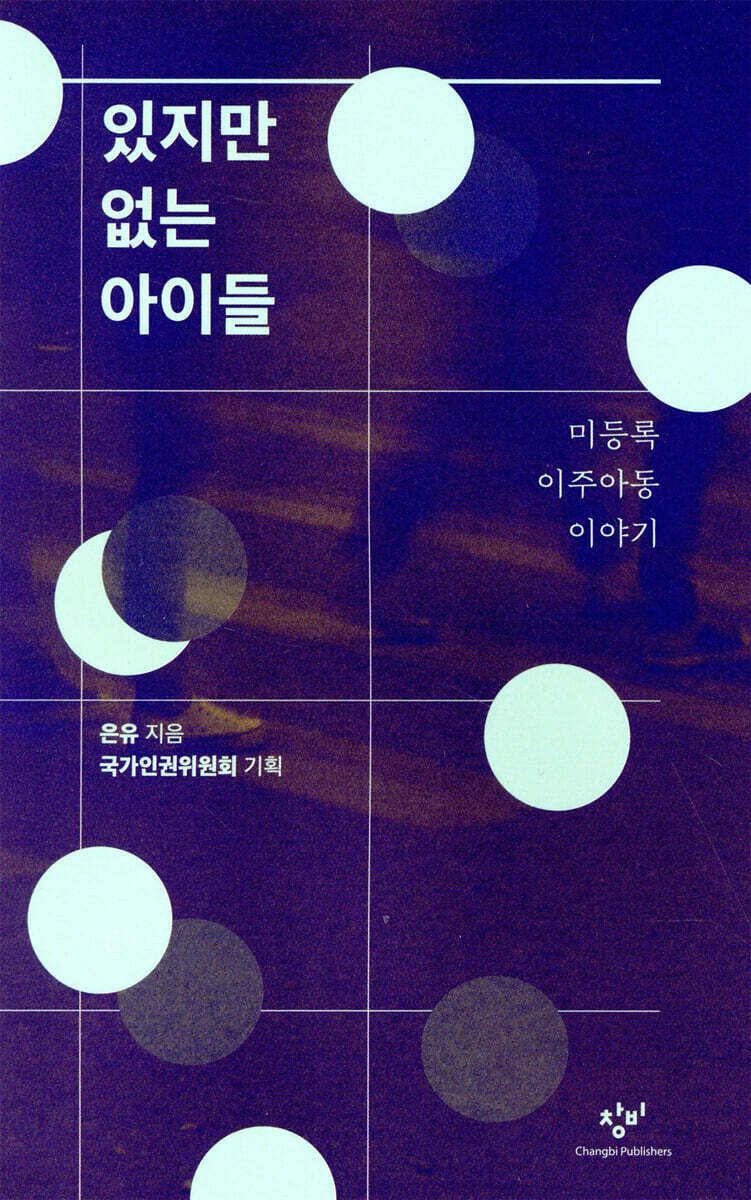
Children who exist but do not exist
 |
Description
Book Introduction
“I learned from them the power to face destiny.” 『Words of Writing』 『Death of an Unknown Child』 New works by Eunyu! The story of undocumented immigrant children: there are, there aren't ... are. There are children who have it but don't. Children who are not cared for by the state because their parents do not have residency status, children who have done nothing wrong but are considered lawbreakers and walk around with their heads down, avoiding public attention – these are undocumented immigrant children. The National Human Rights Commission of Korea planned and authored by Eunyu, "Children Who Are Present But Not Present: Stories of Undocumented Immigrant Children," to create hopes for a system to grant residency status to undocumented long-term immigrant children, and published the book. For the estimated 20,000 undocumented migrant children in the country, exclusion and frustration are a daily reality. Planning for college or the future, as well as going on field trips that require insurance, checking in with a QR code, and eating at a restaurant, are all difficult tasks. They have the right to education according to the UN Convention on the Rights of the Child, but they grow up as 'children who have but do not have' in a contradictory reality where they do not have the right to live because they do not have the right to education on paper. Moreover, although they are born, educated, and live in Korea and grow up as 'Koreans', when they turn 18, they have to 'return' to their parents' home country where they do not know anyone and cannot speak the language. The world dismisses their existence by calling them "illegal immigrants," but through the eyes of a metaphorical writer, these people are not just "marginalized children," but rather solid beings with the language to describe their lives, and fellow citizens who know how to cleverly and courageously ask the question "Why do you want to live in Korea?" with "Then why are you living in Korea?" The voices conveyed in "Children Who Are Present but Not Present" raise profound questions about the residency issues of undocumented immigrant children, and furthermore, the right of Korean society to move forward alongside immigrants. |
- You can preview some of the book's contents.
Preview
index
Prologue: Love the child of another
Nineteen, the anxiety of being kicked out next year
Marina (immigrant child)
Why do you live in Korea?
Feber (immigrant child)
Korea needs them too
Lee Tak-geon (attorney)
I no longer feel like today will be the last day.
Kim Min-hyeok (Lee Joo-ah)
An honest person is important
Seok Won-jeong (migrant rights activist)
Being born is not a sin
Karim (immigrant child)
People are just people
Dahlia (immigrant child)
This is neither buying nor not buying
Inhwa (parent of immigrant child)
If your speaking voice is small, your listening ears must be large.
Iranju (migrant rights activist)
Epilogue When Sadness Becomes a Bodhisattva
Nineteen, the anxiety of being kicked out next year
Marina (immigrant child)
Why do you live in Korea?
Feber (immigrant child)
Korea needs them too
Lee Tak-geon (attorney)
I no longer feel like today will be the last day.
Kim Min-hyeok (Lee Joo-ah)
An honest person is important
Seok Won-jeong (migrant rights activist)
Being born is not a sin
Karim (immigrant child)
People are just people
Dahlia (immigrant child)
This is neither buying nor not buying
Inhwa (parent of immigrant child)
If your speaking voice is small, your listening ears must be large.
Iranju (migrant rights activist)
Epilogue When Sadness Becomes a Bodhisattva
Into the book
At some point, I started to feel sorry for children.
I used to look at the little people who lived with so much effort, even though they didn't want to be born.
I was deeply disturbed for a long time when I saw on the news a child who had done nothing wrong but was abandoned in a desert-like place during the early stages of life.
I wrote down the words of Japanese sociologist Kiryu Minashita, “Protecting the equality of children who cannot be born to their chosen parents should be the prerequisite for public support,” on the first page of my diary and thought about them from time to time.
So what should I do? --- p.7
Can you really live in a nation-state without an ID card, or in a capitalist system without a bank account in your own name?
From presenting their resident registration cards and purchasing masks in the early days of the COVID-19 outbreak to QR check-ins and dining at restaurants, exclusion and frustration are a daily occurrence for "non-citizen" children.
--- p.8
All children born in this country, not just undocumented migrant children, should be able to receive the social support they need to survive and grow without discrimination.
Everyone should be able to design their own life opportunities and enjoy life, not just as a favor or a humanitarian matter, but as a fundamental human right.
--- p.32
I imagine a world where there are more ordinary citizens who love their distant neighbors, their small neighbors, and their future neighbors.
In our society, there are children who are revealed to the world only through adults who watch and listen carefully.
Even without guardians, a safe home, legal residency, or great personal charm or qualifications, children should be able to grow up with sufficient respect and become adults safely.
I hope that the voices of migrant children will become the seeds of a social foundation that protects equality for children who cannot be born to their chosen country or parents.
--- p.35~36
Ultimately, being able to live equally with others.
Being acknowledged as who I am.
Those are the bare minimum things I want.
I've been living like a ghost in Korea.
I want to be recognized as a living person.
--- p.58
Some people ask me why I want to continue living in Korea.
I would like to turn this question back to the person who asked it.
Then why do you live in Korea? It's the same.
I was born and raised here.
So, you live here.
If I had been born and raised in Nigeria, I probably wouldn't have lived there. There doesn't have to be a specific reason, right?
I used to look at the little people who lived with so much effort, even though they didn't want to be born.
I was deeply disturbed for a long time when I saw on the news a child who had done nothing wrong but was abandoned in a desert-like place during the early stages of life.
I wrote down the words of Japanese sociologist Kiryu Minashita, “Protecting the equality of children who cannot be born to their chosen parents should be the prerequisite for public support,” on the first page of my diary and thought about them from time to time.
So what should I do? --- p.7
Can you really live in a nation-state without an ID card, or in a capitalist system without a bank account in your own name?
From presenting their resident registration cards and purchasing masks in the early days of the COVID-19 outbreak to QR check-ins and dining at restaurants, exclusion and frustration are a daily occurrence for "non-citizen" children.
--- p.8
All children born in this country, not just undocumented migrant children, should be able to receive the social support they need to survive and grow without discrimination.
Everyone should be able to design their own life opportunities and enjoy life, not just as a favor or a humanitarian matter, but as a fundamental human right.
--- p.32
I imagine a world where there are more ordinary citizens who love their distant neighbors, their small neighbors, and their future neighbors.
In our society, there are children who are revealed to the world only through adults who watch and listen carefully.
Even without guardians, a safe home, legal residency, or great personal charm or qualifications, children should be able to grow up with sufficient respect and become adults safely.
I hope that the voices of migrant children will become the seeds of a social foundation that protects equality for children who cannot be born to their chosen country or parents.
--- p.35~36
Ultimately, being able to live equally with others.
Being acknowledged as who I am.
Those are the bare minimum things I want.
I've been living like a ghost in Korea.
I want to be recognized as a living person.
--- p.58
Some people ask me why I want to continue living in Korea.
I would like to turn this question back to the person who asked it.
Then why do you live in Korea? It's the same.
I was born and raised here.
So, you live here.
If I had been born and raised in Nigeria, I probably wouldn't have lived there. There doesn't have to be a specific reason, right?
--- p.82
Publisher's Review
"I've been living like a ghost in Korea.
I want to be recognized as a living person."
This book contains the stories of five immigrant children: Marina, Feber, Kim Min-hyeok, Karim, and Dalia, and the adults who work with them: Inhwa, the mother of the immigrant children; Seok Won-jeong, an immigrant rights activist; Iranju, an author and immigrant rights activist who has consistently written about immigrant stories; and Tak-geon Lee, a lawyer who supports immigrant children.
Each of the children featured in this book became undocumented for different reasons.
Their stories are varied: they were born to undocumented immigrants, they were living without any problems but became "illegal aliens" overnight when their fathers left the country and were unable to return, or they converted from Islam to Christianity while living in Korea, making it difficult for them to return home but failing to apply for refugee status.
The world plays a trick on them, repeatedly labeling them as legal or illegal.
Some of them were at risk of deportation and then filed an administrative lawsuit to obtain residency, while others are still living in uncertainty without residency.
Inhwa, an undocumented immigrant and the parent of an undocumented immigrant child, came to Korea in the early 1990s with her five-year-old child, pursuing the “Korean dream.”
She was scammed by a Korean broker and became an undocumented worker. Despite living a difficult life, she still managed to raise her child.
Ho-jun, an undocumented immigrant child who was five years old, has now become an undocumented immigrant worker who is approaching his thirties.
Inhwa asks.
"They give visas to people who marry Koreans, but why not to people who work hard and live in Korea? I've worked here in Korea for 25 years.
I spent all my salary here.
Eat, live, pay rent, pay taxes.
The money I earned wasn't bad money.
This is money I earned through sweat, blood, and tears.
During the time I lived in Korea, the president changed six times.
Korea is a developed country and lives better than Mongolia.
But why isn't anyone addressing the issue of foreign residency?
Love your distant neighbors, not your near ones.
When you speak out about immigrant rights, you often get criticism on social media and in news comments telling you to help your own people first.
But who determines the priorities of social issues, and by what standards? The adults featured in this book happened to witness the suffering of others in their own lives. Rather than prioritizing "what's more important," they simply remained focused on that suffering.
They intervened, cared for, and fought for different reasons, such as ‘to be honest with oneself’ (Seok Won-jeong), ‘with the mindset that even if the speaking voice is small, the listening ears should be large’ (Iranju), and ‘because if it’s not me, there’s no one else who can help’ (Lee Tak-geon).
In our society, there are children who are revealed to the world only through adults who watch and listen carefully.
Nietzsche overturned the moral law of 'love thy neighbor' and said 'love thy neighbor more distantly.'
It is never easy to break the mold of the familiar world of one's acquaintances, region, country, ethnicity, and values and love the children of distant neighbors and strangers. It is a task that takes time and effort.
The adults in this book demonstrate through their lives that loving our distant neighbors, our small neighbors, and our future neighbors, and thus protecting the equality of children who cannot be born to their own country or parents, is the path toward a better community.
No one is born illegal.
Although the metaphor writer is well known as an excellent essayist who writes warm yet sharp prose, he is also a reportage writer who has faithfully conveyed the voices of the socially vulnerable, including victims of state violence, domestic violence, sexual violence, and workplace violence, for a long time.
“The more I hear about the writer representing the voice of the weak, the more embarrassing it becomes.
(…) I think recording what is happening somewhere in the world is neither a good nor a bad thing, it’s just something to do” (page 34), he says humbly. When he started this work, he felt like the fuel of anger and emotion that had been the driving force behind his writing had run out, so he put up a sign saying ‘Absolutely Stable’ and was on hiatus.
It was these 'children who have but don't have' who refilled the empty fuel and ignited the fire in my heart.
I didn't want to be born, but I became a sinner the moment I was born.
Even though I didn't do anything wrong, my heart sinks just seeing a police car.
He suffers from a chronic, subtle anxiety that his school teacher will reveal his situation or that his friends will notice his situation.
Because I can't get insurance, I can't go on school trips, and even if I study hard, I can't participate in competitions.
Because I can't sign up for a ticket reservation site, I can't go to my favorite idol's concert, and after eating tteokbokki, I have to fumble for cash when my friends are 'bank transferring' money for one-tenth of a yen.
The 'life of denial of existence' they speak of is so specific, so vague, and so painful in every detail.
But even so, they boldly ask, "A person is just a person. Where is there a being who is illegal simply by being born?" and are optimistic that our society will change for the better in the future.
These children, who prove their existence simply by living, no matter how much the world tries to erase their existence, show the world that “living is the perfect act.”
Children have the privilege of being protected.
No child is born by choosing the country and parents they will be born into.
It is the responsibility and duty of society and the state to ensure that children grow up with full respect and become adults safely, even without guardians, a safe home, or legal residency.
Ensuring that all children and youth living here receive the social support necessary for survival and growth without discrimination, and that everyone can design their own life opportunities and enjoy life, is not something that should be done out of charity or humanism, but rather a fundamental right granted to all human beings.
In response to the National Human Rights Commission's May 2020 recommendation, the Ministry of Justice announced the "Implementation Plan for Conditional Relief Measures for Illegal Resident Children Born in Korea" in April 2021.
Although it was decided to provide an opportunity for a residency qualification examination to children who meet certain requirements, such as being born in the country and having resided in the country for more than 15 years, this measure only applies to a very small number of children.
Marina, who was approaching nineteen at the time of the interview in the fall of 2020, was subject to deportation starting this year, but a change in the system allowed her to apply for residency.
However, this qualification is only valid for one year and must be renewed annually.
Since Marina has not yet entered university and has no valid reason for staying, no one knows whether Marina will be able to continue living in Korea next year or the year after.
Karim and Dalia, who came to Korea when they were four and two years old respectively, unfortunately do not fall under this system and can still be deported at any time.
Establishing practical and permanent relief measures that encompass the human rights of all long-term migrant children is a task left for our community.
I hope that through the voices contained in "Children Who Are Present but Not Present," a proper path to "legalization of existence" will be created for undocumented immigrant children and youth.
I want to be recognized as a living person."
This book contains the stories of five immigrant children: Marina, Feber, Kim Min-hyeok, Karim, and Dalia, and the adults who work with them: Inhwa, the mother of the immigrant children; Seok Won-jeong, an immigrant rights activist; Iranju, an author and immigrant rights activist who has consistently written about immigrant stories; and Tak-geon Lee, a lawyer who supports immigrant children.
Each of the children featured in this book became undocumented for different reasons.
Their stories are varied: they were born to undocumented immigrants, they were living without any problems but became "illegal aliens" overnight when their fathers left the country and were unable to return, or they converted from Islam to Christianity while living in Korea, making it difficult for them to return home but failing to apply for refugee status.
The world plays a trick on them, repeatedly labeling them as legal or illegal.
Some of them were at risk of deportation and then filed an administrative lawsuit to obtain residency, while others are still living in uncertainty without residency.
Inhwa, an undocumented immigrant and the parent of an undocumented immigrant child, came to Korea in the early 1990s with her five-year-old child, pursuing the “Korean dream.”
She was scammed by a Korean broker and became an undocumented worker. Despite living a difficult life, she still managed to raise her child.
Ho-jun, an undocumented immigrant child who was five years old, has now become an undocumented immigrant worker who is approaching his thirties.
Inhwa asks.
"They give visas to people who marry Koreans, but why not to people who work hard and live in Korea? I've worked here in Korea for 25 years.
I spent all my salary here.
Eat, live, pay rent, pay taxes.
The money I earned wasn't bad money.
This is money I earned through sweat, blood, and tears.
During the time I lived in Korea, the president changed six times.
Korea is a developed country and lives better than Mongolia.
But why isn't anyone addressing the issue of foreign residency?
Love your distant neighbors, not your near ones.
When you speak out about immigrant rights, you often get criticism on social media and in news comments telling you to help your own people first.
But who determines the priorities of social issues, and by what standards? The adults featured in this book happened to witness the suffering of others in their own lives. Rather than prioritizing "what's more important," they simply remained focused on that suffering.
They intervened, cared for, and fought for different reasons, such as ‘to be honest with oneself’ (Seok Won-jeong), ‘with the mindset that even if the speaking voice is small, the listening ears should be large’ (Iranju), and ‘because if it’s not me, there’s no one else who can help’ (Lee Tak-geon).
In our society, there are children who are revealed to the world only through adults who watch and listen carefully.
Nietzsche overturned the moral law of 'love thy neighbor' and said 'love thy neighbor more distantly.'
It is never easy to break the mold of the familiar world of one's acquaintances, region, country, ethnicity, and values and love the children of distant neighbors and strangers. It is a task that takes time and effort.
The adults in this book demonstrate through their lives that loving our distant neighbors, our small neighbors, and our future neighbors, and thus protecting the equality of children who cannot be born to their own country or parents, is the path toward a better community.
No one is born illegal.
Although the metaphor writer is well known as an excellent essayist who writes warm yet sharp prose, he is also a reportage writer who has faithfully conveyed the voices of the socially vulnerable, including victims of state violence, domestic violence, sexual violence, and workplace violence, for a long time.
“The more I hear about the writer representing the voice of the weak, the more embarrassing it becomes.
(…) I think recording what is happening somewhere in the world is neither a good nor a bad thing, it’s just something to do” (page 34), he says humbly. When he started this work, he felt like the fuel of anger and emotion that had been the driving force behind his writing had run out, so he put up a sign saying ‘Absolutely Stable’ and was on hiatus.
It was these 'children who have but don't have' who refilled the empty fuel and ignited the fire in my heart.
I didn't want to be born, but I became a sinner the moment I was born.
Even though I didn't do anything wrong, my heart sinks just seeing a police car.
He suffers from a chronic, subtle anxiety that his school teacher will reveal his situation or that his friends will notice his situation.
Because I can't get insurance, I can't go on school trips, and even if I study hard, I can't participate in competitions.
Because I can't sign up for a ticket reservation site, I can't go to my favorite idol's concert, and after eating tteokbokki, I have to fumble for cash when my friends are 'bank transferring' money for one-tenth of a yen.
The 'life of denial of existence' they speak of is so specific, so vague, and so painful in every detail.
But even so, they boldly ask, "A person is just a person. Where is there a being who is illegal simply by being born?" and are optimistic that our society will change for the better in the future.
These children, who prove their existence simply by living, no matter how much the world tries to erase their existence, show the world that “living is the perfect act.”
Children have the privilege of being protected.
No child is born by choosing the country and parents they will be born into.
It is the responsibility and duty of society and the state to ensure that children grow up with full respect and become adults safely, even without guardians, a safe home, or legal residency.
Ensuring that all children and youth living here receive the social support necessary for survival and growth without discrimination, and that everyone can design their own life opportunities and enjoy life, is not something that should be done out of charity or humanism, but rather a fundamental right granted to all human beings.
In response to the National Human Rights Commission's May 2020 recommendation, the Ministry of Justice announced the "Implementation Plan for Conditional Relief Measures for Illegal Resident Children Born in Korea" in April 2021.
Although it was decided to provide an opportunity for a residency qualification examination to children who meet certain requirements, such as being born in the country and having resided in the country for more than 15 years, this measure only applies to a very small number of children.
Marina, who was approaching nineteen at the time of the interview in the fall of 2020, was subject to deportation starting this year, but a change in the system allowed her to apply for residency.
However, this qualification is only valid for one year and must be renewed annually.
Since Marina has not yet entered university and has no valid reason for staying, no one knows whether Marina will be able to continue living in Korea next year or the year after.
Karim and Dalia, who came to Korea when they were four and two years old respectively, unfortunately do not fall under this system and can still be deported at any time.
Establishing practical and permanent relief measures that encompass the human rights of all long-term migrant children is a task left for our community.
I hope that through the voices contained in "Children Who Are Present but Not Present," a proper path to "legalization of existence" will be created for undocumented immigrant children and youth.
GOODS SPECIFICS
- Publication date: June 18, 2021
- Page count, weight, size: 232 pages | 316g | 125*210*20mm
- ISBN13: 9788936478735
- ISBN10: 8936478737
You may also like
카테고리
korean


korean

![GQ KOREA Mark (Monthly): December [2025]](http://librairie.coreenne.fr/cdn/shop/files/8ef265dbbfbf186523ed75ba7319009d.jpg?v=1765340328&width=3840)


