

China's silent invasion
 |
Description
Book Introduction
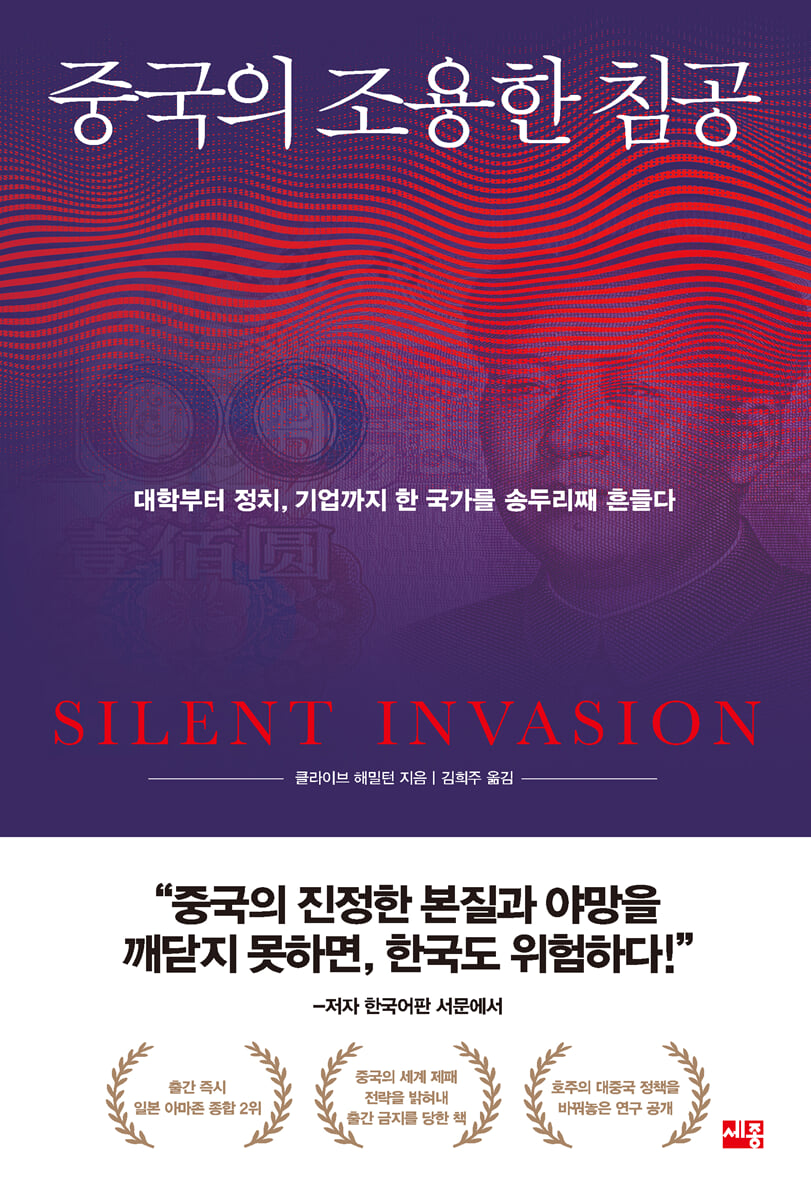
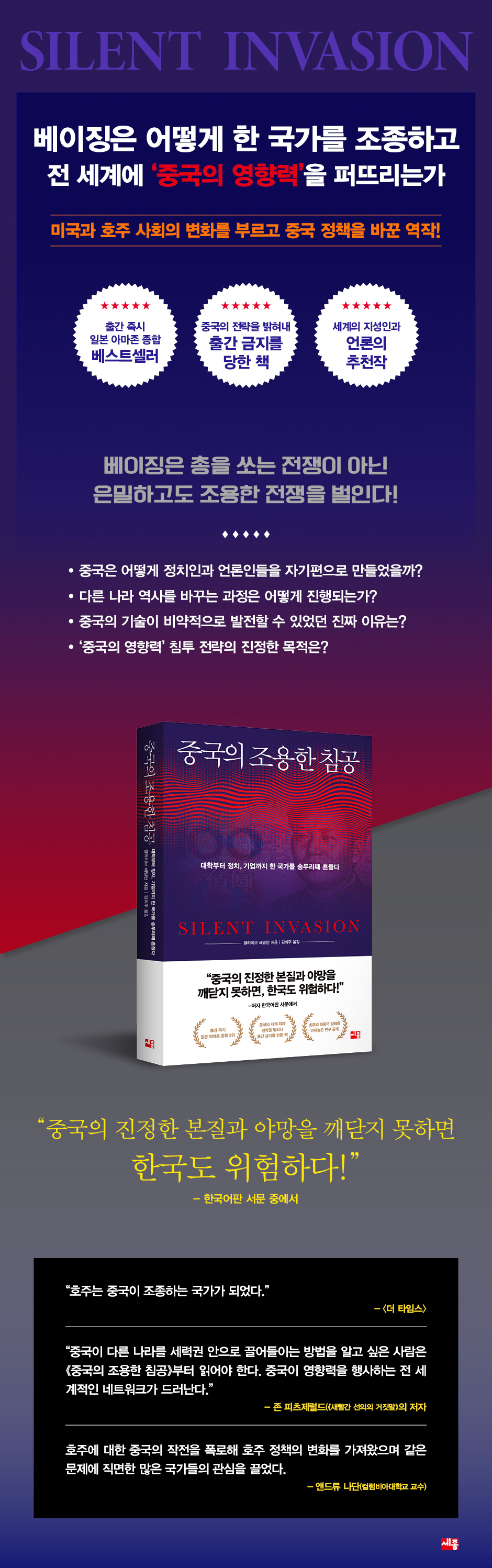
A masterpiece that changed Australia's China policy! A book that revealed China's strategy for world domination and was banned from publication. Immediately after its release, it ranked 2nd on the Japanese Amazon Bestseller list! How is Beijing's "influence penetration" strategy unfolding? “China is bringing other countries into its sphere of influence. Anyone who wants to know how should start by reading "China's Silent Invasion"! John Fitzgerald (author of The White Lie) A book that has captured the world's attention for its keen insight into the Chinese Communist Party's systematic overseas political interference and influence strategies. However, it is also a book that almost never came out because it clearly exposed the true nature of the Chinese Communist Party. The book "China's Silent Invasion," which was just published, influenced Australia's policy of banning donations from foreigners and foreign companies. It received a hot response in Japan, quickly rising to the top of Amazon's comprehensive bestseller list, and is also providing important insights to several Asian countries, including Taiwan. In Korea, it received a lot of attention even before its publication, with inquiries about the publication schedule continuing. This book, which sounded an alarm in many countries that were oblivious to the Chinese Communist Party's strategies, now asks what changes it will bring to Korea. Clive Hamilton, an expert who is often the first to consult with major global media outlets and think tanks on China-related issues, warns that the Chinese Communist Party's global influence cannot be overlooked. Beijing is swaying public opinion and changing policies in China's favor in various areas, including overseas schools, businesses, and the media. The Chinese Communist Party already has its hands in too many areas. This book boldly analyzes and insightfully examines the chain of events that has robbed Australia of its democracy and freedom, offering an alternative to Beijing's influence strategy. |
- You can preview some of the book's contents.
Preview
index
Preface to the Korean edition / Preface
Chapter 1: The Silent Influence
Chapter 2: Self-Portrait in China
Chapter 3: Chinese People Abroad
Chapter 4 Money Flowing In
Chapter 5: From Research Institutes to the Media
Chapter 6: The Economy Mortgaged to China
Chapter 7: Temptation or Coercion
Chapter 8: Old Spies, New Spies
Chapter 9: Enemies Within and the Scientific Community
Chapter 10: China Enters University
Chapter 11: The Culture Wars
Chapter 12: Those Who Help China
Chapter 13: The First Step to Protecting Democracy
Acknowledgments / Abbreviations / Notes
Chapter 1: The Silent Influence
Chapter 2: Self-Portrait in China
Chapter 3: Chinese People Abroad
Chapter 4 Money Flowing In
Chapter 5: From Research Institutes to the Media
Chapter 6: The Economy Mortgaged to China
Chapter 7: Temptation or Coercion
Chapter 8: Old Spies, New Spies
Chapter 9: Enemies Within and the Scientific Community
Chapter 10: China Enters University
Chapter 11: The Culture Wars
Chapter 12: Those Who Help China
Chapter 13: The First Step to Protecting Democracy
Acknowledgments / Abbreviations / Notes
Detailed image
Into the book
Beijing's most important international strategic goal is the dismantling of the US alliance, and the key countries China targets in the Indo-Pacific region are Australia, Japan, and South Korea.
Beijing is using various means to divide relations between South Korea and the United States.
Because they know full well that they cannot dominate Korea unless they weaken the ROK-US alliance.
---From the "Korean Edition Preface"
According to the 1994 plan, the Communist Party declared that patriotism would become "the core theme of our society."
By controlling people's thoughts, the need to control their actions disappeared, and the Party worked tirelessly to instill patriotic ideas in the people's minds.
Wherever you go in China today, you will find installations that remind you of a century of the nation's humiliation at the hands of brutal Japanese and arrogant Westerners, and of the Chinese people's resurgence.
Monuments, memorials, historical relics, and museums installed everywhere have all breathed new narratives into the story.
And all those involved, including teachers, officers, soldiers, and civil servants of state institutions, must attend regular classes designed to strengthen patriotism.
---From Chapter 2, “Self-Portrait of China”
It has been posted that Admiral Zheng He's fleet may have reached northwest Australia hundreds of years before Captain James Cook or Abel Tasman.
Lest we forget China's claim to have discovered Australia, in 2016 former Chinese Foreign Minister Li Zhaoxing gave a speech at the Australian National University, reaffirming his belief that Australia was discovered by a 13th-14th century Yuan Dynasty explorer.
At the time, no one disputed that Li Zhaoxing's speech was fabricating Australian history.
---From Chapter 2, “Self-Portrait of China”
Fitzgerald warned that Beijing's propaganda and security apparatus, which silences people, had "comfortably migrated and settled in Australia".
Leaving Melbourne's bustling streets, I felt a sense of dread and fear, a sense that Australia's future was being taken over by an overwhelmingly powerful force.
And frankly, the power and ruthlessness of China's security apparatus made me anxious about my own future.
---From Chapter 3, “Chinese Abroad”
Lotte was just the beginning.
China has banned the import of Korean cosmetics and electronics, and has also canceled performances by K-pop stars.
Korean tourists walking around downtown China were subjected to verbal abuse, and a Korean film that was very popular in China was also rejected from the Beijing International Film Festival.
As if to prove that China's anger is childish, the face of South Korean pop star Psy, who serves as a judge on a Chinese talent scouting program, has been pixelated.
As China banned group tours and the number of tourists plummeted, South Korea's tourism industry fell into a state of panic.
The Korea-China International Travel Agency in Seoul reported an 80% drop in Chinese tourists.
An executive at one of China's largest travel agencies also acknowledged that "tourism is part of diplomacy."
---From Chapter 7, “Temptation or Coercion”
To allay public anxiety, China supporters compare the total value of Australian assets owned by Chinese nationals to the size of Australian assets owned by American or Japanese companies.
But Americans have been buying Australian assets for over 100 years.
, and the Japanese also acquired it over the course of 50 years.
Chinese investment has grown significantly over the past decade and is expected to grow even faster in the coming years.
There are other figures that Australia should pay more attention to.
The fact is that the first destination for the massive inflow of funds from China is the United States, followed by Australia.
And that too by a hair's breadth.
---From Chapter 6, “The Economy Mortgaged to China”
China's objectives are clear.
It is about improving the level of technology and engineering by riding on the research achievements of other countries.
The US Cyber Command has even described China's cyber theft as "the largest wealth transfer in history."
According to reliable sources, the U.S. loses an estimated $600 billion in economic value to IP theft each year, and China is the primary culprit.
---From Chapter 8, “Old Spies, Modern Spies”
Australian universities must invite Chinese dissident writers and intellectuals.
The Dalai Lama should be invited.
We must ensure that Chinese students are free from ideological constraints by providing them with lectures on human rights and democracy and creating an environment where they can freely ask questions and find their own voices.
If there are signs that they are trying to suppress opinions that challenge the CCP, we must not ignore them, but confront and criticize them.
The Chinese Student and Scholar Association, an anti-democratic organization secretly operated under the control of a foreign government, must be disbanded, and a new organization supporting Chinese students must be established.
The federal government must make it clear that it will never offer permanent residency to Chinese students who participate in political protests supporting Beijing.
This way, Australia can welcome Chinese students as well as students from all over the world.
---From Chapter 10, “China Entering University”
In Shenzhen, when you cross the street when the light is red, a large electronic sign on the opposite side displays a police warning along with the face of a person who has crossed illegally.
And the jaywalking is added to that person's record of violations stored on a computer somewhere.
Currently, there are 100 million CCTVs installed, or one for every 13 people, and that number is increasing.
It may not be long before we see mass surveillance systems capable of tracking the faces of citizens almost everywhere in China.
---From Chapter 11, “Culture Wars”
To build a balanced alliance with the United States, we should promote the formation of an Asian Democratic Alliance, bringing together the democratic nations of India, Japan, South Korea, Indonesia, New Zealand, and Australia.
The formation of an Asian Alliance of Democracy would strengthen the freedom of democratic governments across the region, counter China's systematic attempts to undermine sovereignty, and establish strategic military cooperation toward shared goals.
Let us not forget that countering Chinese influence in Australia is just one of many battles between democracy and new totalitarianisms being waged around the world.
Beijing is using various means to divide relations between South Korea and the United States.
Because they know full well that they cannot dominate Korea unless they weaken the ROK-US alliance.
---From the "Korean Edition Preface"
According to the 1994 plan, the Communist Party declared that patriotism would become "the core theme of our society."
By controlling people's thoughts, the need to control their actions disappeared, and the Party worked tirelessly to instill patriotic ideas in the people's minds.
Wherever you go in China today, you will find installations that remind you of a century of the nation's humiliation at the hands of brutal Japanese and arrogant Westerners, and of the Chinese people's resurgence.
Monuments, memorials, historical relics, and museums installed everywhere have all breathed new narratives into the story.
And all those involved, including teachers, officers, soldiers, and civil servants of state institutions, must attend regular classes designed to strengthen patriotism.
---From Chapter 2, “Self-Portrait of China”
It has been posted that Admiral Zheng He's fleet may have reached northwest Australia hundreds of years before Captain James Cook or Abel Tasman.
Lest we forget China's claim to have discovered Australia, in 2016 former Chinese Foreign Minister Li Zhaoxing gave a speech at the Australian National University, reaffirming his belief that Australia was discovered by a 13th-14th century Yuan Dynasty explorer.
At the time, no one disputed that Li Zhaoxing's speech was fabricating Australian history.
---From Chapter 2, “Self-Portrait of China”
Fitzgerald warned that Beijing's propaganda and security apparatus, which silences people, had "comfortably migrated and settled in Australia".
Leaving Melbourne's bustling streets, I felt a sense of dread and fear, a sense that Australia's future was being taken over by an overwhelmingly powerful force.
And frankly, the power and ruthlessness of China's security apparatus made me anxious about my own future.
---From Chapter 3, “Chinese Abroad”
Lotte was just the beginning.
China has banned the import of Korean cosmetics and electronics, and has also canceled performances by K-pop stars.
Korean tourists walking around downtown China were subjected to verbal abuse, and a Korean film that was very popular in China was also rejected from the Beijing International Film Festival.
As if to prove that China's anger is childish, the face of South Korean pop star Psy, who serves as a judge on a Chinese talent scouting program, has been pixelated.
As China banned group tours and the number of tourists plummeted, South Korea's tourism industry fell into a state of panic.
The Korea-China International Travel Agency in Seoul reported an 80% drop in Chinese tourists.
An executive at one of China's largest travel agencies also acknowledged that "tourism is part of diplomacy."
---From Chapter 7, “Temptation or Coercion”
To allay public anxiety, China supporters compare the total value of Australian assets owned by Chinese nationals to the size of Australian assets owned by American or Japanese companies.
But Americans have been buying Australian assets for over 100 years.
, and the Japanese also acquired it over the course of 50 years.
Chinese investment has grown significantly over the past decade and is expected to grow even faster in the coming years.
There are other figures that Australia should pay more attention to.
The fact is that the first destination for the massive inflow of funds from China is the United States, followed by Australia.
And that too by a hair's breadth.
---From Chapter 6, “The Economy Mortgaged to China”
China's objectives are clear.
It is about improving the level of technology and engineering by riding on the research achievements of other countries.
The US Cyber Command has even described China's cyber theft as "the largest wealth transfer in history."
According to reliable sources, the U.S. loses an estimated $600 billion in economic value to IP theft each year, and China is the primary culprit.
---From Chapter 8, “Old Spies, Modern Spies”
Australian universities must invite Chinese dissident writers and intellectuals.
The Dalai Lama should be invited.
We must ensure that Chinese students are free from ideological constraints by providing them with lectures on human rights and democracy and creating an environment where they can freely ask questions and find their own voices.
If there are signs that they are trying to suppress opinions that challenge the CCP, we must not ignore them, but confront and criticize them.
The Chinese Student and Scholar Association, an anti-democratic organization secretly operated under the control of a foreign government, must be disbanded, and a new organization supporting Chinese students must be established.
The federal government must make it clear that it will never offer permanent residency to Chinese students who participate in political protests supporting Beijing.
This way, Australia can welcome Chinese students as well as students from all over the world.
---From Chapter 10, “China Entering University”
In Shenzhen, when you cross the street when the light is red, a large electronic sign on the opposite side displays a police warning along with the face of a person who has crossed illegally.
And the jaywalking is added to that person's record of violations stored on a computer somewhere.
Currently, there are 100 million CCTVs installed, or one for every 13 people, and that number is increasing.
It may not be long before we see mass surveillance systems capable of tracking the faces of citizens almost everywhere in China.
---From Chapter 11, “Culture Wars”
To build a balanced alliance with the United States, we should promote the formation of an Asian Democratic Alliance, bringing together the democratic nations of India, Japan, South Korea, Indonesia, New Zealand, and Australia.
The formation of an Asian Alliance of Democracy would strengthen the freedom of democratic governments across the region, counter China's systematic attempts to undermine sovereignty, and establish strategic military cooperation toward shared goals.
Let us not forget that countering Chinese influence in Australia is just one of many battles between democracy and new totalitarianisms being waged around the world.
---From Chapter 13, “The First Step to Protecting Democracy”
Publisher's Review
From politics to culture, from real estate to elementary school
Unraveling the full extent of Beijing's "influence strategy."
“From now on, I will explain and document the process by which Australia lost its sovereignty.” (Page 25)
"China's Silent Invasion" explores Beijing's strategy for expanding its influence globally, with Australia at its core, and analyzes the true face of the Chinese Communist Party through China's past and present.
Politicians lobbied by China create policies that are favorable to Chinese companies and the Chinese Communist Party, and these Chinese companies are buying up Australian land and companies at a frightening rate.
If the media publishes articles that are unfavorable to China, such as reporting on these situations, the Chinese Communist Party controls the media by removing advertisements.
From elementary school to university, information, history, and culture education tailored to Chinese tastes are provided.
All this happened in Australia, not China.
The Chinese Communist Party's organized responses and threats are becoming increasingly severe.
This is the result of the authoritarian state's one-party system, the ideology that sees China as a "state" and a "party" as one, and the enormous human and financial power of the Chinese Communist Party.
As the inflow of Chinese capital increases, it becomes impossible to escape the influence of the Chinese Communist Party in all sectors, including politics, economy, and culture.
What's important is that China's strategy of infiltrating influence is ongoing, and Australia is not the only country experiencing this.
A new form of war without gunfire
Overseas Chinese who are weapons in that war
War isn't just about guns and missiles flying around.
China is waging an invisible war in all directions, including geopolitics, geoeconomics, and economic sanctions.
According to Clive Hamilton, China's ultimate goal is, of course, the United States, and the reason it is expanding its influence to various Asian countries, including Australia, is to weaken the alliance with the United States and establish itself as a hegemonic power.
China, which has emerged as an economic and military power, wields the carrot of "soft power" through cultural industrialization on one hand and the stick of economic pressure on the other.
It makes other countries economically dependent on China.
Clive Hamilton believed that Australia had lost its sovereignty because it believed that China was the only country that could bring it economic wealth.
Greece, a European country, also believed that the way to escape the crisis of bankruptcy was to join hands with China, and it is gradually giving up its sovereignty in return for economic support.
China seeks to gain control of the country's key infrastructure, ports and airports through economic aid.
These are devices that can strangle the country at any time.
And it could pose a strategic threat to countries surrounding China, the United States, and the world.
Now Beijing is armed with a new Chinese ideology.
They believe that the Chinese people are superior to all other peoples and dream of a return to the days when China ruled the world.
Thus, overseas Chinese in China also move to revive China.
China is not just within China.
America, Europe, Australia, Japan… … China is everywhere.
Other countries worry that the flow of talented people going abroad to find jobs will weaken their national power, but China is different.
I believe that we can bring excellent overseas technology and culture to China.
In fact, Chinese people living abroad are transferring overseas strategies and technologies in various fields of politics and economy, and are spreading Chinese culture.
This book bolsters the author's argument by interviewing a variety of people, including Chen Yonglin, a former political secretary at the Chinese Consulate, key figures in Chinese politics and business, and Chinese-Australians.
Will Korea become the next Australia?
Korea's Choice Amidst Growing Chinese Influence
“In fact, Korea was once part of China.” (p. 50)
The above words were said by Trump when he met with Xi Jinping.
But this statement isn't just Trump's problem.
The Chinese Communist Party brazenly makes other countries' history its own and propagates it to the world.
So, there is a lot of controversy with Korea over various issues related to history and culture, such as the Northeast Project, kimchi, and hanbok.
A series of events have led many to ignore or despise China.
However, the author argues that it is dangerous to act in a way that is unfamiliar with China's strategy and that we should not ignore or let our guard down toward China.
“Korea is a country proud of its unique history and culture.
But recently, the Chinese Communist Party has been targeting Korean films and
“I am concerned about the subtle influence exerted on the TV industry.” (From the preface to the Korean edition)
It is time to recognize the gravity of the situation and take a serious look at China's influence strategy.
And we have to think about what the best choice is given to us.
Clive Hamilton, in his preface to the Korean edition, argues that only by recognizing China's true nature and ambitions can we preserve democracy and sovereignty.
The advent of a new totalitarian society
Professor Clive Hamilton's Alternative
China is taking on the appearance of a new hegemonic power and is rapidly moving towards a totalitarian society.
It may already be too late to stop China.
Because their influence extends into so many areas.
Clive Hamilton says it takes time to find ways to regain independence, and he recognizes the risks.
They argue that properly recognizing their influence can protect democracy against new totalitarianisms.
We must understand the world situation by reading the invisible influence of the Chinese Communist Party.
If you can't read China's influence strategies and ambitions, you can't understand the world's trends.
This is a must-read for anyone concerned about the direction Korea should take in an uncertain and complex world.
Reviews from overseas readers who read this book first
This book is the best I have ever read about modern China and its mission.
The changes this book brings may seem like small ripples now, but they will become a tidal wave.
-US Amazon Reader
A must-read for anyone interested in world order and the future.
It is the most objective book on China.
-US Amazon Reader
Looking at today's Japan, this book never feels like someone else's story.
Many people read it and earnestly hope that Japan will change.
-Japanese Amazon Reader
A book that explains how China infiltrated Australia.
The Chinese Communist Party's infiltration methods are familiar to Taiwanese and Hong Kongers, but they will be unfamiliar to people in other countries.
The Chinese Communist Party has carried out extensive and deep infiltration into Australia.
-Taiwanese Seongpum Bookstore Reader
Unraveling the full extent of Beijing's "influence strategy."
“From now on, I will explain and document the process by which Australia lost its sovereignty.” (Page 25)
"China's Silent Invasion" explores Beijing's strategy for expanding its influence globally, with Australia at its core, and analyzes the true face of the Chinese Communist Party through China's past and present.
Politicians lobbied by China create policies that are favorable to Chinese companies and the Chinese Communist Party, and these Chinese companies are buying up Australian land and companies at a frightening rate.
If the media publishes articles that are unfavorable to China, such as reporting on these situations, the Chinese Communist Party controls the media by removing advertisements.
From elementary school to university, information, history, and culture education tailored to Chinese tastes are provided.
All this happened in Australia, not China.
The Chinese Communist Party's organized responses and threats are becoming increasingly severe.
This is the result of the authoritarian state's one-party system, the ideology that sees China as a "state" and a "party" as one, and the enormous human and financial power of the Chinese Communist Party.
As the inflow of Chinese capital increases, it becomes impossible to escape the influence of the Chinese Communist Party in all sectors, including politics, economy, and culture.
What's important is that China's strategy of infiltrating influence is ongoing, and Australia is not the only country experiencing this.
A new form of war without gunfire
Overseas Chinese who are weapons in that war
War isn't just about guns and missiles flying around.
China is waging an invisible war in all directions, including geopolitics, geoeconomics, and economic sanctions.
According to Clive Hamilton, China's ultimate goal is, of course, the United States, and the reason it is expanding its influence to various Asian countries, including Australia, is to weaken the alliance with the United States and establish itself as a hegemonic power.
China, which has emerged as an economic and military power, wields the carrot of "soft power" through cultural industrialization on one hand and the stick of economic pressure on the other.
It makes other countries economically dependent on China.
Clive Hamilton believed that Australia had lost its sovereignty because it believed that China was the only country that could bring it economic wealth.
Greece, a European country, also believed that the way to escape the crisis of bankruptcy was to join hands with China, and it is gradually giving up its sovereignty in return for economic support.
China seeks to gain control of the country's key infrastructure, ports and airports through economic aid.
These are devices that can strangle the country at any time.
And it could pose a strategic threat to countries surrounding China, the United States, and the world.
Now Beijing is armed with a new Chinese ideology.
They believe that the Chinese people are superior to all other peoples and dream of a return to the days when China ruled the world.
Thus, overseas Chinese in China also move to revive China.
China is not just within China.
America, Europe, Australia, Japan… … China is everywhere.
Other countries worry that the flow of talented people going abroad to find jobs will weaken their national power, but China is different.
I believe that we can bring excellent overseas technology and culture to China.
In fact, Chinese people living abroad are transferring overseas strategies and technologies in various fields of politics and economy, and are spreading Chinese culture.
This book bolsters the author's argument by interviewing a variety of people, including Chen Yonglin, a former political secretary at the Chinese Consulate, key figures in Chinese politics and business, and Chinese-Australians.
Will Korea become the next Australia?
Korea's Choice Amidst Growing Chinese Influence
“In fact, Korea was once part of China.” (p. 50)
The above words were said by Trump when he met with Xi Jinping.
But this statement isn't just Trump's problem.
The Chinese Communist Party brazenly makes other countries' history its own and propagates it to the world.
So, there is a lot of controversy with Korea over various issues related to history and culture, such as the Northeast Project, kimchi, and hanbok.
A series of events have led many to ignore or despise China.
However, the author argues that it is dangerous to act in a way that is unfamiliar with China's strategy and that we should not ignore or let our guard down toward China.
“Korea is a country proud of its unique history and culture.
But recently, the Chinese Communist Party has been targeting Korean films and
“I am concerned about the subtle influence exerted on the TV industry.” (From the preface to the Korean edition)
It is time to recognize the gravity of the situation and take a serious look at China's influence strategy.
And we have to think about what the best choice is given to us.
Clive Hamilton, in his preface to the Korean edition, argues that only by recognizing China's true nature and ambitions can we preserve democracy and sovereignty.
The advent of a new totalitarian society
Professor Clive Hamilton's Alternative
China is taking on the appearance of a new hegemonic power and is rapidly moving towards a totalitarian society.
It may already be too late to stop China.
Because their influence extends into so many areas.
Clive Hamilton says it takes time to find ways to regain independence, and he recognizes the risks.
They argue that properly recognizing their influence can protect democracy against new totalitarianisms.
We must understand the world situation by reading the invisible influence of the Chinese Communist Party.
If you can't read China's influence strategies and ambitions, you can't understand the world's trends.
This is a must-read for anyone concerned about the direction Korea should take in an uncertain and complex world.
Reviews from overseas readers who read this book first
This book is the best I have ever read about modern China and its mission.
The changes this book brings may seem like small ripples now, but they will become a tidal wave.
-US Amazon Reader
A must-read for anyone interested in world order and the future.
It is the most objective book on China.
-US Amazon Reader
Looking at today's Japan, this book never feels like someone else's story.
Many people read it and earnestly hope that Japan will change.
-Japanese Amazon Reader
A book that explains how China infiltrated Australia.
The Chinese Communist Party's infiltration methods are familiar to Taiwanese and Hong Kongers, but they will be unfamiliar to people in other countries.
The Chinese Communist Party has carried out extensive and deep infiltration into Australia.
-Taiwanese Seongpum Bookstore Reader
GOODS SPECIFICS
- Date of issue: June 4, 2021
- Page count, weight, size: 500 pages | 808g | 210*297*30mm
- ISBN13: 9788984079540
- ISBN10: 8984079545
You may also like
카테고리
korean


korean

![GQ KOREA Mark (Monthly): December [2025]](http://librairie.coreenne.fr/cdn/shop/files/8ef265dbbfbf186523ed75ba7319009d.jpg?v=1765340328&width=3840)


