

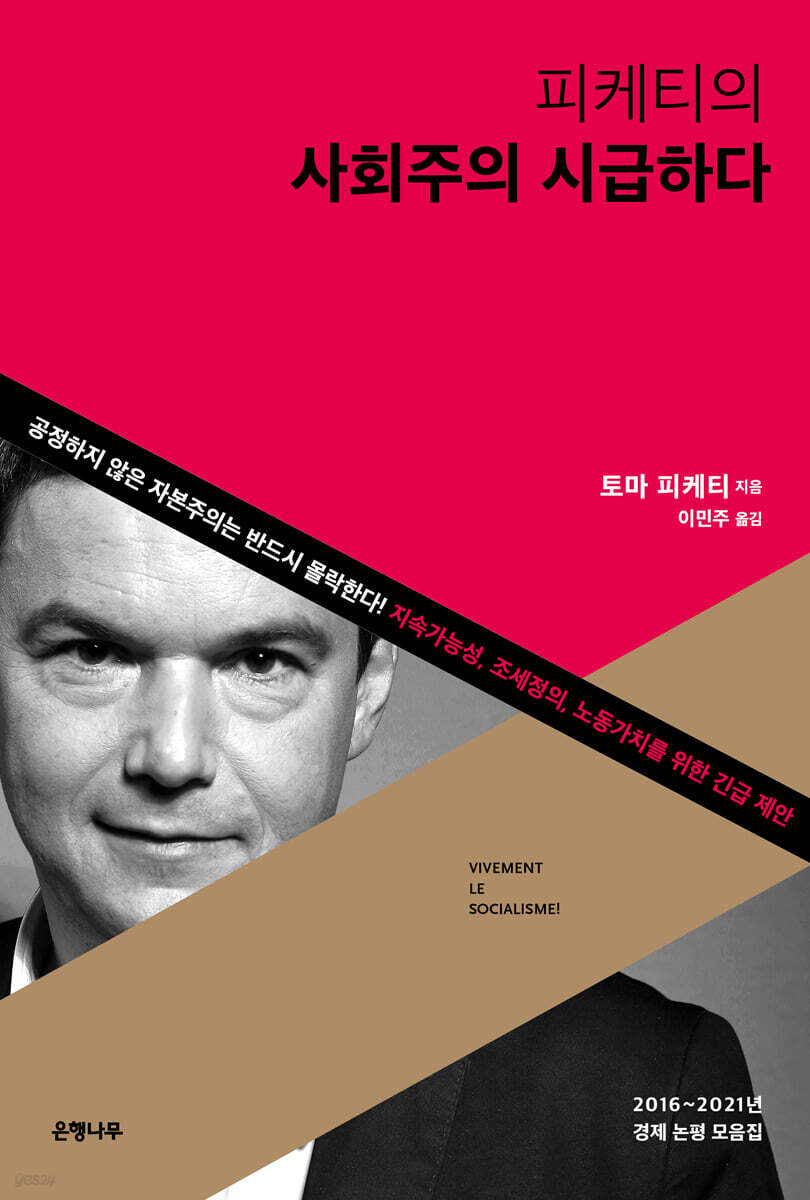
Piketty's socialism is urgent
 |
Description
Book Introduction
“Unfair capitalism will inevitably collapse!” Piketty's Urgent Proposals for Sustainability, Tax Justice, and Labor Value The one and only book that makes understanding Piketty so easy and accessible! Expanding wealth taxes to allow polarized wealth and power to circulate Economic justice that creates a fair society beyond discrimination and hatred based on gender, class, and race. The COVID-19 pandemic hastened the resolution of massive public debt and the implementation of a social security system. Thomas Piketty, an economist who has garnered worldwide attention for his sharp insights and innovative proposals, comprehensively encompassing politics, society, economy, and history, addressing the reality of an unequal society where the return on capital can never be matched by labor income and where the poor can never beat the rich. “Pikety’s Socialism Urgent,” a collection of columns he wrote for Le Monde, France’s largest daily newspaper, from 2016 to 2021, has been published. In this book, Piketty argues that we must no longer simply criticize the limitations of capitalism, but must also be able to present truly meaningful alternatives, emphasizing that the capitalist system desperately needs socialist practices that are participatory, democratic, environmentally friendly, and at the same time based on feminism, multiculturalism, and universalism. In particular, this book vividly reveals Piketty's side as a passionate activist who refuses to be confined within the framework of a theorist, such as redistribution of wealth through a 'basic income' system based on progressive taxation, equalization of education to bridge the gap between classes, a new form of globalization that is not swayed by discrimination and hatred, and ways to revive the global economy from the public debt problem caused by COVID-19, along with current international and socio-political issues of each period. This book not only allows you to see the process by which Piketty's theory was established, but also allows you to enter Piketty's thought in a much easier and more approachable way, free from the burden of existing books that were somewhat voluminous and complex. |
- You can preview some of the book's contents.
Preview
index
Socialism, urgent!
Chapter 1: For Another Globalization 2016-2017
Hillary, Apple, and Us
The IMF, Inequality, and Economic Research
The French right and the European budgeting standard
Is the wage gap between men and women 19% or 64%?
For another globalization
Basic income or fair wages?
Anthony B.
In memory of Professor Atkinson
On productivity in France and Germany
Long live populism!
To form a democratic Eurozone government
About inequality in China
What will the Eurozone parliament look like?
Public capital, private capital
Chapter 2: What Reforms Are Needed? 2017-2018
On inequality in France
What reforms are needed in France?
Reagan's 10th power
LRM members, show your resolve!
A comedy called CICE
Rethinking the Laws of Capital
Repealing the wealth tax is a mistake that will go down in history.
The 2018 Budget Sacrifices Youth
Catalonia Syndrome
Trump and Macron on the same side
Year of Europe, 2018
Parkour Ships Still Have Room for Improvement
For the union within the European Union
What is capital in Russia?
May 1968 and Inequality
The illusion of a 'coalition for social transfer'
Europe, immigrants, and trade
Italy's Nightmare: Social Indigenism
Brazil's First Republic Under Threat
Le Monde and the Billionaires
Chapter 3: If You Love, It's Time to Change_ 2018-2021
Declaration for the Democracy of Europe
Yellow Vests and Tax Justice
1789, the return of debt
America's wealth tax
If you love Europe, it's time for a change.
India's Basic Income Promise
Class divisions in Europe
The illusion of centrist environmentalism
Will the money supply save us?
What is a fair retirement plan?
Advocating for a circular economy
Let's escape identity conflict through economic justice.
Various types of universal pension systems are possible.
Following environmental issues, denial of inequality
Social federalism against national liberalism
A unique opportunity to achieve tax justice in Europe
Sanders, the savior of American democracy
Avoiding the worst
The era of green currency
Fighting Racism, Setting History Straight
Rebuilding internationalism
How to address debt in the COVID-19 era?
Global Inequality: Where Are We?
The Fall of America's Idols
Fighting Discrimination, Measuring Racism
Chapter 1: For Another Globalization 2016-2017
Hillary, Apple, and Us
The IMF, Inequality, and Economic Research
The French right and the European budgeting standard
Is the wage gap between men and women 19% or 64%?
For another globalization
Basic income or fair wages?
Anthony B.
In memory of Professor Atkinson
On productivity in France and Germany
Long live populism!
To form a democratic Eurozone government
About inequality in China
What will the Eurozone parliament look like?
Public capital, private capital
Chapter 2: What Reforms Are Needed? 2017-2018
On inequality in France
What reforms are needed in France?
Reagan's 10th power
LRM members, show your resolve!
A comedy called CICE
Rethinking the Laws of Capital
Repealing the wealth tax is a mistake that will go down in history.
The 2018 Budget Sacrifices Youth
Catalonia Syndrome
Trump and Macron on the same side
Year of Europe, 2018
Parkour Ships Still Have Room for Improvement
For the union within the European Union
What is capital in Russia?
May 1968 and Inequality
The illusion of a 'coalition for social transfer'
Europe, immigrants, and trade
Italy's Nightmare: Social Indigenism
Brazil's First Republic Under Threat
Le Monde and the Billionaires
Chapter 3: If You Love, It's Time to Change_ 2018-2021
Declaration for the Democracy of Europe
Yellow Vests and Tax Justice
1789, the return of debt
America's wealth tax
If you love Europe, it's time for a change.
India's Basic Income Promise
Class divisions in Europe
The illusion of centrist environmentalism
Will the money supply save us?
What is a fair retirement plan?
Advocating for a circular economy
Let's escape identity conflict through economic justice.
Various types of universal pension systems are possible.
Following environmental issues, denial of inequality
Social federalism against national liberalism
A unique opportunity to achieve tax justice in Europe
Sanders, the savior of American democracy
Avoiding the worst
The era of green currency
Fighting Racism, Setting History Straight
Rebuilding internationalism
How to address debt in the COVID-19 era?
Global Inequality: Where Are We?
The Fall of America's Idols
Fighting Discrimination, Measuring Racism
Detailed image
Into the book
To ensure a true circulation of power, changes in the tax and inheritance systems must also be mobilized.
This is not only to improve the distribution of power, but also to ensure that ownership itself circulates better.
As mentioned earlier, the bottom 50% of the population owns virtually nothing, and their share of total wealth has barely improved since the 19th century.
It is absurd to believe that if we wait for the total amount of global wealth to expand sufficiently, ownership will automatically be distributed well.
If such a thing were possible, shouldn't it have been realized long ago?
It is for this very reason that I support a much more voluntary solution.
The idea is to introduce a system that provides a 'minimum asset' to all citizens. This would be around 120,000 euros, which is about 60% of the current average asset size in France, to all citizens who turn 25.
Providing these assets to everyone would require a budget of about 5% of national income, which could easily be raised by combining various taxes.
For example, you can use the annual progressive asset tax (i.e., the taxable amount is the sum of real estate, financial assets, and business assets minus debt) or the progressive inheritance tax.
---From "Socialism is Urgent"
If internationalism is to have another chance on the world stage, it must explicitly abandon the ideology of pursuing absolute free trade that has driven globalization for the past several decades.
Instead, we need to introduce a different type of economic system.
This suggests that we need a model for social development based on clearly defined and verifiable principles in the areas of economic justice, tax justice, and environmental justice.
It is important that the new development model be internationalist in its ultimate purpose and based on the principle of respect for national sovereignty in its practical implementation.
---From "Socialism is Urgent"
Today in France, protests are being held to condemn the wage gap between men and women.
Today's keyword is '19%'.
It refers to the average wage gap between men and women doing the same job.
In other words, it is as if women work for men from 16:34 on November 7th every year (another way to express the French wage gap is that women's wages end with the time they work until 16:34 on November 7th of the year, and after that, they work for free compared to men's wages - translator's note).
While these numbers are symbolic, we must not forget that in reality the situation is much worse.
This is because women are not given the opportunity to perform the same work as men in the first place.
---“Is the wage gap between men and women 19% or 64%?”
Discussions surrounding the 2018 government budget have so far focused on tax breaks for the wealthiest.
In fact, the abolition of the wealth tax and the tax breaks on dividends and interest income will hit the national budget by well over 5 billion euros.
But it's also important to look at the other side of the coin.
The question is, who really suffered from the 2018 budget?
The sacrifices made by young people are particularly noticeable, as government spending per student in higher education has decreased.
[…] Let me be clear.
This reduction in education budgets is completely anachronistic and undoubtedly a huge problem.
Moreover, this is blatantly contrary to the official discourse of the European Union.
Doesn't the European Union proudly proclaim that its primary goal is to invest in education and innovation?
The European Union only sets the slogan, but has no interest in whether its member states actually invest to achieve it.
Moreover, this attitude of 'noisy silence' stands in stark contrast to the usual behavior of EU institutions, which are naturally adept at judging right and wrong in all kinds of reforms.
With investment per student falling by 10% between 2008 and 2018, how can Europe achieve its goal of becoming “the world’s most competitive knowledge economy” between now and 2020 (a goal declared by European leaders at the Lisbon Treaty in 2000, initially set for 2010 but subsequently delayed)?
This is not only to improve the distribution of power, but also to ensure that ownership itself circulates better.
As mentioned earlier, the bottom 50% of the population owns virtually nothing, and their share of total wealth has barely improved since the 19th century.
It is absurd to believe that if we wait for the total amount of global wealth to expand sufficiently, ownership will automatically be distributed well.
If such a thing were possible, shouldn't it have been realized long ago?
It is for this very reason that I support a much more voluntary solution.
The idea is to introduce a system that provides a 'minimum asset' to all citizens. This would be around 120,000 euros, which is about 60% of the current average asset size in France, to all citizens who turn 25.
Providing these assets to everyone would require a budget of about 5% of national income, which could easily be raised by combining various taxes.
For example, you can use the annual progressive asset tax (i.e., the taxable amount is the sum of real estate, financial assets, and business assets minus debt) or the progressive inheritance tax.
---From "Socialism is Urgent"
If internationalism is to have another chance on the world stage, it must explicitly abandon the ideology of pursuing absolute free trade that has driven globalization for the past several decades.
Instead, we need to introduce a different type of economic system.
This suggests that we need a model for social development based on clearly defined and verifiable principles in the areas of economic justice, tax justice, and environmental justice.
It is important that the new development model be internationalist in its ultimate purpose and based on the principle of respect for national sovereignty in its practical implementation.
---From "Socialism is Urgent"
Today in France, protests are being held to condemn the wage gap between men and women.
Today's keyword is '19%'.
It refers to the average wage gap between men and women doing the same job.
In other words, it is as if women work for men from 16:34 on November 7th every year (another way to express the French wage gap is that women's wages end with the time they work until 16:34 on November 7th of the year, and after that, they work for free compared to men's wages - translator's note).
While these numbers are symbolic, we must not forget that in reality the situation is much worse.
This is because women are not given the opportunity to perform the same work as men in the first place.
---“Is the wage gap between men and women 19% or 64%?”
Discussions surrounding the 2018 government budget have so far focused on tax breaks for the wealthiest.
In fact, the abolition of the wealth tax and the tax breaks on dividends and interest income will hit the national budget by well over 5 billion euros.
But it's also important to look at the other side of the coin.
The question is, who really suffered from the 2018 budget?
The sacrifices made by young people are particularly noticeable, as government spending per student in higher education has decreased.
[…] Let me be clear.
This reduction in education budgets is completely anachronistic and undoubtedly a huge problem.
Moreover, this is blatantly contrary to the official discourse of the European Union.
Doesn't the European Union proudly proclaim that its primary goal is to invest in education and innovation?
The European Union only sets the slogan, but has no interest in whether its member states actually invest to achieve it.
Moreover, this attitude of 'noisy silence' stands in stark contrast to the usual behavior of EU institutions, which are naturally adept at judging right and wrong in all kinds of reforms.
With investment per student falling by 10% between 2008 and 2018, how can Europe achieve its goal of becoming “the world’s most competitive knowledge economy” between now and 2020 (a goal declared by European leaders at the Lisbon Treaty in 2000, initially set for 2010 but subsequently delayed)?
---From "2018 Budget, Sacrificing Youth"
Publisher's Review
Income distribution inequality and social polarization reaching extremes,
From identity conflicts around the world to massive public debt in the COVID-19 era,
Piketty's innovative alternative to save capitalism from its limits.
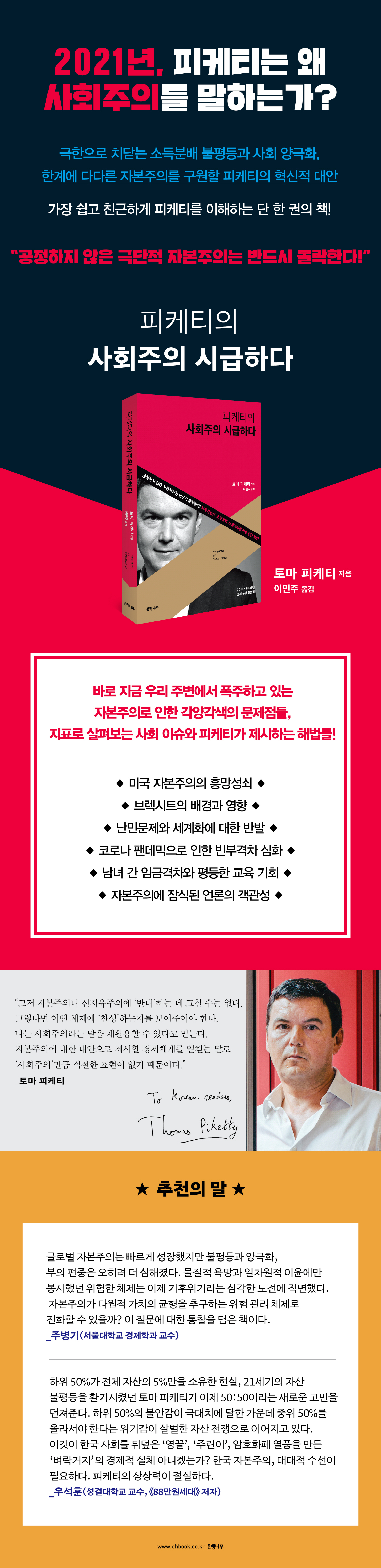
In 2021, why is Piketty talking about socialism?
In a column with the somewhat provocative title “Socialism Urgent,” Piketty explains why he published a book of the same name:
“We cannot simply ‘oppose’ capitalism or neoliberalism.
Then, you have to show which system you are 'in favor of'.
I believe we can recycle the word socialism.
A term referring to an economic system that can be presented as an alternative to capitalism.
“Because there is no expression more appropriate than ‘socialism.’”
Many agree that today's capitalism has its limitations: it exacerbates inequality and depletes natural resources.
But why isn't change happening quickly enough and at the pace needed? Piketty argues that the reason lies in the lack of a clear alternative.
He also says that as a scholar who has studied global inequality and wealth distribution, despite being part of a generation that witnessed the collapse of socialism in the 1990s and was not tempted by it, there is no expression that encompasses alternatives to capitalism as well as the term “socialism.”
From the rise and fall of Trump, the rise of the Macron administration in France, the background and impact of Brexit, the identity conflicts clashing around the world across gender, social class, and race, to the increasing national debt caused by the COVID-19 pandemic, Piketty's pen truly reveals his side as a vibrant practitioner.
The "minimum asset" system that realizes the circulation of power and assets
Urging the realization of tax justice to improve wealth inequality
The capital of the highest income class is increasing at an ever-increasing rate, and economic indicators from around the world, including Europe, the United States, China, and Japan, objectively demonstrate that wealth polarization is worsening.
In this regard, Piketty loudly criticizes the social politics and the state of those in power that are going against the times, despite the fact that tax justice is more important than anything else.
In particular, he points out that France's education policy, which reduces progressive taxes while increasing the education budget to the level of inflation, is going against the times, and repeatedly emphasizes that historically, the improvement in a country's labor productivity was ultimately due to investment in education.
Inequality in education is directly impacting the social ladder, and ultimately, to solve this problem, it is necessary to actively implement systems that accelerate the circulation of power and assets throughout society, such as wealth taxes.
Piketty argues that while the world's wealthy giants and the wealthiest classes may believe they have earned their wealth through their own efforts and abilities, they were simply lucky enough to seize natural and human resources that they had no ownership rights over in the first place, and that large assets beyond a certain level should be treated as temporary and cyclical.
He proposes strengthening the progressive tax system, including the property tax and inheritance tax, to provide a "minimum asset" to all citizens through a top-tier wealth tax of around 80-90%.
Piketty also refutes concerns raised by many that these tax reforms will lead to major corporations leaving the country, arguing that historically, such a worrying situation has never occurred, and that their assets have actually grown at a much faster rate.
Discrimination and hatred based on gender, social class, and race
How can we resolve the identity conflict that has gripped Korea and the world?
Piketty says that the just society he dreams of is one in which everyone has fair access to basic goods such as education, health, housing, and the environment, and through these, can fully participate in economic activity. He also says that this cannot be achieved through financial assistance alone.
Nonetheless, he says that the basic asset system can serve as an important foundation for resolving the increasingly deepening conflicts in various parts of society.
The world today is experiencing extreme conflict due to discrimination and hatred.
For example, in the issue of gender discrimination, it is pointed out that the wage gap cannot be explained by simple numerical comparisons.
A simple comparison of the wage gap between men and women does not reflect the fact that women do not have equal job opportunities as men in the first place, and this also leads to differences in pensions after retirement.
In addition, numerous types of discrimination and hatred based on identity, such as ethnicity, origin, religion, and culture, are clashing all over the world, including in Europe, the United States, and Asia.
Piketty points out that the root cause of this deepening identity conflict, which has no way out, is the lack of discussion on economic issues.
Only when the state imposes sanctions on such discriminatory acts and society structurally realizes economic justice can identity conflicts be resolved.
Media independence, a new face of globalism, the post-pandemic economy…
A Sustainable and Fair Society for 21st Century Korea and the World
Piketty also suggests practical ways to address the need for a new form of globalism that is not mired in racial conflict and refugee issues, citing how the media can maintain its independence from capital, the mounting national debt following the COVID-19 pandemic, and the need for a new form of globalism.
It also criticizes the outdated perspective of economic agreements that only pursue free trade through the abolition of various tariffs in the past, and harshly criticizes the behavior of countries around the world that have only signed the Paris Climate Agreement but have no intention of achieving the agreement's goals.
He also points out the injustice of easily giving up on social issues such as tax inequality and tax evasion by large corporations, which are the root causes of social polarization, while only pointing the finger at immigrants and refugees, and ultimately argues for the need for a new form of globalism.
By following Piketty's arguments on various international issues, we can see that the complex and diverse problems facing Korean society today are not unique to Korea. Furthermore, we can find new perspectives on these problems and inspiration for solutions.
Piketty ultimately says that what he wants to include in this book is not solutions or conclusions to the problems of our political society, but rather the raising of issues and the beginning of a discussion.
Only when sufficient social discussion and consensus are reached can the world society advance further.
From this perspective, the urgent need Piketty advocates is none other than citizens' active interest in the political, social, and economic issues facing all of us in this era.
From identity conflicts around the world to massive public debt in the COVID-19 era,
Piketty's innovative alternative to save capitalism from its limits.
In 2021, why is Piketty talking about socialism?
In a column with the somewhat provocative title “Socialism Urgent,” Piketty explains why he published a book of the same name:
“We cannot simply ‘oppose’ capitalism or neoliberalism.
Then, you have to show which system you are 'in favor of'.
I believe we can recycle the word socialism.
A term referring to an economic system that can be presented as an alternative to capitalism.
“Because there is no expression more appropriate than ‘socialism.’”
Many agree that today's capitalism has its limitations: it exacerbates inequality and depletes natural resources.
But why isn't change happening quickly enough and at the pace needed? Piketty argues that the reason lies in the lack of a clear alternative.
He also says that as a scholar who has studied global inequality and wealth distribution, despite being part of a generation that witnessed the collapse of socialism in the 1990s and was not tempted by it, there is no expression that encompasses alternatives to capitalism as well as the term “socialism.”
From the rise and fall of Trump, the rise of the Macron administration in France, the background and impact of Brexit, the identity conflicts clashing around the world across gender, social class, and race, to the increasing national debt caused by the COVID-19 pandemic, Piketty's pen truly reveals his side as a vibrant practitioner.
The "minimum asset" system that realizes the circulation of power and assets
Urging the realization of tax justice to improve wealth inequality
The capital of the highest income class is increasing at an ever-increasing rate, and economic indicators from around the world, including Europe, the United States, China, and Japan, objectively demonstrate that wealth polarization is worsening.
In this regard, Piketty loudly criticizes the social politics and the state of those in power that are going against the times, despite the fact that tax justice is more important than anything else.
In particular, he points out that France's education policy, which reduces progressive taxes while increasing the education budget to the level of inflation, is going against the times, and repeatedly emphasizes that historically, the improvement in a country's labor productivity was ultimately due to investment in education.
Inequality in education is directly impacting the social ladder, and ultimately, to solve this problem, it is necessary to actively implement systems that accelerate the circulation of power and assets throughout society, such as wealth taxes.
Piketty argues that while the world's wealthy giants and the wealthiest classes may believe they have earned their wealth through their own efforts and abilities, they were simply lucky enough to seize natural and human resources that they had no ownership rights over in the first place, and that large assets beyond a certain level should be treated as temporary and cyclical.
He proposes strengthening the progressive tax system, including the property tax and inheritance tax, to provide a "minimum asset" to all citizens through a top-tier wealth tax of around 80-90%.
Piketty also refutes concerns raised by many that these tax reforms will lead to major corporations leaving the country, arguing that historically, such a worrying situation has never occurred, and that their assets have actually grown at a much faster rate.
Discrimination and hatred based on gender, social class, and race
How can we resolve the identity conflict that has gripped Korea and the world?
Piketty says that the just society he dreams of is one in which everyone has fair access to basic goods such as education, health, housing, and the environment, and through these, can fully participate in economic activity. He also says that this cannot be achieved through financial assistance alone.
Nonetheless, he says that the basic asset system can serve as an important foundation for resolving the increasingly deepening conflicts in various parts of society.
The world today is experiencing extreme conflict due to discrimination and hatred.
For example, in the issue of gender discrimination, it is pointed out that the wage gap cannot be explained by simple numerical comparisons.
A simple comparison of the wage gap between men and women does not reflect the fact that women do not have equal job opportunities as men in the first place, and this also leads to differences in pensions after retirement.
In addition, numerous types of discrimination and hatred based on identity, such as ethnicity, origin, religion, and culture, are clashing all over the world, including in Europe, the United States, and Asia.
Piketty points out that the root cause of this deepening identity conflict, which has no way out, is the lack of discussion on economic issues.
Only when the state imposes sanctions on such discriminatory acts and society structurally realizes economic justice can identity conflicts be resolved.
Media independence, a new face of globalism, the post-pandemic economy…
A Sustainable and Fair Society for 21st Century Korea and the World
Piketty also suggests practical ways to address the need for a new form of globalism that is not mired in racial conflict and refugee issues, citing how the media can maintain its independence from capital, the mounting national debt following the COVID-19 pandemic, and the need for a new form of globalism.
It also criticizes the outdated perspective of economic agreements that only pursue free trade through the abolition of various tariffs in the past, and harshly criticizes the behavior of countries around the world that have only signed the Paris Climate Agreement but have no intention of achieving the agreement's goals.
He also points out the injustice of easily giving up on social issues such as tax inequality and tax evasion by large corporations, which are the root causes of social polarization, while only pointing the finger at immigrants and refugees, and ultimately argues for the need for a new form of globalism.
By following Piketty's arguments on various international issues, we can see that the complex and diverse problems facing Korean society today are not unique to Korea. Furthermore, we can find new perspectives on these problems and inspiration for solutions.
Piketty ultimately says that what he wants to include in this book is not solutions or conclusions to the problems of our political society, but rather the raising of issues and the beginning of a discussion.
Only when sufficient social discussion and consensus are reached can the world society advance further.
From this perspective, the urgent need Piketty advocates is none other than citizens' active interest in the political, social, and economic issues facing all of us in this era.
GOODS SPECIFICS
- Publication date: June 10, 2021
- Page count, weight, size: 408 pages | 556g | 146*215*30mm
- ISBN13: 9791167370273
- ISBN10: 1167370279
You may also like
카테고리
korean


korean

![GQ KOREA Mark (Monthly): December [2025]](http://librairie.coreenne.fr/cdn/shop/files/8ef265dbbfbf186523ed75ba7319009d.jpg?v=1765340328&width=3840)


