

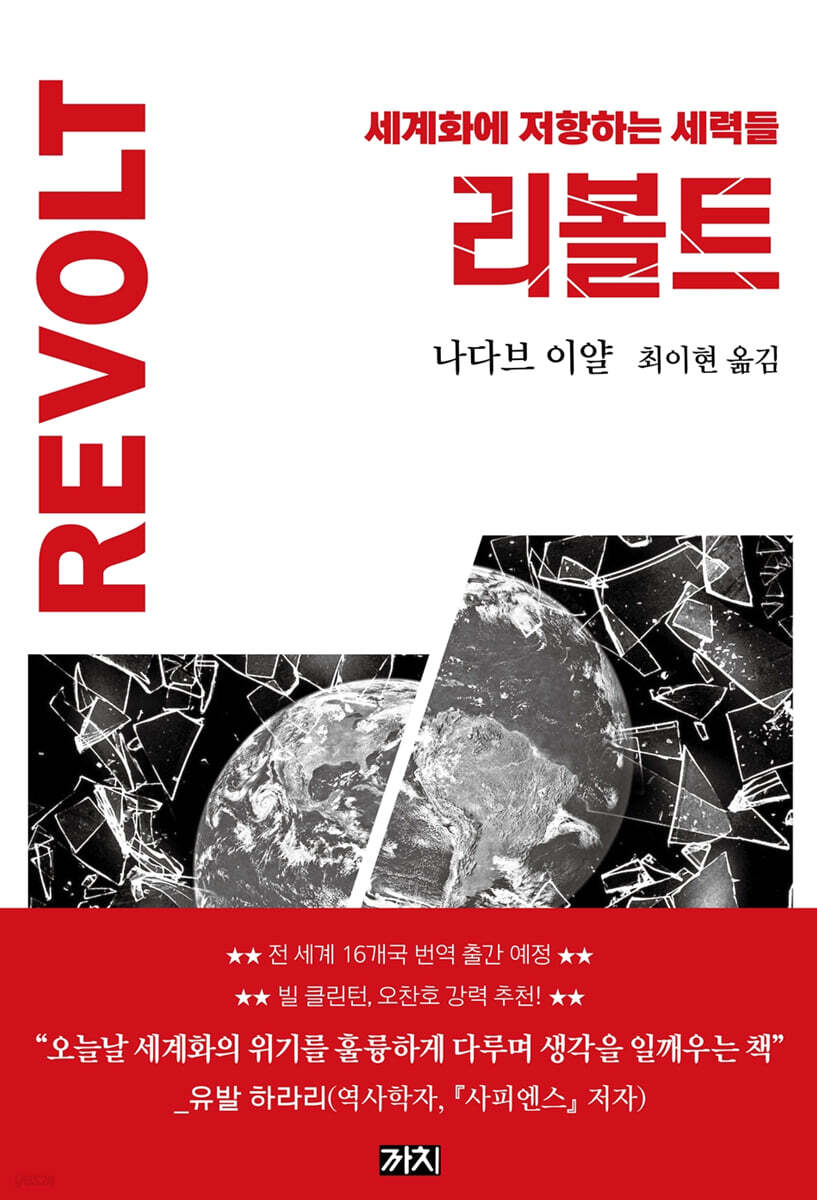
Revolt
 |
Description
Book Introduction
- A word from MD
-
Why is the world angry?Israeli journalist Nadav Eyal has spent over a decade covering people around the world suffering from globalization.
The cases in the book are things we are vaguely familiar with.
Globalization threatens the survival of many people through inequality, labor exploitation, and ecological destruction.
To prevent catastrophe, we must now face reality.
February 23, 2021. Social and Political PD Son Min-gyu
How has globalization changed the lives of people around the world?
A vivid portrayal of the crises people face today, through the eyes of a journalist!
"Revolt," a book recommended by Yuval Harari and scheduled to be published in 16 countries around the world, is a reportage that traces how globalization has changed the lives of people around the world and, based on this, exposes the reality of globalization.
Nadav Eyal, the author of this book and a leading Israeli journalist and winner of the Sokolov Prize, Israel's equivalent of the Pulitzer Prize, has spent over a decade covering events that have occurred in various places since globalization and sharing the voices of the people he met along the way.
By approaching the truth about globalization that we all know but no one wants to talk about, the author seeks to unravel why today's globalization is unsustainable.
Through the journalist's eyes, the lives of those resisting globalization are sharply analyzed and described, allowing readers to vividly experience the dark side of globalization.
A vivid portrayal of the crises people face today, through the eyes of a journalist!
"Revolt," a book recommended by Yuval Harari and scheduled to be published in 16 countries around the world, is a reportage that traces how globalization has changed the lives of people around the world and, based on this, exposes the reality of globalization.
Nadav Eyal, the author of this book and a leading Israeli journalist and winner of the Sokolov Prize, Israel's equivalent of the Pulitzer Prize, has spent over a decade covering events that have occurred in various places since globalization and sharing the voices of the people he met along the way.
By approaching the truth about globalization that we all know but no one wants to talk about, the author seeks to unravel why today's globalization is unsustainable.
Through the journalist's eyes, the lives of those resisting globalization are sharply analyzed and described, allowing readers to vividly experience the dark side of globalization.
- You can preview some of the book's contents.
Preview
index
Preface to the Korean edition
Preface: The Death of an Era
1.
Media outlets under attack
2.
People who bathe twice a month
3.
Globalization War
4.
The Last Land of Elephants
5.
“We refuse to die.”
6.
Signs of resistance
7.
Conversation with a Nationalist
8.
The Resurgence of Nazism
9.
Middle class resistance
10.
Ferrari-driving anarchist
11.
Disappearing Children
12.
The crisis facing humanity
13.
People who escape
14.
Experiments and their costs
15.
River stained with blood
16.
The Story of an Imperial Citizen
17.
“My mother was murdered here.”
18.
anti-globalization activist
19.
The collapse of truth
20.
The fight for progress
21.
New story
Acknowledgements
main
Translator's Note
Biographical Index
Preface: The Death of an Era
1.
Media outlets under attack
2.
People who bathe twice a month
3.
Globalization War
4.
The Last Land of Elephants
5.
“We refuse to die.”
6.
Signs of resistance
7.
Conversation with a Nationalist
8.
The Resurgence of Nazism
9.
Middle class resistance
10.
Ferrari-driving anarchist
11.
Disappearing Children
12.
The crisis facing humanity
13.
People who escape
14.
Experiments and their costs
15.
River stained with blood
16.
The Story of an Imperial Citizen
17.
“My mother was murdered here.”
18.
anti-globalization activist
19.
The collapse of truth
20.
The fight for progress
21.
New story
Acknowledgements
main
Translator's Note
Biographical Index
Detailed image
.jpg)
Publisher's Review
If the production cost is lower and the price of imported goods is lower,
This will be the price paid by people living elsewhere who sacrificed their lives.
This book shows the true face of globalization through the stories of people whose lives have changed due to globalization.
Globalization has helped lift countless people out of dire poverty, reduced illiteracy, and played a significant role in improving human lives, but it has also exploited people's labor.
European and American companies have exploited various regions around the world as exploitation hubs, where labor, energy, and raw materials are available at low prices.
Poor countries in Africa and Asia, desperate for foreign currency and jobs, are falling into the trap set by corporations.
In addition, globalization has ruthlessly destroyed the Earth's ecosystem.
One study found that climate change caused by globalization could push 122 million people back into poverty by 2030.
Furthermore, voices are growing louder that consumerism and relentless production are damaging the ecosystem to a point of irreversible damage, and that neither humans nor animals will survive unless we change.
This book talks about the people who are paying the price of globalization with their whole bodies, and through their voices, it looks into the dark shadows hidden behind globalization.
The miners of Pennsylvania, the people of a Japanese village struggling with a declining birth rate, and the refugees trying to escape their homeland from a catastrophe to safety vividly portray the crises facing the world today.
“I had to decide between Hillary and Trump, two liars.
And I thought at least Trump would try.”
The author uses the situation in Asia as an example to explain the impact of globalization on people.
Thanks to cheap labor in Asia, smartphone prices have stabilized at a reasonable level, but the pollutants generated during their production remain in the production sites, threatening people's lives.
Today, China produces a huge amount of goods for overseas, especially Western, consumers, and as factories are relocated to East Asia to take advantage of lower labor costs, pollutants are also transferred to developing countries.
This clearly demonstrates that globalization is happening even in the air, without the need for border controls, customs regulations, or the dictates of international organizations.
This increase in international trade and imports had a direct impact on the United States.
Americans were able to buy goods at lower prices, which improved their standard of living, but at the same time, American industry was in decline.
According to one study, at least 1 million people lost their jobs in the U.S. manufacturing sector in just a few years in the 2000s, and some of those people were rehired in lower-paying, less secure jobs.
During the 2016 presidential campaign, Trump said, “While skyscrapers are rising in Beijing and cities around the world, Detroit’s factories and towns are being torn down.”
The author explains that these circumstances played a decisive role in Trump's election as president.
The miners in the abandoned Waynesburg mines the author met told him about two things they had heard.
The first is Trump's promise to revive the dying coal industry, and the second is Hillary's promise that no government can bail them out.
Most people the author spoke to emphasized that they disliked Trump, but they would rather have someone who promised to halt the impossibly powerful tide of globalization than someone who promised to create solutions after they were dead.
Ultimately, the people who made Trump president were not "Shy Trump," but those who faced livelihood issues.
In this way, the book addresses the problems faced by people around the world and emphasizes that in a globalized world, crises in one region are not confined to that region.
A local crisis initially stays local, but soon spreads nationwide, then to neighboring countries, and eventually to the entire world.
The only difference is the timing; the crisis that any country is experiencing now is no different from the crisis we will eventually face.
The author seeks to suggest the path forward by exploring the resistance movements taking place around the world today.
An attitude that ignores the problems of exploitation and destruction of the ecosystem due to globalization
It is the result of moral choice, not ignorance.
This book, over 21 chapters, tells the story of the resistance he encountered.
At first glance, the stories in this book may seem like disparate cases from completely different places, but as you read through the chapters, you'll realize that they all stem from a single phenomenon: globalization.
Yuval Harari, author of Sapiens, said of this book, “Revolt brilliantly addresses the crisis of globalization today and awakens our thoughts.
“Not everyone will agree with Nadav Eyal’s interpretation, but few will be indifferent,” he says.
While not all readers of this book will be able to identify with the individuals featured in it, it will offer them a glimpse into the realities facing the world, prompting them to reconsider the debt we owe to others in a globalized world and the direction we must take going forward.
Therefore, this book can be said to be a record of resistance, containing the lives of those who are paying the price of globalization with their whole bodies, and a guide to the path we must take going forward.
This will be the price paid by people living elsewhere who sacrificed their lives.
This book shows the true face of globalization through the stories of people whose lives have changed due to globalization.
Globalization has helped lift countless people out of dire poverty, reduced illiteracy, and played a significant role in improving human lives, but it has also exploited people's labor.
European and American companies have exploited various regions around the world as exploitation hubs, where labor, energy, and raw materials are available at low prices.
Poor countries in Africa and Asia, desperate for foreign currency and jobs, are falling into the trap set by corporations.
In addition, globalization has ruthlessly destroyed the Earth's ecosystem.
One study found that climate change caused by globalization could push 122 million people back into poverty by 2030.
Furthermore, voices are growing louder that consumerism and relentless production are damaging the ecosystem to a point of irreversible damage, and that neither humans nor animals will survive unless we change.
This book talks about the people who are paying the price of globalization with their whole bodies, and through their voices, it looks into the dark shadows hidden behind globalization.
The miners of Pennsylvania, the people of a Japanese village struggling with a declining birth rate, and the refugees trying to escape their homeland from a catastrophe to safety vividly portray the crises facing the world today.
“I had to decide between Hillary and Trump, two liars.
And I thought at least Trump would try.”
The author uses the situation in Asia as an example to explain the impact of globalization on people.
Thanks to cheap labor in Asia, smartphone prices have stabilized at a reasonable level, but the pollutants generated during their production remain in the production sites, threatening people's lives.
Today, China produces a huge amount of goods for overseas, especially Western, consumers, and as factories are relocated to East Asia to take advantage of lower labor costs, pollutants are also transferred to developing countries.
This clearly demonstrates that globalization is happening even in the air, without the need for border controls, customs regulations, or the dictates of international organizations.
This increase in international trade and imports had a direct impact on the United States.
Americans were able to buy goods at lower prices, which improved their standard of living, but at the same time, American industry was in decline.
According to one study, at least 1 million people lost their jobs in the U.S. manufacturing sector in just a few years in the 2000s, and some of those people were rehired in lower-paying, less secure jobs.
During the 2016 presidential campaign, Trump said, “While skyscrapers are rising in Beijing and cities around the world, Detroit’s factories and towns are being torn down.”
The author explains that these circumstances played a decisive role in Trump's election as president.
The miners in the abandoned Waynesburg mines the author met told him about two things they had heard.
The first is Trump's promise to revive the dying coal industry, and the second is Hillary's promise that no government can bail them out.
Most people the author spoke to emphasized that they disliked Trump, but they would rather have someone who promised to halt the impossibly powerful tide of globalization than someone who promised to create solutions after they were dead.
Ultimately, the people who made Trump president were not "Shy Trump," but those who faced livelihood issues.
In this way, the book addresses the problems faced by people around the world and emphasizes that in a globalized world, crises in one region are not confined to that region.
A local crisis initially stays local, but soon spreads nationwide, then to neighboring countries, and eventually to the entire world.
The only difference is the timing; the crisis that any country is experiencing now is no different from the crisis we will eventually face.
The author seeks to suggest the path forward by exploring the resistance movements taking place around the world today.
An attitude that ignores the problems of exploitation and destruction of the ecosystem due to globalization
It is the result of moral choice, not ignorance.
This book, over 21 chapters, tells the story of the resistance he encountered.
At first glance, the stories in this book may seem like disparate cases from completely different places, but as you read through the chapters, you'll realize that they all stem from a single phenomenon: globalization.
Yuval Harari, author of Sapiens, said of this book, “Revolt brilliantly addresses the crisis of globalization today and awakens our thoughts.
“Not everyone will agree with Nadav Eyal’s interpretation, but few will be indifferent,” he says.
While not all readers of this book will be able to identify with the individuals featured in it, it will offer them a glimpse into the realities facing the world, prompting them to reconsider the debt we owe to others in a globalized world and the direction we must take going forward.
Therefore, this book can be said to be a record of resistance, containing the lives of those who are paying the price of globalization with their whole bodies, and a guide to the path we must take going forward.
GOODS SPECIFICS
- Publication date: February 22, 2021
- Page count, weight, size: 496 pages | 714g | 153*225*23mm
- ISBN13: 9788972917328
- ISBN10: 897291732X
You may also like
카테고리
korean


korean

![GQ KOREA Mark (Monthly): December [2025]](http://librairie.coreenne.fr/cdn/shop/files/8ef265dbbfbf186523ed75ba7319009d.jpg?v=1765340328&width=3840)


