

Masters of Scale
 |
Description
Book Introduction
- A word from MD
-
Top 0.1% Success StrategiesThis book is based on the podcast 'Masters of Scale', which has become a business bible through interviews with the most successful entrepreneurs.
You can glimpse the secrets of business success through the vivid startup stories and growth strategies of well-known entrepreneurs such as Bill Gates and Howard Schultz.
June 7, 2022. Economics and Management PD Kim Sang-geun
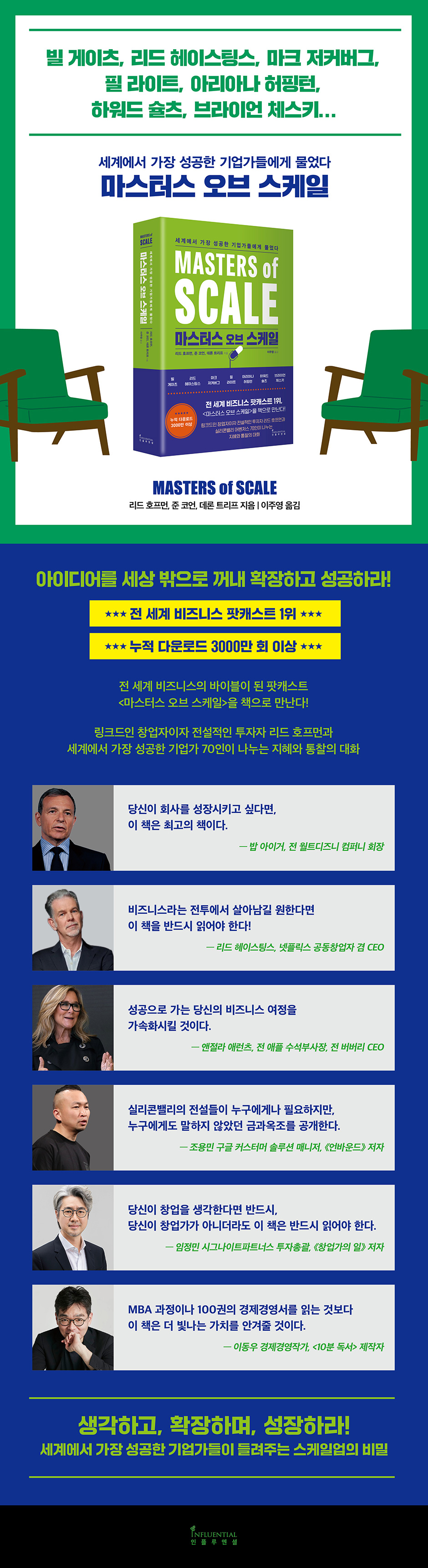
“Think, expand, grow.”
LinkedIn founder and legendary investor Reid Hoffman
A conversation of wisdom and insight shared by 70 Silicon Valley Avengers!
“If you want to grow your business, this is the best book.”
Bob Iger, former Chairman and CEO of The Walt Disney Company
“If you want to survive the battle of business, you must read this book!”
Reed Hastings, Netflix co-founder and CEO
Over 30 million cumulative downloads,
The podcast that became the bible of business around the world.
[Masters of Scale] is now available as a book!
Masters of Scale, a podcast that premiered on May 3, 2017 with an episode featuring Airbnb CEO Brian Chesky, has grown over the past five years into a premier medium for sharing business insights and wisdom around the world.
This podcast, produced by LinkedIn co-founder and legendary Silicon Valley investor Reid Hoffman, June Cohen, who led TED's media organization, and Deron Triff, features former US President Barack Obama and iconic entrepreneurs Bill Gates (Microsoft), Reed Hastings (Netflix), Howard Schultz (Starbucks), Mark Zuckerberg (Facebook), and Brian Chesky (Airbnb), who share the vivid stories of the world's most successful entrepreneurs as they share their startup stories, the process of their companies growing, and the insights they gained along the way.
Based on the podcast of the same name, the book Masters of Scale, based on these original interviews with Reid Hoffman, presents the best strategies of the top 0.1% of entrepreneurs who have 'grown' their companies from zero to infinity.
Successful entrepreneurs don't get discouraged by numerous rejections, but rather explore and try various possibilities to grow their companies into the best.
This book connects the perspectives of 70 legendary entrepreneurs through interviews, uncovering common patterns and providing readers with valuable business insights.
There is no formula for success.
Startups are no longer just the success stories of hoodie-wearing 20-somethings.
Regardless of age, gender, wealth, or education level, this book presents an opportunity to take your ideas out into the world and scale them.
LinkedIn founder and legendary investor Reid Hoffman
A conversation of wisdom and insight shared by 70 Silicon Valley Avengers!
“If you want to grow your business, this is the best book.”
Bob Iger, former Chairman and CEO of The Walt Disney Company
“If you want to survive the battle of business, you must read this book!”
Reed Hastings, Netflix co-founder and CEO
Over 30 million cumulative downloads,
The podcast that became the bible of business around the world.
[Masters of Scale] is now available as a book!
Masters of Scale, a podcast that premiered on May 3, 2017 with an episode featuring Airbnb CEO Brian Chesky, has grown over the past five years into a premier medium for sharing business insights and wisdom around the world.
This podcast, produced by LinkedIn co-founder and legendary Silicon Valley investor Reid Hoffman, June Cohen, who led TED's media organization, and Deron Triff, features former US President Barack Obama and iconic entrepreneurs Bill Gates (Microsoft), Reed Hastings (Netflix), Howard Schultz (Starbucks), Mark Zuckerberg (Facebook), and Brian Chesky (Airbnb), who share the vivid stories of the world's most successful entrepreneurs as they share their startup stories, the process of their companies growing, and the insights they gained along the way.
Based on the podcast of the same name, the book Masters of Scale, based on these original interviews with Reid Hoffman, presents the best strategies of the top 0.1% of entrepreneurs who have 'grown' their companies from zero to infinity.
Successful entrepreneurs don't get discouraged by numerous rejections, but rather explore and try various possibilities to grow their companies into the best.
This book connects the perspectives of 70 legendary entrepreneurs through interviews, uncovering common patterns and providing readers with valuable business insights.
There is no formula for success.
Startups are no longer just the success stories of hoodie-wearing 20-somethings.
Regardless of age, gender, wealth, or education level, this book presents an opportunity to take your ideas out into the world and scale them.
- You can preview some of the book's contents.
Preview
index
Introduction I: Interviews with the World's Most Successful Entrepreneurs
Chapter 1.
Rejection creates another opportunity
How to distinguish between good rejection and bad rejection
ㆍ I was rejected 148 times in investment pitching.
When everyone says 'no'
ㆍ 1% investment pitching success rate
ㆍ The real voice contained in the ambiguous answer
ㆍ Opponents aren't always right.
Don't let rejection control you.
ㆍ About the 'No' that reminds you of your mistakes
Why advice from family or friends is dangerous
Chapter 2.
Now is the time to do 'that thing'
―Things you must do before scaling up
ㆍThe question, 'Where are your users?'
ㆍ Onboarding strategy for each and every user
ㆍ Establish a constitution for the user community.
ㆍ A handmade mindset that upholds core values
ㆍ Build a strong initial partnership.
Coexistence with threatening obstacles
Chapter 3.
A hero's epic begins with an idea.
How to identify a successful idea
Failure is inevitable
If a crazy idea comes to mind, act on it immediately.
The power of simple and imperfect ideas
ㆍThe thought, 'Could this become a business?'
Born to solve everyday problems
ㆍ Twist an already successful formula
Some ideas come from a sense of calling.
ㆍ A groundbreaking idea born from adversity
ㆍ Find bad ideas
Chapter 4.
If you create a culture without loopholes, you become a culture of fools.
Why Companies Need to Build Culture
Netflix's culture built through failure
How Entrepreneurial Thoughts Become Culture
ㆍ Entrepreneurs' passion as a shared belief
ㆍ Experience the culture in your work space
ㆍ The right culture for the right people
The essence of corporate culture is people.
ㆍ Consider diversity in all dimensions
Chapter 5.
Speed is important for growth too
Strategic growth requires a balance of speed and slowness.
Why speed is important for startup growth
ㆍ Time to prepare to move again
ㆍGet out of the competition quickly rather than winning the competition.
ㆍ Make decisions quickly like an airplane pilot.
Problems that arise when starting without considering scale-up
The more investment, the better.
ㆍ We reject investments that violate our core values.
Chapter 6.
There is no formula for success.
―How to learn new rules of the game
ㆍ You must even abandon your own formula for success.
ㆍ Don't stop adventuring into an unfamiliar world.
ㆍ Learning to solve difficult problems
ㆍ Every business should do this
ㆍ Test uncertain hypotheses
ㆍ All teachings come at the right time1
ㆍLearning method of CEO with an engineering background
Chapter 7.
Pay attention to actions, not words.
―Why users' words and actions differ
ㆍ Two types of feedback: words and actions
Don't trust what users tell you about the future.
Become a follower first
ㆍ There is always a reason for a user's actions.
ㆍ Opportunities hidden in deceptive behavior
ㆍContinue to follow what users want
Users pioneer new paths
Culture is effective when it is actually defined.
Connect user empathy to data.
ㆍWhy you should listen carefully to what your users say
ㆍ From virtual products to real products
Chapter 8.
Explore and try out various possibilities
―The art of pivoting: turning a crisis into an opportunity
When is the best time to change direction?
ㆍ A pivot strategy that reboots almost everything
ㆍ From an online shopping mall to an e-commerce solution platform
ㆍ Things to do before pivoting
ㆍ Pivoting in response to crisis situations
ㆍ The wisdom and pivot strategies of entrepreneurs who overcome crises.
ㆍ Create greater power through industry collaboration.
Great startups are born in the most desperate situations.
Chapter 9.
Lead and lead again
―Corporate Growth and Leadership Evolution
ㆍ Conditions for leadership that leads change
A leadership philosophy centered on compassion
A leader is someone who pursues truth.
ㆍ Psychological safety that it is okay to be honest
ㆍ Saving companies from the shadow of a performance-based culture
How to develop talent within the company
Chapter 10.
What name will you leave in the world?
―Corporate social impact and responsibility
A culture where profit and conscience are balanced
ㆍ The starting point of change that creates a cycle of good deeds
ㆍ Unlock the network
How to utilize cloud sourcing
As a company grows, its positive influence expands.
ㆍ Add social responsibility as a function
How to make the world a better place
ㆍMoving people's hearts with stories
Management focused on diversity and connection
Acknowledgements
Search
Chapter 1.
Rejection creates another opportunity
How to distinguish between good rejection and bad rejection
ㆍ I was rejected 148 times in investment pitching.
When everyone says 'no'
ㆍ 1% investment pitching success rate
ㆍ The real voice contained in the ambiguous answer
ㆍ Opponents aren't always right.
Don't let rejection control you.
ㆍ About the 'No' that reminds you of your mistakes
Why advice from family or friends is dangerous
Chapter 2.
Now is the time to do 'that thing'
―Things you must do before scaling up
ㆍThe question, 'Where are your users?'
ㆍ Onboarding strategy for each and every user
ㆍ Establish a constitution for the user community.
ㆍ A handmade mindset that upholds core values
ㆍ Build a strong initial partnership.
Coexistence with threatening obstacles
Chapter 3.
A hero's epic begins with an idea.
How to identify a successful idea
Failure is inevitable
If a crazy idea comes to mind, act on it immediately.
The power of simple and imperfect ideas
ㆍThe thought, 'Could this become a business?'
Born to solve everyday problems
ㆍ Twist an already successful formula
Some ideas come from a sense of calling.
ㆍ A groundbreaking idea born from adversity
ㆍ Find bad ideas
Chapter 4.
If you create a culture without loopholes, you become a culture of fools.
Why Companies Need to Build Culture
Netflix's culture built through failure
How Entrepreneurial Thoughts Become Culture
ㆍ Entrepreneurs' passion as a shared belief
ㆍ Experience the culture in your work space
ㆍ The right culture for the right people
The essence of corporate culture is people.
ㆍ Consider diversity in all dimensions
Chapter 5.
Speed is important for growth too
Strategic growth requires a balance of speed and slowness.
Why speed is important for startup growth
ㆍ Time to prepare to move again
ㆍGet out of the competition quickly rather than winning the competition.
ㆍ Make decisions quickly like an airplane pilot.
Problems that arise when starting without considering scale-up
The more investment, the better.
ㆍ We reject investments that violate our core values.
Chapter 6.
There is no formula for success.
―How to learn new rules of the game
ㆍ You must even abandon your own formula for success.
ㆍ Don't stop adventuring into an unfamiliar world.
ㆍ Learning to solve difficult problems
ㆍ Every business should do this
ㆍ Test uncertain hypotheses
ㆍ All teachings come at the right time1
ㆍLearning method of CEO with an engineering background
Chapter 7.
Pay attention to actions, not words.
―Why users' words and actions differ
ㆍ Two types of feedback: words and actions
Don't trust what users tell you about the future.
Become a follower first
ㆍ There is always a reason for a user's actions.
ㆍ Opportunities hidden in deceptive behavior
ㆍContinue to follow what users want
Users pioneer new paths
Culture is effective when it is actually defined.
Connect user empathy to data.
ㆍWhy you should listen carefully to what your users say
ㆍ From virtual products to real products
Chapter 8.
Explore and try out various possibilities
―The art of pivoting: turning a crisis into an opportunity
When is the best time to change direction?
ㆍ A pivot strategy that reboots almost everything
ㆍ From an online shopping mall to an e-commerce solution platform
ㆍ Things to do before pivoting
ㆍ Pivoting in response to crisis situations
ㆍ The wisdom and pivot strategies of entrepreneurs who overcome crises.
ㆍ Create greater power through industry collaboration.
Great startups are born in the most desperate situations.
Chapter 9.
Lead and lead again
―Corporate Growth and Leadership Evolution
ㆍ Conditions for leadership that leads change
A leadership philosophy centered on compassion
A leader is someone who pursues truth.
ㆍ Psychological safety that it is okay to be honest
ㆍ Saving companies from the shadow of a performance-based culture
How to develop talent within the company
Chapter 10.
What name will you leave in the world?
―Corporate social impact and responsibility
A culture where profit and conscience are balanced
ㆍ The starting point of change that creates a cycle of good deeds
ㆍ Unlock the network
How to utilize cloud sourcing
As a company grows, its positive influence expands.
ㆍ Add social responsibility as a function
How to make the world a better place
ㆍMoving people's hearts with stories
Management focused on diversity and connection
Acknowledgements
Search
Detailed image
Into the book
I used to say, 'I don't marry any idea.'
It doesn't matter who came up with the idea.
I try everything and if it doesn't work, I quickly and mercilessly give up on everything.
Just because an idea fails doesn't mean your instincts about success are wrong.
---From "Chapter 1 I Rejection Creates Another Opportunity"
If you want your company to be hugely successful, you need to create a service that people will be proud to share with each other.
To create a service that will generate buzz, you need to be able to break away from the ordinary and deliver a truly moving experience.
---From "Chapter 2 I Now is the Time to Do 'That Thing'"
We have all experienced failure.
Even when you do everything you should as an entrepreneur, you still fail and make mistakes.
I believe that it doesn't matter how many times you fail, as long as you're right just once.
Then you will hear people say, "Lucky guy," that you have become successful overnight.
---From “Chapter 3 I The Hero’s Epic Begins with an ‘Idea’”
When interviewing, entrepreneurs should first clearly state their company's growth goals and vision, and then detail the qualities they hope employees will possess based on those goals.
Then, you need to ask carefully designed questions and listen to their stories to discover those qualities.
---From "Chapter 4 I If You Create a Culture Without Gaps, It Will Become a Culture of Fools"
Maintaining a balance between fast and slow is tricky.
Going too fast is dangerous, but going too slow can be even more dangerous because it can deplete the resources needed for growth.
Especially when competition is fierce, sometimes it's necessary to take unusual risks to maximize growth.
---From Chapter 5, Speed is Important for Growth
“The world needs better sneakers.” This was Phil’s reason and background for founding Nike.
---From "Chapter 6 I There is no formula for success"
Users don't always do what they're told.
When people take surveys, they tend to answer based on what they think is ideal rather than based on facts.
For example, most city dwellers say their city should have an opera house, but few actually buy opera tickets.
---From “Chapter 7 I Pay Attention to Actions, Not Words”
A crisis pushes entrepreneurs to become more focused and act more quickly.
When a crisis forces entrepreneurs to recalibrate existing assumptions and see the world through new eyes, their creativity can explode.
---From "Chapter 8 I: Exploring and Trying Various Possibilities"
As opportunities and responsibilities grow, balancing the twin imperatives of "social responsibility" and "business success" becomes more difficult and complex.
Starbucks has been able to avoid such risks because it has established and implemented standards and strategies for social responsibility since its inception.
The values pursued by Starbucks are clearly linked to 'business success', which has led to years of rapid growth and development.
It doesn't matter who came up with the idea.
I try everything and if it doesn't work, I quickly and mercilessly give up on everything.
Just because an idea fails doesn't mean your instincts about success are wrong.
---From "Chapter 1 I Rejection Creates Another Opportunity"
If you want your company to be hugely successful, you need to create a service that people will be proud to share with each other.
To create a service that will generate buzz, you need to be able to break away from the ordinary and deliver a truly moving experience.
---From "Chapter 2 I Now is the Time to Do 'That Thing'"
We have all experienced failure.
Even when you do everything you should as an entrepreneur, you still fail and make mistakes.
I believe that it doesn't matter how many times you fail, as long as you're right just once.
Then you will hear people say, "Lucky guy," that you have become successful overnight.
---From “Chapter 3 I The Hero’s Epic Begins with an ‘Idea’”
When interviewing, entrepreneurs should first clearly state their company's growth goals and vision, and then detail the qualities they hope employees will possess based on those goals.
Then, you need to ask carefully designed questions and listen to their stories to discover those qualities.
---From "Chapter 4 I If You Create a Culture Without Gaps, It Will Become a Culture of Fools"
Maintaining a balance between fast and slow is tricky.
Going too fast is dangerous, but going too slow can be even more dangerous because it can deplete the resources needed for growth.
Especially when competition is fierce, sometimes it's necessary to take unusual risks to maximize growth.
---From Chapter 5, Speed is Important for Growth
“The world needs better sneakers.” This was Phil’s reason and background for founding Nike.
---From "Chapter 6 I There is no formula for success"
Users don't always do what they're told.
When people take surveys, they tend to answer based on what they think is ideal rather than based on facts.
For example, most city dwellers say their city should have an opera house, but few actually buy opera tickets.
---From “Chapter 7 I Pay Attention to Actions, Not Words”
A crisis pushes entrepreneurs to become more focused and act more quickly.
When a crisis forces entrepreneurs to recalibrate existing assumptions and see the world through new eyes, their creativity can explode.
---From "Chapter 8 I: Exploring and Trying Various Possibilities"
As opportunities and responsibilities grow, balancing the twin imperatives of "social responsibility" and "business success" becomes more difficult and complex.
Starbucks has been able to avoid such risks because it has established and implemented standards and strategies for social responsibility since its inception.
The values pursued by Starbucks are clearly linked to 'business success', which has led to years of rapid growth and development.
---From "Chapter 10 I What Name Will Be Left in the World"
Publisher's Review
■ “How to accept numerous rejections”
Lazy no, hesitant no, positive no…
There are many kinds of 'no'!
Most of today's notable companies have legendary founding myths.
A brilliant entrepreneur comes up with an idea and seeks investors to turn it into a business.
And I get rejected constantly.
Just when I was about to give up everything, I met the only investor who could see the value in my idea.
Start a business and prove to the world that you are right.
The problem is that the idea you're thinking of right now may be a crappy one, unlike the ideas of successful entrepreneurs, and the many people who rejected it may be right.
Mark Pincus, founder of Zynga (Zynga.com), which took the social gaming world by storm after its debut in 2007, has also experienced the bitter taste of startup failure several times.
In the 1990s, we started an all-in-one computer, and in the early 2000s, we started an internet community business, but we were either too fast or not as good as others.
Through countless rejections and failures, he learned how to accept rejection and what decisions to make for the growth of his business.
“Entrepreneurs have a great instinct for success, and they must trust it and follow it.
But you also have to be able to spot ideas that fail even though you intuitively believe they are right.
In my experience, great entrepreneurs' intuition is correct 95 percent of the time, but their ideas are only correct 25 percent of the time.
That's why I often say, 'I don't marry any idea.'
It doesn't matter who came up with the idea.
I try everything and if it doesn't work, I quickly and mercilessly give up on everything.
“Just because an idea fails doesn’t mean your instincts about success are wrong.”
―p.50 〈Chapter 1 I Rejection Creates Another Opportunity〉
Reid Hoffman analyzes the rejection Mark Pincus received from investors and the market as an “honest no.”
Expert opinions are often right, and bad ideas should be quickly discarded.
An honest no can help you improve a bad idea or move on to another good one.
Mark Pincus embraced honest ideas and quickly cleaned up bad businesses.
If he hadn't accepted the honest no and admitted his failures, he might still be developing Internet communities today.
The experience of failure and the quickness to give up when he thought he was wrong ultimately led him to the path to success.
■ “There is no formula for success.”
Reid Hoffman and 70 legendary Silicon Valley entrepreneurs share their insights.
The Success Formula for Creating a Top 0.1% Business
In 1943, during the height of World War II, the German military developed jet fighters and gained a tactical advantage.
The British company de Havilland provided jet engine technology to the United States, which was lagging behind, free of charge.
The U.S. Air Force provided this technology to Lockheed Martin, but it had neither the manpower to build the fighter nor the technology to develop a model equipped with the new engine.
And this job fell to Kelly Johnson, our chief engineer.
“Typically, when building an airplane, you draw up a ton of drawings and test a ton of parts.
But Kelly threw those rules out and gave engineers and fabricators the freedom to create parts.”
―p.244 〈Chapter 6 I There is no formula for success〉
The technology, which ignored all rules and principles and created a prototype in just 143 days, was used for the next 54 years.
The F-80 fighter used in the Korean War was also produced based on this technology.
Reid Hoffman uses World War II as an example to say that every business today should do the same.
No matter how carefully thought out a business plan may be, it's likely that most business plans are based on existing success formulas.
And once a product or service is launched into the market, it is often discovered that the formula for success is flawed.
For entrepreneurs, business is an 'experiment with new ideas.'
For the experiment to be successful, you must be willing to let go of what you originally believed to be true.
Or at least you should be suspicious.
There is no formula for success.
This is Reid Hoffman's formula for success.
■ "You can't talk about Silicon Valley without mentioning Reid Hoffman."
Netflix, Airbnb, Slack, Flickr, Nike, Google, Apple…
Why do CEOs of successful companies seek him out?
Microsoft founder Bill Gates, Nike founder Phil Knight, Netflix CEO Reed Hastings, Starbucks CEO Howard Schultz, Huffington Post CEO Arianna Huffington, Slack, Flickr, Instagram…
From the world's largest corporations to Silicon Valley's rising startups, how did these entrepreneurs rise to the top in a world where success rates are less than 1%? Why did CEOs who had led their businesses to the top 0.1% so eagerly seek out Reid Hoffman?
The author of this book, Reid Hoffman, is the founder of LinkedIn and a legendary investor who has successfully invested in numerous startups, including Facebook, Airbnb, and Flickr.
The reason the world's most successful entrepreneurs came to him, who is said to have 'explained Silicon Valley without mentioning Reid Hoffman', was to share stories about his own scaling up and the growth of his companies and gain insights.
Masters of Scale says that to grow a business, it's more important to make quick decisions than to make the best decision considering all circumstances, and to have 100 passionate fans than 1 million users.
Rather than trying to release the perfect product into the world, it's wise to launch quickly and then upgrade based on customer feedback.
It's not just the scale and speed of growth that matters.
We must consider where to place corporate values, when to create an organizational culture, and how the corporate values will be remembered in the world.
This book contains the secrets of scale-up from Reid Hoffman, a mentor to entrepreneurs and an icon for startups, and 70 legendary entrepreneurs.
■ “Why the World’s Best Leaders Focus on Growth”
Grow your business and expand its value to the world!
Scale-up strategy to grow into a world-class company
This book focuses on what happens from the early stages of starting a business to the point where it becomes successful and the company makes a social impact.
Each chapter contains 10 scale-up strategies that entrepreneurs will inevitably encounter as they go through the process of starting and growing their business.
From how to handle countless rejections when raising initial funding for a business, to what you must do before starting and scaling, how to find a good idea, why even a small company needs to create an internal culture, what to do to grow, how to overcome a crisis, the qualities of a great leader, and the social impact of a company, each chapter delivers a message and examples of entrepreneurs to learn how the best companies are created and what difficulties they must overcome to grow.
We now live in a time of dynamic change, a time of great upheaval.
In the 'age of scale,' where even success formulas built for the digital age, such as user experience and network effects, are becoming outdated, we hope that the stories of 70 people who started small startups that were ridiculed by the world and grew into global companies will serve as an opportunity for those who are seriously contemplating their work to seek new directions for opportunities.
Lazy no, hesitant no, positive no…
There are many kinds of 'no'!
Most of today's notable companies have legendary founding myths.
A brilliant entrepreneur comes up with an idea and seeks investors to turn it into a business.
And I get rejected constantly.
Just when I was about to give up everything, I met the only investor who could see the value in my idea.
Start a business and prove to the world that you are right.
The problem is that the idea you're thinking of right now may be a crappy one, unlike the ideas of successful entrepreneurs, and the many people who rejected it may be right.
Mark Pincus, founder of Zynga (Zynga.com), which took the social gaming world by storm after its debut in 2007, has also experienced the bitter taste of startup failure several times.
In the 1990s, we started an all-in-one computer, and in the early 2000s, we started an internet community business, but we were either too fast or not as good as others.
Through countless rejections and failures, he learned how to accept rejection and what decisions to make for the growth of his business.
“Entrepreneurs have a great instinct for success, and they must trust it and follow it.
But you also have to be able to spot ideas that fail even though you intuitively believe they are right.
In my experience, great entrepreneurs' intuition is correct 95 percent of the time, but their ideas are only correct 25 percent of the time.
That's why I often say, 'I don't marry any idea.'
It doesn't matter who came up with the idea.
I try everything and if it doesn't work, I quickly and mercilessly give up on everything.
“Just because an idea fails doesn’t mean your instincts about success are wrong.”
―p.50 〈Chapter 1 I Rejection Creates Another Opportunity〉
Reid Hoffman analyzes the rejection Mark Pincus received from investors and the market as an “honest no.”
Expert opinions are often right, and bad ideas should be quickly discarded.
An honest no can help you improve a bad idea or move on to another good one.
Mark Pincus embraced honest ideas and quickly cleaned up bad businesses.
If he hadn't accepted the honest no and admitted his failures, he might still be developing Internet communities today.
The experience of failure and the quickness to give up when he thought he was wrong ultimately led him to the path to success.
■ “There is no formula for success.”
Reid Hoffman and 70 legendary Silicon Valley entrepreneurs share their insights.
The Success Formula for Creating a Top 0.1% Business
In 1943, during the height of World War II, the German military developed jet fighters and gained a tactical advantage.
The British company de Havilland provided jet engine technology to the United States, which was lagging behind, free of charge.
The U.S. Air Force provided this technology to Lockheed Martin, but it had neither the manpower to build the fighter nor the technology to develop a model equipped with the new engine.
And this job fell to Kelly Johnson, our chief engineer.
“Typically, when building an airplane, you draw up a ton of drawings and test a ton of parts.
But Kelly threw those rules out and gave engineers and fabricators the freedom to create parts.”
―p.244 〈Chapter 6 I There is no formula for success〉
The technology, which ignored all rules and principles and created a prototype in just 143 days, was used for the next 54 years.
The F-80 fighter used in the Korean War was also produced based on this technology.
Reid Hoffman uses World War II as an example to say that every business today should do the same.
No matter how carefully thought out a business plan may be, it's likely that most business plans are based on existing success formulas.
And once a product or service is launched into the market, it is often discovered that the formula for success is flawed.
For entrepreneurs, business is an 'experiment with new ideas.'
For the experiment to be successful, you must be willing to let go of what you originally believed to be true.
Or at least you should be suspicious.
There is no formula for success.
This is Reid Hoffman's formula for success.
■ "You can't talk about Silicon Valley without mentioning Reid Hoffman."
Netflix, Airbnb, Slack, Flickr, Nike, Google, Apple…
Why do CEOs of successful companies seek him out?
Microsoft founder Bill Gates, Nike founder Phil Knight, Netflix CEO Reed Hastings, Starbucks CEO Howard Schultz, Huffington Post CEO Arianna Huffington, Slack, Flickr, Instagram…
From the world's largest corporations to Silicon Valley's rising startups, how did these entrepreneurs rise to the top in a world where success rates are less than 1%? Why did CEOs who had led their businesses to the top 0.1% so eagerly seek out Reid Hoffman?
The author of this book, Reid Hoffman, is the founder of LinkedIn and a legendary investor who has successfully invested in numerous startups, including Facebook, Airbnb, and Flickr.
The reason the world's most successful entrepreneurs came to him, who is said to have 'explained Silicon Valley without mentioning Reid Hoffman', was to share stories about his own scaling up and the growth of his companies and gain insights.
Masters of Scale says that to grow a business, it's more important to make quick decisions than to make the best decision considering all circumstances, and to have 100 passionate fans than 1 million users.
Rather than trying to release the perfect product into the world, it's wise to launch quickly and then upgrade based on customer feedback.
It's not just the scale and speed of growth that matters.
We must consider where to place corporate values, when to create an organizational culture, and how the corporate values will be remembered in the world.
This book contains the secrets of scale-up from Reid Hoffman, a mentor to entrepreneurs and an icon for startups, and 70 legendary entrepreneurs.
■ “Why the World’s Best Leaders Focus on Growth”
Grow your business and expand its value to the world!
Scale-up strategy to grow into a world-class company
This book focuses on what happens from the early stages of starting a business to the point where it becomes successful and the company makes a social impact.
Each chapter contains 10 scale-up strategies that entrepreneurs will inevitably encounter as they go through the process of starting and growing their business.
From how to handle countless rejections when raising initial funding for a business, to what you must do before starting and scaling, how to find a good idea, why even a small company needs to create an internal culture, what to do to grow, how to overcome a crisis, the qualities of a great leader, and the social impact of a company, each chapter delivers a message and examples of entrepreneurs to learn how the best companies are created and what difficulties they must overcome to grow.
We now live in a time of dynamic change, a time of great upheaval.
In the 'age of scale,' where even success formulas built for the digital age, such as user experience and network effects, are becoming outdated, we hope that the stories of 70 people who started small startups that were ridiculed by the world and grew into global companies will serve as an opportunity for those who are seriously contemplating their work to seek new directions for opportunities.
GOODS SPECIFICS
- Publication date: June 10, 2022
- Page count, weight, size: 440 pages | 718g | 148*215*30mm
- ISBN13: 9791168340442
- ISBN10: 1168340446
You may also like
카테고리
korean


korean

![ELLE 엘르 스페셜 에디션 A형 : 12월 [2025]](http://librairie.coreenne.fr/cdn/shop/files/b8e27a3de6c9538896439686c6b0e8fb.jpg?v=1766436872&width=3840)


