

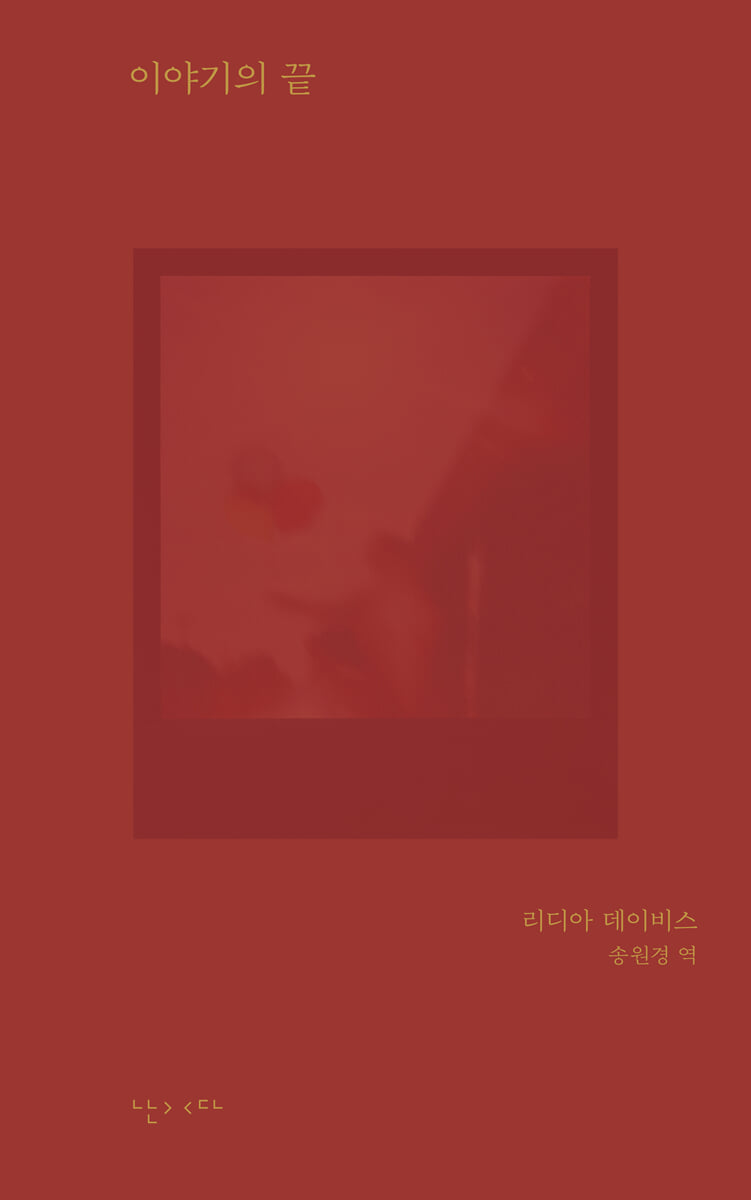
End of the story
 |
Description
Book Introduction
- A word from MD
-
A story that begins only at the end of loveThe only novel by Lydia Davis, one of the most original voices in English-language literature.
It is a long story about the process of trying to reconstruct the love between an ex-lover and a lover through a novel.
A delicate and rational work that depicts the failures of love and the pain of creation.
It leaves the reader imagining various 'endings' until the very end.
November 12, 2024. Novel/Poetry PD Kim Yu-ri
A novelist tries to reconstruct a love that has faded away after a long time.
A stunningly detailed anatomy of memory and loss, passion and disillusionment.
“At first, I just planned to write a short story.
But soon I realized that this had to be a long novel.
“I wanted to write down all the emotions and history the story had.”
The nameless narrator of "The End of the Story" attempts to reconstruct memories of a long-ago love affair into a novel.
But these attempts always end up as vague sketches, and in the end, the past and illusion are not distinguished.
Failed love and the writing that seeks to restore that love—these two trajectories intertwine to depict how memory preserves and transforms the painful terrain of a past love.
Lydia Davis is a writer who has established her own unique voice in the American literary world with her short "story" format.
"The End of the Story" is the author's only full-length novel, and in an interview, the author expressed his affection for the work, mentioning that it was originally started as a short story and then expanded upon in form.
In this novel, the author maintains the signature stinging humor and concise writing style he previously displayed in short stories, while also incorporating the delicate insights into life that only a full-length novel can reveal.
A stunningly detailed anatomy of memory and loss, passion and disillusionment.
“At first, I just planned to write a short story.
But soon I realized that this had to be a long novel.
“I wanted to write down all the emotions and history the story had.”
The nameless narrator of "The End of the Story" attempts to reconstruct memories of a long-ago love affair into a novel.
But these attempts always end up as vague sketches, and in the end, the past and illusion are not distinguished.
Failed love and the writing that seeks to restore that love—these two trajectories intertwine to depict how memory preserves and transforms the painful terrain of a past love.
Lydia Davis is a writer who has established her own unique voice in the American literary world with her short "story" format.
"The End of the Story" is the author's only full-length novel, and in an interview, the author expressed his affection for the work, mentioning that it was originally started as a short story and then expanded upon in form.
In this novel, the author maintains the signature stinging humor and concise writing style he previously displayed in short stories, while also incorporating the delicate insights into life that only a full-length novel can reveal.
- You can preview some of the book's contents.
Preview
Into the book
This seemed to be the end of the story, and for a moment, the end of a long novel.
There was something very final about that bitter cup of tea.
Even though I thought this was the end of the story, I put this car at the beginning.
As if I had to tell the end first to continue the rest of the story.
If anyone asks me about this novel, I say it's a story about a lost man.
--- pp.16~17
There was a time when I enjoyed recalling each and every moment of that first evening.
One evening we were sitting at the table, and my friends were sitting next to me and next to him.
An evening when the noise from the performance was so loud that no one could talk.
For some reason, that time, when nothing had even begun, felt like the best moment.
After he left me, the beginning became not only the beginning of countless happinesses to come, but also the end.
As if the end had already spread to the air of the room where he, who barely knew me, leaned in and whispered to me that evening while we were sitting among the people.
As if the walls of that space had already been built to the end.
--- pp.31~32
For a long time I couldn't decide what to call him in the novel and what to call myself.
What I wanted was a one-syllable English name, like his real name, but as I searched for the right one, I encountered the irony of encountering words that were difficult to translate.
The only translation that could replace the original word was the original word itself.
--- p.50
It was interesting to me that he was twelve years younger.
I couldn't tell if I was going back in time 12 years to be with him, or if he was going forward in time to be with me, if I was his future, or if he was my past.
Sometimes it felt like I was repeating an experience I had long ago.
--- pp.98~99
I imagined that what was happening now was not happening in the present, but in the past.
Because the present will soon become the past, you can imagine looking back on the present from the future even while you are in the middle of it.
In this way, I created distance between myself and the present, and only then was I able to accept the present more comfortably.
--- p.260
I didn't really see myself as a woman.
I never felt like I had any particular gender.
But one day, I was sitting in a restaurant with my feet up on the edge of a chair, wearing sandals, when a strange man came up to me and started talking to me, then went back to his seat. A little while later, on his way out, he passed me, bent down, and touched the toes of my bare feet.
In that moment of shock, I was thrown from one way of being and forced to move into another.
Even when I returned to the way I originally existed, I could not return to my old self.
There was something very final about that bitter cup of tea.
Even though I thought this was the end of the story, I put this car at the beginning.
As if I had to tell the end first to continue the rest of the story.
If anyone asks me about this novel, I say it's a story about a lost man.
--- pp.16~17
There was a time when I enjoyed recalling each and every moment of that first evening.
One evening we were sitting at the table, and my friends were sitting next to me and next to him.
An evening when the noise from the performance was so loud that no one could talk.
For some reason, that time, when nothing had even begun, felt like the best moment.
After he left me, the beginning became not only the beginning of countless happinesses to come, but also the end.
As if the end had already spread to the air of the room where he, who barely knew me, leaned in and whispered to me that evening while we were sitting among the people.
As if the walls of that space had already been built to the end.
--- pp.31~32
For a long time I couldn't decide what to call him in the novel and what to call myself.
What I wanted was a one-syllable English name, like his real name, but as I searched for the right one, I encountered the irony of encountering words that were difficult to translate.
The only translation that could replace the original word was the original word itself.
--- p.50
It was interesting to me that he was twelve years younger.
I couldn't tell if I was going back in time 12 years to be with him, or if he was going forward in time to be with me, if I was his future, or if he was my past.
Sometimes it felt like I was repeating an experience I had long ago.
--- pp.98~99
I imagined that what was happening now was not happening in the present, but in the past.
Because the present will soon become the past, you can imagine looking back on the present from the future even while you are in the middle of it.
In this way, I created distance between myself and the present, and only then was I able to accept the present more comfortably.
--- p.260
I didn't really see myself as a woman.
I never felt like I had any particular gender.
But one day, I was sitting in a restaurant with my feet up on the edge of a chair, wearing sandals, when a strange man came up to me and started talking to me, then went back to his seat. A little while later, on his way out, he passed me, bent down, and touched the toes of my bare feet.
In that moment of shock, I was thrown from one way of being and forced to move into another.
Even when I returned to the way I originally existed, I could not return to my old self.
--- pp.266~267
Publisher's Review
Lydia Davis discusses the writing process of The End of the Story in an interview, revealing that she originally conceived the work as a short story rather than a long novel.
But soon Davis says he was captivated by it all, by what the characters in the story must have seen and felt, and he couldn't help but write it down.
"The End of the Story" contains the voice of a narrator reminiscing about a past love.
The narrator, a translator and novelist, attempts to reconstruct his memories of a past lover into a novel.
At this time, the narrator captures every detail of each incident and even the smallest details that make up the other person in the novel as they were.
The speaker's writing continues obsessively for a long time, as if he is trying to revive and preserve the past time through the act of writing it down.
The novel's story unfolds in two layers.
The first layer is a story of the past that unfolds through the memoirs of the narrator, who is a novelist in the work, and takes the form of a kind of romance novel.
The second layer tells the story of the narrator, a novelist who is trying to write this romance novel, and reveals the creative process of the novel.
The novel moves between two levels, telling the story of a love that ended in failure and then the process of reconstructing that love into a novel.
Thanks to this unique format, the novel never falls into sentimentality while telling the story of a failed love in the past, but instead depicts the process with great clarity and persuasiveness.
In the novel, the perspectives of the subject, who is in the midst of an intense experience of the beginning or end of love, and the narrator, who calmly reflects on it from outside after it has all passed, intersect.
In this process, past experiences and present perceptions are mixed, and the calm and rational gaze of the present seems to re-experience an intense moment from the past.
As a result, "The End of the Story" succeeds in reproducing a love that ended in failure in a rational yet vivid way.
Due to its unique format, which captures the entire process of storytelling, the novel allows readers to participate in the story-making process and explores the various possibilities of memory.
The novel begins with the 'end' of the story being written by the narrator in the novel.
The novel begins by describing the potential endings of the story, such as the narrator's memory of the last time he saw 'him', and his memory of deciding to give up searching for 'him' after a trip to 'him's' address and finding no results, and continues to be conscious of, describe, and reveal various 'endings' throughout the story.
After he left me, the beginning became not only the beginning of countless happinesses to come, but also the end.
As if the end had already spread to the air of the room where he, who barely knew me, leaned in and whispered to me that evening while we were sitting among the people.
As if the walls of that space had already been built to the end.
(Pages 31-32)
At the same time, the speaker does not easily reach a conclusion, but unfolds a world of various possibilities that could have existed while tracing his memories.
The novel is filled with sentences like “maybe,” “maybe,” and “it might have been,” which suggest a situation but postpone a perfect decision, leaving everything in a state of potential.
In some cases, sentences of the above form appear one after another, and countless events that have happened, not happened, or could have happened unfold simultaneously.
In this way, the speaker, together with the reader, looks down into the bottomless 'abyss', the "abyss of all existing possibilities" (from the 'Translator's Note').
In his writing, everything that was and could have been is contained within a single story, and the story becomes infinitely long.
Writing that is constantly conscious of the end while also constantly postponing its own end, 『The End of the Story』 preserves and transforms the painful terrain of a love that has passed, crossing over the world of various possibilities beyond the distinction between present and past.
But soon Davis says he was captivated by it all, by what the characters in the story must have seen and felt, and he couldn't help but write it down.
"The End of the Story" contains the voice of a narrator reminiscing about a past love.
The narrator, a translator and novelist, attempts to reconstruct his memories of a past lover into a novel.
At this time, the narrator captures every detail of each incident and even the smallest details that make up the other person in the novel as they were.
The speaker's writing continues obsessively for a long time, as if he is trying to revive and preserve the past time through the act of writing it down.
The novel's story unfolds in two layers.
The first layer is a story of the past that unfolds through the memoirs of the narrator, who is a novelist in the work, and takes the form of a kind of romance novel.
The second layer tells the story of the narrator, a novelist who is trying to write this romance novel, and reveals the creative process of the novel.
The novel moves between two levels, telling the story of a love that ended in failure and then the process of reconstructing that love into a novel.
Thanks to this unique format, the novel never falls into sentimentality while telling the story of a failed love in the past, but instead depicts the process with great clarity and persuasiveness.
In the novel, the perspectives of the subject, who is in the midst of an intense experience of the beginning or end of love, and the narrator, who calmly reflects on it from outside after it has all passed, intersect.
In this process, past experiences and present perceptions are mixed, and the calm and rational gaze of the present seems to re-experience an intense moment from the past.
As a result, "The End of the Story" succeeds in reproducing a love that ended in failure in a rational yet vivid way.
Due to its unique format, which captures the entire process of storytelling, the novel allows readers to participate in the story-making process and explores the various possibilities of memory.
The novel begins with the 'end' of the story being written by the narrator in the novel.
The novel begins by describing the potential endings of the story, such as the narrator's memory of the last time he saw 'him', and his memory of deciding to give up searching for 'him' after a trip to 'him's' address and finding no results, and continues to be conscious of, describe, and reveal various 'endings' throughout the story.
After he left me, the beginning became not only the beginning of countless happinesses to come, but also the end.
As if the end had already spread to the air of the room where he, who barely knew me, leaned in and whispered to me that evening while we were sitting among the people.
As if the walls of that space had already been built to the end.
(Pages 31-32)
At the same time, the speaker does not easily reach a conclusion, but unfolds a world of various possibilities that could have existed while tracing his memories.
The novel is filled with sentences like “maybe,” “maybe,” and “it might have been,” which suggest a situation but postpone a perfect decision, leaving everything in a state of potential.
In some cases, sentences of the above form appear one after another, and countless events that have happened, not happened, or could have happened unfold simultaneously.
In this way, the speaker, together with the reader, looks down into the bottomless 'abyss', the "abyss of all existing possibilities" (from the 'Translator's Note').
In his writing, everything that was and could have been is contained within a single story, and the story becomes infinitely long.
Writing that is constantly conscious of the end while also constantly postponing its own end, 『The End of the Story』 preserves and transforms the painful terrain of a love that has passed, crossing over the world of various possibilities beyond the distinction between present and past.
GOODS SPECIFICS
- Date of issue: October 18, 2024
- Page count, weight, size: 320 pages | 414g | 134*214*20mm
- ISBN13: 9791194171126
- ISBN10: 1194171125
You may also like
카테고리
korean


korean

![GQ KOREA Mark (Monthly): December [2025]](http://librairie.coreenne.fr/cdn/shop/files/8ef265dbbfbf186523ed75ba7319009d.jpg?v=1765340328&width=3840)


