

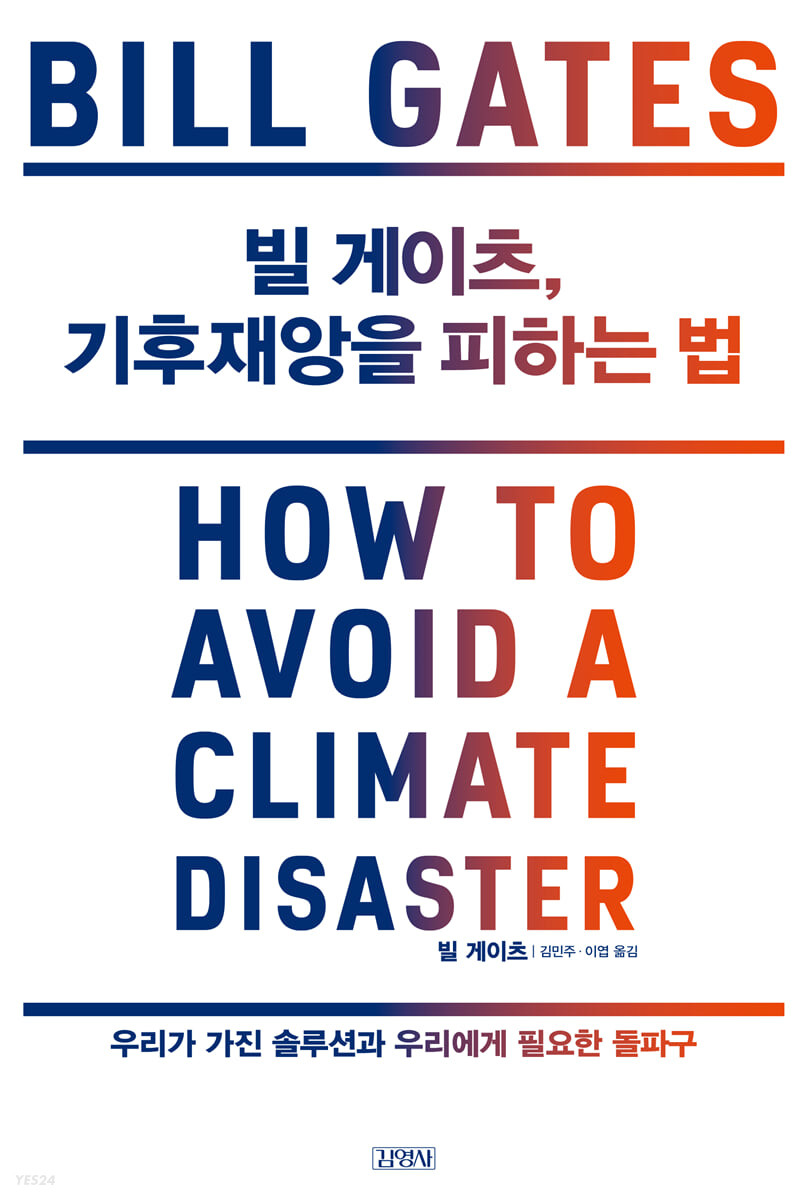
Bill Gates on how to avoid climate disaster
 |
Description
Book Introduction
The very topic that Bill Gates has been all-in on for 10 years! Clear goals and fundamental solutions to avoid climate catastrophe Bill Gates, an innovative engineer and pragmatic environmentalist, finally unveils his solution to overcoming climate disaster after 10 years of intensive research. The goal is clear, and the plan is concrete! We will reduce annual greenhouse gas emissions, currently 51 billion tons, to "net zero" by 2050, starting with developed countries. We will create a 'technology-policy-market structure' that will transform our carbon civilization into a clean energy civilization. It presents specific actions that governments, businesses, and individuals can take to create a plan that ensures growth and the planet are sustainable. A unique solution and feasible roadmap discovered in collaboration with experts in physics, chemistry, biology, engineering, political science, economics, and finance. |
- You can preview some of the book's contents.
Preview
index
From 51 billion to 0 in the West Gate
Chapter 1 Why Zero?
Chapter 2 will be difficult
Chapter 3: Five Questions We Should Ask
Chapter 4: Electricity Generation: 27 Percent of Annual Emissions of 51 Billion Tonnes
Chapter 5 Manufacturing: 31 percent of annual emissions of 51 billion tons
Chapter 6: Livestock and Cultivation: 19 Percent of Annual Emissions of 51 Billion Tonnes
Chapter 7: Transportation and Transport: 16 percent of annual emissions of 51 billion tons
Chapter 8: Cooling and Heating: 7 Percent of Annual Emissions of 51 Billion Tonnes
Chapter 9: Adapting to a Warmer Planet
Chapter 10: How Important Are Government Policies?
Chapter 11: The Road to Zero
Chapter 12 What Each of Us Can Do
Post-Climate Change and COVID-19
main
Acknowledgements
Translator's Note
Search
Chapter 1 Why Zero?
Chapter 2 will be difficult
Chapter 3: Five Questions We Should Ask
Chapter 4: Electricity Generation: 27 Percent of Annual Emissions of 51 Billion Tonnes
Chapter 5 Manufacturing: 31 percent of annual emissions of 51 billion tons
Chapter 6: Livestock and Cultivation: 19 Percent of Annual Emissions of 51 Billion Tonnes
Chapter 7: Transportation and Transport: 16 percent of annual emissions of 51 billion tons
Chapter 8: Cooling and Heating: 7 Percent of Annual Emissions of 51 Billion Tonnes
Chapter 9: Adapting to a Warmer Planet
Chapter 10: How Important Are Government Policies?
Chapter 11: The Road to Zero
Chapter 12 What Each of Us Can Do
Post-Climate Change and COVID-19
main
Acknowledgements
Translator's Note
Search
Detailed image

Into the book
We can change.
We already have the technology needed for change.
There are still many technologies to be developed, but we can make innovation happen.
If we can act quickly, we can avoid the catastrophe that climate change will bring.
This is what I felt while studying climate change and response technologies.
This book explains what we should do and how we can do it.
--- p.9, from the "Preface"
Over the past few years, I've learned a lot from some of the world's leading climate and energy experts.
Discussions with them were always new.
This is because our understanding of climate change has deepened as new data on it emerge and computer modeling techniques used to predict various scenarios have improved.
With the help of these techniques, I was able to distinguish between all the possible outcomes of climate change and those that are likely to actually occur.
As a result, we became convinced that the only way to avoid disaster was to achieve zero.
--- p.33, 「1.
From "Why Zero?"
As we make various attempts to reduce carbon dioxide emissions, we will need more and more electricity.
This method of using electricity instead of fossil fuels is called electrification.
For example, using clean electricity instead of coal to make steel.
One company I'm following with interest has come up with a new method called molten oxide electrolysis.
Instead of melting iron in a furnace with coke, this method involves applying an electric current to a mixture of liquid iron oxide and other ingredients.
During this process, the iron oxide is broken down, leaving only the pure iron needed to make steel and the byproduct oxygen.
Carbon dioxide is not produced.
The technology is promising, but like other ideas for making clean steel, its practical application in industry has yet to be proven.
--- p157~158., 「5.
Among “manufacturing”
In short, we can lower the green premium by making zero-carbon products cheaper (through technological innovation) or carbon-intensive products more expensive (through policy innovation).
Of course, you can pursue both of these simultaneously.
Our goal is not to punish people for their greenhouse gas emissions, but to incentivize them to create competitive zero-carbon alternatives.
By gradually increasing the prices of carbon-intensive products, governments can encourage producers and consumers to make better decisions and encourage innovation that lowers the green premium.
If e-fuels weren't forced to sell at such a low price due to the artificially low price of gasoline, more people would want to make e-fuels.
--- p.265~266, 「10.
How important are government policies?
What we can and must do over the next decade is to introduce drastic decarbonization policies by 2050.
“Reducing greenhouse gas emissions by 2030” and “achieving net zero by 2050” sound similar, but are very different.
‘Reducing greenhouse gas emissions by 2030’ is not an intermediate goal to ‘achieving zero by 2050.’
There is a difference that is not intuitive, but is very crucial.
If we reduce greenhouse gases by 2030 in the wrong way, we may not be able to achieve zero by 2050.
Why is that? Because what needs to be done to reduce greenhouse gases by 2030 is fundamentally different from what needs to be done to achieve net-zero emissions by 2050.
These two goals have different measures of success.
We have to choose between these two.
--- p.280, 「11.
From "The Road to Zero"
When faced with a massive problem like climate change, individuals can easily feel helpless.
But there's no need to do that.
Because even individuals, not just politicians or philanthropists, can make a difference.
Individuals can drive change as citizens, consumers, and employers or employees.
We already have the technology needed for change.
There are still many technologies to be developed, but we can make innovation happen.
If we can act quickly, we can avoid the catastrophe that climate change will bring.
This is what I felt while studying climate change and response technologies.
This book explains what we should do and how we can do it.
--- p.9, from the "Preface"
Over the past few years, I've learned a lot from some of the world's leading climate and energy experts.
Discussions with them were always new.
This is because our understanding of climate change has deepened as new data on it emerge and computer modeling techniques used to predict various scenarios have improved.
With the help of these techniques, I was able to distinguish between all the possible outcomes of climate change and those that are likely to actually occur.
As a result, we became convinced that the only way to avoid disaster was to achieve zero.
--- p.33, 「1.
From "Why Zero?"
As we make various attempts to reduce carbon dioxide emissions, we will need more and more electricity.
This method of using electricity instead of fossil fuels is called electrification.
For example, using clean electricity instead of coal to make steel.
One company I'm following with interest has come up with a new method called molten oxide electrolysis.
Instead of melting iron in a furnace with coke, this method involves applying an electric current to a mixture of liquid iron oxide and other ingredients.
During this process, the iron oxide is broken down, leaving only the pure iron needed to make steel and the byproduct oxygen.
Carbon dioxide is not produced.
The technology is promising, but like other ideas for making clean steel, its practical application in industry has yet to be proven.
--- p157~158., 「5.
Among “manufacturing”
In short, we can lower the green premium by making zero-carbon products cheaper (through technological innovation) or carbon-intensive products more expensive (through policy innovation).
Of course, you can pursue both of these simultaneously.
Our goal is not to punish people for their greenhouse gas emissions, but to incentivize them to create competitive zero-carbon alternatives.
By gradually increasing the prices of carbon-intensive products, governments can encourage producers and consumers to make better decisions and encourage innovation that lowers the green premium.
If e-fuels weren't forced to sell at such a low price due to the artificially low price of gasoline, more people would want to make e-fuels.
--- p.265~266, 「10.
How important are government policies?
What we can and must do over the next decade is to introduce drastic decarbonization policies by 2050.
“Reducing greenhouse gas emissions by 2030” and “achieving net zero by 2050” sound similar, but are very different.
‘Reducing greenhouse gas emissions by 2030’ is not an intermediate goal to ‘achieving zero by 2050.’
There is a difference that is not intuitive, but is very crucial.
If we reduce greenhouse gases by 2030 in the wrong way, we may not be able to achieve zero by 2050.
Why is that? Because what needs to be done to reduce greenhouse gases by 2030 is fundamentally different from what needs to be done to achieve net-zero emissions by 2050.
These two goals have different measures of success.
We have to choose between these two.
--- p.280, 「11.
From "The Road to Zero"
When faced with a massive problem like climate change, individuals can easily feel helpless.
But there's no need to do that.
Because even individuals, not just politicians or philanthropists, can make a difference.
Individuals can drive change as citizens, consumers, and employers or employees.
--- p.310, 「12.
From “What Each of Us Can Do”
From “What Each of Us Can Do”
Publisher's Review
Bill Gates' first book in 20 years of public service!
A comprehensive, realistic, and actionable plan for zero greenhouse gas emissions
Bill Gates is back.
From a tech innovator who founded Microsoft to a respected philanthropist and investor in environmental research, the topic he has been obsessed with for the past decade is climate change.
As co-chair of the Bill & Melinda Gates Foundation, the issue of energy poverty, which he encountered while working to eradicate poverty and disease, became a catalyst.
“The world has a responsibility to provide more energy so that the poorest people can become self-sufficient, but it must provide that energy in a way that no longer emits greenhouse gases.” (p. 13) He went all-in on climate change research, consulting with numerous experts around the world.
And this book contains measures to respond to the climate crisis.
The goal is clear.
Achieving net zero greenhouse gas emissions.
First, developed countries must develop innovative climate solutions to achieve decarbonization by 2050, and then distribute these innovations cheaply around the world to reach a zero-carbon state, where no more greenhouse gases are emitted into the atmosphere.
There is something to note.
We should avoid goals such as 'We will reduce emissions to a certain level by 2030 and achieve zero by 2050.'
This is because ‘reducing emissions by 2030’ is not an intermediate goal to ‘achieving zero by 2050.’
For example, building a gas-fired power plant with carbon capture equipment instead of a coal-fired power plant would reduce carbon dioxide emissions, but the plant would still be operating in 2050.
In other words, even if we can achieve 'reduction by 2030', achieving 'zero by 2050' will become more distant.
What can I do now? What should I start doing right now?
A blueprint for escaping the climate crisis, offering clear goals and a achievable blueprint.
Drawing on his experience commercializing innovation and new ideas, the author presents a concrete plan for achieving "zero."
We introduce renewable energy technologies, such as solar and wind power, that are already being used to reduce carbon emissions, and explore ways to utilize these technologies more efficiently.
But renewable energy alone is not enough.
Because the sun doesn't always rise.
A significant portion of the book is devoted to explaining the innovation required to develop and launch groundbreaking technologies.
For example, this includes technologies that use carbon dioxide captured from seawater and power plants to make cement, or use clean electricity instead of coal to make steel.
Such innovations lower the "green premium," the additional cost of not emitting greenhouse gases.
The author says that making clean energy cheap and stable, comparable to energy produced from fossil fuels, is the key to a strategy to address climate change.
Chapters 4-8 broadly divide greenhouse gas-emitting sectors into five categories and examine how innovations can lower the green premium in each sector.
The manufacturing sector accounts for the largest share, accounting for 31 percent of the 51 billion tonnes of annual emissions.
Electricity generation follows with 27 percent, followed by animal husbandry and cultivation with 19 percent, transportation and transport with 16 percent, and heating and cooling with 7 percent.
It gives you a clear picture of how and where to tackle climate change.
A clean energy transition plan implemented through technological and policy innovation.
An innovative breakthrough that allows growth and the planet to coexist
After delving into areas where immediate, effective solutions and technological breakthroughs are needed to achieve zero, the book concludes with specific recommendations for what governments, businesses, and individuals can do.
The author identifies technology, policy, and markets as three tools we need to transition away from fossil fuels.
To address climate change, we need to increase both the supply and demand for innovation. Ultimately, the main source of innovation supply is businesses, while the main source of innovation demand is the government.
The government should provide appropriate incentives to encourage companies to create more innovation.
In this book, I've highlighted the innovations and inventions needed to achieve zero carbon, such as new electricity storage technologies and new steelmaking methods.
But innovation isn't just about creating new devices.
Innovation is also a new policy that allows new innovations to be brought to market as quickly as possible.
_10.
How Important Are Government Policies? (Page 259)
While it's common to see the environment and growth as opposing forces, the author argues that they can actually spark innovations that can save the economy from COVID-19 and avert climate catastrophe.
Investing in clean energy research and development can spur economic recovery and reduce carbon emissions.
Because in the short term it creates jobs and in the long term it becomes a nutrient that achieves zero.
If the government introduces policies to lower the green premium, it will provide a springboard for clean energy companies to grow.
It is entirely possible to kill two birds with one stone: economic growth and zero-carbon innovation.
The only book that provides a useful framework for thinking about climate issues.
A must-read for transitioning from a carbon-powered civilization to a clean energy civilization.
2021 marks the launch of a new climate regime that imposes greenhouse gas reduction obligations on all countries, regardless of whether they are developed or developing.
Last October, our government declared 'carbon neutrality by 2050' and expressed its intention to join the new climate regime.
There are also reports that the climate crisis is the root cause of the COVID-19 pandemic, which has gripped the world for over a year.
The number of people who are changing the term 'climate change' to 'climate disaster' or 'climate emergency' is increasing.
Awareness of the climate crisis is gradually increasing.
Is it too late? How feasible are the alternatives being discussed globally?
If you want to understand the climate crisis from a scientific and engineering perspective and explore realistic solutions based on our existing technological and institutional foundations, this book will provide a useful "framework" for addressing climate issues.
The author, who has extensive experience in physics, chemistry, biology, engineering, political science, economics, and finance, provides up-to-date information and advanced knowledge, helping you understand the big picture of climate issues.
Bill Gates' "How to Avoid a Climate Disaster" is a must-read for everyone on Earth to transition from a carbon-free civilization to a clean energy civilization.
A comprehensive, realistic, and actionable plan for zero greenhouse gas emissions
Bill Gates is back.
From a tech innovator who founded Microsoft to a respected philanthropist and investor in environmental research, the topic he has been obsessed with for the past decade is climate change.
As co-chair of the Bill & Melinda Gates Foundation, the issue of energy poverty, which he encountered while working to eradicate poverty and disease, became a catalyst.
“The world has a responsibility to provide more energy so that the poorest people can become self-sufficient, but it must provide that energy in a way that no longer emits greenhouse gases.” (p. 13) He went all-in on climate change research, consulting with numerous experts around the world.
And this book contains measures to respond to the climate crisis.
The goal is clear.
Achieving net zero greenhouse gas emissions.
First, developed countries must develop innovative climate solutions to achieve decarbonization by 2050, and then distribute these innovations cheaply around the world to reach a zero-carbon state, where no more greenhouse gases are emitted into the atmosphere.
There is something to note.
We should avoid goals such as 'We will reduce emissions to a certain level by 2030 and achieve zero by 2050.'
This is because ‘reducing emissions by 2030’ is not an intermediate goal to ‘achieving zero by 2050.’
For example, building a gas-fired power plant with carbon capture equipment instead of a coal-fired power plant would reduce carbon dioxide emissions, but the plant would still be operating in 2050.
In other words, even if we can achieve 'reduction by 2030', achieving 'zero by 2050' will become more distant.
What can I do now? What should I start doing right now?
A blueprint for escaping the climate crisis, offering clear goals and a achievable blueprint.
Drawing on his experience commercializing innovation and new ideas, the author presents a concrete plan for achieving "zero."
We introduce renewable energy technologies, such as solar and wind power, that are already being used to reduce carbon emissions, and explore ways to utilize these technologies more efficiently.
But renewable energy alone is not enough.
Because the sun doesn't always rise.
A significant portion of the book is devoted to explaining the innovation required to develop and launch groundbreaking technologies.
For example, this includes technologies that use carbon dioxide captured from seawater and power plants to make cement, or use clean electricity instead of coal to make steel.
Such innovations lower the "green premium," the additional cost of not emitting greenhouse gases.
The author says that making clean energy cheap and stable, comparable to energy produced from fossil fuels, is the key to a strategy to address climate change.
Chapters 4-8 broadly divide greenhouse gas-emitting sectors into five categories and examine how innovations can lower the green premium in each sector.
The manufacturing sector accounts for the largest share, accounting for 31 percent of the 51 billion tonnes of annual emissions.
Electricity generation follows with 27 percent, followed by animal husbandry and cultivation with 19 percent, transportation and transport with 16 percent, and heating and cooling with 7 percent.
It gives you a clear picture of how and where to tackle climate change.
A clean energy transition plan implemented through technological and policy innovation.
An innovative breakthrough that allows growth and the planet to coexist
After delving into areas where immediate, effective solutions and technological breakthroughs are needed to achieve zero, the book concludes with specific recommendations for what governments, businesses, and individuals can do.
The author identifies technology, policy, and markets as three tools we need to transition away from fossil fuels.
To address climate change, we need to increase both the supply and demand for innovation. Ultimately, the main source of innovation supply is businesses, while the main source of innovation demand is the government.
The government should provide appropriate incentives to encourage companies to create more innovation.
In this book, I've highlighted the innovations and inventions needed to achieve zero carbon, such as new electricity storage technologies and new steelmaking methods.
But innovation isn't just about creating new devices.
Innovation is also a new policy that allows new innovations to be brought to market as quickly as possible.
_10.
How Important Are Government Policies? (Page 259)
While it's common to see the environment and growth as opposing forces, the author argues that they can actually spark innovations that can save the economy from COVID-19 and avert climate catastrophe.
Investing in clean energy research and development can spur economic recovery and reduce carbon emissions.
Because in the short term it creates jobs and in the long term it becomes a nutrient that achieves zero.
If the government introduces policies to lower the green premium, it will provide a springboard for clean energy companies to grow.
It is entirely possible to kill two birds with one stone: economic growth and zero-carbon innovation.
The only book that provides a useful framework for thinking about climate issues.
A must-read for transitioning from a carbon-powered civilization to a clean energy civilization.
2021 marks the launch of a new climate regime that imposes greenhouse gas reduction obligations on all countries, regardless of whether they are developed or developing.
Last October, our government declared 'carbon neutrality by 2050' and expressed its intention to join the new climate regime.
There are also reports that the climate crisis is the root cause of the COVID-19 pandemic, which has gripped the world for over a year.
The number of people who are changing the term 'climate change' to 'climate disaster' or 'climate emergency' is increasing.
Awareness of the climate crisis is gradually increasing.
Is it too late? How feasible are the alternatives being discussed globally?
If you want to understand the climate crisis from a scientific and engineering perspective and explore realistic solutions based on our existing technological and institutional foundations, this book will provide a useful "framework" for addressing climate issues.
The author, who has extensive experience in physics, chemistry, biology, engineering, political science, economics, and finance, provides up-to-date information and advanced knowledge, helping you understand the big picture of climate issues.
Bill Gates' "How to Avoid a Climate Disaster" is a must-read for everyone on Earth to transition from a carbon-free civilization to a clean energy civilization.
GOODS SPECIFICS
- Publication date: February 16, 2021
- Page count, weight, size: 356 pages | 506g | 148*220*22mm
- ISBN13: 9788934991366
- ISBN10: 8934991364
You may also like
카테고리
korean


korean

![GQ KOREA Mark (Monthly): December [2025]](http://librairie.coreenne.fr/cdn/shop/files/8ef265dbbfbf186523ed75ba7319009d.jpg?v=1765340328&width=3840)


