

City View
 |
Description
Book Introduction
- A word from MD
-
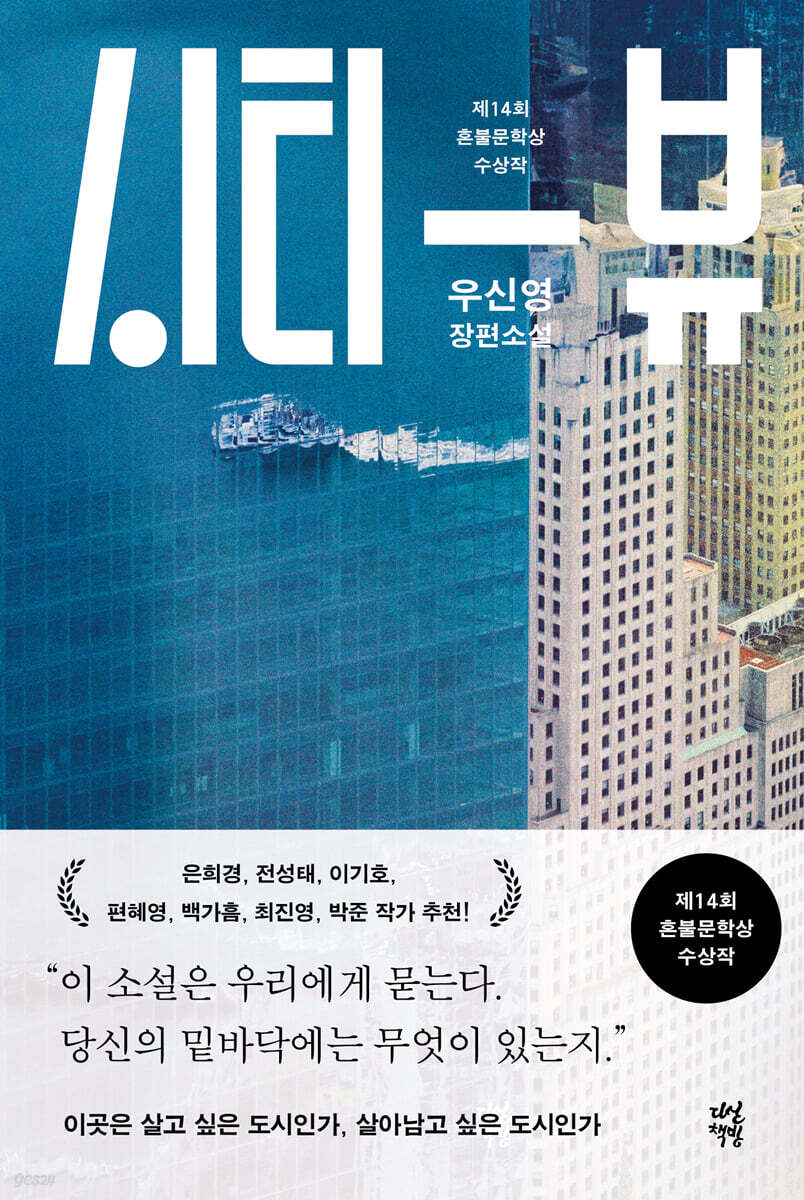
A contemporary novel set in the cutting-edge city of SongdoWinner of the 14th Honbul Literary Award.
It tells the story of the various classes that make up a city today, from the middle class living in fancy high-rise buildings to the young workers who polish their buildings to make them shine.
Through their bodies, they expressed their individual lives, stained with desire and wounds, in a complex manner.
October 4, 2024. Novel/Poetry PD Kim Yu-ri
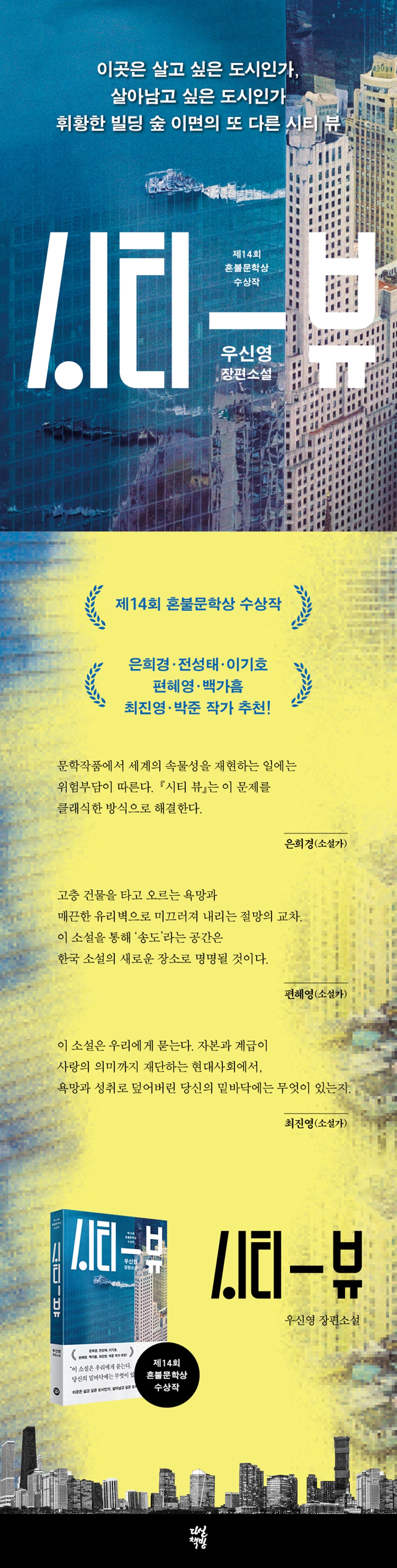
Recommended by Eun Hee-kyung, Jeon Seong-tae, Lee Ki-ho, Pyeon Hye-young, Baek Ga-heum, Choi Jin-young, and Park Jun!
“This novel asks us:
“What’s underneath you?”
The 14th Honbul Literary Award-winning work, “City View,” has been published.
This novel was directly reviewed and selected by seven of the most active Korean literary writers today, including Eun Hee-kyung, Jeon Seong-tae, Lee Gi-ho, Pyeon Hye-young, Baek Ga-heum, Choi Jin-young, and Park Jun.
It paints a detailed portrait of today's city dwellers who struggle to lead smooth lives on the outside while suffering from obsession, deprivation, self-harm, industrial accidents, and trauma.
It was selected as the winner with rave reviews for “excellently revealing the desires and wounds of various classes that make up a city, from the economically stable middle-aged middle class to young workers in their twenties and thirties who eke out an unstable livelihood, through three-dimensional and complex characters.”
“This novel asks us:
“What’s underneath you?”
The 14th Honbul Literary Award-winning work, “City View,” has been published.
This novel was directly reviewed and selected by seven of the most active Korean literary writers today, including Eun Hee-kyung, Jeon Seong-tae, Lee Gi-ho, Pyeon Hye-young, Baek Ga-heum, Choi Jin-young, and Park Jun.
It paints a detailed portrait of today's city dwellers who struggle to lead smooth lives on the outside while suffering from obsession, deprivation, self-harm, industrial accidents, and trauma.
It was selected as the winner with rave reviews for “excellently revealing the desires and wounds of various classes that make up a city, from the economically stable middle-aged middle class to young workers in their twenties and thirties who eke out an unstable livelihood, through three-dimensional and complex characters.”
- You can preview some of the book's contents.
Preview
index
Prologue: New Town
Chapter 1: Elegant Pilates
Chapter 2 Buil Hospital
Chapter 3: Internal Medicine
Chapter 4 Big Guy Jim
Chapter 5 Sorae Port
Chapter 6 Master View
Chapter 7 Peak Point
Chapter 8 Deokjeokdo
Judges' Comments (Eun Hee-kyung, Jeon Seong-tae, Lee Ki-ho, Pyeon Hye-young, Baek Ga-heum, Choi Jin-young, Park Jun)
Author's Note
Chapter 1: Elegant Pilates
Chapter 2 Buil Hospital
Chapter 3: Internal Medicine
Chapter 4 Big Guy Jim
Chapter 5 Sorae Port
Chapter 6 Master View
Chapter 7 Peak Point
Chapter 8 Deokjeokdo
Judges' Comments (Eun Hee-kyung, Jeon Seong-tae, Lee Ki-ho, Pyeon Hye-young, Baek Ga-heum, Choi Jin-young, Park Jun)
Author's Note
Detailed image
Into the book
A city where you want to live, that's another name for this city.
--- p.9
There are many things missing from this city built on reclaimed land.
There is no shady place, no old place, no vague place.
That paradoxically makes this a city worth living in.
--- p.9
If you think about it, the idea that all humans are equal is a beautiful superstition.
All human beings are equal except in that they are human.
You can find out by doing arts and physical education for just 3 days.
Sumi gritted her teeth, saying she would never let her children do anything that would make them feel judged by their bodies.
--- p.37
“Because what we see is our livelihood.”
--- p.41
Sumi didn't want to give up any of the pleasures in life.
In life, you live by waving your own arms.
Am I causing him harm like this?
No, I won't give you any benefit.
Because a little immorality makes a kind wife.
--- p.42
Gian said that one day, when she came to her senses while looking at the sea outside the window in a place where she had no friends, she found herself climbing up the railing holding a child.
Postpartum depression was not cured even with Prozac or Zoloft.
--- p.44
The good and bad thing about climbing was that you didn't really fall.
The walls were fake, the thrill was fake, the act of rising and falling was all fake.
--- p.53
Not everyone knew that they didn't have the luxury of eating well and exercising like Seokjin and Sumi.
Still, they were frustrated with the people who could not tolerate their own appetite and laziness.
They despised the customers and members who came to them with their sick and emaciated bodies in exchange for enjoying cheap pleasures.
The foolishness and impulsiveness of such people fill their pockets, allowing them to buy organic avocados at the department store basement and renew their gym memberships.
--- p.65
“It can’t be helped even if it’s trivial.
“Because I wanted to come to a small place.”
--- p.105
I was at a loss as to how long I would have to go from gym to gym, how long I would have to live eating only 1,300 won bags of chicken breast, and how long I would have to deposit 50,000 won each into my couple account with Chaewon.
'What will I eat to survive once this body shrinks?'
--- p.146
"Doctor, don't you ever want to die? I don't think I'm abnormal.
“Isn’t it normal to want to die sometimes while you’re alive, just as it’s normal to feel sleepy sometimes while you’re awake?”
--- p.166
The only difference was that vomiting was a compulsive purging behavior, just replaced by exercise.
Does Yuhwa, who eats knives, have an eating disorder, or does Sumi, who eats other people's gazes, have an eating disorder?
--- p.9
There are many things missing from this city built on reclaimed land.
There is no shady place, no old place, no vague place.
That paradoxically makes this a city worth living in.
--- p.9
If you think about it, the idea that all humans are equal is a beautiful superstition.
All human beings are equal except in that they are human.
You can find out by doing arts and physical education for just 3 days.
Sumi gritted her teeth, saying she would never let her children do anything that would make them feel judged by their bodies.
--- p.37
“Because what we see is our livelihood.”
--- p.41
Sumi didn't want to give up any of the pleasures in life.
In life, you live by waving your own arms.
Am I causing him harm like this?
No, I won't give you any benefit.
Because a little immorality makes a kind wife.
--- p.42
Gian said that one day, when she came to her senses while looking at the sea outside the window in a place where she had no friends, she found herself climbing up the railing holding a child.
Postpartum depression was not cured even with Prozac or Zoloft.
--- p.44
The good and bad thing about climbing was that you didn't really fall.
The walls were fake, the thrill was fake, the act of rising and falling was all fake.
--- p.53
Not everyone knew that they didn't have the luxury of eating well and exercising like Seokjin and Sumi.
Still, they were frustrated with the people who could not tolerate their own appetite and laziness.
They despised the customers and members who came to them with their sick and emaciated bodies in exchange for enjoying cheap pleasures.
The foolishness and impulsiveness of such people fill their pockets, allowing them to buy organic avocados at the department store basement and renew their gym memberships.
--- p.65
“It can’t be helped even if it’s trivial.
“Because I wanted to come to a small place.”
--- p.105
I was at a loss as to how long I would have to go from gym to gym, how long I would have to live eating only 1,300 won bags of chicken breast, and how long I would have to deposit 50,000 won each into my couple account with Chaewon.
'What will I eat to survive once this body shrinks?'
--- p.146
"Doctor, don't you ever want to die? I don't think I'm abnormal.
“Isn’t it normal to want to die sometimes while you’re alive, just as it’s normal to feel sleepy sometimes while you’re awake?”
--- p.166
The only difference was that vomiting was a compulsive purging behavior, just replaced by exercise.
Does Yuhwa, who eats knives, have an eating disorder, or does Sumi, who eats other people's gazes, have an eating disorder?
--- p.229
Publisher's Review
★14th Honbul Literary Award Winner★
★Recommended by Eun Hee-kyung, Jeon Seong-tae, Lee Ki-ho, Pyeon Hye-young, Baek Ga-heum, Choi Jin-young, and Park Jun★
Is this a city you want to live in, a city you want to survive in?
Another city view behind the dazzling forest of buildings
“This novel asks us:
“What’s at the bottom of you?” - Novelist Jinyoung Choi
The 14th Honbul Literary Award-winning work, “City View,” has been published.
If last year's award-winning novel, "A World to Protect," by Moon Kyung-min, dealt with themes such as the decline of religious authority, disability, and caregiving, leaving a profound impression, "City View" meticulously portrays the portrait of today's urbanites who struggle to lead smooth lives on the outside while suffering from obsession, deprivation, self-harm, industrial accidents, and trauma.
It was selected as this year's winner with rave reviews for "excellently revealing the desires and wounds of various classes that make up a city, from the financially stable middle-aged middle class to young workers in their twenties and thirties who eke out an unstable livelihood, through three-dimensional and complex characters."
This novel, which depicts the vulgar state of affairs as it is without turning a blind eye to reality, appears to have a veneer of popular appeal.
But within it, the question lurks gravely: “What is beneath you?”
This work is in line with last year's award-winning work in that it poses the essential and unavoidable questions of our time in a solid and experienced style.
The Honbul Literary Award, now in its 14th year, was established to revive the immortal spirit of humanity depicted in the late Choi Myeong-hee's epic novel, Honbul.
The most active writers currently leading Korean literature, including Eun Hee-kyung, Jeon Seong-tae, Lee Gi-ho, Pyeon Hye-young, Baek Ga-heum, Choi Jin-young, and Park Jun, will directly judge the entries, and the winning writer will be awarded a prize of 70 million won.
This year, out of a whopping 282 novels submitted, a new writer's novel, "City View," was selected.
The award-winning author, Woo Shin-young, has been teaching literature for a long time and has been honing his own writing style.
This year marks the time when he finally reveals to the world the stories he has been keeping to himself for so long.
Author Woo Shin-young, who not only won the 14th Honbul Literary Award for “City View” but also the 30th Golden Toad Award for her children’s story “Always Affectionate Jukjip,” has now made her name known to readers of all ages.
“Is Yuhwa eating razor blades an eating disorder?
“Is it possible that Sumi, who eats up other people’s gaze, has an eating disorder?”
The “petty immorality” of city dwellers that cannot be easily divided or categorized
Songdo, a city built by reclaiming the sea.
The novel is set in a new city where there are more Pilates centers than convenience stores, and where it is difficult to see an elderly person even if you walk around all day long, and where dizzyingly tall glass buildings form a giant forest.
Like the ocean buried beneath a forest of skyscrapers, desire always lurks beneath the noble masks of city dwellers.
Seok-jin, a doctor, and Sumi, the director of a Pilates center, also hide their desires and deficiencies from each other, but on the surface, they maintain a stable married life.
For example, Sumi continues to meet her younger boyfriend, a fitness trainer in his twenties, without telling her husband, but this is nothing more than a “minor immorality.”
Then one day, when Yu-hwa, a worker from an industrial complex on the outskirts of the city, appears at the hospital in the city center, which is the occupied territory of Soo-mi and Seok-jin, another secret begins to emerge between the couple.
In that they tell deliberate lies, the characters in City View are all somewhat immoral, regardless of class.
But as you read the novel, it becomes difficult to simply criticize them.
Because no one is free from the deficiencies and wounds hidden deep in their hearts.
As poet Park Jun commented, this novel, which “observes delicately yet does not reveal any hypocrisy or falsehood,” takes the premise that everyone is different on the inside and out and ultimately depicts an ironic urban landscape where everyone feels lonely.
What lies at the heart of the novel's ultimate goal is nothing other than compassion for universal humanity.
"Songdo will now be named the new home of Korean novels." - Novelist Pyeon Hye-young
As novelist Eun Hee-kyung said in her review, “In ‘City View,’ space is the theme of the novel,” what stands out in this novel is the symbolism of space.
The characteristics of key locations are actively utilized as elements of the narrative and provide solid support for each character's inner self.
The state-of-the-art, stateless city, built on mudflats rather than solid ground, is read as a space that embodies “the false consciousness of our time” (novelist Jeon Seong-tae) and “the desires of the newly formed middle class in Korean society” (novelist Baek Ga-heum).
The novel deliberately contrasts the city center with its outskirts, meticulously illuminating the different aspects of life within a single space. Furthermore, it dramatically juxtaposes the life of someone who enjoys climbing a fake rock wall with the life of someone who must risk their life clinging to the exterior of a building to clean windows.
The high-rise building, which allows only vertical perspectives from the ground up, becomes a space that hints at the world of achievement and the gap between classes, while also encompassing the narrative of Haeryong, a Korean-Chinese worker who is in a blind spot of safety.
“Because what we see is our livelihood.”
A body suffering from obsession with appearance and a body suffering from physical labor
Stories of all kinds of 'bodies' that perfectly reflect this era.
Among the many spaces depicted in this novel, the 'hospital' in particular functions as a place where the lives of various classes intersect.
The life of a wealthy person who runs a hospital, the life of an eating disorder that requires extreme diet control due to an obsession with appearance, the life of a manual laborer who frequently has to go to the hospital due to industrial accidents, and the life of a person who repeatedly self-harms because there is no way to relieve the inner pain.
A hospital is almost the only place where all kinds of lives can gather, and the traces of each life are etched entirely on the 'body'.
As novelist Lee Ki-ho pointed out, “City View” is ultimately “a novel about the body, pushed forward with the body.”
While vowing, “I won’t let my children be judged by their bodies,” Sumi’s persistent judgment of others’ bodies could be seen as the very definition of the contemporary perspective.
The image of Juni, a twenty-something health trainer who replaces all her meals with 1,300 won chicken breasts, unable to escape the worry of “what will I eat to survive once this body shrinks?” perfectly reflects the modern people struggling to survive in an age where appearances are the center of everything.
In that respect, novelist Lee Ki-ho evaluated 『City View』 as follows.
“Just as the topography of the body changes with the times, we always need a new narrative of the body.
“The drama is here.”
Author's Note
People who clean the glass for a clear, unobstructed view of the city and people who climb the fake rock wall to safely feel the thrill.
By the definition of parallel, they never seemed to brush against each other.
I just couldn't swallow that fact.
I felt nauseous.
That was the beginning of this novel.
★Recommended by Eun Hee-kyung, Jeon Seong-tae, Lee Ki-ho, Pyeon Hye-young, Baek Ga-heum, Choi Jin-young, and Park Jun★
Is this a city you want to live in, a city you want to survive in?
Another city view behind the dazzling forest of buildings
“This novel asks us:
“What’s at the bottom of you?” - Novelist Jinyoung Choi
The 14th Honbul Literary Award-winning work, “City View,” has been published.
If last year's award-winning novel, "A World to Protect," by Moon Kyung-min, dealt with themes such as the decline of religious authority, disability, and caregiving, leaving a profound impression, "City View" meticulously portrays the portrait of today's urbanites who struggle to lead smooth lives on the outside while suffering from obsession, deprivation, self-harm, industrial accidents, and trauma.
It was selected as this year's winner with rave reviews for "excellently revealing the desires and wounds of various classes that make up a city, from the financially stable middle-aged middle class to young workers in their twenties and thirties who eke out an unstable livelihood, through three-dimensional and complex characters."
This novel, which depicts the vulgar state of affairs as it is without turning a blind eye to reality, appears to have a veneer of popular appeal.
But within it, the question lurks gravely: “What is beneath you?”
This work is in line with last year's award-winning work in that it poses the essential and unavoidable questions of our time in a solid and experienced style.
The Honbul Literary Award, now in its 14th year, was established to revive the immortal spirit of humanity depicted in the late Choi Myeong-hee's epic novel, Honbul.
The most active writers currently leading Korean literature, including Eun Hee-kyung, Jeon Seong-tae, Lee Gi-ho, Pyeon Hye-young, Baek Ga-heum, Choi Jin-young, and Park Jun, will directly judge the entries, and the winning writer will be awarded a prize of 70 million won.
This year, out of a whopping 282 novels submitted, a new writer's novel, "City View," was selected.
The award-winning author, Woo Shin-young, has been teaching literature for a long time and has been honing his own writing style.
This year marks the time when he finally reveals to the world the stories he has been keeping to himself for so long.
Author Woo Shin-young, who not only won the 14th Honbul Literary Award for “City View” but also the 30th Golden Toad Award for her children’s story “Always Affectionate Jukjip,” has now made her name known to readers of all ages.
“Is Yuhwa eating razor blades an eating disorder?
“Is it possible that Sumi, who eats up other people’s gaze, has an eating disorder?”
The “petty immorality” of city dwellers that cannot be easily divided or categorized
Songdo, a city built by reclaiming the sea.
The novel is set in a new city where there are more Pilates centers than convenience stores, and where it is difficult to see an elderly person even if you walk around all day long, and where dizzyingly tall glass buildings form a giant forest.
Like the ocean buried beneath a forest of skyscrapers, desire always lurks beneath the noble masks of city dwellers.
Seok-jin, a doctor, and Sumi, the director of a Pilates center, also hide their desires and deficiencies from each other, but on the surface, they maintain a stable married life.
For example, Sumi continues to meet her younger boyfriend, a fitness trainer in his twenties, without telling her husband, but this is nothing more than a “minor immorality.”
Then one day, when Yu-hwa, a worker from an industrial complex on the outskirts of the city, appears at the hospital in the city center, which is the occupied territory of Soo-mi and Seok-jin, another secret begins to emerge between the couple.
In that they tell deliberate lies, the characters in City View are all somewhat immoral, regardless of class.
But as you read the novel, it becomes difficult to simply criticize them.
Because no one is free from the deficiencies and wounds hidden deep in their hearts.
As poet Park Jun commented, this novel, which “observes delicately yet does not reveal any hypocrisy or falsehood,” takes the premise that everyone is different on the inside and out and ultimately depicts an ironic urban landscape where everyone feels lonely.
What lies at the heart of the novel's ultimate goal is nothing other than compassion for universal humanity.
"Songdo will now be named the new home of Korean novels." - Novelist Pyeon Hye-young
As novelist Eun Hee-kyung said in her review, “In ‘City View,’ space is the theme of the novel,” what stands out in this novel is the symbolism of space.
The characteristics of key locations are actively utilized as elements of the narrative and provide solid support for each character's inner self.
The state-of-the-art, stateless city, built on mudflats rather than solid ground, is read as a space that embodies “the false consciousness of our time” (novelist Jeon Seong-tae) and “the desires of the newly formed middle class in Korean society” (novelist Baek Ga-heum).
The novel deliberately contrasts the city center with its outskirts, meticulously illuminating the different aspects of life within a single space. Furthermore, it dramatically juxtaposes the life of someone who enjoys climbing a fake rock wall with the life of someone who must risk their life clinging to the exterior of a building to clean windows.
The high-rise building, which allows only vertical perspectives from the ground up, becomes a space that hints at the world of achievement and the gap between classes, while also encompassing the narrative of Haeryong, a Korean-Chinese worker who is in a blind spot of safety.
“Because what we see is our livelihood.”
A body suffering from obsession with appearance and a body suffering from physical labor
Stories of all kinds of 'bodies' that perfectly reflect this era.
Among the many spaces depicted in this novel, the 'hospital' in particular functions as a place where the lives of various classes intersect.
The life of a wealthy person who runs a hospital, the life of an eating disorder that requires extreme diet control due to an obsession with appearance, the life of a manual laborer who frequently has to go to the hospital due to industrial accidents, and the life of a person who repeatedly self-harms because there is no way to relieve the inner pain.
A hospital is almost the only place where all kinds of lives can gather, and the traces of each life are etched entirely on the 'body'.
As novelist Lee Ki-ho pointed out, “City View” is ultimately “a novel about the body, pushed forward with the body.”
While vowing, “I won’t let my children be judged by their bodies,” Sumi’s persistent judgment of others’ bodies could be seen as the very definition of the contemporary perspective.
The image of Juni, a twenty-something health trainer who replaces all her meals with 1,300 won chicken breasts, unable to escape the worry of “what will I eat to survive once this body shrinks?” perfectly reflects the modern people struggling to survive in an age where appearances are the center of everything.
In that respect, novelist Lee Ki-ho evaluated 『City View』 as follows.
“Just as the topography of the body changes with the times, we always need a new narrative of the body.
“The drama is here.”
Author's Note
People who clean the glass for a clear, unobstructed view of the city and people who climb the fake rock wall to safely feel the thrill.
By the definition of parallel, they never seemed to brush against each other.
I just couldn't swallow that fact.
I felt nauseous.
That was the beginning of this novel.
GOODS SPECIFICS
- Date of issue: September 20, 2024
- Page count, weight, size: 276 pages | 316g | 130*194*17mm
- ISBN13: 9791130647975
- ISBN10: 1130647978
You may also like
카테고리
korean


korean

![GQ KOREA Mark (Monthly): December [2025]](http://librairie.coreenne.fr/cdn/shop/files/8ef265dbbfbf186523ed75ba7319009d.jpg?v=1765340328&width=3840)


