

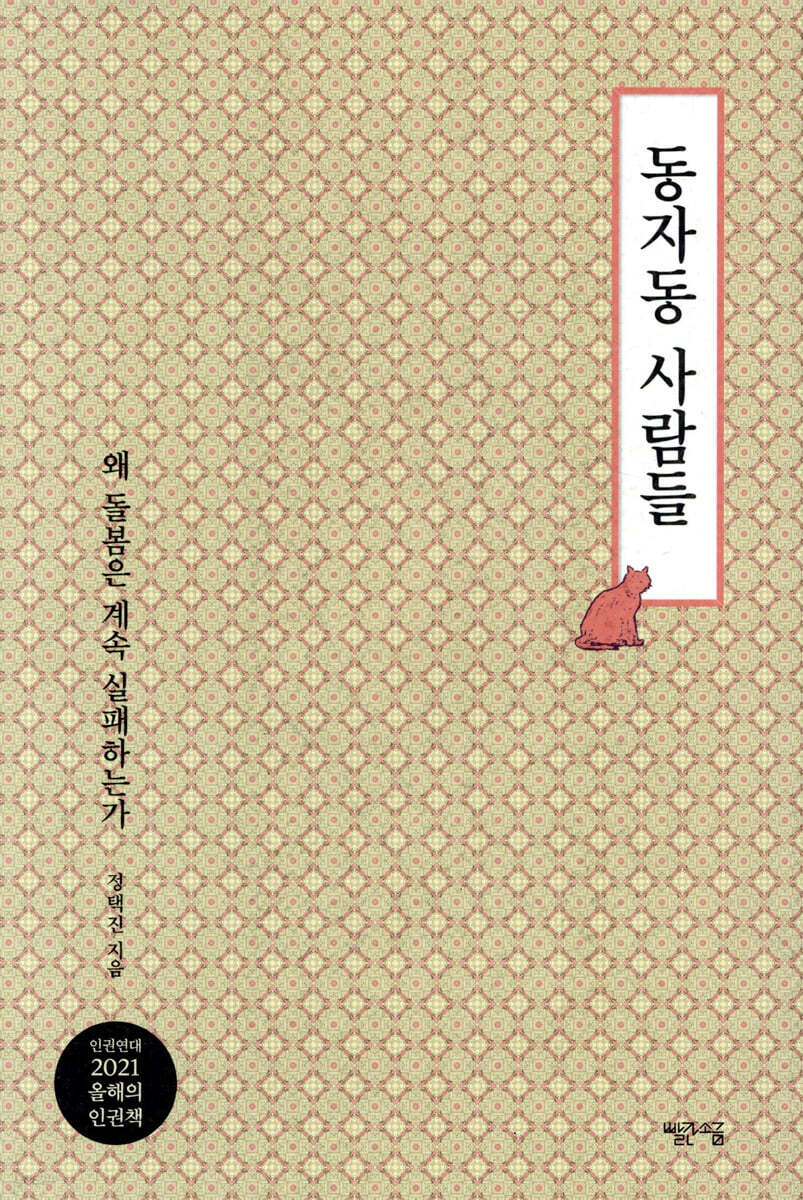
People of Dongja-dong
 |
Description
Book Introduction
- A word from MD
-
The poverty scene here nowDongja-dong, a small village located across from Seoul Station.
Here, the news that South Korea's per capita GDP has surpassed $30,000 is not felt.
Despite institutional support and the care of various organizations, why can't these people escape the shantytowns? This book captures the current state of poverty in South Korea through the eyes of a young researcher.
February 5, 2021. Social and Political PD Son Min-gyu
A cultural technology journal that captures the "present, here" of the residents of Jjokbangchon
Dongja-dong's shantytown is a representative densely populated slum area located across from Seoul Station.
It is also the main setting of the legendary bestseller 『Human Market』 (Kim Hong-shin) in the late 1970s.
It was after the IMF foreign exchange crisis in 1997 that various attempts to help the residents of Dongja-dong, which had been surviving as a shantytown since the Korean War, exploded.
The basic livelihood security system and public funerals for the unclaimed were institutionalized, and the Seoul Metropolitan Government launched a low-cost room project.
Numerous organizations have begun providing various necessities.
Volunteers with their sleeves rolled up visit the Dongja-dong shantytown every year.
But despite this 'care', residents still experience 'social abandonment'.
Their daily lives are shattered by crime and disease, and even when they receive help, they experience a loss of personality and self-esteem.
Our needs and desires as human beings, our place and way of being in the world are denied.
Why do care programs continue to fail? Various attempts to improve residents' lives go beyond economic considerations and involve interventions into their "social lives."
Interventions change the social relations of residents, from the relationships between individuals, the living and the dead, the sense of 'us', to political solidarity.
This book is an attempt to portray the poverty and suffering experienced by residents of the shantytown despite various interventions within the context of 'social relationships.'
Dongja-dong's shantytown is a representative densely populated slum area located across from Seoul Station.
It is also the main setting of the legendary bestseller 『Human Market』 (Kim Hong-shin) in the late 1970s.
It was after the IMF foreign exchange crisis in 1997 that various attempts to help the residents of Dongja-dong, which had been surviving as a shantytown since the Korean War, exploded.
The basic livelihood security system and public funerals for the unclaimed were institutionalized, and the Seoul Metropolitan Government launched a low-cost room project.
Numerous organizations have begun providing various necessities.
Volunteers with their sleeves rolled up visit the Dongja-dong shantytown every year.
But despite this 'care', residents still experience 'social abandonment'.
Their daily lives are shattered by crime and disease, and even when they receive help, they experience a loss of personality and self-esteem.
Our needs and desires as human beings, our place and way of being in the world are denied.
Why do care programs continue to fail? Various attempts to improve residents' lives go beyond economic considerations and involve interventions into their "social lives."
Interventions change the social relations of residents, from the relationships between individuals, the living and the dead, the sense of 'us', to political solidarity.
This book is an attempt to portray the poverty and suffering experienced by residents of the shantytown despite various interventions within the context of 'social relationships.'
- You can preview some of the book's contents.
Preview
index
Entering · Writing about poverty
1.
Yesterday and Today in Jjokbangchon
Dongja-dong's past
space of instability
A space for people who cannot work
The 'environment' of the shantytown
Basic Livelihood Security System and Public Funeral for Unclaimed Persons
Free supplies and low-cost room rental projects
2.
The paradox of care
Jeong Yeong-hee's story
Care gap
loss
The impossibility of care
Impossibility of self-reliance
violence
sexual desire
relationship
awe
Identity theft
Zolpidem
Supply and demand management
3.
How to remember the dead
dissatisfaction
A time of mourning and remembrance
Maintaining identity
A person without family or relatives
The ethics of forgetting
meeting
therapy
Responsibility and Care
Sending off
cold body
Proof of being a relative
A place overlooking the Han River
Remembering
4.
We are not beggars
Paralysis and taming
stigmatized dependence
positive interdependence
Control and objectification
Selection and exclusion
Exhibition of poverty
Free Jjajangmyeon
A thousand won meal
Blame and slander
Exclusion and expulsion
Two separate worlds
5.
The weight of neglected time
2015, September 20 forced evictions
2019, same problem
Memories of Victory
lie
The dilemma of housing rights
The history of a dilapidated space
living space
The crisis of the 'common'
Going out · Social life in the shantytown
1.
Yesterday and Today in Jjokbangchon
Dongja-dong's past
space of instability
A space for people who cannot work
The 'environment' of the shantytown
Basic Livelihood Security System and Public Funeral for Unclaimed Persons
Free supplies and low-cost room rental projects
2.
The paradox of care
Jeong Yeong-hee's story
Care gap
loss
The impossibility of care
Impossibility of self-reliance
violence
sexual desire
relationship
awe
Identity theft
Zolpidem
Supply and demand management
3.
How to remember the dead
dissatisfaction
A time of mourning and remembrance
Maintaining identity
A person without family or relatives
The ethics of forgetting
meeting
therapy
Responsibility and Care
Sending off
cold body
Proof of being a relative
A place overlooking the Han River
Remembering
4.
We are not beggars
Paralysis and taming
stigmatized dependence
positive interdependence
Control and objectification
Selection and exclusion
Exhibition of poverty
Free Jjajangmyeon
A thousand won meal
Blame and slander
Exclusion and expulsion
Two separate worlds
5.
The weight of neglected time
2015, September 20 forced evictions
2019, same problem
Memories of Victory
lie
The dilemma of housing rights
The history of a dilapidated space
living space
The crisis of the 'common'
Going out · Social life in the shantytown
Into the book
It was painful to write about other people's pain and poverty.
I had to constantly ask myself whether I was consuming the suffering of others as material for intellectual amusement, whether I was justifying myself with plausible rhetoric like theoretical contribution, academic engagement, and intellectual intervention.
I had to constantly question and prove what I was writing, why I was writing it, and how I was writing it.
Faced with the closet, I had to think about what I would do and how I would live as a citizen of Omelas.
And then I gradually became mentally exhausted.
However, I felt that avoiding and not facing these questions head-on would be an abdication of my responsibility as a researcher and author.
Now it is up to me to find the answer.
--- p.10~11
In the late 1970s, novelist Kim Hong-shin went on a reporting expedition to write “Human Market” and encountered gangsters and human traffickers, where he suffered hardships. This was a crime-ridden area where “things that cannot be solved with law, common sense, ethics, morality, and righteousness” occurred every day. This was the stage where Jang Chong-chan, the protagonist of “Human Market,” a modern-day Hong Gil-dong, was active: Yangdong, Dodong, and Dongja-dong.
--- p.23~24
It is undeniable that material and economic needs must be met first for a full life.
But an economic life is not necessarily a complete life.
However, the form of life that the basic livelihood security system presupposes reduces a full life, or a good life, to an economic dimension.
At this time, social relationships, interdependence, and everyday care that go beyond the economic dimension of life remain an inevitable gap in which the basic livelihood security system does not and cannot intervene.
--- p.66
By attending funerals, residents demonstrate a connection between the living and the dead.
The connection between the two gives An Je-dong, who was classified as an unclaimed deceased, the paradoxical status of a 'unclaimed deceased with a connection.'
Through this, residents expose the loopholes in the system that defines normal death for unrelated people and those centered on blood relatives.
By maintaining the deceased's posthumous identity through a time of mourning and remembrance, it not only creates a symbolic rift in the institutional standards that define An Je-dong's death as abnormal, but also grants him the status of a normal and good death.
--- p.123
As in the case of free jajangmyeon, giving and receiving that do not lead to giving back raises issues of personality and self-esteem within the gift.
In a situation where the recipient has no choice but to unilaterally accept the other person's offer while recognizing that it cannot be returned, the recipient experiences a loss of self-esteem, as if he or she has lost his or her dignity and face and has become a "beggar."
Therefore, in order for the giving and receiving that cannot be returned to continue, there must be a microscopic mechanism to prevent the personal damage felt by the recipient of the gift.
--- p.194
It is difficult to easily conclude what ethical response is possible in a world without an exit, and what form that response will take.
Povinelli also does not provide a clear answer.
However, Povinelli provides one clue.
He says, “Life is not about setting up some redemptive future, but about understanding that ‘this is what is’.”
Before suggesting alternatives like, "If we do this, things will get better," from a futuristic perspective, we must understand that we are connected to the child in the closet, and that our own happiness is only possible upon the child's suffering.
Furthermore, the work of understanding the 'present here and now' on which these connections emerge must come first.
I had to constantly ask myself whether I was consuming the suffering of others as material for intellectual amusement, whether I was justifying myself with plausible rhetoric like theoretical contribution, academic engagement, and intellectual intervention.
I had to constantly question and prove what I was writing, why I was writing it, and how I was writing it.
Faced with the closet, I had to think about what I would do and how I would live as a citizen of Omelas.
And then I gradually became mentally exhausted.
However, I felt that avoiding and not facing these questions head-on would be an abdication of my responsibility as a researcher and author.
Now it is up to me to find the answer.
--- p.10~11
In the late 1970s, novelist Kim Hong-shin went on a reporting expedition to write “Human Market” and encountered gangsters and human traffickers, where he suffered hardships. This was a crime-ridden area where “things that cannot be solved with law, common sense, ethics, morality, and righteousness” occurred every day. This was the stage where Jang Chong-chan, the protagonist of “Human Market,” a modern-day Hong Gil-dong, was active: Yangdong, Dodong, and Dongja-dong.
--- p.23~24
It is undeniable that material and economic needs must be met first for a full life.
But an economic life is not necessarily a complete life.
However, the form of life that the basic livelihood security system presupposes reduces a full life, or a good life, to an economic dimension.
At this time, social relationships, interdependence, and everyday care that go beyond the economic dimension of life remain an inevitable gap in which the basic livelihood security system does not and cannot intervene.
--- p.66
By attending funerals, residents demonstrate a connection between the living and the dead.
The connection between the two gives An Je-dong, who was classified as an unclaimed deceased, the paradoxical status of a 'unclaimed deceased with a connection.'
Through this, residents expose the loopholes in the system that defines normal death for unrelated people and those centered on blood relatives.
By maintaining the deceased's posthumous identity through a time of mourning and remembrance, it not only creates a symbolic rift in the institutional standards that define An Je-dong's death as abnormal, but also grants him the status of a normal and good death.
--- p.123
As in the case of free jajangmyeon, giving and receiving that do not lead to giving back raises issues of personality and self-esteem within the gift.
In a situation where the recipient has no choice but to unilaterally accept the other person's offer while recognizing that it cannot be returned, the recipient experiences a loss of self-esteem, as if he or she has lost his or her dignity and face and has become a "beggar."
Therefore, in order for the giving and receiving that cannot be returned to continue, there must be a microscopic mechanism to prevent the personal damage felt by the recipient of the gift.
--- p.194
It is difficult to easily conclude what ethical response is possible in a world without an exit, and what form that response will take.
Povinelli also does not provide a clear answer.
However, Povinelli provides one clue.
He says, “Life is not about setting up some redemptive future, but about understanding that ‘this is what is’.”
Before suggesting alternatives like, "If we do this, things will get better," from a futuristic perspective, we must understand that we are connected to the child in the closet, and that our own happiness is only possible upon the child's suffering.
Furthermore, the work of understanding the 'present here and now' on which these connections emerge must come first.
--- p.261
Publisher's Review
Why does care keep failing?
Dongja-dong's shantytown is a representative densely populated slum area located across from Seoul Station.
It is also the main setting of the legendary bestseller 『Human Market』 (Kim Hong-shin) from the late 1970s to early 1980s.
It was after the IMF foreign exchange crisis in 1997 that various attempts to help the residents of Dongja-dong, which had been transformed into a shantytown, red-light district, and shantytown after the Korean War, exploded.
The basic livelihood security system and public funerals for the unclaimed were institutionalized, and the Seoul Metropolitan Government launched a low-cost room project.
Numerous organizations have begun providing various necessities.
Volunteers with their sleeves rolled up visit the Dongja-dong shantytown every year.
But despite this 'care', residents still experience 'social abandonment'.
Their daily lives are shattered by crime and disease, and even when they receive help, they experience a loss of personality and self-esteem.
Our needs and desires as human beings, our place and way of being in the world are denied.
Why does care keep failing?
A cultural technology journal that captures the "present, here" of the residents of Jjokbangchon
The article was written by Jeong Taek-jin, a young researcher in his thirties.
Jeong Taek-jin majored in cultural anthropology and philosophy at Yonsei University.
He received his master's degree from the Department of Cultural Anthropology at the same university's Graduate School with a dissertation titled "Social Life in Jjokbangchon: Focusing on Jjokbangchon in Dongja-dong, Seoul" (2020), and was awarded the Yonsei University Outstanding Dissertation Award for this dissertation. "People in Dongja-dong" is based on this dissertation.
In the introduction to the book, he reveals his inner thoughts about 'writing poverty' in our time.
“It was painful to write about the suffering and poverty of others.
I had to constantly ask myself whether I was consuming the suffering of others as material for intellectual amusement, whether I was justifying myself with plausible rhetoric like theoretical contribution, academic engagement, and intellectual intervention.
I had to constantly question and prove what I was writing, why I was writing it, and how I was writing it.
Faced with the closet, I had to think about what I would do and how I would live as a citizen of Omelas.
And then, I gradually became mentally exhausted.
However, I felt that avoiding and not facing these questions head-on would be an abdication of my responsibility as a researcher and author.
Now it is up to me to find the answer.”
Although it is based on an academic paper, the narrative within the book is rich and interesting.
This may be because I lived and studied with local residents on site for over 9 months.
Professor Jo Moon-young of Yonsei University's Department of Cultural Anthropology evaluated this, saying, "'People of Dongja-dong' is a cultural technology journal that captures the 'present, here' of the residents of the shantytown while dangerously risking the risk of narrative."
Jeong Yeong-hee's Story: The Paradox of Care
Jeong Yeong-hee (45 years old), who lives in a slum in Dongja-dong, always shaves her hair short.
She is a mentally disabled person, a recipient of basic livelihood security, and a divorced mother with one son.
Her older sister, Jeong Min-hee, has been meeting with Jeong Yeong-hee regularly for a long time and taking care of her daily life.
In July 2019, Jeong Yeong-hee won a grant for the housing support project for the vulnerable and moved into public rental housing in Gangbuk-gu, Seoul, escaping the Dongja-dong shantytown. However, she returned to Dongja-dong and mostly lived in her live-in boyfriend Hong In-taek's shantytown.
The state provides care to Jeong Yeong-hee in the form of basic livelihood security.
But this care stops at the economic level.
Routine care is not provided.
Moreover, with a minimum living wage of 512,000 won, it is difficult to make a living, so many people living in shantytowns are tempted to commit identity theft or illegal drug trafficking such as Zolpidem.
You may ask, “Why don’t you just work?”
There are many elderly and sick people in the shantytown.
Jeong Yeong-hee is similar.
Therefore, it seems essential that the family, including the eldest sister Jeong Min-hee, provide daily care to fill the gap in care that the basic livelihood security system cannot provide.
The family believes that Jeong Yeong-hee is poor and lives an 'abnormal' life because she has a congenital mental retardation.
So, although it is difficult, I practice caring consistently.
The family's goal is to live "like a human being," according to Jeong Yeong-hee.
He tries to keep Jeong Yeong-hee connected with her family, hoping that she will 'escape' from the shantytown.
Sometimes, living in a hospital or facility for treatment purposes is recommended.
Meanwhile, when the monthly salary comes in on the 20th, her live-in boyfriend, Hong In-taek, takes 300,000 to 400,000 won or more of Jeong Yeong-hee's salary under the pretext of management fees.
Jeong Yeong-hee has no idea how this money is being used.
The person who implicated her in the cell phone identity theft crime was her live-in boyfriend.
Jeong Yeong-hee is in a situation where she has to take responsibility for 6.6 million won in unpaid debts on three cell phones registered in her name without her knowledge.
Despite these hardships in life, Jeong Yeong-hee does not return to her family.
Do not leave the building or enter the facility.
Even though she is involved in various crimes, she does not break up with her live-in boyfriend.
The family believes that Jeong Yeong-hee's incomprehensible behavior is due to her mental retardation.
But she thinks differently.
It is not a disability, but rather the ‘experience and memory of violence’ that is the cause.
The reason for her divorce is her ex-husband's assault.
However, custody of the child was awarded to the ex-husband.
Because she is a dependent who receives welfare benefits.
At this time, the basic livelihood security benefit functioned as a tool to prove ‘lack of ability to support.’
Jeong Yeong-hee also says that sexual harassment and assault occur frequently when people around her find out that she is a woman.
To prevent sexual harassment and assault, she keeps her hair short.
And despite the unequal relationship and the risk of being involved in a crime, she does not break up with her live-in boyfriend.
Rather, it shows symptoms closer to separation anxiety.
This is because she believes that her live-in boyfriend protects her from the experiences and memories of such violence, as well as from ongoing violence.
Ironically, the person who Jeong Yeong-hee currently relies on the most for care is not the state or her family, but her live-in boyfriend.
There is a gap between the care that Jeong Yeong-hee truly needs and the care provided by 'normal' entities such as the state and family.
This is truly the 'paradox of care'.
Park Hyun-wook's Story: Social Abandonment
G Church, located in Dongja-dong, provides special meals to residents once a month through the 'Sharing Jjajangmyeon with Love' event.
You don't necessarily have to go to G Church to eat Jjajangmyeon.
Because young believers and volunteers deliver Jjajangmyeon throughout Dongja-dong.
Any resident who encounters a volunteer can eat Jjajangmyeon.
One day, Park Hyeon-wook (60 years old), a resident who encountered a volunteer, firmly refused to eat Jjajangmyeon.
Despite repeated offers, he still refuses to accept Jjajangmyeon.
And then we go to 'Sarangbang Food and Drink', run by a resident support organization, and buy food to eat.
The price of a meal here is 1,000 won.
As the volunteers carrying the Jjajangmyeon disappeared, Park Hyun-wook said, “We’re not beggars either…”
If giving is a form of mutual recognition, then in 'Zoom', which does not require a response, the resident is deprived of the opportunity for recognition.
In the distinction between the giver and the receiver, the giver and the receiver, the residents who cannot participate in the process of giving and receiving can never participate in giving back.
When residents are unable to participate in the relationship of giving, they become beings who are deprived of face and dignity, and this experience leads to the language of insult and loss of self-esteem, such as “beggars.”
Park Hyun-wook's act of refusing Jjajangmyeon with a frown is a gesture of refusing the normal relationship of being deprived of the opportunity for recognition and response.
Receiving items or providing meals in the name of support activities may help sustain the lives of the residents of the shantytown.
However, residents have no choice but to reject this, experiencing personal damage and loss of self-esteem as if they were being treated as “beggars.”
On the other hand, the 1,000 won meal price of 'Sarangbang Gourmet' is a fair price for the meal and an act of returning what one has received in return.
A thousand won is an amount that even the residents of the shantytown can afford without much burden, even if they are in dire financial straits.
In a food and drink industry where you can return what you received in the form of a thousand won, these people are not “beggars.”
By paying a thousand won, you participate in the process of giving and receiving, and through this, you respond to the other person's actions.
In this process, residents form a common society with all those who participate in the meal and are granted status as equal members.
In this way, free jajangmyeon fails to create a connection between volunteers and residents despite their good intentions.
Rather, the worlds of the two entities are becoming increasingly separated. The same holds true for the surge in free goods aid following the IMF crisis.
Residents experience a loss of self-esteem and personality as they are unable to participate in the rituals of mutual recognition.
In the free goods support project, the residents of the shantytown are nothing more than complete strangers who cannot become members of 'us'.
Despite ongoing support, residents experience 'social abandonment'.
Social life in the shantytown
Ursula K.
There is no exit in Le Guin's short story "The Ones Who Walk Away from Omelas."
As long as the happiness of the citizens lies in the misery of the child locked in the closet, there is no way to reduce the suffering of the child without harming the happiness of the citizens.
In a world without an exit, it is difficult to easily conclude what ethical response is possible and what form that response will take.
Anthropologist Elizabeth Povinelli also does not provide a clear answer to this question.
It just provides one clue.
He says, “Life is not about setting up some redemptive future, but about understanding that ‘this is what is’.”
There are four narratives that the author mobilizes in this book to understand the 'present and here' of Dongja-dong.
This is also a narrative shared by the residents of Dongja-dong.
①Basic livelihood security, ②Death and funeral, ③Free goods support activities, ④Building number 9-20, a symbol of the slums.
The story of Jeong Yeong-hee mentioned above is related to basic livelihood security, and the story of Park Hyeon-wook is related to free goods support activities.
The book also contains narratives about death, funerals, and building 9-20.
These narratives function as keywords for a ‘new’ understanding of the Dongja-dong shantytown.
The term Dongja-dong shantytown does not only refer to the physical characteristics of the space, such as old and dilapidated buildings or poor sanitary conditions.
Rather, various attempts to intervene in the lives of residents, such as basic livelihood security, unclaimed deaths and funerals, material support activities, and the cheap room business, define the Dongja-dong room village.
The various forms of institutional and non-institutional interventions that have developed over the past 20 years since the 1997 IMF foreign exchange crisis have become the 'environment' that has the greatest impact on the lives of residents.
Therefore, what we should now focus on is the ‘social life’ of the shantytown rather than the ‘physical space.’
The various attempts to improve the lives of the residents of the shantytowns go beyond the economic aspect and are also interventions into the residents' 'social lives'.
Interventions change the social relations of residents, from the relationships between individuals, the living and the dead, the sense of 'us', to political solidarity.
This book is an attempt to portray the poverty and suffering experienced by residents of the shantytown despite various interventions within the context of 'social relationships.'
Professor Kim Won, author of “Female Workers 1970,” praised this work, saying, “It is a masterpiece that unravels the connections made by people in the Dongja-dong shantytown through the keyword of ‘social abandonment’ in the process of various forms of intervention in poverty/care.”
Dongja-dong's shantytown is a representative densely populated slum area located across from Seoul Station.
It is also the main setting of the legendary bestseller 『Human Market』 (Kim Hong-shin) from the late 1970s to early 1980s.
It was after the IMF foreign exchange crisis in 1997 that various attempts to help the residents of Dongja-dong, which had been transformed into a shantytown, red-light district, and shantytown after the Korean War, exploded.
The basic livelihood security system and public funerals for the unclaimed were institutionalized, and the Seoul Metropolitan Government launched a low-cost room project.
Numerous organizations have begun providing various necessities.
Volunteers with their sleeves rolled up visit the Dongja-dong shantytown every year.
But despite this 'care', residents still experience 'social abandonment'.
Their daily lives are shattered by crime and disease, and even when they receive help, they experience a loss of personality and self-esteem.
Our needs and desires as human beings, our place and way of being in the world are denied.
Why does care keep failing?
A cultural technology journal that captures the "present, here" of the residents of Jjokbangchon
The article was written by Jeong Taek-jin, a young researcher in his thirties.
Jeong Taek-jin majored in cultural anthropology and philosophy at Yonsei University.
He received his master's degree from the Department of Cultural Anthropology at the same university's Graduate School with a dissertation titled "Social Life in Jjokbangchon: Focusing on Jjokbangchon in Dongja-dong, Seoul" (2020), and was awarded the Yonsei University Outstanding Dissertation Award for this dissertation. "People in Dongja-dong" is based on this dissertation.
In the introduction to the book, he reveals his inner thoughts about 'writing poverty' in our time.
“It was painful to write about the suffering and poverty of others.
I had to constantly ask myself whether I was consuming the suffering of others as material for intellectual amusement, whether I was justifying myself with plausible rhetoric like theoretical contribution, academic engagement, and intellectual intervention.
I had to constantly question and prove what I was writing, why I was writing it, and how I was writing it.
Faced with the closet, I had to think about what I would do and how I would live as a citizen of Omelas.
And then, I gradually became mentally exhausted.
However, I felt that avoiding and not facing these questions head-on would be an abdication of my responsibility as a researcher and author.
Now it is up to me to find the answer.”
Although it is based on an academic paper, the narrative within the book is rich and interesting.
This may be because I lived and studied with local residents on site for over 9 months.
Professor Jo Moon-young of Yonsei University's Department of Cultural Anthropology evaluated this, saying, "'People of Dongja-dong' is a cultural technology journal that captures the 'present, here' of the residents of the shantytown while dangerously risking the risk of narrative."
Jeong Yeong-hee's Story: The Paradox of Care
Jeong Yeong-hee (45 years old), who lives in a slum in Dongja-dong, always shaves her hair short.
She is a mentally disabled person, a recipient of basic livelihood security, and a divorced mother with one son.
Her older sister, Jeong Min-hee, has been meeting with Jeong Yeong-hee regularly for a long time and taking care of her daily life.
In July 2019, Jeong Yeong-hee won a grant for the housing support project for the vulnerable and moved into public rental housing in Gangbuk-gu, Seoul, escaping the Dongja-dong shantytown. However, she returned to Dongja-dong and mostly lived in her live-in boyfriend Hong In-taek's shantytown.
The state provides care to Jeong Yeong-hee in the form of basic livelihood security.
But this care stops at the economic level.
Routine care is not provided.
Moreover, with a minimum living wage of 512,000 won, it is difficult to make a living, so many people living in shantytowns are tempted to commit identity theft or illegal drug trafficking such as Zolpidem.
You may ask, “Why don’t you just work?”
There are many elderly and sick people in the shantytown.
Jeong Yeong-hee is similar.
Therefore, it seems essential that the family, including the eldest sister Jeong Min-hee, provide daily care to fill the gap in care that the basic livelihood security system cannot provide.
The family believes that Jeong Yeong-hee is poor and lives an 'abnormal' life because she has a congenital mental retardation.
So, although it is difficult, I practice caring consistently.
The family's goal is to live "like a human being," according to Jeong Yeong-hee.
He tries to keep Jeong Yeong-hee connected with her family, hoping that she will 'escape' from the shantytown.
Sometimes, living in a hospital or facility for treatment purposes is recommended.
Meanwhile, when the monthly salary comes in on the 20th, her live-in boyfriend, Hong In-taek, takes 300,000 to 400,000 won or more of Jeong Yeong-hee's salary under the pretext of management fees.
Jeong Yeong-hee has no idea how this money is being used.
The person who implicated her in the cell phone identity theft crime was her live-in boyfriend.
Jeong Yeong-hee is in a situation where she has to take responsibility for 6.6 million won in unpaid debts on three cell phones registered in her name without her knowledge.
Despite these hardships in life, Jeong Yeong-hee does not return to her family.
Do not leave the building or enter the facility.
Even though she is involved in various crimes, she does not break up with her live-in boyfriend.
The family believes that Jeong Yeong-hee's incomprehensible behavior is due to her mental retardation.
But she thinks differently.
It is not a disability, but rather the ‘experience and memory of violence’ that is the cause.
The reason for her divorce is her ex-husband's assault.
However, custody of the child was awarded to the ex-husband.
Because she is a dependent who receives welfare benefits.
At this time, the basic livelihood security benefit functioned as a tool to prove ‘lack of ability to support.’
Jeong Yeong-hee also says that sexual harassment and assault occur frequently when people around her find out that she is a woman.
To prevent sexual harassment and assault, she keeps her hair short.
And despite the unequal relationship and the risk of being involved in a crime, she does not break up with her live-in boyfriend.
Rather, it shows symptoms closer to separation anxiety.
This is because she believes that her live-in boyfriend protects her from the experiences and memories of such violence, as well as from ongoing violence.
Ironically, the person who Jeong Yeong-hee currently relies on the most for care is not the state or her family, but her live-in boyfriend.
There is a gap between the care that Jeong Yeong-hee truly needs and the care provided by 'normal' entities such as the state and family.
This is truly the 'paradox of care'.
Park Hyun-wook's Story: Social Abandonment
G Church, located in Dongja-dong, provides special meals to residents once a month through the 'Sharing Jjajangmyeon with Love' event.
You don't necessarily have to go to G Church to eat Jjajangmyeon.
Because young believers and volunteers deliver Jjajangmyeon throughout Dongja-dong.
Any resident who encounters a volunteer can eat Jjajangmyeon.
One day, Park Hyeon-wook (60 years old), a resident who encountered a volunteer, firmly refused to eat Jjajangmyeon.
Despite repeated offers, he still refuses to accept Jjajangmyeon.
And then we go to 'Sarangbang Food and Drink', run by a resident support organization, and buy food to eat.
The price of a meal here is 1,000 won.
As the volunteers carrying the Jjajangmyeon disappeared, Park Hyun-wook said, “We’re not beggars either…”
If giving is a form of mutual recognition, then in 'Zoom', which does not require a response, the resident is deprived of the opportunity for recognition.
In the distinction between the giver and the receiver, the giver and the receiver, the residents who cannot participate in the process of giving and receiving can never participate in giving back.
When residents are unable to participate in the relationship of giving, they become beings who are deprived of face and dignity, and this experience leads to the language of insult and loss of self-esteem, such as “beggars.”
Park Hyun-wook's act of refusing Jjajangmyeon with a frown is a gesture of refusing the normal relationship of being deprived of the opportunity for recognition and response.
Receiving items or providing meals in the name of support activities may help sustain the lives of the residents of the shantytown.
However, residents have no choice but to reject this, experiencing personal damage and loss of self-esteem as if they were being treated as “beggars.”
On the other hand, the 1,000 won meal price of 'Sarangbang Gourmet' is a fair price for the meal and an act of returning what one has received in return.
A thousand won is an amount that even the residents of the shantytown can afford without much burden, even if they are in dire financial straits.
In a food and drink industry where you can return what you received in the form of a thousand won, these people are not “beggars.”
By paying a thousand won, you participate in the process of giving and receiving, and through this, you respond to the other person's actions.
In this process, residents form a common society with all those who participate in the meal and are granted status as equal members.
In this way, free jajangmyeon fails to create a connection between volunteers and residents despite their good intentions.
Rather, the worlds of the two entities are becoming increasingly separated. The same holds true for the surge in free goods aid following the IMF crisis.
Residents experience a loss of self-esteem and personality as they are unable to participate in the rituals of mutual recognition.
In the free goods support project, the residents of the shantytown are nothing more than complete strangers who cannot become members of 'us'.
Despite ongoing support, residents experience 'social abandonment'.
Social life in the shantytown
Ursula K.
There is no exit in Le Guin's short story "The Ones Who Walk Away from Omelas."
As long as the happiness of the citizens lies in the misery of the child locked in the closet, there is no way to reduce the suffering of the child without harming the happiness of the citizens.
In a world without an exit, it is difficult to easily conclude what ethical response is possible and what form that response will take.
Anthropologist Elizabeth Povinelli also does not provide a clear answer to this question.
It just provides one clue.
He says, “Life is not about setting up some redemptive future, but about understanding that ‘this is what is’.”
There are four narratives that the author mobilizes in this book to understand the 'present and here' of Dongja-dong.
This is also a narrative shared by the residents of Dongja-dong.
①Basic livelihood security, ②Death and funeral, ③Free goods support activities, ④Building number 9-20, a symbol of the slums.
The story of Jeong Yeong-hee mentioned above is related to basic livelihood security, and the story of Park Hyeon-wook is related to free goods support activities.
The book also contains narratives about death, funerals, and building 9-20.
These narratives function as keywords for a ‘new’ understanding of the Dongja-dong shantytown.
The term Dongja-dong shantytown does not only refer to the physical characteristics of the space, such as old and dilapidated buildings or poor sanitary conditions.
Rather, various attempts to intervene in the lives of residents, such as basic livelihood security, unclaimed deaths and funerals, material support activities, and the cheap room business, define the Dongja-dong room village.
The various forms of institutional and non-institutional interventions that have developed over the past 20 years since the 1997 IMF foreign exchange crisis have become the 'environment' that has the greatest impact on the lives of residents.
Therefore, what we should now focus on is the ‘social life’ of the shantytown rather than the ‘physical space.’
The various attempts to improve the lives of the residents of the shantytowns go beyond the economic aspect and are also interventions into the residents' 'social lives'.
Interventions change the social relations of residents, from the relationships between individuals, the living and the dead, the sense of 'us', to political solidarity.
This book is an attempt to portray the poverty and suffering experienced by residents of the shantytown despite various interventions within the context of 'social relationships.'
Professor Kim Won, author of “Female Workers 1970,” praised this work, saying, “It is a masterpiece that unravels the connections made by people in the Dongja-dong shantytown through the keyword of ‘social abandonment’ in the process of various forms of intervention in poverty/care.”
GOODS SPECIFICS
- Date of issue: January 25, 2021
- Page count, weight, size: 284 pages | 388g | 145*215*15mm
- ISBN13: 9791191383003
- ISBN10: 1191383008
You may also like
카테고리
korean


korean

![GQ KOREA Mark (Monthly): December [2025]](http://librairie.coreenne.fr/cdn/shop/files/8ef265dbbfbf186523ed75ba7319009d.jpg?v=1765340328&width=3840)


