

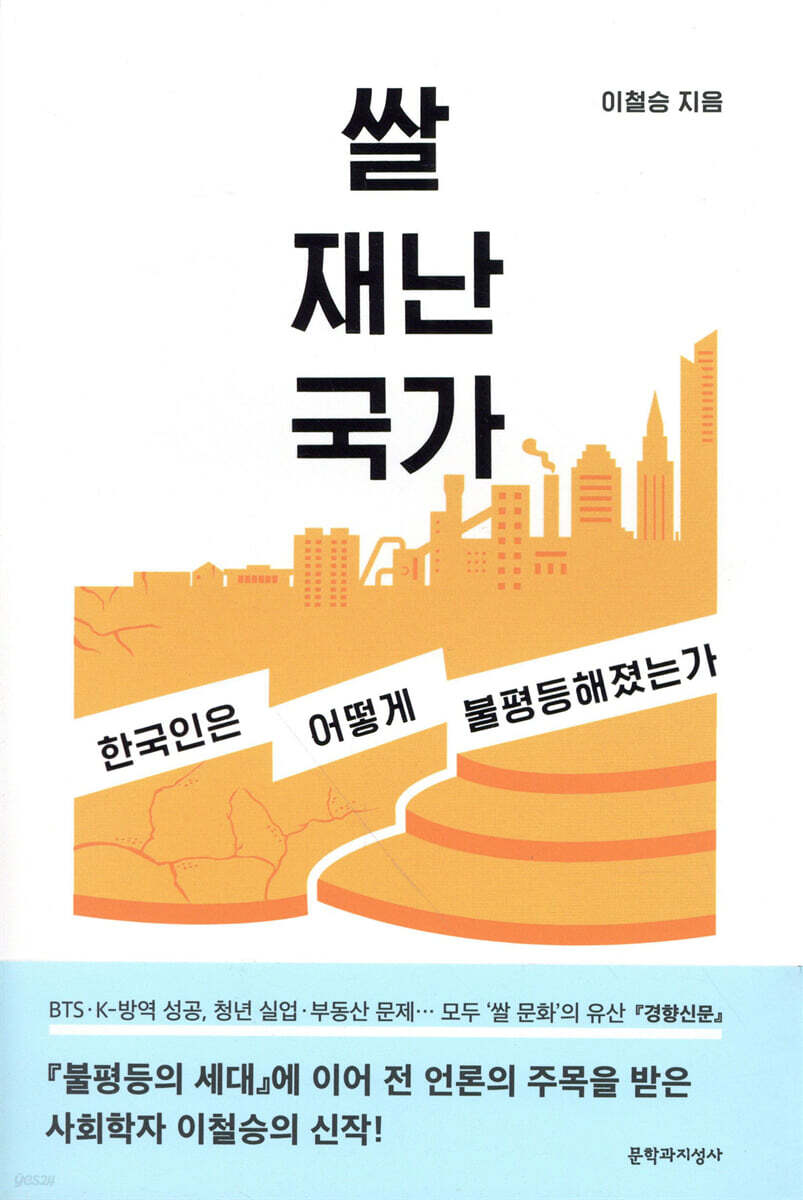
Rice disaster country
 |
Description
Book Introduction
Youth unemployment, discrimination against irregular workers, and academic backgroundism From seniority-based pay and the structure of women's exclusion to real estate issues Three Key Words for Understanding the Structure of Inequality in Korean Society Rice / Disaster / Country The new work of Lee Cheol-seung, author of "Generation of Inequality," which received rave reviews for offering a new perspective on generational theory and inequality in Korean society in 2019 and garnered enthusiastic responses from the media, academia, politics, and the general public, has been published by Munhak-kwa-Jiseongsa. "Rice, Disaster, and the Nation - How Koreans Became Unequal" is it. In his previous work, "Generation of Inequality," author Lee Cheol-seung presented an interesting analysis of various data points, using the keyword "generation" to illustrate how the hierarchical structure of Korean society intertwined with generations and caused inequality. If his previous work was a contemporary analysis of “Why do we still suffer from hierarchy and inequality (despite democratization)?”, this book, as the title suggests, focuses on three keywords: “rice,” “disaster,” and “nation,” and attempts a more in-depth historical analysis of “where did the unequal structure of Korean society and the culture of competition/comparison come from and how were they formed?” To understand the "deep structure" of inequality that permeates Korean society today, we must first examine the social institutions and customs—collaboration, hierarchy, and competition—that East Asian societies and nations have created to produce and sustain food (rice) while fighting recurring disasters. This book traces the evolution of this unequal structure from the formation of ancient states on the Korean Peninsula to the current COVID-19 pandemic. Based on extensive data collection and data analysis, it provides a fascinating account of why and how the "rice farming system," an institution that developed in the East Asian rice-cultivating cultural sphere, was created, and how those institutions shaped the hierarchical and unequal structures of Korean society today. Above all, the author, with his unique insight and original analytical framework, reveals that many problems causing serious divisions and structural crises in modern Korean society, such as youth unemployment, discrimination against irregular workers, academic elitism, seniority-based pay and the exclusion of women, and real estate issues, are closely linked to the legacy of the rice farming system, providing readers with special insights. This book, which argues that old structures must be restructured through new institutions suited to the institutions of modern capitalism and democracy, can therefore be called a plan for structural reform of the rice farming system. |
- You can preview some of the book's contents.
Preview
index
Entering
prolog
Puzzles of this Book | Key Arguments of this Book | Seven Legacies of the Rice Farming System
Chapter 1: The Origins of East Asian States: The Emergence of the Rice Farming System and the Politics of Disaster
Who We Are - Establishing Rice Theory
East Asia is trapped in rice, and Koreans are obsessed with rice farming.
Contrast between rice and wheat
The love of rice among Korean Peninsula residents
The Political Economy of Rice and Bread
Disaster politics in ancient states
The politics of floods and thunderstorms
Drought and the Politics of Water Security
The worst disaster of ancient and pre-modern nations: drought
Joseon Dynasty's drought countermeasures
Complex Disasters: Catalysts for Political Change
Going Out─Rice, Disaster, and the Countries of East Asia
Chapter 2: The Rice Farming Production System and the Birth of Collaborative-Relational Capital
The emergence of an equal cooperative system in rice farming
The communal labor system of rice farming
The duet of cooperation and competition
Continuation of rice farming culture
Comparison, jealousy, and happiness in a rice-farming village
The trust structure of a rice-farming village where collaboration and distrust coexist
Standardization and Equalization: The Invisible Hand of Rice Farming Villages
Transplanting the Rice Farming System to the Modern Era: The Seniority-Based Skill Rise Hypothesis and the Standardization Hypothesis
East Asian Villages: Artisans of Collaboration
Going Out─Beyond Orientalism
Chapter 3: The Corona Pandemic and the Rice Farming System
The Cultural DNA of East Asians: A Social Coordination System
The Success Function of East Asian Rural Communities: Collaboration and Relational Capital
The Corona Pandemic by Country
Rice farming systems and the coronavirus pandemic
Individualism in wheat farming and collectivism in rice farming
Going Out - The Pandemic and the Widening Inequality
Chapter 4: The Rice Farming System and the Political Psychology of Inequality: Why Are Koreans Sensitive to Inequality?
The inequality structure of rice-farming and wheat-farming societies
The Inequality Mechanism of Rice-Grown Society—Connection to the State
How were the rice farming system and the civil service examination system intertwined?
The Interaction Between Officialdom and Rice Farming
The coexistence of the desire for equality and differentiation
The Psychological Structure of the Southern Korean Peninsula's Residents: The Coexistence of Equality and Differentiation
Efforts to address inequality between wheat and rice cultures
The historical origins of efforts to heal inequality
The Legacy of the Rice Farming System: The Underdevelopment of the Welfare State
Modern Koreans' Attitudes toward Welfare: Real Estate and the Welfare State
Going Out─The Production of Inequality Through the State
Chapter 5: Seniority-Based Pay and the Crisis of Fairness
What Causes Youth Unemployment and Labor Market Dualization?
The entanglement of the system (seniority) - subject (generation) - structure (population)
Institutionalization of seniority culture - seniority system
Generational Networks and Korean Pattern Negotiation
Changes in the demographic composition of companies due to changes in population structure
The Age-Generation-Demographic Convergence and the Corporate Cost Crisis
The Seniority-Generation-Demographic Confusion and the Youth Employment Crisis: The Seniority-Generation System and the Labor Movement
Seniority system and women
Going Out─Inequality, From the Present Generation to the Next
Chapter 6: Overcoming the Rice Farming System
From a disaster relief nation to a universal social safety net nation
From tuning for standardization to tuning for diversity
The conflict between the rice farming system and the younger generation
Women as Colleagues
Introduction of a job evaluation system - From testing to proficiency
Seniority vs. Job-Based Pay—Which Inequality Should You Choose?
Reforming the Korean Hierarchical Structure: Beyond the Seniority System
Going out
References
prolog
Puzzles of this Book | Key Arguments of this Book | Seven Legacies of the Rice Farming System
Chapter 1: The Origins of East Asian States: The Emergence of the Rice Farming System and the Politics of Disaster
Who We Are - Establishing Rice Theory
East Asia is trapped in rice, and Koreans are obsessed with rice farming.
Contrast between rice and wheat
The love of rice among Korean Peninsula residents
The Political Economy of Rice and Bread
Disaster politics in ancient states
The politics of floods and thunderstorms
Drought and the Politics of Water Security
The worst disaster of ancient and pre-modern nations: drought
Joseon Dynasty's drought countermeasures
Complex Disasters: Catalysts for Political Change
Going Out─Rice, Disaster, and the Countries of East Asia
Chapter 2: The Rice Farming Production System and the Birth of Collaborative-Relational Capital
The emergence of an equal cooperative system in rice farming
The communal labor system of rice farming
The duet of cooperation and competition
Continuation of rice farming culture
Comparison, jealousy, and happiness in a rice-farming village
The trust structure of a rice-farming village where collaboration and distrust coexist
Standardization and Equalization: The Invisible Hand of Rice Farming Villages
Transplanting the Rice Farming System to the Modern Era: The Seniority-Based Skill Rise Hypothesis and the Standardization Hypothesis
East Asian Villages: Artisans of Collaboration
Going Out─Beyond Orientalism
Chapter 3: The Corona Pandemic and the Rice Farming System
The Cultural DNA of East Asians: A Social Coordination System
The Success Function of East Asian Rural Communities: Collaboration and Relational Capital
The Corona Pandemic by Country
Rice farming systems and the coronavirus pandemic
Individualism in wheat farming and collectivism in rice farming
Going Out - The Pandemic and the Widening Inequality
Chapter 4: The Rice Farming System and the Political Psychology of Inequality: Why Are Koreans Sensitive to Inequality?
The inequality structure of rice-farming and wheat-farming societies
The Inequality Mechanism of Rice-Grown Society—Connection to the State
How were the rice farming system and the civil service examination system intertwined?
The Interaction Between Officialdom and Rice Farming
The coexistence of the desire for equality and differentiation
The Psychological Structure of the Southern Korean Peninsula's Residents: The Coexistence of Equality and Differentiation
Efforts to address inequality between wheat and rice cultures
The historical origins of efforts to heal inequality
The Legacy of the Rice Farming System: The Underdevelopment of the Welfare State
Modern Koreans' Attitudes toward Welfare: Real Estate and the Welfare State
Going Out─The Production of Inequality Through the State
Chapter 5: Seniority-Based Pay and the Crisis of Fairness
What Causes Youth Unemployment and Labor Market Dualization?
The entanglement of the system (seniority) - subject (generation) - structure (population)
Institutionalization of seniority culture - seniority system
Generational Networks and Korean Pattern Negotiation
Changes in the demographic composition of companies due to changes in population structure
The Age-Generation-Demographic Convergence and the Corporate Cost Crisis
The Seniority-Generation-Demographic Confusion and the Youth Employment Crisis: The Seniority-Generation System and the Labor Movement
Seniority system and women
Going Out─Inequality, From the Present Generation to the Next
Chapter 6: Overcoming the Rice Farming System
From a disaster relief nation to a universal social safety net nation
From tuning for standardization to tuning for diversity
The conflict between the rice farming system and the younger generation
Women as Colleagues
Introduction of a job evaluation system - From testing to proficiency
Seniority vs. Job-Based Pay—Which Inequality Should You Choose?
Reforming the Korean Hierarchical Structure: Beyond the Seniority System
Going out
References
Into the book
Why did I consider the interaction between rice, disaster, and the state as the origin of inequality? It's because I believe that the activity of maintaining food supply in the face of recurring disasters lies at the forefront of the evolution of inequality structures.
This book traces the evolution of this unequal structure, from the formation of ancient states on the Korean Peninsula to the present-day COVID-19 pandemic.
[… … ] I will analyze how East Asians and Korean Peninsula residents perceive inequality.
And we will explore how the historical evolution of such unequal structures manifests itself in our modern lives through certain institutions.
By examining the interactions between rice, disaster, and the state around these two axes, we can develop keywords such as collaboration, hierarchy, and competition, ultimately leading to a critique of today's seniority-based pay system.
Through the 'Rice Theory', we aim to unravel the hierarchical and unequal structures of Korean society today - the structure of cooperation and competition, the fervor for education, and the structure of discrimination (against irregular workers and women) in the labor market.
--- p.9~10, from “Introduction”
For Koreans, this hierarchy is a part of everyday life.
Few races are as collaborative as Koreans, but few races are as hierarchical as Koreans.
The structure of the hierarchy is not only strict, but also detailed and tight.
This hierarchy is deeply embedded in every human relationship, every word, and our children learn to adapt and conform to this hierarchy.
[… …] Why have we perpetuated this hierarchical structure so entrenched for so long, and how much longer must we live with it? Why do we so desperately yearn for "equality, justice, and equity," yet simultaneously cherish hierarchy as if it were our very lives? Why do those who champion equality and justice obsess over hierarchies based on academic background, occupation, and seniority? The questions are endless.
This book will not answer all your questions.
But it will touch, sometimes somewhat provocatively.
--- p.23, from "Prologue"
This seniority culture is reborn as the backbone of East Asian corporate organizations—the seniority system.
East Asian companies have created hierarchical structures that divide individuals' lives from entry to retirement into generations sharing the same pay scale, while also creating systems of intergenerational collaboration.
The vertical-horizontal skill tuning system of East Asian village communities is reborn in East Asian corporate organizations through the seniority system.
In a 'family-like company', the manager played the role of a parent, and the seniors played the role of elders in the neighborhood.
My colleagues who joined the company were no different from my cousins and neighborhood friends of the same age.
They rode the treadmill of cooperation and competition within a tightly knit formal and informal network like East Asian village enterprises, and by introducing the cooperative mechanism of East Asian village communities, “standardization,” into production processes and bureaucracy, they created an East Asian enterprise organization that operated “agilely” and “closely.”
--- p.35, from “Prologue”
These three elements—rice (and other plants), the given environment of climate and topography, and the subjects and institutions of rice cultivation—interacted (evolutionarily) to form the early agricultural state system of East Asia.
The question, "Why did East Asians start eating rice?" and the question, "Why on earth did East Asian countries have to create such a powerful bureaucracy (service) system so early on that cannot be found in other regions?" are essentially the same question, with the same "chain link" answer.
Rice, East Asians, and their powerful nations, to borrow Darwin's term, "coevolved."
Rice and a strong and efficient nation are two different, yet mutually compatible, dimensions.
To put it simply, we built a bigger and stronger nation by eating rice, and because we built such a nation, we were able to continue eating rice.
In this respect, even though it may be somewhat awkward, East Asian countries can be called rice states.
--- p.68~69, from “Chapter 1: Origins of East Asian States”
The seniority-based pay system in East Asian companies has transplanted two assumptions from rural communities.
[… … ] These two assumptions made it possible to bypass job evaluations of individuals, regardless of whether they were actually realized in the field.
The assumption that skill levels will level off across individuals, combined with the assumption that individuals' skill levels will grow at the same rate, makes it possible (and justifies) to reward people of the same seniority equally.
Since we work together and achieve the organization's goals, we divide the compensation unequally according to seniority group, and then equally divide it by nth within the same seniority group (therefore, the person with higher seniority buys food and drinks).
Therefore, the seniority system fostered a sense of solidarity among workers who shared their seniority, and served as a stepping stone for collectively improving productivity.
The complaint, “Why are you taking more just because you’re older after working together?” was covered up by a promise about the future, “If you wait, you’ll be rewarded like me.”
In this way, 'delayed compensation' was forced from the older 'generation that had waited long enough' to the 'generation that still had 20 or 30 years to wait'.
In a way, the seniority system is a 'conspiracy' between those who are willing to wait or those who can wait (regular employees).
--- p.149~50, from “Chapter 2: Collaboration in the Rice Farming System - The Birth of Relational Capital”
Ultimately, the main axis of the '(civil) society' developed by East Asians is a system of cooperation and coordination in which people have to interfere with each other and say unpleasant things to each other in order to survive.
We, East Asians, have developed this collaborative system over many years, and during the process of modernization, we transplanted this system into factories and offices.
Are you suffocating from your boss interfering with your work and life in every way?
East Asian society is a place where 'interfering power' operates not only at home but also in the workplace.
Are you getting annoyed by the unpleasant things you hear from the elders in your family during Chuseok?
What is Chuseok? It's a time when the interfering power hierarchy of clan society exposes and evaluates your daily life to the entire household.
East Asia is not an ideal place for individualists to live freely, doing whatever they want without worrying about others.
It is a society where people are closely intertwined with each other, watching, monitoring, copying, nagging, and matching each other's thoughts and actions, and thus becoming more and more similar to each other.
--- p.173~74, from “Chapter 3: The Corona Pandemic and the Rice Farming System”
Perhaps more than the potential spread of the virus due to my deviant behavior, I am more concerned about the resulting barrage of criticism and the resulting loss of face.
The fear of being ostracized from the community for not complying with the 'social coordination system' is the ultimate motivator that drives them to stay home even without testing positive.
So it's not surprising that the vast majority of people are wearing masks and the vast majority are observing the principles of self-quarantine.
Where did this system of social coordination come from? Where did this "culture of looking out for others"—a culture that considers the potential for reputational harm—come from? Was it something the state taught us? Was it something bureaucrats designed? Was it something we learned from other countries, like hiding cotton seeds? No.
I argue that this 'art of social coordination' has its origins in the communal labor system that has been in place in villages for hundreds, if not thousands, of years.
From the ‘rice farming system’ that we have been talking about so far.
--- p.177, from “Chapter 3: The Corona Pandemic and the Rice Farming System”
The developmental states of East Asia and Korea, which emerged from the rice farming system, encouraged urban dwellers from small-scale farming backgrounds to secure 'individualized (private) security assets' through real estate, thereby 'abandoning' their obligations as welfare state safety nets and remaining faithful to their traditional duties as organized production states.
Individuals in civil society were engaged in a competition to acquire assets, each aiming to own one or more houses by the time they left work, a competition not much different from the competition among small farmers to reclaim land under the rice farming system.
The product of that competition is the emergence of a three-tiered asset class.
They are the upper 20 percent of the asset-owning class who can generate income based on their assets, the asset-consuming class (many middle class) who must consume their assets as retirement income, and the asset-poor class at the bottom who have insufficient assets to cover their retirement consumption and have nowhere to rely except the state and their children.
And the result of this division is the world's highest elderly poverty rate we see today.
It is an irony that the rice farming system, which respects the elderly and emphasizes hierarchy, has created in the 21st century post-industrial society.
In 2020, 2030, and beyond, when the establishment of a universal welfare state is delayed, this tradition of private welfare based on assets will be further strengthened, and inequality among workers will be maintained and expanded as inequality in old age.
--- p.274~75, from “Chapter 4: Rice Farming System and the Political Psychology of Inequality”
Today, both intra- and inter-generational inequality in Korea is condensed into this seniority-based system.
This is because the seniority-based system creates inequality between generations and ages, and creates a wage gap between regular workers who can enjoy it and non-regular workers who cannot.
The core demand of the irregular workers' movement for regularization is the application of the seniority system.
Young people spend their 20s competing to get into jobs that offer seniority-based benefits and steady pay increases until they are 60 or 65.
At this point, it could be called a seniority-based republic.
--- p.316~17, from “Chapter 5 Seniority System and the Crisis of Fairness”
In the 21st century, we are witnessing the full benefits and harms of the legacy of the rice-farming national system.
In times of disaster, thanks to the country's efficiency, we can quickly return to our daily lives and get back to work.
But today's post-industrial/information society is no longer a village community based on rice farming.
Individualized disasters and welfare demands, such as illness, accidents, unemployment, childcare, and poverty, expose individual citizens to the numerous risks brought about by capitalism.
The rice-based nation is too slow and indifferent to the individual risks of modern society.
The rice farming community that cared for its members as members of the clan and the village no longer exists.
East Asian settlers only see the benefits of the state when a great disaster strikes, and in their peaceful daily lives, they must navigate a globalized market where individual desires and exploitation run rampant.
What should I do?
--- p.334~35, from “Chapter 6: Overcoming the Rice Farming System”
The seniority system is also effective during the coronavirus pandemic.
How can only the upper class of wage earners prosper in 2020, when the national economy is recording negative growth, the lower classes are losing their jobs due to the pandemic-induced recession, and one in four or five infected elderly people are dying helplessly? In the second quarter, when the direct hit of COVID-19 plunged the global economy into recession, the lowest quintile's earned income fell by 18 percent, while the top quintile's income only saw a 4 percent decline (Statistics Korea, Q2, Household Trends Survey).
This is because the seniority system is designed to automatically and endlessly increase the wages of regular workers, regardless of whether the economy or corporate organizations are in crisis.
This book traces the evolution of this unequal structure, from the formation of ancient states on the Korean Peninsula to the present-day COVID-19 pandemic.
[… … ] I will analyze how East Asians and Korean Peninsula residents perceive inequality.
And we will explore how the historical evolution of such unequal structures manifests itself in our modern lives through certain institutions.
By examining the interactions between rice, disaster, and the state around these two axes, we can develop keywords such as collaboration, hierarchy, and competition, ultimately leading to a critique of today's seniority-based pay system.
Through the 'Rice Theory', we aim to unravel the hierarchical and unequal structures of Korean society today - the structure of cooperation and competition, the fervor for education, and the structure of discrimination (against irregular workers and women) in the labor market.
--- p.9~10, from “Introduction”
For Koreans, this hierarchy is a part of everyday life.
Few races are as collaborative as Koreans, but few races are as hierarchical as Koreans.
The structure of the hierarchy is not only strict, but also detailed and tight.
This hierarchy is deeply embedded in every human relationship, every word, and our children learn to adapt and conform to this hierarchy.
[… …] Why have we perpetuated this hierarchical structure so entrenched for so long, and how much longer must we live with it? Why do we so desperately yearn for "equality, justice, and equity," yet simultaneously cherish hierarchy as if it were our very lives? Why do those who champion equality and justice obsess over hierarchies based on academic background, occupation, and seniority? The questions are endless.
This book will not answer all your questions.
But it will touch, sometimes somewhat provocatively.
--- p.23, from "Prologue"
This seniority culture is reborn as the backbone of East Asian corporate organizations—the seniority system.
East Asian companies have created hierarchical structures that divide individuals' lives from entry to retirement into generations sharing the same pay scale, while also creating systems of intergenerational collaboration.
The vertical-horizontal skill tuning system of East Asian village communities is reborn in East Asian corporate organizations through the seniority system.
In a 'family-like company', the manager played the role of a parent, and the seniors played the role of elders in the neighborhood.
My colleagues who joined the company were no different from my cousins and neighborhood friends of the same age.
They rode the treadmill of cooperation and competition within a tightly knit formal and informal network like East Asian village enterprises, and by introducing the cooperative mechanism of East Asian village communities, “standardization,” into production processes and bureaucracy, they created an East Asian enterprise organization that operated “agilely” and “closely.”
--- p.35, from “Prologue”
These three elements—rice (and other plants), the given environment of climate and topography, and the subjects and institutions of rice cultivation—interacted (evolutionarily) to form the early agricultural state system of East Asia.
The question, "Why did East Asians start eating rice?" and the question, "Why on earth did East Asian countries have to create such a powerful bureaucracy (service) system so early on that cannot be found in other regions?" are essentially the same question, with the same "chain link" answer.
Rice, East Asians, and their powerful nations, to borrow Darwin's term, "coevolved."
Rice and a strong and efficient nation are two different, yet mutually compatible, dimensions.
To put it simply, we built a bigger and stronger nation by eating rice, and because we built such a nation, we were able to continue eating rice.
In this respect, even though it may be somewhat awkward, East Asian countries can be called rice states.
--- p.68~69, from “Chapter 1: Origins of East Asian States”
The seniority-based pay system in East Asian companies has transplanted two assumptions from rural communities.
[… … ] These two assumptions made it possible to bypass job evaluations of individuals, regardless of whether they were actually realized in the field.
The assumption that skill levels will level off across individuals, combined with the assumption that individuals' skill levels will grow at the same rate, makes it possible (and justifies) to reward people of the same seniority equally.
Since we work together and achieve the organization's goals, we divide the compensation unequally according to seniority group, and then equally divide it by nth within the same seniority group (therefore, the person with higher seniority buys food and drinks).
Therefore, the seniority system fostered a sense of solidarity among workers who shared their seniority, and served as a stepping stone for collectively improving productivity.
The complaint, “Why are you taking more just because you’re older after working together?” was covered up by a promise about the future, “If you wait, you’ll be rewarded like me.”
In this way, 'delayed compensation' was forced from the older 'generation that had waited long enough' to the 'generation that still had 20 or 30 years to wait'.
In a way, the seniority system is a 'conspiracy' between those who are willing to wait or those who can wait (regular employees).
--- p.149~50, from “Chapter 2: Collaboration in the Rice Farming System - The Birth of Relational Capital”
Ultimately, the main axis of the '(civil) society' developed by East Asians is a system of cooperation and coordination in which people have to interfere with each other and say unpleasant things to each other in order to survive.
We, East Asians, have developed this collaborative system over many years, and during the process of modernization, we transplanted this system into factories and offices.
Are you suffocating from your boss interfering with your work and life in every way?
East Asian society is a place where 'interfering power' operates not only at home but also in the workplace.
Are you getting annoyed by the unpleasant things you hear from the elders in your family during Chuseok?
What is Chuseok? It's a time when the interfering power hierarchy of clan society exposes and evaluates your daily life to the entire household.
East Asia is not an ideal place for individualists to live freely, doing whatever they want without worrying about others.
It is a society where people are closely intertwined with each other, watching, monitoring, copying, nagging, and matching each other's thoughts and actions, and thus becoming more and more similar to each other.
--- p.173~74, from “Chapter 3: The Corona Pandemic and the Rice Farming System”
Perhaps more than the potential spread of the virus due to my deviant behavior, I am more concerned about the resulting barrage of criticism and the resulting loss of face.
The fear of being ostracized from the community for not complying with the 'social coordination system' is the ultimate motivator that drives them to stay home even without testing positive.
So it's not surprising that the vast majority of people are wearing masks and the vast majority are observing the principles of self-quarantine.
Where did this system of social coordination come from? Where did this "culture of looking out for others"—a culture that considers the potential for reputational harm—come from? Was it something the state taught us? Was it something bureaucrats designed? Was it something we learned from other countries, like hiding cotton seeds? No.
I argue that this 'art of social coordination' has its origins in the communal labor system that has been in place in villages for hundreds, if not thousands, of years.
From the ‘rice farming system’ that we have been talking about so far.
--- p.177, from “Chapter 3: The Corona Pandemic and the Rice Farming System”
The developmental states of East Asia and Korea, which emerged from the rice farming system, encouraged urban dwellers from small-scale farming backgrounds to secure 'individualized (private) security assets' through real estate, thereby 'abandoning' their obligations as welfare state safety nets and remaining faithful to their traditional duties as organized production states.
Individuals in civil society were engaged in a competition to acquire assets, each aiming to own one or more houses by the time they left work, a competition not much different from the competition among small farmers to reclaim land under the rice farming system.
The product of that competition is the emergence of a three-tiered asset class.
They are the upper 20 percent of the asset-owning class who can generate income based on their assets, the asset-consuming class (many middle class) who must consume their assets as retirement income, and the asset-poor class at the bottom who have insufficient assets to cover their retirement consumption and have nowhere to rely except the state and their children.
And the result of this division is the world's highest elderly poverty rate we see today.
It is an irony that the rice farming system, which respects the elderly and emphasizes hierarchy, has created in the 21st century post-industrial society.
In 2020, 2030, and beyond, when the establishment of a universal welfare state is delayed, this tradition of private welfare based on assets will be further strengthened, and inequality among workers will be maintained and expanded as inequality in old age.
--- p.274~75, from “Chapter 4: Rice Farming System and the Political Psychology of Inequality”
Today, both intra- and inter-generational inequality in Korea is condensed into this seniority-based system.
This is because the seniority-based system creates inequality between generations and ages, and creates a wage gap between regular workers who can enjoy it and non-regular workers who cannot.
The core demand of the irregular workers' movement for regularization is the application of the seniority system.
Young people spend their 20s competing to get into jobs that offer seniority-based benefits and steady pay increases until they are 60 or 65.
At this point, it could be called a seniority-based republic.
--- p.316~17, from “Chapter 5 Seniority System and the Crisis of Fairness”
In the 21st century, we are witnessing the full benefits and harms of the legacy of the rice-farming national system.
In times of disaster, thanks to the country's efficiency, we can quickly return to our daily lives and get back to work.
But today's post-industrial/information society is no longer a village community based on rice farming.
Individualized disasters and welfare demands, such as illness, accidents, unemployment, childcare, and poverty, expose individual citizens to the numerous risks brought about by capitalism.
The rice-based nation is too slow and indifferent to the individual risks of modern society.
The rice farming community that cared for its members as members of the clan and the village no longer exists.
East Asian settlers only see the benefits of the state when a great disaster strikes, and in their peaceful daily lives, they must navigate a globalized market where individual desires and exploitation run rampant.
What should I do?
--- p.334~35, from “Chapter 6: Overcoming the Rice Farming System”
The seniority system is also effective during the coronavirus pandemic.
How can only the upper class of wage earners prosper in 2020, when the national economy is recording negative growth, the lower classes are losing their jobs due to the pandemic-induced recession, and one in four or five infected elderly people are dying helplessly? In the second quarter, when the direct hit of COVID-19 plunged the global economy into recession, the lowest quintile's earned income fell by 18 percent, while the top quintile's income only saw a 4 percent decline (Statistics Korea, Q2, Household Trends Survey).
This is because the seniority system is designed to automatically and endlessly increase the wages of regular workers, regardless of whether the economy or corporate organizations are in crisis.
--- p.365, from “Chapter 6: Overcoming the Rice Farming System”
Publisher's Review
From the formation of ancient states on the Korean Peninsula to the coronavirus pandemic
How Korean Society Became Unequal
"Rice, Disaster, and Nation" is the second book in the "Inequality Project," a continuation of the previous work. It analyzes how the legacies of the rice farming system, created through the interaction of "rice," "disaster," and "nation," are manifested in our modern lives through various institutions and how they define us.
So, what institutions and cultures have shaped the lives of Koreans for hundreds and thousands of years, and have passed down the legacy of that system into modern capitalist society, defining our lives today?
In this book, author Lee Cheol-seung clearly presents the positive and negative legacies of this rice farming system by organizing them into seven categories.
If the development of a disaster relief state, a joint labor organization as a dual system of cooperation and competition, and a technology tuning system of standardization and equalization are positive legacies of the rice farming system, then the seniority-based culture based on age and the seniority-based labor market that manifested itself in corporate organizations, the social structure that excluded women, selection and status maintenance through examinations (gwageo system) and disregard for skills, and lastly, the structure of a private welfare system that obsessed with land and assets and inherited them through clan lineage are negative legacies of the rice farming system.
The legacies of the rice farming system, created through the interaction of 'rice', 'disaster', and 'nation', were transplanted to factories and companies in industrial capitalist society, achieving rapid economic development and leading to the global success of East Asian capitalism. As confirmed in Chapter 3 of the book, which analyzes how each civilization is responding to the COVID-19 crisis with data, they have activated a social coordination system to actively and efficiently respond to disasters, making East Asian countries, including Korea, global model countries.
The country that responds effectively and nimbly to the coronavirus pandemic is the future of East Asians.
These legacies of the rice farming system have evolved over hundreds or thousands of years and are still alive or strengthening today as "East Asian" or "Korean" institutions under modern capitalism. However, despite the robust persistence of the rice farming system, some are in crisis, and others have already begun to disappear.
Which of these legacies should we weaken and which should we strengthen?
“The rule is that the older people lead and rule the world.
“We have entered a world where efficiency is no longer a priority.”
A Structural Reform Plan for the Rice Farming System for the Young Generation
This book provides a fascinating analysis of the rice farming system that permeates Korean society today, from the ancient nations of the Korean Peninsula to the COVID-19 pandemic and the role of the welfare state in modern global society, through the interplay of "rice," "disaster," and "nation."
There are many principles that East Asians and Korean Peninsula residents follow as a standard for their lives, but the most unique of these is the "culture of seniority."
The hierarchical structure of the rice farming system, which entrusts important decisions to experienced and older farmers, has become established as the seniority culture and wage system of modern corporate organizations.
Author Lee Cheol-seung concludes this book with a critique of the seniority hierarchy, following his previous work, “Generation of Inequality.”
This book empirically demonstrates, through various data analyses, how the seniority-based pay system, in conjunction with the "generational network" and "population structure," has led to the current structure of youth unemployment, discrimination against irregular workers, and the exclusion of women. It also reveals that the seniority-based pay system is a core legacy of the old system.
At the heart of the problem of inequality in Korean society today lies this seniority-based system, and therefore, throughout this book, author Lee Cheol-seung argues that abolishing this seniority-based system should be given the highest priority among structural reform tasks.
This book consists of a total of six chapters, including the “Prologue.”
First, the "Prologue" introduces the book's big picture by organizing the positive and negative legacies of the rice farming system into seven categories.
Chapter 1, "The Origins of East Asian States," analyzes, through statistical data, how disaster relief and relief systems were formed under the rice farming system of the Korean Peninsula's ancient and pre-modern states over the past two thousand years.
Chapter 2, “Rice Farming Production System and Collaboration - The Birth of Relational Capital,” deals with how the cooperative system of the rice farming system operates and what kind of psychological structure (competition and jealousy) it creates.
Chapter 3, "The Corona Pandemic and the Rice Farming System," is a case study of how this collaborative system operates during a disaster to overcome it. It analyzes each country's response system to the current "Corona Pandemic."
Chapter 4, “The Political Psychology of Inequality in the Rice Farming System,” then compares and analyzes how inequality is formed under the rice and wheat farming systems, how the structure of perception of inequality differs, and what differences in the resulting inequality result from each.
Chapter 5, "The Seniority System and the Crisis of Fairness," analyzes the seniority system, the most important institutional legacy of the rice farming system, and discusses how it intertwines and interacts with "generational networks" and "population structure," resulting in the structures of youth unemployment, discrimination against irregular workers, and the exclusion of women today.
Chapter 6, "Overcoming the Rice Farming System," concludes with a diagnosis and alternatives for the youth unemployment crisis and the structural crisis of the Korean economy through the seniority-based pay system.
How Korean Society Became Unequal
"Rice, Disaster, and Nation" is the second book in the "Inequality Project," a continuation of the previous work. It analyzes how the legacies of the rice farming system, created through the interaction of "rice," "disaster," and "nation," are manifested in our modern lives through various institutions and how they define us.
So, what institutions and cultures have shaped the lives of Koreans for hundreds and thousands of years, and have passed down the legacy of that system into modern capitalist society, defining our lives today?
In this book, author Lee Cheol-seung clearly presents the positive and negative legacies of this rice farming system by organizing them into seven categories.
If the development of a disaster relief state, a joint labor organization as a dual system of cooperation and competition, and a technology tuning system of standardization and equalization are positive legacies of the rice farming system, then the seniority-based culture based on age and the seniority-based labor market that manifested itself in corporate organizations, the social structure that excluded women, selection and status maintenance through examinations (gwageo system) and disregard for skills, and lastly, the structure of a private welfare system that obsessed with land and assets and inherited them through clan lineage are negative legacies of the rice farming system.
The legacies of the rice farming system, created through the interaction of 'rice', 'disaster', and 'nation', were transplanted to factories and companies in industrial capitalist society, achieving rapid economic development and leading to the global success of East Asian capitalism. As confirmed in Chapter 3 of the book, which analyzes how each civilization is responding to the COVID-19 crisis with data, they have activated a social coordination system to actively and efficiently respond to disasters, making East Asian countries, including Korea, global model countries.
The country that responds effectively and nimbly to the coronavirus pandemic is the future of East Asians.
These legacies of the rice farming system have evolved over hundreds or thousands of years and are still alive or strengthening today as "East Asian" or "Korean" institutions under modern capitalism. However, despite the robust persistence of the rice farming system, some are in crisis, and others have already begun to disappear.
Which of these legacies should we weaken and which should we strengthen?
“The rule is that the older people lead and rule the world.
“We have entered a world where efficiency is no longer a priority.”
A Structural Reform Plan for the Rice Farming System for the Young Generation
This book provides a fascinating analysis of the rice farming system that permeates Korean society today, from the ancient nations of the Korean Peninsula to the COVID-19 pandemic and the role of the welfare state in modern global society, through the interplay of "rice," "disaster," and "nation."
There are many principles that East Asians and Korean Peninsula residents follow as a standard for their lives, but the most unique of these is the "culture of seniority."
The hierarchical structure of the rice farming system, which entrusts important decisions to experienced and older farmers, has become established as the seniority culture and wage system of modern corporate organizations.
Author Lee Cheol-seung concludes this book with a critique of the seniority hierarchy, following his previous work, “Generation of Inequality.”
This book empirically demonstrates, through various data analyses, how the seniority-based pay system, in conjunction with the "generational network" and "population structure," has led to the current structure of youth unemployment, discrimination against irregular workers, and the exclusion of women. It also reveals that the seniority-based pay system is a core legacy of the old system.
At the heart of the problem of inequality in Korean society today lies this seniority-based system, and therefore, throughout this book, author Lee Cheol-seung argues that abolishing this seniority-based system should be given the highest priority among structural reform tasks.
This book consists of a total of six chapters, including the “Prologue.”
First, the "Prologue" introduces the book's big picture by organizing the positive and negative legacies of the rice farming system into seven categories.
Chapter 1, "The Origins of East Asian States," analyzes, through statistical data, how disaster relief and relief systems were formed under the rice farming system of the Korean Peninsula's ancient and pre-modern states over the past two thousand years.
Chapter 2, “Rice Farming Production System and Collaboration - The Birth of Relational Capital,” deals with how the cooperative system of the rice farming system operates and what kind of psychological structure (competition and jealousy) it creates.
Chapter 3, "The Corona Pandemic and the Rice Farming System," is a case study of how this collaborative system operates during a disaster to overcome it. It analyzes each country's response system to the current "Corona Pandemic."
Chapter 4, “The Political Psychology of Inequality in the Rice Farming System,” then compares and analyzes how inequality is formed under the rice and wheat farming systems, how the structure of perception of inequality differs, and what differences in the resulting inequality result from each.
Chapter 5, "The Seniority System and the Crisis of Fairness," analyzes the seniority system, the most important institutional legacy of the rice farming system, and discusses how it intertwines and interacts with "generational networks" and "population structure," resulting in the structures of youth unemployment, discrimination against irregular workers, and the exclusion of women today.
Chapter 6, "Overcoming the Rice Farming System," concludes with a diagnosis and alternatives for the youth unemployment crisis and the structural crisis of the Korean economy through the seniority-based pay system.
GOODS SPECIFICS
- Date of issue: January 25, 2021
- Page count, weight, size: 384 pages | 486g | 140*210*18mm
- ISBN13: 9788932038001
- ISBN10: 8932038007
You may also like
카테고리
korean


korean

![GQ KOREA Mark (Monthly): December [2025]](http://librairie.coreenne.fr/cdn/shop/files/8ef265dbbfbf186523ed75ba7319009d.jpg?v=1765340328&width=3840)


