

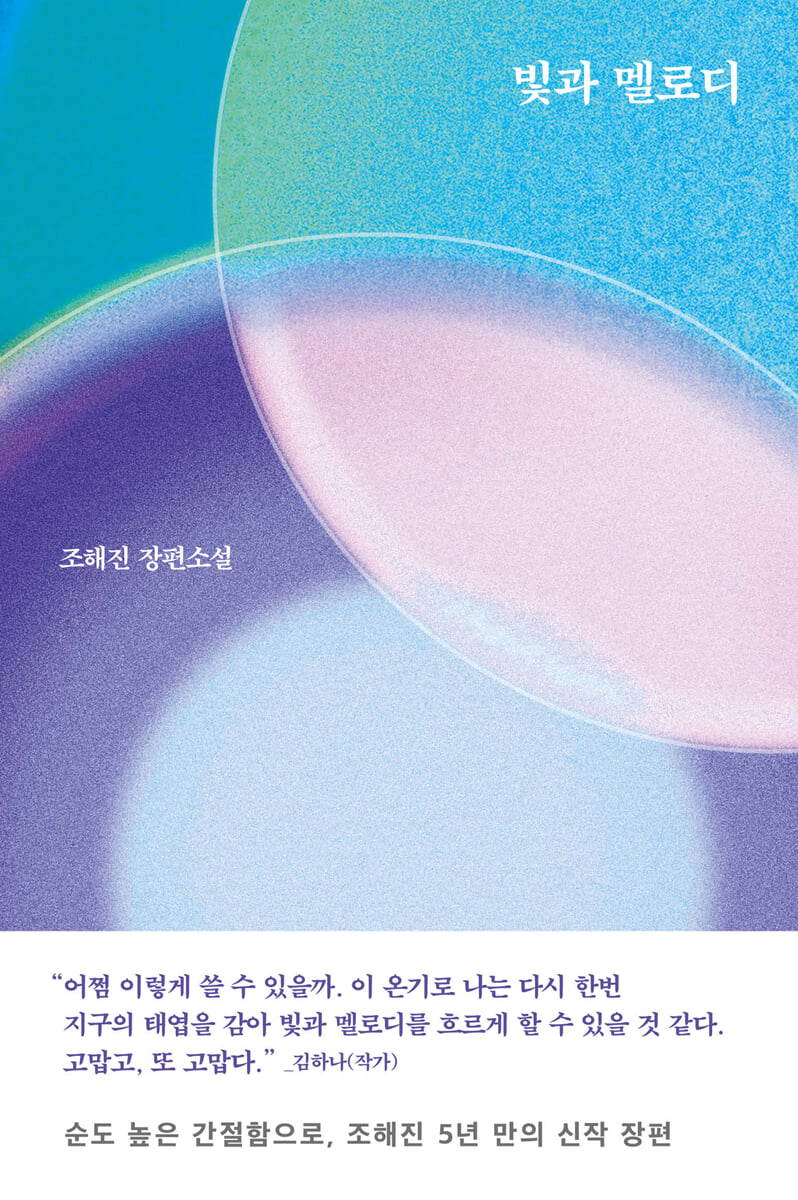
Light and Melody
 |
Description
Book Introduction
“How can you write like this? With this warmth, I wind up the Earth's mainspring once again. “I think I can make light and melody flow.” _Kim Hana (author) “Even in the midst of heavy snow and war, Jo Hae-jin Trying to find warmth somehow. Even in dire circumstances, to a complete stranger “I try not to forget that there are people who reach out to me.” _Oh Eun (poet) With pure earnestness, Jo Hae-jin's new feature-length film, his first in five years The new full-length novel, "Light and Melody," by Jo Hae-jin, a writer who never loses faith in life and people, beautifully depicts the moments when light shines into the lives of those who are isolated or marginalized, has been published by Munhakdongne. Since beginning his career in 2004, Jo Hae-jin has been actively working across short story collections and novels, conveying a sincere message with each work using smooth and precise sentences. Jo Hae-jin's gaze, which clearly observes the lives of people who are outside the public eye, is particularly evident in his feature-length works. From 『I Met Roh Ki-wan』 (Changbi, 2011), which sheds light on the life of North Korean defector Roh Ki-wan, to 『Passing Summer』 (Munye Joongang, 2015), which depicts the process in which people who are immersed in suffering that they cannot overcome on their own face each other, to 『Simple Sincerity』 (Minumsa, 2019), which passionately deals with the issues of overseas adoption and women in military camps, Jo Hae-jin has consistently depicted the lives of people who do not receive much social attention. The full-length novel 『Light and Melody』, which is being presented five years after 『Simple Sincerity』, was serialized in the quarterly 『Literature Village』 from the fall of 2023 to the spring of 2024 (at the time of serialization, the title was 'Eternity of Light'), and was completed after rewriting the fourth part, which corresponds to the conclusion. It is a story that goes one step further than the short story "Escort of Light", which received great acclaim from critics and much love from readers, and clearly imprinted the author Jo Hae-jin on people. "The Escort of Light" is a novel that movingly depicts the "greatness of people saving others" through the story of Seungjun, who gives a camera to twelve-year-old Kwon Eun, who was living alone and feeling abandoned without the protection of adults, and Kwon Eun, who took a step toward life, not death, through the camera. In an interview with the editorial department ahead of the publication of “Light and Melody,” author Jo Hae-jin reveals the reason behind expanding “The Escort of Light” into a full-length novel. After the Russian invasion of Ukraine in 2022, “I wanted to write a novel that would look at the contemporary war and prove through literature how meaningless war is,” and “I thought about several stories with the theme of ‘reversal,’ but no matter what I thought of, I would eventually come back to the message of the short story ‘Escort of Light’” (from the special booklet ‘Light and Melody’ ‘Commentary Book’). The message of "The Escort of Light," which speaks of "small favors or gifts that keep people alive," led the author to write a long story. "Light and Melody" depicts the lives of people who are connected by "small lights" across time and space, following the stories of several new characters added after "Light's Escort." While reading 『Light and Melody』, which earnestly captures the lives of diverse people one by one in a wider space and time, we will experience our hearts warming more than ever as the characters in the novel become people with body heat, and the word "war," which we often pass by without thinking, comes across as a word of urgency with concreteness. |
- You can preview some of the book's contents.
Preview
index
Part 1_007
Part 2_077
Part 3_145
Part 4_217
Author's Note _253
Part 2_077
Part 3_145
Part 4_217
Author's Note _253
Into the book
Captain, do you know what the greatest thing a person can do is?
She asked.
Someone said this.
Saving people is the greatest thing that anyone can do.
therefore……
So, after those words, the very sentence that sometimes broke Seungjun's heart and other times gave him a heavy awakening followed.
No matter what happens to me, you need to remember that you have already saved me.
--- p.120
“The camera was the thing that showed me that I, too, have the right to live.”
When Seungjun was asked why he took pictures of people in conflict zones, he answered like this.
“Because I want to take pictures that save people’s lives.
“Taking pictures that remind me of death and dying people is what makes me live.”
--- p.128
Does he now believe that he can repay that irreversible hatred with messages or gifts?
But emotions weren't like the arrears left on the ledger.
It could not be deducted or refunded.
--- pp.152~153
Minyoung placed her cell phone on her lap and looked at the photo for a long time.
If I ever get to meet Kwon Eun, I'd love to hear where the strength to love photography so much came from.
If I deserve to hear about such love… …
Even someone like me who has never empathized with the love that takes risks to capture suffering people in photographs.
--- p.156
I am……
He looked back at the woman and muttered tearfully.
“I, me too……”
“……”
“I wasn’t born to kill people.”
As he spoke, he realized with a heavy heart.
That was exactly what I wanted to say to my son.
--- p.186
When Lyosha and Nascha's long hug ended, she told them that she wanted to take a picture of them.
At her suggestion, Lyosha handed her his cell phone and the three of them posed in front of her.
The three people on the phone screen whose expressions changed slightly each time she pressed the shutter button made her smile.
Although she was the one taking the picture, she knew that a moment of hers would be captured in their eyes and recorded on film in each of their memories.
It was good for her to know that.
--- pp.196~197
My face and body in the mirror clearly testify to the passage of time, and even though I, no one else, have steadily passed through those years, I still can't believe that I am now an eighty-nine-year-old.
That I can still be lonely at this age, that loneliness is scary, all of that.
--- p.198
Jiyu grabbed Minyoung.
Instead of saying that life is right here, it seems like he wants to say that the most important thing is that we are alive together… …
--- p.215
Min-young, who received the photo book, confessed that after seeing [People, People], she often thought of Kwon Eun and Alma Meyer.
He added that the music score by Jean Verne that saved Alma and the camera that brought Kwon Eun out of the room were ultimately love, and that although they are different loves, they are also the same love, and that it is a love that does not converge on one person but rather passes through that one person like a prism or a projector and extends further.
--- pp.223~224
“Books are just like people.
Neither the future nor destiny is known.
But… … ”
“……”
“But, I like this manuscript.
“I liked it even before it became a book.”
She asked.
Someone said this.
Saving people is the greatest thing that anyone can do.
therefore……
So, after those words, the very sentence that sometimes broke Seungjun's heart and other times gave him a heavy awakening followed.
No matter what happens to me, you need to remember that you have already saved me.
--- p.120
“The camera was the thing that showed me that I, too, have the right to live.”
When Seungjun was asked why he took pictures of people in conflict zones, he answered like this.
“Because I want to take pictures that save people’s lives.
“Taking pictures that remind me of death and dying people is what makes me live.”
--- p.128
Does he now believe that he can repay that irreversible hatred with messages or gifts?
But emotions weren't like the arrears left on the ledger.
It could not be deducted or refunded.
--- pp.152~153
Minyoung placed her cell phone on her lap and looked at the photo for a long time.
If I ever get to meet Kwon Eun, I'd love to hear where the strength to love photography so much came from.
If I deserve to hear about such love… …
Even someone like me who has never empathized with the love that takes risks to capture suffering people in photographs.
--- p.156
I am……
He looked back at the woman and muttered tearfully.
“I, me too……”
“……”
“I wasn’t born to kill people.”
As he spoke, he realized with a heavy heart.
That was exactly what I wanted to say to my son.
--- p.186
When Lyosha and Nascha's long hug ended, she told them that she wanted to take a picture of them.
At her suggestion, Lyosha handed her his cell phone and the three of them posed in front of her.
The three people on the phone screen whose expressions changed slightly each time she pressed the shutter button made her smile.
Although she was the one taking the picture, she knew that a moment of hers would be captured in their eyes and recorded on film in each of their memories.
It was good for her to know that.
--- pp.196~197
My face and body in the mirror clearly testify to the passage of time, and even though I, no one else, have steadily passed through those years, I still can't believe that I am now an eighty-nine-year-old.
That I can still be lonely at this age, that loneliness is scary, all of that.
--- p.198
Jiyu grabbed Minyoung.
Instead of saying that life is right here, it seems like he wants to say that the most important thing is that we are alive together… …
--- p.215
Min-young, who received the photo book, confessed that after seeing [People, People], she often thought of Kwon Eun and Alma Meyer.
He added that the music score by Jean Verne that saved Alma and the camera that brought Kwon Eun out of the room were ultimately love, and that although they are different loves, they are also the same love, and that it is a love that does not converge on one person but rather passes through that one person like a prism or a projector and extends further.
--- pp.223~224
“Books are just like people.
Neither the future nor destiny is known.
But… … ”
“……”
“But, I like this manuscript.
“I liked it even before it became a book.”
--- pp.226~227
Publisher's Review
Riding a small favor without expecting anything in return
Beyond time and space
The melody of life that resonates like a miracle
"Light and Melody" begins with the reunion of Kwon Eun and Seungjun, who share precious memories from their childhood, as documentary photographer and reporter, respectively, and seven years after that encounter.
Those seven years brought about great changes for both of them.
Eun-eun Kwon goes to Syria to film during the civil war and suffers an injury that causes her to lose half of her left leg and loses her will to live.
Unable to find any more conflict zones, Kwon Eun-eun declines all photography commissions and barely makes ends meet on the intermittent royalties she receives. She feels the “desire to quietly disappear” (p. 26) she felt in the small, dark room of her childhood resurface.
The person who reaches out to Kwon is Anna Anderson.
Anna is the younger sister of photographer Gary Anderson, whom Kwon Eun-i liked the most and wanted to be like. They first started contacting each other after Kwon Eun-i wrote an article mourning Gary's death.
Anna, who lives in England, invites Eun Kwon to her home and asks her to make a short film about the life of her father, Colin Anderson.
Colin, who had been a pilot in the Royal Air Force during the Dresden operation in his youth, had a lifelong relationship with his son, Gary, who was a conflict zone photographer.
As Eun-eun Kwon reflects on the lives of Colin and Gary and creates a video, she begins to deeply contemplate whether her photos truly saved someone's life as she had hoped, or whether they were merely self-satisfaction.
This worry also began when Kwon Eun-i met Salma.
Before he was injured, Kwon Eun-eun went to a refugee camp on the island of Lesbos to film and met Salma.
Salma was a girl who didn't come out of her house even in the sweltering heat of midday.
As Salma takes an interest in Kwon Eun's camera, the two gradually become closer, but as Kwon Eun gets to know Salma better, she begins to feel that she will not be able to take pictures of Salma.
This is because the image of Salma, who was left alone after losing her younger sibling and mother during the evacuation, was so similar to her own childhood.
Kwon Eun-eun realizes that she has been able to take photographs only when she maintains an objective distance from her subjects, and begins to think that she has been indifferent to their real lives outside of the photographs, and that she may have even exploited their suffering for the sake of her photographs.
Meanwhile, Seungjun became the parent of a child a few months ago.
Seungjun, who has been raising his daughter with his wife Minyoung, receives an offer from a senior colleague to interview Nascha, a Ukrainian woman living after the Russian invasion, as his parental leave is nearing its end.
Seungjun hesitates for a moment, but then thinks that if it were Kwon Eun, he would have rushed to the place where the war was in full swing, and after much thought, he accepts the offer.
However, when Min-yeong learns of this, the two people's peaceful daily life begins to shake little by little as she says that while caring for her daughter, she wants to see only "good, warm, and beautiful things" and not do things like "having to listen to the words of someone who might die at any time" (p. 39).
But the two people's wishes are the same.
I want to raise my daughter safely.
In fact, the decisive reason why Seungjun agreed to the interview with Nascha was because she was pregnant.
The fact that Nascha, like himself and Minyoung, was someone who felt a strong sense of love and responsibility for life made Seungjun feel attached to Nascha.
Nascha lives with her unborn baby in Kharkiv, Ukraine, a city that is regularly hit by air raids and bombings due to its proximity to the Russian border.
The apartment where Nascha lives was originally occupied by twelve families, but most of them fled due to the constant air raids, and now only Nascha and his wife and their neighbor Oksana remain.
Nascha experiences the horrors and dangers of war firsthand as he hides in the basement pantry with Oksana whenever the air raid sirens sound.
Nascha worries about whether she will be able to give birth safely in this situation, but she tries to calm her anxious mind for the sake of the child.
The courage to hold each other's hands without hesitation,
A life brightly lit by that warmth
The interview with Nascha led to Seungjun in Korea and Eun-i Kwon in England reconnecting.
And as waves of light gradually spread out from the two people, other people's stories begin to unfold.
'Favor' has such a powerful force that the person who receives it may find himself passing it on to others.
The characters in "Light and Melody" are of different nationalities and ages, and often have no direct connection, but like light spreading and overlapping in the form of waves, they deeply permeate each other's lives.
They do not hesitate to reach out to those in need, regardless of their circumstances, and to become closely connected to each other's lives.
In a war rife with death and suffering, those who extend a helping hand to others, whom they might otherwise ignore, simply because they are suffering, instantly neutralize the violence of war.
They know all too well that what keeps “those who think only of death or are dying” (p. 86) alive is not something grand, but something as light and fragile as “a fleeting light” (p. 230).
The thin light that begins from them will extend to the people who will live in the next generation, passing through the camera that Seungjun handed to Kwon Eun, and the hand of hospitality that Kwon Eun extended to Nascha.
And “it will not converge on one person, but will pass through that person like a prism or a projector and extend further” (pp. 223-224) and finally reach us.
So that the clockwork of life may not stop even in the midst of any violence or pain, and so that the light and melody may continue to flow.
From the author's note
"Light and Melody" doesn't stay in the regret inside me
Meet another 'person, people' and go further
May it flow deeper and light up
Now I,
Dream quietly.
So that it may be remembered and not forgotten,
May we all gather together in the hope that the pain and suffering will not be repeated…
Beyond time and space
The melody of life that resonates like a miracle
"Light and Melody" begins with the reunion of Kwon Eun and Seungjun, who share precious memories from their childhood, as documentary photographer and reporter, respectively, and seven years after that encounter.
Those seven years brought about great changes for both of them.
Eun-eun Kwon goes to Syria to film during the civil war and suffers an injury that causes her to lose half of her left leg and loses her will to live.
Unable to find any more conflict zones, Kwon Eun-eun declines all photography commissions and barely makes ends meet on the intermittent royalties she receives. She feels the “desire to quietly disappear” (p. 26) she felt in the small, dark room of her childhood resurface.
The person who reaches out to Kwon is Anna Anderson.
Anna is the younger sister of photographer Gary Anderson, whom Kwon Eun-i liked the most and wanted to be like. They first started contacting each other after Kwon Eun-i wrote an article mourning Gary's death.
Anna, who lives in England, invites Eun Kwon to her home and asks her to make a short film about the life of her father, Colin Anderson.
Colin, who had been a pilot in the Royal Air Force during the Dresden operation in his youth, had a lifelong relationship with his son, Gary, who was a conflict zone photographer.
As Eun-eun Kwon reflects on the lives of Colin and Gary and creates a video, she begins to deeply contemplate whether her photos truly saved someone's life as she had hoped, or whether they were merely self-satisfaction.
This worry also began when Kwon Eun-i met Salma.
Before he was injured, Kwon Eun-eun went to a refugee camp on the island of Lesbos to film and met Salma.
Salma was a girl who didn't come out of her house even in the sweltering heat of midday.
As Salma takes an interest in Kwon Eun's camera, the two gradually become closer, but as Kwon Eun gets to know Salma better, she begins to feel that she will not be able to take pictures of Salma.
This is because the image of Salma, who was left alone after losing her younger sibling and mother during the evacuation, was so similar to her own childhood.
Kwon Eun-eun realizes that she has been able to take photographs only when she maintains an objective distance from her subjects, and begins to think that she has been indifferent to their real lives outside of the photographs, and that she may have even exploited their suffering for the sake of her photographs.
Meanwhile, Seungjun became the parent of a child a few months ago.
Seungjun, who has been raising his daughter with his wife Minyoung, receives an offer from a senior colleague to interview Nascha, a Ukrainian woman living after the Russian invasion, as his parental leave is nearing its end.
Seungjun hesitates for a moment, but then thinks that if it were Kwon Eun, he would have rushed to the place where the war was in full swing, and after much thought, he accepts the offer.
However, when Min-yeong learns of this, the two people's peaceful daily life begins to shake little by little as she says that while caring for her daughter, she wants to see only "good, warm, and beautiful things" and not do things like "having to listen to the words of someone who might die at any time" (p. 39).
But the two people's wishes are the same.
I want to raise my daughter safely.
In fact, the decisive reason why Seungjun agreed to the interview with Nascha was because she was pregnant.
The fact that Nascha, like himself and Minyoung, was someone who felt a strong sense of love and responsibility for life made Seungjun feel attached to Nascha.
Nascha lives with her unborn baby in Kharkiv, Ukraine, a city that is regularly hit by air raids and bombings due to its proximity to the Russian border.
The apartment where Nascha lives was originally occupied by twelve families, but most of them fled due to the constant air raids, and now only Nascha and his wife and their neighbor Oksana remain.
Nascha experiences the horrors and dangers of war firsthand as he hides in the basement pantry with Oksana whenever the air raid sirens sound.
Nascha worries about whether she will be able to give birth safely in this situation, but she tries to calm her anxious mind for the sake of the child.
The courage to hold each other's hands without hesitation,
A life brightly lit by that warmth
The interview with Nascha led to Seungjun in Korea and Eun-i Kwon in England reconnecting.
And as waves of light gradually spread out from the two people, other people's stories begin to unfold.
'Favor' has such a powerful force that the person who receives it may find himself passing it on to others.
The characters in "Light and Melody" are of different nationalities and ages, and often have no direct connection, but like light spreading and overlapping in the form of waves, they deeply permeate each other's lives.
They do not hesitate to reach out to those in need, regardless of their circumstances, and to become closely connected to each other's lives.
In a war rife with death and suffering, those who extend a helping hand to others, whom they might otherwise ignore, simply because they are suffering, instantly neutralize the violence of war.
They know all too well that what keeps “those who think only of death or are dying” (p. 86) alive is not something grand, but something as light and fragile as “a fleeting light” (p. 230).
The thin light that begins from them will extend to the people who will live in the next generation, passing through the camera that Seungjun handed to Kwon Eun, and the hand of hospitality that Kwon Eun extended to Nascha.
And “it will not converge on one person, but will pass through that person like a prism or a projector and extend further” (pp. 223-224) and finally reach us.
So that the clockwork of life may not stop even in the midst of any violence or pain, and so that the light and melody may continue to flow.
From the author's note
"Light and Melody" doesn't stay in the regret inside me
Meet another 'person, people' and go further
May it flow deeper and light up
Now I,
Dream quietly.
So that it may be remembered and not forgotten,
May we all gather together in the hope that the pain and suffering will not be repeated…
GOODS SPECIFICS
- Date of issue: August 30, 2024
- Page count, weight, size: 260 pages | 133*200*20mm
- ISBN13: 9791141607241
- ISBN10: 1141607247
You may also like
카테고리
korean


korean

![GQ KOREA Mark (Monthly): December [2025]](http://librairie.coreenne.fr/cdn/shop/files/8ef265dbbfbf186523ed75ba7319009d.jpg?v=1765340328&width=3840)


