

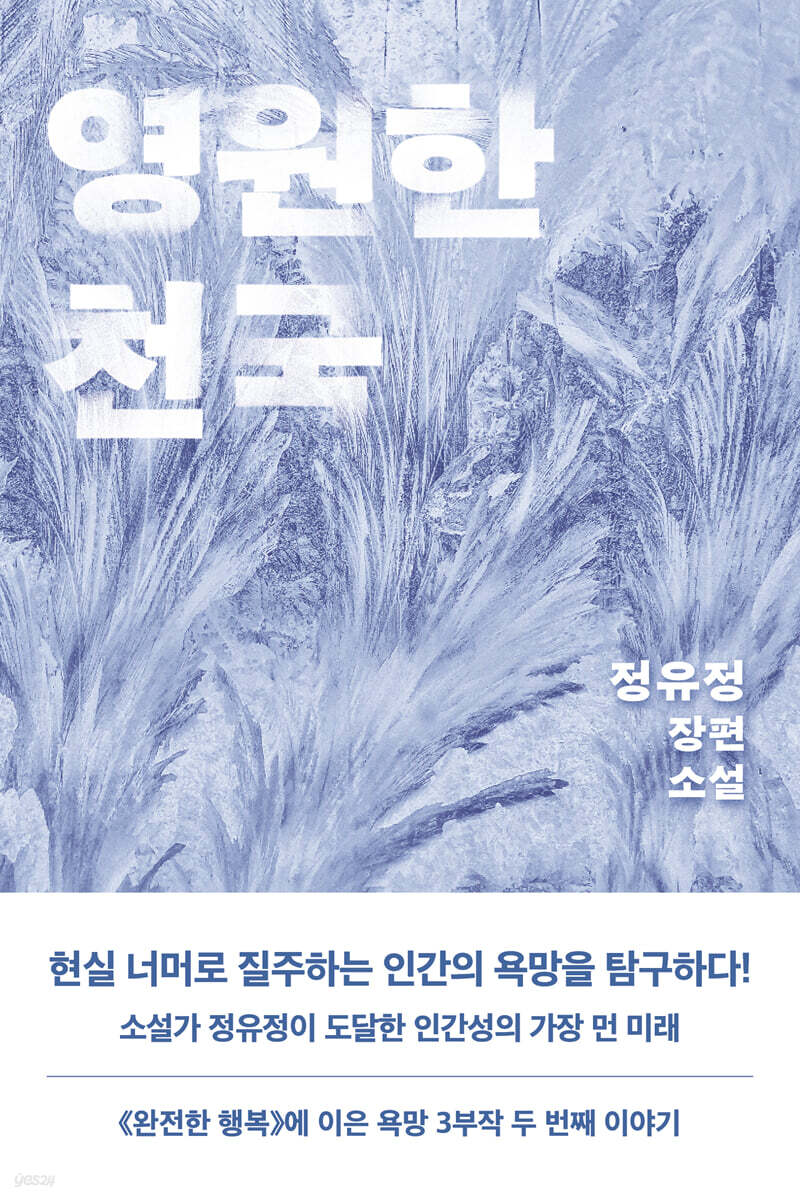
Eternal Heaven
 |
Description
Book Introduction
Exploring human desires that run beyond reality!
The Farthest Future of Humanity, as Reached by Novelist Jeong Yu-jeong The second story in the Desire Trilogy, following "Perfect Happiness," is now available! A new work by novelist Jeong Yu-jeong, who has led readers into the 'Jeong Yu-jeong World' with each published work, is being published. In "28", he deals with infectious diseases, and in "Jin, Genie", he deals with hominoids. The author, who has been sensing the changes in the world a priori and exploring what is most human within it, has published this new work, the second book in the desire trilogy following "Perfect Happiness", "Eternal Heaven". The author, who faced human 'evil' and fought a fierce battle with it in the evil trilogy 'Seven Years of Night', '28', and 'The Origin of Species', now confronts human 'desire' head-on. What Jeong Yu-jeong's sharp pen aims at is the end of human desire, that distant realm. With the advancement of science, human desires have become more and more easily and conveniently achievable. As science advances, humanity will be able to satisfy more and more desires in more diverse ways. So, can we ever reach a point where our desires are completely fulfilled? If we could choose everything in an eternal world, transcending the constraints of time and space, and experience every possible world, what would ultimately remain as human desires? A novel is like a huge blockbuster prepared for the reader. It creates a vivid world by moving through time and space. At one end of the novel is a world surrounded by drift ice. Those who seek and those who try to steal, those who run away and those who wait, come together to form a veritable 'bokmajeon'. The desires of each of the characters, each meticulously realized, are as sharp as the winter wind. On the other side of the axe is the 'Haesang', a technician who lives off desire. Haesang, a storyteller and programming engineer who realizes others' desires, meets 'Gyeongju' after following a strange request that came to him. The place where they meet is 'Lola'. Lola's world is a veritable Benjaminian arcade where luminous virtualities meet to create reality. What do we desire in Lola, which reminds us of a virtual theater for future humanity? When human desires intersect and collide, what is the ultimate desire we are left with? The novel opens one door of a tightly closed arcade, allowing the reader to escape. For this novel, the author personally traveled between Abashiri, Hokkaido and the Bahariya Desert in Egypt. In the dark sea surrounded by giant ice floes, in the middle of what was once the sea but is now a barren and dry land, the novel was drawn up. Maybe that's why. This novel is colder and hotter than ever. It resembles the 'wildness of humans' that the author is aiming for. Despite the overwhelming volume of over 500 pages, the intense immersion that drives the reader without a moment to breathe, the vivid characters that seem to ooze blood, and the narrative that pushes forward without fear are already Jeong Yu-jeong's signature. She invites readers into the world of her works, a world that only she can write. |
- You can preview some of the book's contents.
Preview
index
Chapter 1: Sea, Lola
Chapter 2: Gyeongju, Sam-aewon
Chapter 3: Sea, Lola
Chapter 4: Gyeongju, Sam-aewon
Chapter 5: Sea, Lola
Chapter 6: Race, Dream Theater
Epilogue Lola
Author's Note
Chapter 2: Gyeongju, Sam-aewon
Chapter 3: Sea, Lola
Chapter 4: Gyeongju, Sam-aewon
Chapter 5: Sea, Lola
Chapter 6: Race, Dream Theater
Epilogue Lola
Author's Note
Detailed image

Into the book
I was invited to that man's house.
I accepted it without hesitation.
I set off without hesitation.
It was my job to go when called.
That's why I'm standing on this dark, unfamiliar street right now.
As the signpost indicates, the name of this street is Man-gyeong-ro.
--- p.9
“Let’s say everything you said is true.
Still, I don't understand.
“Why does science do this to humans?”
“Science cannot go backwards.
“We just arrived where we were supposed to arrive.”
--- p.322
“I didn’t come to Lola because I wanted to live forever.
I just ran away.
And very hastily.
It wasn't until I came here that I started to wonder.
What if I hadn't run away then?
What kind of life would I have lived?
Could you understand my life?
“At least I hope I can find some clue to understand.”
I couldn't understand why that understanding was so important.
All living things are born by chance.
We form relationships by chance, live by chance, and die.
A life with clearly defined cause and effect would only exist in the Lola Theater.
“I need a chance to live without the design of fate.
“If I don’t run away, if I can endure, I think I’ll know why I existed in that world.”
--- p.392
“Think carefully about the meaning of blank paper.
Can we clearly set up a sign that we are going to die in a random and infinite space-time?
It's similar to the hypothetical statement, "If I win the lottery, I'll be rich."
“In that the lottery avoids me and goes to other people.”
“Is there no way?”
The look in his eyes as he looked at me was a complex mixture of understanding, frustration, and longing.
I answered without hesitation.
"no."
“Absolutely?”
Instead of answering, I got up from my chair.
He also woke up.
We stood facing each other in silence.
Silence flowed endlessly.
“Then I...” he finally opened his mouth.
“I won’t come back.”
--- p.395
I don't think I misread the race.
However, there was one thing that was overlooked.
It was 'something' hidden behind the outer shell of consciousness.
If I had remembered how he tried to save himself when he was pushed to the edge by his brother's death, if I had remembered how he stabbed the other person in the eye with a chopstick just as he was about to be stabbed in the chest, I would have known beforehand.
What is the 'something' that is crouching in his nature?
It was a desire to endure, to fight, and to ultimately overcome.
I named this desire wildness.
Perhaps this was a special quality that God had bestowed upon human nature.
In that you have to break the seal yourself and wake up.
In that it is an element that gives meaning to one's life.
In that it is a permanent disposition that cannot be altered by any plan of fate.
I accepted it without hesitation.
I set off without hesitation.
It was my job to go when called.
That's why I'm standing on this dark, unfamiliar street right now.
As the signpost indicates, the name of this street is Man-gyeong-ro.
--- p.9
“Let’s say everything you said is true.
Still, I don't understand.
“Why does science do this to humans?”
“Science cannot go backwards.
“We just arrived where we were supposed to arrive.”
--- p.322
“I didn’t come to Lola because I wanted to live forever.
I just ran away.
And very hastily.
It wasn't until I came here that I started to wonder.
What if I hadn't run away then?
What kind of life would I have lived?
Could you understand my life?
“At least I hope I can find some clue to understand.”
I couldn't understand why that understanding was so important.
All living things are born by chance.
We form relationships by chance, live by chance, and die.
A life with clearly defined cause and effect would only exist in the Lola Theater.
“I need a chance to live without the design of fate.
“If I don’t run away, if I can endure, I think I’ll know why I existed in that world.”
--- p.392
“Think carefully about the meaning of blank paper.
Can we clearly set up a sign that we are going to die in a random and infinite space-time?
It's similar to the hypothetical statement, "If I win the lottery, I'll be rich."
“In that the lottery avoids me and goes to other people.”
“Is there no way?”
The look in his eyes as he looked at me was a complex mixture of understanding, frustration, and longing.
I answered without hesitation.
"no."
“Absolutely?”
Instead of answering, I got up from my chair.
He also woke up.
We stood facing each other in silence.
Silence flowed endlessly.
“Then I...” he finally opened his mouth.
“I won’t come back.”
--- p.395
I don't think I misread the race.
However, there was one thing that was overlooked.
It was 'something' hidden behind the outer shell of consciousness.
If I had remembered how he tried to save himself when he was pushed to the edge by his brother's death, if I had remembered how he stabbed the other person in the eye with a chopstick just as he was about to be stabbed in the chest, I would have known beforehand.
What is the 'something' that is crouching in his nature?
It was a desire to endure, to fight, and to ultimately overcome.
I named this desire wildness.
Perhaps this was a special quality that God had bestowed upon human nature.
In that you have to break the seal yourself and wake up.
In that it is an element that gives meaning to one's life.
In that it is a permanent disposition that cannot be altered by any plan of fate.
--- p.523
Publisher's Review
“It’s more fun here than I thought.
“It’s like a fortune teller.”
Haesae, a designer who uses the virtual world Lola to create a first-person virtual theater called 'Dream Theater' based on the client's memories.
She was one of the original designers who created Dream Theater, but she hasn't been getting many commissions lately.
A strange request comes from a man asking Haesang to create a dream theater based on his own memories.
I was invited to that man's house.
I accepted it without hesitation.
I set off without hesitation.
It was my job to go when called.
That's why I'm standing on this dark, unfamiliar street right now.
As the signpost tells us, the name of this street is Man-gyeong-ro.
- Page 9 of the text
The memory of the client, Gyeongju, is miserable.
A series of misfortunes befall him, even though he was making a name for himself as a chiropractor.
Following his father's death, he loses his job due to a medical accident, and to make matters worse, his younger brother, who had fought with him and left home, is found dead in a homeless village.
A depressed Gyeongju takes a job as a security guard at Samaewon, a homeless rehabilitation facility with a high salary and room and board.
A remote cape in the West Sea where drift ice drifts due to abnormal weather.
Gyeongju, who entered Samaewon located on Cheon-ae Plateau, hears rumors circulating among the homeless people.
That humans have discovered a way to avoid death, and that random tickets are being issued to homeless people as experimental subjects.
There are rumors that a series of homeless murders are taking place to get that ticket.
Gyeongju is obsessed with the idea that her younger brother Seungju's death might be connected to this.
“A ridiculously wealthy American biotechnology company has found a way to make humans immortal.
no.
It's not that I don't die.
A new race with god-like abilities, perhaps.
If you can have anything, do anything, and be anything, I don't think that's like God, it's just God.
Anyway, that company joined hands with the world's best game company and created a world where gods would reside.
A world where there are no rich, no poor, and no sick.
“An eternal paradise where everyone lives equally and freely.”
- Page 106
Gyeong-ju, who was suffering from guilt, notices that Park Jae-i, a fellow security guard who joined the company with her, is secretly looking for something among the homeless.
Then one day, while on patrol at dawn, Gyeongju discovers mysterious footprints heading towards the mountain behind Sam-ae-won.
And at the end of those footprints, on the cold snowy field at dawn, Jay, who should have been sleeping in his lodging, is found covered in blood.
While being carried to the hospital by Gyeongju, Jay calls Hae-sang's name while in a state of unconsciousness.
“I didn’t come to Lola because I wanted to live forever.
I just ran away.
And very hastily.
It wasn't until I came here that I started to wonder.
What if I hadn't run away then?
What kind of life would I have lived?
Could you understand my life?
“At least I hope I can find some clue to understand.”
I couldn't understand why that understanding was so important.
All living things are born by chance.
We form relationships by chance, live by chance, and die.
A life with clearly defined cause and effect would only exist in the Lola Theater.
“I need a chance to live without the design of fate.
“If I don’t run away, if I can endure, I think I’ll know why I existed in that world.”
- Page 392
The ultimate human desire to endure, to confront, and to ultimately overcome, wildness
Witnessing science and technology that have expanded beyond the realms of convenience to include art and philosophy, we can say, “Science cannot go backwards.”
The line from a character in the work, “I just arrived where I was supposed to arrive,” makes me feel keenly that it is a phrase that permeates this era.
The author, who faced this era without any vague optimism or high evaluation of humanity, said, “About an immortal life where anything can be done and no one dies.
“A world without troubles like poverty, misfortune, or conflict,” he continues to imagine that distant future.
The writer, who fearlessly pushed his imagination to its limits, encounters a humanity held in his hands in a distant territory that only literature can reach.
The virtual reality world of Lola in the novel is a huge metaphor for this world.
But humanity doesn't stop at wandering forever in the arcade.
The author reveals human nature through 'Dream Theater'.
Humans seek play even in eternity, and in that, they seek to encounter ‘themselves.’
In this respect, Gyeongju's desire to design a dream theater in the most strict way possible for himself is significant.
I don't think I misread the race.
However, there was one thing that was overlooked.
It was 'something' hidden behind the outer shell of consciousness.
If I had remembered how he tried to save himself when he was pushed to the edge by his brother's death, if I had remembered how he stabbed the other person in the eye with a chopstick just as he was about to be stabbed in the chest, I would have known beforehand.
What is the 'something' that is crouching in his nature?
- Page 523
The desire to live a life without any plan.
The desire to jump into that raw world and face it head on.
The desire to finally wrestle with my fate and win.
What the writer encounters at the end of human desire is this seething wildness.
In the cold deep sea beneath the thick ice floes, under the hot desert sun, what Jeong Yu-jeong has drawn is sharp, overwhelming, and hot, as if it were slicing through the marrow.
This is why the second installment of the 'Desire Trilogy' is so vivid.
Author's Note
So, this novel is a story about 'humanity's last desire to endure, confront, and overcome.'
It is also a story about the pursuit of what one considers valuable in life.
I gave the name 'wildness' to this temperament of desire and pursuit.
Sometimes I wonder if we live in an age where we are losing our wildness.
There is also a tendency to mock itself, deny its value, or give up on it.
However, we are both social and individual beings.
The undeniable truth is that as an individual being, I am responsible for myself as the agent of my own life.
So please remember that.
That the primordial wildness breathes in our genes.
That it is a precious weapon in our lives.
“It’s like a fortune teller.”
Haesae, a designer who uses the virtual world Lola to create a first-person virtual theater called 'Dream Theater' based on the client's memories.
She was one of the original designers who created Dream Theater, but she hasn't been getting many commissions lately.
A strange request comes from a man asking Haesang to create a dream theater based on his own memories.
I was invited to that man's house.
I accepted it without hesitation.
I set off without hesitation.
It was my job to go when called.
That's why I'm standing on this dark, unfamiliar street right now.
As the signpost tells us, the name of this street is Man-gyeong-ro.
- Page 9 of the text
The memory of the client, Gyeongju, is miserable.
A series of misfortunes befall him, even though he was making a name for himself as a chiropractor.
Following his father's death, he loses his job due to a medical accident, and to make matters worse, his younger brother, who had fought with him and left home, is found dead in a homeless village.
A depressed Gyeongju takes a job as a security guard at Samaewon, a homeless rehabilitation facility with a high salary and room and board.
A remote cape in the West Sea where drift ice drifts due to abnormal weather.
Gyeongju, who entered Samaewon located on Cheon-ae Plateau, hears rumors circulating among the homeless people.
That humans have discovered a way to avoid death, and that random tickets are being issued to homeless people as experimental subjects.
There are rumors that a series of homeless murders are taking place to get that ticket.
Gyeongju is obsessed with the idea that her younger brother Seungju's death might be connected to this.
“A ridiculously wealthy American biotechnology company has found a way to make humans immortal.
no.
It's not that I don't die.
A new race with god-like abilities, perhaps.
If you can have anything, do anything, and be anything, I don't think that's like God, it's just God.
Anyway, that company joined hands with the world's best game company and created a world where gods would reside.
A world where there are no rich, no poor, and no sick.
“An eternal paradise where everyone lives equally and freely.”
- Page 106
Gyeong-ju, who was suffering from guilt, notices that Park Jae-i, a fellow security guard who joined the company with her, is secretly looking for something among the homeless.
Then one day, while on patrol at dawn, Gyeongju discovers mysterious footprints heading towards the mountain behind Sam-ae-won.
And at the end of those footprints, on the cold snowy field at dawn, Jay, who should have been sleeping in his lodging, is found covered in blood.
While being carried to the hospital by Gyeongju, Jay calls Hae-sang's name while in a state of unconsciousness.
“I didn’t come to Lola because I wanted to live forever.
I just ran away.
And very hastily.
It wasn't until I came here that I started to wonder.
What if I hadn't run away then?
What kind of life would I have lived?
Could you understand my life?
“At least I hope I can find some clue to understand.”
I couldn't understand why that understanding was so important.
All living things are born by chance.
We form relationships by chance, live by chance, and die.
A life with clearly defined cause and effect would only exist in the Lola Theater.
“I need a chance to live without the design of fate.
“If I don’t run away, if I can endure, I think I’ll know why I existed in that world.”
- Page 392
The ultimate human desire to endure, to confront, and to ultimately overcome, wildness
Witnessing science and technology that have expanded beyond the realms of convenience to include art and philosophy, we can say, “Science cannot go backwards.”
The line from a character in the work, “I just arrived where I was supposed to arrive,” makes me feel keenly that it is a phrase that permeates this era.
The author, who faced this era without any vague optimism or high evaluation of humanity, said, “About an immortal life where anything can be done and no one dies.
“A world without troubles like poverty, misfortune, or conflict,” he continues to imagine that distant future.
The writer, who fearlessly pushed his imagination to its limits, encounters a humanity held in his hands in a distant territory that only literature can reach.
The virtual reality world of Lola in the novel is a huge metaphor for this world.
But humanity doesn't stop at wandering forever in the arcade.
The author reveals human nature through 'Dream Theater'.
Humans seek play even in eternity, and in that, they seek to encounter ‘themselves.’
In this respect, Gyeongju's desire to design a dream theater in the most strict way possible for himself is significant.
I don't think I misread the race.
However, there was one thing that was overlooked.
It was 'something' hidden behind the outer shell of consciousness.
If I had remembered how he tried to save himself when he was pushed to the edge by his brother's death, if I had remembered how he stabbed the other person in the eye with a chopstick just as he was about to be stabbed in the chest, I would have known beforehand.
What is the 'something' that is crouching in his nature?
- Page 523
The desire to live a life without any plan.
The desire to jump into that raw world and face it head on.
The desire to finally wrestle with my fate and win.
What the writer encounters at the end of human desire is this seething wildness.
In the cold deep sea beneath the thick ice floes, under the hot desert sun, what Jeong Yu-jeong has drawn is sharp, overwhelming, and hot, as if it were slicing through the marrow.
This is why the second installment of the 'Desire Trilogy' is so vivid.
Author's Note
So, this novel is a story about 'humanity's last desire to endure, confront, and overcome.'
It is also a story about the pursuit of what one considers valuable in life.
I gave the name 'wildness' to this temperament of desire and pursuit.
Sometimes I wonder if we live in an age where we are losing our wildness.
There is also a tendency to mock itself, deny its value, or give up on it.
However, we are both social and individual beings.
The undeniable truth is that as an individual being, I am responsible for myself as the agent of my own life.
So please remember that.
That the primordial wildness breathes in our genes.
That it is a precious weapon in our lives.
GOODS SPECIFICS
- Date of issue: August 28, 2024
- Page count, weight, size: 524 pages | 754g | 140*210*35mm
- ISBN13: 9791167374561
- ISBN10: 1167374568
You may also like
카테고리
korean


korean

![GQ KOREA Mark (Monthly): December [2025]](http://librairie.coreenne.fr/cdn/shop/files/8ef265dbbfbf186523ed75ba7319009d.jpg?v=1765340328&width=3840)


