

Become a cyborg
 |
Description
Book Introduction
- A word from MD
-
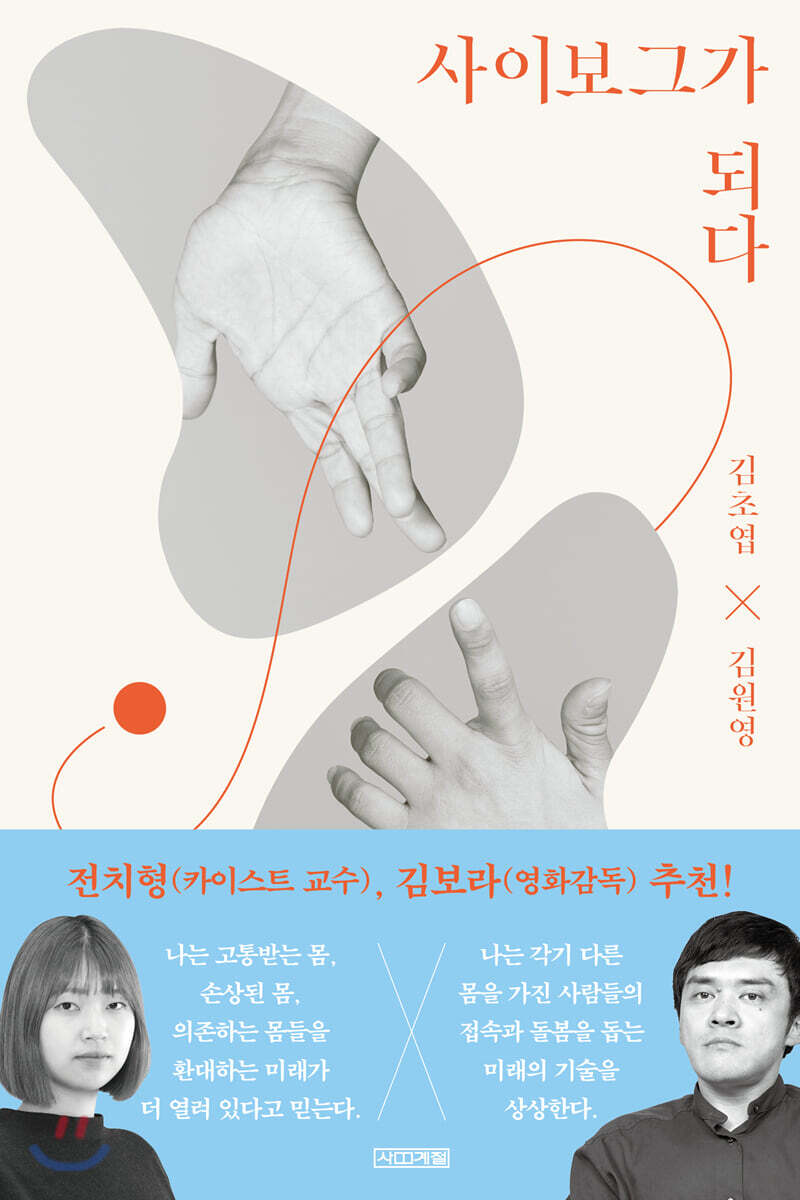
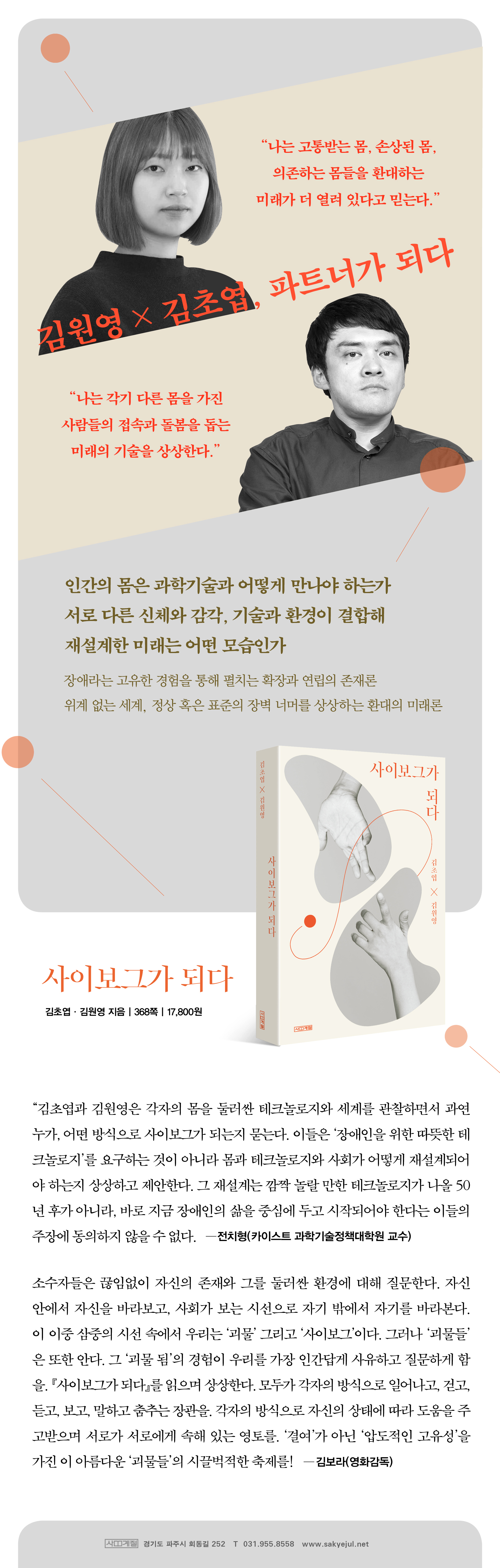
The intersection of the human body and science and technologyNovelist Kim Cho-yeop and lawyer Kim Won-young have something in common.
From childhood, I encountered machines (hearing aids and wheelchairs) that compensated for my damaged body.
The two discuss the future cyborgs will create through their own experiences and reflections.
The two men's insights into the ontology and ethics of cyborgs shine.
January 15, 2021. Social and Political PD Son Min-gyu
When we look at the things that fill the word "future" today—artificial intelligence, robots, the Internet of Things, autonomous driving, virtual reality—it seems as if that future will unfold independently of the human body.
A world that operates with minimal human intervention, a society led by bodies that transcend human biological limitations using cutting-edge technology, would it be a convenient and seamless place free from pain, conflict, or impossibility? Kim Cho-yeop and Kim Won-young, who began living as "cyborgs" around the age of fifteen after encountering machines (hearing aids and wheelchairs) that compensate for their physical impairments, have consistently been fascinated by the intersection of the human body and science and technology.
The two share a shared concern that today's science and technology are developing without considering the specific experiences of individuals with diverse bodies and senses.
Based on their experiences living with hearing impairment (Kim Cho-yeop) and physical disability (Kim Won-young) and their understanding of their identities cultivated within the field of the disability rights movement, they suggest a different tomorrow we can embrace when the unique experience of disability is combined with science and technology in relationships with others, the environment, and society.
Kim Cho-yeop imagines a new world designed around the cognitive, sensory, and motor worlds of people with disabilities, while Kim Won-young anticipates future technologies that will allow people with different vulnerabilities and dependencies to connect more closely and care for one another.
The two men push their long-standing concerns far and deep, envisioning a future where the diverse constituents of this world rediscover and welcome one another beyond all hierarchies and norms of normalcy.
Here, a thrilling journey through the symbol of cyborg awaits you, reaching a more humane future.
A world that operates with minimal human intervention, a society led by bodies that transcend human biological limitations using cutting-edge technology, would it be a convenient and seamless place free from pain, conflict, or impossibility? Kim Cho-yeop and Kim Won-young, who began living as "cyborgs" around the age of fifteen after encountering machines (hearing aids and wheelchairs) that compensate for their physical impairments, have consistently been fascinated by the intersection of the human body and science and technology.
The two share a shared concern that today's science and technology are developing without considering the specific experiences of individuals with diverse bodies and senses.
Based on their experiences living with hearing impairment (Kim Cho-yeop) and physical disability (Kim Won-young) and their understanding of their identities cultivated within the field of the disability rights movement, they suggest a different tomorrow we can embrace when the unique experience of disability is combined with science and technology in relationships with others, the environment, and society.
Kim Cho-yeop imagines a new world designed around the cognitive, sensory, and motor worlds of people with disabilities, while Kim Won-young anticipates future technologies that will allow people with different vulnerabilities and dependencies to connect more closely and care for one another.
The two men push their long-standing concerns far and deep, envisioning a future where the diverse constituents of this world rediscover and welcome one another beyond all hierarchies and norms of normalcy.
Here, a thrilling journey through the symbol of cyborg awaits you, reaching a more humane future.
- You can preview some of the book's contents.
Preview
index
Recommendation
Entering _ Kim Won-young
Part 1: Are We Cyborgs?
Chapter 1: Becoming a Cyborg _ Kim Cho-yeop
Cyborg Man from the Diamond Planet | A Disability Cyborg, Strange and Familiar | Technology That Transforms Instead of Enhancing
Chapter 2: The Status of Wheelchairs in Space _ Kim Won-young
Companion Wheelchair | A disabled cyborg standing in front of a mirror | Are prosthetic limbs and wheelchairs part of the body? | Becoming a wheelchair
Chapter 3: Disability and Technology, Between Promise and Reality _ Kim Cho-yeop
A warm technology that overcomes disability? | "We will end disability" | Will technology bring about the end of disability?
Chapter 4: Blue Tape Cyborg _ Kim Won-young
Humans who survived Mars | Humans beyond human | Not as human as Hawking | Beings who question human identity | Beings like duct tape
Part 2: Imagination of Care and Repair
Chapter 5: The Feuding Cyborgs _ Kim Cho-yeop
Invisible Disabilities | The Cyborg Stigma | Do Cyborgs Dream of Robotic Exoskeletons? | Maintaining a Cyborg Body | There Is No Such Thing as a Cyborg
Chapter 6: Disability-Cyborg Design _ Wonyoung Kim
The Limits of Bone Engineering | Sperm Whale Bones and Invisible Hearing Aids | Fashion and Discretion | Technology, Disability, and Fetishism | Avoiding the Uncanny Valley | Designing for Disability
Chapter 7: Cyborgs Redesigning the World _ Kim Cho-yeop
Declaring the Technology of Disability | People with Disabilities as Knowledge Producers | Universal Design, Disability-Centered Design | Is Straw Banning Ableism? | YouTube and Hashtags: A New Wave in the Disability Rights Movement | Accessibility in Virtual Space | Remaining Questions
Chapter 8: Superhuman Gaps _ Kim Won-young
A drug that cures disabilities | Become Captain America through treatment? | The allure of smoothness | Seamless design and the labor of seams | A being that creates cracks in a smooth world | The power to endure bumps
Part 3: The Futurology of Coalition and Hospitality
Chapter 9: Imagining the Future of Disability _ Kim Cho-yeop
Our Other Cognitive World | Design Your Spaceship | Anthropologists on Mars | Cyborg Neutrality
Chapter 10: Cyborgs Existing Connectedly _ Kim Won-young
If I stand on my own two feet, will I be free from dependence? | A robot that cares for me, a robot that I care for | A life without having to see others' faces | The ontology of coalitions - Technology that helps us be together
Bold _ Kim Cho-yeop, Kim Won-young
Becoming Partners | Stories Beyond Survival | Examining the Complex Relationship Between Disability and Science and Technology | Opportunities to Reveal One's Body or Existence, Online and Offline | The Uniqueness of the Disability Experience | On the Symbol of the Cyborg | The Inseparable Connection Between Humanity and Technological Civilization | The Moment Our Lives Intersect
Coming out _ Kim Cho-yeop
Acknowledgements
References
Entering _ Kim Won-young
Part 1: Are We Cyborgs?
Chapter 1: Becoming a Cyborg _ Kim Cho-yeop
Cyborg Man from the Diamond Planet | A Disability Cyborg, Strange and Familiar | Technology That Transforms Instead of Enhancing
Chapter 2: The Status of Wheelchairs in Space _ Kim Won-young
Companion Wheelchair | A disabled cyborg standing in front of a mirror | Are prosthetic limbs and wheelchairs part of the body? | Becoming a wheelchair
Chapter 3: Disability and Technology, Between Promise and Reality _ Kim Cho-yeop
A warm technology that overcomes disability? | "We will end disability" | Will technology bring about the end of disability?
Chapter 4: Blue Tape Cyborg _ Kim Won-young
Humans who survived Mars | Humans beyond human | Not as human as Hawking | Beings who question human identity | Beings like duct tape
Part 2: Imagination of Care and Repair
Chapter 5: The Feuding Cyborgs _ Kim Cho-yeop
Invisible Disabilities | The Cyborg Stigma | Do Cyborgs Dream of Robotic Exoskeletons? | Maintaining a Cyborg Body | There Is No Such Thing as a Cyborg
Chapter 6: Disability-Cyborg Design _ Wonyoung Kim
The Limits of Bone Engineering | Sperm Whale Bones and Invisible Hearing Aids | Fashion and Discretion | Technology, Disability, and Fetishism | Avoiding the Uncanny Valley | Designing for Disability
Chapter 7: Cyborgs Redesigning the World _ Kim Cho-yeop
Declaring the Technology of Disability | People with Disabilities as Knowledge Producers | Universal Design, Disability-Centered Design | Is Straw Banning Ableism? | YouTube and Hashtags: A New Wave in the Disability Rights Movement | Accessibility in Virtual Space | Remaining Questions
Chapter 8: Superhuman Gaps _ Kim Won-young
A drug that cures disabilities | Become Captain America through treatment? | The allure of smoothness | Seamless design and the labor of seams | A being that creates cracks in a smooth world | The power to endure bumps
Part 3: The Futurology of Coalition and Hospitality
Chapter 9: Imagining the Future of Disability _ Kim Cho-yeop
Our Other Cognitive World | Design Your Spaceship | Anthropologists on Mars | Cyborg Neutrality
Chapter 10: Cyborgs Existing Connectedly _ Kim Won-young
If I stand on my own two feet, will I be free from dependence? | A robot that cares for me, a robot that I care for | A life without having to see others' faces | The ontology of coalitions - Technology that helps us be together
Bold _ Kim Cho-yeop, Kim Won-young
Becoming Partners | Stories Beyond Survival | Examining the Complex Relationship Between Disability and Science and Technology | Opportunities to Reveal One's Body or Existence, Online and Offline | The Uniqueness of the Disability Experience | On the Symbol of the Cyborg | The Inseparable Connection Between Humanity and Technological Civilization | The Moment Our Lives Intersect
Coming out _ Kim Cho-yeop
Acknowledgements
References
Detailed image
Into the book
My relationship with technology is intimate, complex, and constantly changing and expanding.
It's not the promise of a perfect hearing aid or hearing treatment in the distant future, but rather the technologies that enable new ways of communicating and the environments in which they occur that have actually improved my life.
(…) Even though I wear a hearing aid, I use text interpretation when attending lectures and talks, and I infer the content of audio content through a voice-to-text conversion program.
Conversations that are not fully understood in reality are continued via email and KakaoTalk.
My social interactions rely heavily on the textual communication provided by IT technology.
If I were to remove all online texts from my life, I would become disconnected from society.
My relationship with technology is very close, and our interaction is constantly changing and expanding.
(…) Is technology liberating or oppressive?
Are cyborgs real or just a metaphor?
Will 'warm technology' for people with disabilities really improve their lives?
With the advancement of technology, will disabilities one day disappear and become a target for elimination?
Will there still be people living with disabilities in the ultimate future?
The life of a disabled cyborg is a story about the present and the future.
--- p.35~39
If I become a cyborg armed with cutting-edge technology, will my 'nothingness' really disappear?
Since 1997, when I was in the first year of middle school, I've been riding it, pushing it, lifting it, jumping on it, lying on it, and doing 90-degree turns on it.
(…) I became wheelchair-en-wheeled.
It was only when I began to vaguely recognize myself as a being integrated with the wheelchair, rather than a 'deficient' human being in a wheelchair, that I began to seriously confront the question of identity.
(…) We must reflect on the fact that science does not identify the meaning of disability itself, as long as it assumes that you are still human ‘despite your disability’ and that your disability will soon be overcome so that you can be included in a more ‘complete’ human community.
If science still views disability as a state of 'absence (lack)', then wheelchairs, no matter how much technological advancement they make, will still be regarded as merely assistive devices that solve the problem of 'lack' of walking ability.
Even though we may actually be able to do more things with more advanced wheelchairs, we may still feel like we are more deprived.
--- p.57~61
Why Farmers Need to Speak in Spoken Language
On March 26, 2020, KT released an advertisement titled "My Name is Kim So-hee - Filled with Heart." It depicted KT's application of Giga Genie AI voice synthesis technology to give a "voice" to Kim, a deaf person.
(…) In reality, hearing-impaired people like Kim and me, who are farmers, cannot clearly hear the voice created by Giga Genie.
So, the 'voice' that Giga Genie gifted to Kim is not a voice for the hearing impaired, but a voice that hearing people want to hear from the hearing impaired.
(…) Not all farmers or hearing impaired people want to hear sound, and those who do hear sound are not always satisfied with the sound.
When you first hear the sound, your feelings may not be joy, but fear or stress.
However, non-disabled people who watch these 'emotional videos' consistently try to read the 'joy of regaining sound' in the reactions of hearing-impaired people wearing hearing aids.
--- p.66~70
Why cutting-edge technology desires the bodies of people with disabilities
Even when we blindly believe that technology will save humanity, using a disabled person as a model makes this belief safe and rational, a "healthy" and common-sense attitude toward technology as a tool.
Even when we want to consume disabled people commercially, sexually, or religiously, if we show them wearing fancy, expensive wheelchairs, fantastically designed prosthetics, or Winter Soldier-like prosthetic arms, this is easily accepted as a safe, "wholesome" depiction of disabled people as cool, futuristic, and attractive.
(…) We live in a society where there is a certain cultural attitude that admires science and technology as more than just tools (technofetishism).
Meanwhile, many of us harbor some kind of emotion or impulse toward disabled bodies, whether it's disgust, admiration, or sexual objectification, or something about their design rather than their "ability."
When technology and the disabled body meet in a single image, it becomes much easier to fetishize both technology and disability itself, with little risk of falling into some kind of 'uncanny valley.'
I suspect this is why hopeful articles about the "Fourth Industrial Revolution"—including promotional photos of James Gillingham, Amy Mullins, Oscar Pistorius, and images of people with disabilities—are more likely to be commercially successful.
--- p.170~172
Disability-centered design rather than universal design
While it would certainly be a good thing if technologies developed for the disabled were eventually widely used by ordinary users, the concept of universal design also has its pitfalls.
Hamley emphasizes the need for a disability-centric approach that goes beyond universal design.
(…) If universal design does not clearly define the category of ‘universality,’ it creates the possibility that the needs of people with disabilities will be decentralized from the universal.
It's important to keep in mind that the universal of human history has always been a neutral template represented by a very specific body: white, male, cisgender, straight, able-bodied, middle-class.
In other words, Hamley's argument is to question neutrality, and to pursue value-explicit design that centers on disability rather than value-neutral design.
Disability-centered design requires a concrete understanding of how the bodies of people with disabilities interact with their environments.
Without this understanding, if we only design for everyone, ramps that are designed to be convenient for everyone may be useful for people pushing strollers and pulling carriers, but they end up being too steep and narrow for manual wheelchair users.
--- p.203~204
If we had perfect technology, would it be okay not to see other people's faces?
When we step outside the comfortable communities we know and turn to the outside world, into open spaces of interaction, there are encounters of friendship, hospitality, love, and solidarity that are only possible amidst the dangers and discord.
(…) There was a user in a residential facility for the disabled who drank more than ten cups of coffee mix every day despite having severe diabetes.
(…) One day, a social worker saw an autistic person he met in another place repeatedly tearing up paper with his hands, and he thought of that user who used to drink more than ten cups of coffee mix every day.
Could it be that he enjoys unwrapping coffee mix wrappers rather than coffee (he actually did!)? While the current care community may seem inefficient and unstable compared to the future care systems we imagine, it's always connected to other beings, and thus can deconstruct the very structure of the questions surrounding care.
The question of care ethics—whether a person with severe diabetes should be forced to abstain from coffee mixes, even if it means forcing them to do so—seems to be a question about the conflict between the values of self-determination and health protection.
Then, when I connected with the 'other', an autistic person who cuts paper by hand, the object and purpose of care shifted to a completely different dimension.
It's not the promise of a perfect hearing aid or hearing treatment in the distant future, but rather the technologies that enable new ways of communicating and the environments in which they occur that have actually improved my life.
(…) Even though I wear a hearing aid, I use text interpretation when attending lectures and talks, and I infer the content of audio content through a voice-to-text conversion program.
Conversations that are not fully understood in reality are continued via email and KakaoTalk.
My social interactions rely heavily on the textual communication provided by IT technology.
If I were to remove all online texts from my life, I would become disconnected from society.
My relationship with technology is very close, and our interaction is constantly changing and expanding.
(…) Is technology liberating or oppressive?
Are cyborgs real or just a metaphor?
Will 'warm technology' for people with disabilities really improve their lives?
With the advancement of technology, will disabilities one day disappear and become a target for elimination?
Will there still be people living with disabilities in the ultimate future?
The life of a disabled cyborg is a story about the present and the future.
--- p.35~39
If I become a cyborg armed with cutting-edge technology, will my 'nothingness' really disappear?
Since 1997, when I was in the first year of middle school, I've been riding it, pushing it, lifting it, jumping on it, lying on it, and doing 90-degree turns on it.
(…) I became wheelchair-en-wheeled.
It was only when I began to vaguely recognize myself as a being integrated with the wheelchair, rather than a 'deficient' human being in a wheelchair, that I began to seriously confront the question of identity.
(…) We must reflect on the fact that science does not identify the meaning of disability itself, as long as it assumes that you are still human ‘despite your disability’ and that your disability will soon be overcome so that you can be included in a more ‘complete’ human community.
If science still views disability as a state of 'absence (lack)', then wheelchairs, no matter how much technological advancement they make, will still be regarded as merely assistive devices that solve the problem of 'lack' of walking ability.
Even though we may actually be able to do more things with more advanced wheelchairs, we may still feel like we are more deprived.
--- p.57~61
Why Farmers Need to Speak in Spoken Language
On March 26, 2020, KT released an advertisement titled "My Name is Kim So-hee - Filled with Heart." It depicted KT's application of Giga Genie AI voice synthesis technology to give a "voice" to Kim, a deaf person.
(…) In reality, hearing-impaired people like Kim and me, who are farmers, cannot clearly hear the voice created by Giga Genie.
So, the 'voice' that Giga Genie gifted to Kim is not a voice for the hearing impaired, but a voice that hearing people want to hear from the hearing impaired.
(…) Not all farmers or hearing impaired people want to hear sound, and those who do hear sound are not always satisfied with the sound.
When you first hear the sound, your feelings may not be joy, but fear or stress.
However, non-disabled people who watch these 'emotional videos' consistently try to read the 'joy of regaining sound' in the reactions of hearing-impaired people wearing hearing aids.
--- p.66~70
Why cutting-edge technology desires the bodies of people with disabilities
Even when we blindly believe that technology will save humanity, using a disabled person as a model makes this belief safe and rational, a "healthy" and common-sense attitude toward technology as a tool.
Even when we want to consume disabled people commercially, sexually, or religiously, if we show them wearing fancy, expensive wheelchairs, fantastically designed prosthetics, or Winter Soldier-like prosthetic arms, this is easily accepted as a safe, "wholesome" depiction of disabled people as cool, futuristic, and attractive.
(…) We live in a society where there is a certain cultural attitude that admires science and technology as more than just tools (technofetishism).
Meanwhile, many of us harbor some kind of emotion or impulse toward disabled bodies, whether it's disgust, admiration, or sexual objectification, or something about their design rather than their "ability."
When technology and the disabled body meet in a single image, it becomes much easier to fetishize both technology and disability itself, with little risk of falling into some kind of 'uncanny valley.'
I suspect this is why hopeful articles about the "Fourth Industrial Revolution"—including promotional photos of James Gillingham, Amy Mullins, Oscar Pistorius, and images of people with disabilities—are more likely to be commercially successful.
--- p.170~172
Disability-centered design rather than universal design
While it would certainly be a good thing if technologies developed for the disabled were eventually widely used by ordinary users, the concept of universal design also has its pitfalls.
Hamley emphasizes the need for a disability-centric approach that goes beyond universal design.
(…) If universal design does not clearly define the category of ‘universality,’ it creates the possibility that the needs of people with disabilities will be decentralized from the universal.
It's important to keep in mind that the universal of human history has always been a neutral template represented by a very specific body: white, male, cisgender, straight, able-bodied, middle-class.
In other words, Hamley's argument is to question neutrality, and to pursue value-explicit design that centers on disability rather than value-neutral design.
Disability-centered design requires a concrete understanding of how the bodies of people with disabilities interact with their environments.
Without this understanding, if we only design for everyone, ramps that are designed to be convenient for everyone may be useful for people pushing strollers and pulling carriers, but they end up being too steep and narrow for manual wheelchair users.
--- p.203~204
If we had perfect technology, would it be okay not to see other people's faces?
When we step outside the comfortable communities we know and turn to the outside world, into open spaces of interaction, there are encounters of friendship, hospitality, love, and solidarity that are only possible amidst the dangers and discord.
(…) There was a user in a residential facility for the disabled who drank more than ten cups of coffee mix every day despite having severe diabetes.
(…) One day, a social worker saw an autistic person he met in another place repeatedly tearing up paper with his hands, and he thought of that user who used to drink more than ten cups of coffee mix every day.
Could it be that he enjoys unwrapping coffee mix wrappers rather than coffee (he actually did!)? While the current care community may seem inefficient and unstable compared to the future care systems we imagine, it's always connected to other beings, and thus can deconstruct the very structure of the questions surrounding care.
The question of care ethics—whether a person with severe diabetes should be forced to abstain from coffee mixes, even if it means forcing them to do so—seems to be a question about the conflict between the values of self-determination and health protection.
Then, when I connected with the 'other', an autistic person who cuts paper by hand, the object and purpose of care shifted to a completely different dimension.
--- p.299~304
Publisher's Review
How should the human body interact with science and technology?
Different bodies, senses, technologies and environments combine to create
What does a redesigned future look like?
Humans have developed science and technology to explore the laws of nature and to provide what is necessary for the survival, maintenance, and improvement of the community.
Naturally, science and technology aim for a better tomorrow, a future with less exposure to danger and disease and with minimal inconvenience or impossibility.
The future envisioned by the so-called "Fourth Industrial Revolution" is also one in which humans, deeply connected to networks, seamlessly navigate a world designed for them, without the constraints of physical distance or environment.
In this optimistic picture, humans are depicted as beings who have no limitations in enjoying the benefits of technological civilization, or who have overcome physical and mental limitations by replacing or supplementing their innate vulnerabilities with various machines, equipment, and medicines.
Kim Cho-yeop and Kim Won-young, who have lived in close connection with technology, such as hearing aids and wheelchairs, respectively, take a critical look at the "technological utopia" proposed by elites of global tech companies, technocrats, and futurists.
In particular, it points out the emptiness of discussions that use easy metaphors like “posthuman” or “transhuman” to refer to the bodies of disabled people combined with machines at the forefront.
While it is true that scientific and medical achievements have cured diseases and improved the functions of damaged bodies, integrating with machines in real life is never a smooth experience. Some technologies are not only inaccessible to people with disabilities, but promises of an end to disability erase the various possibilities for people with disabilities to live better in the here and now.
For some people, providing sign language or written information may be more appropriate than technology that improves hearing, or a wheelchair may be more appropriate than a robotic exoskeleton.
The bodies of people with disabilities are so diverse that they cannot be standardized, even if they have the same type of disability, and each person faces different situations.
(…) The gazes covered with warmth and charity close their eyes to the reality of disabled cyborgs, and only promote futuristic images as ambassadors for technological optimism.
We keep postponing the task of addressing the pain and barriers experienced by people with disabilities here and now to a future when technology will advance.
Ramps, elevators, and sign language interpretation don't require cutting-edge, amazing technology to make it happen.
- Page 87
As people with disabilities who have developed their own modes of mobility, communication, and everyday wisdom through close interaction with machines, the two authors boldly bring the unique experiences and newly constructed identities of people with disabilities through the combination of their bodies and senses with technology to the center of discourse on science, technology, and the future.
This is not just to point out the myths and harms of technological optimism, or to expose those who are left out of such discussions.
In an era where the human condition is increasingly intertwined with technological civilization, the experiences of people with disabilities, who have endured and integrated the daily bumps, seams, and steps that arise from the connection and discord with machines and the environment built around non-disabled people, can play a significant role in helping us imagine and design a different future.
Furthermore, if we view technology not simply as a tool to compensate for damage, but as an opportunity to define disabled people as "extended" beings rather than "deficient" beings by constructing parts of their bodies, and as beings "connected" to the world and others, I believe we can envision a future in which all humans can live equally and fully, despite their inherent vulnerabilities and dependencies.
When a visually impaired person moves as one with a guide dog, or when a person with severe brain damage connects with a wheelchair and then connects with an activity support worker who pushes the wheelchair, the experience of overcoming the many misalignments, discord, and gaps in connection between these two is the capacity that we 'need to strengthen' in the future.
(…) I said that people with vulnerable physical conditions, such as disabilities or illnesses, may be the ones who can exert their capabilities in the automated and seamless society that some tech elites dream of.
As a being who has the courage to reveal the differences and the ability to willingly endure misaligned seams.
- Pages 250-251
Therefore, in this book, 'cyborg' goes far beyond the dictionary definition of an organism combined with a machine.
Kim Cho-yeop and Kim Won-young use the symbol "cyborg" to symbolize the ensemble of humans, science, technology, nature, the environment, and all other physical and cultural elements interacting, complementing and caring for one another, and coexisting.
This book will be an intellectual journey that examines the specific realities of "disabled cyborgs" at the forefront and imagines a world without hierarchy, beyond the barriers of normality or standards.
Fix, fill, add, and repair
The imagination of a cyborg redesigning the world
Kim Cho-yeop, a woman who majored in natural science and works as a science fiction writer, had long struggled to connect these elements of herself with her identity as a hearing impaired person. She believed that depicting beings with different cognitive and sensory worlds through science fiction and creating a space-time centered around them was a separate issue from her disability.
However, in the process of writing this book, I discovered people with various types of disabilities, including my partner Wonyoung Kim, each navigating an unfriendly world in their own way, and I encountered the courage to shake up rigid hierarchies and norms of normalcy and call for a structural change in the world. Only then was I able to connect and integrate the various identities within me.
Because we have established that a person's identity cannot be separated from the way his body interacts with the world.
In this book, Kim Cho-yeop introduces people with disabilities who actively participate in the field of science and technology by reconfiguring, modifying, or repairing machines connected to their bodies, as well as developers who design tools and environments with the needs and accessibility of people with disabilities at the center.
From kitchens for the visually impaired designed to allow the entire cooking process to be confirmed through touch and sound, to houses designed with ramps at the center for wheelchair access, to text interpretation services for the hearing impaired, to online games with meticulous accessibility settings so that people of all physical abilities can participate, to YouTubers sharing their daily lives and advocating for their rights, people with disabilities are no longer just objects of kindness and charity, but are fully demonstrating their potential as knowledge producers.
Kim Cho-yeop introduces the concept of 'creep technoscience', recently proposed in disability studies, and gives positive meaning to this movement.
Crib Technoscience seeks to focus on how people with disabilities reconfigure everyday technologies and reshape the world within their specific experiences of disability.
People with disabilities are not simply recipients of the world or shaped by it; they are actively re-creators of the world.
(…) People with disabilities are constantly ‘tinkering’ with their surroundings, as well as with their local communities and communities.
Disability scholars have coined the term "creating a world for people with disabilities."
The work of disabled people adapting to their disabilities and creatively repairing their environments (…) If this everyday knowledge is properly captured, we will be able to secure knowledge that will be helpful not only to disabled people, but to all people with vulnerabilities and dependencies.
- Pages 188-189
Kim Cho-yeop then critically examines the ways in which recent science fiction works portray disabled characters and the perspectives on designing the world surrounding them, suggesting that the genre of science fiction can serve as a place for thought experiments, exploring a future in which each individual's subjective world coexists despite their incomplete understanding, and the unknown realm that can be reached by striving to imagine the lives of others. This is because science fiction is a story that rebuilds the world from the ground up, centering on other beings, and is a "story that explores accessibility," such as devising ways to take humans to the past and future, space and the deep sea, or designing an environment where non-human beings can live.
So, what kind of future does Kim Cho-yeop aspire to? He envisions a world free of meritocracy, which assigns hierarchy to physical conditions and pursues only physical and mental competence, and proposes the concept of "cyborg neutrality."
Cyborgs are always precarious and unstable beings, teetering between contempt and superiority.
So, can we imagine 'cyborgism' not as an icon at the forefront of transhumanism, not as an alienated machine-human who frowns at everyone he meets, but simply as a neutral characteristic of humans?
(…) Even if it is a very difficult imagination, I believe that a future where vulnerable people can comfortably be themselves is more liberating than a world where everyone is ‘competent.’
(…) Let’s redesign the spaceship where other beings live and share a single space.
Such a design would require numerous drawings.
(…) If we look at those countless drawings together and continue to revise them, we may be able to create a future different from the present.
- Pages 281-282
Slow, misaligned, and slippery bodies appearing in a smooth world
The ontology of expansion and coalescence that emerges from the gaps they create
Unlike Kim Cho-yeop, who had an 'invisible disability', Kim Won-young, who had significantly shorter legs and longer arms than others and a body that could not walk, was interested in the shape and structure of his own body from a young age.
He, who had been perceiving himself as a being of 'nothingness', lacking something compared to a standard body, discovered himself 'existing' there in a new form as a combination of 'human + wheelchair' when he stood in front of a mirror with a wheelchair he had encountered for the first time at the age of fifteen.
We are faced with the question of identity: 'Who on earth are you?'
He brings this question to the gaze of science and technology, which seeks to eliminate obstacles, that is, to eliminate my 'absence'.
If a wheelchair is merely a tool to compensate for my shortcomings, then even with the most advanced wheelchairs developed, wouldn't I still be a "deficient" human being? If I consider the wheelchair a part of my body, then what kind of person would I be once I step out of it? Kim Won-young addresses this long-standing question through a concrete, everyday scene where people with different physical conditions and abilities come together with machines and technology to help one another.
Y (who is wheelchair-bound and hearing impaired) visited an auto repair shop in Gyeonggi Province in late summer 2020 to have an auto box installed.
(…) As B, a person with a disability, gained expertise as an auto mechanic, he probably also became interested in auto boxes, which are needed by many wheelchair users around him.
J's father, A, watched his daughter (who is hearing impaired) grow into an architectural expert through hearing aids and digital devices, and he would have had a special interest in the relationship between disability and technology and Y's professional growth as a friend of his daughter.
Knowing Y well, I recognize that Y may have difficulty communicating with people wearing masks, and because I use a wheelchair like Y, I understand the specifics of vehicles for people with disabilities (which A is not familiar with).
In this way, Y, I, J's father A, mechanic B, J's car, and the machine called the autobox met at that place and cooperated and exchanged opinions in various ways to install an autobox suitable for Y in his new car.
- Pages 111-112
Viewing the disabled body combined with technology through the symbol of a cyborg is not to praise the "humanistic hero" who overcame disability through the power of science and technology, or to discover a "hybrid being" who crosses the boundaries between machine and human, normal and abnormal.
Like duct tape that is placed anywhere and mends and connects objects, it is to focus on the relationships that fill in each other's vulnerabilities and form a network within the close network of humans and other humans, science and technology, culture and the environment.
Kim Won-young describes these inconspicuous yet deeply connected and caring beings as “heroic, like duct tape” (borrowing the expression used by reporter Kim Hye-ri in her article on the film “The Martian”).
If we can view the disabled body, which has become one with the machine, as a new identity, is it also possible to fashion that body? How should a body equipped with a machine express its desire for beauty? Kim Won-young, still conflicted about whether to find a way to be beautiful with a wheelchair, like Paralympic track and field athlete Amy Mullins, who revealed her sleek figure with her elegantly curved carbon fiber prosthetic legs, or to proudly reveal her "natural" self after leaving her wheelchair, cites Amy Mullins' words about feeling "naked" without her prosthetic legs to describe her relationship with her wheelchair.
The prosthetics fitted on the body of a disabled person are a kind of home, a place that cannot be reduced to mere tools or designs.
In this way, Kim Won-young explores a new ontology that explains people with disabilities who use prosthetics such as wheelchairs, hearing aids, white canes, and artificial limbs throughout the book.
He focuses on the abilities of people with disabilities who are struggling to adapt to the trend of cutting-edge tech companies like Apple and Tesla pursuing ever-more seamless designs and designs that minimize human intervention, and who complain about the inconvenience.
In a situation where the majority says it's convenient, the presence of a disabled person who says, "I can't access it," creates cracks and seams in the smooth world, giving us another opportunity to think.
In that gap, we connect with others with different bodies, senses, and minds, and we stand beside each other, caring for each other's vulnerabilities.
Kim Won-young awaits the future technologies that will emerge from this very gap.
I would like to say that the condition of life called coalition is a life that is connected to the ‘other’ who may appear at any time.
The typist is my support worker, my guide dog, my wheelchair, my hearing aid, my auto box, my duct tape, my friends, my audience, and my readers.
(…) It could be a person who repeatedly tears paper, a strange teenage boy who asks himself in the mirror, “Who the hell are you?”, or a science fiction novelist who appears like a comet and draws up a picture of a space hero we’ve never seen before.
Maybe it's an animal face.
These 'others', who transport us to worlds and identities we never imagined, appear as errors in the smooth order of knowledge, technology, ideas, political beliefs, and wisdom that we believed to be firm.
Instead of rejecting, repelling, and wiping away such errors, the community of care begins a new exploration between the seams opened by the errors.
What will the knowledge and technology that helps others, helps as others, and helps others help themselves, be open to the emergence of the future-other, look like?
- Pages 305-307
Kim Won-young and Kim Cho-yeop become partners.
Kim Won-young and Kim Cho-yeop grew up within the explosive growth of the disability rights movement in Korean society since the 2000s.
In other words, they have developed a perspective that accepts their disability as an identity rather than a 'lack' and resists the social structure that makes physical impairment a disability.
From this perspective, attempts by science and technology to treat, correct, and eliminate disabilities are bound to be viewed critically, but as individuals who have sustained life and improved bodily functions through the achievements of science and technology, they have chosen to intervene in that direction rather than exclude science and technology.
Although the two people are headed in similar directions, they unfold different themes stemming from their gender identities, types of disabilities, intellectual backgrounds, and life paths.
Kim Won-young, a person with a physical disability, a lawyer, an actor, and a history of rehabilitation schools and disability rights communities, pursues his interest in the form and movement of the body, and further describes how to define the state of the body when it meets artificial prosthetics, whether it can be beautiful in itself, and what unexpected encounters occur when such beings appear in a space filled with standard or normal bodies.
On the other hand, Kim Cho-yeop, a woman with sensory impairment, science fiction writer, and science major, is more interested in how people with diverse bodies and senses create tools, environments, and worlds that are suitable for them in the fields of science, technology, and creativity.
The conversation at the back of this book features two people who find interesting perspectives on each other's differences.
Kim Cho-yeop, who does not usually wear a hearing aid, is intrigued by Kim Won-young, who feels the wheelchair as a part of the body and explores its aesthetic potential. Kim Won-young, who has been a member of a community of people with disabilities for a long time, is amazed by Kim Cho-yeop's perspective on the world, embodying the perspective of disability studies without such experience.
Discovering the rich meaning that arises when their experiences and perspectives intersect will also be a great joy for readers of this book.
Different bodies, senses, technologies and environments combine to create
What does a redesigned future look like?
Humans have developed science and technology to explore the laws of nature and to provide what is necessary for the survival, maintenance, and improvement of the community.
Naturally, science and technology aim for a better tomorrow, a future with less exposure to danger and disease and with minimal inconvenience or impossibility.
The future envisioned by the so-called "Fourth Industrial Revolution" is also one in which humans, deeply connected to networks, seamlessly navigate a world designed for them, without the constraints of physical distance or environment.
In this optimistic picture, humans are depicted as beings who have no limitations in enjoying the benefits of technological civilization, or who have overcome physical and mental limitations by replacing or supplementing their innate vulnerabilities with various machines, equipment, and medicines.
Kim Cho-yeop and Kim Won-young, who have lived in close connection with technology, such as hearing aids and wheelchairs, respectively, take a critical look at the "technological utopia" proposed by elites of global tech companies, technocrats, and futurists.
In particular, it points out the emptiness of discussions that use easy metaphors like “posthuman” or “transhuman” to refer to the bodies of disabled people combined with machines at the forefront.
While it is true that scientific and medical achievements have cured diseases and improved the functions of damaged bodies, integrating with machines in real life is never a smooth experience. Some technologies are not only inaccessible to people with disabilities, but promises of an end to disability erase the various possibilities for people with disabilities to live better in the here and now.
For some people, providing sign language or written information may be more appropriate than technology that improves hearing, or a wheelchair may be more appropriate than a robotic exoskeleton.
The bodies of people with disabilities are so diverse that they cannot be standardized, even if they have the same type of disability, and each person faces different situations.
(…) The gazes covered with warmth and charity close their eyes to the reality of disabled cyborgs, and only promote futuristic images as ambassadors for technological optimism.
We keep postponing the task of addressing the pain and barriers experienced by people with disabilities here and now to a future when technology will advance.
Ramps, elevators, and sign language interpretation don't require cutting-edge, amazing technology to make it happen.
- Page 87
As people with disabilities who have developed their own modes of mobility, communication, and everyday wisdom through close interaction with machines, the two authors boldly bring the unique experiences and newly constructed identities of people with disabilities through the combination of their bodies and senses with technology to the center of discourse on science, technology, and the future.
This is not just to point out the myths and harms of technological optimism, or to expose those who are left out of such discussions.
In an era where the human condition is increasingly intertwined with technological civilization, the experiences of people with disabilities, who have endured and integrated the daily bumps, seams, and steps that arise from the connection and discord with machines and the environment built around non-disabled people, can play a significant role in helping us imagine and design a different future.
Furthermore, if we view technology not simply as a tool to compensate for damage, but as an opportunity to define disabled people as "extended" beings rather than "deficient" beings by constructing parts of their bodies, and as beings "connected" to the world and others, I believe we can envision a future in which all humans can live equally and fully, despite their inherent vulnerabilities and dependencies.
When a visually impaired person moves as one with a guide dog, or when a person with severe brain damage connects with a wheelchair and then connects with an activity support worker who pushes the wheelchair, the experience of overcoming the many misalignments, discord, and gaps in connection between these two is the capacity that we 'need to strengthen' in the future.
(…) I said that people with vulnerable physical conditions, such as disabilities or illnesses, may be the ones who can exert their capabilities in the automated and seamless society that some tech elites dream of.
As a being who has the courage to reveal the differences and the ability to willingly endure misaligned seams.
- Pages 250-251
Therefore, in this book, 'cyborg' goes far beyond the dictionary definition of an organism combined with a machine.
Kim Cho-yeop and Kim Won-young use the symbol "cyborg" to symbolize the ensemble of humans, science, technology, nature, the environment, and all other physical and cultural elements interacting, complementing and caring for one another, and coexisting.
This book will be an intellectual journey that examines the specific realities of "disabled cyborgs" at the forefront and imagines a world without hierarchy, beyond the barriers of normality or standards.
Fix, fill, add, and repair
The imagination of a cyborg redesigning the world
Kim Cho-yeop, a woman who majored in natural science and works as a science fiction writer, had long struggled to connect these elements of herself with her identity as a hearing impaired person. She believed that depicting beings with different cognitive and sensory worlds through science fiction and creating a space-time centered around them was a separate issue from her disability.
However, in the process of writing this book, I discovered people with various types of disabilities, including my partner Wonyoung Kim, each navigating an unfriendly world in their own way, and I encountered the courage to shake up rigid hierarchies and norms of normalcy and call for a structural change in the world. Only then was I able to connect and integrate the various identities within me.
Because we have established that a person's identity cannot be separated from the way his body interacts with the world.
In this book, Kim Cho-yeop introduces people with disabilities who actively participate in the field of science and technology by reconfiguring, modifying, or repairing machines connected to their bodies, as well as developers who design tools and environments with the needs and accessibility of people with disabilities at the center.
From kitchens for the visually impaired designed to allow the entire cooking process to be confirmed through touch and sound, to houses designed with ramps at the center for wheelchair access, to text interpretation services for the hearing impaired, to online games with meticulous accessibility settings so that people of all physical abilities can participate, to YouTubers sharing their daily lives and advocating for their rights, people with disabilities are no longer just objects of kindness and charity, but are fully demonstrating their potential as knowledge producers.
Kim Cho-yeop introduces the concept of 'creep technoscience', recently proposed in disability studies, and gives positive meaning to this movement.
Crib Technoscience seeks to focus on how people with disabilities reconfigure everyday technologies and reshape the world within their specific experiences of disability.
People with disabilities are not simply recipients of the world or shaped by it; they are actively re-creators of the world.
(…) People with disabilities are constantly ‘tinkering’ with their surroundings, as well as with their local communities and communities.
Disability scholars have coined the term "creating a world for people with disabilities."
The work of disabled people adapting to their disabilities and creatively repairing their environments (…) If this everyday knowledge is properly captured, we will be able to secure knowledge that will be helpful not only to disabled people, but to all people with vulnerabilities and dependencies.
- Pages 188-189
Kim Cho-yeop then critically examines the ways in which recent science fiction works portray disabled characters and the perspectives on designing the world surrounding them, suggesting that the genre of science fiction can serve as a place for thought experiments, exploring a future in which each individual's subjective world coexists despite their incomplete understanding, and the unknown realm that can be reached by striving to imagine the lives of others. This is because science fiction is a story that rebuilds the world from the ground up, centering on other beings, and is a "story that explores accessibility," such as devising ways to take humans to the past and future, space and the deep sea, or designing an environment where non-human beings can live.
So, what kind of future does Kim Cho-yeop aspire to? He envisions a world free of meritocracy, which assigns hierarchy to physical conditions and pursues only physical and mental competence, and proposes the concept of "cyborg neutrality."
Cyborgs are always precarious and unstable beings, teetering between contempt and superiority.
So, can we imagine 'cyborgism' not as an icon at the forefront of transhumanism, not as an alienated machine-human who frowns at everyone he meets, but simply as a neutral characteristic of humans?
(…) Even if it is a very difficult imagination, I believe that a future where vulnerable people can comfortably be themselves is more liberating than a world where everyone is ‘competent.’
(…) Let’s redesign the spaceship where other beings live and share a single space.
Such a design would require numerous drawings.
(…) If we look at those countless drawings together and continue to revise them, we may be able to create a future different from the present.
- Pages 281-282
Slow, misaligned, and slippery bodies appearing in a smooth world
The ontology of expansion and coalescence that emerges from the gaps they create
Unlike Kim Cho-yeop, who had an 'invisible disability', Kim Won-young, who had significantly shorter legs and longer arms than others and a body that could not walk, was interested in the shape and structure of his own body from a young age.
He, who had been perceiving himself as a being of 'nothingness', lacking something compared to a standard body, discovered himself 'existing' there in a new form as a combination of 'human + wheelchair' when he stood in front of a mirror with a wheelchair he had encountered for the first time at the age of fifteen.
We are faced with the question of identity: 'Who on earth are you?'
He brings this question to the gaze of science and technology, which seeks to eliminate obstacles, that is, to eliminate my 'absence'.
If a wheelchair is merely a tool to compensate for my shortcomings, then even with the most advanced wheelchairs developed, wouldn't I still be a "deficient" human being? If I consider the wheelchair a part of my body, then what kind of person would I be once I step out of it? Kim Won-young addresses this long-standing question through a concrete, everyday scene where people with different physical conditions and abilities come together with machines and technology to help one another.
Y (who is wheelchair-bound and hearing impaired) visited an auto repair shop in Gyeonggi Province in late summer 2020 to have an auto box installed.
(…) As B, a person with a disability, gained expertise as an auto mechanic, he probably also became interested in auto boxes, which are needed by many wheelchair users around him.
J's father, A, watched his daughter (who is hearing impaired) grow into an architectural expert through hearing aids and digital devices, and he would have had a special interest in the relationship between disability and technology and Y's professional growth as a friend of his daughter.
Knowing Y well, I recognize that Y may have difficulty communicating with people wearing masks, and because I use a wheelchair like Y, I understand the specifics of vehicles for people with disabilities (which A is not familiar with).
In this way, Y, I, J's father A, mechanic B, J's car, and the machine called the autobox met at that place and cooperated and exchanged opinions in various ways to install an autobox suitable for Y in his new car.
- Pages 111-112
Viewing the disabled body combined with technology through the symbol of a cyborg is not to praise the "humanistic hero" who overcame disability through the power of science and technology, or to discover a "hybrid being" who crosses the boundaries between machine and human, normal and abnormal.
Like duct tape that is placed anywhere and mends and connects objects, it is to focus on the relationships that fill in each other's vulnerabilities and form a network within the close network of humans and other humans, science and technology, culture and the environment.
Kim Won-young describes these inconspicuous yet deeply connected and caring beings as “heroic, like duct tape” (borrowing the expression used by reporter Kim Hye-ri in her article on the film “The Martian”).
If we can view the disabled body, which has become one with the machine, as a new identity, is it also possible to fashion that body? How should a body equipped with a machine express its desire for beauty? Kim Won-young, still conflicted about whether to find a way to be beautiful with a wheelchair, like Paralympic track and field athlete Amy Mullins, who revealed her sleek figure with her elegantly curved carbon fiber prosthetic legs, or to proudly reveal her "natural" self after leaving her wheelchair, cites Amy Mullins' words about feeling "naked" without her prosthetic legs to describe her relationship with her wheelchair.
The prosthetics fitted on the body of a disabled person are a kind of home, a place that cannot be reduced to mere tools or designs.
In this way, Kim Won-young explores a new ontology that explains people with disabilities who use prosthetics such as wheelchairs, hearing aids, white canes, and artificial limbs throughout the book.
He focuses on the abilities of people with disabilities who are struggling to adapt to the trend of cutting-edge tech companies like Apple and Tesla pursuing ever-more seamless designs and designs that minimize human intervention, and who complain about the inconvenience.
In a situation where the majority says it's convenient, the presence of a disabled person who says, "I can't access it," creates cracks and seams in the smooth world, giving us another opportunity to think.
In that gap, we connect with others with different bodies, senses, and minds, and we stand beside each other, caring for each other's vulnerabilities.
Kim Won-young awaits the future technologies that will emerge from this very gap.
I would like to say that the condition of life called coalition is a life that is connected to the ‘other’ who may appear at any time.
The typist is my support worker, my guide dog, my wheelchair, my hearing aid, my auto box, my duct tape, my friends, my audience, and my readers.
(…) It could be a person who repeatedly tears paper, a strange teenage boy who asks himself in the mirror, “Who the hell are you?”, or a science fiction novelist who appears like a comet and draws up a picture of a space hero we’ve never seen before.
Maybe it's an animal face.
These 'others', who transport us to worlds and identities we never imagined, appear as errors in the smooth order of knowledge, technology, ideas, political beliefs, and wisdom that we believed to be firm.
Instead of rejecting, repelling, and wiping away such errors, the community of care begins a new exploration between the seams opened by the errors.
What will the knowledge and technology that helps others, helps as others, and helps others help themselves, be open to the emergence of the future-other, look like?
- Pages 305-307
Kim Won-young and Kim Cho-yeop become partners.
Kim Won-young and Kim Cho-yeop grew up within the explosive growth of the disability rights movement in Korean society since the 2000s.
In other words, they have developed a perspective that accepts their disability as an identity rather than a 'lack' and resists the social structure that makes physical impairment a disability.
From this perspective, attempts by science and technology to treat, correct, and eliminate disabilities are bound to be viewed critically, but as individuals who have sustained life and improved bodily functions through the achievements of science and technology, they have chosen to intervene in that direction rather than exclude science and technology.
Although the two people are headed in similar directions, they unfold different themes stemming from their gender identities, types of disabilities, intellectual backgrounds, and life paths.
Kim Won-young, a person with a physical disability, a lawyer, an actor, and a history of rehabilitation schools and disability rights communities, pursues his interest in the form and movement of the body, and further describes how to define the state of the body when it meets artificial prosthetics, whether it can be beautiful in itself, and what unexpected encounters occur when such beings appear in a space filled with standard or normal bodies.
On the other hand, Kim Cho-yeop, a woman with sensory impairment, science fiction writer, and science major, is more interested in how people with diverse bodies and senses create tools, environments, and worlds that are suitable for them in the fields of science, technology, and creativity.
The conversation at the back of this book features two people who find interesting perspectives on each other's differences.
Kim Cho-yeop, who does not usually wear a hearing aid, is intrigued by Kim Won-young, who feels the wheelchair as a part of the body and explores its aesthetic potential. Kim Won-young, who has been a member of a community of people with disabilities for a long time, is amazed by Kim Cho-yeop's perspective on the world, embodying the perspective of disability studies without such experience.
Discovering the rich meaning that arises when their experiences and perspectives intersect will also be a great joy for readers of this book.
GOODS SPECIFICS
- Date of issue: January 15, 2021
- Page count, weight, size: 368 pages | 570g | 140*210*21mm
- ISBN13: 9791160947045
- ISBN10: 116094704X
You may also like
카테고리
korean


korean

![GQ KOREA Mark (Monthly): December [2025]](http://librairie.coreenne.fr/cdn/shop/files/8ef265dbbfbf186523ed75ba7319009d.jpg?v=1765340328&width=3840)


