

Night and Day in the Rust Belt
 |
Description
Book Introduction
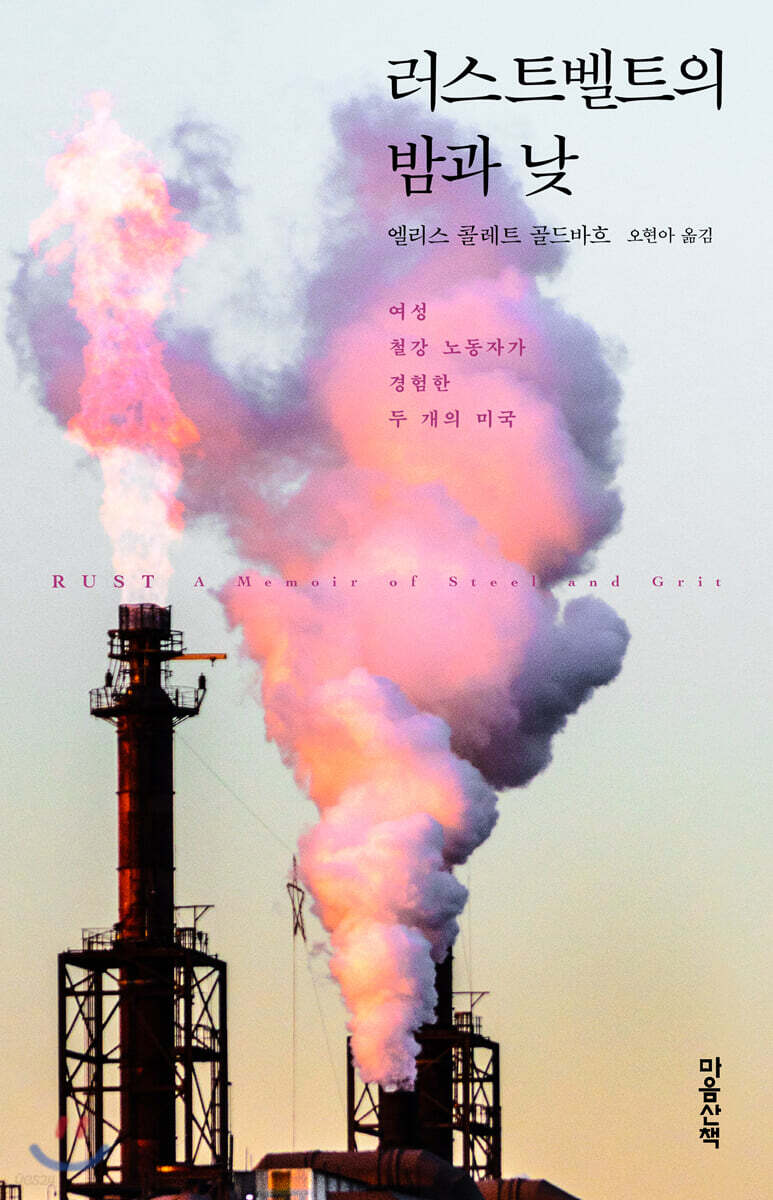
The 2020 US presidential election battleground, the Rust Belt, has erupted. The Voice of Women Steelworkers Amazon Recommends "Best Biographies and Memoirs" The 2020 US presidential election between Biden and Trump. During the particularly fierce election campaign, the eyes of the world were focused on this place. The Rust Belt, America's declining industrial region. Biden has regained attention by recapturing votes in Rust Belt states like Pennsylvania, Michigan, and Wisconsin, where Trump had been ahead four years ago. The industrial region around the Great Lakes, which led the revival of American manufacturing until the 1970s, lost its former glory due to the decline of manufacturing and the relocation of industrial centers, and was given the name "Rust Belt," meaning "rust." There have been numerous diagnoses and discourses about this region, from the high unemployment and poverty caused by industrialization to the "hillbillies"—poor white workers who felt deprived of their rights. However, this is the first book in Korea to contain the voices of female workers in the Rust Belt steel mills. Maumsanchaek's new book, "Night and Day in the Rust Belt," is the story of a female worker who finally broke out of a steel mill, a workplace considered male-dominated. Born in 1986, author Ellis Collette Goldbach grew up in Cleveland, a Rust Belt city. As a child, he faced the rusty and dreary industrial landscape of Cleveland, yet believed he had a better future ahead of him. He went on to graduate school with the dream of becoming a professor, but financial difficulties due to student loans and bipolar disorder forced him to give up on earning a master's degree. While desperately looking for a job, he was recommended by a friend to work at the ArcelorMittal Cleveland Steel Mill, an industrial area he had longed to escape. After completing the 1,040-hour training period, workers can become regular employees with “livable wages, good benefits, and union protection,” but the reality of working at a steel mill is not easy. There are many things that bother him, from the constant sexual discrimination he faces at the steel mill site, to the constant risk of death and injury, to the intense day and night shift work. Not only that, but you always have to be careful of the huge cranes rattling overhead and the forklifts moving through the workshop, and the work of melting zinc with high heat and applying it to steel is extremely dangerous. From the orientation for new steelworkers to the inside of the steel mill, the work process, the workers' culture, and their political leanings, the author documents it all in detail and vividly. As he worked and got to know his colleagues for a long time, he gradually came to understand the significance of the steel mill, where the workers' lives and deaths intersect, and the unique beauty of the Rust Belt. As he watches his colleagues passionately mourn the workers who died for a living, he develops a bond with his superior who teaches him how to drive a forklift, something he had been afraid of, and grows as a steel worker. In this way, "Night and Day in the Rust Belt," written by the author through his own experiences, is a book steeped in the sweat, tears, and lives of Rust Belt workers. |
- You can preview some of the book's contents.
Preview
index
1 Cleveland's Legacy
2 Orientation
3 Qualifications of Steel Workers
4 The world of steel mills
5 traffic accidents
6 Steelworks, sacred ground
7 'Cauldron' Guardians
8 Two Americas
9 College days
10 The Singer in the Mental Ward
11 Love conquers hate
12 Fireworks that light up the night
Acknowledgements
Translator's Note
Recommendation
2 Orientation
3 Qualifications of Steel Workers
4 The world of steel mills
5 traffic accidents
6 Steelworks, sacred ground
7 'Cauldron' Guardians
8 Two Americas
9 College days
10 The Singer in the Mental Ward
11 Love conquers hate
12 Fireworks that light up the night
Acknowledgements
Translator's Note
Recommendation
Detailed image
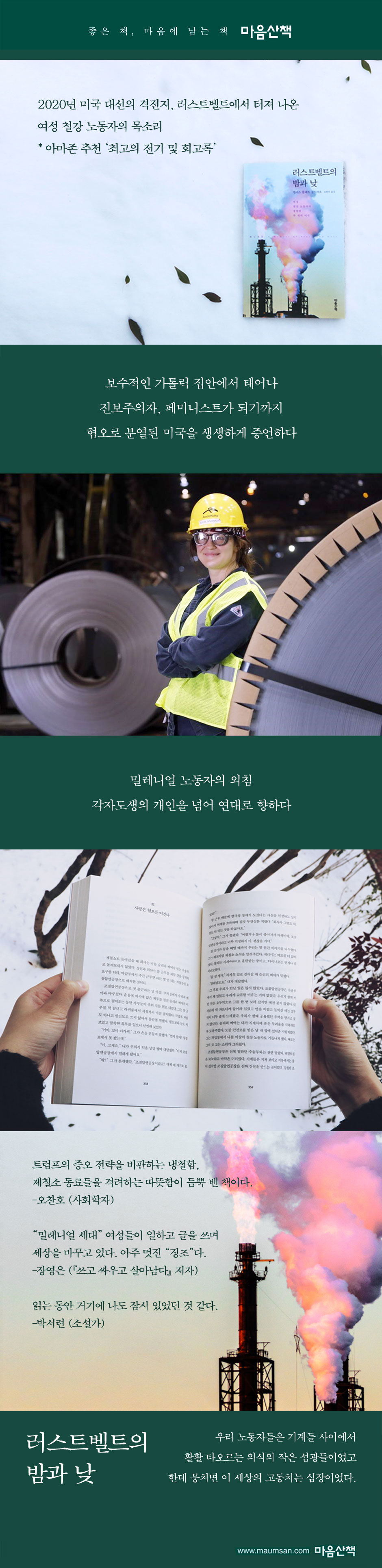
Into the book
Steel mills are usually nightmares.
Early in the morning, orange flames shoot high into the sky from tall fireworks.
The chimney spews out white smoke.
The railroad crosses a desolate, drained land, and the yellow waters of the Cuyahoga River flow into the mouth of Lake Erie.
Many factory buildings stand rusty and soot-covered, their blackness like congealed blood.
Inside these buildings, furnaces roar, machines whir, and cranes squeak under the weight of their loads.
In these buildings, molten iron is transformed into steel.
(…) Wherever you look at the steel mill, it seems like they are shouting this.
This is a place where I can kill you.
This is a place where people die
--- p.11~12
In Rust Belt cities, orange flames aren't just a portent of foul odors and pollution.
It is neither an anachronism nor proof of a lack of innovation.
It might be a baffling presence for people in cities like San Francisco or Boston, but for us it's more than that.
It's jobs and taxes.
It refers to economic growth.
When that flame burns, Cleveland is doing well, the steel workers say.
That flame is part of our history and our identity.
It is a constant reminder that in a world where nothing is made to last, there are things that stand the test of time.
--- p.23
Fire raged from the pit like a devil with a pitchfork, but you hadn't truly seen hell until you saw that furnace.
Bright orange gas emanating from the crucible created visions of rapidly moving, suffering bodies and twisted souls.
Half-peeled faces floated above the molten metal and then disappeared in an instant.
The devil's tail struck the surface and the monsters came up to the surface to breathe.
--- p.73~74
I waited for the right time and let the veteran talk on his own.
He started spouting nonsense about how all women are snakes.
“You women want to be taken care of,” he told me.
“You women only think about money.”
You women, you women.
When he finally stopped talking to catch his breath, I glared and held up my middle finger.
“Whoa, whoa, whoa,” he said, taking a few steps back in surprise.
“Did you just do it to me?”
"yes."
“To my face?”
"yes.
What should I do? Should I cry or something?”
--- p.105
For as long as I can remember, my life has been a struggle to find my place in relationships with men.
I didn't know how to get my way without seeming difficult.
I didn't know how to express myself without seeming insecure.
I didn't know how to be assertive without seeming like a bitch.
--- p.106
Although there were female workers in the steel mill, they were clearly a minority.
Some men still viewed female workers as quotas that the company had to fill.
At best, they regarded women workers as symbolic figures, and in many cases they did not trust our judgment.
Whenever we offered an idea or opinion, these men would always ask another man to confirm what we had said.
He would often try to mansplain and blurt out things that sounded straight out of the 1950s.
--- p.123
Deaths at the steel mill were commemorated in some of the strangest places.
The bulletin board in one corner of the 'Social Hut' was covered with obituaries of employees.
Funeral notices were placed at the entrance and on the tables, and fundraising activities for the bereaved families of deceased colleagues were also held frequently.
It didn't matter whether the cause of death was heart attack, old age, or cancer.
The staff remembered each deceased colleague passionately as if they were family.
It wasn't that I was using a horrible story as shock therapy.
Those stories were a way of remembering all those who gave their lives for a living.
More importantly, those stories were a way of telling the hard truth that it could happen to anyone, it could happen to me.
--- p.166
When I was a little child driving my father's car past the steel mill, all I saw was disgust.
I saw a fireball and an ominous orange flame.
The steelworks were nothing more than the remains of a declining and dying industry, and the rust that covered the countless factory buildings seemed to be a fitting shadow.
At that time, I didn't know that the steel mill was sacred ground.
It was a monument, a memorial.
For some, it was a place of death.
For many, it was a place of identity.
--- p.166
The flames of the steel mills symbolized the kind of stagnation that characterized the Rust Belt.
We failed to innovate.
Couldn't move forward.
Failing to keep up with the rapidly growing technology industry.
Cleveland was a city built on sad stories.
At least that's what I thought.
At the time, I didn't know that Cleveland was also a city of revival.
(…) We may have lost, but we did what we do best.
We continued to move forward quietly.
--- p.172
Beware of immigrants who rape your women and steal your jobs.
Beware of the minority that will destroy everyone.
Beware of Muslims who will kill you in an instant.
Beware of globalists, feminists, socialists, and Democrats.
Trump seemed to have sensed the Rust Belt's unease and given people there a few targets to blame.
But the actual cause of our anxiety is much more difficult to grasp than we believe.
--- p.178
Dad had already lost so much that he was afraid of losing more.
You've been vulnerable all your life, but you've masked it with angry, far-right political leanings, and you've been harboring the illusion of control by owning a gun.
Dad was waiting for someone like Trump to lend credence to his fears.
Immigrants were at the border, Muslims were at the doorstep, and Hillary Clinton was strangling democracy.
When Trump said another disaster was upon us, Dad was too scared to ignore the message.
--- p.186
Instead of highlighting our resilience, Trump has crushed us and highlighted our worst weaknesses.
He considered industrial workers to be fallen people and made us believe that our only identity was our downfall.
He provided a scapegoat for our anxieties and a target for our anger, blinding us to the fact that he was just another wealthy, powerful man seeking more power.
He inspired us with vengeance and incited our anger.
He has damaged the good in our hearts.
That meant he had absolutely no understanding of the delicate beauty of all that we were fighting to protect.
--- p.190~191
A few days before I started training with Mike, I asked my uncle what would happen if I fell into a zinc barrel.
“If Jesus loves you,” he replied.
“You’re going to leave me there to die.”
The old man told the story of a man who fell into a zinc vat at another steel mill.
Third-degree burns were not the problem.
When he fell into the zinc vat, his lung tissue hardened due to inhaling the liquid metal.
Doctors were unable to remove the liquid metal from his lungs.
The man survived, but it would have been better for him to have died.
--- p.195
“What I’m trying to say is that the female employees don’t really like working in the ‘pot,’” the manager said.
“There are very few female employees who work there for a long time.”
I got upset.
Even though I had applied for a position with a consistent work schedule, the manager was now giving me another reason to accept the position.
He said that women weren't suited for the position, and I wanted to prove him wrong.
“I’ll go there,” I answered without hesitation.
--- p.202
You don't have to wear a seat belt while clearing the trash, but you always have to wear a seat belt when going next to the lobby.
Not only was it difficult to move around in the narrow workbench, but there were no barriers or anything like that around it.
If you slip, you'll fall straight into a zinc barrel.
The confidence that had built up as I cleaned up the mess quickly dwindled.
--- p.224
As I continued to push the lever, I suddenly felt the forklift being pulled forward.
The forklift driver's seat seemed to shake, and then the rear of the vehicle was lifted into the air.
My body slammed into the steering wheel.
My heart pounded wildly, and the warnings I had heard during orientation flashed through my mind.
The forklift may overturn.
You could lose your life in a forklift.
--- p.229
Tony shrugged and turned on the television, but he was already asleep before the opening credits even started.
Factory work made me feel tired like I had never felt before.
I felt like I was walking through mud the whole time because I barely made up for the sleep I lost from working the night shift.
I couldn't fully concentrate on anything.
I forgot to buy chicken at the supermarket.
Even though there was a mountain of laundry, I just left it there.
As I was scrubbing the bathtub hard, I suddenly looked down at it and realized that I had scrubbed it that morning.
My head was dizzy and foggy.
My diet quickly changed from home-cooked meals to energy drinks and takeout food.
It always felt like I was barely breathing.
--- p.230
I always welcome rumors.
This has become a kind of ritual.
Sleepy Bear told me all sorts of stories while he was awake.
It was rarely longer than an hour, but it was the time of day I looked forward to the most.
Even though it had been several months since I started working at the steel mill, I still felt awkward and shy around my coworkers.
Most of them were older than me, and many shared a long history of slang and reminiscences.
I was at a loss as to how to get into them, but Sleepy Bear's backstory helped me get into that world.
--- p.246
“Now that Obama is president, it’s going to be harder to get a license,” Dad explained.
“It’s best to take the class now because it threatens our right to bear arms.
Then we won't have to worry about Obama taking away our freedoms."
Until then, I had no interest in guns whatsoever.
To tell the truth, I was afraid of guns.
I hated carrying a gun, let alone holding one, but my father's warning got to me.
--- p.252
“We did all the fucking cleaning and now Jeremy is yelling at us?”
Sleepy Bear smiled and shook his head.
“Now you know how things work here.”
I threw the note on the floor and frowned.
“I wasn’t going to say that,” I said to Sleepy Bear.
“What, what are you talking about?”
“Jeremy, fuck you.”
When Sleepy Bear laughed, I laughed too.
He was a proud parent watching his child ride a bike without training wheels, and I was a little kid tottering to the end of the driveway.
--- p.261~262
I was furious that Trump was building his platform on the backs of steelworkers.
His hostility and venom were not of the steel mill.
This was a place of history and family, a place of struggle for justice and equality.
This was the place where the veteran worker taught the 'orange hat' tricks.
This was a place where camaraderie was fostered amidst the machines that took workers' lives.
This was a place to boost the morale of union colleagues who were having a hard time.
This is a place where everyone—regardless of race, creed, gender, or orientation—can safely return home after a day of work.
It was a place that protected me from going back.
--- p.269~270
Aaron and Ben were both freshmen.
I had three and a half more years of school ahead of me, and I couldn't let them do the same thing to other girls.
Although it was too late to report the sexual assault to the police, it was possible to pursue justice at the school level.
I felt like I could bring this issue to the attention of the school, but I haven't made up my mind yet.
I was worried that if I reported it to the school, I might face criticism and resentment from the students, and I doubted whether I would have the courage to deal with the fight that would follow.
--- p.298
“Trump saw women as objects to be used as he pleased.
Rich, privileged men have the right to be rude to women.
That's the male-privileged mindset that drives the culture of sexual assault and sexual harassment.
“It’s surprising that someone who calls himself a Christian would advocate such values.”
“So, what about Bill Clinton?” my dad asked, practically spitting out the words at me.
“I think Clinton was pretty rude to women, wasn’t he?”
--- p.327
I was so lost in the pain of my illness for months that I didn't even notice that I had changed.
The fear was gone, and in its place the steelworker remained.
--- p.363
Some people have 'Love Trumps Hate' written on their heads.
They held up signs that read "Donald Trump, the slogan of Trump's opponents, inspired by Donald Trump's last name, which means "I will win," and a sacred power seemed to flow through the crowd.
It was not a righteous force demanding judgment, nor was it a force so strong that it could not be resisted, nor was it confined to political ideology or artificial institutions.
It was like a whisper, a distant promise of something better, and it reminded me of a voice I had heard in church when I was nine.
Perhaps, after that long period of darkness, the prayer I offered in the chapel—let me learn to love myself as a woman—had finally been answered.
--- p.373~376
“Just a moment,” I said firmly, as if I were refuting the term “racing feminist.”
“Women face a lot of criticism and condemnation when they come forward about sexual violence.
It's not a problem to be taken lightly.
It's unfair that so many women feel shamed for raising their voices.
I was sexually assaulted when I was a college student.
I raised the issue publicly, but no one believed me.
They said it was all my fault.
“People’s reactions are as wrong as sexual assault.”
--- p.383
All the clichés I had heard as a child suddenly came to mind.
If you dream it, you can achieve it! You are a special flower with limitless potential! That's true, but that's not all.
Perhaps as a culture we've become so captivated by this damned sense of specialness that we've blinded ourselves to the toxicity of individualism that has consumed our nation.
We wanted to cling to ideology blindfolded, bound by self-righteousness, arrogance, personal pleasure, personal narrative, personal belief, and personal pride.
We preferred a space where we didn't have to look deeply into ourselves.
I preferred a space where I didn't have to respect the complexities of people I couldn't understand, where I didn't have to form a community with people who disagreed with me, and where I could eliminate and ignore anything that complicated or denied our reality.
Instead of community, they pursued train wrecks, disasters, and scandals.
I crave anything that stimulates the secretion of adrenaline.
Because entertainment was easier than facing our true selves—sometimes confusing and boring.
(…) Perhaps in that dream, I was trying so hard to separate myself from the world, even though I really needed to be more connected to it.
--- p.399~400
We were a product of an unexpected economic downturn.
Just before the long-awaited adulthood arrives, the carpet is pulled from under your feet.
Now that it was cleared away, we humbled ourselves and walked silently, enduring the hardship.
Before making policy, we had to serve sandwiches.
I had to pour a latte before I could speak out in society.
I needed to tie my knot before I could commit to anything meaningful, but Ocasio-Cortez's election was a sign.
It was a rainbow after heavy rain.
It was a sign that the water level was receding, and evidence that good things could happen after the heavy rain.
After a long period of minimum wages, underemployment, and terrible frustration, our generation is finally starting to show its strength.
--- p.412~413
I wasn't afraid.
Instead, I imagined all the lights there dimming, as they do just before a power outage, and I looked at each person as a flickering light in the dark steel mill.
I could see across the hot rolling mill past the end of the finishing line and into the blast furnace beyond.
We were tiny sparks of consciousness burning among the machines—all of us, made of one substance, a pulse pulsing in the darkness—and together we were the beating heart of the world.
--- p.415
The flame was proof of what we could create, transform, and refine.
As the pink sky finally faded and the horizon disappeared, the flame flicked its bright tongue into the darkness, burning away memories of soot and grime and rust, and illuminating the night for the lives that had been born and then perished beneath it.
If you look closely, the flames are breathtaking.
In that light, the steel mill looked almost sacred.
Early in the morning, orange flames shoot high into the sky from tall fireworks.
The chimney spews out white smoke.
The railroad crosses a desolate, drained land, and the yellow waters of the Cuyahoga River flow into the mouth of Lake Erie.
Many factory buildings stand rusty and soot-covered, their blackness like congealed blood.
Inside these buildings, furnaces roar, machines whir, and cranes squeak under the weight of their loads.
In these buildings, molten iron is transformed into steel.
(…) Wherever you look at the steel mill, it seems like they are shouting this.
This is a place where I can kill you.
This is a place where people die
--- p.11~12
In Rust Belt cities, orange flames aren't just a portent of foul odors and pollution.
It is neither an anachronism nor proof of a lack of innovation.
It might be a baffling presence for people in cities like San Francisco or Boston, but for us it's more than that.
It's jobs and taxes.
It refers to economic growth.
When that flame burns, Cleveland is doing well, the steel workers say.
That flame is part of our history and our identity.
It is a constant reminder that in a world where nothing is made to last, there are things that stand the test of time.
--- p.23
Fire raged from the pit like a devil with a pitchfork, but you hadn't truly seen hell until you saw that furnace.
Bright orange gas emanating from the crucible created visions of rapidly moving, suffering bodies and twisted souls.
Half-peeled faces floated above the molten metal and then disappeared in an instant.
The devil's tail struck the surface and the monsters came up to the surface to breathe.
--- p.73~74
I waited for the right time and let the veteran talk on his own.
He started spouting nonsense about how all women are snakes.
“You women want to be taken care of,” he told me.
“You women only think about money.”
You women, you women.
When he finally stopped talking to catch his breath, I glared and held up my middle finger.
“Whoa, whoa, whoa,” he said, taking a few steps back in surprise.
“Did you just do it to me?”
"yes."
“To my face?”
"yes.
What should I do? Should I cry or something?”
--- p.105
For as long as I can remember, my life has been a struggle to find my place in relationships with men.
I didn't know how to get my way without seeming difficult.
I didn't know how to express myself without seeming insecure.
I didn't know how to be assertive without seeming like a bitch.
--- p.106
Although there were female workers in the steel mill, they were clearly a minority.
Some men still viewed female workers as quotas that the company had to fill.
At best, they regarded women workers as symbolic figures, and in many cases they did not trust our judgment.
Whenever we offered an idea or opinion, these men would always ask another man to confirm what we had said.
He would often try to mansplain and blurt out things that sounded straight out of the 1950s.
--- p.123
Deaths at the steel mill were commemorated in some of the strangest places.
The bulletin board in one corner of the 'Social Hut' was covered with obituaries of employees.
Funeral notices were placed at the entrance and on the tables, and fundraising activities for the bereaved families of deceased colleagues were also held frequently.
It didn't matter whether the cause of death was heart attack, old age, or cancer.
The staff remembered each deceased colleague passionately as if they were family.
It wasn't that I was using a horrible story as shock therapy.
Those stories were a way of remembering all those who gave their lives for a living.
More importantly, those stories were a way of telling the hard truth that it could happen to anyone, it could happen to me.
--- p.166
When I was a little child driving my father's car past the steel mill, all I saw was disgust.
I saw a fireball and an ominous orange flame.
The steelworks were nothing more than the remains of a declining and dying industry, and the rust that covered the countless factory buildings seemed to be a fitting shadow.
At that time, I didn't know that the steel mill was sacred ground.
It was a monument, a memorial.
For some, it was a place of death.
For many, it was a place of identity.
--- p.166
The flames of the steel mills symbolized the kind of stagnation that characterized the Rust Belt.
We failed to innovate.
Couldn't move forward.
Failing to keep up with the rapidly growing technology industry.
Cleveland was a city built on sad stories.
At least that's what I thought.
At the time, I didn't know that Cleveland was also a city of revival.
(…) We may have lost, but we did what we do best.
We continued to move forward quietly.
--- p.172
Beware of immigrants who rape your women and steal your jobs.
Beware of the minority that will destroy everyone.
Beware of Muslims who will kill you in an instant.
Beware of globalists, feminists, socialists, and Democrats.
Trump seemed to have sensed the Rust Belt's unease and given people there a few targets to blame.
But the actual cause of our anxiety is much more difficult to grasp than we believe.
--- p.178
Dad had already lost so much that he was afraid of losing more.
You've been vulnerable all your life, but you've masked it with angry, far-right political leanings, and you've been harboring the illusion of control by owning a gun.
Dad was waiting for someone like Trump to lend credence to his fears.
Immigrants were at the border, Muslims were at the doorstep, and Hillary Clinton was strangling democracy.
When Trump said another disaster was upon us, Dad was too scared to ignore the message.
--- p.186
Instead of highlighting our resilience, Trump has crushed us and highlighted our worst weaknesses.
He considered industrial workers to be fallen people and made us believe that our only identity was our downfall.
He provided a scapegoat for our anxieties and a target for our anger, blinding us to the fact that he was just another wealthy, powerful man seeking more power.
He inspired us with vengeance and incited our anger.
He has damaged the good in our hearts.
That meant he had absolutely no understanding of the delicate beauty of all that we were fighting to protect.
--- p.190~191
A few days before I started training with Mike, I asked my uncle what would happen if I fell into a zinc barrel.
“If Jesus loves you,” he replied.
“You’re going to leave me there to die.”
The old man told the story of a man who fell into a zinc vat at another steel mill.
Third-degree burns were not the problem.
When he fell into the zinc vat, his lung tissue hardened due to inhaling the liquid metal.
Doctors were unable to remove the liquid metal from his lungs.
The man survived, but it would have been better for him to have died.
--- p.195
“What I’m trying to say is that the female employees don’t really like working in the ‘pot,’” the manager said.
“There are very few female employees who work there for a long time.”
I got upset.
Even though I had applied for a position with a consistent work schedule, the manager was now giving me another reason to accept the position.
He said that women weren't suited for the position, and I wanted to prove him wrong.
“I’ll go there,” I answered without hesitation.
--- p.202
You don't have to wear a seat belt while clearing the trash, but you always have to wear a seat belt when going next to the lobby.
Not only was it difficult to move around in the narrow workbench, but there were no barriers or anything like that around it.
If you slip, you'll fall straight into a zinc barrel.
The confidence that had built up as I cleaned up the mess quickly dwindled.
--- p.224
As I continued to push the lever, I suddenly felt the forklift being pulled forward.
The forklift driver's seat seemed to shake, and then the rear of the vehicle was lifted into the air.
My body slammed into the steering wheel.
My heart pounded wildly, and the warnings I had heard during orientation flashed through my mind.
The forklift may overturn.
You could lose your life in a forklift.
--- p.229
Tony shrugged and turned on the television, but he was already asleep before the opening credits even started.
Factory work made me feel tired like I had never felt before.
I felt like I was walking through mud the whole time because I barely made up for the sleep I lost from working the night shift.
I couldn't fully concentrate on anything.
I forgot to buy chicken at the supermarket.
Even though there was a mountain of laundry, I just left it there.
As I was scrubbing the bathtub hard, I suddenly looked down at it and realized that I had scrubbed it that morning.
My head was dizzy and foggy.
My diet quickly changed from home-cooked meals to energy drinks and takeout food.
It always felt like I was barely breathing.
--- p.230
I always welcome rumors.
This has become a kind of ritual.
Sleepy Bear told me all sorts of stories while he was awake.
It was rarely longer than an hour, but it was the time of day I looked forward to the most.
Even though it had been several months since I started working at the steel mill, I still felt awkward and shy around my coworkers.
Most of them were older than me, and many shared a long history of slang and reminiscences.
I was at a loss as to how to get into them, but Sleepy Bear's backstory helped me get into that world.
--- p.246
“Now that Obama is president, it’s going to be harder to get a license,” Dad explained.
“It’s best to take the class now because it threatens our right to bear arms.
Then we won't have to worry about Obama taking away our freedoms."
Until then, I had no interest in guns whatsoever.
To tell the truth, I was afraid of guns.
I hated carrying a gun, let alone holding one, but my father's warning got to me.
--- p.252
“We did all the fucking cleaning and now Jeremy is yelling at us?”
Sleepy Bear smiled and shook his head.
“Now you know how things work here.”
I threw the note on the floor and frowned.
“I wasn’t going to say that,” I said to Sleepy Bear.
“What, what are you talking about?”
“Jeremy, fuck you.”
When Sleepy Bear laughed, I laughed too.
He was a proud parent watching his child ride a bike without training wheels, and I was a little kid tottering to the end of the driveway.
--- p.261~262
I was furious that Trump was building his platform on the backs of steelworkers.
His hostility and venom were not of the steel mill.
This was a place of history and family, a place of struggle for justice and equality.
This was the place where the veteran worker taught the 'orange hat' tricks.
This was a place where camaraderie was fostered amidst the machines that took workers' lives.
This was a place to boost the morale of union colleagues who were having a hard time.
This is a place where everyone—regardless of race, creed, gender, or orientation—can safely return home after a day of work.
It was a place that protected me from going back.
--- p.269~270
Aaron and Ben were both freshmen.
I had three and a half more years of school ahead of me, and I couldn't let them do the same thing to other girls.
Although it was too late to report the sexual assault to the police, it was possible to pursue justice at the school level.
I felt like I could bring this issue to the attention of the school, but I haven't made up my mind yet.
I was worried that if I reported it to the school, I might face criticism and resentment from the students, and I doubted whether I would have the courage to deal with the fight that would follow.
--- p.298
“Trump saw women as objects to be used as he pleased.
Rich, privileged men have the right to be rude to women.
That's the male-privileged mindset that drives the culture of sexual assault and sexual harassment.
“It’s surprising that someone who calls himself a Christian would advocate such values.”
“So, what about Bill Clinton?” my dad asked, practically spitting out the words at me.
“I think Clinton was pretty rude to women, wasn’t he?”
--- p.327
I was so lost in the pain of my illness for months that I didn't even notice that I had changed.
The fear was gone, and in its place the steelworker remained.
--- p.363
Some people have 'Love Trumps Hate' written on their heads.
They held up signs that read "Donald Trump, the slogan of Trump's opponents, inspired by Donald Trump's last name, which means "I will win," and a sacred power seemed to flow through the crowd.
It was not a righteous force demanding judgment, nor was it a force so strong that it could not be resisted, nor was it confined to political ideology or artificial institutions.
It was like a whisper, a distant promise of something better, and it reminded me of a voice I had heard in church when I was nine.
Perhaps, after that long period of darkness, the prayer I offered in the chapel—let me learn to love myself as a woman—had finally been answered.
--- p.373~376
“Just a moment,” I said firmly, as if I were refuting the term “racing feminist.”
“Women face a lot of criticism and condemnation when they come forward about sexual violence.
It's not a problem to be taken lightly.
It's unfair that so many women feel shamed for raising their voices.
I was sexually assaulted when I was a college student.
I raised the issue publicly, but no one believed me.
They said it was all my fault.
“People’s reactions are as wrong as sexual assault.”
--- p.383
All the clichés I had heard as a child suddenly came to mind.
If you dream it, you can achieve it! You are a special flower with limitless potential! That's true, but that's not all.
Perhaps as a culture we've become so captivated by this damned sense of specialness that we've blinded ourselves to the toxicity of individualism that has consumed our nation.
We wanted to cling to ideology blindfolded, bound by self-righteousness, arrogance, personal pleasure, personal narrative, personal belief, and personal pride.
We preferred a space where we didn't have to look deeply into ourselves.
I preferred a space where I didn't have to respect the complexities of people I couldn't understand, where I didn't have to form a community with people who disagreed with me, and where I could eliminate and ignore anything that complicated or denied our reality.
Instead of community, they pursued train wrecks, disasters, and scandals.
I crave anything that stimulates the secretion of adrenaline.
Because entertainment was easier than facing our true selves—sometimes confusing and boring.
(…) Perhaps in that dream, I was trying so hard to separate myself from the world, even though I really needed to be more connected to it.
--- p.399~400
We were a product of an unexpected economic downturn.
Just before the long-awaited adulthood arrives, the carpet is pulled from under your feet.
Now that it was cleared away, we humbled ourselves and walked silently, enduring the hardship.
Before making policy, we had to serve sandwiches.
I had to pour a latte before I could speak out in society.
I needed to tie my knot before I could commit to anything meaningful, but Ocasio-Cortez's election was a sign.
It was a rainbow after heavy rain.
It was a sign that the water level was receding, and evidence that good things could happen after the heavy rain.
After a long period of minimum wages, underemployment, and terrible frustration, our generation is finally starting to show its strength.
--- p.412~413
I wasn't afraid.
Instead, I imagined all the lights there dimming, as they do just before a power outage, and I looked at each person as a flickering light in the dark steel mill.
I could see across the hot rolling mill past the end of the finishing line and into the blast furnace beyond.
We were tiny sparks of consciousness burning among the machines—all of us, made of one substance, a pulse pulsing in the darkness—and together we were the beating heart of the world.
--- p.415
The flame was proof of what we could create, transform, and refine.
As the pink sky finally faded and the horizon disappeared, the flame flicked its bright tongue into the darkness, burning away memories of soot and grime and rust, and illuminating the night for the lives that had been born and then perished beneath it.
If you look closely, the flames are breathtaking.
In that light, the steel mill looked almost sacred.
--- p.417
Publisher's Review
Born into a conservative Catholic family, she became a progressive and feminist.
A vivid testimony to an America divided by hate.
The United States, often called a "melting pot of races," is a federal state with strong national characteristics not only for its race but also for each state. It also has deep-rooted divisions throughout its history, dating back to the Civil War, but the hateful tactics Trump employed to win the election have deepened the divide.
The author argues that Trump exploited the anxiety of Rust Belt workers who were losing their livelihoods, providing them with a scapegoat and a target for their anger.
The targets were immigrants, Democrats, Muslims and protesters chanting “Black Lives Matter.”
He admits that, as a worker, he has also viewed the white-collar workers of the eastern United States, the so-called "elites," with prejudice, saying that people have failed to see the "veil that covers their eyes" as hatred and hostility divides the country.
The author testifies not only to his experience as a worker in the Rust Belt, but also to his life straddling the divides of a divided America.
The author's life, raised in a conservative household and then becoming a progressive, is itself a vivid portrait of a divided America.
The author, who grew up in a devout Catholic family that supported the Republican Party, dreamed of becoming a nun as a child and went to a Catholic university in Steubenville.
However, after being sexually assaulted and experiencing rape culture in college, she drops out.
Afterwards, he re-enrolls in a university with a progressive atmosphere, participates in social movements, and experiences a new world.
He tries to live as a progressive, but he constantly clashes with his family and conservative colleagues on topics like feminism, abortion, and guns.
For example, during Obama's presidency, the author's father, who had failed in business, became obsessed with the idea of an apocalypse and began to buy guns and ammunition, and the part where his parents urged him to get a gun license before Obama took away his freedom to carry a gun, offer a glimpse into conservatives' deep-rooted fears about guns.
The book also contains the author's experience of praying the rosary at a rally for Democratic presidential candidate John Kerry to protest abortion rights when she was attending a Catholic university, and the complex feelings she felt when she later participated in the Women's March as a feminist and saw counter-protesters who, like her, were opposing abortion rights.
The author's experience of accepting feminism, a taboo topic at home, as an adult and even sharing it with her colleagues at the steel mill will deeply resonate with readers.
It never occurred to me that my hostility was the rift that divided this country.
The rift went beyond political parties and economics.
It goes beyond Congress and the White House, beyond our salaries and positions.
The crack was born from human weakness.
We have forgotten how to look at each other.
We let our guard down.
We closed our eyes.
Then the weavers of curtains and illusions appeared and recognized the darkness we ourselves had brought about.
They carefully covered our eyes, believing us to be blind and unable to discern right from wrong.
I hope that none of us—neither the steelworkers nor the lawyers—will ever see the world clearly again.
-Page 270
The Cry of Millennial Workers
Moving beyond the individualistic approach of each person to solidarity
As a millennial, the author tells his life story in a candid manner.
Looking back on his childhood, when he was obsessed with the dream that “I am special and I can achieve anything I dream,” and worked hard with “American passion, like climbing a mountain,” but ended up working in a steel mill, he diagnoses that his generation “closed its eyes to the toxicity of individualism.”
Being so self-absorbed that they failed to respect the complexities of others, did not build a community with those who shared different perspectives, and simply eliminated and ignored anything that negated the reality they dreamed of.
He confesses that he has been trying to separate himself from the world, even though he really needs to be more connected to it.
He also laments the generational pain of having to “serve sandwiches and pour lattes” while enduring “the terrible frustration of minimum wage and downward employment” as “products of an unexpected recession.”
Working with steel mill workers in similar situations, he learns to empathize with the plight and pain of his colleagues and, by extension, millennials, and to see “unity forged in the orange flames of the steel mill.”
In a place where the risk of industrial accidents is always present, we realize that we are not special "me" but rather "we" who are connected to each other as we look after each other.
After regaining his faith in the community and reassessing his priorities at the steel mill, he once again embarks on the challenge of pursuing his true dream.
The author's growth toward "community" and his heartfelt support for millennials will be a valid message not only to American but also to Korean millennial readers.
It also tells the story of the political rise of American millennials.
In particular, the part that mentions Alexandria Ocasio-Cortez, who emerged as a symbol of millennials by becoming the youngest female representative in U.S. history at the age of 29 as a member of the Democratic Party, will provide readers with an opportunity to think about millennials' political participation, not just as voters.
Just as the young Jeon Tae-il 50 years ago expressed his sense of unity with others by calling all other people “my other selves,” Goldbach, too, empathizes with workers and realizes that there are “other selves” around him.
Instead of turning a blind eye to the “toxicity of individualism,” we learned to empathize with the suffering of others and to connect with them.
“We are people with strong courage and strength,” she says, finally confirming her identity.
At this time, we must be a collection of 'other selves'.
In this way, she becomes passionately connected to the world through honest, steel-like labor.
-From the Translator's Note
A moving labor narrative told by a female worker.
The author vividly portrays the steel mill landscape, reminiscent of Dante's Inferno, while working alongside the eccentric, hard-charging steelworkers, discovers the value of empathy and solidarity that overcomes political differences.
This is a sharp and heartwarming look at the American working class.
- [Publisher's Weekly]
The author vividly portrays the struggles of workers not only in the steel mills but also in the world beyond.
It is a moving story that looks directly at the life of the working class.
- [Kirkus Review]
"Night and Day in the Rust Belt" follows in the footsteps of "Hillbilly Elegy" and other books published after the 2016 U.S. presidential election.
The great appeal of this book is that it keenly observes the steel mill landscape through the eyes of female workers in a male-dominated work environment.
It also brilliantly illustrates how workers' identities are constantly exploited by politicians, and how politicians' rhetoric can tear families apart.
As the author's journey to find himself unfolds movingly, his diagnosis of American society shines throughout.
- [Paperback Paris]
The author, with an outsider's perspective—as a woman and a progressive—gains insight into the lives of steelworkers, candidly shares the hard-won wisdom that while many issues divide us, work unites us.
- [Booklist]
If there is a worker who finds meaning in the midst of a steel mill in a neglected and declining industrial area, there is much to be learned from him.
As our country is divided along regional, political, and demographic lines, this book is a healing elixir that soothes our wounds.
- [LIT Magazine]
It follows in the tradition of Upton Sinclair's The Jungle, Studs Turkle's Work, Molly Martin's Hard-Hatted Women, and Barbara Ehrenreich's The Betrayal of Labor.
This book humbly reminds us that we have not properly understood the value of labor, which is essential to our existence.
- [Washington Examiner]
This timely book captures our attention like an unquenchable flame rising from a chimney next to I-490.
It is well deserved.
The author recounts in fiery language the days he spent working under those fires, caught between the desire to leave his hometown, his family, and the will to live he found alongside his surly male colleagues.
- [Cleveland Magazine]
An honest memoir about life in the Rust Belt, a place the author desperately wanted to escape, and the hard-working steelworkers he eventually fell in love with.
- [Chicago Sun-Times]
You won't be able to take your eyes off Goldbach's honest writing about what it means to be a millennial, a woman, a daughter, and a believer today.
- [American Catholic Magazine]
Goldbach becomes the Rust Belt's muse, a fervent ode to steel and the steel industry that has found itself.
Judging by the sentences that are full of passion and power, it seems like he has definitely learned how to sing.
- [Pittsburgh Post-Gazette]
Goldbach skillfully weaves together a story of mental illness, poverty, rape culture, and his childhood within the Catholic Church, blending descriptive and reflective insight.
- [National Catholic Reporter]
A vivid testimony to an America divided by hate.
The United States, often called a "melting pot of races," is a federal state with strong national characteristics not only for its race but also for each state. It also has deep-rooted divisions throughout its history, dating back to the Civil War, but the hateful tactics Trump employed to win the election have deepened the divide.
The author argues that Trump exploited the anxiety of Rust Belt workers who were losing their livelihoods, providing them with a scapegoat and a target for their anger.
The targets were immigrants, Democrats, Muslims and protesters chanting “Black Lives Matter.”
He admits that, as a worker, he has also viewed the white-collar workers of the eastern United States, the so-called "elites," with prejudice, saying that people have failed to see the "veil that covers their eyes" as hatred and hostility divides the country.
The author testifies not only to his experience as a worker in the Rust Belt, but also to his life straddling the divides of a divided America.
The author's life, raised in a conservative household and then becoming a progressive, is itself a vivid portrait of a divided America.
The author, who grew up in a devout Catholic family that supported the Republican Party, dreamed of becoming a nun as a child and went to a Catholic university in Steubenville.
However, after being sexually assaulted and experiencing rape culture in college, she drops out.
Afterwards, he re-enrolls in a university with a progressive atmosphere, participates in social movements, and experiences a new world.
He tries to live as a progressive, but he constantly clashes with his family and conservative colleagues on topics like feminism, abortion, and guns.
For example, during Obama's presidency, the author's father, who had failed in business, became obsessed with the idea of an apocalypse and began to buy guns and ammunition, and the part where his parents urged him to get a gun license before Obama took away his freedom to carry a gun, offer a glimpse into conservatives' deep-rooted fears about guns.
The book also contains the author's experience of praying the rosary at a rally for Democratic presidential candidate John Kerry to protest abortion rights when she was attending a Catholic university, and the complex feelings she felt when she later participated in the Women's March as a feminist and saw counter-protesters who, like her, were opposing abortion rights.
The author's experience of accepting feminism, a taboo topic at home, as an adult and even sharing it with her colleagues at the steel mill will deeply resonate with readers.
It never occurred to me that my hostility was the rift that divided this country.
The rift went beyond political parties and economics.
It goes beyond Congress and the White House, beyond our salaries and positions.
The crack was born from human weakness.
We have forgotten how to look at each other.
We let our guard down.
We closed our eyes.
Then the weavers of curtains and illusions appeared and recognized the darkness we ourselves had brought about.
They carefully covered our eyes, believing us to be blind and unable to discern right from wrong.
I hope that none of us—neither the steelworkers nor the lawyers—will ever see the world clearly again.
-Page 270
The Cry of Millennial Workers
Moving beyond the individualistic approach of each person to solidarity
As a millennial, the author tells his life story in a candid manner.
Looking back on his childhood, when he was obsessed with the dream that “I am special and I can achieve anything I dream,” and worked hard with “American passion, like climbing a mountain,” but ended up working in a steel mill, he diagnoses that his generation “closed its eyes to the toxicity of individualism.”
Being so self-absorbed that they failed to respect the complexities of others, did not build a community with those who shared different perspectives, and simply eliminated and ignored anything that negated the reality they dreamed of.
He confesses that he has been trying to separate himself from the world, even though he really needs to be more connected to it.
He also laments the generational pain of having to “serve sandwiches and pour lattes” while enduring “the terrible frustration of minimum wage and downward employment” as “products of an unexpected recession.”
Working with steel mill workers in similar situations, he learns to empathize with the plight and pain of his colleagues and, by extension, millennials, and to see “unity forged in the orange flames of the steel mill.”
In a place where the risk of industrial accidents is always present, we realize that we are not special "me" but rather "we" who are connected to each other as we look after each other.
After regaining his faith in the community and reassessing his priorities at the steel mill, he once again embarks on the challenge of pursuing his true dream.
The author's growth toward "community" and his heartfelt support for millennials will be a valid message not only to American but also to Korean millennial readers.
It also tells the story of the political rise of American millennials.
In particular, the part that mentions Alexandria Ocasio-Cortez, who emerged as a symbol of millennials by becoming the youngest female representative in U.S. history at the age of 29 as a member of the Democratic Party, will provide readers with an opportunity to think about millennials' political participation, not just as voters.
Just as the young Jeon Tae-il 50 years ago expressed his sense of unity with others by calling all other people “my other selves,” Goldbach, too, empathizes with workers and realizes that there are “other selves” around him.
Instead of turning a blind eye to the “toxicity of individualism,” we learned to empathize with the suffering of others and to connect with them.
“We are people with strong courage and strength,” she says, finally confirming her identity.
At this time, we must be a collection of 'other selves'.
In this way, she becomes passionately connected to the world through honest, steel-like labor.
-From the Translator's Note
A moving labor narrative told by a female worker.
The author vividly portrays the steel mill landscape, reminiscent of Dante's Inferno, while working alongside the eccentric, hard-charging steelworkers, discovers the value of empathy and solidarity that overcomes political differences.
This is a sharp and heartwarming look at the American working class.
- [Publisher's Weekly]
The author vividly portrays the struggles of workers not only in the steel mills but also in the world beyond.
It is a moving story that looks directly at the life of the working class.
- [Kirkus Review]
"Night and Day in the Rust Belt" follows in the footsteps of "Hillbilly Elegy" and other books published after the 2016 U.S. presidential election.
The great appeal of this book is that it keenly observes the steel mill landscape through the eyes of female workers in a male-dominated work environment.
It also brilliantly illustrates how workers' identities are constantly exploited by politicians, and how politicians' rhetoric can tear families apart.
As the author's journey to find himself unfolds movingly, his diagnosis of American society shines throughout.
- [Paperback Paris]
The author, with an outsider's perspective—as a woman and a progressive—gains insight into the lives of steelworkers, candidly shares the hard-won wisdom that while many issues divide us, work unites us.
- [Booklist]
If there is a worker who finds meaning in the midst of a steel mill in a neglected and declining industrial area, there is much to be learned from him.
As our country is divided along regional, political, and demographic lines, this book is a healing elixir that soothes our wounds.
- [LIT Magazine]
It follows in the tradition of Upton Sinclair's The Jungle, Studs Turkle's Work, Molly Martin's Hard-Hatted Women, and Barbara Ehrenreich's The Betrayal of Labor.
This book humbly reminds us that we have not properly understood the value of labor, which is essential to our existence.
- [Washington Examiner]
This timely book captures our attention like an unquenchable flame rising from a chimney next to I-490.
It is well deserved.
The author recounts in fiery language the days he spent working under those fires, caught between the desire to leave his hometown, his family, and the will to live he found alongside his surly male colleagues.
- [Cleveland Magazine]
An honest memoir about life in the Rust Belt, a place the author desperately wanted to escape, and the hard-working steelworkers he eventually fell in love with.
- [Chicago Sun-Times]
You won't be able to take your eyes off Goldbach's honest writing about what it means to be a millennial, a woman, a daughter, and a believer today.
- [American Catholic Magazine]
Goldbach becomes the Rust Belt's muse, a fervent ode to steel and the steel industry that has found itself.
Judging by the sentences that are full of passion and power, it seems like he has definitely learned how to sing.
- [Pittsburgh Post-Gazette]
Goldbach skillfully weaves together a story of mental illness, poverty, rape culture, and his childhood within the Catholic Church, blending descriptive and reflective insight.
- [National Catholic Reporter]
GOODS SPECIFICS
- Publication date: December 15, 2020
- Page count, weight, size: 432 pages | 612g | 145*225*25mm
- ISBN13: 9788960906532
- ISBN10: 8960906530
You may also like
카테고리
korean


korean

![GQ KOREA Mark (Monthly): December [2025]](http://librairie.coreenne.fr/cdn/shop/files/8ef265dbbfbf186523ed75ba7319009d.jpg?v=1765340328&width=3840)


