

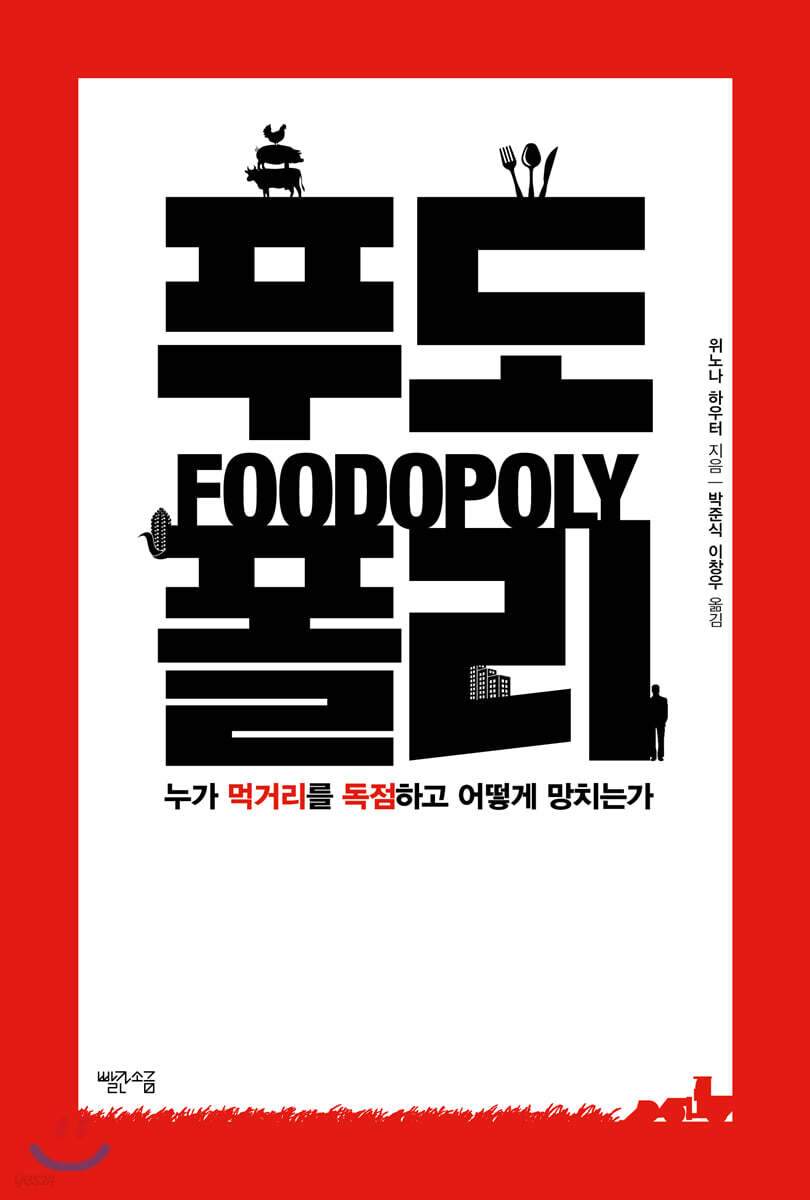
Foodopoly
 |
Description
Book Introduction
Foodopoly is a combination of the words food and monopoly.
That is, it means ‘food monopoly.’
Author Winona Houter currently runs an organic family farm and participates in the local food movement.
But as one of America's most respected food activists, Houter believes the local food movement isn't enough to solve the food and ecological crises.
In "Food Poli," she targets the real cause of the problem.
Foodopoly is the control of food production by a few large corporations, preventing farmers from growing healthy produce and limiting consumer choices at the grocery store.
Political power also supports this.
『Food Poli』 is based on a deep understanding of the history and field of agriculture and food.
This book tells the shocking and true story of what happens behind the meat, vegetables, grains, and milk we eat almost every day.
It also lifts the curtain on agricultural policy, an area that few people know about but is incredibly important.
It shows how agricultural policy has been hijacked by lobbyists, used to support large corporations like Cargill, Tyson, Kraft, and ConAgra while driving out independent farmers and food processors.
Houter argues that solving the agricultural and food crisis requires a complete structural change – not just individual choices but also political change.
That is, it means ‘food monopoly.’
Author Winona Houter currently runs an organic family farm and participates in the local food movement.
But as one of America's most respected food activists, Houter believes the local food movement isn't enough to solve the food and ecological crises.
In "Food Poli," she targets the real cause of the problem.
Foodopoly is the control of food production by a few large corporations, preventing farmers from growing healthy produce and limiting consumer choices at the grocery store.
Political power also supports this.
『Food Poli』 is based on a deep understanding of the history and field of agriculture and food.
This book tells the shocking and true story of what happens behind the meat, vegetables, grains, and milk we eat almost every day.
It also lifts the curtain on agricultural policy, an area that few people know about but is incredibly important.
It shows how agricultural policy has been hijacked by lobbyists, used to support large corporations like Cargill, Tyson, Kraft, and ConAgra while driving out independent farmers and food processors.
Houter argues that solving the agricultural and food crisis requires a complete structural change – not just individual choices but also political change.
- You can preview some of the book's contents.
Preview
index
preface
Part 1: Farm and Food Policies Run Wild
1.
Let the young people leave the farm!
Part 2: Integrating All Links in the Food Chain
2.
Junk food promotion forces
3.
The Walmartization of the food chain
Part 3: The Agricultural and Organic Industries: Putting Profits Before People
4.
Green dinosaurs no longer live in California
5.
The Paradox of Organic Food
Part 4: Relaxing Food Safety Regulations
6.
Food that is becoming poisonous
7.
Animals soaked in drugs
Part 5: The Story of Factory Farms
8.
Cowboys vs. Meatpackers: The Last Cattle Drive
9.
pig-like pursuit of profit
10.
modern-day serfs
11.
milking
Part 6: Theft of Life
12.
Commercializing Life: The Birth of Life Science Companies
13.
David and Goliath
14.
The Future of Food: Science Fiction or Nature?
Part 7: Building the Political Power to Challenge Foodopoli
15.
Eat politically, act politically
16.
For a bright future
Release: Who Should We Fight? - Chae Hyo-jeong
Part 1: Farm and Food Policies Run Wild
1.
Let the young people leave the farm!
Part 2: Integrating All Links in the Food Chain
2.
Junk food promotion forces
3.
The Walmartization of the food chain
Part 3: The Agricultural and Organic Industries: Putting Profits Before People
4.
Green dinosaurs no longer live in California
5.
The Paradox of Organic Food
Part 4: Relaxing Food Safety Regulations
6.
Food that is becoming poisonous
7.
Animals soaked in drugs
Part 5: The Story of Factory Farms
8.
Cowboys vs. Meatpackers: The Last Cattle Drive
9.
pig-like pursuit of profit
10.
modern-day serfs
11.
milking
Part 6: Theft of Life
12.
Commercializing Life: The Birth of Life Science Companies
13.
David and Goliath
14.
The Future of Food: Science Fiction or Nature?
Part 7: Building the Political Power to Challenge Foodopoli
15.
Eat politically, act politically
16.
For a bright future
Release: Who Should We Fight? - Chae Hyo-jeong
Detailed image

Into the book
The food system is in crisis due to the integration and organization of how we produce food and the food industry itself.
To address this, we must go beyond focusing on consumer choices and take a closer look at the corporate, scientific, industrial, and political structures that underpin this unhealthy system.
The fight over this will be about more than personal choices and voting with our forks.
We need old-fashioned political activism.
The goal of this book is to uncover what the problem is and why we need to do much more than create food hubs and expand farmers' direct sales channels.
We must confront head-on “foodopoly” – the phenomenon where a small number of corporations control our entire food system, from seed to plate.
--- p.16~17
Most consumers (people who eat food) view food as the most important element for sustaining life.
But big business sees our kitchens and stomachs as profit generators.
The unwavering determination of a few powerful multinational corporations to centralize ownership and control of food production and distribution systems has led to unprecedented consolidation across the entire food chain.
Food and agricultural products have been reduced to a form of currency that causes quarterly net income fluctuations on the income statement.
The value of these products is assessed in terms of return on investment or merger and acquisition opportunities, which determine the parent company's strategy.
The value is described in Wall Street terms like deals, synergies, diversification, and blockbuster game changers.
--- p.27
McDonald's, Burger King, and Wendy's account for 73 percent of fast food sales, including hamburgers.
McDonald's, the largest single buyer of beef, buys 454,000 tons a year, paying about $1.3 billion.
The market dominance of these fast-food chains has led to further consolidation in the beef industry.
As a result, beef processing has become the most concentrated industry in the livestock sector.
Feedlots are also growing larger to sell cattle to an increasingly consolidated meat industry.
Based on current market share, just four companies (Cargill, Tyson Foods, JBS, and National Beef) slaughter more than 80 percent of cattle.
--- p.236
Not long after, USDA inspectors in the United States called HACCP an acronym for “Have A Cup of Coffee and Pray.”
As the meatpackers hoped, HACCP created a "self-regulatory system" for companies, and inspectors began monitoring plant records rather than inspecting the meat directly.
If HACCP had required the industry to develop sanitation plans to address the situation and allowed inspectors to conduct real-time microbiological tests, the new system would have improved meat safety.
But this was far from the intention of implementing HACCP.
--- p.188~189
The greatest virtue of this book is that it goes beyond simply talking about 'what' is happening in the food production system and 'how' dangerous it is, and persistently asks 'why.'
The question of why this is happening ultimately leads us to find out who is causing this.
It is the foodopoli, the power that monopolizes and dominates the food production system.
Familiar food polyglots like Pepsi, Kellogg, Nestlé, Hershey, and Unilever appear, as well as infamous global food companies like Monsanto and Cargill.
If this were Korea, would it be possible to reveal the monopolization process of Cheil Jedang and its successor CJ Food affiliates, which began with the saccharin smuggling business? By revealing the names of corporate executives, law firms and consulting firms involved, and their political lobbying and connections?
A movement that only talks about the structure of evil and does not ask about the perpetrators of evil cannot improve the structure.
The 'anti-monopoly law' that I consistently heard in this book is a message that both the structure and the subject of monopolies must be dismantled.
To address this, we must go beyond focusing on consumer choices and take a closer look at the corporate, scientific, industrial, and political structures that underpin this unhealthy system.
The fight over this will be about more than personal choices and voting with our forks.
We need old-fashioned political activism.
The goal of this book is to uncover what the problem is and why we need to do much more than create food hubs and expand farmers' direct sales channels.
We must confront head-on “foodopoly” – the phenomenon where a small number of corporations control our entire food system, from seed to plate.
--- p.16~17
Most consumers (people who eat food) view food as the most important element for sustaining life.
But big business sees our kitchens and stomachs as profit generators.
The unwavering determination of a few powerful multinational corporations to centralize ownership and control of food production and distribution systems has led to unprecedented consolidation across the entire food chain.
Food and agricultural products have been reduced to a form of currency that causes quarterly net income fluctuations on the income statement.
The value of these products is assessed in terms of return on investment or merger and acquisition opportunities, which determine the parent company's strategy.
The value is described in Wall Street terms like deals, synergies, diversification, and blockbuster game changers.
--- p.27
McDonald's, Burger King, and Wendy's account for 73 percent of fast food sales, including hamburgers.
McDonald's, the largest single buyer of beef, buys 454,000 tons a year, paying about $1.3 billion.
The market dominance of these fast-food chains has led to further consolidation in the beef industry.
As a result, beef processing has become the most concentrated industry in the livestock sector.
Feedlots are also growing larger to sell cattle to an increasingly consolidated meat industry.
Based on current market share, just four companies (Cargill, Tyson Foods, JBS, and National Beef) slaughter more than 80 percent of cattle.
--- p.236
Not long after, USDA inspectors in the United States called HACCP an acronym for “Have A Cup of Coffee and Pray.”
As the meatpackers hoped, HACCP created a "self-regulatory system" for companies, and inspectors began monitoring plant records rather than inspecting the meat directly.
If HACCP had required the industry to develop sanitation plans to address the situation and allowed inspectors to conduct real-time microbiological tests, the new system would have improved meat safety.
But this was far from the intention of implementing HACCP.
--- p.188~189
The greatest virtue of this book is that it goes beyond simply talking about 'what' is happening in the food production system and 'how' dangerous it is, and persistently asks 'why.'
The question of why this is happening ultimately leads us to find out who is causing this.
It is the foodopoli, the power that monopolizes and dominates the food production system.
Familiar food polyglots like Pepsi, Kellogg, Nestlé, Hershey, and Unilever appear, as well as infamous global food companies like Monsanto and Cargill.
If this were Korea, would it be possible to reveal the monopolization process of Cheil Jedang and its successor CJ Food affiliates, which began with the saccharin smuggling business? By revealing the names of corporate executives, law firms and consulting firms involved, and their political lobbying and connections?
A movement that only talks about the structure of evil and does not ask about the perpetrators of evil cannot improve the structure.
The 'anti-monopoly law' that I consistently heard in this book is a message that both the structure and the subject of monopolies must be dismantled.
--- p.455~456
Publisher's Review
How was Foodopoly created?
“Most consumers (people who eat food) view food as the most important element for sustaining life.
But big business sees our kitchens and stomachs as profit generators.”
Chapter 1 of 『Poodopoli』 begins with this sentence.
It can be said that the entire book is contained in this sentence.
As of 2010, Cargill, Tyson Foods, JBS, and National Beef produced 80% of the beef cattle in the United States.
And Smithfield, Tyson Foods, JBS, and Excel produced 66% of America's pork.
The proportion of pigs raised on factory farms, including these companies, increased from 30% in 1992 to 65% in 2007.
The broiler industry is in a similar situation.
As of 2010, the top five poultry producers—Tyson Foods, JBS/Pilgrim's Pride, Sanderson Farms, and Koch Foods—accounted for 70% of the broiler meat consumed in the United States.
How was this possible? The answer is "vertical integration."
Unlike the traditional individualized method, now food production, processing, and distribution are all done by one company.
For example, Tyson Foods raises cattle in factory farms, slaughters and butchers them in its own slaughterhouse, and then supplies them to McDonald's.
This vertical integration is in line with the manufacturers' strategy to maximize profits.
It is also a result of the demands of fast food companies such as McDonald's.
In the United States, McDonald's, Burger King, and Wendy's account for 73 percent of fast food sales, including hamburgers.
McDonald's, the largest single buyer of beef, buys 454,000 tons a year, paying about $1.3 billion.
The market dominance of these fast-food chains has led to further consolidation in the beef industry.
And what poured oil on the fire was the alliance of agro-industry, finance capital, and political power.
Under the slogan “go big or go home,” they created money and changed laws to eliminate small farmers and transform agriculture into a monopoly centered on corporate farming.
Author Winona Houter describes this “food monopoly” as Foodopoly, a portmanteau of “food” and “monopoly.”
The history of American agriculture can be summed up in one word: the history of monopolies.
『Food Poli』 reveals this process of monopolization through “meticulous research” on the agricultural and organic industries, the meat industry including livestock farming, and the life sciences industry.
The Paradox of Organic Food
The same goes for organic foods.
In the United States, organic food has grown from small-scale home-grown production to an industry dominated by food corporations, with annual sales of approximately $30 billion (as of 2011).
Organic food, once popular as an alternative to the corporate-controlled food system, is now controlled by mega-food corporations.
Today, 14 of the top 20 food processors have either acquired organic brands or launched their own organic brands.
Whole Foods Market dominates the U.S. natural foods retail sector, while United Natural Foods dominates distribution.
As organic and natural foods became profitable businesses, Walmart also got in on the action.
Known for its ultra-efficient distribution network, the giant announced in 2006 that it would increase the number of organic products it sold and sell them at a 10 percent premium over conventional products.
But what Walmart calls organic is different from what many consumers expect from organic products.
It partners with major food companies to create organic versions of processed foods already sold in Walmart stores.
It also makes processed foods organic by replacing high-fructose corn syrup with sugar made from sugarcane and eliminating preservatives.
Walmart's fresh food executive admitted that the organic market entry was simply a marketing ploy, saying, "Organic farming is simply a different way of farming, no better or worse than anything else."
All this was possible because the Department of Agriculture created a “streamlined” certification process for international trade and commerce.
In the organic food sector, too, the alliance of agro-finance and political power exerted its influence.
Maud Barlow, author of "To Whom the Waters Belong," observes:
“Houter makes it clear who is responsible for the food crisis.
“It is the political and agricultural leaders who profit from a food system dominated by large corporations.”
Political change is needed, not just personal choices.
There are several books that reveal the structure and problems of the food production system.
If the story of "Foodopoli" had stopped here, it wouldn't have been so compelling.
But this book goes a step further, revealing who is doing this and why, by revealing the names of the giant monopolies.
In 'Unlock', political scientist Chae Hyo-jeong makes this point:
“A movement that only talks about the structure of evil and does not ask about the perpetrators of evil cannot improve the structure.”
Author Winona Houter currently runs an organic family farm in The Plains, Virginia, and is a part of the local food movement.
But as one of America's most respected food activists, Houter believes the local food movement isn't enough to solve the food and ecological crises.
Because the movement to become good producers and consumers alone cannot dismantle food politics.
Solving the agricultural and food crisis requires a complete structural change – a political shift as well as individual choices.
Since Foodopoli is already an alliance of agro-industrial, financial, and political power, the movement against it must also be highly political.
People on the other side of Foodopoli
However, 『Poodopoli』 does not move towards very radical labor politics or the political power of the peasants.
It seems to demand a level of dismantling of monopolies and strong regulation of finance capital comparable to the New Deal era of the 1930s.
But what were popular demands then now sound like the demands of a radical minority.
The government is openly promoting deregulation for the freedom of business and allowing virtually unlimited market freedom.
In this era, even the 'anti-monopoly law' has become a radical claim.
However, it was not the goal of socialism or communism, but a demand for a 'normal market economy' to escape from the state of panic, and it was also the goal pursued by free market advocates to keep the market safe and healthy.
In that respect, this book differs from the perspectives of Vandana Sivana, who criticizes the food industry system from an anti-colonial perspective, and the radical animal rights and anti-capitalist right to life movements that oppose anthropocentrism.
But that difference brings into play a subject that has often been neglected in discussions up to now as the subject of the anti-monopoly movement.
It is the small farmers and family farmers of the industrial countries on the other side of the food system, as well as the workers and citizens at risk who are oppressed under the food system.
The anti-monopoly front against food politics creates a new front of solidarity connecting farmers, workers, and citizens in advanced countries.
As you read the book, you may see an American-centric perspective.
However, because the United States is the heart of the food industry, and because the monopoly and governance technologies it has developed are becoming global standards, understanding the ruling structure of the food industry's heart is paramount to countering it. (From the excerpt)
“Most consumers (people who eat food) view food as the most important element for sustaining life.
But big business sees our kitchens and stomachs as profit generators.”
Chapter 1 of 『Poodopoli』 begins with this sentence.
It can be said that the entire book is contained in this sentence.
As of 2010, Cargill, Tyson Foods, JBS, and National Beef produced 80% of the beef cattle in the United States.
And Smithfield, Tyson Foods, JBS, and Excel produced 66% of America's pork.
The proportion of pigs raised on factory farms, including these companies, increased from 30% in 1992 to 65% in 2007.
The broiler industry is in a similar situation.
As of 2010, the top five poultry producers—Tyson Foods, JBS/Pilgrim's Pride, Sanderson Farms, and Koch Foods—accounted for 70% of the broiler meat consumed in the United States.
How was this possible? The answer is "vertical integration."
Unlike the traditional individualized method, now food production, processing, and distribution are all done by one company.
For example, Tyson Foods raises cattle in factory farms, slaughters and butchers them in its own slaughterhouse, and then supplies them to McDonald's.
This vertical integration is in line with the manufacturers' strategy to maximize profits.
It is also a result of the demands of fast food companies such as McDonald's.
In the United States, McDonald's, Burger King, and Wendy's account for 73 percent of fast food sales, including hamburgers.
McDonald's, the largest single buyer of beef, buys 454,000 tons a year, paying about $1.3 billion.
The market dominance of these fast-food chains has led to further consolidation in the beef industry.
And what poured oil on the fire was the alliance of agro-industry, finance capital, and political power.
Under the slogan “go big or go home,” they created money and changed laws to eliminate small farmers and transform agriculture into a monopoly centered on corporate farming.
Author Winona Houter describes this “food monopoly” as Foodopoly, a portmanteau of “food” and “monopoly.”
The history of American agriculture can be summed up in one word: the history of monopolies.
『Food Poli』 reveals this process of monopolization through “meticulous research” on the agricultural and organic industries, the meat industry including livestock farming, and the life sciences industry.
The Paradox of Organic Food
The same goes for organic foods.
In the United States, organic food has grown from small-scale home-grown production to an industry dominated by food corporations, with annual sales of approximately $30 billion (as of 2011).
Organic food, once popular as an alternative to the corporate-controlled food system, is now controlled by mega-food corporations.
Today, 14 of the top 20 food processors have either acquired organic brands or launched their own organic brands.
Whole Foods Market dominates the U.S. natural foods retail sector, while United Natural Foods dominates distribution.
As organic and natural foods became profitable businesses, Walmart also got in on the action.
Known for its ultra-efficient distribution network, the giant announced in 2006 that it would increase the number of organic products it sold and sell them at a 10 percent premium over conventional products.
But what Walmart calls organic is different from what many consumers expect from organic products.
It partners with major food companies to create organic versions of processed foods already sold in Walmart stores.
It also makes processed foods organic by replacing high-fructose corn syrup with sugar made from sugarcane and eliminating preservatives.
Walmart's fresh food executive admitted that the organic market entry was simply a marketing ploy, saying, "Organic farming is simply a different way of farming, no better or worse than anything else."
All this was possible because the Department of Agriculture created a “streamlined” certification process for international trade and commerce.
In the organic food sector, too, the alliance of agro-finance and political power exerted its influence.
Maud Barlow, author of "To Whom the Waters Belong," observes:
“Houter makes it clear who is responsible for the food crisis.
“It is the political and agricultural leaders who profit from a food system dominated by large corporations.”
Political change is needed, not just personal choices.
There are several books that reveal the structure and problems of the food production system.
If the story of "Foodopoli" had stopped here, it wouldn't have been so compelling.
But this book goes a step further, revealing who is doing this and why, by revealing the names of the giant monopolies.
In 'Unlock', political scientist Chae Hyo-jeong makes this point:
“A movement that only talks about the structure of evil and does not ask about the perpetrators of evil cannot improve the structure.”
Author Winona Houter currently runs an organic family farm in The Plains, Virginia, and is a part of the local food movement.
But as one of America's most respected food activists, Houter believes the local food movement isn't enough to solve the food and ecological crises.
Because the movement to become good producers and consumers alone cannot dismantle food politics.
Solving the agricultural and food crisis requires a complete structural change – a political shift as well as individual choices.
Since Foodopoli is already an alliance of agro-industrial, financial, and political power, the movement against it must also be highly political.
People on the other side of Foodopoli
However, 『Poodopoli』 does not move towards very radical labor politics or the political power of the peasants.
It seems to demand a level of dismantling of monopolies and strong regulation of finance capital comparable to the New Deal era of the 1930s.
But what were popular demands then now sound like the demands of a radical minority.
The government is openly promoting deregulation for the freedom of business and allowing virtually unlimited market freedom.
In this era, even the 'anti-monopoly law' has become a radical claim.
However, it was not the goal of socialism or communism, but a demand for a 'normal market economy' to escape from the state of panic, and it was also the goal pursued by free market advocates to keep the market safe and healthy.
In that respect, this book differs from the perspectives of Vandana Sivana, who criticizes the food industry system from an anti-colonial perspective, and the radical animal rights and anti-capitalist right to life movements that oppose anthropocentrism.
But that difference brings into play a subject that has often been neglected in discussions up to now as the subject of the anti-monopoly movement.
It is the small farmers and family farmers of the industrial countries on the other side of the food system, as well as the workers and citizens at risk who are oppressed under the food system.
The anti-monopoly front against food politics creates a new front of solidarity connecting farmers, workers, and citizens in advanced countries.
As you read the book, you may see an American-centric perspective.
However, because the United States is the heart of the food industry, and because the monopoly and governance technologies it has developed are becoming global standards, understanding the ruling structure of the food industry's heart is paramount to countering it. (From the excerpt)
GOODS SPECIFICS
- Publication date: November 23, 2020
- Page count, weight, size: 492 pages | 708g | 152*225*23mm
- ISBN13: 9791196585990
- ISBN10: 1196585997
You may also like
카테고리
korean


korean

![GQ KOREA Mark (Monthly): December [2025]](http://librairie.coreenne.fr/cdn/shop/files/8ef265dbbfbf186523ed75ba7319009d.jpg?v=1765340328&width=3840)


