

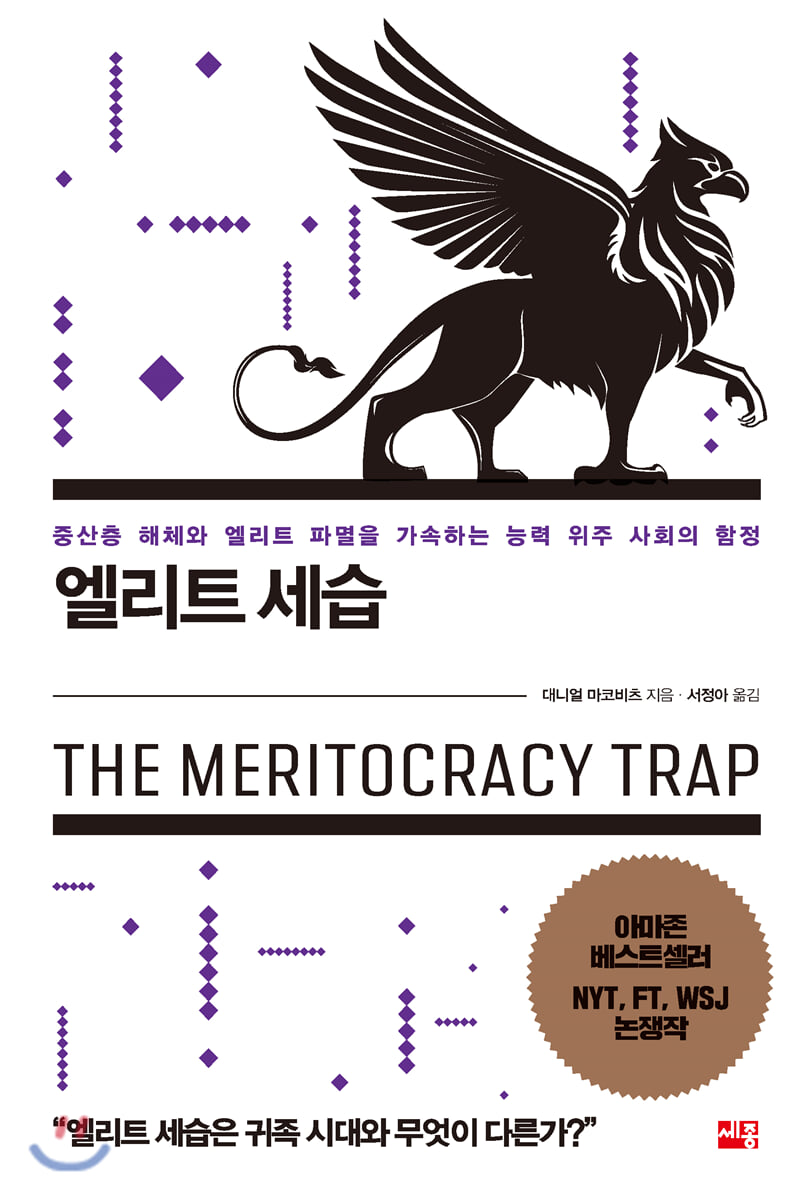
elite hereditary succession
 |
Description
Book Introduction
Middle class opportunities are disappearing, and the elite are depressed by self-exploitation. A keen insight into the pitfalls of the meritocracy era. A 20-year masterpiece by Yale Law School professor Daniel Markowitz! Professor Daniel Markowitz's book, "The Meritocracy Trap," which criticizes the meritocracy that fairly evaluates people based on their abilities, has finally been published, saying that it is leading the elite to self-destruction along with the impoverishment of the middle class. Published in the United States in 2019, this book sparked a debate on meritocracy in American society, and it has also received a flood of inquiries about its publication schedule in Korea, confirming the high level of interest in fairness in our society. Professor Markowitz brilliantly traces how the American elite society he encountered has changed and how that change has shaped American society. Meritocracy eventually began to produce a modern-day aristocratic society, an elite class system. While the aristocrats of the past inherited land and property, the modern elite inherit 'human capital' through expensive education. The accumulated ability itself is not fair. The author also points out Korea as a representative meritocratic society. Today's elites spend their entire lives building up their human capital, landing "great jobs," and then burn out, constantly proving their talents. "Hereditary Elite", which thoroughly exposes the myth of meritocracy, also suggests alternatives to the acceleration of elite education and elite-oriented jobs, the two central pillars of meritocracy. |
- You can preview some of the book's contents.
Preview
index
Recommendationㆍ6
Recommendation Letterㆍ8
Introductionㆍ14
Part 1: The Era of the Powerful Elite
Chapter 1.
The Birth of an Elite Aristocracyㆍ45
Education has become too competitive | Extreme professional elites? | Unprecedented inequality | The universally recognized standard of "ability"
Chapter 2.
The Decline of the Middle Class and the Self-Exploitation of the Eliteㆍ73
Opportunity is disappearing | The end of the 'consistently good life' | Driving people to losers | Exploitation of the elite | High-performance human capital | The salt mine of white-collar workers
Chapter 3.
The Coming Class Warㆍ115
Meritocracy as a Modern-Day Discrimination Standard | The New Ruling Class | Income Defense Industries and the Rule of Law | The Rising Aristocracy Against the State | Corruption Driven by Meritocracy | Middle-Class Nativism and Populism | The Intensification of Class Wars | The New Caste System
Part 2: How Meritocracy Works
Chapter 4.
Working Wealthyㆍ161
From vagrant to hard worker | Escape from the struggle between capital and labor | A culture of effort | Poverty and wealth | The war on poverty | A new division | The changing face of inequality | A bolder opponent
Chapter 5.
Elite Education and Hereditary Statusㆍ213
Marriages of the Elite | From Cradle to Kindergarten | Special Education for School-Ageing Children | Prestigious Universities | Graduate and Professional Schools | $10 Million Per Child | The End of Opportunity | The Trials of the Privileged
Chapter 6.
Dark and Glamorous Occupationsㆍ281
The Technological Revolution in the Workplace | Complex Finance and Its Beneficiaries | The Vanishing Middle Manager | The Hollowing Out of the Middle Class | Affordable Education | People Deprived of Work and Leisure | The Exploitation of Effort
Part 3: The New Nobility and the Rest of Society
Chapter 7.
The overall gap in occupations, families, and consumptionㆍ341
Fault lines become clear | The workplace is a completely different place | The productivity of elite families | Politics is progressive, economics is conservative | Elite consumption | The city becomes a fortress | The return of Fitzgerald and Hemingway
Chapter 8.
Super Elite Economyㆍ397
Management Innovation | Why Today's Innovation Favors Skills | The Human Capital Curse
Chapter 9.
"Competence" and "Fairness" Are Mythsㆍ435
A New Imagination to Overthrow the Emerging Aristocracy | The Illusion of Ability | A Massive Shipwreck
Conclusion: What Should We Do? 454
Acknowledgments 479
Figure and Table 485
Recommendation Letterㆍ8
Introductionㆍ14
Part 1: The Era of the Powerful Elite
Chapter 1.
The Birth of an Elite Aristocracyㆍ45
Education has become too competitive | Extreme professional elites? | Unprecedented inequality | The universally recognized standard of "ability"
Chapter 2.
The Decline of the Middle Class and the Self-Exploitation of the Eliteㆍ73
Opportunity is disappearing | The end of the 'consistently good life' | Driving people to losers | Exploitation of the elite | High-performance human capital | The salt mine of white-collar workers
Chapter 3.
The Coming Class Warㆍ115
Meritocracy as a Modern-Day Discrimination Standard | The New Ruling Class | Income Defense Industries and the Rule of Law | The Rising Aristocracy Against the State | Corruption Driven by Meritocracy | Middle-Class Nativism and Populism | The Intensification of Class Wars | The New Caste System
Part 2: How Meritocracy Works
Chapter 4.
Working Wealthyㆍ161
From vagrant to hard worker | Escape from the struggle between capital and labor | A culture of effort | Poverty and wealth | The war on poverty | A new division | The changing face of inequality | A bolder opponent
Chapter 5.
Elite Education and Hereditary Statusㆍ213
Marriages of the Elite | From Cradle to Kindergarten | Special Education for School-Ageing Children | Prestigious Universities | Graduate and Professional Schools | $10 Million Per Child | The End of Opportunity | The Trials of the Privileged
Chapter 6.
Dark and Glamorous Occupationsㆍ281
The Technological Revolution in the Workplace | Complex Finance and Its Beneficiaries | The Vanishing Middle Manager | The Hollowing Out of the Middle Class | Affordable Education | People Deprived of Work and Leisure | The Exploitation of Effort
Part 3: The New Nobility and the Rest of Society
Chapter 7.
The overall gap in occupations, families, and consumptionㆍ341
Fault lines become clear | The workplace is a completely different place | The productivity of elite families | Politics is progressive, economics is conservative | Elite consumption | The city becomes a fortress | The return of Fitzgerald and Hemingway
Chapter 8.
Super Elite Economyㆍ397
Management Innovation | Why Today's Innovation Favors Skills | The Human Capital Curse
Chapter 9.
"Competence" and "Fairness" Are Mythsㆍ435
A New Imagination to Overthrow the Emerging Aristocracy | The Illusion of Ability | A Massive Shipwreck
Conclusion: What Should We Do? 454
Acknowledgments 479
Figure and Table 485
Detailed image

Into the book
Today, middle-class children are falling behind wealthy children in school, and middle-class adults are being pushed out of the workforce by graduates of prestigious universities.
Opportunities are blocked for the middle class.
What's more, they blame those who lose in the competition for income and status.
Even if everyone follows the rules, it's a competition where only the wealthy win.
But meritocracy is also harmful to elites.
Because of this educational philosophy, wealthy parents invest thousands of hours and millions of dollars in their children's elite education.
--- From the "Preface"
Elite college graduates monopolize the best jobs, while new technologies are invented to benefit highly skilled workers, making the best jobs better and the rest worse.
The phenomenon of elite parents monopolizing elite education thanks to their earned income through their abilities is becoming more severe with each generation.
In this way, meritocracy creates a feedback loop between education and jobs, within which inequality in one field amplifies inequality in other fields.
--- From "Chapter 2: The Decline of the Middle Class and the Self-Exploitation of the Elite"
As elite occupations consistently demand high performance, wealthy adults in elite occupations submit to their discipline throughout adulthood.
Meritocracy traps the elite in a never-ending competition that leaves them unable to move.
All colleagues are competitors.
At every stage, it's either win or lose.
--- From "Chapter 2: The Decline of the Middle Class and the Self-Exploitation of the Elite"
Today, labor income has a distinct presence even at the highest end of the income distribution.
Eight of the ten wealthiest people in America built their wealth not through inheritance or the return of inherited capital, but through compensation earned through labor, such as starting or managing a business, in the form of stock shares held by the founder or partners.
--- From "Chapter 4: The Working Wealthy"
Not all dynasties are born under equal conditions.
In some dynasties, there is a price to pay for status.
Those born noble could automatically and without cost pass their status on to their children.
However, in the era of meritocracy, elites must bear enormous costs to maintain their wealth and status.
Exclusive and rigorous education builds human capital in a way that dominates the lives of those who absorb it.
Meritocracy maintains its dynasty by reconstructing families, homes, and children after corporations, workplaces, and products.
--- From "Chapter 5 Elite Education and Inheritance of Status"
Today, elite parents, positioned within the new order, naturally provide their children with the social and economic foundations necessary for membership in the upper working class.
Human capital investment takes place during the lifetime of parents and has replaced physical and financial capital as the primary means of transmitting elite status to the next generation.
--- From "Chapter 5 Elite Education and Inheritance of Status"
While children in the past lived in the present without any worries, children today anxiously prepare for the future.
Wealthy households, long focused on consumption, have now become sites of investment and production for building the next generation's human capital.
The $10 million worth of inherited power is the financial cost of the new system.
The fatigue, anxiety, and false identity experienced by elite students are the human costs of the new system.
In two ways, parents' unjust actions plague their descendants for generations.
--- From "Chapter 5 Elite Education and Inheritance of Status"
The financial industry was once a lucrative sector for middle-class, mid-skilled workers, but now it favors highly skilled, upper-class workers.
As countless mid-skilled jobs disappear and are replaced by a smaller number, the financial industry is dominated by highly skilled elite professionals doing flashy tasks, while unskilled, unprofessional support staff doing gritty work play a secondary role.
In short, the labor market in the financial sector has become polarized.
--- From "Chapter 6: Gloomy Occupations and Glamorous Occupations"
The U.S. Bureau of Labor Statistics projects that the occupations that will see the fastest declines over the next 10 years will all be mid-skilled, while the 10 occupations that will see the fastest growth will be either unskilled or highly skilled.
The McKinsey Global Institute, a division of McKinsey Consulting, predicts even more dramatic changes, predicting that nearly a third of the U.S. workforce will be displaced by automation by 2030, the vast majority of whom are mid-skilled.
--- From "Chapter 6: Gloomy Occupations and Glamorous Occupations"
Human capital accounts for a disproportionately large portion of elite assets, and elites are trapped in the human capital paradox, investing too much in their skills to truly work.
When occupation determines income and effort determines status, workers who pursue aspirations and interests different from those desired by the market—that is, workers who are not tied to wages and occupations for other purposes—are ostracizing themselves and their children from the elite.
To succeed in the meritocracy, elites must work incredibly long hours in isolation.
--- From "Chapter 6: Gloomy Occupations and Glamorous Occupations"
Dynastic privileges reconstructed according to meritocracy may be less stable than the privileges once enjoyed by the nobility (though historically, the nobility appeared to be secure on the outside but did not actually experience a stable life).
It obviously costs more for the elite.
The new generation of elites must reclaim their privileges through honest effort.
In the age of meritocracy, elites exploit themselves, not others, to gain income.
Opportunities are blocked for the middle class.
What's more, they blame those who lose in the competition for income and status.
Even if everyone follows the rules, it's a competition where only the wealthy win.
But meritocracy is also harmful to elites.
Because of this educational philosophy, wealthy parents invest thousands of hours and millions of dollars in their children's elite education.
--- From the "Preface"
Elite college graduates monopolize the best jobs, while new technologies are invented to benefit highly skilled workers, making the best jobs better and the rest worse.
The phenomenon of elite parents monopolizing elite education thanks to their earned income through their abilities is becoming more severe with each generation.
In this way, meritocracy creates a feedback loop between education and jobs, within which inequality in one field amplifies inequality in other fields.
--- From "Chapter 2: The Decline of the Middle Class and the Self-Exploitation of the Elite"
As elite occupations consistently demand high performance, wealthy adults in elite occupations submit to their discipline throughout adulthood.
Meritocracy traps the elite in a never-ending competition that leaves them unable to move.
All colleagues are competitors.
At every stage, it's either win or lose.
--- From "Chapter 2: The Decline of the Middle Class and the Self-Exploitation of the Elite"
Today, labor income has a distinct presence even at the highest end of the income distribution.
Eight of the ten wealthiest people in America built their wealth not through inheritance or the return of inherited capital, but through compensation earned through labor, such as starting or managing a business, in the form of stock shares held by the founder or partners.
--- From "Chapter 4: The Working Wealthy"
Not all dynasties are born under equal conditions.
In some dynasties, there is a price to pay for status.
Those born noble could automatically and without cost pass their status on to their children.
However, in the era of meritocracy, elites must bear enormous costs to maintain their wealth and status.
Exclusive and rigorous education builds human capital in a way that dominates the lives of those who absorb it.
Meritocracy maintains its dynasty by reconstructing families, homes, and children after corporations, workplaces, and products.
--- From "Chapter 5 Elite Education and Inheritance of Status"
Today, elite parents, positioned within the new order, naturally provide their children with the social and economic foundations necessary for membership in the upper working class.
Human capital investment takes place during the lifetime of parents and has replaced physical and financial capital as the primary means of transmitting elite status to the next generation.
--- From "Chapter 5 Elite Education and Inheritance of Status"
While children in the past lived in the present without any worries, children today anxiously prepare for the future.
Wealthy households, long focused on consumption, have now become sites of investment and production for building the next generation's human capital.
The $10 million worth of inherited power is the financial cost of the new system.
The fatigue, anxiety, and false identity experienced by elite students are the human costs of the new system.
In two ways, parents' unjust actions plague their descendants for generations.
--- From "Chapter 5 Elite Education and Inheritance of Status"
The financial industry was once a lucrative sector for middle-class, mid-skilled workers, but now it favors highly skilled, upper-class workers.
As countless mid-skilled jobs disappear and are replaced by a smaller number, the financial industry is dominated by highly skilled elite professionals doing flashy tasks, while unskilled, unprofessional support staff doing gritty work play a secondary role.
In short, the labor market in the financial sector has become polarized.
--- From "Chapter 6: Gloomy Occupations and Glamorous Occupations"
The U.S. Bureau of Labor Statistics projects that the occupations that will see the fastest declines over the next 10 years will all be mid-skilled, while the 10 occupations that will see the fastest growth will be either unskilled or highly skilled.
The McKinsey Global Institute, a division of McKinsey Consulting, predicts even more dramatic changes, predicting that nearly a third of the U.S. workforce will be displaced by automation by 2030, the vast majority of whom are mid-skilled.
--- From "Chapter 6: Gloomy Occupations and Glamorous Occupations"
Human capital accounts for a disproportionately large portion of elite assets, and elites are trapped in the human capital paradox, investing too much in their skills to truly work.
When occupation determines income and effort determines status, workers who pursue aspirations and interests different from those desired by the market—that is, workers who are not tied to wages and occupations for other purposes—are ostracizing themselves and their children from the elite.
To succeed in the meritocracy, elites must work incredibly long hours in isolation.
--- From "Chapter 6: Gloomy Occupations and Glamorous Occupations"
Dynastic privileges reconstructed according to meritocracy may be less stable than the privileges once enjoyed by the nobility (though historically, the nobility appeared to be secure on the outside but did not actually experience a stable life).
It obviously costs more for the elite.
The new generation of elites must reclaim their privileges through honest effort.
In the age of meritocracy, elites exploit themselves, not others, to gain income.
--- From Chapter 9, “Ability” and “Fairness” are Myths
Publisher's Review
Created by the super elite with economic power
A new aristocracy: "hereditary elite"
● Highly recommended by Michael Sandel!
● [New York Times] [Financial Times] Hot Topic
Why Even the Top 1% Elite Aren't Happy
Now, in all advanced societies, aristocracy has retreated and meritocracy has become the basic creed.
Meritocracy, which states that anyone can get an opportunity based on their ability, seems extremely reasonable.
Because the meritocracy is not properly observed, only the unfair cases of successful college entrance or employment through 'parental chance' are criticized.
Moreover, elites who graduated from prestigious universities and secured high-paying jobs seem to have a sense of moral superiority based on their diligence.
Meritocracy is not attacked even though elite parents pour enormous amounts of money into their children's education to develop their "abilities" to a level that can be passed down.
The elite are passing on their legacy by investing directly in human capital rather than inheriting physical assets.
This is a gap that the middle class and below cannot keep up with.
Harvard and Yale universities have more students from the top 1% of income earners than from the bottom 50%.
Korea is also facing a similar situation.
Meritocracy, or meritocracy, is a hidden mechanism that maintains the concentration and inheritance of wealth and privilege from generation to generation, and is a silent trigger that creates resentment and division between classes.
This new aristocracy carries the burden of having to constantly rebuild privileges in subsequent generations.
As each generation changes, we must establish our own achievements and re-establish our elite status.
But in this meritocracy, elites excel at achieving that goal through ample financial resources and distinctive ways of raising their children.
However, the fierce self-exploitation that continues from the cradle only prepares for misfortune.
One elite with outstanding abilities
Replacing hundreds of middle-class jobs
Meritocracy also deepens social disparities in the job search process.
Elite employers select graduates from prestigious universities and pay high salaries and performance-based bonuses.
As it becomes commonplace for highly educated elites to monopolize labor productivity with their advanced technology and receive high wages, the middle class with decent jobs is being pushed out of the workforce.
A small elite with high education and technical or management skills replaces thousands of workers.
We have entered a society where skills and a sincere work ethic alone no longer guarantee a good job.
As the labor market increasingly favors those with specialized education and expensive training, middle-class workers without degrees from top universities face discrimination across the labor market.
The competition for merit is pushing the middle class out of the center of the economy and society, making it impossible for them to even be subject to the social standards that measure and allocate benefits, prestige, and wealth.
Meritocracy also turns prestigious universities, law schools, the financial sector, and the IT industry into battlegrounds where elites compete for their ambitions, pushing the majority of citizens to the margins of society.
It sends middle-class children to hopeless schools and middle-class adults to dead-end jobs.
Today's meritocracy divides the elite and the middle class in this way.
This objection seems justified.
The public interest in complex financial products and the IT technologies that steal our attention is unclear, and the majority of the middle class's share has gone to a small elite.
The problem today is
The widening gap between the working elite and the middle class
In the past, the gap between the middle class and the poor was large, but today, the gap between the elite and the middle class is becoming a more serious problem.
As the basic social problem of poverty was resolved, the wages of the middle class decreased, and the living standards of the middle class and the poor became similar.
The two classes, the elite and the middle class, are becoming more and more separated in all aspects, including marriage, education, and consumption.
It is perhaps natural that the middle class is angry and social discontent is growing.
Moreover, in American society, elites actively embrace those of different genders, races, and cultural backgrounds, but they easily dismiss the average middle class as “incompetent and lazy.”
The following is an excerpt from the recommendation for this book by Professor Seunghoon Yang (Department of Sociology, Kyungnam University).
“Thomas Piketty said that the rate of return on capital is higher than the economic growth rate and higher than labor income, but Markowitz says that this calculation is wrong.
The elites derive their wealth not from rental income or financial gain, but from labor income.
“Those who earn hundreds of millions, tens of billions, and even hundreds of billions of won in labor income are the elite of the new era.”
The immeasurable anxiety of the young elite
The modern upper class, which does the most work of any class
Are elites truly happy in a meritocracy? Unlike the aristocracy of the past, meritocracy draws insecure and unsophisticated elites into a ruthless, lifelong competition, encouraging them to achieve income and status through arduous effort.
The elite are constantly tense and exhausted from their lifetime of fierce competition for privilege.
Elite millennials living in a meritocratic world are suffering from 'collective anxiety.'
It's because of the fear that I might not be able to live up to expectations.
They are uncertain about their previous achievements and worry that the same ordeals they have faced will repeat themselves, as the competitive school will only lead to an equally competitive workplace.
Even elites in the meritocracy age believe that meritocracy does not promote true success and will lead to wealth but in an unhealthy direction.
In reality, the inequality that comes with meritocracy benefits no one, so escaping the trap of meritocracy would actually benefit everyone.
If the middle class, which has lost its self-esteem and has been blocked from achieving success today, were liberated from meritocracy, it would regain its original position and actively participate in social and economic life.
If the elite class, currently mired in wasteful self-exploitation, were liberated from meritocracy, they would regain their true selves by gaining precious freedom and leisure, rather than diminishing their status and wealth.
Moreover, if we are liberated from meritocracy, we will be able to return the oppressive and distrustful society that has been created by meritocracy to its original state.
Education and jobs, the two central axes of meritocracy
A revolution is needed
The author, who has been exploring the idea of this book, "The Trap of Meritocracy," for 20 years, says that we should start by recognizing that there are problems with meritocracy.
This is obviously not an easy task.
This is because, in democratic societies for a long time, the idea that ability equals fairness and open opportunity has been accepted.
However, if the era of universal inheritance of elites, created abilities, created elites, and emerging aristocrats continues, the current society cannot be sustained.
The older the problem, the more difficult it is to find solutions, but the author concludes by suggesting alternatives in two avenues: education and jobs.
Bold and shocking.
Markovitz puts the brakes on the optimistic self-praise that well-educated professionals habitually spout.
- The New York Times Book Review
A new aristocracy: "hereditary elite"
● Highly recommended by Michael Sandel!
● [New York Times] [Financial Times] Hot Topic
Why Even the Top 1% Elite Aren't Happy
Now, in all advanced societies, aristocracy has retreated and meritocracy has become the basic creed.
Meritocracy, which states that anyone can get an opportunity based on their ability, seems extremely reasonable.
Because the meritocracy is not properly observed, only the unfair cases of successful college entrance or employment through 'parental chance' are criticized.
Moreover, elites who graduated from prestigious universities and secured high-paying jobs seem to have a sense of moral superiority based on their diligence.
Meritocracy is not attacked even though elite parents pour enormous amounts of money into their children's education to develop their "abilities" to a level that can be passed down.
The elite are passing on their legacy by investing directly in human capital rather than inheriting physical assets.
This is a gap that the middle class and below cannot keep up with.
Harvard and Yale universities have more students from the top 1% of income earners than from the bottom 50%.
Korea is also facing a similar situation.
Meritocracy, or meritocracy, is a hidden mechanism that maintains the concentration and inheritance of wealth and privilege from generation to generation, and is a silent trigger that creates resentment and division between classes.
This new aristocracy carries the burden of having to constantly rebuild privileges in subsequent generations.
As each generation changes, we must establish our own achievements and re-establish our elite status.
But in this meritocracy, elites excel at achieving that goal through ample financial resources and distinctive ways of raising their children.
However, the fierce self-exploitation that continues from the cradle only prepares for misfortune.
One elite with outstanding abilities
Replacing hundreds of middle-class jobs
Meritocracy also deepens social disparities in the job search process.
Elite employers select graduates from prestigious universities and pay high salaries and performance-based bonuses.
As it becomes commonplace for highly educated elites to monopolize labor productivity with their advanced technology and receive high wages, the middle class with decent jobs is being pushed out of the workforce.
A small elite with high education and technical or management skills replaces thousands of workers.
We have entered a society where skills and a sincere work ethic alone no longer guarantee a good job.
As the labor market increasingly favors those with specialized education and expensive training, middle-class workers without degrees from top universities face discrimination across the labor market.
The competition for merit is pushing the middle class out of the center of the economy and society, making it impossible for them to even be subject to the social standards that measure and allocate benefits, prestige, and wealth.
Meritocracy also turns prestigious universities, law schools, the financial sector, and the IT industry into battlegrounds where elites compete for their ambitions, pushing the majority of citizens to the margins of society.
It sends middle-class children to hopeless schools and middle-class adults to dead-end jobs.
Today's meritocracy divides the elite and the middle class in this way.
This objection seems justified.
The public interest in complex financial products and the IT technologies that steal our attention is unclear, and the majority of the middle class's share has gone to a small elite.
The problem today is
The widening gap between the working elite and the middle class
In the past, the gap between the middle class and the poor was large, but today, the gap between the elite and the middle class is becoming a more serious problem.
As the basic social problem of poverty was resolved, the wages of the middle class decreased, and the living standards of the middle class and the poor became similar.
The two classes, the elite and the middle class, are becoming more and more separated in all aspects, including marriage, education, and consumption.
It is perhaps natural that the middle class is angry and social discontent is growing.
Moreover, in American society, elites actively embrace those of different genders, races, and cultural backgrounds, but they easily dismiss the average middle class as “incompetent and lazy.”
The following is an excerpt from the recommendation for this book by Professor Seunghoon Yang (Department of Sociology, Kyungnam University).
“Thomas Piketty said that the rate of return on capital is higher than the economic growth rate and higher than labor income, but Markowitz says that this calculation is wrong.
The elites derive their wealth not from rental income or financial gain, but from labor income.
“Those who earn hundreds of millions, tens of billions, and even hundreds of billions of won in labor income are the elite of the new era.”
The immeasurable anxiety of the young elite
The modern upper class, which does the most work of any class
Are elites truly happy in a meritocracy? Unlike the aristocracy of the past, meritocracy draws insecure and unsophisticated elites into a ruthless, lifelong competition, encouraging them to achieve income and status through arduous effort.
The elite are constantly tense and exhausted from their lifetime of fierce competition for privilege.
Elite millennials living in a meritocratic world are suffering from 'collective anxiety.'
It's because of the fear that I might not be able to live up to expectations.
They are uncertain about their previous achievements and worry that the same ordeals they have faced will repeat themselves, as the competitive school will only lead to an equally competitive workplace.
Even elites in the meritocracy age believe that meritocracy does not promote true success and will lead to wealth but in an unhealthy direction.
In reality, the inequality that comes with meritocracy benefits no one, so escaping the trap of meritocracy would actually benefit everyone.
If the middle class, which has lost its self-esteem and has been blocked from achieving success today, were liberated from meritocracy, it would regain its original position and actively participate in social and economic life.
If the elite class, currently mired in wasteful self-exploitation, were liberated from meritocracy, they would regain their true selves by gaining precious freedom and leisure, rather than diminishing their status and wealth.
Moreover, if we are liberated from meritocracy, we will be able to return the oppressive and distrustful society that has been created by meritocracy to its original state.
Education and jobs, the two central axes of meritocracy
A revolution is needed
The author, who has been exploring the idea of this book, "The Trap of Meritocracy," for 20 years, says that we should start by recognizing that there are problems with meritocracy.
This is obviously not an easy task.
This is because, in democratic societies for a long time, the idea that ability equals fairness and open opportunity has been accepted.
However, if the era of universal inheritance of elites, created abilities, created elites, and emerging aristocrats continues, the current society cannot be sustained.
The older the problem, the more difficult it is to find solutions, but the author concludes by suggesting alternatives in two avenues: education and jobs.
Bold and shocking.
Markovitz puts the brakes on the optimistic self-praise that well-educated professionals habitually spout.
- The New York Times Book Review
GOODS SPECIFICS
- Publication date: November 10, 2020
- Page count, weight, size: 504 pages | 718g | 152*225*23mm
- ISBN13: 9788984078017
- ISBN10: 8984078018
You may also like
카테고리
korean


korean

![GQ KOREA Mark (Monthly): December [2025]](http://librairie.coreenne.fr/cdn/shop/files/8ef265dbbfbf186523ed75ba7319009d.jpg?v=1765340328&width=3840)


