

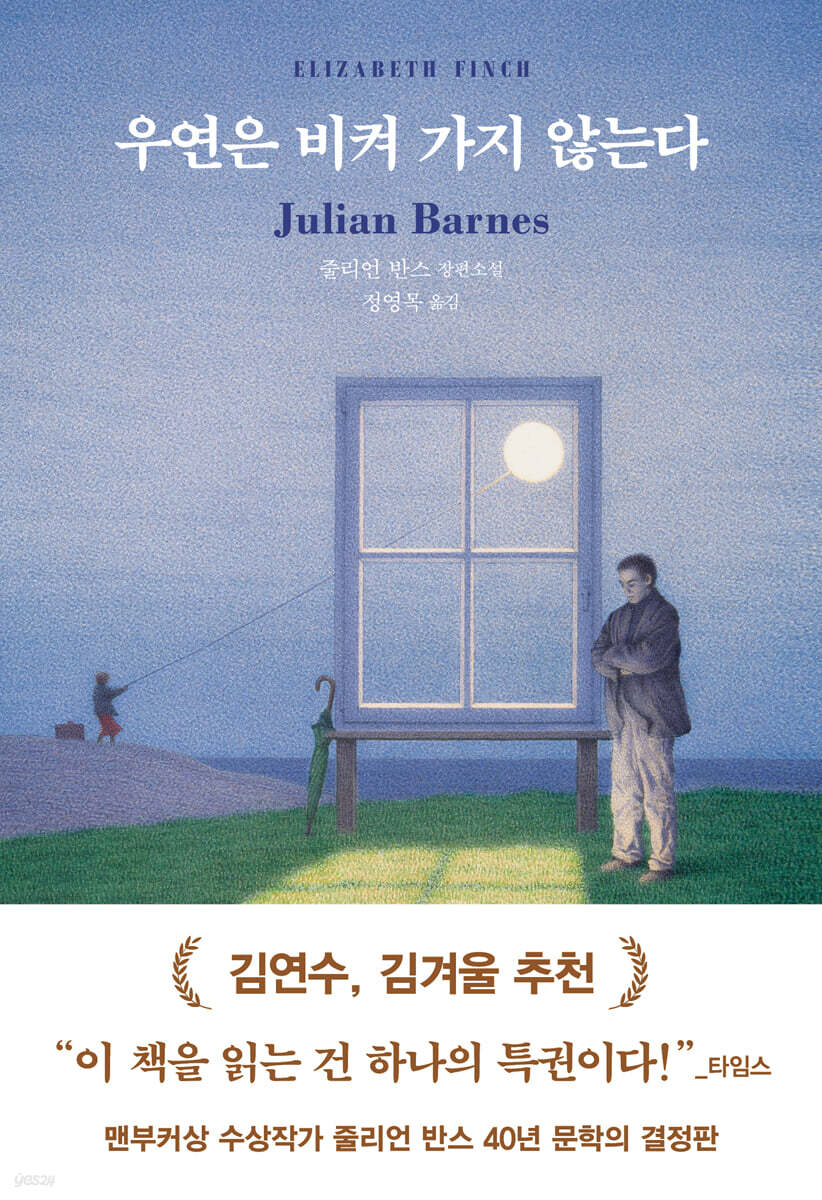
Chance never goes away
 |
Description
Book Introduction
- A word from MD
-
Reading novels is something I do to change myself.Julian Barnes' new work.
As a representative writer of Anglo-American literature, he proved that 'this is how a novel is written.'
Through the character of Elizabeth Finch, the irony of truth is revealed and the multifaceted nature of humanity and life is intellectually unraveled.
As you read this novel, you will realize that understanding others is a process for changing yourself.
September 6, 2024. Novel/Poetry PD Kim Yu-ri
“Reading a Julian Barnes novel is a privilege.”_The Times
Julian Barnes, the living king of British literature, releases his first full-length novel in six years!
― Recommended by Kim Yeon-su and Kim Gyul-woo! ―
Julian Barnes, winner of the Man Booker Prize for his novel, "The Sense of an Ending," has published a new novel, "Chance Never Goes Away," translated by Dasan Books.
This is Julian Barnes' first work in Korea in six years since "Memories of Love," and he has once again proven his literary achievement with a unique story that only he can create, with rave reviews saying, "This is Julian Barnes."
The novel begins with a man who has been through a difficult time in his marriage and career, but who meets a professor who becomes a great inspiration for his life.
Julian Barnes, who always poses powerful questions using an overwhelming first-person narrator, explores the fascinating fictional character Professor Elizabeth Finch and the Roman Emperor Julian, who is called an apostate by the victors of history, through the narrator 'Neil' in this work.
And finally, it forces you to face an unexpected question.
'Is that the person you know, that person?'
This novel, which contains the essence of the topics that Julian Barnes, now nearly eighty, has been grappling with for nearly half a century, boldly crosses the boundaries of fiction and non-fiction to present a fascinating look at the limits of memory, the distortion of history, and the multifaceted nature of humanity and life.
Some people say that this work is of unknown genre.
Yes, that's right.
There is no other way to define it than that it is a story only Julian Barnes could write.
It is a work that can be said to be the definitive edition of Julian Barnes' 40 years of literature and is like his literary fingerprint.
Julian Barnes, the living king of British literature, releases his first full-length novel in six years!
― Recommended by Kim Yeon-su and Kim Gyul-woo! ―
Julian Barnes, winner of the Man Booker Prize for his novel, "The Sense of an Ending," has published a new novel, "Chance Never Goes Away," translated by Dasan Books.
This is Julian Barnes' first work in Korea in six years since "Memories of Love," and he has once again proven his literary achievement with a unique story that only he can create, with rave reviews saying, "This is Julian Barnes."
The novel begins with a man who has been through a difficult time in his marriage and career, but who meets a professor who becomes a great inspiration for his life.
Julian Barnes, who always poses powerful questions using an overwhelming first-person narrator, explores the fascinating fictional character Professor Elizabeth Finch and the Roman Emperor Julian, who is called an apostate by the victors of history, through the narrator 'Neil' in this work.
And finally, it forces you to face an unexpected question.
'Is that the person you know, that person?'
This novel, which contains the essence of the topics that Julian Barnes, now nearly eighty, has been grappling with for nearly half a century, boldly crosses the boundaries of fiction and non-fiction to present a fascinating look at the limits of memory, the distortion of history, and the multifaceted nature of humanity and life.
Some people say that this work is of unknown genre.
Yes, that's right.
There is no other way to define it than that it is a story only Julian Barnes could write.
It is a work that can be said to be the definitive edition of Julian Barnes' 40 years of literature and is like his literary fingerprint.
- You can preview some of the book's contents.
Preview
index
one
two
three
Acknowledgements
After moving
Recommendation
two
three
Acknowledgements
After moving
Recommendation
Detailed image
.jpg)
Into the book
“Don’t be fooled by time and don’t imagine that history—especially intellectual history—is linear.” (…) “And don’t forget:
“Even in a novel, let alone a biography or a history book, if you see a character neatly summarized by three adjectives, always be suspicious of such descriptions.”
--- p.23
“Of course, we must consider the element of chance not only in this class but also outside of it, in our own turbulent and hectic lives.”
--- p.32
There are some things we can try to do and some things we can't try to do.
(…) The things we can do are by their nature free, unhindered, and unobstructed.
When we do things we cannot do, we become accustomed to them, we become bound and hindered.
--- p.42
The dead cannot tell us that we are wrong.
Only the living can do that.
But they may be lying.
So I trust the dead more.
Is this weird or is this sensible?
In addition, why do we expect collective memory—what we call history—to be less prone to error than individual memory?
--- p.43
If she taught us one thing, it is that history is a long-term endeavor, and that it is not a listless, comatose state, waiting for us to point our telescopes, large or small, at it, but rather an active, seething, and occasionally volcanic explosion.
--- p.57
“I would argue that failure tells us more than success, and that a clean loser who has a grudge after losing tells us a lot.
Furthermore, apostates are always more interesting than true believers and holy martyrs.
“The apostate is the representative of doubt, and doubt—lively doubt—is the sign of an active intellect.”
--- p.58
We have to fool ourselves constantly, every day, in small actions and thoughts, and then in big actions and thoughts, to believe what we think our country represents, like constantly repeating comforting bedtime stories.
--- p.63
“The present task is to correct our understanding of the past.
This task is more urgent when the past cannot be corrected.”
--- p.90
A coherent narrative may be nothing more than an illusion, since it seeks to reconcile conflicting judgments.
Perhaps it would be equally possible to describe someone simply by listing implicit facts worth examining.
--- p.217
People see us differently than we see ourselves.
Well, to live as a human being, you have to misunderstand your own history.
“Even in a novel, let alone a biography or a history book, if you see a character neatly summarized by three adjectives, always be suspicious of such descriptions.”
--- p.23
“Of course, we must consider the element of chance not only in this class but also outside of it, in our own turbulent and hectic lives.”
--- p.32
There are some things we can try to do and some things we can't try to do.
(…) The things we can do are by their nature free, unhindered, and unobstructed.
When we do things we cannot do, we become accustomed to them, we become bound and hindered.
--- p.42
The dead cannot tell us that we are wrong.
Only the living can do that.
But they may be lying.
So I trust the dead more.
Is this weird or is this sensible?
In addition, why do we expect collective memory—what we call history—to be less prone to error than individual memory?
--- p.43
If she taught us one thing, it is that history is a long-term endeavor, and that it is not a listless, comatose state, waiting for us to point our telescopes, large or small, at it, but rather an active, seething, and occasionally volcanic explosion.
--- p.57
“I would argue that failure tells us more than success, and that a clean loser who has a grudge after losing tells us a lot.
Furthermore, apostates are always more interesting than true believers and holy martyrs.
“The apostate is the representative of doubt, and doubt—lively doubt—is the sign of an active intellect.”
--- p.58
We have to fool ourselves constantly, every day, in small actions and thoughts, and then in big actions and thoughts, to believe what we think our country represents, like constantly repeating comforting bedtime stories.
--- p.63
“The present task is to correct our understanding of the past.
This task is more urgent when the past cannot be corrected.”
--- p.90
A coherent narrative may be nothing more than an illusion, since it seeks to reconcile conflicting judgments.
Perhaps it would be equally possible to describe someone simply by listing implicit facts worth examining.
--- p.217
People see us differently than we see ourselves.
Well, to live as a human being, you have to misunderstand your own history.
--- p.288
Publisher's Review
A mortal task for two people that one man must tie up,
The irony of truth becoming fainter as it becomes clearer
After going through two divorces and feeling a sense of loss in his life, Neil meets Professor Elizabeth Finch at a class for adults.
Neil realizes that she won't be teaching him lessons that force him to think about facts like stuffing a goose's stomach with food.
That for once in my life, I have found my true place.
As expected, Finch was a special professor.
He was an 'adult' who turned the students' small thoughts into something interesting without belittling them in the least.
Neil admires her, who is much smarter than him, and they continue to meet for about 20 years after graduation.
The two have lunch together for a set 75 minutes and discuss philosophy and history in depth.
Then one day, Finch suddenly passes away, and Neil receives as his heirloom the documents and notebooks she had written throughout her life.
He feels there is some signal here and begins to seriously investigate it.
Completing an essay on Julian the Apostate that I had previously submitted as an unfinished assignment, and reflecting on Elizabeth Finch.
And then, we gradually get closer to an unexpected truth.
“Before the inexplicable power of chance,
“How fragmented is life, how inevitably false?”
"Chance Never Goes Away" is a novel that explores the themes that Julian Barnes has spent his life trying to answer and understand, through the dynamics of relationships that have never been explored before.
When he first started writing as a writer, school novels were all the rage, and Barnes swore he would never write one.
But as time goes by, he begins to unfold the literary themes he has been obsessed with for 40 years in a deeper and more challenging way through the story of Professor Elizabeth Finch and his student Neil.
To Neil, Elizabeth Finch was “a bolt of advice.”
He was a teacher who had a profound influence on his thoughts and life, and was a mysterious and powerful figure.
Neil's recollection of Elizabeth Finch attempts to create a coherent narrative of her person, which ironically runs counter to the very 'monotheism' that Elizabeth Finch was most wary of.
Ultimately, the voices of the other students reveal that the Elizabeth Finch Neil thinks of exists only in his stubborn memories.
This novel is a story about human history, which moves between a single belief and convenient avoidance.
In this world where chance intrudes, we persistently reflect on how powerless the thoughts of those who believe they understand better are, and why history is nothing more than interpretation.
And finally, in life, we come to the realization that “there are some things we can do and some things we cannot do.”
Because letting chance do what it wants is the inevitable fate of humans enduring life.
The more you read, the more you discover new layers.
Julian Barnes's most intelligent and fascinating novel
A living legend of British literature, Julian Barnes's new work is always a major event in the literary world.
As a hybrid writer who freely moves between genres such as novels, essays, and biographies, his writings are a regular topic of study for critics.
And the ending is always followed by rave reviews: “No one can criticize Barnes’s novels as anything other than excellent work” (The Guardian) and “Reading Julian Barnes is a privilege” (The Times).
This book highlights Julian Barnes's sincere love for the philosophy of "Chance Never Goes Away."
Blurring the lines between fiction and non-fiction, it offers various interpretations of Julian, who has been recorded in history as a traitor to Christianity, and raises questions about whether the historical facts we know are properly evaluated.
The stories of numerous thinkers, philosophers, and writers, including Plato, Socrates, and Voltaire, that are brought up in the process provide intellectual pleasure.
Julian Barnes has always crafted sentences that are precise and clear, without any unnecessary frills.
In doing so, the story is woven intricately with meaningful irony, complicating the reader's mind.
This book, which creates a strange tension through the intertwining of three characters - Neil, Elizabeth Finch, and Julian - allows you to discover new layers the deeper you dig into your thoughts.
I can confidently say that this novel will be a treasure for those who are not afraid to think.
The irony of truth becoming fainter as it becomes clearer
After going through two divorces and feeling a sense of loss in his life, Neil meets Professor Elizabeth Finch at a class for adults.
Neil realizes that she won't be teaching him lessons that force him to think about facts like stuffing a goose's stomach with food.
That for once in my life, I have found my true place.
As expected, Finch was a special professor.
He was an 'adult' who turned the students' small thoughts into something interesting without belittling them in the least.
Neil admires her, who is much smarter than him, and they continue to meet for about 20 years after graduation.
The two have lunch together for a set 75 minutes and discuss philosophy and history in depth.
Then one day, Finch suddenly passes away, and Neil receives as his heirloom the documents and notebooks she had written throughout her life.
He feels there is some signal here and begins to seriously investigate it.
Completing an essay on Julian the Apostate that I had previously submitted as an unfinished assignment, and reflecting on Elizabeth Finch.
And then, we gradually get closer to an unexpected truth.
“Before the inexplicable power of chance,
“How fragmented is life, how inevitably false?”
"Chance Never Goes Away" is a novel that explores the themes that Julian Barnes has spent his life trying to answer and understand, through the dynamics of relationships that have never been explored before.
When he first started writing as a writer, school novels were all the rage, and Barnes swore he would never write one.
But as time goes by, he begins to unfold the literary themes he has been obsessed with for 40 years in a deeper and more challenging way through the story of Professor Elizabeth Finch and his student Neil.
To Neil, Elizabeth Finch was “a bolt of advice.”
He was a teacher who had a profound influence on his thoughts and life, and was a mysterious and powerful figure.
Neil's recollection of Elizabeth Finch attempts to create a coherent narrative of her person, which ironically runs counter to the very 'monotheism' that Elizabeth Finch was most wary of.
Ultimately, the voices of the other students reveal that the Elizabeth Finch Neil thinks of exists only in his stubborn memories.
This novel is a story about human history, which moves between a single belief and convenient avoidance.
In this world where chance intrudes, we persistently reflect on how powerless the thoughts of those who believe they understand better are, and why history is nothing more than interpretation.
And finally, in life, we come to the realization that “there are some things we can do and some things we cannot do.”
Because letting chance do what it wants is the inevitable fate of humans enduring life.
The more you read, the more you discover new layers.
Julian Barnes's most intelligent and fascinating novel
A living legend of British literature, Julian Barnes's new work is always a major event in the literary world.
As a hybrid writer who freely moves between genres such as novels, essays, and biographies, his writings are a regular topic of study for critics.
And the ending is always followed by rave reviews: “No one can criticize Barnes’s novels as anything other than excellent work” (The Guardian) and “Reading Julian Barnes is a privilege” (The Times).
This book highlights Julian Barnes's sincere love for the philosophy of "Chance Never Goes Away."
Blurring the lines between fiction and non-fiction, it offers various interpretations of Julian, who has been recorded in history as a traitor to Christianity, and raises questions about whether the historical facts we know are properly evaluated.
The stories of numerous thinkers, philosophers, and writers, including Plato, Socrates, and Voltaire, that are brought up in the process provide intellectual pleasure.
Julian Barnes has always crafted sentences that are precise and clear, without any unnecessary frills.
In doing so, the story is woven intricately with meaningful irony, complicating the reader's mind.
This book, which creates a strange tension through the intertwining of three characters - Neil, Elizabeth Finch, and Julian - allows you to discover new layers the deeper you dig into your thoughts.
I can confidently say that this novel will be a treasure for those who are not afraid to think.
GOODS SPECIFICS
- Date of issue: September 2, 2024
- Format: Hardcover book binding method guide
- Page count, weight, size: 300 pages | 410g | 140*210*20mm
- ISBN13: 9791130655925
- ISBN10: 113065592X
You may also like
카테고리
korean


korean

![GQ KOREA Mark (Monthly): December [2025]](http://librairie.coreenne.fr/cdn/shop/files/8ef265dbbfbf186523ed75ba7319009d.jpg?v=1765340328&width=3840)


