

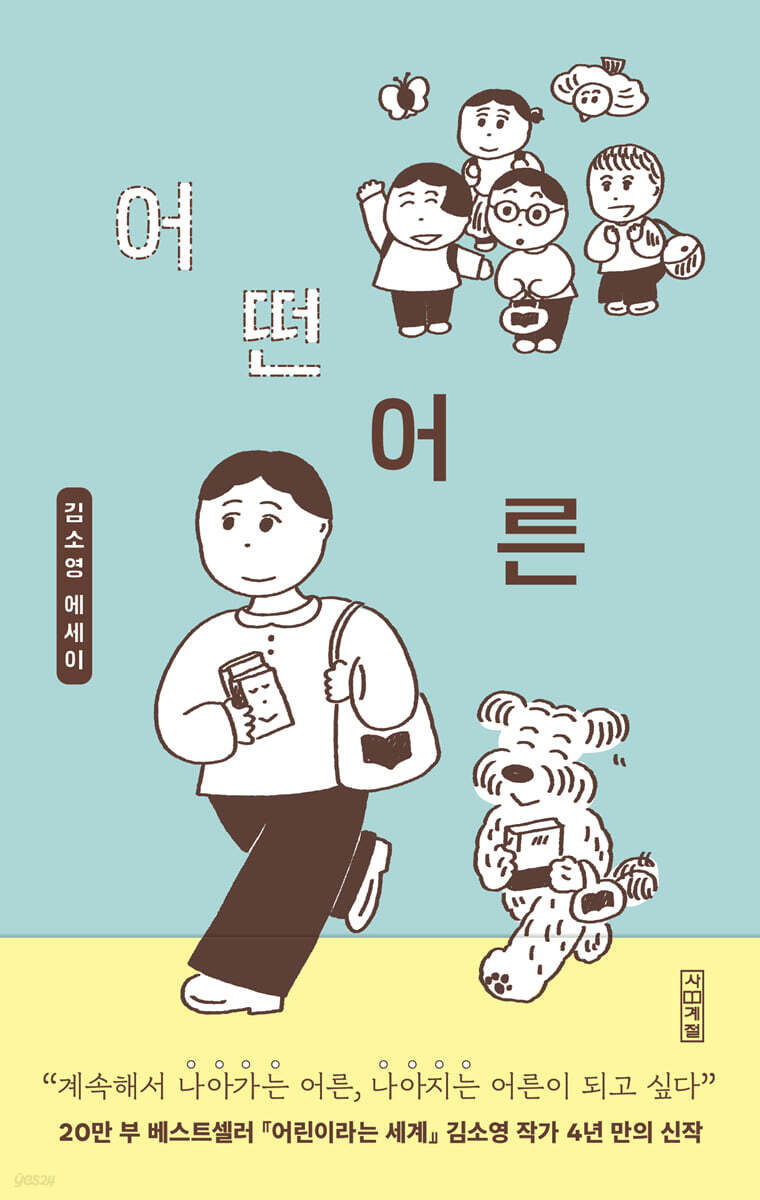
some adult
 |
Description
Book Introduction
- A word from MD
-
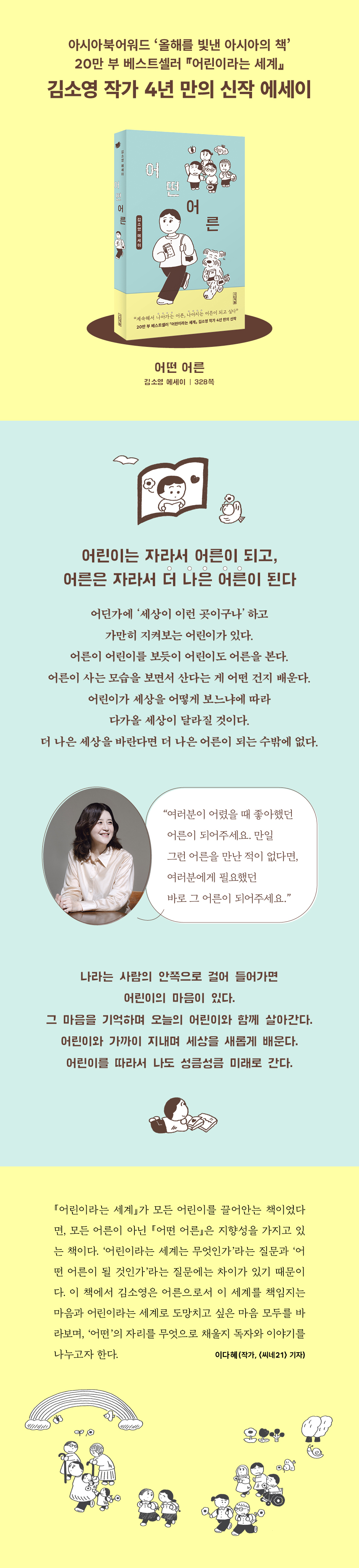
Adults who advance, adults who improveA new work by Kim So-young, 『The World of Children』.
This time, we answer the question, 'What kind of adult should I become?'
It conveys everyday moments where children and adults come into contact, and tells us that children need a variety of adults.
Children who experience the future through adults.
We must become adults who move forward and improve in our own ways.
November 15, 2024. Essay PD Lee Ju-eun
Author Kim So-young, who reached 200,000 readers with her work, “The World of Children,” has published a new essay, “A Certain Adult,” after four years.
If the previous work was a work that called out the existence of 'children' as individuals with their own world, fellow citizens, and the next generation, the new book 'Some Adult' is a book that examines the position of adults who live in the same era as children and explores the roles adults need to play until a child grows into another adult.
Those who have discovered and gained a new understanding of children through "The World of Children" naturally ask themselves, "So, what kind of adult should I become?"
In the face of this question, rather than filling the space of ‘some,’ the author says that children are watching adults, and that they are learning, realizing, and changing as they watch.
When we think about the relationship between children and adults, we often think of a scene where an adult is watching a small, weak, and immature child, but the truth is that children are also watching adults.
It is the job of children to learn about the world by watching adults, to think about how to live, and to grow each day.
The author says that any adult who can remember and guess this process is fine.
Because children need a variety of adults.
The new book, "A Certain Adult," features various moments where children and adults look at each other, talk to each other, and pass each other by in everyday spaces such as the author's workplace, the reading classroom, the laundromat, the neighborhood restaurant, and walking paths, as well as public places such as schools, libraries, and museums.
You can also see the faces of adults, who are shaped by law and system, history and culture, and the children who grow into the adults of tomorrow within those walls.
These vivid anecdotes, written from a child's perspective, allow readers to envision the kind of adults who should be present in a child's perspective.
If children are the ones who will live in the future, then adults are the ones who provide the blueprint for imagining that future.
Our future will depend on what kind of adults we choose to become.
If the previous work was a work that called out the existence of 'children' as individuals with their own world, fellow citizens, and the next generation, the new book 'Some Adult' is a book that examines the position of adults who live in the same era as children and explores the roles adults need to play until a child grows into another adult.
Those who have discovered and gained a new understanding of children through "The World of Children" naturally ask themselves, "So, what kind of adult should I become?"
In the face of this question, rather than filling the space of ‘some,’ the author says that children are watching adults, and that they are learning, realizing, and changing as they watch.
When we think about the relationship between children and adults, we often think of a scene where an adult is watching a small, weak, and immature child, but the truth is that children are also watching adults.
It is the job of children to learn about the world by watching adults, to think about how to live, and to grow each day.
The author says that any adult who can remember and guess this process is fine.
Because children need a variety of adults.
The new book, "A Certain Adult," features various moments where children and adults look at each other, talk to each other, and pass each other by in everyday spaces such as the author's workplace, the reading classroom, the laundromat, the neighborhood restaurant, and walking paths, as well as public places such as schools, libraries, and museums.
You can also see the faces of adults, who are shaped by law and system, history and culture, and the children who grow into the adults of tomorrow within those walls.
These vivid anecdotes, written from a child's perspective, allow readers to envision the kind of adults who should be present in a child's perspective.
If children are the ones who will live in the future, then adults are the ones who provide the blueprint for imagining that future.
Our future will depend on what kind of adults we choose to become.
- You can preview some of the book's contents.
Preview
index
Entering
Part 1 What do you think?
What day is it today?
Appearance
A child who speaks little
Friendship is for children
neighbor adults
Words I don't want to hear
A museum where children and adults meet
Children and Culture Arts
Porcelain teacup theory
My Young Readers
Do you love humans?
Close to children
Become the adult you liked when you were young
Part 2 When I was seventeen
1st year of middle school
Beautiful things in the world
reader
So the poem is
An adult called a teacher
some kids
When you're seventeen
worker
The Joy of Love
Reasons to learn
Flower shade
Part 3: Adults of Adults
Disappear
When summer comes I
noisy walk
Indifference is a no-no
Please explain it in detail
Exceptions
When children become hated
What is innocence?
Adult's adult
grandma
Adults with friends
doll
Part 1 What do you think?
What day is it today?
Appearance
A child who speaks little
Friendship is for children
neighbor adults
Words I don't want to hear
A museum where children and adults meet
Children and Culture Arts
Porcelain teacup theory
My Young Readers
Do you love humans?
Close to children
Become the adult you liked when you were young
Part 2 When I was seventeen
1st year of middle school
Beautiful things in the world
reader
So the poem is
An adult called a teacher
some kids
When you're seventeen
worker
The Joy of Love
Reasons to learn
Flower shade
Part 3: Adults of Adults
Disappear
When summer comes I
noisy walk
Indifference is a no-no
Please explain it in detail
Exceptions
When children become hated
What is innocence?
Adult's adult
grandma
Adults with friends
doll
Detailed image
Into the book
To Chan-i, I am just a piece of his life, a piece of his daily life.
It wasn't Chan-i who left, it was me.
Regardless of my regrets or longing, Chan-i had to play for a little while before going to math academy after reading class.
In Chan-i's play, I only had a very small role of bringing him glasses.
(…) Someday in my childhood I will be a retired actor.
It may be that I was given a small role that it is difficult to remember when it appeared and what role it played.
Still, I plan to do my best to fulfill my role as a ‘reading class teacher.’
With that ambition, I prepare for class today as well.
I close my eyes and take a deep breath.
--- pp.34~35
To children, friends are not just 'play objects'.
People with similar experience and knowledge levels, people who share important daily life such as school life, and people with similar social status.
Friends know similar things and do not know similar things.
There are moments and jokes that only they know about.
(…) Some children find a place to breathe outside the home thanks to their friends.
Although home is almost an absolute necessity for children, it is not the ideal environment for all children.
Children may find comfort, hope, or a moment of family respite while hanging out with friends.
How much a child who senses the heavy air in the home during these difficult times will need a friend.
For children, friends are a real part of life.
--- pp.48~49
When Seojun said he was going to participate in the skating competition, his mother said she was secretly worried.
The kids who participate in that competition are usually reserve players, so I thought there would be a difference in skill level between them and Seojun, who is learning as a hobby.
But Seojun said he knew too and said, “It’s okay.
“I want to know how well those kids are doing and what my current level of skill is,” he said.
I wondered how much courage was contained in that small heart.
Children, like adults, take life seriously.
--- p.93
Sometimes when something in the world seems unchangeable, when the more you fight for change, the worse it seems.
At times like these, we often think, 'I wish someone from the future would come and tell me that I'm doing well now and that things will get better in the future.'
The people who can actually say such things, the people closest to the future, are children.
We must ensure the lives and safety of children, and encourage and protect them so they can live 'truly'.
We must live with children, teaching them to have opinions about the kind of world they want to create, listening to their voices, and respecting each and every one of them as citizens.
Children are close to us.
Just like the future.
--- p.123
For children, school is a place where they learn fairly, are understood, and are protected.
It is not just a place to prepare for college entrance exams or career paths, but an ‘outside home’ where you spend most of your day.
It is a place where you exist as a citizen with a name, not as someone's child or as the number of a certain house.
In such schools, children develop private lives.
--- pp.170~171
One day, a child was reading a book and asked why funerals lasted three days.
When I explained, “It’s about sharing your grief over time,” he asked again.
"But why share your sorrow? I always felt strange when I heard that.
“If you share your sorrow, more people will be sad.”
(…) If I were asked that question again, I would say this.
Sadness is real, and once it happens, it doesn't go away.
If you share sadness between two people, it becomes two pieces, and if you divide it again, it becomes four pieces, and if it gets smaller like that, it becomes enough to be kept.
--- pp.217~218
When helplessness almost becomes weariness, when I worry about the unchanging world, I think of the giant statues and people who have disappeared without a trace.
Let's live life as it is without too much pressure.
Life is precious, but I don't really know what meaning it has.
Maybe there isn't any.
If there is any meaning to my life, it may lie in living as one of many people.
So, for now, it is my duty to exist.
The same goes for you.
--- p.225
Why did he cry? I know it's wrong to speculate on other people's circumstances, but I couldn't stop thinking about him for a long time.
He may have cried simply because the poem was so beautiful.
Maybe you recently lost your dog or are going through some other difficult time.
But I kept thinking of a child playing with a dog in a snowy field.
Could it be that there is a dog in his heart that can be summoned at the same time?
The power of poetry is great, but I also thought that childlike innocence is quite persistent.
If the meaning of the phrase 'child's heart' is true, then innocence is by no means weak.
--- p.297
Now my dream is to become a grandmother who can eat a whole watermelon.
I also want to be a grandmother who sits on the bench in her apartment in the evening and receives greetings from neighborhood dogs out for a walk.
The grandmother who requests the most 'large print books' from the library will become the grandmother who takes the bus every season and goes on package tours.
You might be the grandmother who goes to the wrong lab at the hospital and asks the doctor the same question three times.
Let's worry about that when we get there.
It wasn't Chan-i who left, it was me.
Regardless of my regrets or longing, Chan-i had to play for a little while before going to math academy after reading class.
In Chan-i's play, I only had a very small role of bringing him glasses.
(…) Someday in my childhood I will be a retired actor.
It may be that I was given a small role that it is difficult to remember when it appeared and what role it played.
Still, I plan to do my best to fulfill my role as a ‘reading class teacher.’
With that ambition, I prepare for class today as well.
I close my eyes and take a deep breath.
--- pp.34~35
To children, friends are not just 'play objects'.
People with similar experience and knowledge levels, people who share important daily life such as school life, and people with similar social status.
Friends know similar things and do not know similar things.
There are moments and jokes that only they know about.
(…) Some children find a place to breathe outside the home thanks to their friends.
Although home is almost an absolute necessity for children, it is not the ideal environment for all children.
Children may find comfort, hope, or a moment of family respite while hanging out with friends.
How much a child who senses the heavy air in the home during these difficult times will need a friend.
For children, friends are a real part of life.
--- pp.48~49
When Seojun said he was going to participate in the skating competition, his mother said she was secretly worried.
The kids who participate in that competition are usually reserve players, so I thought there would be a difference in skill level between them and Seojun, who is learning as a hobby.
But Seojun said he knew too and said, “It’s okay.
“I want to know how well those kids are doing and what my current level of skill is,” he said.
I wondered how much courage was contained in that small heart.
Children, like adults, take life seriously.
--- p.93
Sometimes when something in the world seems unchangeable, when the more you fight for change, the worse it seems.
At times like these, we often think, 'I wish someone from the future would come and tell me that I'm doing well now and that things will get better in the future.'
The people who can actually say such things, the people closest to the future, are children.
We must ensure the lives and safety of children, and encourage and protect them so they can live 'truly'.
We must live with children, teaching them to have opinions about the kind of world they want to create, listening to their voices, and respecting each and every one of them as citizens.
Children are close to us.
Just like the future.
--- p.123
For children, school is a place where they learn fairly, are understood, and are protected.
It is not just a place to prepare for college entrance exams or career paths, but an ‘outside home’ where you spend most of your day.
It is a place where you exist as a citizen with a name, not as someone's child or as the number of a certain house.
In such schools, children develop private lives.
--- pp.170~171
One day, a child was reading a book and asked why funerals lasted three days.
When I explained, “It’s about sharing your grief over time,” he asked again.
"But why share your sorrow? I always felt strange when I heard that.
“If you share your sorrow, more people will be sad.”
(…) If I were asked that question again, I would say this.
Sadness is real, and once it happens, it doesn't go away.
If you share sadness between two people, it becomes two pieces, and if you divide it again, it becomes four pieces, and if it gets smaller like that, it becomes enough to be kept.
--- pp.217~218
When helplessness almost becomes weariness, when I worry about the unchanging world, I think of the giant statues and people who have disappeared without a trace.
Let's live life as it is without too much pressure.
Life is precious, but I don't really know what meaning it has.
Maybe there isn't any.
If there is any meaning to my life, it may lie in living as one of many people.
So, for now, it is my duty to exist.
The same goes for you.
--- p.225
Why did he cry? I know it's wrong to speculate on other people's circumstances, but I couldn't stop thinking about him for a long time.
He may have cried simply because the poem was so beautiful.
Maybe you recently lost your dog or are going through some other difficult time.
But I kept thinking of a child playing with a dog in a snowy field.
Could it be that there is a dog in his heart that can be summoned at the same time?
The power of poetry is great, but I also thought that childlike innocence is quite persistent.
If the meaning of the phrase 'child's heart' is true, then innocence is by no means weak.
--- p.297
Now my dream is to become a grandmother who can eat a whole watermelon.
I also want to be a grandmother who sits on the bench in her apartment in the evening and receives greetings from neighborhood dogs out for a walk.
The grandmother who requests the most 'large print books' from the library will become the grandmother who takes the bus every season and goes on package tours.
You might be the grandmother who goes to the wrong lab at the hospital and asks the doctor the same question three times.
Let's worry about that when we get there.
--- p.310
Publisher's Review
Questions from 200,000 Readers Who Encountered "The World of Children"
“What kind of adult should I become?”
As 『The World of Children』 received much love, author Kim So-young met countless readers in bookstores, libraries, and lecture halls, both domestically and internationally.
The most frequently asked question by readers attending the lecture, who wanted to understand, respect, and live well with children, was, “What kind of adult should I become?”
This was a question that could only be answered by closely examining the environment in which today's children and adults live, where they encounter each other, and how they relate to each other.
This book can be said to be the author's careful and sincere response to readers' questions that have arrived in various ways over the past four years.
What the author has prepared is not a clear answer such as ‘an adult who respects children’ or ‘a loving adult.’
Instead, it invites readers into the specific world of life where children and adults meet, such as the kind response of a laundry shop owner who does not reject the children's clumsiness when they come to leave a lost puppy, the brief encounter between an adult who greets a child on his way to school while doing volunteer work as a "green mother" and the child who is encouraged by the sound, and the indifferent sight of an adult who does not lift the mask on his chin even when asked by a child.
Through small anecdotes that bring characters and situations to life, readers can imagine how adults appear through the eyes of children, how children and adults interact and influence each other in everyday life, and gauge their own place in the world.
Neighbors tell us where the country really is.
Neighbors show children that there are 'real' people in this world.
When buying ice cream at the local supermarket, or walking to and from school dressed as a gentleman with a hooded overcoat draped over his head and his shoe bag on his knee, a child sees real people.
Adult neighbors have already appeared in the background of children's lives, knowingly or unknowingly.
Children themselves also influence my life as neighbors.
Routinely, every day.
- Pages 60-62
Questions from readers and audiences were not always friendly.
Some people took an aggressive stance, asking if it was the adults' fault if an accident occurred due to children deliberately playing in a 'school zone', while others criticized the author, who had argued that the 'no kids zone' was clearly discriminatory against children, for being unrealistic, citing examples of unavoidable situations.
Author Kim So-young firmly distinguishes between areas that cannot be compromised and areas that can be adjusted by considering the circumstances, and presents answers that have been carefully considered and prepared.
I wish the 'easy phrase' 'no kids zone' would disappear.
I hope that along with the words, the concept will become obsolete and disappear.
Rather than the simple solution of posting a "No Kids Zone" sign in a cafe or restaurant, a more reasonable solution is the cumbersome and inconvenient solution of considering and coordinating each other's circumstances.
(…) I think it would be right to explain various reasons, such as it being difficult for children to enter because there are many breakable decorations, or the railings are dangerous so children are restricted from entering, or the food is hot so it is dangerous for children to run around so the child seats are restricted.
Even if the conclusion is the same, we should not take discrimination for granted by saying 'no kids zone'.
Because, in good times and bad, 'easy words' have a strong influence.
(…) The only time a child’s entry should be restricted is when it is necessary to protect the child.
- Pages 264-268
In this way, much of this book was written through direct and indirect conversations between the reader and the author.
Words of sympathy and support, sharp criticism, and earnest questions all reflect the image of today's adults and contemporary Korean society, so it is perhaps natural that they begin there.
In response to the author's question, readers will ask a further question.
As children grow and become adults, we, as adults, will ask and answer questions to become better adults.
"If you walk inside a person, you will find the heart of a child."
What kind of child becomes what kind of adult
Author Kim So-young's emphasis on children's stories does not mean that she intends to protect and respect only children.
Just as we, the adults who read this book, were once children, today's children will also become teenagers and then adults.
Therefore, love and support sent to a child can be seen as support and respect for a person's entire life.
From this perspective, this book was not written to solve problems that arise between children on one side and adults on the other.
Rather, it follows the flow of a person growing into an adult through adolescence, drawing concentric circles with the child's mind at the innermost, and examines both the 'between' between a child and an adult and the 'process' of a child becoming an adult.
It is often said that we lose our innocence as we become adults, but just as children do not suddenly become teenagers one day and teenagers do not suddenly become adults overnight, we do not lose our innocence and move on to the next stage.
Growing the mind does not mean abandoning the previous stage of mind, but rather drawing concentric circles.
Keeping the child's heart in the innermost part, gradually drawing a larger circle.
To be exact, it may not be a circle.
When I look back at my own heart, some parts are sunken and some parts are swollen, forming a somewhat odd shape.
There are deep valleys in childhood that we never want to think about again.
Some parts didn't grow properly, but I filled them in later and made them look pretty good.
Anyway, if you walk inside a person called Nara, you will find the heart of a child.
It would be difficult to live only looking into that heart, but you must never forget it.
Because my life is not disconnected.
- Pages 293-294
Misunderstandings about innocence separate the worlds of children and adults.
When we praise childlike innocence as something beautiful and pure, or dismiss it as childish thinking, and look at it as something that only children have and that adults do not, children are inevitably objectified, and the continuity of life is lost.
Through a three-part structure that spans childhood, youth, and adulthood, the author painstakingly describes how innocence changes and continues throughout life, sometimes blossoming and sometimes being ruthlessly cut down, and how it navigates life.
That is why the experiences and emotions of adolescence, which are often considered to be somewhere between childhood and adulthood, are described with great weight.
I don't remember her name or face, but I vividly remember the atmosphere that surrounded us the moment she started singing.
No one can forget such a beautiful moment.
Even if you think you have forgotten, it will be engraved in a corner of your body forever, and you will be diligently working to make you hate the ugly things less and like the beautiful things more.
We were all seventeen or eighteen years old, so it's not at all strange that such an institution would come into existence.
(…) What was the essence of what we felt that day? Was it simply the experience of "sensitive children"? I don't think so.
As time passed and I thought about it, what we felt was a sense of awe towards art.
I learned that if something is too beautiful, it can move you.
At least I was scared enough to be surprised.
- Pages 176-177
Children who learn about the world by quietly observing adults become adults who shine their own light after going through adolescence, when eternal beauty is engraved in their bodies and minds.
And then welcome the next child.
The process continues without interruption.
“All through my days as a child, as a teenager, and as an adult, I was myself.” (Page 6) This book, which contains the journey of a child becoming an adult, can be seen as an honest exploration of life.
As adults see children, so children see adults.
We learn what it's like to live by watching adults live.
The most common way to do this for children is to create separate spaces and benefits just for them.
Examples include creating a ‘children’s museum’ or a ‘kids’ café’ and conducting educational programs through experiential or playful methods.
While there are certainly benefits and conveniences to this approach, author Kim So-young repeatedly emphasizes that children and adults need to see each other regularly, share the same space, and experience being equal citizens by enjoying the same benefits.
Children learn how to navigate the world by watching adults, and adults learn new sensibilities and changed values of the next generation by watching children.
“Exhibitions for children” are good, but I like “exhibitions for everyone” better, with explanations that even children can understand.
In such a space, it would be good for children to see adults respecting history and culture.
The sight of adults researching and exhibiting, and carefully appreciating and exploring artifacts, will be as memorable to children as the experience or souvenir itself.
I like museums.
The museum's exhibits are public heritage.
It's good that I have the right to see it.
I hope that children will be more welcomed in museums as citizens and as members of humanity.
I believe that legacy is passed on to the next generation.
- Pages 79-80
Many adults have difficulty dealing with children, and even envy the things that children enjoy today, because they do not see children often.
Without knowing the specifics of the lives of contemporary children, they judge and evaluate today's children based on the one child they know best, their past self.
“To understand children, you must look at the children in front of you.” (pp. 285-286) If you look a little more closely at the children you encounter in your daily life and listen closely to news related to children, you will begin to notice things you had not noticed before.
You will see people who are weak like children and do not have enough rights, people who have to rely on others to survive.
In other words, saying that children and adults should see each other is no different from saying that citizens with diverse identities should encounter each other more frequently and on a daily basis.
Through the author's meticulously captured scenes of children looking at adults and adults looking at children, readers will be able to picture a society where various beings naturally appear and disappear into each other's lives.
Things you can enjoy even if you don't qualify
The value of publicness confirmed in the daily lives of children and adolescents
This book features not only adults children encounter in real life, such as caregivers, school teachers, store owners, and neighbors, but also adults who embody the face of law, institutions, history, and culture.
As the saying goes, “Thanks to the generation that raised and taught us creating a ‘one’ that didn’t exist before, we have become a generation that demands more” (p. 122), public education, museums, children’s protection zones, and cultural arts that the previous generation created and that everyone can enjoy can also be considered another form of ‘adulting.’
Author Kim So-young, particularly through the school setting where children and adolescents spend a significant amount of time, demonstrates the value of what everyone can enjoy equally, of what can be enjoyed as a citizen, free from innate conditions or circumstances.
He reveals how he overcame the dark tunnel of his adolescence thanks to the trustworthy adults, beautiful school grounds, and excellent facilities of the school, vividly showing how beautiful and reassuring the word "publicness" is.
Even if the teachers didn't specifically love me, just the fact that I was one of the beloved children was enough.
Love is something that can be received without having to be qualified.
I wouldn't be the only one.
Children who could forget the shadow of home, violence, coldness, tension and anxiety, at least while at school.
(…) There were good things at school that I would have never known about if it weren’t for school.
School facilities were available for everyone to use equally without worrying about anyone else's opinion.
Because it belonged to everyone, it was also mine.
(…) For some children, school is the brightest place they can be.
For some children, school time is the most stable time of the day.
For some children, a single tree or flower at school can be a breath of fresh air.
For some children, school lunches are the most balanced diet.
Some children absolutely need their teacher's love.
A love that can be received without guilt or responsibility.
- Pages 168-171
Children and adolescents are the ones who are most affected by their innate conditions.
They are still unable to take responsibility for their own livelihood and their political rights are limited, so they have no choice but to accept the circumstances they are given.
That is why rights that are equally given and that everyone can enjoy without special qualifications are all the more precious and urgent.
The author, who meets children through books in reading classes, especially emphasizes the public nature of the cultural and artistic fields.
Each area of culture and art, including books, performances, and exhibitions, expresses the collective capabilities accumulated by a society in a variety of ways and forms a contemporary sensibility.
Through culture and the arts, children learn a common language, aesthetics, values, and forms of expression, becoming members of society. Adults experience the future by encountering new sensibilities and expressions demonstrated by children.
For children, culture and art are both a way to learn about the world and a way to reveal themselves to the world.
Understanding the work, knowing the artist's intention, understanding the context, and meeting other viewers.
Even when children themselves become creators, they should be encouraged to pursue works that convey that message.
Because culture and art are social.
(…) bringing about social and personal change at the same time.
That's what culture and art do.
In that respect, culture and art cannot be the exclusive property of a specific class.
During the COVID-19 era, some children were able to access exhibitions and performances through personal opportunities and receive arts education, while others were excluded from all activities outside of school.
Cultural and artistic education is civic education.
If we do not strengthen publicness, not only will there be a gap between classes, but there will also be great difficulties in understanding and communication within generations.
- Pages 83-85
The more accessible ways children can access culture and the more public spaces accessible to all ages, the more we can move toward a future with more diverse ways of communicating and understanding.
In this way, this book emphasizes the value of publicness through schools, cultural arts, various facilities, and systems, and clearly demonstrates once again that work for children and youth is work for the future of all of us.
“What kind of adult should I become?”
As 『The World of Children』 received much love, author Kim So-young met countless readers in bookstores, libraries, and lecture halls, both domestically and internationally.
The most frequently asked question by readers attending the lecture, who wanted to understand, respect, and live well with children, was, “What kind of adult should I become?”
This was a question that could only be answered by closely examining the environment in which today's children and adults live, where they encounter each other, and how they relate to each other.
This book can be said to be the author's careful and sincere response to readers' questions that have arrived in various ways over the past four years.
What the author has prepared is not a clear answer such as ‘an adult who respects children’ or ‘a loving adult.’
Instead, it invites readers into the specific world of life where children and adults meet, such as the kind response of a laundry shop owner who does not reject the children's clumsiness when they come to leave a lost puppy, the brief encounter between an adult who greets a child on his way to school while doing volunteer work as a "green mother" and the child who is encouraged by the sound, and the indifferent sight of an adult who does not lift the mask on his chin even when asked by a child.
Through small anecdotes that bring characters and situations to life, readers can imagine how adults appear through the eyes of children, how children and adults interact and influence each other in everyday life, and gauge their own place in the world.
Neighbors tell us where the country really is.
Neighbors show children that there are 'real' people in this world.
When buying ice cream at the local supermarket, or walking to and from school dressed as a gentleman with a hooded overcoat draped over his head and his shoe bag on his knee, a child sees real people.
Adult neighbors have already appeared in the background of children's lives, knowingly or unknowingly.
Children themselves also influence my life as neighbors.
Routinely, every day.
- Pages 60-62
Questions from readers and audiences were not always friendly.
Some people took an aggressive stance, asking if it was the adults' fault if an accident occurred due to children deliberately playing in a 'school zone', while others criticized the author, who had argued that the 'no kids zone' was clearly discriminatory against children, for being unrealistic, citing examples of unavoidable situations.
Author Kim So-young firmly distinguishes between areas that cannot be compromised and areas that can be adjusted by considering the circumstances, and presents answers that have been carefully considered and prepared.
I wish the 'easy phrase' 'no kids zone' would disappear.
I hope that along with the words, the concept will become obsolete and disappear.
Rather than the simple solution of posting a "No Kids Zone" sign in a cafe or restaurant, a more reasonable solution is the cumbersome and inconvenient solution of considering and coordinating each other's circumstances.
(…) I think it would be right to explain various reasons, such as it being difficult for children to enter because there are many breakable decorations, or the railings are dangerous so children are restricted from entering, or the food is hot so it is dangerous for children to run around so the child seats are restricted.
Even if the conclusion is the same, we should not take discrimination for granted by saying 'no kids zone'.
Because, in good times and bad, 'easy words' have a strong influence.
(…) The only time a child’s entry should be restricted is when it is necessary to protect the child.
- Pages 264-268
In this way, much of this book was written through direct and indirect conversations between the reader and the author.
Words of sympathy and support, sharp criticism, and earnest questions all reflect the image of today's adults and contemporary Korean society, so it is perhaps natural that they begin there.
In response to the author's question, readers will ask a further question.
As children grow and become adults, we, as adults, will ask and answer questions to become better adults.
"If you walk inside a person, you will find the heart of a child."
What kind of child becomes what kind of adult
Author Kim So-young's emphasis on children's stories does not mean that she intends to protect and respect only children.
Just as we, the adults who read this book, were once children, today's children will also become teenagers and then adults.
Therefore, love and support sent to a child can be seen as support and respect for a person's entire life.
From this perspective, this book was not written to solve problems that arise between children on one side and adults on the other.
Rather, it follows the flow of a person growing into an adult through adolescence, drawing concentric circles with the child's mind at the innermost, and examines both the 'between' between a child and an adult and the 'process' of a child becoming an adult.
It is often said that we lose our innocence as we become adults, but just as children do not suddenly become teenagers one day and teenagers do not suddenly become adults overnight, we do not lose our innocence and move on to the next stage.
Growing the mind does not mean abandoning the previous stage of mind, but rather drawing concentric circles.
Keeping the child's heart in the innermost part, gradually drawing a larger circle.
To be exact, it may not be a circle.
When I look back at my own heart, some parts are sunken and some parts are swollen, forming a somewhat odd shape.
There are deep valleys in childhood that we never want to think about again.
Some parts didn't grow properly, but I filled them in later and made them look pretty good.
Anyway, if you walk inside a person called Nara, you will find the heart of a child.
It would be difficult to live only looking into that heart, but you must never forget it.
Because my life is not disconnected.
- Pages 293-294
Misunderstandings about innocence separate the worlds of children and adults.
When we praise childlike innocence as something beautiful and pure, or dismiss it as childish thinking, and look at it as something that only children have and that adults do not, children are inevitably objectified, and the continuity of life is lost.
Through a three-part structure that spans childhood, youth, and adulthood, the author painstakingly describes how innocence changes and continues throughout life, sometimes blossoming and sometimes being ruthlessly cut down, and how it navigates life.
That is why the experiences and emotions of adolescence, which are often considered to be somewhere between childhood and adulthood, are described with great weight.
I don't remember her name or face, but I vividly remember the atmosphere that surrounded us the moment she started singing.
No one can forget such a beautiful moment.
Even if you think you have forgotten, it will be engraved in a corner of your body forever, and you will be diligently working to make you hate the ugly things less and like the beautiful things more.
We were all seventeen or eighteen years old, so it's not at all strange that such an institution would come into existence.
(…) What was the essence of what we felt that day? Was it simply the experience of "sensitive children"? I don't think so.
As time passed and I thought about it, what we felt was a sense of awe towards art.
I learned that if something is too beautiful, it can move you.
At least I was scared enough to be surprised.
- Pages 176-177
Children who learn about the world by quietly observing adults become adults who shine their own light after going through adolescence, when eternal beauty is engraved in their bodies and minds.
And then welcome the next child.
The process continues without interruption.
“All through my days as a child, as a teenager, and as an adult, I was myself.” (Page 6) This book, which contains the journey of a child becoming an adult, can be seen as an honest exploration of life.
As adults see children, so children see adults.
We learn what it's like to live by watching adults live.
The most common way to do this for children is to create separate spaces and benefits just for them.
Examples include creating a ‘children’s museum’ or a ‘kids’ café’ and conducting educational programs through experiential or playful methods.
While there are certainly benefits and conveniences to this approach, author Kim So-young repeatedly emphasizes that children and adults need to see each other regularly, share the same space, and experience being equal citizens by enjoying the same benefits.
Children learn how to navigate the world by watching adults, and adults learn new sensibilities and changed values of the next generation by watching children.
“Exhibitions for children” are good, but I like “exhibitions for everyone” better, with explanations that even children can understand.
In such a space, it would be good for children to see adults respecting history and culture.
The sight of adults researching and exhibiting, and carefully appreciating and exploring artifacts, will be as memorable to children as the experience or souvenir itself.
I like museums.
The museum's exhibits are public heritage.
It's good that I have the right to see it.
I hope that children will be more welcomed in museums as citizens and as members of humanity.
I believe that legacy is passed on to the next generation.
- Pages 79-80
Many adults have difficulty dealing with children, and even envy the things that children enjoy today, because they do not see children often.
Without knowing the specifics of the lives of contemporary children, they judge and evaluate today's children based on the one child they know best, their past self.
“To understand children, you must look at the children in front of you.” (pp. 285-286) If you look a little more closely at the children you encounter in your daily life and listen closely to news related to children, you will begin to notice things you had not noticed before.
You will see people who are weak like children and do not have enough rights, people who have to rely on others to survive.
In other words, saying that children and adults should see each other is no different from saying that citizens with diverse identities should encounter each other more frequently and on a daily basis.
Through the author's meticulously captured scenes of children looking at adults and adults looking at children, readers will be able to picture a society where various beings naturally appear and disappear into each other's lives.
Things you can enjoy even if you don't qualify
The value of publicness confirmed in the daily lives of children and adolescents
This book features not only adults children encounter in real life, such as caregivers, school teachers, store owners, and neighbors, but also adults who embody the face of law, institutions, history, and culture.
As the saying goes, “Thanks to the generation that raised and taught us creating a ‘one’ that didn’t exist before, we have become a generation that demands more” (p. 122), public education, museums, children’s protection zones, and cultural arts that the previous generation created and that everyone can enjoy can also be considered another form of ‘adulting.’
Author Kim So-young, particularly through the school setting where children and adolescents spend a significant amount of time, demonstrates the value of what everyone can enjoy equally, of what can be enjoyed as a citizen, free from innate conditions or circumstances.
He reveals how he overcame the dark tunnel of his adolescence thanks to the trustworthy adults, beautiful school grounds, and excellent facilities of the school, vividly showing how beautiful and reassuring the word "publicness" is.
Even if the teachers didn't specifically love me, just the fact that I was one of the beloved children was enough.
Love is something that can be received without having to be qualified.
I wouldn't be the only one.
Children who could forget the shadow of home, violence, coldness, tension and anxiety, at least while at school.
(…) There were good things at school that I would have never known about if it weren’t for school.
School facilities were available for everyone to use equally without worrying about anyone else's opinion.
Because it belonged to everyone, it was also mine.
(…) For some children, school is the brightest place they can be.
For some children, school time is the most stable time of the day.
For some children, a single tree or flower at school can be a breath of fresh air.
For some children, school lunches are the most balanced diet.
Some children absolutely need their teacher's love.
A love that can be received without guilt or responsibility.
- Pages 168-171
Children and adolescents are the ones who are most affected by their innate conditions.
They are still unable to take responsibility for their own livelihood and their political rights are limited, so they have no choice but to accept the circumstances they are given.
That is why rights that are equally given and that everyone can enjoy without special qualifications are all the more precious and urgent.
The author, who meets children through books in reading classes, especially emphasizes the public nature of the cultural and artistic fields.
Each area of culture and art, including books, performances, and exhibitions, expresses the collective capabilities accumulated by a society in a variety of ways and forms a contemporary sensibility.
Through culture and the arts, children learn a common language, aesthetics, values, and forms of expression, becoming members of society. Adults experience the future by encountering new sensibilities and expressions demonstrated by children.
For children, culture and art are both a way to learn about the world and a way to reveal themselves to the world.
Understanding the work, knowing the artist's intention, understanding the context, and meeting other viewers.
Even when children themselves become creators, they should be encouraged to pursue works that convey that message.
Because culture and art are social.
(…) bringing about social and personal change at the same time.
That's what culture and art do.
In that respect, culture and art cannot be the exclusive property of a specific class.
During the COVID-19 era, some children were able to access exhibitions and performances through personal opportunities and receive arts education, while others were excluded from all activities outside of school.
Cultural and artistic education is civic education.
If we do not strengthen publicness, not only will there be a gap between classes, but there will also be great difficulties in understanding and communication within generations.
- Pages 83-85
The more accessible ways children can access culture and the more public spaces accessible to all ages, the more we can move toward a future with more diverse ways of communicating and understanding.
In this way, this book emphasizes the value of publicness through schools, cultural arts, various facilities, and systems, and clearly demonstrates once again that work for children and youth is work for the future of all of us.
GOODS SPECIFICS
- Date of issue: November 13, 2024
- Page count, weight, size: 328 pages | 480g | 130*205*20mm
- ISBN13: 9791169813419
- ISBN10: 1169813410
You may also like
카테고리
korean


korean

![GQ KOREA Mark (Monthly): December [2025]](http://librairie.coreenne.fr/cdn/shop/files/8ef265dbbfbf186523ed75ba7319009d.jpg?v=1765340328&width=3840)


