

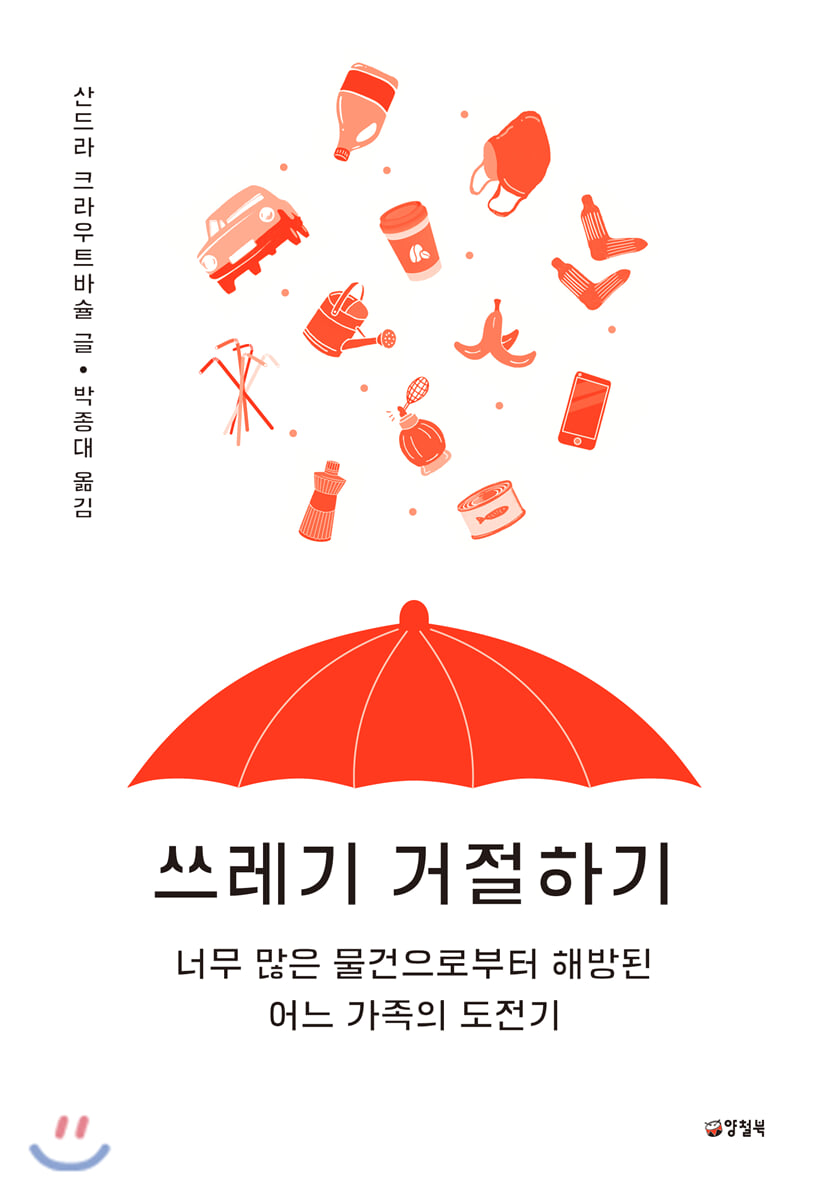
Rejecting trash
 |
Description
Book Introduction
- A word from MD
-
A Joyful Family's Zero Waste ChallengeIt's common sense that we need to reduce waste.
We must reduce the use of disposable products and avoid indiscriminate consumption.
But it is difficult to actually put it into practice.
The Sandra family, the main characters of this book, take on the challenge of zero waste by chance.
And then I realized.
That there is a lot we can do.
October 8, 2020. Social and Political PD Son Min-gyu
The second challenge, following "We Decided to Live Plastic-Free," is "Rejecting Waste."
From zero plastic to zero waste, a family's smart consumption habits reject 'excess'!
While experimenting with car sharing with neighbors, keeping the fridge half-full, and satisfying fashion cravings at flea markets, spending has decreased, and families have become closer through discussions and passion for a "zero-waste" lifestyle.
In the 10 years since the experiment became a reality, each of the three children has found a way to lighten their lives in their own way, says their mother, Sandra.
Another interesting aspect of this book is the fierce debate between the parents' well-intentioned challenges and the three children's willingness to express their own opinions, sometimes agreeing and sometimes resisting.
‘Rejecting Trash’ is a way to do it together without being forced, and to do it lightly and enjoyably as much as you choose.
In an age of excess, overflowing with both stuff and trash, this family's delightful challenge to live lightly asks me, "Am I okay with living with so much stuff?"
From zero plastic to zero waste, a family's smart consumption habits reject 'excess'!
While experimenting with car sharing with neighbors, keeping the fridge half-full, and satisfying fashion cravings at flea markets, spending has decreased, and families have become closer through discussions and passion for a "zero-waste" lifestyle.
In the 10 years since the experiment became a reality, each of the three children has found a way to lighten their lives in their own way, says their mother, Sandra.
Another interesting aspect of this book is the fierce debate between the parents' well-intentioned challenges and the three children's willingness to express their own opinions, sometimes agreeing and sometimes resisting.
‘Rejecting Trash’ is a way to do it together without being forced, and to do it lightly and enjoyably as much as you choose.
In an age of excess, overflowing with both stuff and trash, this family's delightful challenge to live lightly asks me, "Am I okay with living with so much stuff?"
- You can preview some of the book's contents.
Preview
index
Introduction: What We Really Need
Part 1 Questions
Our family decided to live plastic-free.
“Did the children really participate in the experiment voluntarily?”
Is living plastic-free enough?
Where does trash originate?
Part 2 of the experiment
Seven Years of Experimentation: The 'Half-Body Car'
Compulsory vegetarian?
Rewrite, think less
New proposals for packaging containers
Filling the fridge halfway and doing a food rescue exercise
Extending the Life of Your Items with the Free Shop
Part 3 Solution
From experiment to exercise, with neighbors
The joy of rejection and surrender
The Value of Food and Food Sharing
Ecological Summary of the Exchange Student System
Smart Digital Device Usage
Empty wisely
Upcycling: A New Value for Things
All together through sharing of goods and information
A brief summary of our experiment
Take my share of responsibility
Reviews
Glossary of Terms
Additional information
Translator's Note
Part 1 Questions
Our family decided to live plastic-free.
“Did the children really participate in the experiment voluntarily?”
Is living plastic-free enough?
Where does trash originate?
Part 2 of the experiment
Seven Years of Experimentation: The 'Half-Body Car'
Compulsory vegetarian?
Rewrite, think less
New proposals for packaging containers
Filling the fridge halfway and doing a food rescue exercise
Extending the Life of Your Items with the Free Shop
Part 3 Solution
From experiment to exercise, with neighbors
The joy of rejection and surrender
The Value of Food and Food Sharing
Ecological Summary of the Exchange Student System
Smart Digital Device Usage
Empty wisely
Upcycling: A New Value for Things
All together through sharing of goods and information
A brief summary of our experiment
Take my share of responsibility
Reviews
Glossary of Terms
Additional information
Translator's Note
Detailed image
Into the book
“What do I really need?”
I've asked myself this question often, and I've often felt the answer.
Those are things I've always missed so much.
Because I, too, know very well the psychological psychology of trying to relieve stress by shopping when I can't feel myself for even a single moment and can't do the things I like for even a single moment.
This is a dilemma.
It seems like what we really need is our own time, rest, and freedom of thought.
If we don't get these, we try to compensate with things we don't need.
But these things only provide temporary satisfaction and are of no help in the long run.
Most people instinctively know that they cannot live a good life by accumulating a lot of unnecessary stuff.
--- p.6
“We’ve always thought that maybe we could share a car with someone.
“It’s a hassle and a shame to borrow a car every time, whether from your parents or relatives.”
The moment I heard that, I couldn't believe my ears.
My husband and I had already discussed such a plan a few weeks ago, but we gave up because we couldn't think of anyone who would realistically put the plan into practice with us.
The same was true for the Martins.
I've been seriously considering personal car sharing, but haven't found a suitable partner yet.
“Then how about you give it a try with us?
“I think it will be okay.”
--- p.62
After I finished washing the dishes, I put them back in the box in the trunk.
When I lit the candles and my husband started playing the guitar, there was nothing outside except a table, chairs, and wet swimsuits hanging on a clothesline.
It was really nice not having so many things around.
Somehow, I felt liberated from everything.
--- p.66~67
When it comes to meat, our family has had quite a tumultuous journey.
Malene became a vegetarian when she was eight, and my husband decided early in our experiment that he would no longer eat meat.
We had never eaten much meat compared to other families, but because of our two vegetarians, our diet became more and more vegetarian over time.
That was a real ordeal for Leonard, the meat-lover.
…when I finally told my family that I was going to try veganism, Leonard finally burst into tears over lunch, and said, sobbing:
“If even Mom does that, there’s no one left to cook meat for me! I’ll just go live at Grandma’s!”
“Leo, you know, in the end, what matters is doing what you think is right.
That way I feel at ease.
What matters is you.
“No one can force you to do that.”
Meanwhile, I realized that Leonard was holding out like that because he didn't want to be a 'forced vegetarian'.
So I wanted to reassure my son.
--- p.78~82
I was twenty years old.
My high school classmate Elke was going to the US for a year, so I went to the US to meet her.
The very next day after arriving, I discovered a place I could never have imagined back then in my hometown.
It was a ‘shopping mall’ that I went to under Elke’s guidance.
This massive shopping center was not only larger than anything I had ever seen before, but it was also the largest I had seen since.
It was a city within a city, with numerous shops, restaurants, cosmetics stores, beauty salons, and even an amusement park and a small casino.
Elke went there because she had something to buy, and since she had been in the US for about a year already, she seemed to be quite used to the flood of products.
But I was different.
A stimulus that could only be described as an 'unbridled desire for things' arose within me like a flood.
…As time went on, I tried to avoid going to shopping centers or other similar places with my children.
Of course, I myself tried to avoid going to such places if possible.
Just looking at the various mouth-watering products stimulated my desire to buy, and I found myself buying things I didn't need in the first place or things I would regret buying later.
This experience has been confirmed many times in the process of living without plastic.
--- p.86~88
It was a weekday evening.
We set off for the big box store just after dark.
I was a little excited.
This type of 'food rescue movement' has oscillated between legal and illegal.
It's true that I was anxious about what would happen if I got caught.
Martin was different.
As expected of a veteran with a lot of experience in this kind of thing, he was incredibly calm.
We loaded our backpacks and a few bags onto our bikes and headed to the supermarket parking lot, parked our bikes behind the fence, and headed toward the warehouse with our headlamps on.
The moment I finally opened the door to the 'garbage dump', my first impression was that it seemed like a place that had nothing to do with garbage.
It just felt like a slightly disorganized food warehouse.
It was smaller than our kitchen, and was filled with countless plastic and cardboard boxes filled with all sorts of food and drinks.
I was a little taken aback and stood stiffly for a moment.
Is this really all 'garbage'?
“Did we by any chance enter the food warehouse?”
It was the first thing I said to Martin as soon as I recovered from my embarrassment.
--- p.124
One-third of the food produced worldwide was being thrown away.
In the European Union, an average of 173 kilograms of food is wasted per person per year.
In Germany, 11 million tonnes of food are thrown away every year, and in Austria, around 800,000 tonnes.
--- p.126
The ubiquitous glut of products, the exhausting process of trying to find something that fits your needs, Malene's earnest efforts to make the "right" decision, and me persuading her to cast aside her doubts and just buy what she likes, the countless ski suits that remain unsold even after clearance sales? This begs the question:
What happens to the ski suits that remain after clearance sales? How can ski suits imported from China only cost 40 euros? Recently, I heard in a university lecture that 8 billion T-shirts are produced worldwide each year.
How many ski suits are there? And how many of them end up in the trash because they're not being chosen by consumers?
--- p.139
The American environmental movement and zero-waste movement have long championed the 3R principle.
Reduce, Reuse, Recycle. Let's use less, reuse again, and recycle.
I'm not alone in my thoughts, but I have one more thing to add here.
Perhaps the thing that should come before these three is Refuse.
This means rejecting ‘excess.’
I've completely fallen into the new consumption habits I've developed over the years since my experiment with living without plastic.
Moreover, by voluntarily deciding to give up and reject some consumer goods, the cost of living did not go up, but rather went down in many areas.
Especially when it comes to things like detergents and hygiene products, I've been able to save quite a bit of money by giving up certain items over the years.
Items like toilet bowl cleaner, paper towels, cotton pads, and window and floor cleaners were found to be entirely unnecessary, or replaced with items that could be reused for a long time.
--- p.151
Today, climatologists and scientists say:
We have at most 10 years left.
To prevent irreversible catastrophes like the complete melting of permafrost and the catastrophic consequences that unchecked climate change would bring to human civilization.
In that time, we need to convince everyone to start consuming differently, traveling differently, consuming less, or at least wasting less.
Is it possible? Can it happen in 10 years?
I've asked myself this question often, and I've often felt the answer.
Those are things I've always missed so much.
Because I, too, know very well the psychological psychology of trying to relieve stress by shopping when I can't feel myself for even a single moment and can't do the things I like for even a single moment.
This is a dilemma.
It seems like what we really need is our own time, rest, and freedom of thought.
If we don't get these, we try to compensate with things we don't need.
But these things only provide temporary satisfaction and are of no help in the long run.
Most people instinctively know that they cannot live a good life by accumulating a lot of unnecessary stuff.
--- p.6
“We’ve always thought that maybe we could share a car with someone.
“It’s a hassle and a shame to borrow a car every time, whether from your parents or relatives.”
The moment I heard that, I couldn't believe my ears.
My husband and I had already discussed such a plan a few weeks ago, but we gave up because we couldn't think of anyone who would realistically put the plan into practice with us.
The same was true for the Martins.
I've been seriously considering personal car sharing, but haven't found a suitable partner yet.
“Then how about you give it a try with us?
“I think it will be okay.”
--- p.62
After I finished washing the dishes, I put them back in the box in the trunk.
When I lit the candles and my husband started playing the guitar, there was nothing outside except a table, chairs, and wet swimsuits hanging on a clothesline.
It was really nice not having so many things around.
Somehow, I felt liberated from everything.
--- p.66~67
When it comes to meat, our family has had quite a tumultuous journey.
Malene became a vegetarian when she was eight, and my husband decided early in our experiment that he would no longer eat meat.
We had never eaten much meat compared to other families, but because of our two vegetarians, our diet became more and more vegetarian over time.
That was a real ordeal for Leonard, the meat-lover.
…when I finally told my family that I was going to try veganism, Leonard finally burst into tears over lunch, and said, sobbing:
“If even Mom does that, there’s no one left to cook meat for me! I’ll just go live at Grandma’s!”
“Leo, you know, in the end, what matters is doing what you think is right.
That way I feel at ease.
What matters is you.
“No one can force you to do that.”
Meanwhile, I realized that Leonard was holding out like that because he didn't want to be a 'forced vegetarian'.
So I wanted to reassure my son.
--- p.78~82
I was twenty years old.
My high school classmate Elke was going to the US for a year, so I went to the US to meet her.
The very next day after arriving, I discovered a place I could never have imagined back then in my hometown.
It was a ‘shopping mall’ that I went to under Elke’s guidance.
This massive shopping center was not only larger than anything I had ever seen before, but it was also the largest I had seen since.
It was a city within a city, with numerous shops, restaurants, cosmetics stores, beauty salons, and even an amusement park and a small casino.
Elke went there because she had something to buy, and since she had been in the US for about a year already, she seemed to be quite used to the flood of products.
But I was different.
A stimulus that could only be described as an 'unbridled desire for things' arose within me like a flood.
…As time went on, I tried to avoid going to shopping centers or other similar places with my children.
Of course, I myself tried to avoid going to such places if possible.
Just looking at the various mouth-watering products stimulated my desire to buy, and I found myself buying things I didn't need in the first place or things I would regret buying later.
This experience has been confirmed many times in the process of living without plastic.
--- p.86~88
It was a weekday evening.
We set off for the big box store just after dark.
I was a little excited.
This type of 'food rescue movement' has oscillated between legal and illegal.
It's true that I was anxious about what would happen if I got caught.
Martin was different.
As expected of a veteran with a lot of experience in this kind of thing, he was incredibly calm.
We loaded our backpacks and a few bags onto our bikes and headed to the supermarket parking lot, parked our bikes behind the fence, and headed toward the warehouse with our headlamps on.
The moment I finally opened the door to the 'garbage dump', my first impression was that it seemed like a place that had nothing to do with garbage.
It just felt like a slightly disorganized food warehouse.
It was smaller than our kitchen, and was filled with countless plastic and cardboard boxes filled with all sorts of food and drinks.
I was a little taken aback and stood stiffly for a moment.
Is this really all 'garbage'?
“Did we by any chance enter the food warehouse?”
It was the first thing I said to Martin as soon as I recovered from my embarrassment.
--- p.124
One-third of the food produced worldwide was being thrown away.
In the European Union, an average of 173 kilograms of food is wasted per person per year.
In Germany, 11 million tonnes of food are thrown away every year, and in Austria, around 800,000 tonnes.
--- p.126
The ubiquitous glut of products, the exhausting process of trying to find something that fits your needs, Malene's earnest efforts to make the "right" decision, and me persuading her to cast aside her doubts and just buy what she likes, the countless ski suits that remain unsold even after clearance sales? This begs the question:
What happens to the ski suits that remain after clearance sales? How can ski suits imported from China only cost 40 euros? Recently, I heard in a university lecture that 8 billion T-shirts are produced worldwide each year.
How many ski suits are there? And how many of them end up in the trash because they're not being chosen by consumers?
--- p.139
The American environmental movement and zero-waste movement have long championed the 3R principle.
Reduce, Reuse, Recycle. Let's use less, reuse again, and recycle.
I'm not alone in my thoughts, but I have one more thing to add here.
Perhaps the thing that should come before these three is Refuse.
This means rejecting ‘excess.’
I've completely fallen into the new consumption habits I've developed over the years since my experiment with living without plastic.
Moreover, by voluntarily deciding to give up and reject some consumer goods, the cost of living did not go up, but rather went down in many areas.
Especially when it comes to things like detergents and hygiene products, I've been able to save quite a bit of money by giving up certain items over the years.
Items like toilet bowl cleaner, paper towels, cotton pads, and window and floor cleaners were found to be entirely unnecessary, or replaced with items that could be reused for a long time.
--- p.151
Today, climatologists and scientists say:
We have at most 10 years left.
To prevent irreversible catastrophes like the complete melting of permafrost and the catastrophic consequences that unchecked climate change would bring to human civilization.
In that time, we need to convince everyone to start consuming differently, traveling differently, consuming less, or at least wasting less.
Is it possible? Can it happen in 10 years?
--- p.153
Publisher's Review
From zero plastic to zero waste, rejecting ‘excess’
A family's smart spending habits!
Rejecting plastic wasn't enough
One day in September 2009, Sandra happened to see a movie called Plastic Planet.
Although I felt uncomfortable seeing disposable plastic bottles sometimes, I consoled myself by thinking that it was okay as long as I separated my trash properly. But after watching the movie, I couldn't do that anymore.
Plastic has covered the Earth, and the future of the Earth is uncertain due to climate change… Sandra, a mother of three, decided to live without plastic for at least a month, and her husband and children readily agreed.
The plastic-free experiment that started so spontaneously led to a life of ‘refusing waste.’
Shortly after they began their first zero-plastic experiment, the Sandra family realized that they would never be 100 percent successful.
I couldn't give up the plastic in the beer bottle and jam lids, the beer and jam that my husband and children loved.
The main principle of the experiment was that it should not be stressful for the family and that it should be 'fun'.
And the more I experimented, the more I realized that the most important thing was to 'not use' things as much as possible.
The Sandra family naturally took their zero-plastic experiment to a zero-waste life.
What happened in 10 years?
This vividly depicts the ten years of experimentation that led to life, how waste was reduced in every aspect of life, from eating and wearing to moving, and how families shared their thoughts and moved toward a "common goal" when faced with a choice.
The story of living without a car for months after my car broke down and then meeting a like-minded neighbor and co-owning a car for seven years; the feeling of freedom from things experienced on a summer vacation in that 'half-sized' car; the story of feeling light with a half-full fridge instead of being swayed by the buy-one-get-one deal; and even the incident where I emptied a large supermarket dumpster after learning that one-third of food produced worldwide is thrown away.
We can take a close look at how things are being discarded in our homes and in our society, and what kind of pollution the things we use cause during their production.
Not alone, but many, a change in the system
The sheer volume of plastic and waste threatening our planet, coupled with the sense of personal inability to do anything about it, can leave people feeling helpless, but Sandra and her family remain relentless.
The secret is to have fun as much as you can.
And above all, Sandra says that the people she works with are her greatest motivation.
The Sandra family's delightful challenges and experiments are spreading from friends to neighbors and into the community.
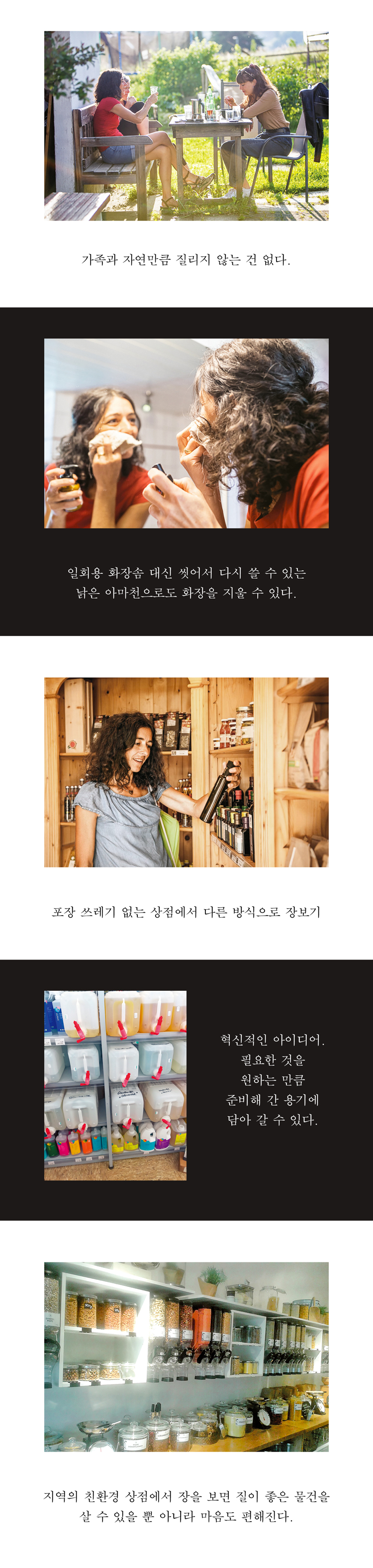
'Free stores' where people can share old clothes and other items for free are popping up, 'open bookshelves' where people can share books they've already read, and 'packaging-free stores' that produce no packaging waste are popping up all over the region.
By observing how one person's small steps accumulate to create a big change that changes the surroundings, we can gauge the direction our society should take.
Reject 'excess'
Sandra says that the most valuable thing about living a life of "no waste" is that everyone in her family lives lightly in their own way and becomes happy.
And the less you have, the more free and restful you become.
When you own something, a sense of responsibility follows.
Things also need to be taken care of, so they need to be swept and cleaned.
So the more you have, the busier you have to be.
What if I could reclaim the time I've lost to so many things? The moment I reject "excess," wouldn't my home expand and I feel lighter?
A family's smart spending habits!
Rejecting plastic wasn't enough
One day in September 2009, Sandra happened to see a movie called Plastic Planet.
Although I felt uncomfortable seeing disposable plastic bottles sometimes, I consoled myself by thinking that it was okay as long as I separated my trash properly. But after watching the movie, I couldn't do that anymore.
Plastic has covered the Earth, and the future of the Earth is uncertain due to climate change… Sandra, a mother of three, decided to live without plastic for at least a month, and her husband and children readily agreed.
The plastic-free experiment that started so spontaneously led to a life of ‘refusing waste.’
Shortly after they began their first zero-plastic experiment, the Sandra family realized that they would never be 100 percent successful.
I couldn't give up the plastic in the beer bottle and jam lids, the beer and jam that my husband and children loved.
The main principle of the experiment was that it should not be stressful for the family and that it should be 'fun'.
And the more I experimented, the more I realized that the most important thing was to 'not use' things as much as possible.
The Sandra family naturally took their zero-plastic experiment to a zero-waste life.
What happened in 10 years?
This vividly depicts the ten years of experimentation that led to life, how waste was reduced in every aspect of life, from eating and wearing to moving, and how families shared their thoughts and moved toward a "common goal" when faced with a choice.
The story of living without a car for months after my car broke down and then meeting a like-minded neighbor and co-owning a car for seven years; the feeling of freedom from things experienced on a summer vacation in that 'half-sized' car; the story of feeling light with a half-full fridge instead of being swayed by the buy-one-get-one deal; and even the incident where I emptied a large supermarket dumpster after learning that one-third of food produced worldwide is thrown away.
We can take a close look at how things are being discarded in our homes and in our society, and what kind of pollution the things we use cause during their production.
Not alone, but many, a change in the system
The sheer volume of plastic and waste threatening our planet, coupled with the sense of personal inability to do anything about it, can leave people feeling helpless, but Sandra and her family remain relentless.
The secret is to have fun as much as you can.
And above all, Sandra says that the people she works with are her greatest motivation.
The Sandra family's delightful challenges and experiments are spreading from friends to neighbors and into the community.
'Free stores' where people can share old clothes and other items for free are popping up, 'open bookshelves' where people can share books they've already read, and 'packaging-free stores' that produce no packaging waste are popping up all over the region.
By observing how one person's small steps accumulate to create a big change that changes the surroundings, we can gauge the direction our society should take.
Reject 'excess'
Sandra says that the most valuable thing about living a life of "no waste" is that everyone in her family lives lightly in their own way and becomes happy.
And the less you have, the more free and restful you become.
When you own something, a sense of responsibility follows.
Things also need to be taken care of, so they need to be swept and cleaned.
So the more you have, the busier you have to be.
What if I could reclaim the time I've lost to so many things? The moment I reject "excess," wouldn't my home expand and I feel lighter?
GOODS SPECIFICS
- Date of publication: September 28, 2020
- Page count, weight, size: 252 pages | 396g | 145*210*14mm
- ISBN13: 9788963723310
- ISBN10: 8963723313
You may also like
카테고리
korean


korean

![GQ KOREA Mark (Monthly): December [2025]](http://librairie.coreenne.fr/cdn/shop/files/8ef265dbbfbf186523ed75ba7319009d.jpg?v=1765340328&width=3840)


