

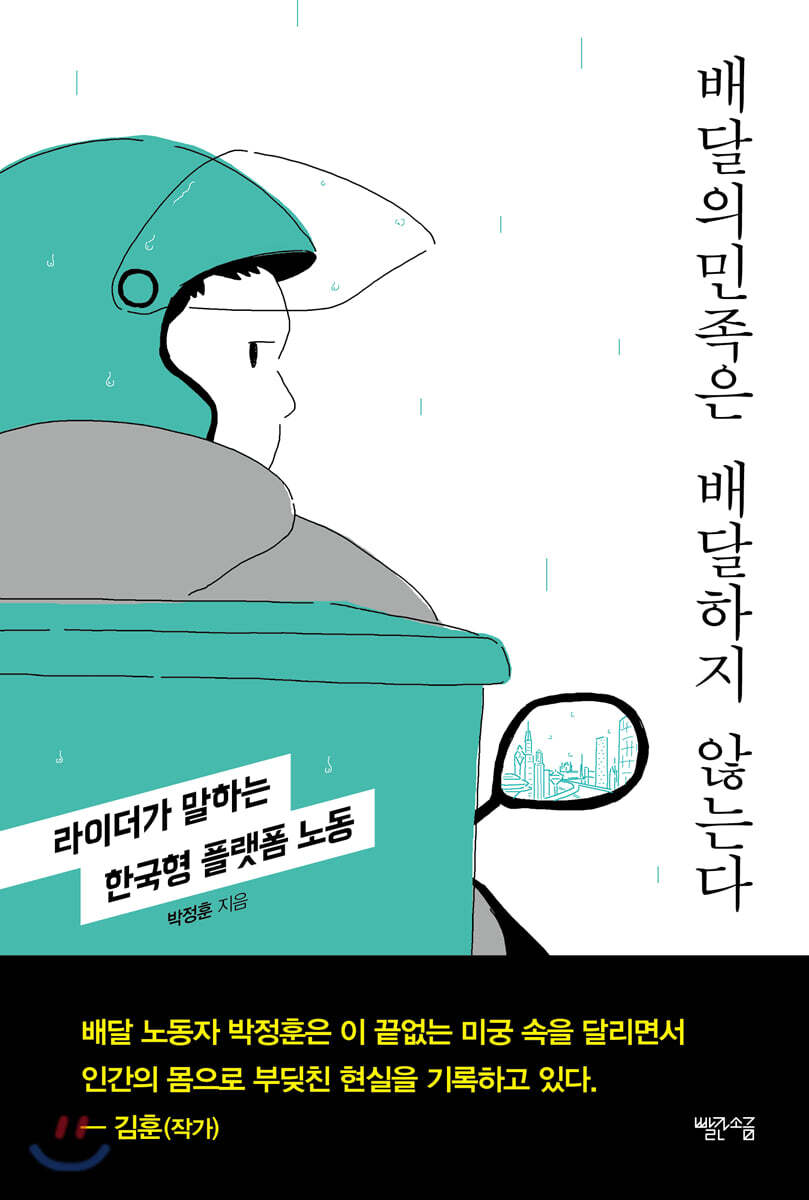
Baedal Minjok does not deliver.
 |
Description
Book Introduction
Recommended by author Kim Hoon! The Age of Platforms: A Story of "Human Labor" As of March 2020, Baedal Minjok had been downloaded by a whopping 54 million people, recorded 10 million monthly visitors, and 50 million monthly orders. Considering that there are about 50 million Korean citizens, it is truly a national application. However, Baedal Minjok, contrary to its name, does not deliver. There is a separate company called Baemin Riders that manages riders wearing mint-colored uniforms. It is a sister company of Baedal Minjok. This separation of order brokerage apps and delivery agency platforms has created a unique delivery industry structure unique to Korea. As Kim Hoon, the author of 『Song of the Sword』, who recommended this book, said, “The title of this book, 『Baedal Minjok Does Not Deliver』, summarizes the way platform capitalism works.” “On a platform, workers are not employed by the platform, but are their own bosses and isolated, helpless individuals. Platforms reign supreme as giant dinosaurs of capitalism, but their existence is like a mirage or a phantom, making it difficult to regulate through law and institutions. Delivery worker Park Jeong-hoon records the reality he encounters with his human body while running through this endless labyrinth.” In this way, author Kim Hoon concisely understands the ‘innovation’ of the platform industry, symbolized by Baedal Minjok, as the operating method of platform capitalism that distorts human labor. Therefore, it would be okay to read the title of this book as 'Platforms Don't Work' or 'Algorithms Don't Work'. This book is about 'human labor' in the age of platforms. |
- You can preview some of the book's contents.
Preview
index
Introduction · Dreaming of a 21st-Century Luddite
1.
Would you like to log in to the platform?
I am Rider 1. Chicken restaurant owner, becoming a rider.
2.
Baedal Minjok Doesn't Deliver - Korea's Unique Delivery Industry Structure
I wish platforms like Rider 2 and Hypermarket had days off.
3.
Why Uber Eats Withdrew from Korea - The Dilemma of Uber Eats-Type Platforms
I'm a Rider 3. I feel burdened by the rating system.
4.
Self-Employed or Employed? - Baemin Riders and Yogiyo Plus
I am Rider 4, 30 years of delivery experience, Mr. Deokjae's politics
5.
What Does Bburung Live On? - Franchise-Type Delivery Platforms and Neighborhood Delivery Agencies
I am Rider 5 · From McDonald's Rider to Delivery Rider
6.
Conditions for true 'innovation' in the platform industry
I am Rider 6 · Moon Joong-won's 'Last Order'
Going out · A new algorithm
1.
Would you like to log in to the platform?
I am Rider 1. Chicken restaurant owner, becoming a rider.
2.
Baedal Minjok Doesn't Deliver - Korea's Unique Delivery Industry Structure
I wish platforms like Rider 2 and Hypermarket had days off.
3.
Why Uber Eats Withdrew from Korea - The Dilemma of Uber Eats-Type Platforms
I'm a Rider 3. I feel burdened by the rating system.
4.
Self-Employed or Employed? - Baemin Riders and Yogiyo Plus
I am Rider 4, 30 years of delivery experience, Mr. Deokjae's politics
5.
What Does Bburung Live On? - Franchise-Type Delivery Platforms and Neighborhood Delivery Agencies
I am Rider 5 · From McDonald's Rider to Delivery Rider
6.
Conditions for true 'innovation' in the platform industry
I am Rider 6 · Moon Joong-won's 'Last Order'
Going out · A new algorithm
Into the book
In "Why This Isn't a Job," I divided regular workers into the first labor market and irregular workers into the second Dodong market, and explained that the third labor market, comprised of unemployed people such as job seekers, housewives, the elderly, the laid-off, and those who work two jobs after work, is growing.
It was predicted that the emergence of platforms would fundamentally shake up the third labor market.
Unemployed people who used to stay on Albamon and Alba Heaven can now escape unemployment by constantly logging into the platform app.
What has changed is that workers in the third labor market have started wearing a new name tag, “CEO,” instead of the labels “non-regular worker” or “part-time worker.”
Perhaps because this name was embarrassing, the world gave them the fancy name of 'platform workers'.
--- p.8
The form of platform that has recently become an issue worldwide is bilateral or trilateral mediation.
It connects customers, restaurants, and riders (three parties) or mediates between clients and workers (two parties).
However, in Korea, order brokerage platforms and delivery agency platforms are separated.
Here comes the local delivery agency.
So, in Korea's platform industry, two platforms (order brokerage and delivery agency) mediate between four parties: customers, restaurants, local delivery agencies, and riders.
--- p.74
The annual premium for paid transportation insurance for personal injury (insurance with a limit on compensation) and property damage of up to 30 million won is 4 million won.
If you just sign up for this and work, you'll be in big trouble.
If an accident occurs that exceeds the personal injury compensation limit, the rider will be fined for being uninsured and will be required to pay damages for the portion exceeding the limit.
Therefore, you need to sign up for Daein 2, but the annual insurance premium for Daein 2 is close to 8 million won.
A vicious cycle of not signing up because the insurance premiums are high repeats itself.
Currently, the number of vehicles covered by free transportation insurance is only 130,000, and the number of vehicles covered by paid transportation insurance is only 20,000.
Since insurance operates according to the law of large numbers, the loss ratio of free transportation insurance with a large number of subscribers is higher than that of paid transportation insurance with a small number of subscribers.
For this reason, insurance companies are turning a blind eye to the issue of paid transportation insurance.
--- p.231
Let's assume that 3 million won per month is a beginner's income and 4 million won per month is an average income.
After deducting the expenses as above, you earn 3,175,000 won.
However, they work 22 hours more per week than riders with employment status.
If it is calculated that workers worked 22 hours of overtime every week, a 1.5 times premium would be added, and minimum wage workers would have to be paid an additional 1.13 million won per month.
Considering working hours, 4 million won per month can be seen as less than the minimum wage for delivery workers.
Therefore, if you earn 5 million won per month, you will be earning slightly more than a minimum wage worker.
In this case, since the four major insurances are not available, you must separately prepare for pension and expenses incurred in case of unemployment.
However, there are only a few riders who earn more than 5 million won per month.
It is possible to make 70 deliveries per day, 6 days a week, for 3,000 won each.
You have to do 5-6 per hour, but it's hard to guess at what speed you'll be moving.
It was predicted that the emergence of platforms would fundamentally shake up the third labor market.
Unemployed people who used to stay on Albamon and Alba Heaven can now escape unemployment by constantly logging into the platform app.
What has changed is that workers in the third labor market have started wearing a new name tag, “CEO,” instead of the labels “non-regular worker” or “part-time worker.”
Perhaps because this name was embarrassing, the world gave them the fancy name of 'platform workers'.
--- p.8
The form of platform that has recently become an issue worldwide is bilateral or trilateral mediation.
It connects customers, restaurants, and riders (three parties) or mediates between clients and workers (two parties).
However, in Korea, order brokerage platforms and delivery agency platforms are separated.
Here comes the local delivery agency.
So, in Korea's platform industry, two platforms (order brokerage and delivery agency) mediate between four parties: customers, restaurants, local delivery agencies, and riders.
--- p.74
The annual premium for paid transportation insurance for personal injury (insurance with a limit on compensation) and property damage of up to 30 million won is 4 million won.
If you just sign up for this and work, you'll be in big trouble.
If an accident occurs that exceeds the personal injury compensation limit, the rider will be fined for being uninsured and will be required to pay damages for the portion exceeding the limit.
Therefore, you need to sign up for Daein 2, but the annual insurance premium for Daein 2 is close to 8 million won.
A vicious cycle of not signing up because the insurance premiums are high repeats itself.
Currently, the number of vehicles covered by free transportation insurance is only 130,000, and the number of vehicles covered by paid transportation insurance is only 20,000.
Since insurance operates according to the law of large numbers, the loss ratio of free transportation insurance with a large number of subscribers is higher than that of paid transportation insurance with a small number of subscribers.
For this reason, insurance companies are turning a blind eye to the issue of paid transportation insurance.
--- p.231
Let's assume that 3 million won per month is a beginner's income and 4 million won per month is an average income.
After deducting the expenses as above, you earn 3,175,000 won.
However, they work 22 hours more per week than riders with employment status.
If it is calculated that workers worked 22 hours of overtime every week, a 1.5 times premium would be added, and minimum wage workers would have to be paid an additional 1.13 million won per month.
Considering working hours, 4 million won per month can be seen as less than the minimum wage for delivery workers.
Therefore, if you earn 5 million won per month, you will be earning slightly more than a minimum wage worker.
In this case, since the four major insurances are not available, you must separately prepare for pension and expenses incurred in case of unemployment.
However, there are only a few riders who earn more than 5 million won per month.
It is possible to make 70 deliveries per day, 6 days a week, for 3,000 won each.
You have to do 5-6 per hour, but it's hard to guess at what speed you'll be moving.
--- p.235~236
Publisher's Review
Korea's unique delivery industry structure
As of March 2020, Baedal Minjok had been downloaded by a whopping 54 million people, recorded 10 million monthly visitors, and 50 million monthly orders.
Considering that there are about 50 million Korean citizens, it is truly a national application.
However, Baedal Minjok, contrary to its name, does not deliver.
There is a separate company called Baemin Riders that manages riders wearing mint-colored uniforms.
It is a sister company of Baedal Minjok.
This separation of order brokerage apps and delivery agency platforms has created a unique delivery industry structure unique to Korea.
This is the birth of the ‘Korean-style delivery platform.’
There are three stops we need to make to understand the Korean delivery platform industry.
The first stop is the Uber Eats type, which is the most basic platform form.
Uber Eats allows users to log in and out freely, making it a good model for examining the globally controversial issue of platform labor.
It can be seen as the most flexible form.
Unfortunately, Uber Eats withdrew from Korea on October 14, 2019.
It's been two years since I started my business in Korea.
Coupang Eats is now successful by copying Uber Eats' system.
The second stop is the Baemin Riders and Yogiyo Plus types operated by delivery intermediary services Baedal Minjok and Yogiyo.
Baemin Riders and Yogiyo Plus are examples of relatively solid platform companies that have entered the delivery agency service market based on their monopoly on order brokerage apps.
Most orders received through order brokerage apps are processed by delivery agencies, but orders from restaurants selected by Baedal Minjok and Yogiyo are processed through delivery agencies they created.
Riders think they are contracting directly with Baedal Minjok or Yogiyo, but in reality, they are contracting with subsidiaries created by Baedal Minjok and Yogiyo.
Finally, Vroom, Barogo.
It is a franchise type Korean delivery agency platform that is represented by Saenggakdaero.
The most common form in the current delivery industry is the Korean-style delivery agency platform.
Even within this, there are significant differences, such as the head office being able to make workers wear uniforms with its logo on them without taking any responsibility, and even if it does take responsibility, it is the franchise branch manager who bears the responsibility.
The form of platform that has recently become an issue worldwide is bilateral or trilateral mediation.
It connects customers, restaurants, and riders (three parties) or mediates between clients and workers (two parties).
However, in Korea, order brokerage platforms (Baedal Minjok, Yogiyo, etc.) and delivery agency platforms (Bburung, Bargo, etc.) are divided.
Here comes the local delivery agency.
So, in Korea's platform industry, two platforms (order brokerage and delivery agency) mediate between four parties: customers, restaurants, local delivery agencies, and riders.
There is also a unique relationship between delivery agency platforms and local delivery agencies.
Delivery agency platforms sign 'consignment contracts' with local delivery agencies.
And this local delivery agency enters into a "brokerage contract" with the rider. Just as CU convenience store part-timers are employees of the local convenience store, not CU headquarters, the platform company has no relationship with the rider.
However, like a franchise business, riders must wear a delivery vest and carry a delivery box with the platform company's logo.
Moreover, unlike CU convenience store ALAGA, which is an employee of the franchise store, riders are not employees of the delivery agency.
It's like moving away twice.
Stories from the Field Written by Platform Workers
The platform industry is attracting attention.
In July 2017, KakaoTalk launched Kakao Bank, actress Jun Ji-hyun appeared in a Market Kurly advertisement in 2018, and in 2019, Tada became the center of the platform industry and the Fourth Industrial Revolution.
Consumers were enthusiastic about the emergence of new platform companies, and these companies became icons of consumer convenience and innovation.
This atmosphere led to the creation of a presidential organization called the 'Fourth Industrial Revolution Committee.'
This is truly the 'era of platforms'.
As the platform gained attention, interest in the delivery industry also increased.
A flood of content related to the platform delivery industry has emerged.
Most of the cases are analyzed from foreign countries.
Unfortunately, content based on Korean cases is rare.
Perhaps no other book has dealt with platform labor issues as realistically and professionally as "Baedal Minjok Doesn't Deliver."
Park Jeong-hoon, the author of this book, is the chairman of Korea's first delivery workers' union, the Riders Union.
He worked as the president of the Alba Union, and while looking for a job that would provide the four major insurances and allow him to work freely, he happened to work as a McDonald's rider.
In the summer of 2018, I staged a one-person protest holding a picket sign that said, "Please give me 100 won in heat wave allowance."
The attention this protest received led to the formation of the Riders Union.
He has been working as a delivery driver for four years now, and has experience at McDonald's, Uber Eats, Coupang Eats, local delivery agencies, and Baemin Riders.
I met a wide range of people, including riders working in various capacities, as well as local delivery agency owners, executives from famous platform companies, government officials, members of the National Assembly, doctors, lawyers, and restaurant owners.
This book is a product of that experience.
This book, consisting of six chapters, includes stories from current riders at the end of each chapter, titled 'I am a Rider.'
The lives of Nam Do, the owner of a chicken restaurant who became a rider, Deok Jae, who has 30 years of delivery experience, and Hyosung, who transformed from a McDonald's rider to a delivery agent rider, are vividly portrayed.
In the Age of Platforms, on "Human Labor" - Recommended by Kim Hoon!
As Kim Hoon, the author of "Song of the Sword," who recommended this book, said, "The title of this book, "Baedal Minjok Doesn't Deliver," summarizes how platform capitalism works."
“The platform captures the entirety of human daily life as digitized data, connects labor to it, and turns this connection into a source of profit.
The platform fragments the time and functions of workers entering its vast and dense network, trapping them within a structure of self-exploitation.
Workers on the platform are not employed by the platform, but are their own bosses and isolated, independent individuals.
Platforms reign supreme as giant dinosaurs of capitalism, but their existence is like a mirage or a phantom, making it difficult to regulate through law and institutions.
Delivery worker Park Jeong-hoon, racing through this endless labyrinth, documents the realities he encounters with his human body. His two motorcycles, barreling through the harsh, cutting-edge terrain of our time, are paving the way for humanity.
In this way, author Kim Hoon concisely understands the "innovation" of the platform industry, symbolized by Baedal Minjok, as the operating method of platform capitalism that distorts human labor.
Therefore, it would be okay to read the title of this book as 'Platforms Don't Work' or 'Algorithms Don't Work'.
This book is about 'human labor' in the age of platforms.
A small ball shot by a rider
The problems created by the Korean platform industry described above are diverse.
A representative example is the status issue of platform delivery riders.
The question is whether to view them as self-employed or as employees.
This is closely related to issues such as the method of calculating delivery fees, treatment of riders, and industrial accident handling.
There is also the issue of commercial insurance called 'paid transportation insurance'.
This insurance premium is close to 10 million won per year for riders in their 20s, making it virtually impossible to get insurance.
Because the risk of accidents is high, insurance companies raise premiums, and because premiums are high, riders do not sign up for insurance, creating a vicious cycle.
There are also issues with the two-wheeled vehicle system.
It may be hard to believe, but there is no motorcycle mechanic license in Korea.
As a result, there is no standard labor cost.
It's worth calling.
Since the prices of motorcycle parts are not transparently disclosed, there are many cases of direct overseas purchases.
The most serious problem that arises in this process is 'distrust' rather than the 100,000 to 200,000 won bag.
However, rider Park Jeong-hoon does not stop at pointing out the problems caused by the Korean platform industry.
We ask fundamental questions and seek alternatives.
This is why the book begins in Chapter 1 by answering the question, "What exactly is a platform, and why did it emerge?"
I believe that a richer discussion is possible only when we consider why platforms are necessary from the perspective of capital, not labor, and whether this is truly a sustainable and desirable direction.
The easy and realistic explanation of the platform stands out.
And these questions lead to other fundamental questions: "How can we guarantee workers who log in and out freely the minimum wage required by labor law?" and "Are the platform's algorithms, unknown to riders and restaurant owners, not acting as command and supervision?"
Today, he continues to ride “the harsh, cutting-edge terrain of our time” with his fellow riders to find the answer to this question.
Is the delivery fee expensive?
The book introduces sharp debates about the delivery industry and labor.
Among them, we introduce the issue of 'delivery fees', which has become a hot topic these days, through the voice of Chairman Park Jeong-hoon (see Park Jeong-hoon's Facebook post from September 7).
1.
Was delivery free in the past?
If delivery was free, where did the wages of delivery workers in the past come from? Whether it was the cost of the food or the business owner's contribution to maximize profits, delivery fees were paid.
It's only when delivery is outsourced (by handing it over to a delivery service) that delivery fees become visible to consumers.
2.
How are delivery fees distributed within 1.5km?
Restaurant owners pay 5.8% to 12.5% to order brokerage platforms such as Baedal Minjok and Yogiyo.
This is the platform cost for receiving orders, and can be considered as an advertising fee.
After an order is placed, I have been paying around 3,500 to 4,000 won to the delivery agency for delivery.
Then, you pay about 100 won to delivery service programs such as Burung, Barogo, and Saenggakdaero, and about 200 to 400 won to a local delivery agency, and then go to the rider.
The restaurant owner pays about half of this delivery fee, and the consumer is asked to pay the other half.
In order to run a business, the business owner may have to shoulder all the delivery fees.
Local delivery agencies have been competing to lower these delivery fees to secure restaurants.
Because anyone can start a business.
That's why delivery fees haven't increased in the past 10 years.
Looking at the recent controversy over delivery fees, I can only feel the difference in times.
3.
Is the delivery fee expensive?
If you hired the riders directly and paid them wages, you should expect to pay around 3 million won per month.
It could be more or less than this, but I think this is usually the amount you think about.
If you consider the four major insurances, annual leave, retirement pay, motorcycle costs, gas costs, and insurance premiums and the liability in case of an accident, you will have to pay more than 3 million won per month.
It will be at least 4 million won per month.
You need to take this into account to calculate your actual delivery charges.
Even if you hire just one person, you have to pay this amount (of course, McDonald's riders get minimum wage plus a commission of about 400 won per ride).
4.
What if the delivery fee paid by the consumer exceeds 5,000 won?
It is likely to be a long distance delivery.
The stores that appear on the delivery app are not located close to my house.
You are exposed to it according to the advertising algorithm.
If you advertise in the neighborhoods of customers who live far away from your restaurant, your restaurant will be exposed to those customers.
Customers sometimes order delivery without paying attention to this distance.
Sometimes, when I order delivery from a franchise restaurant that is 3-4km away, I feel frustrated and think, "Why do I have to order from so far away when there is a place nearby?"
This advertisement is the reason why 125cc motorcycles appeared in motorcycle delivery and why long-distance delivery began.
Since riders don't go for long distance deliveries, there's no reason to catch them unless you add a surcharge.
If this is too much of a hassle, it's better to find a nearby delivery restaurant and order delivery.
Delivery apps also need to explain this system well.
As of March 2020, Baedal Minjok had been downloaded by a whopping 54 million people, recorded 10 million monthly visitors, and 50 million monthly orders.
Considering that there are about 50 million Korean citizens, it is truly a national application.
However, Baedal Minjok, contrary to its name, does not deliver.
There is a separate company called Baemin Riders that manages riders wearing mint-colored uniforms.
It is a sister company of Baedal Minjok.
This separation of order brokerage apps and delivery agency platforms has created a unique delivery industry structure unique to Korea.
This is the birth of the ‘Korean-style delivery platform.’
There are three stops we need to make to understand the Korean delivery platform industry.
The first stop is the Uber Eats type, which is the most basic platform form.
Uber Eats allows users to log in and out freely, making it a good model for examining the globally controversial issue of platform labor.
It can be seen as the most flexible form.
Unfortunately, Uber Eats withdrew from Korea on October 14, 2019.
It's been two years since I started my business in Korea.
Coupang Eats is now successful by copying Uber Eats' system.
The second stop is the Baemin Riders and Yogiyo Plus types operated by delivery intermediary services Baedal Minjok and Yogiyo.
Baemin Riders and Yogiyo Plus are examples of relatively solid platform companies that have entered the delivery agency service market based on their monopoly on order brokerage apps.
Most orders received through order brokerage apps are processed by delivery agencies, but orders from restaurants selected by Baedal Minjok and Yogiyo are processed through delivery agencies they created.
Riders think they are contracting directly with Baedal Minjok or Yogiyo, but in reality, they are contracting with subsidiaries created by Baedal Minjok and Yogiyo.
Finally, Vroom, Barogo.
It is a franchise type Korean delivery agency platform that is represented by Saenggakdaero.
The most common form in the current delivery industry is the Korean-style delivery agency platform.
Even within this, there are significant differences, such as the head office being able to make workers wear uniforms with its logo on them without taking any responsibility, and even if it does take responsibility, it is the franchise branch manager who bears the responsibility.
The form of platform that has recently become an issue worldwide is bilateral or trilateral mediation.
It connects customers, restaurants, and riders (three parties) or mediates between clients and workers (two parties).
However, in Korea, order brokerage platforms (Baedal Minjok, Yogiyo, etc.) and delivery agency platforms (Bburung, Bargo, etc.) are divided.
Here comes the local delivery agency.
So, in Korea's platform industry, two platforms (order brokerage and delivery agency) mediate between four parties: customers, restaurants, local delivery agencies, and riders.
There is also a unique relationship between delivery agency platforms and local delivery agencies.
Delivery agency platforms sign 'consignment contracts' with local delivery agencies.
And this local delivery agency enters into a "brokerage contract" with the rider. Just as CU convenience store part-timers are employees of the local convenience store, not CU headquarters, the platform company has no relationship with the rider.
However, like a franchise business, riders must wear a delivery vest and carry a delivery box with the platform company's logo.
Moreover, unlike CU convenience store ALAGA, which is an employee of the franchise store, riders are not employees of the delivery agency.
It's like moving away twice.
Stories from the Field Written by Platform Workers
The platform industry is attracting attention.
In July 2017, KakaoTalk launched Kakao Bank, actress Jun Ji-hyun appeared in a Market Kurly advertisement in 2018, and in 2019, Tada became the center of the platform industry and the Fourth Industrial Revolution.
Consumers were enthusiastic about the emergence of new platform companies, and these companies became icons of consumer convenience and innovation.
This atmosphere led to the creation of a presidential organization called the 'Fourth Industrial Revolution Committee.'
This is truly the 'era of platforms'.
As the platform gained attention, interest in the delivery industry also increased.
A flood of content related to the platform delivery industry has emerged.
Most of the cases are analyzed from foreign countries.
Unfortunately, content based on Korean cases is rare.
Perhaps no other book has dealt with platform labor issues as realistically and professionally as "Baedal Minjok Doesn't Deliver."
Park Jeong-hoon, the author of this book, is the chairman of Korea's first delivery workers' union, the Riders Union.
He worked as the president of the Alba Union, and while looking for a job that would provide the four major insurances and allow him to work freely, he happened to work as a McDonald's rider.
In the summer of 2018, I staged a one-person protest holding a picket sign that said, "Please give me 100 won in heat wave allowance."
The attention this protest received led to the formation of the Riders Union.
He has been working as a delivery driver for four years now, and has experience at McDonald's, Uber Eats, Coupang Eats, local delivery agencies, and Baemin Riders.
I met a wide range of people, including riders working in various capacities, as well as local delivery agency owners, executives from famous platform companies, government officials, members of the National Assembly, doctors, lawyers, and restaurant owners.
This book is a product of that experience.
This book, consisting of six chapters, includes stories from current riders at the end of each chapter, titled 'I am a Rider.'
The lives of Nam Do, the owner of a chicken restaurant who became a rider, Deok Jae, who has 30 years of delivery experience, and Hyosung, who transformed from a McDonald's rider to a delivery agent rider, are vividly portrayed.
In the Age of Platforms, on "Human Labor" - Recommended by Kim Hoon!
As Kim Hoon, the author of "Song of the Sword," who recommended this book, said, "The title of this book, "Baedal Minjok Doesn't Deliver," summarizes how platform capitalism works."
“The platform captures the entirety of human daily life as digitized data, connects labor to it, and turns this connection into a source of profit.
The platform fragments the time and functions of workers entering its vast and dense network, trapping them within a structure of self-exploitation.
Workers on the platform are not employed by the platform, but are their own bosses and isolated, independent individuals.
Platforms reign supreme as giant dinosaurs of capitalism, but their existence is like a mirage or a phantom, making it difficult to regulate through law and institutions.
Delivery worker Park Jeong-hoon, racing through this endless labyrinth, documents the realities he encounters with his human body. His two motorcycles, barreling through the harsh, cutting-edge terrain of our time, are paving the way for humanity.
In this way, author Kim Hoon concisely understands the "innovation" of the platform industry, symbolized by Baedal Minjok, as the operating method of platform capitalism that distorts human labor.
Therefore, it would be okay to read the title of this book as 'Platforms Don't Work' or 'Algorithms Don't Work'.
This book is about 'human labor' in the age of platforms.
A small ball shot by a rider
The problems created by the Korean platform industry described above are diverse.
A representative example is the status issue of platform delivery riders.
The question is whether to view them as self-employed or as employees.
This is closely related to issues such as the method of calculating delivery fees, treatment of riders, and industrial accident handling.
There is also the issue of commercial insurance called 'paid transportation insurance'.
This insurance premium is close to 10 million won per year for riders in their 20s, making it virtually impossible to get insurance.
Because the risk of accidents is high, insurance companies raise premiums, and because premiums are high, riders do not sign up for insurance, creating a vicious cycle.
There are also issues with the two-wheeled vehicle system.
It may be hard to believe, but there is no motorcycle mechanic license in Korea.
As a result, there is no standard labor cost.
It's worth calling.
Since the prices of motorcycle parts are not transparently disclosed, there are many cases of direct overseas purchases.
The most serious problem that arises in this process is 'distrust' rather than the 100,000 to 200,000 won bag.
However, rider Park Jeong-hoon does not stop at pointing out the problems caused by the Korean platform industry.
We ask fundamental questions and seek alternatives.
This is why the book begins in Chapter 1 by answering the question, "What exactly is a platform, and why did it emerge?"
I believe that a richer discussion is possible only when we consider why platforms are necessary from the perspective of capital, not labor, and whether this is truly a sustainable and desirable direction.
The easy and realistic explanation of the platform stands out.
And these questions lead to other fundamental questions: "How can we guarantee workers who log in and out freely the minimum wage required by labor law?" and "Are the platform's algorithms, unknown to riders and restaurant owners, not acting as command and supervision?"
Today, he continues to ride “the harsh, cutting-edge terrain of our time” with his fellow riders to find the answer to this question.
Is the delivery fee expensive?
The book introduces sharp debates about the delivery industry and labor.
Among them, we introduce the issue of 'delivery fees', which has become a hot topic these days, through the voice of Chairman Park Jeong-hoon (see Park Jeong-hoon's Facebook post from September 7).
1.
Was delivery free in the past?
If delivery was free, where did the wages of delivery workers in the past come from? Whether it was the cost of the food or the business owner's contribution to maximize profits, delivery fees were paid.
It's only when delivery is outsourced (by handing it over to a delivery service) that delivery fees become visible to consumers.
2.
How are delivery fees distributed within 1.5km?
Restaurant owners pay 5.8% to 12.5% to order brokerage platforms such as Baedal Minjok and Yogiyo.
This is the platform cost for receiving orders, and can be considered as an advertising fee.
After an order is placed, I have been paying around 3,500 to 4,000 won to the delivery agency for delivery.
Then, you pay about 100 won to delivery service programs such as Burung, Barogo, and Saenggakdaero, and about 200 to 400 won to a local delivery agency, and then go to the rider.
The restaurant owner pays about half of this delivery fee, and the consumer is asked to pay the other half.
In order to run a business, the business owner may have to shoulder all the delivery fees.
Local delivery agencies have been competing to lower these delivery fees to secure restaurants.
Because anyone can start a business.
That's why delivery fees haven't increased in the past 10 years.
Looking at the recent controversy over delivery fees, I can only feel the difference in times.
3.
Is the delivery fee expensive?
If you hired the riders directly and paid them wages, you should expect to pay around 3 million won per month.
It could be more or less than this, but I think this is usually the amount you think about.
If you consider the four major insurances, annual leave, retirement pay, motorcycle costs, gas costs, and insurance premiums and the liability in case of an accident, you will have to pay more than 3 million won per month.
It will be at least 4 million won per month.
You need to take this into account to calculate your actual delivery charges.
Even if you hire just one person, you have to pay this amount (of course, McDonald's riders get minimum wage plus a commission of about 400 won per ride).
4.
What if the delivery fee paid by the consumer exceeds 5,000 won?
It is likely to be a long distance delivery.
The stores that appear on the delivery app are not located close to my house.
You are exposed to it according to the advertising algorithm.
If you advertise in the neighborhoods of customers who live far away from your restaurant, your restaurant will be exposed to those customers.
Customers sometimes order delivery without paying attention to this distance.
Sometimes, when I order delivery from a franchise restaurant that is 3-4km away, I feel frustrated and think, "Why do I have to order from so far away when there is a place nearby?"
This advertisement is the reason why 125cc motorcycles appeared in motorcycle delivery and why long-distance delivery began.
Since riders don't go for long distance deliveries, there's no reason to catch them unless you add a surcharge.
If this is too much of a hassle, it's better to find a nearby delivery restaurant and order delivery.
Delivery apps also need to explain this system well.
GOODS SPECIFICS
- Date of issue: September 12, 2020
- Page count, weight, size: 248 pages | 354g | 145*215*20mm
- ISBN13: 9791196585983
- ISBN10: 1196585989
You may also like
카테고리
korean


korean

![GQ KOREA Mark (Monthly): December [2025]](http://librairie.coreenne.fr/cdn/shop/files/8ef265dbbfbf186523ed75ba7319009d.jpg?v=1765340328&width=3840)


