

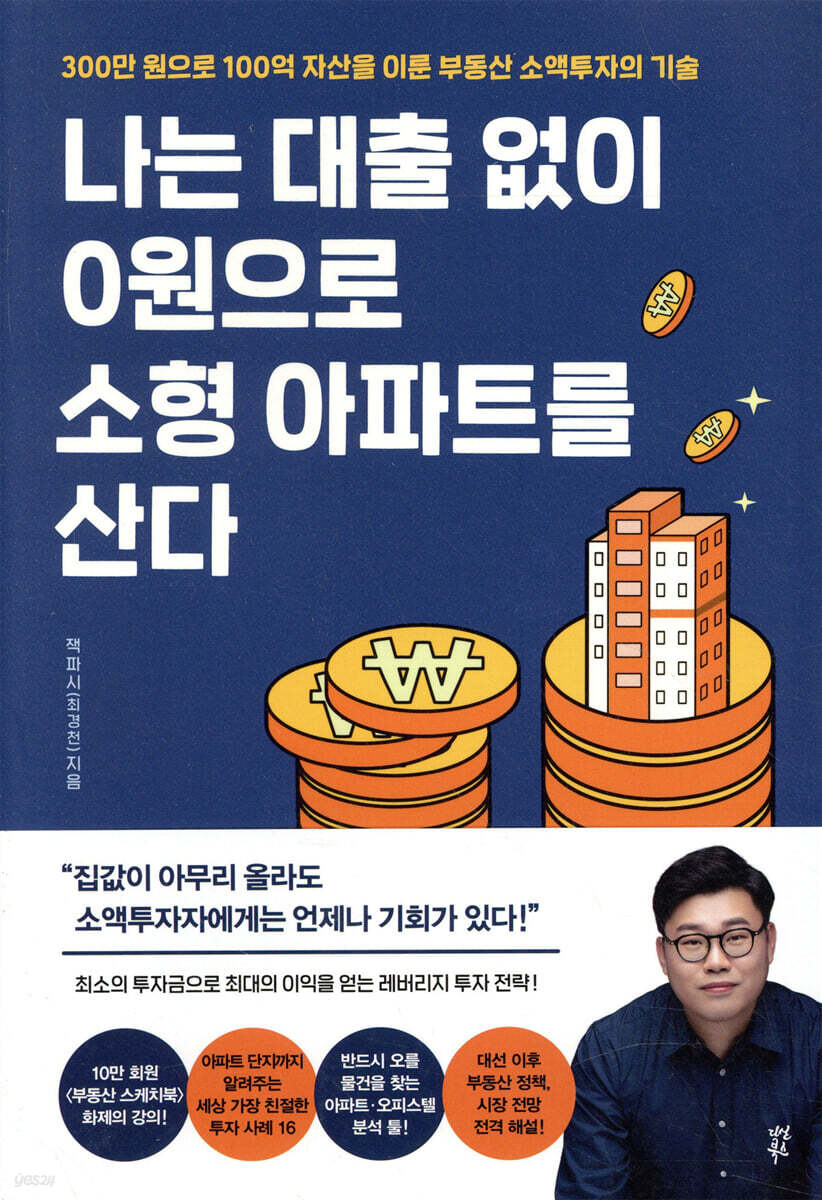
I bought a small apartment for 0 won without a loan.
 |
Description
Book Introduction
“No cloud-grabbing, no mosaic processing, “A candid and realistic real estate investment strategy book!” Real estate salesman Jack Parsey's practical investment lectures, first recognized by investors! If you want to make investments that will never lose money, open this book! The hot topic of the 100,000-member "Real Estate Sketchbook" lecture! 16 Investment Cases That Inform You About Apartment Complexes Apartment/officetel analysis tool that finds properties that are sure to rise! After three years of working, I only had 3 million won in my bank account. I had to take out a loan because I didn't have the 20 million won deposit to bid on the real estate auction. Ten years after he started investing in real estate, he became a wealthy person, owning over 50 properties worth 11 billion won. This is the story of Jack Passy, the hottest influencer in the real estate industry and a 30-something FIRE tribe member who wrote "I bought a small apartment for 0 won without a loan." This book is a compilation of the techniques and practical examples of small-scale investment that the author developed over the past 10 years, while searching for a house that he could invest in without money by searching for properties on Naver Real Estate for 6 months because he didn't even have a real estate deposit. The author is a master of Mupi investment, recognized by investors first, as when Jack Parsey buys an item, trading volume soars, and when he opens a lecture, it closes in one day. In this book, he generously shares the investment strategies he has personally implemented and continues to use to make money. His case studies, which reveal everything from the apartment complex name to the purchase date, investment cost, and profit, provide investment experience just by reading them. The apartment and officetel investment feasibility analysis he developed is an analysis tool that condenses 10 years of investment experience. Moreover, the tax-saving strategy that has allowed me to consistently invest without fearing taxes as an individual owner of multiple homes is a unique know-how that cannot be heard anywhere else. This book will empower anyone to jump into real estate investing and provide clear answers to investors who wonder, "Can I really buy a home for zero dollars without a loan?" |
- You can preview some of the book's contents.
Preview
index
Prologue | I wish you'd buy a house too.
[Chapter 1]
A 30-year-old office worker who only had 3 million won
How did you get started investing in real estate?
You can't get rich on 10 years of salary.
What saved me from investing in stocks with a -90% return
I bought a house in my 20s and my life completely changed.
I started investing in real estate because I had no money.
How to become a homeowner of 50 homes in 10 years?
Seoul Apartments: Investment Opportunities Still Abound
Are you on the path to wealth?
[Chapter 2]
How to have 11 billion assets without loans
Could I have become a landlord?
★10-Year Real Estate Investment Cash Flow Statement
People without homes should buy their own homes first.
Free yourself from the fear of becoming a multi-homeowner
Three Real Estate Portfolio Strategies to Minimize Risk
Seoul isn't the only place where money is made.
Tax-saving tips for multi-homeowners
What You Learn When You Own 20+ Properties
[Chapter 3]
Just read the market trends well
You can find the optimal buying timing.
★The ranking of the cities in each of the eight provinces nationwide and the top 3 apartments in each city.
Top-down investing: Seeing the forest before the trees
Investment Timing Through the Real Estate Cycle
Before investing in real estate, look at the US first.
Five Must-See Data for Regional Analysis
Timing your purchases based on sales and lease price trends
Understanding the Upside Potential of the Housing Affordability Index
Developing an Exit Strategy Based on Current and Future Supply
Finding Short-Term Rising Areas by Listing Ratio
Reading Market Sentiment with Initial Sale Rates
How to Use Big Data to Analyze a Region from Various Perspectives
[Chapter 4]
Informing you about the apartment complex
16 Best Investment Cases
★Jack Parsey's Real Estate Portfolio on a Map
Investment in Seoul's new apartments using the GTX line
Strategy to purchase two undervalued apartments in the metropolitan area
How to Invest in Local Apartments Without Losing Money
Reverse thinking! Buying a Gangnam officetel with a flip phone
Can I invest in subscription rights with a small amount?
Aim for newly built villas in Seoul's subway stations and semi-industrial areas.
[Chapter 5]
Looking for a property that will definitely rise in value
Create your own investment tool
★Investment principles should vary depending on the type of real estate.
Real estate investing also requires principles.
Process real estate big data to create your own.
Get the tools that will make investing easier.
Analysis of Apartment Investment Feasibility Indicators
Valuation model for finding undervalued officetels
Creating Efficient Forest Maps for Busy Investors
Creating a Thoroughly Analyzed Forestry Checklist
[Chapter 6]
Anyone can do it even if they don't have money
You can become rich in real estate
There are no barriers to entry into real estate investing.
Post a map of the Seoul Metropolitan Area subway lines in your room right now.
First, get as much real estate information in your head as possible.
Don't pass on good things to others.
Thinking about the real estate market after the presidential election
[Chapter 1]
A 30-year-old office worker who only had 3 million won
How did you get started investing in real estate?
You can't get rich on 10 years of salary.
What saved me from investing in stocks with a -90% return
I bought a house in my 20s and my life completely changed.
I started investing in real estate because I had no money.
How to become a homeowner of 50 homes in 10 years?
Seoul Apartments: Investment Opportunities Still Abound
Are you on the path to wealth?
[Chapter 2]
How to have 11 billion assets without loans
Could I have become a landlord?
★10-Year Real Estate Investment Cash Flow Statement
People without homes should buy their own homes first.
Free yourself from the fear of becoming a multi-homeowner
Three Real Estate Portfolio Strategies to Minimize Risk
Seoul isn't the only place where money is made.
Tax-saving tips for multi-homeowners
What You Learn When You Own 20+ Properties
[Chapter 3]
Just read the market trends well
You can find the optimal buying timing.
★The ranking of the cities in each of the eight provinces nationwide and the top 3 apartments in each city.
Top-down investing: Seeing the forest before the trees
Investment Timing Through the Real Estate Cycle
Before investing in real estate, look at the US first.
Five Must-See Data for Regional Analysis
Timing your purchases based on sales and lease price trends
Understanding the Upside Potential of the Housing Affordability Index
Developing an Exit Strategy Based on Current and Future Supply
Finding Short-Term Rising Areas by Listing Ratio
Reading Market Sentiment with Initial Sale Rates
How to Use Big Data to Analyze a Region from Various Perspectives
[Chapter 4]
Informing you about the apartment complex
16 Best Investment Cases
★Jack Parsey's Real Estate Portfolio on a Map
Investment in Seoul's new apartments using the GTX line
Strategy to purchase two undervalued apartments in the metropolitan area
How to Invest in Local Apartments Without Losing Money
Reverse thinking! Buying a Gangnam officetel with a flip phone
Can I invest in subscription rights with a small amount?
Aim for newly built villas in Seoul's subway stations and semi-industrial areas.
[Chapter 5]
Looking for a property that will definitely rise in value
Create your own investment tool
★Investment principles should vary depending on the type of real estate.
Real estate investing also requires principles.
Process real estate big data to create your own.
Get the tools that will make investing easier.
Analysis of Apartment Investment Feasibility Indicators
Valuation model for finding undervalued officetels
Creating Efficient Forest Maps for Busy Investors
Creating a Thoroughly Analyzed Forestry Checklist
[Chapter 6]
Anyone can do it even if they don't have money
You can become rich in real estate
There are no barriers to entry into real estate investing.
Post a map of the Seoul Metropolitan Area subway lines in your room right now.
First, get as much real estate information in your head as possible.
Don't pass on good things to others.
Thinking about the real estate market after the presidential election
Detailed image
.jpg)
Into the book
One of the reasons why many people hesitate to invest in real estate is probably because of the preconceived notion that a large amount of seed money is required.
But even if you have some seed money, it doesn't feel easy when you actually try to invest.
No matter how hard you study through books or lectures.
This may be the burden of having a large sum of money, which was saved with great effort, tied up in one real estate.
So what if you could fund your investment solely through leverage? What if you could secure a margin of safety by purchasing properties below market price, and receive a deposit equal to or exceeding the purchase price? Considering that the subsequent deposit or sale price will rise at least at the rate of inflation, this investment strategy carries virtually no risk.
Why hesitate on such a cost-free investment?
---From "How did a 30-year-old office worker with only 3 million won in savings start investing in real estate?"
Everything in this book is a method I have tried and used to make money, and I am still making money using the same methods.
Even people who took my class, not just me, made money in the same way.
In fact, the market is limited and my investment method is something that anyone can do, so the more it becomes known, the more competition there is, making investing difficult.
Yet, the reason I am so open about revealing all my investment methods is because I know that not many people will actually put them into practice.
I, too, read about 100 books in the early days of my real estate investment and immediately applied the ones I could implement to my investments.
In other words, if you just read a book and don't act on it, it's meaningless.
---From "Chapter 2: How I Became a Homeowner with 11 Billion Won in Assets Without a Loan"
Top-down investing is a method of investing that first examines the most macroscopic data and, if the situation appears favorable, gradually analyzes microscopic data to find the most stable and undervalued investment opportunities.
Simply put, it is finding investment destinations by going down to the largest unit, the real estate market of advanced countries and Korea → flow at the ‘province’ level → flow at the ‘city’ level → specific apartment complex.
(syncopation)
The flow of each province is very important. When a province-level upward market comes, there is a city that rises first in that province.
It would be good to refer to the order of the rising tide of the city and the major apartments shown at the beginning of this chapter.
However, there is no need to memorize the order of the poem's flow.
All you need to know is a simple rule: investors start entering each province in descending order of population.
And the next investors who watch this decide whether to follow suit and invest in semi-new construction and construction that have not yet risen in price, even if it is late, in the city with the largest population, or to invest in pre-sale rights and large-scale apartments in the city with the next largest population but that have not yet risen in price.
That is, the order of increase is determined by population size.
---From "Chapter 3: Finding the Optimal Buying Timing Just by Reading Market Flows Well"
An example is the Chungju Jiwell Apartment purchased in July 2021.
The plan was to set aside the remaining 135 million won of the 145 million won sale price as a deposit, find a tenant who would move in with this amount before the remaining amount was paid, and use that deposit to pay the purchase price.
In general, the deposit would be 14.5 million won, which is 10% of the sale price, but it is a hassle because you have to get 4.5 million won back later anyway.
In this way, the expected rental price is subtracted from the sale price and the gap is set as the deposit.
Of course, from the seller's perspective, there are those who ask for 10% of the purchase price even if they have to return it because more cash is coming in, so you have to negotiate well.
However, the fact that the deposit is 10% of the sales price is merely a 'custom' in real estate transactions and is not stipulated by law.
So, let's consider the deposit as a subject of agreement and negotiate it in my favor.
If you put down a small deposit, you can buy two or three houses.
I actually didn't have enough money to comfortably afford a down payment until a few years ago.
When I was really into investing, I didn't have a down payment, so I borrowed money from friends, family, and even my coworkers to invest. So, the down payment, which can be said to be the biggest initial cost for me, was one of the most important parts.
---From "16 of the friendliest investment cases that tell you about apartment complexes in Chapter 4"
The basic principle of all investing is to buy low and sell high.
However, if you don't set a standard for buying cheap and selling expensive, your investment itself can be swayed by other people's words or temporary prices.
I set my own criteria before I start buying.
For example, when investing in a local apartment with a publicly announced price of less than 100 million won, purchase only at a price between 120% and 150% of the publicly announced price.
In the case of a recently purchased officetel in Gangnam, it was purchased at 110-130% of the publicly announced price.
(syncopation)
Also, since the purchase is made with a clear numerical basis, there is almost no chance of failure.
Also, because they are not swayed by the words of others or one-off articles, they do not buy overvalued items or sell hastily out of impatience.
You can invest with peace of mind while still achieving the desired return.
---From "Chapter 5: Creating Your Own Investment Tool to Find Real Estate That Will Definitely Rise"
While working hard at your company, set aside one evening during the week to manually search for properties on Naver.
After dinner, you can sit down at your computer and browse, or like me, you can lie on the sofa and browse on your phone.
Since you have to go see the property you found through a search on Saturday, it is best to contact the real estate agent on Thursday or Friday to make an appointment to see the house with the owner or tenant.
So, it would be best to schedule your property search on Wednesday or Thursday evenings if possible.
If this becomes a habit, you might be able to do a quick routine like I do now, searching on Friday evenings and going straight to the forest on Saturdays.
These types of skills can be learned quickly as you gain experience, so even if you feel a bit lost at first, think of it as a process of learning one step at a time and proceed slowly.
But even if you have some seed money, it doesn't feel easy when you actually try to invest.
No matter how hard you study through books or lectures.
This may be the burden of having a large sum of money, which was saved with great effort, tied up in one real estate.
So what if you could fund your investment solely through leverage? What if you could secure a margin of safety by purchasing properties below market price, and receive a deposit equal to or exceeding the purchase price? Considering that the subsequent deposit or sale price will rise at least at the rate of inflation, this investment strategy carries virtually no risk.
Why hesitate on such a cost-free investment?
---From "How did a 30-year-old office worker with only 3 million won in savings start investing in real estate?"
Everything in this book is a method I have tried and used to make money, and I am still making money using the same methods.
Even people who took my class, not just me, made money in the same way.
In fact, the market is limited and my investment method is something that anyone can do, so the more it becomes known, the more competition there is, making investing difficult.
Yet, the reason I am so open about revealing all my investment methods is because I know that not many people will actually put them into practice.
I, too, read about 100 books in the early days of my real estate investment and immediately applied the ones I could implement to my investments.
In other words, if you just read a book and don't act on it, it's meaningless.
---From "Chapter 2: How I Became a Homeowner with 11 Billion Won in Assets Without a Loan"
Top-down investing is a method of investing that first examines the most macroscopic data and, if the situation appears favorable, gradually analyzes microscopic data to find the most stable and undervalued investment opportunities.
Simply put, it is finding investment destinations by going down to the largest unit, the real estate market of advanced countries and Korea → flow at the ‘province’ level → flow at the ‘city’ level → specific apartment complex.
(syncopation)
The flow of each province is very important. When a province-level upward market comes, there is a city that rises first in that province.
It would be good to refer to the order of the rising tide of the city and the major apartments shown at the beginning of this chapter.
However, there is no need to memorize the order of the poem's flow.
All you need to know is a simple rule: investors start entering each province in descending order of population.
And the next investors who watch this decide whether to follow suit and invest in semi-new construction and construction that have not yet risen in price, even if it is late, in the city with the largest population, or to invest in pre-sale rights and large-scale apartments in the city with the next largest population but that have not yet risen in price.
That is, the order of increase is determined by population size.
---From "Chapter 3: Finding the Optimal Buying Timing Just by Reading Market Flows Well"
An example is the Chungju Jiwell Apartment purchased in July 2021.
The plan was to set aside the remaining 135 million won of the 145 million won sale price as a deposit, find a tenant who would move in with this amount before the remaining amount was paid, and use that deposit to pay the purchase price.
In general, the deposit would be 14.5 million won, which is 10% of the sale price, but it is a hassle because you have to get 4.5 million won back later anyway.
In this way, the expected rental price is subtracted from the sale price and the gap is set as the deposit.
Of course, from the seller's perspective, there are those who ask for 10% of the purchase price even if they have to return it because more cash is coming in, so you have to negotiate well.
However, the fact that the deposit is 10% of the sales price is merely a 'custom' in real estate transactions and is not stipulated by law.
So, let's consider the deposit as a subject of agreement and negotiate it in my favor.
If you put down a small deposit, you can buy two or three houses.
I actually didn't have enough money to comfortably afford a down payment until a few years ago.
When I was really into investing, I didn't have a down payment, so I borrowed money from friends, family, and even my coworkers to invest. So, the down payment, which can be said to be the biggest initial cost for me, was one of the most important parts.
---From "16 of the friendliest investment cases that tell you about apartment complexes in Chapter 4"
The basic principle of all investing is to buy low and sell high.
However, if you don't set a standard for buying cheap and selling expensive, your investment itself can be swayed by other people's words or temporary prices.
I set my own criteria before I start buying.
For example, when investing in a local apartment with a publicly announced price of less than 100 million won, purchase only at a price between 120% and 150% of the publicly announced price.
In the case of a recently purchased officetel in Gangnam, it was purchased at 110-130% of the publicly announced price.
(syncopation)
Also, since the purchase is made with a clear numerical basis, there is almost no chance of failure.
Also, because they are not swayed by the words of others or one-off articles, they do not buy overvalued items or sell hastily out of impatience.
You can invest with peace of mind while still achieving the desired return.
---From "Chapter 5: Creating Your Own Investment Tool to Find Real Estate That Will Definitely Rise"
While working hard at your company, set aside one evening during the week to manually search for properties on Naver.
After dinner, you can sit down at your computer and browse, or like me, you can lie on the sofa and browse on your phone.
Since you have to go see the property you found through a search on Saturday, it is best to contact the real estate agent on Thursday or Friday to make an appointment to see the house with the owner or tenant.
So, it would be best to schedule your property search on Wednesday or Thursday evenings if possible.
If this becomes a habit, you might be able to do a quick routine like I do now, searching on Friday evenings and going straight to the forest on Saturdays.
These types of skills can be learned quickly as you gain experience, so even if you feel a bit lost at first, think of it as a process of learning one step at a time and proceed slowly.
---From "Chapter 6: Anyone Can Become a Real Estate Millionaire Even Without Money"
Publisher's Review
“What changed my life was buying an apartment in my 20s, even though I had no money!”
From a failed stock investment with a -90% return to becoming a real estate investor with 11 billion won in assets.
The author says that his life completely changed after buying a house in his 20s.
I invested in Hong Kong stocks introduced in a book I happened to read and made a profit of 50 million won with 20 million won, but this was just beginner's luck.
Even after starting my career, I continued to invest in stocks, but my account was often emptied due to hasty investments that focused only on theme stocks, stocks with rapid growth, and coins.
Then, the company I invested in with a short-term loan was delisted, resulting in a -90% return. My account details were mistakenly sent to my parents' house, and I got a bad scolding from my mother. After that, I came to my senses and decided to leave the stock market.
I first became interested in real estate investing after buying my first home.
The author, who had difficulty saving up seed money as an office worker with a monthly salary of around 2 million won, began investing in real estate through auctions, which allowed him to obtain large loans.
At the time, he only had 3 million won in his bank account, and he had to take out a loan to secure the 20 million won bid deposit.
Afterwards, as lending regulations were introduced for auctions, the strategy changed to gap investment, which allows small investments without loans, and the company has accumulated experience in various investments that can be made with small amounts, such as apartments, villas, officetels, and subscription rights.
Through consistent small investments over the past 10 years, he currently owns approximately 50 rental properties with an asset value of 11 billion won.
Even though he had to quit his first company of 10 years due to COVID-19, he was not anxious.
Because he already owned about 30 houses when he retired.
Some people ask:
“Wouldn’t you feel uneasy if there were about 50 of them?”
“How can I buy 50 houses with my salary as an office worker?”
The author asks:
Isn't it more insecure to live in South Korea without a home of your own?
This book is the answer to the above questions.
How could he buy dozens of houses with a salary of less than 3 million won? How did he secure the cash flow to purchase real estate every year while owning so much real estate? How did he, as an individual owner of multiple homes, consistently invest without fear of taxes? What basis did he have for continuing to purchase even recently, when real estate prices were at their peak? The answers to all these questions are in this book.
“Stocks and coins are not allowed, but real estate is!”
The secret to making 50 million won in profit with zero investment!
After leaving his job, the author opened a blog and began posting detailed information and investment cases he had obtained through his own efforts.
In addition, we provide detailed information essential for gap investing to those who lack investment information by posting directly reprocessed data such as a list of urgently sold properties, regional increase/decrease in properties, transaction volume, and property ratio that are helpful for market analysis on our blog every week.
The author's efforts were well-received by investors, and the blog surpassed 20,000 subscribers in just one year and three months.
His lectures, which teach a unique method of small-scale investment, sell out in the hundreds in a single day, as he provides one-on-one consultations after the lectures and provides unstinting support to help them succeed in their investments.
His investment experience and genuine attitude were passed on to many investors through word of mouth, and now, when you go to a forest and say, “This is the apartment that Jack Parsey bought,” it is recognized as a guarantee of a profitable apartment.
So what is this investment method that attracts tens of thousands of investors and generates dozens of transactions when he buys? He outlines three key elements for successful real estate investing.
The first is the 'buy strategy', which minimizes investment.
To achieve this, we invest primarily in properties that are on the market for sale at prices between 120% and 150% of the listed price, and immediately sign lease contracts to minimize our investment.
Yes, that's right.
This is a well-known gap investment method.
However, he is very thorough in selecting properties that do not require any money, to the point where he only searches for properties on Naver Real Estate for six months.
The second is the 'selling strategy', which involves buying only items that are sure to rise in price.
The author does not necessarily look for conditions for rising objects in individual complexes.
He emphasizes that in order to succeed in real estate investment, you must first look into the local market trends.
It is a top-down investment method.
This is a method of preemptively securing real estate in areas where prices are expected to rise by analyzing real estate big data to understand the current real estate market cycle and predicting market trends at the time of sale.
Through this, the investment is aimed at generating profits of more than 50 million won with an investment of 0 won.
The third is a 'portfolio strategy' that allows you to maintain your investments with peace of mind.
When investing in real estate under an individual's name, the property must be held for at least two years to meet the basic transfer tax rate requirements.
This is why a long-term perspective is essential when entering the real estate market.
The author created a portfolio that would never lose money unless real estate prices across the country fell simultaneously.
Through three portfolio strategies—a 6:4 portfolio by region, a 4:2:2:2 portfolio by property type, and a portfolio by income type—we were able to respond quickly to ever-changing policies without being swayed by the market or one-time news.
“Seoul Apartments: There Are Still Investment Opportunities!”
How to seize the opportunity to make a fortune in the real estate market under the Yoon Seok-yeol administration!
The author asserts that he has never failed in his 10 years of real estate investing.
The reason this was possible was because we invested during the recovery period after the recession in the real estate cycle.
So, with transaction volumes plummeting and real estate prices at their peak, isn't now the worst time to invest? The author demonstrates this with his own actions.
I have been buying steadily until recently in March 2022.
The author has been able to invest in real estate with such confidence because he knows that there will always be investment opportunities.
The real estate cycle that determines buying opportunities occurs slightly differently in each region.
In fact, the metropolitan area has been on the rise since 2013, but metropolitan cities such as Daegu, Busan, and Ulsan and the seven provinces (excluding Jeollanam-do) experienced a decline from 2016 to 2019.
Conversely, while the metropolitan area experienced a period of decline from 2009 to 2013, there were regions that showed an annual increase rate of over 10%.
As not all regions progress through the same cycle, and the flow pattern varies from region to region, investments should be made according to the recovery and boom periods of each region.
The real estate cycle shows different trends not only depending on the region but also on the investment method, such as auction, gap investment, pre-sale rights, and redevelopment/reconstruction.
The markets for residential and commercial real estate often move differently.
If you can develop the ability to read market trends, the opportunities to make money in real estate are endless.
The book divides the country into three major categories: the metropolitan area, the five major cities, and the eight provincial provinces, and examines the real estate market trends in each region after 2022.
Using just five pieces of data, even a beginner can read macro market trends.
Through this, we will inform you why Seoul real estate prices are bound to rise in 2022, how the temporary exemption from the capital gains tax can be an opportunity to purchase Seoul apartments, which regions will see price increases after 2022, and what buying and selling strategies should be adopted for each region.
Additionally, after deciding on an area to invest in, if you want to analyze a region in more depth, we provide detailed explanations of which data to look at.
At the very end of the book, it also predicts how the real estate market will change under the Yoon Seok-yeol administration after the 2022 presidential election.
We examine President Yoon Seok-yeol's real estate policy pledges, including housing supply, urban development, taxes, loans, and rentals, one by one, and carefully analyze whether these policies will be implemented and what the expected consequences will be if implemented.
Just reading this book will give you a clear picture of the real estate market after 2022.
★★★Reasonable recommendations from students who made money just by following the instructions!★★★
"A real estate investment strategy book that's honest and realistic, without any artificial manipulation or manipulation!" _Ohyeohye
"The only book that will make you a real estate investor right now! His honest experiences, which even I, hesitant due to vague fears, was able to embark on the path of investing, are truly a blessing to own in this book!" _Se-seon Couple Oriental Medical Clinic
“I experienced a miracle when I met him.
I just followed the method he taught me in class, and I ended up with three houses and 17 million won.
And now, six months later, the price of the house has gone up by 100 million won!” _Rona Victory
“In my mid-50s, when I was nearing retirement and was at a loss as to what to do next, I happened to meet Jack Passy.
A year later, I am now living a life full of hope each day as a multi-homeowner.” _Kukhwajangsu
“I read Jack Parsey’s writing three times.
“Once, I was amazed by the detailed investment process, twice, I learned an investment method that anyone can follow, and three times, I steeled myself before investing. That’s how I entered the new world of apartment investment.” _Kangs
“Jack Parsey’s writing is a hell of an anthill.
There is not a single article that pours out everything he knows to the point where you wonder, 'Is this even okay?', and once you get into it, you can't get out.
I am glad that I can now confidently read his writings, which are so full of depth that I feel sorry reading them for free!” _Dangsil
From a failed stock investment with a -90% return to becoming a real estate investor with 11 billion won in assets.
The author says that his life completely changed after buying a house in his 20s.
I invested in Hong Kong stocks introduced in a book I happened to read and made a profit of 50 million won with 20 million won, but this was just beginner's luck.
Even after starting my career, I continued to invest in stocks, but my account was often emptied due to hasty investments that focused only on theme stocks, stocks with rapid growth, and coins.
Then, the company I invested in with a short-term loan was delisted, resulting in a -90% return. My account details were mistakenly sent to my parents' house, and I got a bad scolding from my mother. After that, I came to my senses and decided to leave the stock market.
I first became interested in real estate investing after buying my first home.
The author, who had difficulty saving up seed money as an office worker with a monthly salary of around 2 million won, began investing in real estate through auctions, which allowed him to obtain large loans.
At the time, he only had 3 million won in his bank account, and he had to take out a loan to secure the 20 million won bid deposit.
Afterwards, as lending regulations were introduced for auctions, the strategy changed to gap investment, which allows small investments without loans, and the company has accumulated experience in various investments that can be made with small amounts, such as apartments, villas, officetels, and subscription rights.
Through consistent small investments over the past 10 years, he currently owns approximately 50 rental properties with an asset value of 11 billion won.
Even though he had to quit his first company of 10 years due to COVID-19, he was not anxious.
Because he already owned about 30 houses when he retired.
Some people ask:
“Wouldn’t you feel uneasy if there were about 50 of them?”
“How can I buy 50 houses with my salary as an office worker?”
The author asks:
Isn't it more insecure to live in South Korea without a home of your own?
This book is the answer to the above questions.
How could he buy dozens of houses with a salary of less than 3 million won? How did he secure the cash flow to purchase real estate every year while owning so much real estate? How did he, as an individual owner of multiple homes, consistently invest without fear of taxes? What basis did he have for continuing to purchase even recently, when real estate prices were at their peak? The answers to all these questions are in this book.
“Stocks and coins are not allowed, but real estate is!”
The secret to making 50 million won in profit with zero investment!
After leaving his job, the author opened a blog and began posting detailed information and investment cases he had obtained through his own efforts.
In addition, we provide detailed information essential for gap investing to those who lack investment information by posting directly reprocessed data such as a list of urgently sold properties, regional increase/decrease in properties, transaction volume, and property ratio that are helpful for market analysis on our blog every week.
The author's efforts were well-received by investors, and the blog surpassed 20,000 subscribers in just one year and three months.
His lectures, which teach a unique method of small-scale investment, sell out in the hundreds in a single day, as he provides one-on-one consultations after the lectures and provides unstinting support to help them succeed in their investments.
His investment experience and genuine attitude were passed on to many investors through word of mouth, and now, when you go to a forest and say, “This is the apartment that Jack Parsey bought,” it is recognized as a guarantee of a profitable apartment.
So what is this investment method that attracts tens of thousands of investors and generates dozens of transactions when he buys? He outlines three key elements for successful real estate investing.
The first is the 'buy strategy', which minimizes investment.
To achieve this, we invest primarily in properties that are on the market for sale at prices between 120% and 150% of the listed price, and immediately sign lease contracts to minimize our investment.
Yes, that's right.
This is a well-known gap investment method.
However, he is very thorough in selecting properties that do not require any money, to the point where he only searches for properties on Naver Real Estate for six months.
The second is the 'selling strategy', which involves buying only items that are sure to rise in price.
The author does not necessarily look for conditions for rising objects in individual complexes.
He emphasizes that in order to succeed in real estate investment, you must first look into the local market trends.
It is a top-down investment method.
This is a method of preemptively securing real estate in areas where prices are expected to rise by analyzing real estate big data to understand the current real estate market cycle and predicting market trends at the time of sale.
Through this, the investment is aimed at generating profits of more than 50 million won with an investment of 0 won.
The third is a 'portfolio strategy' that allows you to maintain your investments with peace of mind.
When investing in real estate under an individual's name, the property must be held for at least two years to meet the basic transfer tax rate requirements.
This is why a long-term perspective is essential when entering the real estate market.
The author created a portfolio that would never lose money unless real estate prices across the country fell simultaneously.
Through three portfolio strategies—a 6:4 portfolio by region, a 4:2:2:2 portfolio by property type, and a portfolio by income type—we were able to respond quickly to ever-changing policies without being swayed by the market or one-time news.
“Seoul Apartments: There Are Still Investment Opportunities!”
How to seize the opportunity to make a fortune in the real estate market under the Yoon Seok-yeol administration!
The author asserts that he has never failed in his 10 years of real estate investing.
The reason this was possible was because we invested during the recovery period after the recession in the real estate cycle.
So, with transaction volumes plummeting and real estate prices at their peak, isn't now the worst time to invest? The author demonstrates this with his own actions.
I have been buying steadily until recently in March 2022.
The author has been able to invest in real estate with such confidence because he knows that there will always be investment opportunities.
The real estate cycle that determines buying opportunities occurs slightly differently in each region.
In fact, the metropolitan area has been on the rise since 2013, but metropolitan cities such as Daegu, Busan, and Ulsan and the seven provinces (excluding Jeollanam-do) experienced a decline from 2016 to 2019.
Conversely, while the metropolitan area experienced a period of decline from 2009 to 2013, there were regions that showed an annual increase rate of over 10%.
As not all regions progress through the same cycle, and the flow pattern varies from region to region, investments should be made according to the recovery and boom periods of each region.
The real estate cycle shows different trends not only depending on the region but also on the investment method, such as auction, gap investment, pre-sale rights, and redevelopment/reconstruction.
The markets for residential and commercial real estate often move differently.
If you can develop the ability to read market trends, the opportunities to make money in real estate are endless.
The book divides the country into three major categories: the metropolitan area, the five major cities, and the eight provincial provinces, and examines the real estate market trends in each region after 2022.
Using just five pieces of data, even a beginner can read macro market trends.
Through this, we will inform you why Seoul real estate prices are bound to rise in 2022, how the temporary exemption from the capital gains tax can be an opportunity to purchase Seoul apartments, which regions will see price increases after 2022, and what buying and selling strategies should be adopted for each region.
Additionally, after deciding on an area to invest in, if you want to analyze a region in more depth, we provide detailed explanations of which data to look at.
At the very end of the book, it also predicts how the real estate market will change under the Yoon Seok-yeol administration after the 2022 presidential election.
We examine President Yoon Seok-yeol's real estate policy pledges, including housing supply, urban development, taxes, loans, and rentals, one by one, and carefully analyze whether these policies will be implemented and what the expected consequences will be if implemented.
Just reading this book will give you a clear picture of the real estate market after 2022.
★★★Reasonable recommendations from students who made money just by following the instructions!★★★
"A real estate investment strategy book that's honest and realistic, without any artificial manipulation or manipulation!" _Ohyeohye
"The only book that will make you a real estate investor right now! His honest experiences, which even I, hesitant due to vague fears, was able to embark on the path of investing, are truly a blessing to own in this book!" _Se-seon Couple Oriental Medical Clinic
“I experienced a miracle when I met him.
I just followed the method he taught me in class, and I ended up with three houses and 17 million won.
And now, six months later, the price of the house has gone up by 100 million won!” _Rona Victory
“In my mid-50s, when I was nearing retirement and was at a loss as to what to do next, I happened to meet Jack Passy.
A year later, I am now living a life full of hope each day as a multi-homeowner.” _Kukhwajangsu
“I read Jack Parsey’s writing three times.
“Once, I was amazed by the detailed investment process, twice, I learned an investment method that anyone can follow, and three times, I steeled myself before investing. That’s how I entered the new world of apartment investment.” _Kangs
“Jack Parsey’s writing is a hell of an anthill.
There is not a single article that pours out everything he knows to the point where you wonder, 'Is this even okay?', and once you get into it, you can't get out.
I am glad that I can now confidently read his writings, which are so full of depth that I feel sorry reading them for free!” _Dangsil
GOODS SPECIFICS
- Publication date: April 19, 2022
- Page count, weight, size: 412 pages | 720g | 153*224*30mm
- ISBN13: 9791130689876
- ISBN10: 1130689875
You may also like
카테고리
korean


korean

![ELLE 엘르 스페셜 에디션 A형 : 12월 [2025]](http://librairie.coreenne.fr/cdn/shop/files/b8e27a3de6c9538896439686c6b0e8fb.jpg?v=1766436872&width=3840)


