

About sorry
 |
Description
Book Introduction
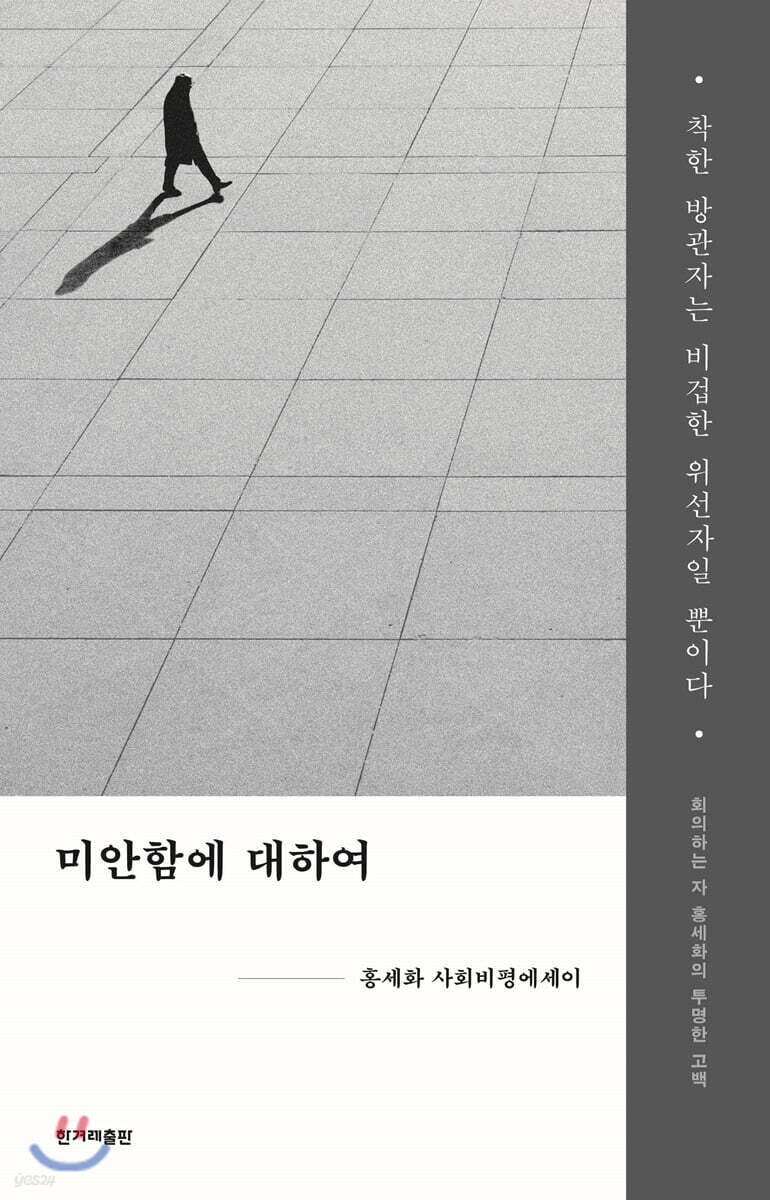
“A good bystander is nothing but a cowardly hypocrite.”
Hong Se-hwa's Transparent Confession
Progressive intellectual Hong Se-hwa has compiled into a book the columns he wrote for the Hankyoreh over the past six years since April 16, 2014.
In the preface of this book, the author confesses that he wrote about the 'regret' within himself.
Fortunately, the “survivors” feel sorry for the Sewol ferry students who died so helplessly, for the sexual minorities suffering in the swamp of irrationality and fanaticism, and for the refugees and migrant workers.
Hong Se-hwa sees the inheritance of poverty, not the inheritance of wealth.
He asks us.
In a society where poverty is a sin, when the poor cannot speak for themselves, whether out of envy or jealousy, let's look at inherited poverty instead of seeing the inheritance of wealth.
So, I say, let's raise our voices with all our might to reduce the pain, unhappiness, and anxiety here and now.
The author speaks to people from the same place.
Are you not confirming your own ethical superiority and becoming self-satisfied by simply lamenting?
It is easy to hate and lament the world.
It is difficult to move beyond lament to anger, and beyond anger to participation, solidarity, and persuasion.
If everyone gave up on trying to persuade others, how could we possibly bring about change in the world?
Meaningful work is always difficult.
It's not that the path we take is difficult, but that it is difficult and that's why we must take it.
In an interview with Le Monde, Thomas Piketty said that we have no choice but to rely on democracy until the end.
“I do not write books for those who rule us.
They don't read books anyway.
I write books for people who read books.
“Written for citizens, union members, and political activists of all stripes.”
Hong Se-hwa's Transparent Confession
Progressive intellectual Hong Se-hwa has compiled into a book the columns he wrote for the Hankyoreh over the past six years since April 16, 2014.
In the preface of this book, the author confesses that he wrote about the 'regret' within himself.
Fortunately, the “survivors” feel sorry for the Sewol ferry students who died so helplessly, for the sexual minorities suffering in the swamp of irrationality and fanaticism, and for the refugees and migrant workers.
Hong Se-hwa sees the inheritance of poverty, not the inheritance of wealth.
He asks us.
In a society where poverty is a sin, when the poor cannot speak for themselves, whether out of envy or jealousy, let's look at inherited poverty instead of seeing the inheritance of wealth.
So, I say, let's raise our voices with all our might to reduce the pain, unhappiness, and anxiety here and now.
The author speaks to people from the same place.
Are you not confirming your own ethical superiority and becoming self-satisfied by simply lamenting?
It is easy to hate and lament the world.
It is difficult to move beyond lament to anger, and beyond anger to participation, solidarity, and persuasion.
If everyone gave up on trying to persuade others, how could we possibly bring about change in the world?
Meaningful work is always difficult.
It's not that the path we take is difficult, but that it is difficult and that's why we must take it.
In an interview with Le Monde, Thomas Piketty said that we have no choice but to rely on democracy until the end.
“I do not write books for those who rule us.
They don't read books anyway.
I write books for people who read books.
“Written for citizens, union members, and political activists of all stripes.”
- You can preview some of the book's contents.
Preview
index
The Regret of the Survivor
Part 1: Are Human Bodies Equal?
A Tale of Two Workers
We are Kim Yong-gyun
Layers of arrogance
I will keep talking
Workers who became 'chimney farmers'
Part 2 If even one person is not free
I am Alaida
A good bystander is a cowardly hypocrite
The Root of Hatred
Century of Liberation
Part 3: I'm sorry to the children
The trap of confirmation bias
Don't tell me to have a child
I feel sorry for the children
Beyond Intellectual Racism
The responsibility to break the chain
For the schools of the Democratic Republic
Part 4: Holding an impossible dream in my heart
The inheritance of poverty and politics
To keep memories
The fear of asymmetry
For real freedom
“Pants for the next revolution”
They say justice has no power, but
“Why don’t you buy milk?”
If it's a holy place, it's a holy place
In the land of the perpetrators
How would you act?
Part 5 Even though there is a long way to go
What is progress?
The politics of unabashed corruption
Symbolic Violence and the Neoliberalization of the Mind
The Trap of Controlled Nationalism
Building a new fortress
For a humane life for all
Machiavelli's humility
A turbulent golden age and a frightening imagination
Every nation has its own level of government.
Where is the opposition's wildness?
Something more frightening than terrorism
The empty space of the scream
Even if there is a long way to go
Part 1: Are Human Bodies Equal?
A Tale of Two Workers
We are Kim Yong-gyun
Layers of arrogance
I will keep talking
Workers who became 'chimney farmers'
Part 2 If even one person is not free
I am Alaida
A good bystander is a cowardly hypocrite
The Root of Hatred
Century of Liberation
Part 3: I'm sorry to the children
The trap of confirmation bias
Don't tell me to have a child
I feel sorry for the children
Beyond Intellectual Racism
The responsibility to break the chain
For the schools of the Democratic Republic
Part 4: Holding an impossible dream in my heart
The inheritance of poverty and politics
To keep memories
The fear of asymmetry
For real freedom
“Pants for the next revolution”
They say justice has no power, but
“Why don’t you buy milk?”
If it's a holy place, it's a holy place
In the land of the perpetrators
How would you act?
Part 5 Even though there is a long way to go
What is progress?
The politics of unabashed corruption
Symbolic Violence and the Neoliberalization of the Mind
The Trap of Controlled Nationalism
Building a new fortress
For a humane life for all
Machiavelli's humility
A turbulent golden age and a frightening imagination
Every nation has its own level of government.
Where is the opposition's wildness?
Something more frightening than terrorism
The empty space of the scream
Even if there is a long way to go
Into the book
We must become free agents wherever our bodies reside: at home, in our places of learning, and at work.
That's human nature.
--- p.13
Hate is stronger than love.
For example, even among those who love Chun Doo-hwan (Jeon Sa-mo), the feeling of hatred towards the opposition party is much stronger than the feeling of love for Chun Doo-hwan.
Just as love blinds us, hate paralyzes our reason.
--- p.48
Education has become a means to possession rather than an end in itself, and students have become customers before they become citizens.
(…) Citizens are aware of the duties and responsibilities that come with freedom and rights, but customers only exercise purchasing power and do not have a sense of duties and responsibilities.
--- p.68~69
Reality mocks the sacrament of words.
--- p.83
The reason I actively support basic income is because of the desperate situation that young people in Korea are facing.
As a member of the older generation, I feel a sense of ethical guilt, and for me, the Republic of Korea has never been a democratic republic.
It is a country ruled by the social aristocracy, where the privileged class has been strengthened and maintained through the inheritance of wealth.
--- p.121
People who have difficulty paying a fine of 1 to 2 million won, people who do not have money themselves and find it difficult to borrow money from family and friends.
I hardly ever remember meeting such people in person around me.
But there were so many people like that in the world, and the world was divided like luxury apartments and rental apartments.
I also used the expression 'marginalized and abandoned people', but it was closer to an idea.
Michel Foucault, author of Discipline and Punish, criticized intellectuals who did not put into practice their work while introducing the work of forming a prison watch group with colleagues and juniors.
The arrows of criticism should have been aimed at me first.
--- p.137
In an interview with Le Monde, Thomas Piketty said that we have no choice but to rely on democracy until the end.
“I do not write books for those who rule us.
They don't read books anyway.
I write books for people who read books.
“Written for citizens, union members, and political activists of all stripes.”
--- p.153
What good are these words now? Children who, with their meager means, saved their pocket money to send their children on school trips will never return to their parents.
As a member of society living in this era, I am truly sorry and ashamed to the victims and their families.
The incompetence to stop this wrong trend in society is a great sin, and I am ashamed to even say that I pray for the souls of the deceased.
What more can I say?
--- p.160
Currently, Korea's progressive forces are targeting the prosecution and one or two media outlets, keeping them hidden within their camp.
If Prosecutor General Yoon Seok-yeol were to step down, wouldn't this be an alarming time when the progressive forces' work would be almost over?
--- p.167
Politics converged with governance and administration, the squares once heated by candlelight gave way to markets, and citizens returned to being consumers.
--- p.192
One of the traps we can easily fall into is to remain complacent, confirming our own ethical superiority through lamentation.
In reality, it is easy to lament that the world is disgusting.
We must learn to go beyond lament and become angry, and beyond anger, we must learn to participate, to unite, and to persuade.
If people are so stubborn about their existing ideas that it's hard to convince them, and if we give up on trying to convince them, how can we possibly bring about change in the world?
Meaningful work is always difficult.
Let's review it again.
It's not that the path we take is difficult, but that it is difficult, and that's why we must take it.
That's human nature.
--- p.13
Hate is stronger than love.
For example, even among those who love Chun Doo-hwan (Jeon Sa-mo), the feeling of hatred towards the opposition party is much stronger than the feeling of love for Chun Doo-hwan.
Just as love blinds us, hate paralyzes our reason.
--- p.48
Education has become a means to possession rather than an end in itself, and students have become customers before they become citizens.
(…) Citizens are aware of the duties and responsibilities that come with freedom and rights, but customers only exercise purchasing power and do not have a sense of duties and responsibilities.
--- p.68~69
Reality mocks the sacrament of words.
--- p.83
The reason I actively support basic income is because of the desperate situation that young people in Korea are facing.
As a member of the older generation, I feel a sense of ethical guilt, and for me, the Republic of Korea has never been a democratic republic.
It is a country ruled by the social aristocracy, where the privileged class has been strengthened and maintained through the inheritance of wealth.
--- p.121
People who have difficulty paying a fine of 1 to 2 million won, people who do not have money themselves and find it difficult to borrow money from family and friends.
I hardly ever remember meeting such people in person around me.
But there were so many people like that in the world, and the world was divided like luxury apartments and rental apartments.
I also used the expression 'marginalized and abandoned people', but it was closer to an idea.
Michel Foucault, author of Discipline and Punish, criticized intellectuals who did not put into practice their work while introducing the work of forming a prison watch group with colleagues and juniors.
The arrows of criticism should have been aimed at me first.
--- p.137
In an interview with Le Monde, Thomas Piketty said that we have no choice but to rely on democracy until the end.
“I do not write books for those who rule us.
They don't read books anyway.
I write books for people who read books.
“Written for citizens, union members, and political activists of all stripes.”
--- p.153
What good are these words now? Children who, with their meager means, saved their pocket money to send their children on school trips will never return to their parents.
As a member of society living in this era, I am truly sorry and ashamed to the victims and their families.
The incompetence to stop this wrong trend in society is a great sin, and I am ashamed to even say that I pray for the souls of the deceased.
What more can I say?
--- p.160
Currently, Korea's progressive forces are targeting the prosecution and one or two media outlets, keeping them hidden within their camp.
If Prosecutor General Yoon Seok-yeol were to step down, wouldn't this be an alarming time when the progressive forces' work would be almost over?
--- p.167
Politics converged with governance and administration, the squares once heated by candlelight gave way to markets, and citizens returned to being consumers.
--- p.192
One of the traps we can easily fall into is to remain complacent, confirming our own ethical superiority through lamentation.
In reality, it is easy to lament that the world is disgusting.
We must learn to go beyond lament and become angry, and beyond anger, we must learn to participate, to unite, and to persuade.
If people are so stubborn about their existing ideas that it's hard to convince them, and if we give up on trying to convince them, how can we possibly bring about change in the world?
Meaningful work is always difficult.
Let's review it again.
It's not that the path we take is difficult, but that it is difficult, and that's why we must take it.
--- p.239
Publisher's Review
“We forget easily.”
Hong Se-hwa exposes the reality obscured by the sacrament of words.
Where is the center and where is the periphery? The author believes the center is merely a point.
When points outside the center are connected, the line becomes the periphery.
It is not the center but the periphery that social contradictions are sharply revealed and human suffering and unhappiness are brought to light.
So, the place that opens up a new world is also the frontier.
The author closely examines the periphery of our society.
In Part 1, “Are Human Bodies Equal?” the author reflects on the lives of working people.
Korea has the highest industrial accident death rate among member countries of the Organization for Economic Cooperation and Development (OECD), with over 2,000 deaths per year.
In the first half of 2020, when the world's attention was focused on the coronavirus and prosecutorial reform, on April 29, 38 irregular subcontracted workers died in a fire at a warehouse in Icheon, Gyeonggi Province; on May 10, security guard Choi Hee-seok took his own life in an apartment in Ui-dong, Gangbuk-gu, Seoul; and on May 29, laid-off Samsung worker Kim Yong-hee came down from a steel tower at Gangnam Station after 355 days.
Our society excludes working people from citizenship.
The author says that human nature is to be “a free subject wherever the body resides: at home, in school, and at work.”
Part 2, “If Even One Person Is Not Free,” criticizes the distorted landscape that hatred has left in our society.
The author defines disgust as an emotion that exerts political power.
In 2017, the Moon Jae-in administration excluded anti-discrimination legislation from its 100 key national tasks, its supporters declared that the existence of sexual minorities was a "later" issue, and in July 2018, 710,000 Koreans signed a petition rejecting the refugee applications of around 500 Yemenis.
The author confesses that he is an Ally (a person who opposes discrimination against sexual minorities and stands in solidarity for an equal society) and shouts, “A society in which even one person is not free is not a free society.”
Part 3, “I’m Sorry to the Children,” argues that in a society where consciousness betrays existence, the true purpose and function of education must be restored.
In our society, education has become a means to possession rather than an end in itself, and students have become customers before they become citizens.
How did these results come about despite the world's longest study time? The author believes the core of the problem lies in the separation of "learning" and "thinking."
If learning is acquiring knowledge, thinking is 'I' thinking on the basis of learning.
Our education stops at learning and does not help us think for ourselves.
Without 'me', we cannot have self-esteem and self-respect, and we cannot form self-consciousness.
Part 4, “Holding an Impossible Dream in Your Heart,” examines the poverty and discrimination prevalent in the Democratic Republic.
The reality of 'Hell Joseon' is in the numbers.
In 2015, an average of five people died from industrial accidents every day, and 38 people committed suicide.
But what is surprising is that this hellish Joseon exists and does not exist at the same time.
The group that rules our society does not see or feel Hell Joseon.
This asymmetry may be the most Hell Joseon-like aspect.
Part 5, “Even if there is a long way to go,” critically examines the reality and future of progressive politics.
The author asks:
"What makes the Moon Jae-in administration progressive?" In "The Cho Kuk Situation," the author confesses to seeing the shadow of greed that leads people to do everything possible to win in competition.
Whether that greed is illegal or not is a secondary issue.
He bitterly remarks that as 'neoliberalism of the mind' has now reached its final stage, the values of solidarity, social justice, and publicness have become objects of ridicule and remain as the echoless cries of the weak.
Politics converged with governance and administration, the squares once heated by candlelight gave way to markets, and citizens returned to being consumers.
“There is a survivor’s regret inside me.”
Intelligence and compassion, sharp critical thinking and a warm gaze
After the author took over as the head of Jean Valjean Bank, the world he saw was a world divided like a rental apartment in a luxury apartment complex.
Every year, 40,000 people find it difficult to pay fines of less than 2 million won, and those who do not have the money themselves and cannot borrow money from family and friends.
Until then, the expression 'marginalized and abandoned people' had been used, but it was only an idea that did not reflect reality.
The reality of 'the guilty until proven innocent, the innocent until proven guilty' is that not having money is not only a crime, but also a crime that leads to crime.
For the author, who feels ethically guilty as a member of the older generation, the Republic of Korea has never been a democratic republic.
To the author, South Korea is a country of social aristocracy where those born with a silver spoon in their mouths have inherited wealth and strengthened and maintained their vested interests.
In South Korea, most of the instability factors in life are passed on to families and individuals.
In human society, if someone is in a situation where they need the kindness and charity of others, that in itself means that their dignity has already been violated.
Is a society where dignity, not wealth or poverty, is inherited? For the 26 years since "I Am a Parisian Taxi Driver," the author has consistently cried out from the same spot until his throat was hoarse.
Let's be angry, let's get involved, let's be in solidarity, let's persuade.
This book is a desperate voice from progressive intellectual Hong Se-hwa.
Hong Se-hwa exposes the reality obscured by the sacrament of words.
Where is the center and where is the periphery? The author believes the center is merely a point.
When points outside the center are connected, the line becomes the periphery.
It is not the center but the periphery that social contradictions are sharply revealed and human suffering and unhappiness are brought to light.
So, the place that opens up a new world is also the frontier.
The author closely examines the periphery of our society.
In Part 1, “Are Human Bodies Equal?” the author reflects on the lives of working people.
Korea has the highest industrial accident death rate among member countries of the Organization for Economic Cooperation and Development (OECD), with over 2,000 deaths per year.
In the first half of 2020, when the world's attention was focused on the coronavirus and prosecutorial reform, on April 29, 38 irregular subcontracted workers died in a fire at a warehouse in Icheon, Gyeonggi Province; on May 10, security guard Choi Hee-seok took his own life in an apartment in Ui-dong, Gangbuk-gu, Seoul; and on May 29, laid-off Samsung worker Kim Yong-hee came down from a steel tower at Gangnam Station after 355 days.
Our society excludes working people from citizenship.
The author says that human nature is to be “a free subject wherever the body resides: at home, in school, and at work.”
Part 2, “If Even One Person Is Not Free,” criticizes the distorted landscape that hatred has left in our society.
The author defines disgust as an emotion that exerts political power.
In 2017, the Moon Jae-in administration excluded anti-discrimination legislation from its 100 key national tasks, its supporters declared that the existence of sexual minorities was a "later" issue, and in July 2018, 710,000 Koreans signed a petition rejecting the refugee applications of around 500 Yemenis.
The author confesses that he is an Ally (a person who opposes discrimination against sexual minorities and stands in solidarity for an equal society) and shouts, “A society in which even one person is not free is not a free society.”
Part 3, “I’m Sorry to the Children,” argues that in a society where consciousness betrays existence, the true purpose and function of education must be restored.
In our society, education has become a means to possession rather than an end in itself, and students have become customers before they become citizens.
How did these results come about despite the world's longest study time? The author believes the core of the problem lies in the separation of "learning" and "thinking."
If learning is acquiring knowledge, thinking is 'I' thinking on the basis of learning.
Our education stops at learning and does not help us think for ourselves.
Without 'me', we cannot have self-esteem and self-respect, and we cannot form self-consciousness.
Part 4, “Holding an Impossible Dream in Your Heart,” examines the poverty and discrimination prevalent in the Democratic Republic.
The reality of 'Hell Joseon' is in the numbers.
In 2015, an average of five people died from industrial accidents every day, and 38 people committed suicide.
But what is surprising is that this hellish Joseon exists and does not exist at the same time.
The group that rules our society does not see or feel Hell Joseon.
This asymmetry may be the most Hell Joseon-like aspect.
Part 5, “Even if there is a long way to go,” critically examines the reality and future of progressive politics.
The author asks:
"What makes the Moon Jae-in administration progressive?" In "The Cho Kuk Situation," the author confesses to seeing the shadow of greed that leads people to do everything possible to win in competition.
Whether that greed is illegal or not is a secondary issue.
He bitterly remarks that as 'neoliberalism of the mind' has now reached its final stage, the values of solidarity, social justice, and publicness have become objects of ridicule and remain as the echoless cries of the weak.
Politics converged with governance and administration, the squares once heated by candlelight gave way to markets, and citizens returned to being consumers.
“There is a survivor’s regret inside me.”
Intelligence and compassion, sharp critical thinking and a warm gaze
After the author took over as the head of Jean Valjean Bank, the world he saw was a world divided like a rental apartment in a luxury apartment complex.
Every year, 40,000 people find it difficult to pay fines of less than 2 million won, and those who do not have the money themselves and cannot borrow money from family and friends.
Until then, the expression 'marginalized and abandoned people' had been used, but it was only an idea that did not reflect reality.
The reality of 'the guilty until proven innocent, the innocent until proven guilty' is that not having money is not only a crime, but also a crime that leads to crime.
For the author, who feels ethically guilty as a member of the older generation, the Republic of Korea has never been a democratic republic.
To the author, South Korea is a country of social aristocracy where those born with a silver spoon in their mouths have inherited wealth and strengthened and maintained their vested interests.
In South Korea, most of the instability factors in life are passed on to families and individuals.
In human society, if someone is in a situation where they need the kindness and charity of others, that in itself means that their dignity has already been violated.
Is a society where dignity, not wealth or poverty, is inherited? For the 26 years since "I Am a Parisian Taxi Driver," the author has consistently cried out from the same spot until his throat was hoarse.
Let's be angry, let's get involved, let's be in solidarity, let's persuade.
This book is a desperate voice from progressive intellectual Hong Se-hwa.
GOODS SPECIFICS
- Date of publication: August 28, 2020
- Page count, weight, size: 240 pages | 386g | 138*215*20mm
- ISBN13: 9791160404197
- ISBN10: 1160404194
You may also like
카테고리
korean


korean

![GQ KOREA Mark (Monthly): December [2025]](http://librairie.coreenne.fr/cdn/shop/files/8ef265dbbfbf186523ed75ba7319009d.jpg?v=1765340328&width=3840)


