

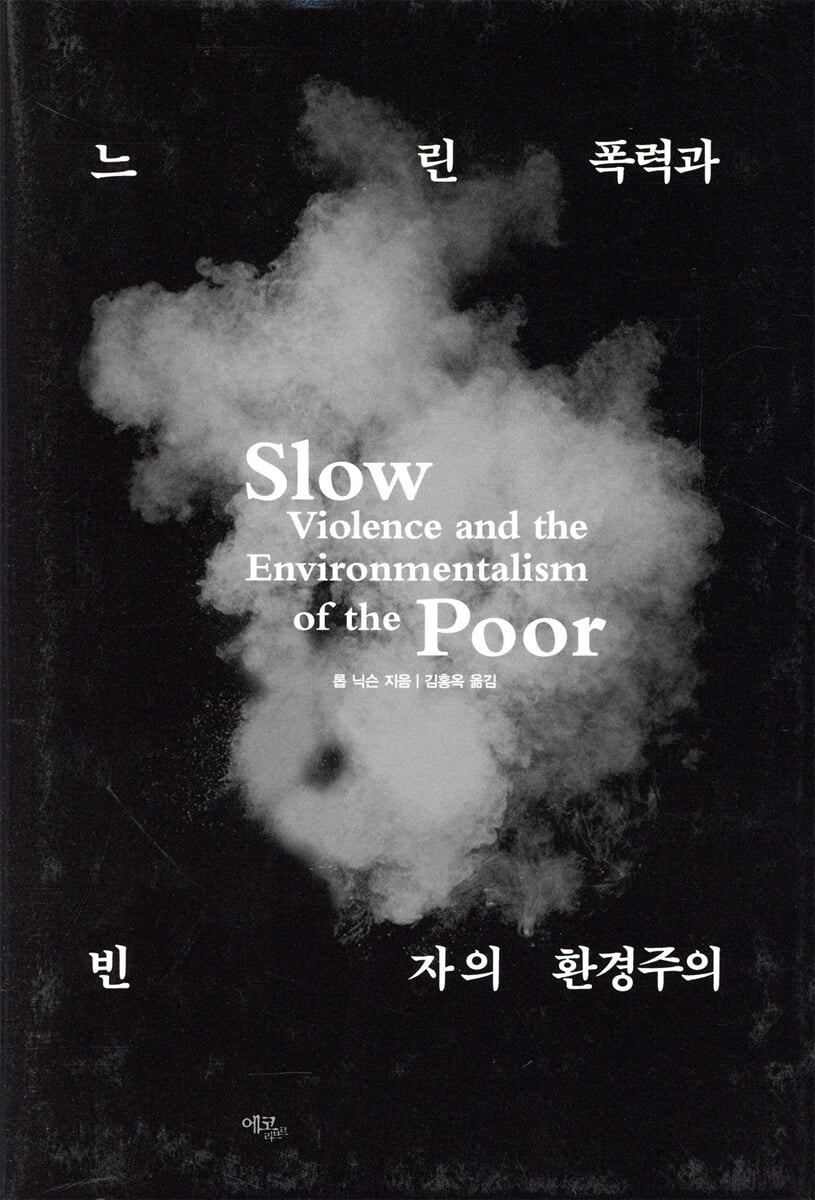
Slow Violence and the Environmentalism of the Poor
 |
Description
Book Introduction
Slow violence still occurs around the world, creating poverty.
I believe the economic logic behind the dumping of toxic waste in low-income countries is flawless, and I believe we should accept it.
… … I used to think that African countries had low levels of pollution.
But the country's air quality is so poor that it's inefficient compared to Los Angeles.
… … Just between us, what if the World Bank encouraged more polluting industries to be relocated to the poorest countries?
-Lawrence Summers, World Bank confidential memo (December 12, 1991)
The reason I quoted Summers's article first is because the author of the book mentions that African countries have been triple-neglected.
The author explains the reason as follows:
“First, as a political actor; second, as a long-term victim of what I call ‘slow violence’ in this book; and third, as a culture with its own environmental practices and concerns.
“I open with Summers’s startling proposition precisely because I see it as containing the strategic and expressive challenges that slow violence poses as it impacts the environmentalism of the poor.”
I believe the economic logic behind the dumping of toxic waste in low-income countries is flawless, and I believe we should accept it.
… … I used to think that African countries had low levels of pollution.
But the country's air quality is so poor that it's inefficient compared to Los Angeles.
… … Just between us, what if the World Bank encouraged more polluting industries to be relocated to the poorest countries?
-Lawrence Summers, World Bank confidential memo (December 12, 1991)
The reason I quoted Summers's article first is because the author of the book mentions that African countries have been triple-neglected.
The author explains the reason as follows:
“First, as a political actor; second, as a long-term victim of what I call ‘slow violence’ in this book; and third, as a culture with its own environmental practices and concerns.
“I open with Summers’s startling proposition precisely because I see it as containing the strategic and expressive challenges that slow violence poses as it impacts the environmentalism of the poor.”
- You can preview some of the book's contents.
Preview
index
introduction
preface
1 Slow Violence, Neoliberalism, and Environmental Picaresque
2. Fast-Forward Fossils: Oil Dictatorship and the Resource Curse
3 Pipe Dreams: Ken Saro-wiwa, Environmental Justice, and the Rights of Minorities
4 Slow Violence, Gender, and the Environmentalism of the Poor
5 Unimagined Communities: Megadams, Monuments of Modernity, and Development Refugees
6 Strangers in Ecovillages: Race, Tourism, and the Environment
7 The Ecology of Aftereffects: Precision Strikes and Slow Violence
8 Environmentalism, Postcolonialism, and American Studies
Conclusion: A View from the Sea: The Future of Resistance
main
Acknowledgements
Translator's Note
Search
preface
1 Slow Violence, Neoliberalism, and Environmental Picaresque
2. Fast-Forward Fossils: Oil Dictatorship and the Resource Curse
3 Pipe Dreams: Ken Saro-wiwa, Environmental Justice, and the Rights of Minorities
4 Slow Violence, Gender, and the Environmentalism of the Poor
5 Unimagined Communities: Megadams, Monuments of Modernity, and Development Refugees
6 Strangers in Ecovillages: Race, Tourism, and the Environment
7 The Ecology of Aftereffects: Precision Strikes and Slow Violence
8 Environmentalism, Postcolonialism, and American Studies
Conclusion: A View from the Sea: The Future of Resistance
main
Acknowledgements
Translator's Note
Search
Publisher's Review
Slow violence still occurs around the world, creating poverty.
I believe the economic logic behind the dumping of toxic waste in low-income countries is flawless, and I believe we should accept it.
… … I used to think that African countries had low levels of pollution.
But the country's air quality is so poor that it's inefficient compared to Los Angeles.
… … Just between us, what if the World Bank encouraged more polluting industries to be relocated to the poorest countries?
-Lawrence Summers, World Bank confidential memo (December 12, 1991)
The reason I quoted Summers's article first is because the author of the book mentions that African countries have been triple-neglected.
The author explains the reason as follows:
“First, as a political actor; second, as a long-term victim of what I call ‘slow violence’ in this book; and third, as a culture with its own environmental practices and concerns.
“I open with Summers’s startling proposition precisely because I see it as containing the strategic and expressive challenges that slow violence poses as it impacts the environmentalism of the poor.”
Three concerns that form the core of this book
The first is the author's belief that there is a need for a political, creative, and theoretical rethinking of what he considers most important and what he calls "slow violence."
What the author means by the expression "slow violence" is violence that happens unseen, time-delayed destruction that spreads widely across space and time, and violence that occurs over long periods of time that is not generally considered violence at all.
Violence conventionally refers to events or actions that are immediate in time and explosive or dramatic in space, that is, shocking and unfold right before our eyes.
The author believes we need to consider a different kind of violence, one that is neither dramatic nor immediate, but that grows and accumulates, and whose impact spreads over vast timescales.
I also believe that we must pay attention to the expressive, narrative, and strategic challenges that arise from the invisibility of slow violence.
Climate change, the melting ice sheet, the movement of toxic substances, biomagnification, deforestation, the radioactive fallout from war, ocean acidification, and countless other unfolding environmental disasters present enormous expressive barriers that hinder efforts to unite and take decisive action.
The toxins from war, the long-term human and ecological destruction caused by climate change, and the appalling neglect of those who have been victims are neither remembered nor properly represented in strategic planning.
A second concern is the environmentalism of the poor.
Because the main victims of slow violence are the poor and resource-deprived.
The poverty of the invisible is exacerbated by the invisibility of the slow violence that permeates so many areas of life.
The contemporary media's tendency toward visible violence exacerbates the vulnerability of the ecosystem, which is treated as disposable by turbo-capitalism (a capitalism that lacks measures to maintain social equilibrium and quell social unrest), while also exacerbating the vulnerability of what Kevin Bales, in another book, calls "disposable people."
We have seen a resurgence of poor people's environmentalism, which opposes the disposable view of both ecosystems and humans, largely (though not exclusively) in the so-called Global South.
The key issue that arises accordingly is strategy.
In other words, the neoliberal era has strengthened the attack on resources, but at the same time, it has also intensified resistance to it.
Whether that resistance is a struggle confined to a specific, isolated location, or grounded in activism that transcends national boundaries as part of an effort to build solidarity across regions.
A third concern is the role of environmental writer-activists in providing visibility to connect slow violence and the environmentalism of the poor.
Fueled by their keen imagination and passion for the world, they contribute to advancing the cause of environmentally disadvantaged groups that the media often ignores.
The topics they focus on are transnational phenomena like petroleum imperialism, the mega-dam industry, the outsourcing of toxic substances, neocolonial tourism, inhumane conservation practices, the deregulation of business and the environment, and the militarization of commerce—phenomena that particularly threaten the livelihoods, prospects, and memory mechanisms of the poor, who are disproportionately concentrated in the Global South.
Aldo Leopold said, “We can only take an ethical attitude towards what we can see for ourselves.”
It is difficult to act ethically toward human and living communities that are outside our sensory realm.
Therefore, there is a need to visualize slow violence and challenge the privileges enjoyed by those who are already visible.
This is where writer-activists come into play.
They lead us to imagine and understand dangers that are difficult for our senses to perceive (because they are geographically distant, too minute or too vast in scale, or occur beyond the observational or physiological lifespan of a human observer).
Their narrative imagination provides us with a different kind of testimony than ever before: a testimony of an invisible landscape.
The development of this book
Building on these three pillars, each chapter of the text presents a representative writer-activist and the examples of slow violence they have highlighted.
Chapter 1, “Slow Violence, Neoliberalism, and Environmental Picaresque,” is based on the gas leak at the Union Carbide plant in Bhopal, India, in December 1984, and uses Indra Sinha’s novel “Animals’ People” as its main text.
Chapter 2, “Fast-Forward Fossils: The Oil Dictatorship and the Resource Curse,” exposes the reality of Saudi Arabia’s resource curse caused by the plunder of big oil companies through Abdelrahman Munif’s five-part novel, “Salt City.”
Chapter 3, “Pipe Dream: Ken Saro-Wiwa, Environmental Justice, and the Rights of Minorities,” features Ken Saro-Wiwa.
He was a writer and activist who was executed by the Nigerian regime for representing the minority ethnic groups in the Niger Delta who suffered damage from oil extraction by oil companies Shell and Chevron.
Chapter 4, “Slow Violence, Gender, and the Environmentalism of the Poor,” features Wangari Maathai, a Kenyan writer and activist who led the Green Belt Movement against land loss and desertification.
Chapter 5, “Unimagined Communities: Megadams, Monuments of Modernity, and Development Refugees,” discusses the construction of megadams, particularly in the Third World.
Arundhati Roy's book, The Greater Common Good, sheds light on the issue of development refugees related to the construction of the Sardar Sarovar Dam on the Narmada River in India.
Chapter 6, “Strangers in Ecovillages: Race, Tourism, and Environmental Time,” addresses the trauma of forced displacement in South Africa’s enclosure ecology, typified by game reserves and indigenous reserves.
The main texts include the author's visit to a game lodge in South Africa, Njabulo Ndebele's essay "Game Lodges and Leisure Colonists," James Baldwin's essay "The Stranger in the Village," and Nadine Gordimer's short story "The Best Safari."
Chapter 7, “The Ecology of Aftereffects: Precision Strikes and Slow Violence,” examines the aftermath of modern wars such as the Gulf War and the Iraq War.
It addresses the ecology of the aftermath of war by contrasting the perspectives of Michael Kelly, author of Martyr's Day: Chronicles of a Little War, with the life of Carol Picoux, who experienced the Gulf War firsthand as an Army nurse.
Chapter 8, “Environmentalism, Postcolonialism, and American Studies,” introduces the process of reconciliation between postcolonial studies and environmental studies, which have long been at odds, and proposes a provincialization of American studies (i.e., viewing the United States from an external perspective and adjusting its position in the world).
This trend is also influencing environmentalism, shifting its intellectual flow away from an American exceptionalist tendency focused on domestic issues like wilderness ethics toward a more diverse environmental approach—one that is more compatible with the underlying forces of the global environmental movement.
The Role of the Writer and the Future of Resistance
As this book shows, superpowers like the United States and multinational corporations have secretly committed a variety of violence on a global scale to maintain an appearance of wealth and peace.
And it's still the same now.
But the important thing is that we are faced with the problem of how to make these dramatic events known to the world.
So how do we make visible and act accordingly on the slow, long-term violence that threatens sustainable security at local, national, and global levels? Especially in an age where new digital media seem to overvalue what's happening now.
So the important question of strategy remains.
The question is how we can combine the stamina of activists with the agility of new media as we pursue stronger transnational solidarity.
At the end of the book, the author addresses the difficult topic of Jean-Paul Sartre's "literary commitment," quoting his description of the writer as "a being who has chosen a kind of secondary practice, a practice of so-called revelation."
But now, contrary to Sartre's conviction, innovations in exposure technology have transformed the meaning of these secondary practices beyond recognition.
So “writer” has become an increasingly common title.
Participatory writing will never again be a Sartrean professional calling.
This is because we have entered the era of the so-called writer-hacker activist [hacktivist: a new word combining the words hacker and activist, referring to people who break into computer systems and promote agendas related to political and social movements].
Some writer-activists are quick-hit workers, while others are involved with a long-term perspective.
They strive to bring a sense of urgency to issues that might otherwise be relegated to the margins by technological, neurobiological, and politically indifferent forces.
Whether our increasingly connected and distracted era exacerbates or mitigates myopic thinking about environmental destruction will largely depend on the political action of ordinary people.
Could the vast rebellious energy that seeks to defend information commons (systems for handling information, such as online communities or public libraries) also contribute to the equally vigorous defense of environmental commons—the oceans, the atmosphere, the land?
New media may not be a panacea, but if used with creative vigilance, they have the potential to emerge as a resource of hope within a broad coalition advancing environmental justice.
Such a coalition must draw on strategic energy and empower more traditional activists: labor groups, indigenous groups, student groups, progressive scientists, activists fighting for human rights, women's rights, and civil liberties, and organized movements opposing unchecked globalization.
Within this coalition, multi-talented writer-activists will continue to play a crucial role, bringing to the surface submerged stories of injustice and resource rebellion and imbuing them with emotional power.
Although the technological landscape may change rapidly, some things remain more tenacious than ever.
An example is the belief expressed in Nadine Gordimer's words 25 years ago: "Writers who believe in social change always find ways to do so that their societies cannot even imagine, let alone demand."
I believe the economic logic behind the dumping of toxic waste in low-income countries is flawless, and I believe we should accept it.
… … I used to think that African countries had low levels of pollution.
But the country's air quality is so poor that it's inefficient compared to Los Angeles.
… … Just between us, what if the World Bank encouraged more polluting industries to be relocated to the poorest countries?
-Lawrence Summers, World Bank confidential memo (December 12, 1991)
The reason I quoted Summers's article first is because the author of the book mentions that African countries have been triple-neglected.
The author explains the reason as follows:
“First, as a political actor; second, as a long-term victim of what I call ‘slow violence’ in this book; and third, as a culture with its own environmental practices and concerns.
“I open with Summers’s startling proposition precisely because I see it as containing the strategic and expressive challenges that slow violence poses as it impacts the environmentalism of the poor.”
Three concerns that form the core of this book
The first is the author's belief that there is a need for a political, creative, and theoretical rethinking of what he considers most important and what he calls "slow violence."
What the author means by the expression "slow violence" is violence that happens unseen, time-delayed destruction that spreads widely across space and time, and violence that occurs over long periods of time that is not generally considered violence at all.
Violence conventionally refers to events or actions that are immediate in time and explosive or dramatic in space, that is, shocking and unfold right before our eyes.
The author believes we need to consider a different kind of violence, one that is neither dramatic nor immediate, but that grows and accumulates, and whose impact spreads over vast timescales.
I also believe that we must pay attention to the expressive, narrative, and strategic challenges that arise from the invisibility of slow violence.
Climate change, the melting ice sheet, the movement of toxic substances, biomagnification, deforestation, the radioactive fallout from war, ocean acidification, and countless other unfolding environmental disasters present enormous expressive barriers that hinder efforts to unite and take decisive action.
The toxins from war, the long-term human and ecological destruction caused by climate change, and the appalling neglect of those who have been victims are neither remembered nor properly represented in strategic planning.
A second concern is the environmentalism of the poor.
Because the main victims of slow violence are the poor and resource-deprived.
The poverty of the invisible is exacerbated by the invisibility of the slow violence that permeates so many areas of life.
The contemporary media's tendency toward visible violence exacerbates the vulnerability of the ecosystem, which is treated as disposable by turbo-capitalism (a capitalism that lacks measures to maintain social equilibrium and quell social unrest), while also exacerbating the vulnerability of what Kevin Bales, in another book, calls "disposable people."
We have seen a resurgence of poor people's environmentalism, which opposes the disposable view of both ecosystems and humans, largely (though not exclusively) in the so-called Global South.
The key issue that arises accordingly is strategy.
In other words, the neoliberal era has strengthened the attack on resources, but at the same time, it has also intensified resistance to it.
Whether that resistance is a struggle confined to a specific, isolated location, or grounded in activism that transcends national boundaries as part of an effort to build solidarity across regions.
A third concern is the role of environmental writer-activists in providing visibility to connect slow violence and the environmentalism of the poor.
Fueled by their keen imagination and passion for the world, they contribute to advancing the cause of environmentally disadvantaged groups that the media often ignores.
The topics they focus on are transnational phenomena like petroleum imperialism, the mega-dam industry, the outsourcing of toxic substances, neocolonial tourism, inhumane conservation practices, the deregulation of business and the environment, and the militarization of commerce—phenomena that particularly threaten the livelihoods, prospects, and memory mechanisms of the poor, who are disproportionately concentrated in the Global South.
Aldo Leopold said, “We can only take an ethical attitude towards what we can see for ourselves.”
It is difficult to act ethically toward human and living communities that are outside our sensory realm.
Therefore, there is a need to visualize slow violence and challenge the privileges enjoyed by those who are already visible.
This is where writer-activists come into play.
They lead us to imagine and understand dangers that are difficult for our senses to perceive (because they are geographically distant, too minute or too vast in scale, or occur beyond the observational or physiological lifespan of a human observer).
Their narrative imagination provides us with a different kind of testimony than ever before: a testimony of an invisible landscape.
The development of this book
Building on these three pillars, each chapter of the text presents a representative writer-activist and the examples of slow violence they have highlighted.
Chapter 1, “Slow Violence, Neoliberalism, and Environmental Picaresque,” is based on the gas leak at the Union Carbide plant in Bhopal, India, in December 1984, and uses Indra Sinha’s novel “Animals’ People” as its main text.
Chapter 2, “Fast-Forward Fossils: The Oil Dictatorship and the Resource Curse,” exposes the reality of Saudi Arabia’s resource curse caused by the plunder of big oil companies through Abdelrahman Munif’s five-part novel, “Salt City.”
Chapter 3, “Pipe Dream: Ken Saro-Wiwa, Environmental Justice, and the Rights of Minorities,” features Ken Saro-Wiwa.
He was a writer and activist who was executed by the Nigerian regime for representing the minority ethnic groups in the Niger Delta who suffered damage from oil extraction by oil companies Shell and Chevron.
Chapter 4, “Slow Violence, Gender, and the Environmentalism of the Poor,” features Wangari Maathai, a Kenyan writer and activist who led the Green Belt Movement against land loss and desertification.
Chapter 5, “Unimagined Communities: Megadams, Monuments of Modernity, and Development Refugees,” discusses the construction of megadams, particularly in the Third World.
Arundhati Roy's book, The Greater Common Good, sheds light on the issue of development refugees related to the construction of the Sardar Sarovar Dam on the Narmada River in India.
Chapter 6, “Strangers in Ecovillages: Race, Tourism, and Environmental Time,” addresses the trauma of forced displacement in South Africa’s enclosure ecology, typified by game reserves and indigenous reserves.
The main texts include the author's visit to a game lodge in South Africa, Njabulo Ndebele's essay "Game Lodges and Leisure Colonists," James Baldwin's essay "The Stranger in the Village," and Nadine Gordimer's short story "The Best Safari."
Chapter 7, “The Ecology of Aftereffects: Precision Strikes and Slow Violence,” examines the aftermath of modern wars such as the Gulf War and the Iraq War.
It addresses the ecology of the aftermath of war by contrasting the perspectives of Michael Kelly, author of Martyr's Day: Chronicles of a Little War, with the life of Carol Picoux, who experienced the Gulf War firsthand as an Army nurse.
Chapter 8, “Environmentalism, Postcolonialism, and American Studies,” introduces the process of reconciliation between postcolonial studies and environmental studies, which have long been at odds, and proposes a provincialization of American studies (i.e., viewing the United States from an external perspective and adjusting its position in the world).
This trend is also influencing environmentalism, shifting its intellectual flow away from an American exceptionalist tendency focused on domestic issues like wilderness ethics toward a more diverse environmental approach—one that is more compatible with the underlying forces of the global environmental movement.
The Role of the Writer and the Future of Resistance
As this book shows, superpowers like the United States and multinational corporations have secretly committed a variety of violence on a global scale to maintain an appearance of wealth and peace.
And it's still the same now.
But the important thing is that we are faced with the problem of how to make these dramatic events known to the world.
So how do we make visible and act accordingly on the slow, long-term violence that threatens sustainable security at local, national, and global levels? Especially in an age where new digital media seem to overvalue what's happening now.
So the important question of strategy remains.
The question is how we can combine the stamina of activists with the agility of new media as we pursue stronger transnational solidarity.
At the end of the book, the author addresses the difficult topic of Jean-Paul Sartre's "literary commitment," quoting his description of the writer as "a being who has chosen a kind of secondary practice, a practice of so-called revelation."
But now, contrary to Sartre's conviction, innovations in exposure technology have transformed the meaning of these secondary practices beyond recognition.
So “writer” has become an increasingly common title.
Participatory writing will never again be a Sartrean professional calling.
This is because we have entered the era of the so-called writer-hacker activist [hacktivist: a new word combining the words hacker and activist, referring to people who break into computer systems and promote agendas related to political and social movements].
Some writer-activists are quick-hit workers, while others are involved with a long-term perspective.
They strive to bring a sense of urgency to issues that might otherwise be relegated to the margins by technological, neurobiological, and politically indifferent forces.
Whether our increasingly connected and distracted era exacerbates or mitigates myopic thinking about environmental destruction will largely depend on the political action of ordinary people.
Could the vast rebellious energy that seeks to defend information commons (systems for handling information, such as online communities or public libraries) also contribute to the equally vigorous defense of environmental commons—the oceans, the atmosphere, the land?
New media may not be a panacea, but if used with creative vigilance, they have the potential to emerge as a resource of hope within a broad coalition advancing environmental justice.
Such a coalition must draw on strategic energy and empower more traditional activists: labor groups, indigenous groups, student groups, progressive scientists, activists fighting for human rights, women's rights, and civil liberties, and organized movements opposing unchecked globalization.
Within this coalition, multi-talented writer-activists will continue to play a crucial role, bringing to the surface submerged stories of injustice and resource rebellion and imbuing them with emotional power.
Although the technological landscape may change rapidly, some things remain more tenacious than ever.
An example is the belief expressed in Nadine Gordimer's words 25 years ago: "Writers who believe in social change always find ways to do so that their societies cannot even imagine, let alone demand."
GOODS SPECIFICS
- Date of publication: July 27, 2020
- Format: Hardcover book binding method guide
- Page count, weight, size: 580 pages | 914g | 148*217*35mm
- ISBN13: 9788962632118
- ISBN10: 896263211X
You may also like
카테고리
korean


korean

![GQ KOREA Mark (Monthly): December [2025]](http://librairie.coreenne.fr/cdn/shop/files/8ef265dbbfbf186523ed75ba7319009d.jpg?v=1765340328&width=3840)


