

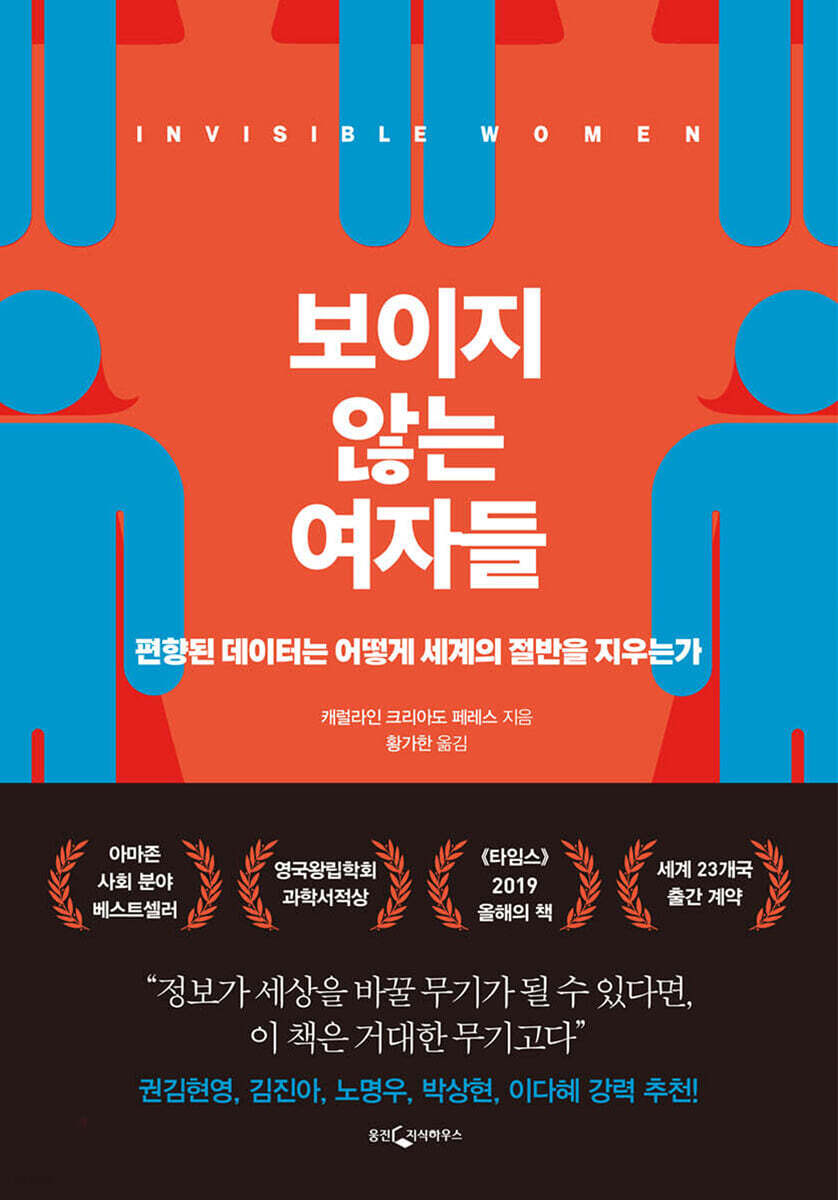
Invisible Women
 |
Description
Book Introduction
"If information can be a weapon that changes the world, this book is a massive arsenal."
The ultimate weapon for feminists against invisible discrimination and violence.
From smartphone and automobile design to healthcare, labor, and urban planning.
How do women become invisible in a world where men are the norm?
√ Winner of the Royal Society Science Book Award · [Times] Book of the Year · Amazon Social Studies Bestseller
√ [The New York Times], [The Guardian], [Forbes]… 'Gender Fact Check' garners global media attention
√ Strongly recommended by domestic intellectuals including Kwon Kim Hyun-young, Kim Jin-ah, Noh Myung-woo, Park Sang-hyun, and Lee Da-hye.
Do you keep dropping your smartphone? Do you catch colds because of the low office air conditioning? Do your masks and seat belts feel too loose or too tight, and do your prescribed medications seem to be ineffective? If so, you're probably a woman!
"Invisible Women" is a book that demonstrates how this world, designed for men and by men, excludes half the population: women.
Because of the mindset that considers men as the default human value, knowledge and information related to women are not properly collected.
The resulting data gap leaves women poor, sick, and sometimes even dead.
The author, one of Britain's most prominent feminist activists and journalists, closely examines the impact of data gaps on women and the cross-section of discrimination across 16 areas, including technology, labor, healthcare, urban planning, economics, politics, and disaster relief.
It suggests how restoring women's perspectives and knowledge, which have been hidden and overlooked, will benefit both men and women, and the world as a whole.
Based on extensive statistical data and a wealth of case studies, this book will dispel the endless debate and misconceptions surrounding gender, while providing a weapon for advancing toward a more rational and equal society.
The ultimate weapon for feminists against invisible discrimination and violence.
From smartphone and automobile design to healthcare, labor, and urban planning.
How do women become invisible in a world where men are the norm?
√ Winner of the Royal Society Science Book Award · [Times] Book of the Year · Amazon Social Studies Bestseller
√ [The New York Times], [The Guardian], [Forbes]… 'Gender Fact Check' garners global media attention
√ Strongly recommended by domestic intellectuals including Kwon Kim Hyun-young, Kim Jin-ah, Noh Myung-woo, Park Sang-hyun, and Lee Da-hye.
Do you keep dropping your smartphone? Do you catch colds because of the low office air conditioning? Do your masks and seat belts feel too loose or too tight, and do your prescribed medications seem to be ineffective? If so, you're probably a woman!
"Invisible Women" is a book that demonstrates how this world, designed for men and by men, excludes half the population: women.
Because of the mindset that considers men as the default human value, knowledge and information related to women are not properly collected.
The resulting data gap leaves women poor, sick, and sometimes even dead.
The author, one of Britain's most prominent feminist activists and journalists, closely examines the impact of data gaps on women and the cross-section of discrimination across 16 areas, including technology, labor, healthcare, urban planning, economics, politics, and disaster relief.
It suggests how restoring women's perspectives and knowledge, which have been hidden and overlooked, will benefit both men and women, and the world as a whole.
Based on extensive statistical data and a wealth of case studies, this book will dispel the endless debate and misconceptions surrounding gender, while providing a weapon for advancing toward a more rational and equal society.
- You can preview some of the book's contents.
Preview
index
preface
Introduction: Male is the default
Part 1 Daily Life
Chapter 1: Can Snow Clearing Be Sexist?: Moving
Chapter 2 Gender-Neutral Restrooms: Urban Planning
Part 2 workplace
Chapter 3: Hard Friday: Care Work
Chapter 4 The Myth of Meritocracy: Hiring and Promotion
Chapter 5: Men are Universal, Women are Special: Industrial Safety
Chapter 6: Worse Than a Shoe: Precarious Labor
Part 3 Design
Chapter 7: Why Bangladeshi Women Rejected Modern Stoves: Development Plans
Chapter 8: One Size Fits All Men: The Social Standard
Chapter 9: The Sea of Men: Technology
Part 4 Medical
Chapter 10: Drugs That Don't Work: Medical Research
Chapter 11: “Unusual” Symptoms: Diagnosis and Treatment
Part 5 Public Life
Chapter 12: Freely Exploitable Resources: Labor Value
Chapter 13 From Women's Wallets to Men's Wallets: Taxes
Chapter 14: Passports are Human Rights: Politics
Part 6 Disaster
Chapter 15: Who Will Build Again: Disaster Recovery
Chapter 16 You Don't Die from Disaster: Refugees
Conclusion
Acknowledgements
Translator's Note
References
Introduction: Male is the default
Part 1 Daily Life
Chapter 1: Can Snow Clearing Be Sexist?: Moving
Chapter 2 Gender-Neutral Restrooms: Urban Planning
Part 2 workplace
Chapter 3: Hard Friday: Care Work
Chapter 4 The Myth of Meritocracy: Hiring and Promotion
Chapter 5: Men are Universal, Women are Special: Industrial Safety
Chapter 6: Worse Than a Shoe: Precarious Labor
Part 3 Design
Chapter 7: Why Bangladeshi Women Rejected Modern Stoves: Development Plans
Chapter 8: One Size Fits All Men: The Social Standard
Chapter 9: The Sea of Men: Technology
Part 4 Medical
Chapter 10: Drugs That Don't Work: Medical Research
Chapter 11: “Unusual” Symptoms: Diagnosis and Treatment
Part 5 Public Life
Chapter 12: Freely Exploitable Resources: Labor Value
Chapter 13 From Women's Wallets to Men's Wallets: Taxes
Chapter 14: Passports are Human Rights: Politics
Part 6 Disaster
Chapter 15: Who Will Build Again: Disaster Recovery
Chapter 16 You Don't Die from Disaster: Refugees
Conclusion
Acknowledgements
Translator's Note
References
Detailed image

Into the book
One of the most important things about gender data gaps is that they are usually neither malicious nor even intentional.
Quite the opposite.
It can be considered a kind of thoughtlessness, as it is merely a product of a way of thinking that has existed for thousands of years.
It's doubly pointless in that men don't need to be mentioned, and women aren't even mentioned.
This is because when we refer to a person as human, we mean a man.
---From the "Preface"
In northern Sweden, trauma patient data has been collected since 1985, and pedestrians make up the majority of this database.
Pedestrians are three times more likely to be injured on slippery or icy roads than drivers and account for 50% of all traffic-related injuries spent in hospitals.
And most of these pedestrians are women.
(……) It was found that these injuries resulted in medical expenses and decreased productivity.
The cost of pedestrian falls alone during one winter reached 36 million kronor (approximately 4.3 billion won).
(……)
Even with these minimal estimates, the cost of winter pedestrian accidents is roughly twice the cost of winter road maintenance.
In the city of Solna, near Stockholm, it was three times higher, and some studies have shown even higher levels.
Whatever the exact difference, it is clear that it is far more economical to prevent injuries by prioritizing pedestrians in the snow removal order.
---From "Chapter 1: Can Snow Clearing Be Sexist?"
Before the introduction of “if you don’t use it, it’s gone” paternity leave, only 6% of Swedish men used it, even though the system had been in place since 1974.
In other words, they didn't even use the vacation time they had until the government forced them to.
This pattern was repeated in Iceland.
The introduction of the “daddy quota” doubled the amount of parental leave requested by men.
In Korea, when “daddy leave” was introduced in 2007, the rate of men using parental leave more than tripled.
---From "Chapter 3: Hard Friday"
Think of a genius.
You most likely thought of a man.
I thought of Einstein.
The famous photo of him with his hair disheveled and his tongue sticking out.
This bias (which I like to call the "smart bias") means that in reality, male professors are always perceived as more knowledgeable, objective, and naturally gifted.
However, the method of determining promotion based solely on lecture evaluations does not reflect this point at all.
Intelligence bias is often the result of data gaps.
Female geniuses have been so largely erased from history that they don't come to mind right away.
As a result, when a profession is considered to require 'intelligence', what is really meant is 'penis'.
---From "Chapter 4: The Myth of Meritocracy"
Ill-fitting personal protective equipment can be fatal to workers working in hazardous environments.
In 1997, a British police officer was stabbed to death while using a water hammer to break down an apartment door.
I took it off because it was difficult to use the pump while wearing the bulletproof vest.
(……) Female police officers in the UK are getting bruises from their police belts.
Many people receive physical therapy because their injury prevention vests do not fit properly.
Many officers also say there is no room for their chests inside the vests.
Not only is this uncomfortable, but it also causes the safety vest to lift up, leaving your lower back vulnerable.
The very reason for wearing a vest becomes meaningless.
---From "Chapter 5: Men are Universal, Women are Special"
A 2013 report on user experiences of five ovens in Bangladesh, sponsored by WashPlus and the USAID, repeatedly acknowledged that all five took longer to cook than traditional ovens and required constant supervision.
This adds to the workload by preventing women from multitasking and forcing them to change their cooking methods.
Despite this, the report continues to say that the woman, not the oven, should be repaired.
Rather than having to educate oven designers on how to avoid increasing women's already averaging 15 hours a day, women should be educated on how good their "improved" ovens are.
---From "Chapter 7: Why Bangladeshi Women Rejected Modern Stoves"
The purpose of voice recognition systems built into cars is to make driving safer by reducing distractions.
However, it often does not work properly when used by women.
After buying a 2012 Ford Focus, a woman discovered that the voice recognition system only understood her husband when he was sitting in the passenger seat.
Another woman contacted the manufacturer for help after her Buick's built-in voice-activated phone feature stopped working.
“The employee told me point-blank that it would never work on my voice and that I should ask a man to do it for me.” Just after I wrote that sentence, I saw my mother trying unsuccessfully to call my aunt using the voice recognition system in the Volvo Cross Country.
The fifth time I failed, I suggested to my mother that she lower her voice.
Then it worked at once.
---From "One Size Fits 8 Men"
In 2010, Stopregen discovered a fact.
It was found that there was a difference between men and women in 'body sway'.
“It’s a small and subtle difference that you can’t tell with the naked eye, but if you convert it into a number to show how the body twists back and forth, there is a significant difference between men and women.
As soon as I discovered this, I knew I had something to say about the reasons why men and women experience motion sickness differently.
“Because all I’ve said so far has been that it has to do with controlling the body.” Afterwards, Stopregen also found evidence that “a woman’s clinginess varies with the menstrual cycle.”
This fact is important.
“This is because women’s sensitivity to motion sickness changes according to their menstrual cycle.
And the two are connected, believe it or not.”
---From "Chapter 9: The Sea of Men"
Two million women take Valium each year for conditions ranging from anxiety to epilepsy, and the drug has been aggressively marketed to women for decades.
However, according to a 2003 paper, this “Mom’s Little Helper” has never been tested in a randomized clinical trial with female subjects.
According to a 1992 study by the Government Accountability Office, less than 50% of prescription drugs on the market were analyzed by gender.
In 2015, a Dutch newspaper boldly reported that “nothing is known about the effects of a vast number of over-the-counter drugs on women.”
---From "Chapter 10 Ineffective Medicines"
Rachel endured severe menstrual cramps and heavy bleeding for ten years, taking painkillers, until she finally collapsed mid-performance.
(……) Doctors suspected kidney stones and performed several urological tests, but all of them came back negative.
(……) Eventually, while Rachel was talking about how sick she was, the doctor shook his head and said, “The patient should be discharged.
“There is nothing wrong with your body,” he said.
But there was a problem.
Rachel was diagnosed with endometriosis.
In the UK, it takes an average of eight years to be diagnosed with the disease, and in the US, it takes ten years, and there is currently no cure.
Although it is estimated that one in 10 women will develop the condition – that's 176 million worldwide – it wasn't until 2017 that the UK's National Institute for Health and Clinical Excellence first issued guidance to doctors.
The first piece of advice was:
“Listen carefully to what women say.”
---From Chapter 11, “Unusual” Symptoms
There are two things to note here.
First, there is a gender data gap at the top when it comes to electing representatives of the people, except for half of humanity.
The “best” politicians don’t mean “those who graduated from good schools and universities and have free confidence, money, and time.”
The best politicians are those who perform best as a whole, as a functional group.
And in this context, the best means diversity.
Everything we have seen so far in this book demonstrates the importance of diverse perspectives.
The data we accumulate while living our entire lives as women is important.
That data is at the heart of national governance.
---From "Chapter 14: Passports are Human Rights"
Women don't die from disasters, says Maureen Fordham.
They die because of their gender, and because of a society that doesn't take into account how gender limits women's lives.
(……) In Sri Lanka, swimming and tree climbing are taught “overwhelmingly” to boys.
As a result, when the tsunami struck in December 2004, the mortality rate for women was four times that of men.
Because it was easier for men to survive the flood.
In Bangladesh, there is a social stigma against girls learning to swim, making their chances of surviving a flood “significantly” lower.
The vulnerability of women, thus created by society, is weakened by the fact that they cannot leave the house without being accompanied by a male relative.
As a result, when a cyclone hits, women waste precious evacuation time waiting for male relatives to come and take them to safety.
---From Chapter 16, “You Don’t Die Because of Disaster”
What this story shows is that the need to fill the gender data gap extends beyond the confines of the passport.
As we've seen with the impact of women in politics, peace talks, and urban planning and design, filling the data gap is good for everyone.
Even in mathematics.
If we exclude half of humanity from knowledge production, we miss out on insights that could change the world.
Could a male mathematician have come up with Tymina's elegantly simple solution? Given that few men are avid knitters, it's unlikely.
However, the traditional female skill of crochet and the traditional male field of mathematics met through Tymina.
And thanks to this encounter, a problem that many mathematicians had given up on as hopeless was finally solved.
Tymina provided the missing link for male mathematicians.
Quite the opposite.
It can be considered a kind of thoughtlessness, as it is merely a product of a way of thinking that has existed for thousands of years.
It's doubly pointless in that men don't need to be mentioned, and women aren't even mentioned.
This is because when we refer to a person as human, we mean a man.
---From the "Preface"
In northern Sweden, trauma patient data has been collected since 1985, and pedestrians make up the majority of this database.
Pedestrians are three times more likely to be injured on slippery or icy roads than drivers and account for 50% of all traffic-related injuries spent in hospitals.
And most of these pedestrians are women.
(……) It was found that these injuries resulted in medical expenses and decreased productivity.
The cost of pedestrian falls alone during one winter reached 36 million kronor (approximately 4.3 billion won).
(……)
Even with these minimal estimates, the cost of winter pedestrian accidents is roughly twice the cost of winter road maintenance.
In the city of Solna, near Stockholm, it was three times higher, and some studies have shown even higher levels.
Whatever the exact difference, it is clear that it is far more economical to prevent injuries by prioritizing pedestrians in the snow removal order.
---From "Chapter 1: Can Snow Clearing Be Sexist?"
Before the introduction of “if you don’t use it, it’s gone” paternity leave, only 6% of Swedish men used it, even though the system had been in place since 1974.
In other words, they didn't even use the vacation time they had until the government forced them to.
This pattern was repeated in Iceland.
The introduction of the “daddy quota” doubled the amount of parental leave requested by men.
In Korea, when “daddy leave” was introduced in 2007, the rate of men using parental leave more than tripled.
---From "Chapter 3: Hard Friday"
Think of a genius.
You most likely thought of a man.
I thought of Einstein.
The famous photo of him with his hair disheveled and his tongue sticking out.
This bias (which I like to call the "smart bias") means that in reality, male professors are always perceived as more knowledgeable, objective, and naturally gifted.
However, the method of determining promotion based solely on lecture evaluations does not reflect this point at all.
Intelligence bias is often the result of data gaps.
Female geniuses have been so largely erased from history that they don't come to mind right away.
As a result, when a profession is considered to require 'intelligence', what is really meant is 'penis'.
---From "Chapter 4: The Myth of Meritocracy"
Ill-fitting personal protective equipment can be fatal to workers working in hazardous environments.
In 1997, a British police officer was stabbed to death while using a water hammer to break down an apartment door.
I took it off because it was difficult to use the pump while wearing the bulletproof vest.
(……) Female police officers in the UK are getting bruises from their police belts.
Many people receive physical therapy because their injury prevention vests do not fit properly.
Many officers also say there is no room for their chests inside the vests.
Not only is this uncomfortable, but it also causes the safety vest to lift up, leaving your lower back vulnerable.
The very reason for wearing a vest becomes meaningless.
---From "Chapter 5: Men are Universal, Women are Special"
A 2013 report on user experiences of five ovens in Bangladesh, sponsored by WashPlus and the USAID, repeatedly acknowledged that all five took longer to cook than traditional ovens and required constant supervision.
This adds to the workload by preventing women from multitasking and forcing them to change their cooking methods.
Despite this, the report continues to say that the woman, not the oven, should be repaired.
Rather than having to educate oven designers on how to avoid increasing women's already averaging 15 hours a day, women should be educated on how good their "improved" ovens are.
---From "Chapter 7: Why Bangladeshi Women Rejected Modern Stoves"
The purpose of voice recognition systems built into cars is to make driving safer by reducing distractions.
However, it often does not work properly when used by women.
After buying a 2012 Ford Focus, a woman discovered that the voice recognition system only understood her husband when he was sitting in the passenger seat.
Another woman contacted the manufacturer for help after her Buick's built-in voice-activated phone feature stopped working.
“The employee told me point-blank that it would never work on my voice and that I should ask a man to do it for me.” Just after I wrote that sentence, I saw my mother trying unsuccessfully to call my aunt using the voice recognition system in the Volvo Cross Country.
The fifth time I failed, I suggested to my mother that she lower her voice.
Then it worked at once.
---From "One Size Fits 8 Men"
In 2010, Stopregen discovered a fact.
It was found that there was a difference between men and women in 'body sway'.
“It’s a small and subtle difference that you can’t tell with the naked eye, but if you convert it into a number to show how the body twists back and forth, there is a significant difference between men and women.
As soon as I discovered this, I knew I had something to say about the reasons why men and women experience motion sickness differently.
“Because all I’ve said so far has been that it has to do with controlling the body.” Afterwards, Stopregen also found evidence that “a woman’s clinginess varies with the menstrual cycle.”
This fact is important.
“This is because women’s sensitivity to motion sickness changes according to their menstrual cycle.
And the two are connected, believe it or not.”
---From "Chapter 9: The Sea of Men"
Two million women take Valium each year for conditions ranging from anxiety to epilepsy, and the drug has been aggressively marketed to women for decades.
However, according to a 2003 paper, this “Mom’s Little Helper” has never been tested in a randomized clinical trial with female subjects.
According to a 1992 study by the Government Accountability Office, less than 50% of prescription drugs on the market were analyzed by gender.
In 2015, a Dutch newspaper boldly reported that “nothing is known about the effects of a vast number of over-the-counter drugs on women.”
---From "Chapter 10 Ineffective Medicines"
Rachel endured severe menstrual cramps and heavy bleeding for ten years, taking painkillers, until she finally collapsed mid-performance.
(……) Doctors suspected kidney stones and performed several urological tests, but all of them came back negative.
(……) Eventually, while Rachel was talking about how sick she was, the doctor shook his head and said, “The patient should be discharged.
“There is nothing wrong with your body,” he said.
But there was a problem.
Rachel was diagnosed with endometriosis.
In the UK, it takes an average of eight years to be diagnosed with the disease, and in the US, it takes ten years, and there is currently no cure.
Although it is estimated that one in 10 women will develop the condition – that's 176 million worldwide – it wasn't until 2017 that the UK's National Institute for Health and Clinical Excellence first issued guidance to doctors.
The first piece of advice was:
“Listen carefully to what women say.”
---From Chapter 11, “Unusual” Symptoms
There are two things to note here.
First, there is a gender data gap at the top when it comes to electing representatives of the people, except for half of humanity.
The “best” politicians don’t mean “those who graduated from good schools and universities and have free confidence, money, and time.”
The best politicians are those who perform best as a whole, as a functional group.
And in this context, the best means diversity.
Everything we have seen so far in this book demonstrates the importance of diverse perspectives.
The data we accumulate while living our entire lives as women is important.
That data is at the heart of national governance.
---From "Chapter 14: Passports are Human Rights"
Women don't die from disasters, says Maureen Fordham.
They die because of their gender, and because of a society that doesn't take into account how gender limits women's lives.
(……) In Sri Lanka, swimming and tree climbing are taught “overwhelmingly” to boys.
As a result, when the tsunami struck in December 2004, the mortality rate for women was four times that of men.
Because it was easier for men to survive the flood.
In Bangladesh, there is a social stigma against girls learning to swim, making their chances of surviving a flood “significantly” lower.
The vulnerability of women, thus created by society, is weakened by the fact that they cannot leave the house without being accompanied by a male relative.
As a result, when a cyclone hits, women waste precious evacuation time waiting for male relatives to come and take them to safety.
---From Chapter 16, “You Don’t Die Because of Disaster”
What this story shows is that the need to fill the gender data gap extends beyond the confines of the passport.
As we've seen with the impact of women in politics, peace talks, and urban planning and design, filling the data gap is good for everyone.
Even in mathematics.
If we exclude half of humanity from knowledge production, we miss out on insights that could change the world.
Could a male mathematician have come up with Tymina's elegantly simple solution? Given that few men are avid knitters, it's unlikely.
However, the traditional female skill of crochet and the traditional male field of mathematics met through Tymina.
And thanks to this encounter, a problem that many mathematicians had given up on as hopeless was finally solved.
Tymina provided the missing link for male mathematicians.
---From the “Conclusion”
Publisher's Review
A smartphone that is too big and heavy to hold in one hand,
Standard office temperature optimized for a 40-year-old male weighing 70 kg,
'Painless heart attacks', which are mainly found in women, are often not even diagnosed...
"How do women become invisible in a world where men are the norm?"
“6 inches (152.4 mm).” This is the average size of the latest smartphone LCDs.
The iPhone 12 model, scheduled to be released in the second half of 2020, is said to be slightly smaller at 5.4 inches (137.1 mm).
Apple is already actively promoting it with the slogan, “Size that’s perfect for one-handed operation.”
But for women, who make up more than half of iPhone users, this is a different story.
Considering that the average woman's span is 18-20cm, most women are lucky not to drop their smartphones, let alone operate them with one hand.
The problem isn't just smartphones.
Google's voice recognition system is 70% more likely to accurately recognize a man's voice than a woman's, and women are 47% more likely to be seriously injured in the same car accident.
There are too many examples of this to simply dismiss it as a conspiracy hatched by someone obsessed with male supremacy.
From minor inconveniences to life-threatening threats, where does the discrimination women face on a daily basis come from?
"Invisible Women" is a book that demonstrates how a world designed with data biased toward men excludes half the population: women.
Caroline Criado-Perez, the author of this book and a British feminist, says that information and knowledge related to women are not properly collected because of the mindset that assumes men are the default human value.
This creates a so-called 'gender data gap'.
As a result, when social standards are created in almost every field, women are obscured, erased, and ultimately made invisible.
Setting the right temperature in an office during the summer is a prime example of this.
The formula for determining standard office temperature is based on the basal metabolic rate of a 40-year-old man weighing 70 kg, which is on average 5 degrees lower than the appropriate temperature for women.
Furthermore, because the diagnosis and treatment of heart attacks are geared towards men, female heart attack patients often miss the golden time.
In fact, women's warning signs of a heart attack often include abdominal pain, shortness of breath, or nausea, without chest pain (a common warning sign in men).
This book, which uncovers the mechanisms of gender discrimination from a data perspective and presents a new paradigm for gender issues, attracted worldwide attention upon its publication and elicited an explosive response from the media and readers.
It won the Royal Society of London's Science Book Award in 2019, was selected as the Book of the Year by The Times, and received rave reviews from major foreign media outlets such as The New York Times, The Guardian, The Independent, and Forbes.
"Snow removal order, performance evaluation system, GDP calculation method... Discrimination was found in unexpected places."
From automobile design to healthcare, labor, urban planning, politics, and disaster situations.
Fighting gender ignorance and prejudice with facts.
Snow removal operations in the Swedish city of Karlskoga are a bit special.
While other regions and countries start clearing snow on major roads and end on sidewalks and bike paths, snow removal in Karlskoga proceeds in the opposite order.
It's clear why Karlskoga's snow removal approach focuses on pedestrians and public transport users.
I found it easier to drive than to push a stroller (or wheelchair, or bicycle) in the snow.
And when it comes to moving, walking or using public transportation, and having complicated routes due to grocery shopping or taking children to and from school, it is overwhelmingly women (regardless of nationality).
The power of concrete, verified data was instrumental in revealing this truth, defying expectations that snow clearing would be gender-neutral.
"Invisible Women" is significant in that it gathers together factual evidence that proves the invisible discrimination against women.
To enhance reliability, we carefully selected official data released by various international organizations, NGOs, and governments, as well as articles and papers published in major media outlets. Each source is fully cited, resulting in approximately 1,330 references.
In a world where deep-rooted data gaps make it difficult to find quantitatively and qualitatively satisfactory data on women, this book is a valuable treasure trove for researchers in the field of gender.
Drawing on extensive statistical data and a wealth of case studies, the author delves into the reality of the "tilted playing field" that disadvantages women across 16 areas, including technology, labor, healthcare, urban planning, economics, politics, and disaster management.
Although seemingly gender-neutral, there are countless instances of gender discrimination beyond snow removal.
The performance-based performance evaluation system implemented by numerous companies and universities is advantageous to 'employees without anyone to take care of.'
Considering that women perform 75% of unpaid care work globally and spend three to six hours a day on unpaid care, working mothers with children are running a different race at work.
GDP, which is a standard for measuring a country's economic size, does not include housework or caregiving, which serves as an excuse to undervalue women's labor and productivity.
There is also ample evidence that clinical trials on women are not conducted in the life-threatening medical field.
In 2014, the FDA reported that the second most common drug side effect in women was "ineffectiveness."
Even 'Valium', which is taken by 2 million women every year for conditions such as anxiety and epilepsy, has never been subjected to a randomized clinical trial on female subjects.
The aspects of discrimination presented in this book remind us that the saying that women become poor, sick, and sometimes even die "just because they are women" is a reality, not an exaggeration.
This is why "Invisible Women" is an essential resource for those fighting sexism, a powerful weapon in their arsenal, providing them with facts.
“This is a problem that goes beyond the boundaries of the passport.”
Filling the gap that benefits both men and women
When we talk about gender discrimination or the need to improve women's rights, we often get met with criticism that this only benefits women.
The authors assert that filling the gender data gap benefits us all, regardless of gender.
And the numbers prove it all.
Before Sweden restructured its snow removal policy to focus on pedestrians, the cost of pedestrian accidents in winter was roughly twice the cost of road maintenance.
According to an official from the Stockholm Transport Board, “When we cleared 200 kilometers of bicycle and pedestrian paths with special machines, the accident rate was cut in half.” The World Economic Forum predicted that if the gender employment gap, which stands at 27% (global average), were eliminated, the US GDP would increase by up to 9% and the Eurozone GDP by up to 13%.
Of course, this assumes that increased investment in public services will reduce women's unpaid care work.
This is the moment when politicians' excuses about insufficient resources or limited growth potential become meaningless.
Ultimately, it all comes down to priorities.
While this book contains the largest body of data on women currently available, it falls short of completely filling the data gap that has persisted for over 2,000 years.
The authors also note that some things remain unstudied and therefore unknown as they explain the impact of data gaps on women.
But it also offers a clear and fundamental way to solve the problem.
It is about increasing the advancement of women in all fields.
Women who participate in decision-making, research, and knowledge production do not forget women.
Invisible Women clearly shows us how we should act and where we should go in a world full of blank spaces.
Standard office temperature optimized for a 40-year-old male weighing 70 kg,
'Painless heart attacks', which are mainly found in women, are often not even diagnosed...
"How do women become invisible in a world where men are the norm?"
“6 inches (152.4 mm).” This is the average size of the latest smartphone LCDs.
The iPhone 12 model, scheduled to be released in the second half of 2020, is said to be slightly smaller at 5.4 inches (137.1 mm).
Apple is already actively promoting it with the slogan, “Size that’s perfect for one-handed operation.”
But for women, who make up more than half of iPhone users, this is a different story.
Considering that the average woman's span is 18-20cm, most women are lucky not to drop their smartphones, let alone operate them with one hand.
The problem isn't just smartphones.
Google's voice recognition system is 70% more likely to accurately recognize a man's voice than a woman's, and women are 47% more likely to be seriously injured in the same car accident.
There are too many examples of this to simply dismiss it as a conspiracy hatched by someone obsessed with male supremacy.
From minor inconveniences to life-threatening threats, where does the discrimination women face on a daily basis come from?
"Invisible Women" is a book that demonstrates how a world designed with data biased toward men excludes half the population: women.
Caroline Criado-Perez, the author of this book and a British feminist, says that information and knowledge related to women are not properly collected because of the mindset that assumes men are the default human value.
This creates a so-called 'gender data gap'.
As a result, when social standards are created in almost every field, women are obscured, erased, and ultimately made invisible.
Setting the right temperature in an office during the summer is a prime example of this.
The formula for determining standard office temperature is based on the basal metabolic rate of a 40-year-old man weighing 70 kg, which is on average 5 degrees lower than the appropriate temperature for women.
Furthermore, because the diagnosis and treatment of heart attacks are geared towards men, female heart attack patients often miss the golden time.
In fact, women's warning signs of a heart attack often include abdominal pain, shortness of breath, or nausea, without chest pain (a common warning sign in men).
This book, which uncovers the mechanisms of gender discrimination from a data perspective and presents a new paradigm for gender issues, attracted worldwide attention upon its publication and elicited an explosive response from the media and readers.
It won the Royal Society of London's Science Book Award in 2019, was selected as the Book of the Year by The Times, and received rave reviews from major foreign media outlets such as The New York Times, The Guardian, The Independent, and Forbes.
"Snow removal order, performance evaluation system, GDP calculation method... Discrimination was found in unexpected places."
From automobile design to healthcare, labor, urban planning, politics, and disaster situations.
Fighting gender ignorance and prejudice with facts.
Snow removal operations in the Swedish city of Karlskoga are a bit special.
While other regions and countries start clearing snow on major roads and end on sidewalks and bike paths, snow removal in Karlskoga proceeds in the opposite order.
It's clear why Karlskoga's snow removal approach focuses on pedestrians and public transport users.
I found it easier to drive than to push a stroller (or wheelchair, or bicycle) in the snow.
And when it comes to moving, walking or using public transportation, and having complicated routes due to grocery shopping or taking children to and from school, it is overwhelmingly women (regardless of nationality).
The power of concrete, verified data was instrumental in revealing this truth, defying expectations that snow clearing would be gender-neutral.
"Invisible Women" is significant in that it gathers together factual evidence that proves the invisible discrimination against women.
To enhance reliability, we carefully selected official data released by various international organizations, NGOs, and governments, as well as articles and papers published in major media outlets. Each source is fully cited, resulting in approximately 1,330 references.
In a world where deep-rooted data gaps make it difficult to find quantitatively and qualitatively satisfactory data on women, this book is a valuable treasure trove for researchers in the field of gender.
Drawing on extensive statistical data and a wealth of case studies, the author delves into the reality of the "tilted playing field" that disadvantages women across 16 areas, including technology, labor, healthcare, urban planning, economics, politics, and disaster management.
Although seemingly gender-neutral, there are countless instances of gender discrimination beyond snow removal.
The performance-based performance evaluation system implemented by numerous companies and universities is advantageous to 'employees without anyone to take care of.'
Considering that women perform 75% of unpaid care work globally and spend three to six hours a day on unpaid care, working mothers with children are running a different race at work.
GDP, which is a standard for measuring a country's economic size, does not include housework or caregiving, which serves as an excuse to undervalue women's labor and productivity.
There is also ample evidence that clinical trials on women are not conducted in the life-threatening medical field.
In 2014, the FDA reported that the second most common drug side effect in women was "ineffectiveness."
Even 'Valium', which is taken by 2 million women every year for conditions such as anxiety and epilepsy, has never been subjected to a randomized clinical trial on female subjects.
The aspects of discrimination presented in this book remind us that the saying that women become poor, sick, and sometimes even die "just because they are women" is a reality, not an exaggeration.
This is why "Invisible Women" is an essential resource for those fighting sexism, a powerful weapon in their arsenal, providing them with facts.
“This is a problem that goes beyond the boundaries of the passport.”
Filling the gap that benefits both men and women
When we talk about gender discrimination or the need to improve women's rights, we often get met with criticism that this only benefits women.
The authors assert that filling the gender data gap benefits us all, regardless of gender.
And the numbers prove it all.
Before Sweden restructured its snow removal policy to focus on pedestrians, the cost of pedestrian accidents in winter was roughly twice the cost of road maintenance.
According to an official from the Stockholm Transport Board, “When we cleared 200 kilometers of bicycle and pedestrian paths with special machines, the accident rate was cut in half.” The World Economic Forum predicted that if the gender employment gap, which stands at 27% (global average), were eliminated, the US GDP would increase by up to 9% and the Eurozone GDP by up to 13%.
Of course, this assumes that increased investment in public services will reduce women's unpaid care work.
This is the moment when politicians' excuses about insufficient resources or limited growth potential become meaningless.
Ultimately, it all comes down to priorities.
While this book contains the largest body of data on women currently available, it falls short of completely filling the data gap that has persisted for over 2,000 years.
The authors also note that some things remain unstudied and therefore unknown as they explain the impact of data gaps on women.
But it also offers a clear and fundamental way to solve the problem.
It is about increasing the advancement of women in all fields.
Women who participate in decision-making, research, and knowledge production do not forget women.
Invisible Women clearly shows us how we should act and where we should go in a world full of blank spaces.
GOODS SPECIFICS
- Date of issue: July 6, 2020
- Format: Paperback book binding method guide
- Page count, weight, size: 464 pages | 646g | 150*215*30mm
- ISBN13: 9788901242644
- ISBN10: 8901242648
You may also like
카테고리
korean


korean

![GQ KOREA Mark (Monthly): December [2025]](http://librairie.coreenne.fr/cdn/shop/files/8ef265dbbfbf186523ed75ba7319009d.jpg?v=1765340328&width=3840)


