

The racist inside me
 |
Description
Book Introduction
- A word from MD
- No matter how hard we try, we all distinguish ourselves from others and discriminate against other groups.
When discrimination and prejudice become severe, hatred takes hold.
This book, written by an Austrian sociologist, analyzes the discrimination and prejudice that arise along boundaries such as gender, class, race, and nationality, and considers inequality.
- Son Min-gyu, Social and Political MD
The true face of self-righteousness and discrimination hidden behind boundaries, belonging, and the desire for recognition.
A book that points out discriminatory views that I was not aware of before.
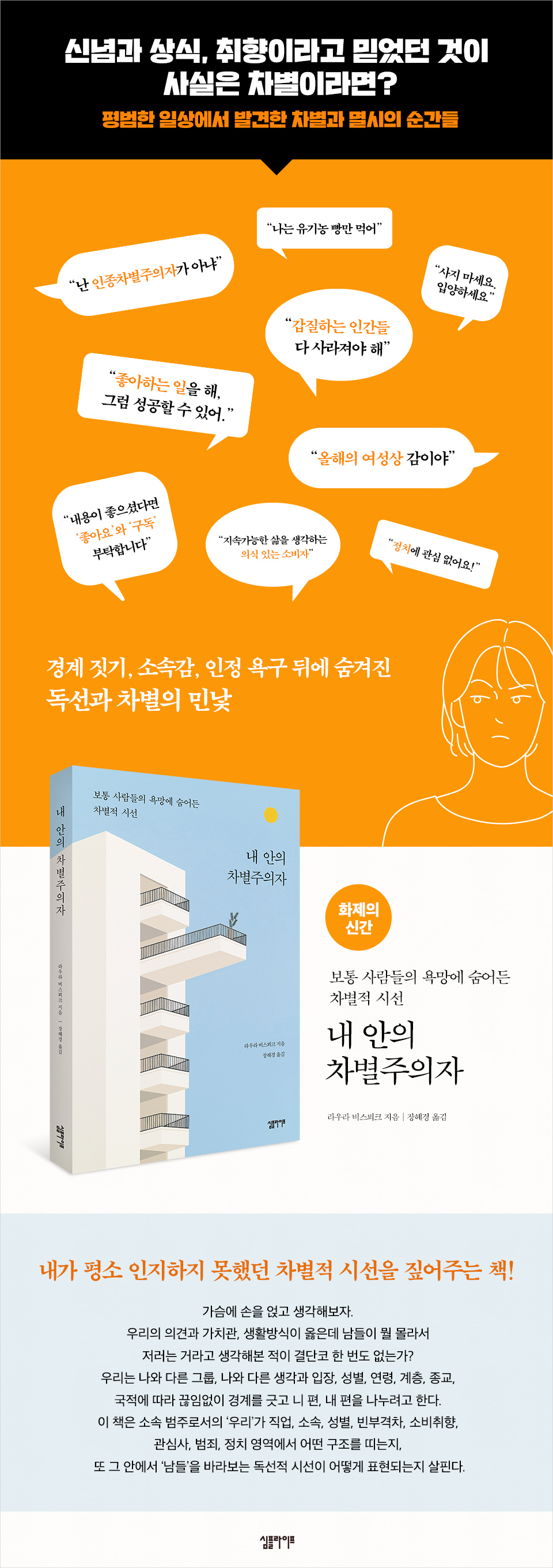
What if what we believed to be beliefs, common sense, and tastes were actually discrimination?
Moments of discrimination and contempt found in ordinary daily life
Are voters who support far-right parties fools, lacking common sense and common sense? Are refugees and immigrants potential criminals who steal our jobs and threaten our safety? Are office workers, commuting to work every day and doing jobs they don't like, slaves to a meager salary? Our thinking is correct, but aren't those few "idiots" causing democracy to regress, society to become increasingly vicious, safety to be threatened, and even the opportunity for fair competition to be lost?
"The Discriminationist Within Me" is a book that asks those who have ever thought this way, "How should I live?" and makes them reflect on themselves and society.
This book, which passionately captures the voice of a young sociologist who is attracting attention in Europe, is considered a masterpiece that examines the self-righteousness and contempt inherent in the hearts of those who are convinced that their values are righteous, and makes us reconsider how we should view those who live differently from us.
Would you accept that posting photos on Instagram, eating organic food, and adopting a sheltered dog are all discriminatory actions?
Reading this book will allow us to clearly see how our beliefs, philosophies, and actions, intertwined with social structures, are distorted into discrimination.
The author, who has consistently studied social inequality at university and has paid particular attention to gender equality and the lives of minorities, has calmly explained, using various cases, sociological theories, and a witty writing style, how we distinguish between 'self' and 'others' in our daily lives – eating, working, and playing – how we ridicule and ignore differences, and how such boundary-making and contemptuous gazes solidify discrimination in society.
A book that points out discriminatory views that I was not aware of before.
What if what we believed to be beliefs, common sense, and tastes were actually discrimination?
Moments of discrimination and contempt found in ordinary daily life
Are voters who support far-right parties fools, lacking common sense and common sense? Are refugees and immigrants potential criminals who steal our jobs and threaten our safety? Are office workers, commuting to work every day and doing jobs they don't like, slaves to a meager salary? Our thinking is correct, but aren't those few "idiots" causing democracy to regress, society to become increasingly vicious, safety to be threatened, and even the opportunity for fair competition to be lost?
"The Discriminationist Within Me" is a book that asks those who have ever thought this way, "How should I live?" and makes them reflect on themselves and society.
This book, which passionately captures the voice of a young sociologist who is attracting attention in Europe, is considered a masterpiece that examines the self-righteousness and contempt inherent in the hearts of those who are convinced that their values are righteous, and makes us reconsider how we should view those who live differently from us.
Would you accept that posting photos on Instagram, eating organic food, and adopting a sheltered dog are all discriminatory actions?
Reading this book will allow us to clearly see how our beliefs, philosophies, and actions, intertwined with social structures, are distorted into discrimination.
The author, who has consistently studied social inequality at university and has paid particular attention to gender equality and the lives of minorities, has calmly explained, using various cases, sociological theories, and a witty writing style, how we distinguish between 'self' and 'others' in our daily lives – eating, working, and playing – how we ridicule and ignore differences, and how such boundary-making and contemptuous gazes solidify discrimination in society.
- You can preview some of the book's contents.
Preview
index
Introduction: The Operating Principles of Self-Righteousness and Contempt
Chapter 1 Job
1.
The supreme principle is to 'do what you love'.
― The elitism hidden in common success stories
― Passion doesn't get paid.
― To avoid becoming a slave to spontaneity
2.
Separation of head and hands
― Are manual laborers simply ignorant?
―Vertical division of labor and power
― A New Professional Identity: From Craftsman to Designer
― Do it yourself: The joys and sorrows of making things yourself
Chapter 2 Gender
1.
Same behavior, different evaluation
―There are working moms, but no working dads.
- Who takes up more space?
―Why women tend to speak in a low voice
― High cost, low recognition
2.
The Myth of Manliness
― What's the problem with gender-segregated education?
― Revealing your pain becomes a weakness.
Violence reproduces masculinity.
― Reasons for claiming reverse discrimination
― For the crying man
Chapter 3 Immigration
1.
Who is qualified to stay here?
― A photo that moved the world
― Poor or brave
2.
Strangers and Open Society
― Immigrants who have become vested interests
― The paradox of boundary-making
― The problem of names: expatriates, immigrants, refugees, and escapees
― Degradation of others is related to modernity.
Chapter 4: Poverty and Wealth
1.
Unemployment is a personal failure
― I blame the situation, you blame yourself
― Punishment, not support
― The result of personalizing unemployment
―Symbolic violence and stigmatization
― Prove your performance with wages.
2.
The tyranny of entrepreneurship
Self-employed people who take risks
― Can success be achieved through effort alone?
― The illusion that starting a business will give you freedom
― Startups: A New Form of Labor Exploitation?
― The line between work and personal life is blurring.
― A self armed with an entrepreneurial spirit
Chapter 5 Crime
1.
lower class criminals
―All men are equal before the law.
― High-ranking criminals and the extent of damage
―Heroes above the law
2.
Blaming the Victim: A Way of Contempt
― The Fair World Hypothesis
― Is sexual crime the victim's fault?
Why should we strive to prevent damage?
― The reversal of victim and perpetrator reflected in language
Chapter 6 Consumption
1.
Conspicuous Consumption: The Struggle for Status Through Commodities
― Millionaire in jeans
What I consume speaks volumes about me.
― Cool and the status symbol of sneakers
― Become a product and go higher
2.
moral superiority
― The luxury of organic
- I buy it.
Therefore, I am sustainable.
― Status symbols of the citizen class: adopting abandoned dogs, bicycles, and posting about cooking
― Environmental protection is also a privilege.
Chapter 7 Attention
1.
Extroversion is the norm
― A society where introverts are not recognized
- Be friendly with everyone without formality.
― Various coaches who teach social skills
2.
Popular digital selves
― For both walks and interior design, ‘like’
― Alienation, jealousy, depression
― The amount of attention determines everything.
― Hashtags, the eventification of the online self
― Network Prisons and Self-Censorship
Chapter 8 Politics
1.
If you have political differences, you are an enemy
― Diversity is bleeding
― Hostility reduces complexity.
― Fake news that attacks democracy
― Political apathy that endangers the liberal order
2.
Voter disregard
― Even if the facts are wrong, I am right.
― Understanding is not the same as agreement.
― The right to interpretation belongs to the privileged class.
― Focus on the realities rather than public anxiety.
― Identity politics and a culture that stifles healthy debate
No one is free from the self-righteousness of their words.
main
Chapter 1 Job
1.
The supreme principle is to 'do what you love'.
― The elitism hidden in common success stories
― Passion doesn't get paid.
― To avoid becoming a slave to spontaneity
2.
Separation of head and hands
― Are manual laborers simply ignorant?
―Vertical division of labor and power
― A New Professional Identity: From Craftsman to Designer
― Do it yourself: The joys and sorrows of making things yourself
Chapter 2 Gender
1.
Same behavior, different evaluation
―There are working moms, but no working dads.
- Who takes up more space?
―Why women tend to speak in a low voice
― High cost, low recognition
2.
The Myth of Manliness
― What's the problem with gender-segregated education?
― Revealing your pain becomes a weakness.
Violence reproduces masculinity.
― Reasons for claiming reverse discrimination
― For the crying man
Chapter 3 Immigration
1.
Who is qualified to stay here?
― A photo that moved the world
― Poor or brave
2.
Strangers and Open Society
― Immigrants who have become vested interests
― The paradox of boundary-making
― The problem of names: expatriates, immigrants, refugees, and escapees
― Degradation of others is related to modernity.
Chapter 4: Poverty and Wealth
1.
Unemployment is a personal failure
― I blame the situation, you blame yourself
― Punishment, not support
― The result of personalizing unemployment
―Symbolic violence and stigmatization
― Prove your performance with wages.
2.
The tyranny of entrepreneurship
Self-employed people who take risks
― Can success be achieved through effort alone?
― The illusion that starting a business will give you freedom
― Startups: A New Form of Labor Exploitation?
― The line between work and personal life is blurring.
― A self armed with an entrepreneurial spirit
Chapter 5 Crime
1.
lower class criminals
―All men are equal before the law.
― High-ranking criminals and the extent of damage
―Heroes above the law
2.
Blaming the Victim: A Way of Contempt
― The Fair World Hypothesis
― Is sexual crime the victim's fault?
Why should we strive to prevent damage?
― The reversal of victim and perpetrator reflected in language
Chapter 6 Consumption
1.
Conspicuous Consumption: The Struggle for Status Through Commodities
― Millionaire in jeans
What I consume speaks volumes about me.
― Cool and the status symbol of sneakers
― Become a product and go higher
2.
moral superiority
― The luxury of organic
- I buy it.
Therefore, I am sustainable.
― Status symbols of the citizen class: adopting abandoned dogs, bicycles, and posting about cooking
― Environmental protection is also a privilege.
Chapter 7 Attention
1.
Extroversion is the norm
― A society where introverts are not recognized
- Be friendly with everyone without formality.
― Various coaches who teach social skills
2.
Popular digital selves
― For both walks and interior design, ‘like’
― Alienation, jealousy, depression
― The amount of attention determines everything.
― Hashtags, the eventification of the online self
― Network Prisons and Self-Censorship
Chapter 8 Politics
1.
If you have political differences, you are an enemy
― Diversity is bleeding
― Hostility reduces complexity.
― Fake news that attacks democracy
― Political apathy that endangers the liberal order
2.
Voter disregard
― Even if the facts are wrong, I am right.
― Understanding is not the same as agreement.
― The right to interpretation belongs to the privileged class.
― Focus on the realities rather than public anxiety.
― Identity politics and a culture that stifles healthy debate
No one is free from the self-righteousness of their words.
main
Detailed image
Into the book
- The cry to 'do what you love' is a disguised and hidden elitism.
How many people can truly live a life solely focused on pursuing their passions? Perhaps it's possible for young people whose parents pay for their college tuition, rent, and allowance.
But it is absolutely impossible for a single parent to raise their children alone without any help.
- The term ‘working mom’ itself carries a nuance of discrimination.
No one uses the terms 'working dad' or 'working parent'.
This is because gender role stereotypes have determined that childcare is women's responsibility.
So, for example, a teenage single mother raising a child alone is criticized as being irresponsible.
Because she gave birth to a child without any plan and without the ability to take responsibility.
So what happens to a father who refuses to raise his child?
- Not only are physical conditions like height unavoidable, but the way we use our bodies in formal spaces is also evaluated differently depending on gender.
The habit of sitting with your legs wide open on buses or subways to monopolize space is especially common among men.
This phenomenon of men spreading their legs cannot be explained solely by the male body structure or selfishness.
More important than biological conditions or selfishness is the question, "How much space do I have?"
- Who occupies space, and who can or should occupy space, is also a very interesting point in relation to sexual crimes.
When a sexual crime occurs on an American college campus, female students are told not to go out at night.
Isn't that odd? Wouldn't it be more effective to keep men tied up at home to prevent this?
- Menstruation is not a condition that can be called a 'luxury'.
It's something you have to go through even if you don't want to.
Yet, menstrual products such as tampons and sanitary pads are classified as “luxury goods” on the tax list.
Going to the movies or buying flowers are personal choices that we may or may not make.
But I can't avoid menstruation.
However, sanitary products are classified as ‘luxury goods’ rather than ‘daily necessities’.
Women have to pay high taxes to live as women.
- In fact, many unemployed people think that they are different from other unemployed people.
He differentiates between himself and others, saying that he lost his job because of the circumstances, but others lost their jobs because of their own fault.
It is believed that one can preserve one's social identity by not identifying with others.
- The very same people who quit their jobs because they didn't want to be exploited by their employers are, interestingly enough, not hesitant to exploit their own employees.
The startup world is often touted as a workplace paradise, but a quick peek behind the scenes reveals that this image is nothing more than a facade.
- Large-scale economic crimes, such as those 'up there', are considered an inevitable part of corporate activities.
This is something that can happen in business, so as long as you don't get caught, you can turn a blind eye and let it go.
It is a crime that not just anyone can commit even if they want to, so it even gives the impression of being intelligent and smart.
On the other hand, car theft, home invasion, and fraud are morally reprehensible crimes.
- If we downplay the characteristics of introverts and perceive them as being too slow, too shy, or too insecure, this too creates a kind of social inequality.
When a person's characteristics become the conditions that lead to a 'successful' life, they also have a significant impact on the individual's daily opportunities.
- I'm not interested in politics! Saying that is an act of privilege.
Because being apolitical is also a privilege.
If it's okay to be apolitical, why should you be privileged because of your gender, wealth, race, or sexual orientation? You must be guaranteed a dignified life and safety.
- There are many claims that people who do not enjoy privileges look down on other disadvantaged groups in order to feel superior.
Self-righteousness and contempt are typical attitudes of people from the 'lower class'.
However, being an elite does not mean that you do not look down on others.
No, rather, this phenomenon is more prominent among the elite.
It's just that society doesn't question their behavior.
Because they have the right to interpret.
How many people can truly live a life solely focused on pursuing their passions? Perhaps it's possible for young people whose parents pay for their college tuition, rent, and allowance.
But it is absolutely impossible for a single parent to raise their children alone without any help.
- The term ‘working mom’ itself carries a nuance of discrimination.
No one uses the terms 'working dad' or 'working parent'.
This is because gender role stereotypes have determined that childcare is women's responsibility.
So, for example, a teenage single mother raising a child alone is criticized as being irresponsible.
Because she gave birth to a child without any plan and without the ability to take responsibility.
So what happens to a father who refuses to raise his child?
- Not only are physical conditions like height unavoidable, but the way we use our bodies in formal spaces is also evaluated differently depending on gender.
The habit of sitting with your legs wide open on buses or subways to monopolize space is especially common among men.
This phenomenon of men spreading their legs cannot be explained solely by the male body structure or selfishness.
More important than biological conditions or selfishness is the question, "How much space do I have?"
- Who occupies space, and who can or should occupy space, is also a very interesting point in relation to sexual crimes.
When a sexual crime occurs on an American college campus, female students are told not to go out at night.
Isn't that odd? Wouldn't it be more effective to keep men tied up at home to prevent this?
- Menstruation is not a condition that can be called a 'luxury'.
It's something you have to go through even if you don't want to.
Yet, menstrual products such as tampons and sanitary pads are classified as “luxury goods” on the tax list.
Going to the movies or buying flowers are personal choices that we may or may not make.
But I can't avoid menstruation.
However, sanitary products are classified as ‘luxury goods’ rather than ‘daily necessities’.
Women have to pay high taxes to live as women.
- In fact, many unemployed people think that they are different from other unemployed people.
He differentiates between himself and others, saying that he lost his job because of the circumstances, but others lost their jobs because of their own fault.
It is believed that one can preserve one's social identity by not identifying with others.
- The very same people who quit their jobs because they didn't want to be exploited by their employers are, interestingly enough, not hesitant to exploit their own employees.
The startup world is often touted as a workplace paradise, but a quick peek behind the scenes reveals that this image is nothing more than a facade.
- Large-scale economic crimes, such as those 'up there', are considered an inevitable part of corporate activities.
This is something that can happen in business, so as long as you don't get caught, you can turn a blind eye and let it go.
It is a crime that not just anyone can commit even if they want to, so it even gives the impression of being intelligent and smart.
On the other hand, car theft, home invasion, and fraud are morally reprehensible crimes.
- If we downplay the characteristics of introverts and perceive them as being too slow, too shy, or too insecure, this too creates a kind of social inequality.
When a person's characteristics become the conditions that lead to a 'successful' life, they also have a significant impact on the individual's daily opportunities.
- I'm not interested in politics! Saying that is an act of privilege.
Because being apolitical is also a privilege.
If it's okay to be apolitical, why should you be privileged because of your gender, wealth, race, or sexual orientation? You must be guaranteed a dignified life and safety.
- There are many claims that people who do not enjoy privileges look down on other disadvantaged groups in order to feel superior.
Self-righteousness and contempt are typical attitudes of people from the 'lower class'.
However, being an elite does not mean that you do not look down on others.
No, rather, this phenomenon is more prominent among the elite.
It's just that society doesn't question their behavior.
Because they have the right to interpret.
--- From the text
Publisher's Review
What if what we believed to be beliefs, common sense, and tastes were actually discrimination?
Moments of discrimination and contempt found in ordinary daily life
Are voters who support far-right parties fools, lacking common sense and common sense? Are refugees and immigrants potential criminals who steal our jobs and threaten our safety? Are office workers, commuting to work every day and doing jobs they don't like, slaves to a meager salary? Our thinking is correct, but aren't those few "idiots" causing democracy to regress, society to become increasingly vicious, safety to be threatened, and even the opportunity for fair competition to be lost?
"The Discriminationist Within Me" is a book that asks those who have ever thought this way, "How should I live?" and makes them reflect on themselves and society.
This book, which passionately captures the voice of a young sociologist who is attracting attention in Europe, is considered a masterpiece that examines the self-righteousness and contempt inherent in the hearts of those who are convinced that their values are righteous, and makes us reconsider how we should view those who live differently from us.
Would it be acceptable to post photos on Instagram, eat organic food, and adopt a stray dog as discriminatory behavior? This book vividly reveals how our beliefs, philosophies, and actions, intertwined with social structures, can be distorted into discrimination.
The author, who has consistently studied social inequality at university and has paid particular attention to gender equality and the lives of minorities, has calmly explained, using various cases, sociological theories, and a witty writing style, how we distinguish between 'self' and 'others' in our daily lives – eating, working, and playing – how we ridicule and ignore differences, and how such boundary-making and contemptuous gazes solidify discrimination in society.
Scenes of discrimination and alienation born from the human desire to be superior to others.
The operating principles of self-righteousness and exclusion, examined across eight themes: affiliation, occupation, gender, wealth gap, preferences, and political leanings.
We live in an age of unprecedented labeling: ‘social evil,’ ‘parasite,’ ‘sexist,’ ‘reactionary,’ ‘feminist,’ ‘regular worker, non-regular worker,’ ‘bullying,’ ‘old fart,’ ‘progressive, conservative,’ ‘multicultural family.’
This kind of labeling is a form of exclusion and contempt that most easily demarcates me and you, us and them, and is used as a means of drawing lines by labeling myself and others, sending them looks of disgust or silent contempt.
The author dissects, through various perspectives and layers, the psychology of constantly drawing boundaries and dividing people into your side and my side based on different groups, thoughts and positions, gender, age, class, religion, and nationality, the contradictions of labeling that occur frequently in our society, the harmful effects of stereotypes, and the mechanisms of hatred and contempt.
The author also keenly captures the ridicule and discrimination hidden in the thought, “I am a little different.”
“I’m not a racist.” “I won’t live like that old fart.” “Don’t buy it.
Adopt me,” “I only eat organic food because I care about the environment,” and other common expressions that reveal who I am hide a desire to constantly appear different from others and feel superior, and this sense of superiority is producing and expanding new forms of discrimination.
In a world where even a single comment on social media or a single photo on Instagram clearly reveals what we eat and drink, who we want to be friends with, what kind of person we want to be seen as, and what values we share, we reveal our affiliations, status, and tastes to solidify our own side and belittle or secretly ignore the other side.
The author laments that we are gradually losing the space for ‘difference,’ ‘respect,’ and ‘dialogue.’
In an age where consumer behavior has become a symbol of status, occupation has become identity, and political differences have become animosity, this book traces the discriminatory perspectives and contradictions within me, and reflects on the meaning of equality, methods of communication, and the meaning of coexistence.
What defines first and third class?
How should we treat people who think differently and live differently?
This book examines the structure of "us" as a category of belonging in the areas of occupation, affiliation, gender, wealth gap, consumer preferences, interests, crime, and politics, and how a self-righteous perspective on "others" is expressed within it.
It consists of a total of eight parts, and Part 1, “Work,” examines how telling young people, “Do what you love, and you’ll be successful” can become violence, and how welfare and wages are neglected in a society that forces passion in the name of “self-realization.”
We also examine the root causes of how manual and mental workers disparage each other and where this division comes from.
Part 2, “Sex,” examines the discriminatory views on women contained in everyday expressions such as “Woman of the Year” and “working mom,” as well as the socially highly regarded roles of men, and analyzes the structure and stereotypes of gender inequality, as well as the various categories of gender inequality that still persist.
Part 3, "Immigration," examines how immigrant discourse fuels inequality and the nature of hostility based on affiliation and status.
Part 4, "The Gap Between the Rich and the Poor," examines the vicious cycle of employment and unemployment caused by the gap between the rich and the poor, how the unemployed become social parasites, and how the entrepreneurial mindset shifts responsibility for the labor market onto individuals.
Part 5, “Crime,” analyzes the judicial inequality that catches only petty thieves while letting big thieves go free, and the absurdity behind violence that shifts responsibility to the victim.
Part 6, 'Consumption', examines the various forms of status display using products and the reality in which ethical consumption has become a status consciousness.
Part 7, “Interest,” analyzes the problems of the digital self trapped in “followers” and “likes” and the various phenomena that arise from this.
Part 8, ‘Politics,’ analyzes the social ill of unconditionally turning those with different political stances into enemies and the attitude of voters who belittle and pathologize each other.
A book that seeks understanding, consideration, and a path to coexistence
This book raises fundamental questions about how our discriminatory perspectives, which we take for granted and take for granted, were created.
Conversely, it also reminds us that if we do not change the social structure, everyone could become a contributing factor or aiding and abetting inequality.
This book reminds us that the people we have called "them" until now could one day be us. It asks what we need now for our society to take a step forward.
It makes me realize that the peace and comfort I enjoy are built on the sacrifices of those I once pointed fingers at as "them." It provides an opportunity to turn the harsh gaze directed at others back on myself, and it offers a starting point for moving toward a path of respect and coexistence rather than exclusion and hatred.
I recommend this book to all young people, as well as to intellectuals, educated people, and those who wish to live as mature citizens.
Moments of discrimination and contempt found in ordinary daily life
Are voters who support far-right parties fools, lacking common sense and common sense? Are refugees and immigrants potential criminals who steal our jobs and threaten our safety? Are office workers, commuting to work every day and doing jobs they don't like, slaves to a meager salary? Our thinking is correct, but aren't those few "idiots" causing democracy to regress, society to become increasingly vicious, safety to be threatened, and even the opportunity for fair competition to be lost?
"The Discriminationist Within Me" is a book that asks those who have ever thought this way, "How should I live?" and makes them reflect on themselves and society.
This book, which passionately captures the voice of a young sociologist who is attracting attention in Europe, is considered a masterpiece that examines the self-righteousness and contempt inherent in the hearts of those who are convinced that their values are righteous, and makes us reconsider how we should view those who live differently from us.
Would it be acceptable to post photos on Instagram, eat organic food, and adopt a stray dog as discriminatory behavior? This book vividly reveals how our beliefs, philosophies, and actions, intertwined with social structures, can be distorted into discrimination.
The author, who has consistently studied social inequality at university and has paid particular attention to gender equality and the lives of minorities, has calmly explained, using various cases, sociological theories, and a witty writing style, how we distinguish between 'self' and 'others' in our daily lives – eating, working, and playing – how we ridicule and ignore differences, and how such boundary-making and contemptuous gazes solidify discrimination in society.
Scenes of discrimination and alienation born from the human desire to be superior to others.
The operating principles of self-righteousness and exclusion, examined across eight themes: affiliation, occupation, gender, wealth gap, preferences, and political leanings.
We live in an age of unprecedented labeling: ‘social evil,’ ‘parasite,’ ‘sexist,’ ‘reactionary,’ ‘feminist,’ ‘regular worker, non-regular worker,’ ‘bullying,’ ‘old fart,’ ‘progressive, conservative,’ ‘multicultural family.’
This kind of labeling is a form of exclusion and contempt that most easily demarcates me and you, us and them, and is used as a means of drawing lines by labeling myself and others, sending them looks of disgust or silent contempt.
The author dissects, through various perspectives and layers, the psychology of constantly drawing boundaries and dividing people into your side and my side based on different groups, thoughts and positions, gender, age, class, religion, and nationality, the contradictions of labeling that occur frequently in our society, the harmful effects of stereotypes, and the mechanisms of hatred and contempt.
The author also keenly captures the ridicule and discrimination hidden in the thought, “I am a little different.”
“I’m not a racist.” “I won’t live like that old fart.” “Don’t buy it.
Adopt me,” “I only eat organic food because I care about the environment,” and other common expressions that reveal who I am hide a desire to constantly appear different from others and feel superior, and this sense of superiority is producing and expanding new forms of discrimination.
In a world where even a single comment on social media or a single photo on Instagram clearly reveals what we eat and drink, who we want to be friends with, what kind of person we want to be seen as, and what values we share, we reveal our affiliations, status, and tastes to solidify our own side and belittle or secretly ignore the other side.
The author laments that we are gradually losing the space for ‘difference,’ ‘respect,’ and ‘dialogue.’
In an age where consumer behavior has become a symbol of status, occupation has become identity, and political differences have become animosity, this book traces the discriminatory perspectives and contradictions within me, and reflects on the meaning of equality, methods of communication, and the meaning of coexistence.
What defines first and third class?
How should we treat people who think differently and live differently?
This book examines the structure of "us" as a category of belonging in the areas of occupation, affiliation, gender, wealth gap, consumer preferences, interests, crime, and politics, and how a self-righteous perspective on "others" is expressed within it.
It consists of a total of eight parts, and Part 1, “Work,” examines how telling young people, “Do what you love, and you’ll be successful” can become violence, and how welfare and wages are neglected in a society that forces passion in the name of “self-realization.”
We also examine the root causes of how manual and mental workers disparage each other and where this division comes from.
Part 2, “Sex,” examines the discriminatory views on women contained in everyday expressions such as “Woman of the Year” and “working mom,” as well as the socially highly regarded roles of men, and analyzes the structure and stereotypes of gender inequality, as well as the various categories of gender inequality that still persist.
Part 3, "Immigration," examines how immigrant discourse fuels inequality and the nature of hostility based on affiliation and status.
Part 4, "The Gap Between the Rich and the Poor," examines the vicious cycle of employment and unemployment caused by the gap between the rich and the poor, how the unemployed become social parasites, and how the entrepreneurial mindset shifts responsibility for the labor market onto individuals.
Part 5, “Crime,” analyzes the judicial inequality that catches only petty thieves while letting big thieves go free, and the absurdity behind violence that shifts responsibility to the victim.
Part 6, 'Consumption', examines the various forms of status display using products and the reality in which ethical consumption has become a status consciousness.
Part 7, “Interest,” analyzes the problems of the digital self trapped in “followers” and “likes” and the various phenomena that arise from this.
Part 8, ‘Politics,’ analyzes the social ill of unconditionally turning those with different political stances into enemies and the attitude of voters who belittle and pathologize each other.
A book that seeks understanding, consideration, and a path to coexistence
This book raises fundamental questions about how our discriminatory perspectives, which we take for granted and take for granted, were created.
Conversely, it also reminds us that if we do not change the social structure, everyone could become a contributing factor or aiding and abetting inequality.
This book reminds us that the people we have called "them" until now could one day be us. It asks what we need now for our society to take a step forward.
It makes me realize that the peace and comfort I enjoy are built on the sacrifices of those I once pointed fingers at as "them." It provides an opportunity to turn the harsh gaze directed at others back on myself, and it offers a starting point for moving toward a path of respect and coexistence rather than exclusion and hatred.
I recommend this book to all young people, as well as to intellectuals, educated people, and those who wish to live as mature citizens.
GOODS SPECIFICS
- Date of issue: July 10, 2020
- Page count, weight, size: 260 pages | 404g | 140*215*20mm
- ISBN13: 9791186757628
- ISBN10: 1186757620
You may also like
카테고리
korean


korean

![GQ KOREA Mark (Monthly): December [2025]](http://librairie.coreenne.fr/cdn/shop/files/8ef265dbbfbf186523ed75ba7319009d.jpg?v=1765340328&width=3840)


