

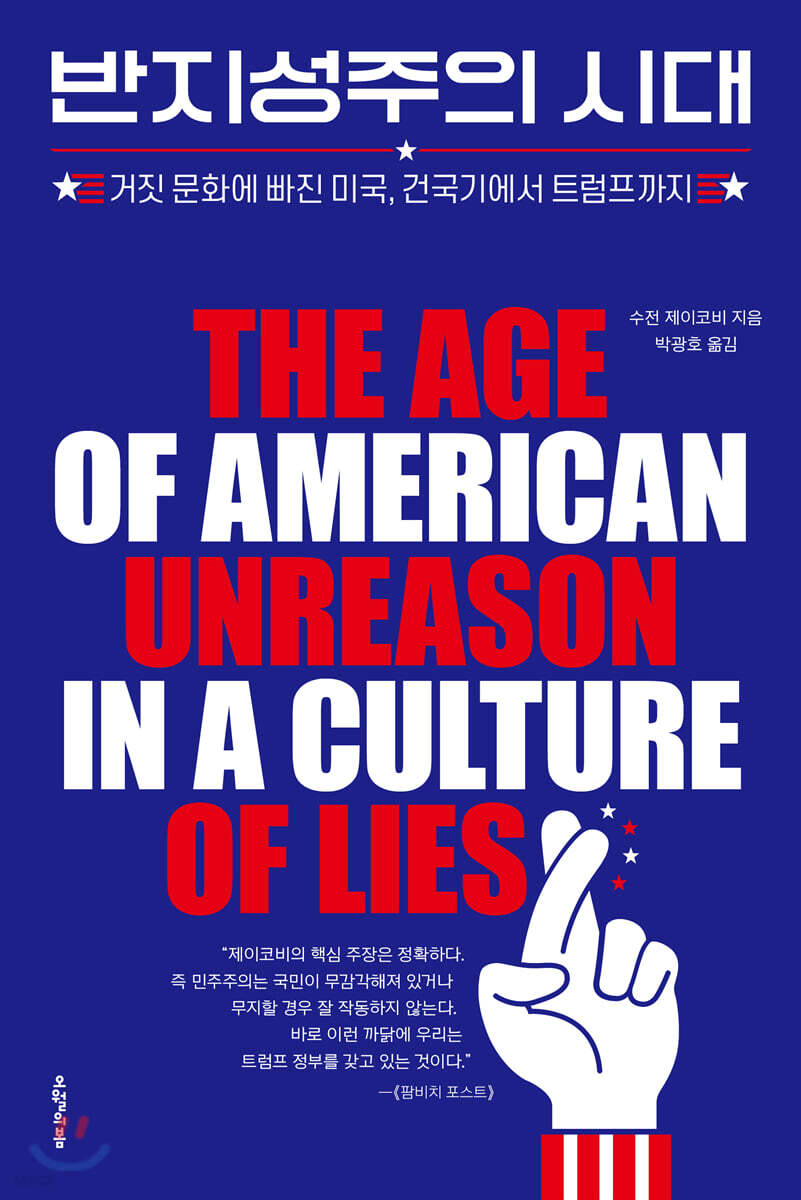
The Age of Anti-Intellectualism
 |
Description
Book Introduction
- A word from MD
- Many have pointed to American anti-intellectualism as the reason for the election of President Trump, who has been criticized for his hate speech and irrational behavior.
This book argues that anti-intellectualism is not a recent phenomenon.
We trace the origins and reality of anti-intellectualism that has driven America since its founding.
- Son Min-gyu, Social and Political MD
A problematic work that predicted the Trump era
America's anti-intellectual culture ultimately gave birth to Trump.
A 21st-century version of the classic Western intellectual history, American Anti-Intellectualism.
The book that most vividly portrays America today
How Religious Fundamentalism and Infotainment Culture Ruined America
What will we do in the age of post-truth and fake news?
The Trump era is not over yet.
His unprecedentedly ignorant and outrageous words and actions have earned him shunning even from the conservative right, and there's a strong prediction that he'll lose the next presidential election. But who knows? Could another upset unfold like in 2016?
But the bigger problem is that Trump won't be the last.
Twelve years ago, George W.
Just like Bush did.
In the 21st century, America is likely to call for a second Bush or a second Trump at any time.
The general theory that history repeats itself is not enough.
The book's central argument is that something lurks beneath the surface that cannot be explained simply by voters' periodic desire for regime change, and that it must be sought in the long-term, persistent trends that have driven the United States since its founding.
"The Age of Anti-Intellectualism" is a critique of civilization that vividly highlights the enormous tectonic shifts created by the clash between the two major axes of rational enlightenment and religious fundamentalism over the past 200 years since the nation's founding, and is a scathing social critique of the fundamental crisis that modern America has faced as a result.
It is also a cultural study that reveals why so many ordinary Americans support Trump.
It awakens us to the urgent task of awakened intellectuals in the current climate of post-truth, fake news, and junk science, a departure from the great traditions of American intellectual history.
America's anti-intellectual culture ultimately gave birth to Trump.
A 21st-century version of the classic Western intellectual history, American Anti-Intellectualism.
The book that most vividly portrays America today
How Religious Fundamentalism and Infotainment Culture Ruined America
What will we do in the age of post-truth and fake news?
The Trump era is not over yet.
His unprecedentedly ignorant and outrageous words and actions have earned him shunning even from the conservative right, and there's a strong prediction that he'll lose the next presidential election. But who knows? Could another upset unfold like in 2016?
But the bigger problem is that Trump won't be the last.
Twelve years ago, George W.
Just like Bush did.
In the 21st century, America is likely to call for a second Bush or a second Trump at any time.
The general theory that history repeats itself is not enough.
The book's central argument is that something lurks beneath the surface that cannot be explained simply by voters' periodic desire for regime change, and that it must be sought in the long-term, persistent trends that have driven the United States since its founding.
"The Age of Anti-Intellectualism" is a critique of civilization that vividly highlights the enormous tectonic shifts created by the clash between the two major axes of rational enlightenment and religious fundamentalism over the past 200 years since the nation's founding, and is a scathing social critique of the fundamental crisis that modern America has faced as a result.
It is also a cultural study that reveals why so many ordinary Americans support Trump.
It awakens us to the urgent task of awakened intellectuals in the current climate of post-truth, fake news, and junk science, a departure from the great traditions of American intellectual history.
- You can preview some of the book's contents.
Preview
index
Introduction: The Resurgence of Powerful Anti-Intellectualism
Chapter 1: How We Live Today: The Story of Our Common People
Chapter 2: How We Lived Then: Intelligence and Ignorance in a New Nation
Chapter 3: Social Pseudoscience in the Early Years of America's Culture Wars
Chapter 4: Reds, Leftists, and Sympathizers
Chapter 5: Middlebrow Culture, from its heyday to its decline
Chapter 6: Blaming the 1960s
Chapter 7 Legacies: Youth Culture and Celebrity Culture
Chapter 8: The New Appearance of Old Religions
Chapter 9: Junk Thought and Junk Science
Chapter 10: The Culture of Distraction
Chapter 11: Public Life: Setting the Bar for Idiocy Lower and Lower
Conclusion: What to Do in an Age of Amnesia and Post-Truth
Acknowledgements
main
Selected References
Translator's Note
Search
Chapter 1: How We Live Today: The Story of Our Common People
Chapter 2: How We Lived Then: Intelligence and Ignorance in a New Nation
Chapter 3: Social Pseudoscience in the Early Years of America's Culture Wars
Chapter 4: Reds, Leftists, and Sympathizers
Chapter 5: Middlebrow Culture, from its heyday to its decline
Chapter 6: Blaming the 1960s
Chapter 7 Legacies: Youth Culture and Celebrity Culture
Chapter 8: The New Appearance of Old Religions
Chapter 9: Junk Thought and Junk Science
Chapter 10: The Culture of Distraction
Chapter 11: Public Life: Setting the Bar for Idiocy Lower and Lower
Conclusion: What to Do in an Age of Amnesia and Post-Truth
Acknowledgements
main
Selected References
Translator's Note
Search
Into the book
The book was first published in hardcover by Pantheon Press in the winter of 2008, when a young senator with the unusual name of Barack Hussein Obama and an older senator named Hillary Rodham Clinton were tackling the snowy fields of New Hampshire in their quest for the Democratic presidential nomination.
I thought that either Obama or Clinton would be better than Bush, as I believe that rationality and respect for knowledge are important qualifications for a president.
But I see no reason to change the generally pessimistic argument contained in the preface to the first edition.
There I argued that it was difficult to suppress the fear that “the scales of American history have tilted significantly against the vibrant and colorful life essential to a functioning democracy.”
The Bush administration's perceived tendency toward anti-intellectualism was less a function of Bush's personal failings than of a general process of lowering the bar for stupidity in American culture since the 1970s.
--- p.10~11
The reason I've always taken Trump so seriously is that, while rereading Hofstadter's book and doing research for this book, Trump seemed to me not just a deviant, but an anti-intellectual candidate who exhibited easily recognizable patterns.
When he publicly revealed his ambition to trade management of his personal brand for management of the American brand, Hofstadter's warning lingered in my mind:
“There is a possibility that various paths of choice may be blocked.
“The culture of the future may be dominated solely by those who are devoted to a particular creed.”
--- p.13
The adjective "unprecedented" often used to describe Trump's presidential bid is only half true.
Trump is unprecedented only in the sense that he is the first president to have never served in government or the military.
In other respects, he is part of a broader phenomenon of economic resentment and anti-intellectualism that is by no means unprecedented in early or modern American history.
What Trump had (and still has) is access to social media, which has unprecedented reach and influence.
Facebook and Twitter, which were in their infancy in the early years of this century, had by 2015 grown into expansive and effective tools for Trump to attack public discourse in a way that everyone could understand.
If I had predicted in 2008 how quickly social media would expand and how effectively it could disseminate factually unsubstantiated opinions to the public, I might have recognized the Trump we would soon see, or someone like him.
--- p.22
There is considerable evidence that Americans have become increasingly reluctant to regard reason as a virtue, whether by applying strict standards of truth and logic to what they see and hear on social media or by deliberately turning a blind eye to scientific research-based expertise in decisions about war and peace.
To give one example, among developed countries, Americans are the only ones who view evolution by natural selection as "controversial" rather than established mainstream science.
The continued strength of religious fundamentalism in the United States (also unique among developed nations) is usually cited as the sole reason for the curious persistence of opposition to evolution.
But such a simple answer alone doesn't address the larger question of why so many Americans, even non-fundamentalists, readily dismiss scientific consensus.
A more realistic and complex explanation cannot be found in religious fundamentalism alone, or even around it, but must be sought in the low level of public knowledge about science in general and evolution in particular.
--- p.27~28
America now suffers from a disease that is a mixture of ignorance, anti-rationalism, and anti-intellectualism, which, combined with science and technology, has mutated into something far more dangerous than ever before.
The disease that has developed in this way is paradoxically inextricably linked to an attitude of indifference, an attitude of indifference to [dissent], which is both aggressive and passive.
This state of affairs is aggressively promoted by everyone from politicians to media executives whose livelihoods depend on citizens seeking their opinions on sound bites and blogs, and passively accepted by a nation captivated by the snake that promises effortless infotainment if you eat the fruit of the Twitter tree.
Is there still time left to ameliorate the decadent effects of that poisoned apple? And do cultural preservationists have the will to do so? As long as we continue to strive to bring that will to the judgment of history, people will live in the unwavering hope that it will happen.
--- p.32~33
It is impossible to define anti-intellectualism as a historical force or an enduring American reality in the same precise or useful way as abolitionism or feminism.
In Hofstadter's view, anti-intellectualism is not an independent historical or social phenomenon, but the result of some other goal (such as the desire to expand educational opportunities to more people, or to regain control of religious life from the church's ruling elite).
Hofstadter wrote:
“No one thinks that they are going against ideology and culture.
No one wakes up in the morning, looks in the mirror, smiles, and says, 'Okay, today I'm going to torture intellectuals and strangle ideology!'" I think that's a bit too lenient a description of anti-intellectualism.
Even then and now, only a very small number of people consider themselves enemies of ideology and culture (or of ideology and culture as they define it).
But what public figures actually do in relation to culture is far more important than what they say in front of the mirror.
--- p.46~47
What explains the powerful pull of Americans toward values that seem so at odds not only with intellectual modernism and science, but also with the age-old Enlightenment rationalism that so fundamentally shaped this nation's founding? Any attempt to answer this question must begin by considering the self-contradictory cultural and political forces that shaped the idea of American exceptionalism before the nation itself existed and became a vital component of the young republic's formative decades of experimentation.
Many of these forces, while deeply revering scholarship, were deeply suspicious of excessive learning, and they mutated into the irrational present generation through economic and demographic changes that first-generation Americans could not have imagined.
I thought that either Obama or Clinton would be better than Bush, as I believe that rationality and respect for knowledge are important qualifications for a president.
But I see no reason to change the generally pessimistic argument contained in the preface to the first edition.
There I argued that it was difficult to suppress the fear that “the scales of American history have tilted significantly against the vibrant and colorful life essential to a functioning democracy.”
The Bush administration's perceived tendency toward anti-intellectualism was less a function of Bush's personal failings than of a general process of lowering the bar for stupidity in American culture since the 1970s.
--- p.10~11
The reason I've always taken Trump so seriously is that, while rereading Hofstadter's book and doing research for this book, Trump seemed to me not just a deviant, but an anti-intellectual candidate who exhibited easily recognizable patterns.
When he publicly revealed his ambition to trade management of his personal brand for management of the American brand, Hofstadter's warning lingered in my mind:
“There is a possibility that various paths of choice may be blocked.
“The culture of the future may be dominated solely by those who are devoted to a particular creed.”
--- p.13
The adjective "unprecedented" often used to describe Trump's presidential bid is only half true.
Trump is unprecedented only in the sense that he is the first president to have never served in government or the military.
In other respects, he is part of a broader phenomenon of economic resentment and anti-intellectualism that is by no means unprecedented in early or modern American history.
What Trump had (and still has) is access to social media, which has unprecedented reach and influence.
Facebook and Twitter, which were in their infancy in the early years of this century, had by 2015 grown into expansive and effective tools for Trump to attack public discourse in a way that everyone could understand.
If I had predicted in 2008 how quickly social media would expand and how effectively it could disseminate factually unsubstantiated opinions to the public, I might have recognized the Trump we would soon see, or someone like him.
--- p.22
There is considerable evidence that Americans have become increasingly reluctant to regard reason as a virtue, whether by applying strict standards of truth and logic to what they see and hear on social media or by deliberately turning a blind eye to scientific research-based expertise in decisions about war and peace.
To give one example, among developed countries, Americans are the only ones who view evolution by natural selection as "controversial" rather than established mainstream science.
The continued strength of religious fundamentalism in the United States (also unique among developed nations) is usually cited as the sole reason for the curious persistence of opposition to evolution.
But such a simple answer alone doesn't address the larger question of why so many Americans, even non-fundamentalists, readily dismiss scientific consensus.
A more realistic and complex explanation cannot be found in religious fundamentalism alone, or even around it, but must be sought in the low level of public knowledge about science in general and evolution in particular.
--- p.27~28
America now suffers from a disease that is a mixture of ignorance, anti-rationalism, and anti-intellectualism, which, combined with science and technology, has mutated into something far more dangerous than ever before.
The disease that has developed in this way is paradoxically inextricably linked to an attitude of indifference, an attitude of indifference to [dissent], which is both aggressive and passive.
This state of affairs is aggressively promoted by everyone from politicians to media executives whose livelihoods depend on citizens seeking their opinions on sound bites and blogs, and passively accepted by a nation captivated by the snake that promises effortless infotainment if you eat the fruit of the Twitter tree.
Is there still time left to ameliorate the decadent effects of that poisoned apple? And do cultural preservationists have the will to do so? As long as we continue to strive to bring that will to the judgment of history, people will live in the unwavering hope that it will happen.
--- p.32~33
It is impossible to define anti-intellectualism as a historical force or an enduring American reality in the same precise or useful way as abolitionism or feminism.
In Hofstadter's view, anti-intellectualism is not an independent historical or social phenomenon, but the result of some other goal (such as the desire to expand educational opportunities to more people, or to regain control of religious life from the church's ruling elite).
Hofstadter wrote:
“No one thinks that they are going against ideology and culture.
No one wakes up in the morning, looks in the mirror, smiles, and says, 'Okay, today I'm going to torture intellectuals and strangle ideology!'" I think that's a bit too lenient a description of anti-intellectualism.
Even then and now, only a very small number of people consider themselves enemies of ideology and culture (or of ideology and culture as they define it).
But what public figures actually do in relation to culture is far more important than what they say in front of the mirror.
--- p.46~47
What explains the powerful pull of Americans toward values that seem so at odds not only with intellectual modernism and science, but also with the age-old Enlightenment rationalism that so fundamentally shaped this nation's founding? Any attempt to answer this question must begin by considering the self-contradictory cultural and political forces that shaped the idea of American exceptionalism before the nation itself existed and became a vital component of the young republic's formative decades of experimentation.
Many of these forces, while deeply revering scholarship, were deeply suspicious of excessive learning, and they mutated into the irrational present generation through economic and demographic changes that first-generation Americans could not have imagined.
--- p.76
Publisher's Review
A problematic work that predicted the era of Trumpism and post-truth.
When the author first wrote this book, he had George W.
It was Bush.
The author views the eight years during which Bush was president as the height of anti-intellectualism and anti-rationalism in modern American political history.
The Bush administration's perceived tendency toward anti-intellectualism was less a function of Bush's personal failings than of a general process of lowering the bar for stupidity in American culture since the 1970s.
And when the first edition of this book was published (in 2008), the progressive Obama was in the midst of a campaign to prevent the Republican Party from remaining in power for a long time.
At the time, Trump was still a member of the Democratic Party, and Twitter had only about a million users.
But it was hardly surprising to the author that eight years later, the crisis of American democracy he had diagnosed was recurring once again, or even worse, in its worst form.
Rather, he even predicted that Trump might be elected.
Writing the revised edition wasn't that difficult either.
All that was needed was to add the influence of Trump and the growing influence of social media (Twitter had over 317 million users in 2016).
This book became a hot topic among American intellectuals who were shocked by the emergence of the most anti-intellectual president in American history, a stark contrast to Obama, as it provided a clue to understanding this unbelievable reality, and it was praised as a 21st-century version of Richard Hofstadter's American Anti-Intellectualism, a classic of Western intellectual history, and became one of the most important bestsellers of that year.
Because it starkly exposed the anti-intellectual culture in America that led to Trump's election.
Considering that Korea has been baptized by the United States in virtually every aspect, including politics, economics, history, religion, and culture, this book, which traces the irrationality and anti-scientific nature that pervades American society, holds significant implications for us as well.
In particular, the fake news churned out by conservative YouTubers, the political rise of fundamentalist Protestant forces, and the incitement of hatred against social minorities are strikingly similar to our reality.
According to an estimate by a theologian (Kim Jin-ho), about 40% of the power elite in Korean society are Protestants, and they have already made great contributions to the creation and maintenance of two consecutive far-right regimes under the names of 'Kosoyoung' (Korea University, Somang Church, Yeongnam) and 'Samija' (Sarang Church, Research Group for Managing the Future).
This is why the contents of this book, which traces the impact of religious fundamentalism, which promotes anti-rationalism and anti-intellectualism, on the nation and society, cannot be dismissed as a foreign issue.
The revival of powerful religious fundamentalism that dreams of a new political order
“For a civilized nation to expect its people to be ignorant and yet free is to expect something that never was, and never will be.” When Thomas Jefferson said this in 1816, at the dawn of the nation’s founding, he could not have imagined that America would still be struggling with this dilemma two centuries later.
The grand Enlightenment ideals of the Founders led the United States, once a colony of European civilization, to become the world's most powerful nation. However, the religious fundamentalists' desire to establish a Christian nation in the New World also strongly motivated many Americans, making the United States the most religious nation among the world's advanced nations.
The author points to the resurgence of religious fundamentalism as the greatest driving force behind the proliferation of anti-intellectualism and anti-rationalism in the United States over the past 40 years.
Religious fundamentalism, which opposes most of the great rationalist insights that have transformed Western civilization since the dawn of the Enlightenment, is based on a willing ignorance, as is starkly demonstrated in the battle between evolution and creationism.
Among developed countries, the United States is the only country where many people still view evolution as "controversial" rather than established mainstream science.
Anti-intellectualism in America has deepened as the path of fundamentalism, which rejects secular knowledge and learning that conflicts with the Bible, has blocked the path of rational Christianity, which seeks to reconcile rationalism and Christian faith.
A 2006 Pew Forum research survey asked the following question:
"Which should have the most important influence on American law? The Bible or the will of the people? When the will of the people conflicts with the Bible, which should prevail?" A staggering 60 percent of white evangelicals answered the Bible, not the will of the people.
Among those who held that view, 16 percent were white mainline Protestants, 23 percent were Catholics, and 7 percent considered themselves secular.
In a democratic society, the Bible should be upheld, not the will of the people! This is the problem.
One of the key differences between the past and present in the revival of fundamentalism is that modern right-wing fundamentalists believe it is their religious duty to take sides in politics and institutionalize their moral values.
Journalist Bill Moyers warned of the dangers:
“One of the biggest changes that has happened in politics in my lifetime is that such delusions are no longer peripheral.
It went from the fringes to the mainstream, occupying the Oval Office and the seats of power in Congress.
For the first time in our history, ideology and theology monopolize power in Washington.”
They are not just a right-wing party bastion, but are also deeply involved in secular politics, training right-wing warriors through ultra-conservative Christian colleges (for example, classes at Patrick Henry College were canceled for days before the 2004 presidential election because too many students were working on Bush's re-election campaign), and even forming close alliances with right-wing Catholics who tout their commitment to papal infallibility and to abortion, homosexuality, premarital sex, and contraception.
Anti-rationalism and anti-intellectualism are addicted to infotainment, junk ideas and junk science,
And it thrives when mixed with a poor education system.
Regardless of political stance, two key components of American anti-intellectualism and anti-rationalism have remained largely unchanged since the 1890s.
One is the belief that intellectualism and secular higher education are staunch enemies of faith.
The romantic myth of the early autodidact, associated with the idea of "rugged individualism," has often been used to attack the idea that education is a legitimate government duty.
Moreover, the negative image created by the right wing by linking liberalism and communism during the McCarthy era and the rebellious 1960s gave rise to contempt and rejection of the elite (commonly known as "eggheads").
And the resurgence of religious fundamentalism since the 1960s has had a detrimental effect on public education in many areas, which is one reason why American high school students have less scientific knowledge than their peers in Europe and Asia.
Another is the poison of pseudoscience, which traces its origins to Social Darwinism, which attempted to rationalize the excessive wealth and poverty of the Gilded Age by applying Darwin's theory of evolution to the social sphere during the early stages of the culture war surrounding the theory of evolution.
This led to the bastion of eugenics until World War II, to Ayn Rand's "objectivist" philosophy in the tumultuous mid-20th century, and more recently to the cult of the market economy and all sorts of junk science.
The author points to the rapid transition from print culture to visual culture (infotainment culture) as another driving force that has amplified anti-intellectualism in the United States over the past 40 years.
The reason the 1960s are important in American intellectual history is because they show the beginning of the decline of print culture due to visual culture.
The voluntary attention that print demands is the antithesis of the reflexive distraction that infotainment media encourages—whether it's music on your iPod, flashy images on a homepage, text messages, video games, or the latest in "reality" TV.
The decline in the ability to subjectively accept and judge the overflow of information reinforces public ignorance about science and religion.
More than two-thirds of Americans don't know that DNA is the key to unlocking their genetics.
Nine out of ten people do not understand radiation and what it can do to the human body.
One in five adults is convinced that the sun revolves around the Earth.
In 2001, less than half of American adults had read even one novel or book of poetry.
Only 57 percent of Americans have read even one nonfiction book.
These responses point to the alarming failure of public education in primary and secondary schools, and illustrate why the public either cannot or will not understand scientists' warnings about evolution or climate change.
This also explains why voters did not judge Trump for dismissing global warming as a hoax.
The more Trump mocked the experts, the more he endeared himself to his supporters.
This is the biggest reason why Americans elected the man who currently occupies the White House with a culture of lies.
Anti-intellectualism thrives on the ignorance of the masses.
The author strongly appeals that public intellectuals have a responsibility to collaborate to awaken the intellectual laziness of the public, who are addicted to an infotainment culture that obscures and conceals the truth, and to create an era of post- and post-truth.
When the author first wrote this book, he had George W.
It was Bush.
The author views the eight years during which Bush was president as the height of anti-intellectualism and anti-rationalism in modern American political history.
The Bush administration's perceived tendency toward anti-intellectualism was less a function of Bush's personal failings than of a general process of lowering the bar for stupidity in American culture since the 1970s.
And when the first edition of this book was published (in 2008), the progressive Obama was in the midst of a campaign to prevent the Republican Party from remaining in power for a long time.
At the time, Trump was still a member of the Democratic Party, and Twitter had only about a million users.
But it was hardly surprising to the author that eight years later, the crisis of American democracy he had diagnosed was recurring once again, or even worse, in its worst form.
Rather, he even predicted that Trump might be elected.
Writing the revised edition wasn't that difficult either.
All that was needed was to add the influence of Trump and the growing influence of social media (Twitter had over 317 million users in 2016).
This book became a hot topic among American intellectuals who were shocked by the emergence of the most anti-intellectual president in American history, a stark contrast to Obama, as it provided a clue to understanding this unbelievable reality, and it was praised as a 21st-century version of Richard Hofstadter's American Anti-Intellectualism, a classic of Western intellectual history, and became one of the most important bestsellers of that year.
Because it starkly exposed the anti-intellectual culture in America that led to Trump's election.
Considering that Korea has been baptized by the United States in virtually every aspect, including politics, economics, history, religion, and culture, this book, which traces the irrationality and anti-scientific nature that pervades American society, holds significant implications for us as well.
In particular, the fake news churned out by conservative YouTubers, the political rise of fundamentalist Protestant forces, and the incitement of hatred against social minorities are strikingly similar to our reality.
According to an estimate by a theologian (Kim Jin-ho), about 40% of the power elite in Korean society are Protestants, and they have already made great contributions to the creation and maintenance of two consecutive far-right regimes under the names of 'Kosoyoung' (Korea University, Somang Church, Yeongnam) and 'Samija' (Sarang Church, Research Group for Managing the Future).
This is why the contents of this book, which traces the impact of religious fundamentalism, which promotes anti-rationalism and anti-intellectualism, on the nation and society, cannot be dismissed as a foreign issue.
The revival of powerful religious fundamentalism that dreams of a new political order
“For a civilized nation to expect its people to be ignorant and yet free is to expect something that never was, and never will be.” When Thomas Jefferson said this in 1816, at the dawn of the nation’s founding, he could not have imagined that America would still be struggling with this dilemma two centuries later.
The grand Enlightenment ideals of the Founders led the United States, once a colony of European civilization, to become the world's most powerful nation. However, the religious fundamentalists' desire to establish a Christian nation in the New World also strongly motivated many Americans, making the United States the most religious nation among the world's advanced nations.
The author points to the resurgence of religious fundamentalism as the greatest driving force behind the proliferation of anti-intellectualism and anti-rationalism in the United States over the past 40 years.
Religious fundamentalism, which opposes most of the great rationalist insights that have transformed Western civilization since the dawn of the Enlightenment, is based on a willing ignorance, as is starkly demonstrated in the battle between evolution and creationism.
Among developed countries, the United States is the only country where many people still view evolution as "controversial" rather than established mainstream science.
Anti-intellectualism in America has deepened as the path of fundamentalism, which rejects secular knowledge and learning that conflicts with the Bible, has blocked the path of rational Christianity, which seeks to reconcile rationalism and Christian faith.
A 2006 Pew Forum research survey asked the following question:
"Which should have the most important influence on American law? The Bible or the will of the people? When the will of the people conflicts with the Bible, which should prevail?" A staggering 60 percent of white evangelicals answered the Bible, not the will of the people.
Among those who held that view, 16 percent were white mainline Protestants, 23 percent were Catholics, and 7 percent considered themselves secular.
In a democratic society, the Bible should be upheld, not the will of the people! This is the problem.
One of the key differences between the past and present in the revival of fundamentalism is that modern right-wing fundamentalists believe it is their religious duty to take sides in politics and institutionalize their moral values.
Journalist Bill Moyers warned of the dangers:
“One of the biggest changes that has happened in politics in my lifetime is that such delusions are no longer peripheral.
It went from the fringes to the mainstream, occupying the Oval Office and the seats of power in Congress.
For the first time in our history, ideology and theology monopolize power in Washington.”
They are not just a right-wing party bastion, but are also deeply involved in secular politics, training right-wing warriors through ultra-conservative Christian colleges (for example, classes at Patrick Henry College were canceled for days before the 2004 presidential election because too many students were working on Bush's re-election campaign), and even forming close alliances with right-wing Catholics who tout their commitment to papal infallibility and to abortion, homosexuality, premarital sex, and contraception.
Anti-rationalism and anti-intellectualism are addicted to infotainment, junk ideas and junk science,
And it thrives when mixed with a poor education system.
Regardless of political stance, two key components of American anti-intellectualism and anti-rationalism have remained largely unchanged since the 1890s.
One is the belief that intellectualism and secular higher education are staunch enemies of faith.
The romantic myth of the early autodidact, associated with the idea of "rugged individualism," has often been used to attack the idea that education is a legitimate government duty.
Moreover, the negative image created by the right wing by linking liberalism and communism during the McCarthy era and the rebellious 1960s gave rise to contempt and rejection of the elite (commonly known as "eggheads").
And the resurgence of religious fundamentalism since the 1960s has had a detrimental effect on public education in many areas, which is one reason why American high school students have less scientific knowledge than their peers in Europe and Asia.
Another is the poison of pseudoscience, which traces its origins to Social Darwinism, which attempted to rationalize the excessive wealth and poverty of the Gilded Age by applying Darwin's theory of evolution to the social sphere during the early stages of the culture war surrounding the theory of evolution.
This led to the bastion of eugenics until World War II, to Ayn Rand's "objectivist" philosophy in the tumultuous mid-20th century, and more recently to the cult of the market economy and all sorts of junk science.
The author points to the rapid transition from print culture to visual culture (infotainment culture) as another driving force that has amplified anti-intellectualism in the United States over the past 40 years.
The reason the 1960s are important in American intellectual history is because they show the beginning of the decline of print culture due to visual culture.
The voluntary attention that print demands is the antithesis of the reflexive distraction that infotainment media encourages—whether it's music on your iPod, flashy images on a homepage, text messages, video games, or the latest in "reality" TV.
The decline in the ability to subjectively accept and judge the overflow of information reinforces public ignorance about science and religion.
More than two-thirds of Americans don't know that DNA is the key to unlocking their genetics.
Nine out of ten people do not understand radiation and what it can do to the human body.
One in five adults is convinced that the sun revolves around the Earth.
In 2001, less than half of American adults had read even one novel or book of poetry.
Only 57 percent of Americans have read even one nonfiction book.
These responses point to the alarming failure of public education in primary and secondary schools, and illustrate why the public either cannot or will not understand scientists' warnings about evolution or climate change.
This also explains why voters did not judge Trump for dismissing global warming as a hoax.
The more Trump mocked the experts, the more he endeared himself to his supporters.
This is the biggest reason why Americans elected the man who currently occupies the White House with a culture of lies.
Anti-intellectualism thrives on the ignorance of the masses.
The author strongly appeals that public intellectuals have a responsibility to collaborate to awaken the intellectual laziness of the public, who are addicted to an infotainment culture that obscures and conceals the truth, and to create an era of post- and post-truth.
GOODS SPECIFICS
- Date of issue: July 6, 2020
- Page count, weight, size: 528 pages | 650g | 149*223*35mm
- ISBN13: 9791190422369
- ISBN10: 1190422360
You may also like
카테고리
korean


korean

![GQ KOREA Mark (Monthly): December [2025]](http://librairie.coreenne.fr/cdn/shop/files/8ef265dbbfbf186523ed75ba7319009d.jpg?v=1765340328&width=3840)


