

cataclysm
 |
Description
Book Introduction
- A word from MD
-
The crises that shaped the world todayCrisis analysis expert Adam Tooze analyzes the 2008 global financial crisis in his book, “Collapse.”
In "Cataclysm," the author discusses two events that led to the United States' rise to superpower status in the 20th century.
The world system, reorganized through world wars and the Great Depression, was examined from the perspectives of politics, economy, actors, and structures.
July 7, 2020. Social and Political PD Son Min-gyu
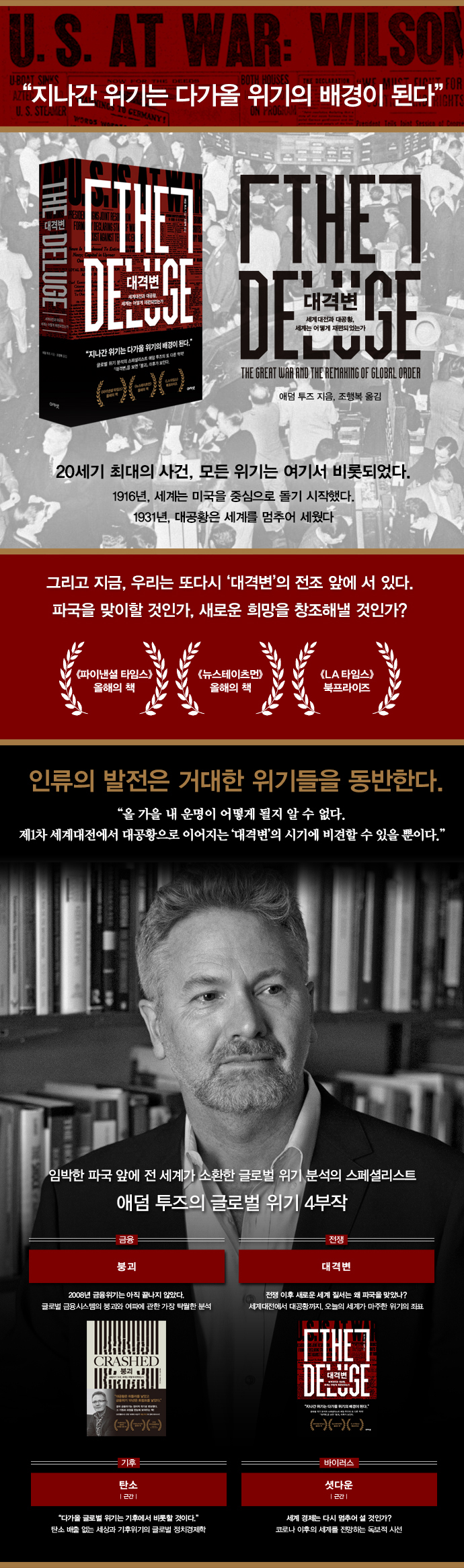
[Financial Times] Book of the Year
[New Statesman] Book of the Year
[LA Times] Book Prize
The greatest events of the 20th century, all crises, originated here.
“The coming crisis becomes the backdrop to the past crisis.”
After World War I, the United States emerged as the world's sole superpower, taking the lead in post-war settlement and reparations issues with its absolute economic superiority, including financial power.
Tooze characterizes the American preponderance that forged the new world order as “absent but present.”
But the new world, built on an unstable foundation, faces a catastrophe that leads to another war.
How did this new world order combine to lead to disaster? Who is ultimately responsible for the endless human-caused catastrophes? Can the world achieve lasting stability and peace? The questions this book raises remain relevant because we live in a world shaped by a defining moment a century ago.
Author Adam Tooze has been one of the most in-demand people in the world since the COVID-19 pandemic.
He also received significant attention in Korea for his book, Crashed (2019), which densely describes the world after the 2008 global financial crisis.
Focusing on recurring moments of crisis at the global level, he is currently writing a four-part series on the global crisis, covering the post-pandemic world outlook (Shutdown) and the political economy of the climate crisis (Carbon).
The period that Tooze points to as a point of comparison for the current unprecedented crisis is the interwar period between the two world wars.
『Cataclysm』 is another of his masterpieces, dealing with the reorganization of the world order from World War I to the Great Depression.
[New Statesman] Book of the Year
[LA Times] Book Prize
The greatest events of the 20th century, all crises, originated here.
“The coming crisis becomes the backdrop to the past crisis.”
After World War I, the United States emerged as the world's sole superpower, taking the lead in post-war settlement and reparations issues with its absolute economic superiority, including financial power.
Tooze characterizes the American preponderance that forged the new world order as “absent but present.”
But the new world, built on an unstable foundation, faces a catastrophe that leads to another war.
How did this new world order combine to lead to disaster? Who is ultimately responsible for the endless human-caused catastrophes? Can the world achieve lasting stability and peace? The questions this book raises remain relevant because we live in a world shaped by a defining moment a century ago.
Author Adam Tooze has been one of the most in-demand people in the world since the COVID-19 pandemic.
He also received significant attention in Korea for his book, Crashed (2019), which densely describes the world after the 2008 global financial crisis.
Focusing on recurring moments of crisis at the global level, he is currently writing a four-part series on the global crisis, covering the post-pandemic world outlook (Shutdown) and the political economy of the climate crisis (Carbon).
The period that Tooze points to as a point of comparison for the current unprecedented crisis is the interwar period between the two world wars.
『Cataclysm』 is another of his masterpieces, dealing with the reorganization of the world order from World War I to the Great Depression.
- You can preview some of the book's contents.
Preview
index
Acknowledgements
introduction
Part 1: The Eurasian Crisis
Chapter 1: The War that Reached an Unstable Balance
Chapter 2: Peace Without Victory
Chapter 3: The Graveyard of the Fallen, Russian Democracy
Chapter 4: China Enters the World of War
Chapter 5 Treaty of Brest-Litovsk
Chapter 6: The Cruel Peace Treaty
Chapter 7: The Collapsing World
Chapter 8 Intervention
Part 2: Securing a Democratic Victory
Chapter 9: Encouraging the Negotiating Nation
Chapter 10: The Arsenal of Democracy
Chapter 11: The Armistice: Putting the Wilsonian Script into Action
Chapter 12: Democracy in Trouble
Part 3: Unfinished Peace
Chapter 13: The World Order in Tatters
Chapter 14: The Truth About Treaties
Chapter 15 Compensation
Chapter 16: European Conformity
Chapter 17: Conformity in Asia
Chapter 18: The Great Failure of Wilsonianism
Part 4: The Search for a New Order
Chapter 19: Severe Deflation
Chapter 20: The Crisis of the Empire
Chapter 21: Washington Conference
Chapter 22: The Reinvention of Communism
Chapter 23 Genoa: The Fall of British Hegemony
Chapter 24: Europe on the Brink
Chapter 25: The New Politics of War and Peace
Chapter 26: The Great Depression
conclusion
annotation
Translator's Note
Biographical Index
introduction
Part 1: The Eurasian Crisis
Chapter 1: The War that Reached an Unstable Balance
Chapter 2: Peace Without Victory
Chapter 3: The Graveyard of the Fallen, Russian Democracy
Chapter 4: China Enters the World of War
Chapter 5 Treaty of Brest-Litovsk
Chapter 6: The Cruel Peace Treaty
Chapter 7: The Collapsing World
Chapter 8 Intervention
Part 2: Securing a Democratic Victory
Chapter 9: Encouraging the Negotiating Nation
Chapter 10: The Arsenal of Democracy
Chapter 11: The Armistice: Putting the Wilsonian Script into Action
Chapter 12: Democracy in Trouble
Part 3: Unfinished Peace
Chapter 13: The World Order in Tatters
Chapter 14: The Truth About Treaties
Chapter 15 Compensation
Chapter 16: European Conformity
Chapter 17: Conformity in Asia
Chapter 18: The Great Failure of Wilsonianism
Part 4: The Search for a New Order
Chapter 19: Severe Deflation
Chapter 20: The Crisis of the Empire
Chapter 21: Washington Conference
Chapter 22: The Reinvention of Communism
Chapter 23 Genoa: The Fall of British Hegemony
Chapter 24: Europe on the Brink
Chapter 25: The New Politics of War and Peace
Chapter 26: The Great Depression
conclusion
annotation
Translator's Note
Biographical Index
Detailed image
Into the book
“This is like the Deluge.
It is a cataclysm of nature that will bring unprecedented changes to the structure of society and industry.
It is a typhoon that uproots the ornamental plant called modern society.
…an earthquake that shook the lives of Europeans, who had been like rocks.
In that great chaos, nations will advance or retreat generations at a time.”
---From the "Introduction"
The new order showed signs of fundamentally changing the relationship between the great powers—Britain, France, Italy, Japan, Germany, Russia, and the United States—leaving behind the squabbles and nationalist protests of the new states.
Understanding the scale and significance of these power shifts required geostrategic and historical imagination.
The new order in the making was determined by the absence of its most crucial element.
It was America's new power.
---From the "Introduction"
Wilson's actions came too late.
Had he seriously considered negotiations in the summer of 1917, the political landscape in both Russia and Germany might have been fundamentally different.
What would the Provisional Government, struggling in Russia, have done if it had proposed an immediate peace in June or July, expecting to receive the same praise Wilson is now bestowing on Trotsky? One can only imagine.
---From Chapter 5
The deflationary policy pursued by the United States from the spring of 1920 was the real key to the 'global Thermidor' of the 1920s (referring to the month in which the coup d'état that overthrew the revolutionary government of the Mountain Faction during the French Revolution took place).
It was the main driving force behind the restoration of order both domestically and internationally.
This may be the most underrated event in 20th century world history.
---From Chapter 19
The gold standard was tied to a vision of international cooperation that went beyond technical discussions among central banks.
The gold standard, which was at the very heart of the international system, had an 'abuse-preventing' effect not only on inflation-prone socialists who demanded massive increases in spending.
The 'golden chains' also bound the militarists.
Given the US government's rejection of a more robust collective security system, a liberalism firmly rooted in the market was the only meaningful safeguard against the return of imperialism.
---From Chapter 26
Wilson and Hoover wanted revolutionary change in the rest of the world.
It would be even better if they could support their ideal of America's destiny.
But their ideal was not McCarthyism and the Cold War, but a conservatism that looked back to the 19th century.
It is a cataclysm of nature that will bring unprecedented changes to the structure of society and industry.
It is a typhoon that uproots the ornamental plant called modern society.
…an earthquake that shook the lives of Europeans, who had been like rocks.
In that great chaos, nations will advance or retreat generations at a time.”
---From the "Introduction"
The new order showed signs of fundamentally changing the relationship between the great powers—Britain, France, Italy, Japan, Germany, Russia, and the United States—leaving behind the squabbles and nationalist protests of the new states.
Understanding the scale and significance of these power shifts required geostrategic and historical imagination.
The new order in the making was determined by the absence of its most crucial element.
It was America's new power.
---From the "Introduction"
Wilson's actions came too late.
Had he seriously considered negotiations in the summer of 1917, the political landscape in both Russia and Germany might have been fundamentally different.
What would the Provisional Government, struggling in Russia, have done if it had proposed an immediate peace in June or July, expecting to receive the same praise Wilson is now bestowing on Trotsky? One can only imagine.
---From Chapter 5
The deflationary policy pursued by the United States from the spring of 1920 was the real key to the 'global Thermidor' of the 1920s (referring to the month in which the coup d'état that overthrew the revolutionary government of the Mountain Faction during the French Revolution took place).
It was the main driving force behind the restoration of order both domestically and internationally.
This may be the most underrated event in 20th century world history.
---From Chapter 19
The gold standard was tied to a vision of international cooperation that went beyond technical discussions among central banks.
The gold standard, which was at the very heart of the international system, had an 'abuse-preventing' effect not only on inflation-prone socialists who demanded massive increases in spending.
The 'golden chains' also bound the militarists.
Given the US government's rejection of a more robust collective security system, a liberalism firmly rooted in the market was the only meaningful safeguard against the return of imperialism.
---From Chapter 26
Wilson and Hoover wanted revolutionary change in the rest of the world.
It would be even better if they could support their ideal of America's destiny.
But their ideal was not McCarthyism and the Cold War, but a conservatism that looked back to the 19th century.
---From "Conclusion"
Publisher's Review
The greatest events of the 20th century, all crises, originated here.
“The coming crisis becomes the backdrop to the past crisis.”
After World War I, the United States emerged as the world's sole superpower, taking the lead in post-war settlement and reparations issues with its absolute economic superiority, including financial power.
Tooze characterizes the American preponderance that forged the new world order as “absent but present.”
But the new world, built on an unstable foundation, faces a catastrophe that leads to another war.
How did this new world order combine to lead to disaster? Who is ultimately responsible for the endless human-caused catastrophes? Can the world achieve lasting stability and peace? The questions this book raises remain relevant because we live in a world shaped by a defining moment a century ago.
Author Adam Tooze has been one of the most in-demand people in the world since the COVID-19 pandemic.
He also received significant attention in Korea for his book, Crashed (2019), which densely describes the world after the 2008 global financial crisis.
Focusing on recurring moments of crisis at the global level, he is currently writing a four-part series on the global crisis, covering the post-pandemic world outlook (Shutdown) and the political economy of the climate crisis (Carbon).
The period that Tooze points to as a point of comparison for the current unprecedented crisis is the interwar period between the two world wars.
『Cataclysm』 is another of his masterpieces, dealing with the reorganization of the world order from World War I to the Great Depression.
“I don’t know what my fate will be this fall.
It can only be compared to the period of 'cataclysm' from World War I to the Great Depression.”
― From an interview with the JoongAng Ilbo in April 2020
Winners and losers compromise on new interdependence
And a reconstructed 'economic consequences of peace'
In 1915, during the height of World War I, David Lloyd George, then British Minister of War, predicted the coming 'cataclysm' by comparing it to the 'deluge' in the Bible.
And as he said, the world shook breathlessly.
The Bolshevik seizure of power in 1917, the Treaty of Brest-Litovsk, the fall of the Romanov, Hohenzollern, and Habsburg monarchies, the Treaty of Versailles, the emergence of nation-states in Europe and the Middle East, revolution and counter-revolution in Eastern Europe, civil war and famine in Russia, the French occupation of the Rhineland, hyperinflation in Germany… … .
The film traces the strategic actions of eight great powers (Britain, France, Germany, Italy, Japan, Russia, China, and the United States) and the conflicts between them, telling the story of a conflict that shaped the political and ideological elements of the modern world.
In this unbalanced world, winners and losers are entangled with the United States, compromising with new interdependence.
“This is like the ‘Great Flood.’
It is a great natural catastrophe that will bring about unprecedented changes to the structure of society and industry.
… … In that great chaos, nations will advance or retreat generations at a time.” David Lloyd George, “Introduction”
Establishing peace in the postwar world meant accepting Germany as a member of the new world order.
There was a question of compensation at stake.
In his best-selling book, The Economic Consequence of the Peace, Keynes questioned the political legitimacy of the Treaty of Versailles, criticizing the excessive demands placed on Germany point by point.
By closely analyzing Keynes's arguments and examining the dynamics of the US and Europe, Tooze provides a broader understanding of treaty and reparations issues beyond the "economic consequences."
If France and Britain were to prevent Germany from making harsh demands, the US debt restructuring was key, and if we trace how this played out in postwar negotiations and events such as the French occupation of the Ruhr (1923), we find ourselves shaking our heads at Keynes's assessment that "the real culprit behind the peace treaty was that withered Frenchman Clemenceau who had absorbed Bismarck's politics."
A new world order formed under the slogan of "peace without victory."
Reassessing Woodrow Wilson and Collective Deflation
The person who dominated the period of reorganization of the new world order was Woodrow Wilson, the 28th President of the United States.
Wilson used America's superior economic power as leverage to "force" the allies and the negotiating powers to agree on a victory for neither side, rather than a victory for the "right" side.
This slogan, "Peace without Victory," is a key element defining the American-led postwar order, along with the consistent policy goal of "Open Door."
Tooze persistently describes how this pursuit of hegemony was consistently maintained as a goal of nationalist America, from the Versailles Treaty, the Washington Naval Conference, and the handling of the reparations issue.
Here, Wilson sheds his mystique as an idealist known for advocating the principle of national self-determination and emerges as a realist who embodies American values.
In an extension of these policies, the United States pursued strong deflationary policies and forced other countries to follow suit.
It also served as a means of reducing military spending.
The hope was that when financial pressures came, people would forget their political grievances and focus on market principles, and that this market-based liberalism would prevent a resurgence of imperialist competition.
'Golden chains' refers to the gold standard system, meaning that the power to issue currency is tied to gold.
The pursuit of currency value stability, symbolized by the return to the gold standard, also served as a shackle that bound the ankles of militarists, symbolized by imperialism.
In this respect, Tooze argues that Britain's departure from the gold standard in September 1931 was the trigger for the coming Second World War.
America's Return to Nationalism, a World Lost in Cooperation and Solidarity
Will the world face destruction again?
The world order of 'Great Upheaval' is swept up in the Great Depression and faces destruction in an unfinished state.
In 1931, Hoover's moratorium on German reparations, which would have permanently ended the war, was blocked by Congress, and the United States once again reverted to nationalism.
This closely resembles the current movement to break away from the world order by prioritizing one's own country.
Since the COVID-19 outbreak, we have become more acutely aware of the need for global cooperation and solidarity.
The “pandemic-led crisis” is becoming a reality.
We are once again standing on the brink of a 'cataclysm'.
Will it lead to catastrophe or create new hope? The "past crisis," born from the greatest event of the 20th century, will serve as a barometer for the "coming crisis."
“The coming crisis becomes the backdrop to the past crisis.”
After World War I, the United States emerged as the world's sole superpower, taking the lead in post-war settlement and reparations issues with its absolute economic superiority, including financial power.
Tooze characterizes the American preponderance that forged the new world order as “absent but present.”
But the new world, built on an unstable foundation, faces a catastrophe that leads to another war.
How did this new world order combine to lead to disaster? Who is ultimately responsible for the endless human-caused catastrophes? Can the world achieve lasting stability and peace? The questions this book raises remain relevant because we live in a world shaped by a defining moment a century ago.
Author Adam Tooze has been one of the most in-demand people in the world since the COVID-19 pandemic.
He also received significant attention in Korea for his book, Crashed (2019), which densely describes the world after the 2008 global financial crisis.
Focusing on recurring moments of crisis at the global level, he is currently writing a four-part series on the global crisis, covering the post-pandemic world outlook (Shutdown) and the political economy of the climate crisis (Carbon).
The period that Tooze points to as a point of comparison for the current unprecedented crisis is the interwar period between the two world wars.
『Cataclysm』 is another of his masterpieces, dealing with the reorganization of the world order from World War I to the Great Depression.
“I don’t know what my fate will be this fall.
It can only be compared to the period of 'cataclysm' from World War I to the Great Depression.”
― From an interview with the JoongAng Ilbo in April 2020
Winners and losers compromise on new interdependence
And a reconstructed 'economic consequences of peace'
In 1915, during the height of World War I, David Lloyd George, then British Minister of War, predicted the coming 'cataclysm' by comparing it to the 'deluge' in the Bible.
And as he said, the world shook breathlessly.
The Bolshevik seizure of power in 1917, the Treaty of Brest-Litovsk, the fall of the Romanov, Hohenzollern, and Habsburg monarchies, the Treaty of Versailles, the emergence of nation-states in Europe and the Middle East, revolution and counter-revolution in Eastern Europe, civil war and famine in Russia, the French occupation of the Rhineland, hyperinflation in Germany… … .
The film traces the strategic actions of eight great powers (Britain, France, Germany, Italy, Japan, Russia, China, and the United States) and the conflicts between them, telling the story of a conflict that shaped the political and ideological elements of the modern world.
In this unbalanced world, winners and losers are entangled with the United States, compromising with new interdependence.
“This is like the ‘Great Flood.’
It is a great natural catastrophe that will bring about unprecedented changes to the structure of society and industry.
… … In that great chaos, nations will advance or retreat generations at a time.” David Lloyd George, “Introduction”
Establishing peace in the postwar world meant accepting Germany as a member of the new world order.
There was a question of compensation at stake.
In his best-selling book, The Economic Consequence of the Peace, Keynes questioned the political legitimacy of the Treaty of Versailles, criticizing the excessive demands placed on Germany point by point.
By closely analyzing Keynes's arguments and examining the dynamics of the US and Europe, Tooze provides a broader understanding of treaty and reparations issues beyond the "economic consequences."
If France and Britain were to prevent Germany from making harsh demands, the US debt restructuring was key, and if we trace how this played out in postwar negotiations and events such as the French occupation of the Ruhr (1923), we find ourselves shaking our heads at Keynes's assessment that "the real culprit behind the peace treaty was that withered Frenchman Clemenceau who had absorbed Bismarck's politics."
A new world order formed under the slogan of "peace without victory."
Reassessing Woodrow Wilson and Collective Deflation
The person who dominated the period of reorganization of the new world order was Woodrow Wilson, the 28th President of the United States.
Wilson used America's superior economic power as leverage to "force" the allies and the negotiating powers to agree on a victory for neither side, rather than a victory for the "right" side.
This slogan, "Peace without Victory," is a key element defining the American-led postwar order, along with the consistent policy goal of "Open Door."
Tooze persistently describes how this pursuit of hegemony was consistently maintained as a goal of nationalist America, from the Versailles Treaty, the Washington Naval Conference, and the handling of the reparations issue.
Here, Wilson sheds his mystique as an idealist known for advocating the principle of national self-determination and emerges as a realist who embodies American values.
In an extension of these policies, the United States pursued strong deflationary policies and forced other countries to follow suit.
It also served as a means of reducing military spending.
The hope was that when financial pressures came, people would forget their political grievances and focus on market principles, and that this market-based liberalism would prevent a resurgence of imperialist competition.
'Golden chains' refers to the gold standard system, meaning that the power to issue currency is tied to gold.
The pursuit of currency value stability, symbolized by the return to the gold standard, also served as a shackle that bound the ankles of militarists, symbolized by imperialism.
In this respect, Tooze argues that Britain's departure from the gold standard in September 1931 was the trigger for the coming Second World War.
America's Return to Nationalism, a World Lost in Cooperation and Solidarity
Will the world face destruction again?
The world order of 'Great Upheaval' is swept up in the Great Depression and faces destruction in an unfinished state.
In 1931, Hoover's moratorium on German reparations, which would have permanently ended the war, was blocked by Congress, and the United States once again reverted to nationalism.
This closely resembles the current movement to break away from the world order by prioritizing one's own country.
Since the COVID-19 outbreak, we have become more acutely aware of the need for global cooperation and solidarity.
The “pandemic-led crisis” is becoming a reality.
We are once again standing on the brink of a 'cataclysm'.
Will it lead to catastrophe or create new hope? The "past crisis," born from the greatest event of the 20th century, will serve as a barometer for the "coming crisis."
GOODS SPECIFICS
- Date of publication: June 29, 2020
- Format: Hardcover book binding method guide
- Page count, weight, size: 748 pages | 1,206g | 153*225*40mm
- ISBN13: 9788957336823
- ISBN10: 8957336826
You may also like
카테고리
korean


korean

![GQ KOREA Mark (Monthly): December [2025]](http://librairie.coreenne.fr/cdn/shop/files/8ef265dbbfbf186523ed75ba7319009d.jpg?v=1765340328&width=3840)


