

Corona Sapiens
 |
Description
Book Introduction
- A word from MD
- How will the world change after COVID-19? Leading South Korean intellectuals Choi Jae-cheon (Ecology and Humanity), Chang Ha-joon (Restructuring the Economy), Choi Jae-boong (Transition of Civilization), Hong Ki-bin (New System), Kim Nu-ri (Overturning Worldviews), and Kim Kyung-il (Measures of Happiness) each examine the present and future in their respective fields.
- Son Min-gyu, Social and Political MD
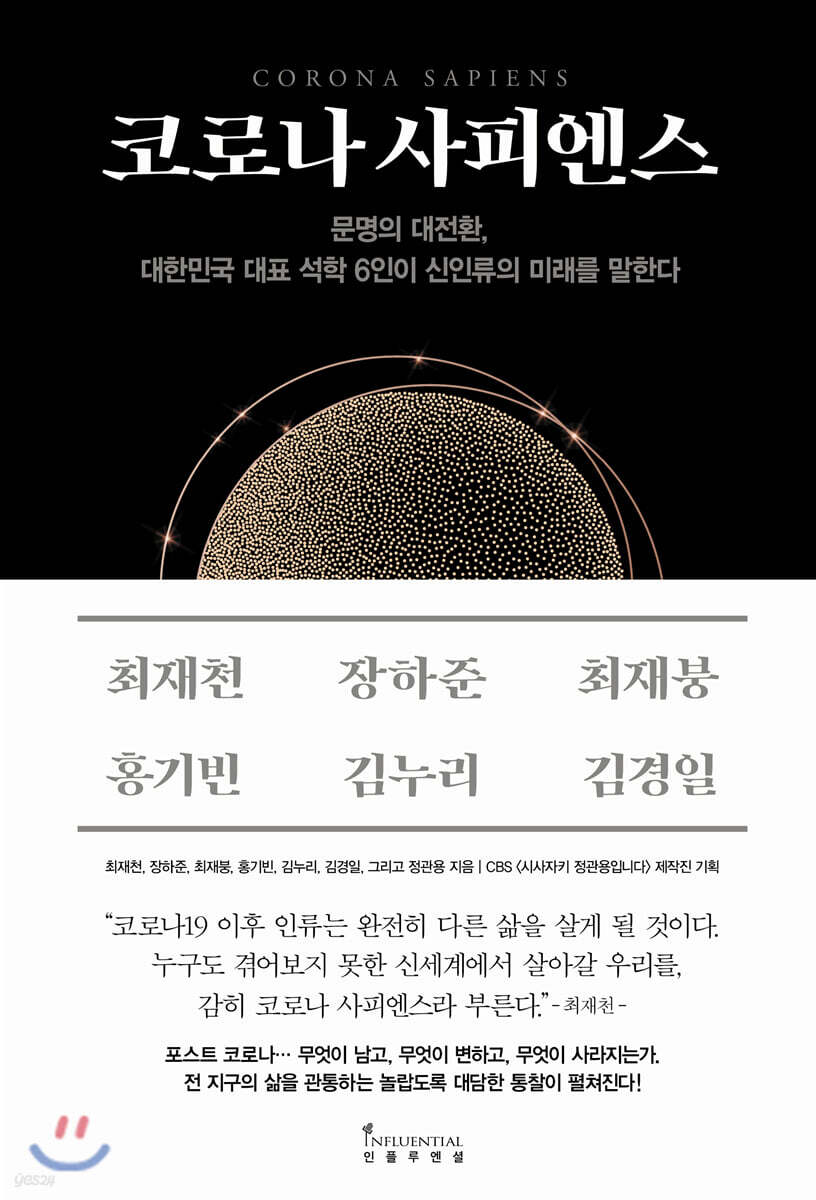
“After COVID-19, humanity will live a completely different life.
We dare to call ourselves Corona Sapiens, living in a new world that no one has ever experienced before.”
Choi Jae-cheon, Jang Ha-joon, Choi Jae-boong, Hong Ki-bin, Kim Nu-ri, Kim Kyung-il…
The Future of the New Humanity as Proposed by Six Leading Korean Scholars
A startlingly bold insight, a conviction and a warning, a new insight that permeates life across the planet.
It seems clear that humanity will live a completely different life than before due to the COVID-19 pandemic.
Amidst the growing self-reflection that it will be difficult to overcome this crisis with the language and methods of the past, leading intellectuals from various fields have offered bold insights.
They are Choi Jae-cheon (Ecology and Humanity), Chang Ha-joon (Restructuring the Economy), Choi Jae-boong (Transition of Civilization), Hong Ki-bin (New System), Kim Nu-ri (Overturning the Worldview), and Kim Kyung-il (Measures of Happiness).
How will our lives change? What should we pay attention to from past misjudgments and decisions? What needs to be corrected and what needs to be cultivated? What opportunities can be found in crisis? They boldly call us, who will live in a new world no one has ever experienced, "Corona Sapiens," and offer broad insights into the new humanity that will have to live under a completely different system in the wake of the COVID-19 pandemic.
We dare to call ourselves Corona Sapiens, living in a new world that no one has ever experienced before.”
Choi Jae-cheon, Jang Ha-joon, Choi Jae-boong, Hong Ki-bin, Kim Nu-ri, Kim Kyung-il…
The Future of the New Humanity as Proposed by Six Leading Korean Scholars
A startlingly bold insight, a conviction and a warning, a new insight that permeates life across the planet.
It seems clear that humanity will live a completely different life than before due to the COVID-19 pandemic.
Amidst the growing self-reflection that it will be difficult to overcome this crisis with the language and methods of the past, leading intellectuals from various fields have offered bold insights.
They are Choi Jae-cheon (Ecology and Humanity), Chang Ha-joon (Restructuring the Economy), Choi Jae-boong (Transition of Civilization), Hong Ki-bin (New System), Kim Nu-ri (Overturning the Worldview), and Kim Kyung-il (Measures of Happiness).
How will our lives change? What should we pay attention to from past misjudgments and decisions? What needs to be corrected and what needs to be cultivated? What opportunities can be found in crisis? They boldly call us, who will live in a new world no one has ever experienced, "Corona Sapiens," and offer broad insights into the new humanity that will have to live under a completely different system in the wake of the COVID-19 pandemic.
- You can preview some of the book's contents.
Preview
index
Introduction_ For us, the Corona Sapiens, who will live a completely different life from before.
Post-Corona [1] Ecology and Humanity_ Choi Jae-cheon
Viruses break out every 3 to 5 years.
How should humanity survive?
Post-Corona [2] Economic Restructuring_ Ha-Joon Chang
"A Great Depression Like 1929 Is Coming"
How the World Economy Resets
Post-Corona [3] Transition of Civilization_ Choi Jae-boong
“Accept it or die.”
How the Phono Sapiens Civilization Accelerates
Post-Corona [4] New System_ Hong Ki-bin
All four pillars of global capitalism have collapsed.
What is the future that must be created, not the future that has already been created?
Post-Corona [5] Overturning the Worldview_ Kim Nu-ri
“Either capitalism collapses or capitalism becomes human.”
How does the grand framework for the world change?
Post-Corona [6] The Scale of Happiness_ Kim Kyung-il
"I can't survive on the one-track system imposed by society."
Where is the standard for happiness?
Post-Corona [1] Ecology and Humanity_ Choi Jae-cheon
Viruses break out every 3 to 5 years.
How should humanity survive?
Post-Corona [2] Economic Restructuring_ Ha-Joon Chang
"A Great Depression Like 1929 Is Coming"
How the World Economy Resets
Post-Corona [3] Transition of Civilization_ Choi Jae-boong
“Accept it or die.”
How the Phono Sapiens Civilization Accelerates
Post-Corona [4] New System_ Hong Ki-bin
All four pillars of global capitalism have collapsed.
What is the future that must be created, not the future that has already been created?
Post-Corona [5] Overturning the Worldview_ Kim Nu-ri
“Either capitalism collapses or capitalism becomes human.”
How does the grand framework for the world change?
Post-Corona [6] The Scale of Happiness_ Kim Kyung-il
"I can't survive on the one-track system imposed by society."
Where is the standard for happiness?
Detailed image
.jpg)
Into the book
The biggest characteristic of this coronavirus is that it is very weak.
At first, it comes in so gently that you don't even feel any symptoms.
They keep spreading it to others without even knowing that they have it.
Then, it reveals its true colors and enters not only the lungs but also other organs at a very fast rate.
It is transmitted through contact, but if the virus invades and quickly becomes critical, that person cannot spread it even if they want to.
---From "Post-Corona (1) Ecology and Humanity: Choi Jae-cheon"
Most experts say the only answer is a vaccine, but I disagree.
They say it takes at least a year to develop a vaccine.
It will probably take about 2-3 years in practice.
But if viruses continue to attack us almost every year in the future, vaccines will always have to be on the back burner.
It's like a vaccine is developed and distributed only after tens of thousands of people die over the course of a year.
Vaccines are made from weakened or killed pathogens like bacteria or viruses, or by extracting the surface proteins or toxins surrounding the pathogens. There are better vaccines than these chemical vaccines.
These are behavioral vaccines and ecological vaccines.
---From "Post-Corona (1) Ecology and Humanity: Choi Jae-cheon"
There is now hope that people may finally be making the calculation that it is better not to disturb nature.
We can't afford to be hit by a catastrophe like this every few years.
Now, eco-centric companies that put ecology at the center of their economic activities will emerge, and consumers will only choose such companies.
Ecological transition is the only way to survive.
---From "Post-Corona (1) Ecology and Humanity_ Choi Jae-cheon"
Now is the time to loosen up your money.
That's the only way.
How you solve it here is important.
Because even though we've been releasing a lot of money since 2008, almost none of that money has gone into the real economy.
Banks simply piled up money and companies took on excessive debt, which only created bubbles in the asset market.
So, you can't do it that way this time either.
Especially this time, even if people spend money, it is difficult to go out and spend.
That's why we need to give money to people who really need it to make a living.
---From "Post-Corona (2) Economic Restructuring_ Ha-Joon Chang"
However, some argue that given the unprecedented economic crisis brought about by COVID-19, the Moon Jae-in administration should scrap all of its policies, including raising the minimum wage, implementing the 52-hour workweek, and pursuing income-led growth, and instead shift towards growth.
What do you think about this? How can we grow in this situation?
Right now, keeping our citizens safe and healthy is paramount.
And as I said before, growth is a means.
Ultimately, the goal is to make all citizens live well.
It is time to abandon such values that have reversed the roles of subject and object.
---From "Post-Corona (2) Economic Restructuring_ Ha-Joon Chang"
When the world's top 100 digital ventures come to our country, more than half of them are illegal.
That's what they mean when they talk about a regulatory republic.
Uber is one of them, Airbnb is another, and there are many others as well.
One of the issues that has come to light this time is telemedicine.
In our country, telemedicine is illegal, so people who are afraid of infection are reluctant to visit hospitals and receive medical diagnosis.
Many countries, such as the United States, China, and Japan, have already implemented this.
In our country, if there is a threat to existing jobs, it can be considered a target of regulation.
In fact, protection is definitely necessary.
However, the pace of change in world civilization is too fast to be maintained through regulations alone.
Protection should not lead to elimination.
---From "Post-Corona (3) Transition of Civilization_ Choi Jae-boong"
There is a makgeolli company with three employees and annual sales of 200 million won.
When the owner was facing financial difficulties and was about to close the business, his son jumped in, saying, "Our makgeolli tastes good and is good, so I'll try to save it." After using social media marketing, sales increased 100-fold in just 10 years.
20 billion won.
Makgeolli is a traditional industry.
Applying the civilization of Phono Sapiens there opened the way.
This means that there is no need to worry about jobs disappearing.
The idea is that we can only achieve a balance between supply and demand by continuously creating new jobs through new civilizations.
---From "Post-Corona (3) Transition of Civilization_ Choi Jae-boong"
My friends in Europe often compare COVID-19 to the Black Death.
Of course, the casualty numbers are incomparable.
In the 14th century, almost half the population died.
But I think that Europeans are similar in that this is an event that will fundamentally change their way of life as they feel such a great shock and tragedy.
I'm accepting that after COVID-19, the entire civilization will change in a completely new way.
Because the structures that have supported global capitalist civilization for the past 40 years are all collapsing.
There are four structures.
Globalization, urbanization, financialization, and ecological crisis.
---From "Post-Corona [4] New System_ Hong Ki-bin"
There may be things we need to change in the way we live.
First of all, is it really necessary to travel abroad once a year, polluting the air and spending money? Do we really need to touch the Leaning Tower of Pisa? Do we really need to drink groundwater, bedrock, and even meltwater from glaciers in plastic containers in the city? The Danes and we farm and raise pigs, just like we do. If we send our agricultural products to Denmark and import pork from Denmark just because it's a few hundred or thousand won cheaper, what will happen to the planet?
---From "Post-Corona [4] New System_ Hong Ki-bin"
First, capitalism, if left unchecked, will prey on humans.
In Germany, they call it 'beast capitalism'.
That means becoming a beast.
That is the reality of Korean society today.
In Korean society, beast capitalism is more rampant than in any other country in the world.
In other words, the Korean National Assembly is over-represented by liberal democrats and those who support the so-called free market economy.
That's why unemployment and inequality are so severe.
The fact that Korea boasts the world's highest unemployment, inequality, mortality, and industrial accident rates means that the brutality of capitalism is rampant in Korean society.
---From "Post-Corona [5] Overturning the Worldview_ Kim Nu-ri"
The third principle for the post-COVID era is to be wary of the risks of disaster capitalism.
Capitalism has always used social and natural disasters as golden opportunities to strengthen its dominance.
The recent behavior of several Korean conglomerates and large corporations amid the COVID-19 crisis, along with the capital-friendly measures taken by officials at the Ministry of Strategy and Finance, warn of the potential recurrence of the evils of disaster capitalism.
Clearly, our national response was excellent and our awareness was high, but we must never lose sight of this evil.
---From "Post-Corona [5] Overturning the Worldview_ Kim Nu-ri"
Until recently, students coming from abroad were looked upon with disdain.
From a psychologist's perspective, that's a natural reaction.
The word reaction itself is a reflexive action that occurs unconsciously.
However, one thing that must be noted is that if you act according to the reactions of your body organs, you are not a human but an animal.
It is human to control that with reason.
… No matter how much you love someone, if they suddenly appear on a dark street at night, you can’t help but be surprised.
There's no need to feel guilty about that reaction.
But there is nothing more foolish than clinging to that reaction for too long or disguising that reaction as some policy or social value.
---From "Post-Corona [6] The Scale of Happiness_ Kim Kyung-il"
COVID-19 is anxiety, not anger.
So, right now, we are not ‘angry’ because of the coronavirus, but rather ‘anxious’ because of the coronavirus.
Why does anxiety increase? It increases because of uncertainty.
However, uncertainty can be sufficiently resolved by showing the facts.
When you're feeling anxious, the best thing to do is get the facts straight.
That's what the Korean government and the Korean system did well.
When I found out the truth, I thought, 'Oh, the risk of infection is high.
But, thinking, 'The fatality rate must be about this much,' they use their own energy, society's energy, or group energy for good things.
---From "Post-Corona [6] The Scale of Happiness_ Kim Kyung-il"
Before the COVID-19 outbreak, we were stuck in a cycle of endless satisfaction, thinking, "I have to have this, I have to have that."
Then, look at what people who have time alone due to this situation do.
Don't people who like sweet things stir their coffee 1,000 times to make dalgona coffee?
I've developed my own like.
That's what gives me real satisfaction.
It's true happiness.
If you keep pursuing socially desirable things that you don't really like, you'll end up earning a lot more.
We need to have much more and take much more.
But in a society or culture where we discover what we truly like and develop our abilities to do so, we can all live happily together while coexisting with less.
At first, it comes in so gently that you don't even feel any symptoms.
They keep spreading it to others without even knowing that they have it.
Then, it reveals its true colors and enters not only the lungs but also other organs at a very fast rate.
It is transmitted through contact, but if the virus invades and quickly becomes critical, that person cannot spread it even if they want to.
---From "Post-Corona (1) Ecology and Humanity: Choi Jae-cheon"
Most experts say the only answer is a vaccine, but I disagree.
They say it takes at least a year to develop a vaccine.
It will probably take about 2-3 years in practice.
But if viruses continue to attack us almost every year in the future, vaccines will always have to be on the back burner.
It's like a vaccine is developed and distributed only after tens of thousands of people die over the course of a year.
Vaccines are made from weakened or killed pathogens like bacteria or viruses, or by extracting the surface proteins or toxins surrounding the pathogens. There are better vaccines than these chemical vaccines.
These are behavioral vaccines and ecological vaccines.
---From "Post-Corona (1) Ecology and Humanity: Choi Jae-cheon"
There is now hope that people may finally be making the calculation that it is better not to disturb nature.
We can't afford to be hit by a catastrophe like this every few years.
Now, eco-centric companies that put ecology at the center of their economic activities will emerge, and consumers will only choose such companies.
Ecological transition is the only way to survive.
---From "Post-Corona (1) Ecology and Humanity_ Choi Jae-cheon"
Now is the time to loosen up your money.
That's the only way.
How you solve it here is important.
Because even though we've been releasing a lot of money since 2008, almost none of that money has gone into the real economy.
Banks simply piled up money and companies took on excessive debt, which only created bubbles in the asset market.
So, you can't do it that way this time either.
Especially this time, even if people spend money, it is difficult to go out and spend.
That's why we need to give money to people who really need it to make a living.
---From "Post-Corona (2) Economic Restructuring_ Ha-Joon Chang"
However, some argue that given the unprecedented economic crisis brought about by COVID-19, the Moon Jae-in administration should scrap all of its policies, including raising the minimum wage, implementing the 52-hour workweek, and pursuing income-led growth, and instead shift towards growth.
What do you think about this? How can we grow in this situation?
Right now, keeping our citizens safe and healthy is paramount.
And as I said before, growth is a means.
Ultimately, the goal is to make all citizens live well.
It is time to abandon such values that have reversed the roles of subject and object.
---From "Post-Corona (2) Economic Restructuring_ Ha-Joon Chang"
When the world's top 100 digital ventures come to our country, more than half of them are illegal.
That's what they mean when they talk about a regulatory republic.
Uber is one of them, Airbnb is another, and there are many others as well.
One of the issues that has come to light this time is telemedicine.
In our country, telemedicine is illegal, so people who are afraid of infection are reluctant to visit hospitals and receive medical diagnosis.
Many countries, such as the United States, China, and Japan, have already implemented this.
In our country, if there is a threat to existing jobs, it can be considered a target of regulation.
In fact, protection is definitely necessary.
However, the pace of change in world civilization is too fast to be maintained through regulations alone.
Protection should not lead to elimination.
---From "Post-Corona (3) Transition of Civilization_ Choi Jae-boong"
There is a makgeolli company with three employees and annual sales of 200 million won.
When the owner was facing financial difficulties and was about to close the business, his son jumped in, saying, "Our makgeolli tastes good and is good, so I'll try to save it." After using social media marketing, sales increased 100-fold in just 10 years.
20 billion won.
Makgeolli is a traditional industry.
Applying the civilization of Phono Sapiens there opened the way.
This means that there is no need to worry about jobs disappearing.
The idea is that we can only achieve a balance between supply and demand by continuously creating new jobs through new civilizations.
---From "Post-Corona (3) Transition of Civilization_ Choi Jae-boong"
My friends in Europe often compare COVID-19 to the Black Death.
Of course, the casualty numbers are incomparable.
In the 14th century, almost half the population died.
But I think that Europeans are similar in that this is an event that will fundamentally change their way of life as they feel such a great shock and tragedy.
I'm accepting that after COVID-19, the entire civilization will change in a completely new way.
Because the structures that have supported global capitalist civilization for the past 40 years are all collapsing.
There are four structures.
Globalization, urbanization, financialization, and ecological crisis.
---From "Post-Corona [4] New System_ Hong Ki-bin"
There may be things we need to change in the way we live.
First of all, is it really necessary to travel abroad once a year, polluting the air and spending money? Do we really need to touch the Leaning Tower of Pisa? Do we really need to drink groundwater, bedrock, and even meltwater from glaciers in plastic containers in the city? The Danes and we farm and raise pigs, just like we do. If we send our agricultural products to Denmark and import pork from Denmark just because it's a few hundred or thousand won cheaper, what will happen to the planet?
---From "Post-Corona [4] New System_ Hong Ki-bin"
First, capitalism, if left unchecked, will prey on humans.
In Germany, they call it 'beast capitalism'.
That means becoming a beast.
That is the reality of Korean society today.
In Korean society, beast capitalism is more rampant than in any other country in the world.
In other words, the Korean National Assembly is over-represented by liberal democrats and those who support the so-called free market economy.
That's why unemployment and inequality are so severe.
The fact that Korea boasts the world's highest unemployment, inequality, mortality, and industrial accident rates means that the brutality of capitalism is rampant in Korean society.
---From "Post-Corona [5] Overturning the Worldview_ Kim Nu-ri"
The third principle for the post-COVID era is to be wary of the risks of disaster capitalism.
Capitalism has always used social and natural disasters as golden opportunities to strengthen its dominance.
The recent behavior of several Korean conglomerates and large corporations amid the COVID-19 crisis, along with the capital-friendly measures taken by officials at the Ministry of Strategy and Finance, warn of the potential recurrence of the evils of disaster capitalism.
Clearly, our national response was excellent and our awareness was high, but we must never lose sight of this evil.
---From "Post-Corona [5] Overturning the Worldview_ Kim Nu-ri"
Until recently, students coming from abroad were looked upon with disdain.
From a psychologist's perspective, that's a natural reaction.
The word reaction itself is a reflexive action that occurs unconsciously.
However, one thing that must be noted is that if you act according to the reactions of your body organs, you are not a human but an animal.
It is human to control that with reason.
… No matter how much you love someone, if they suddenly appear on a dark street at night, you can’t help but be surprised.
There's no need to feel guilty about that reaction.
But there is nothing more foolish than clinging to that reaction for too long or disguising that reaction as some policy or social value.
---From "Post-Corona [6] The Scale of Happiness_ Kim Kyung-il"
COVID-19 is anxiety, not anger.
So, right now, we are not ‘angry’ because of the coronavirus, but rather ‘anxious’ because of the coronavirus.
Why does anxiety increase? It increases because of uncertainty.
However, uncertainty can be sufficiently resolved by showing the facts.
When you're feeling anxious, the best thing to do is get the facts straight.
That's what the Korean government and the Korean system did well.
When I found out the truth, I thought, 'Oh, the risk of infection is high.
But, thinking, 'The fatality rate must be about this much,' they use their own energy, society's energy, or group energy for good things.
---From "Post-Corona [6] The Scale of Happiness_ Kim Kyung-il"
Before the COVID-19 outbreak, we were stuck in a cycle of endless satisfaction, thinking, "I have to have this, I have to have that."
Then, look at what people who have time alone due to this situation do.
Don't people who like sweet things stir their coffee 1,000 times to make dalgona coffee?
I've developed my own like.
That's what gives me real satisfaction.
It's true happiness.
If you keep pursuing socially desirable things that you don't really like, you'll end up earning a lot more.
We need to have much more and take much more.
But in a society or culture where we discover what we truly like and develop our abilities to do so, we can all live happily together while coexisting with less.
---From "Post-Corona [6] The Scale of Happiness_ Kim Kyung-il"
Publisher's Review
Choi Jae-cheon, Jang Ha-joon, Choi Jae-boong, Hong Ki-bin, Kim Nu-ri, and Kim Gyeong-il
Six leading scholars from South Korea examine the lives of the new human race, "Corona Sapiens."
The Next Virus.
What will the world look like after COVID-19?
In what order will it be reorganized?
How will thoughts and paradigms change?
This book is a compilation of the main contents of the special project "COVID-19, the Era of New Humanity" on CBS's "Current Affairs with Jeong Gwan-yong," in which scholars from various fields come together to predict the future after the COVID-19 incident and gain insight into the new era.
Six scholars, including Choi Jae-cheon, Distinguished Professor of Eco-Science at Ewha Womans University; Chang Ha-joon, Professor of Economics at Cambridge University; Choi Jae-boong, Professor of Service Convergence Design at Sungkyunkwan University; Hong Ki-bin, Director of the Karl Polanyi Institute for Economic Research; Kim Nu-ri, Director of the German European Research Center; and Kim Kyung-il, Professor of Psychology at Ajou University, analyze our society from various aspects such as ecology, economy, society, politics, and psychology, and provide an in-depth diagnosis of the changes and opportunities that COVID-19 will bring to our lives and the world.
Because we will live a life fundamentally different from the very foundations of civilization, we dare to define human life with the new term "Corona Sapiens," and explore alternative ways of living for the new humanity after the COVID-19 pandemic.
Capitalism as it was yesterday can no longer function.
A time for deep reflection on what humans have destroyed
"How can we grow in this situation? Right now, keeping our citizens safe is paramount.
Growth is just a means; the goal is to make all citizens prosperous.
It is time to abandon such values that have reversed the roles of the subject and object.” _Ha-Joon Chang (Restructuring the Economy)
Economist Professor Ha-Joon Chang emphasizes that COVID-19 is an "unprecedented situation."
There has never been a situation like this where demand, supply, and consumption collapsed all at once.
In a situation where everything collapses in an instant, society inevitably reveals its weaknesses in the most vulnerable areas that we have been blind to.
Problems that were once relegated to the back burner for growth—a devastated job market, soaring unemployment, precarious self-employment, and an imperfect welfare system—are now emerging as priorities that must be addressed immediately.
This is precisely why there has been so much discussion about the neoliberalism that has dominated the world since the 2008 financial crisis.
This crisis is prompting many to seriously consider the questions: "What truly matters in human life?" and "How should individuals change their perceptions and behaviors, and how should society be reorganized to achieve those values?"
“If a virus were to strike humanity every three to five years, we would be left beating the drum.
Every time that happens, people will die and we will struggle to develop a vaccine for one or three years.
Chemical vaccines are not the answer.
The correct answer is ecological vaccines and behavioral vaccines.” _Choi Jae-cheon (Ecology and Humans)
It's not just the economy.
Ecologist Professor Choi Jae-cheon says that ultimately, viruses like this one started when humans invaded the natural ecosystem.
Ecologists have been persistently arguing that preserving the natural environment without damaging it is ultimately more beneficial to humans, but to no avail.
However, predictions continue that a viral shock like COVID-19 will threaten humanity every three to five years, raising fundamental questions about the existing way of development that causes ecological crises.
Professor Choi Jae-cheon says, “In the future, eco-centric companies that put ecology at the center of their economic activities will emerge, and consumers will only choose such companies.”
At the same time, he calls for ecological vaccines (distancing humans from nature) and behavioral vaccines (social distancing) as fundamental measures rather than chemical vaccines.
Truly, ecological transformation is the only way to survive.
The system, worldview, and values that have dominated global capitalism are all collapsing.
What are the standards of life for the new human race?
“Europeans compare COVID-19 to the Black Death.
Regardless of the number of casualties, the impact was so great that it fundamentally changed our way of life.
In fact, over the past 40 years, all four pillars that supported capitalist civilization have collapsed.
“We have no choice but to move toward a different civilization.” _Hong Ki-bin (New System)
Director Hong Ki-bin, renowned for his research on alternative systems, asserts firmly that “the entire civilization could change in a completely new way after the COVID-19 situation,” citing the collapse of four systems as evidence.
This means that the four pillars that have supported global capitalist civilization for the past 40 years have collapsed: the globalization of industry, the urbanization of life, the financialization of value, and the marketization of the environment.
In such a situation, he argues, humanity has no choice but to advance into areas not on the map.
“We have to choose one of two things.
Either abolish capitalism or humanize capitalism.
“If capitalism continues to operate in its current form, I don’t think the 22nd century will ever come.” _Kim Nu-ri (Overturning the Worldview)
Professor Kim Nu-ri, a professor at Chung-Ang University and a critic of political and social education, talks about the change in the framework of perception, or in other words, values, from another perspective.
The argument is that in the Korean reality where beast capitalism is rampant, we must change what is truly important, that is, achieve a 'value shift.'
In particular, he emphasizes that the mindset of meritocracy, which has dominated Korean society (using ability as the standard for evaluation), must change to the mindset of dignity, a perspective that literally regards the dignity of all human beings equally.
Furthermore, after witnessing the tragedy in the United States, Korea's unique American-centric worldview began to crumble, and at the same time, growth-first and development-oriented ideologies were dealt a fatal blow.
“We have lived our lives struggling for recognition, struggling to be recognized by others.
But since the COVID-19 outbreak, my life has changed to one that is for myself, not for others.
“It is and must be shifted from a socially imposed want to a like for myself.” _Kim Kyung-il (The Scale of Happiness)
There will also be many changes in personal values.
Cognitive psychologist Professor Kim Kyung-il provides an important insight.
It is time to break free from the so-called 'struggle for recognition', which involves constant comparison and competition with others in a capitalist society.
He says we should focus on things that truly bring us satisfaction, in particular, things we truly like, rather than things that are socially imposed wants.
The COVID-19 pandemic has led to a redefinition of ownership and desire. As we move toward a "society that pursues wise satisfaction," I propose we find a path to coexistence where you and I can be happy together with less.
Perhaps a golden opportunity to reset the standards of civilization.
What opportunities will the Fourth Industrial Revolution present in a contactless society?
“The COVID-19 pandemic will further accelerate the development of the Phono Sapiens civilization.
Working from home, working three to four days a week, and online classes will become the new "standard of civilization."
This is a very important time.
“The virus shock is coming again.” _Choi Jae-boong (Transition of Civilization)
The COVID-19 pandemic has not only brought about crisis and reflection.
We've seen the explosive impact of the Fourth Industrial Revolution through the COVID-19 pandemic, and we expect this to further develop in the post-COVID-19 era.
With predictions of a repeat of the pandemic shock prevalent, working from home and online education must be feasible to maintain daily life when another virus emerges.
Demand for "non-face-to-face" services that can reduce infection will continue to grow, and this trend will undoubtedly accelerate the Fourth Industrial Revolution.
The response of Phono Sapiens to an unexpected pandemic was remarkable.
They developed apps such as an app for tracking confirmed coronavirus cases and an app for purchasing public masks, and distributed them free of charge to all citizens.
They adapted to the contactless daily life faster than any other generation, and in fact, led the way.
Professor Choi Jae-boong says:
"Experienced with COVID-19 this time, we have the answer to which side can overcome the crisis more healthily and safely." He added that unless older generations take a more proactive approach and transition to a digital civilization, humanity may not be able to survive together.
Six leading scholars from South Korea examine the lives of the new human race, "Corona Sapiens."
The Next Virus.
What will the world look like after COVID-19?
In what order will it be reorganized?
How will thoughts and paradigms change?
This book is a compilation of the main contents of the special project "COVID-19, the Era of New Humanity" on CBS's "Current Affairs with Jeong Gwan-yong," in which scholars from various fields come together to predict the future after the COVID-19 incident and gain insight into the new era.
Six scholars, including Choi Jae-cheon, Distinguished Professor of Eco-Science at Ewha Womans University; Chang Ha-joon, Professor of Economics at Cambridge University; Choi Jae-boong, Professor of Service Convergence Design at Sungkyunkwan University; Hong Ki-bin, Director of the Karl Polanyi Institute for Economic Research; Kim Nu-ri, Director of the German European Research Center; and Kim Kyung-il, Professor of Psychology at Ajou University, analyze our society from various aspects such as ecology, economy, society, politics, and psychology, and provide an in-depth diagnosis of the changes and opportunities that COVID-19 will bring to our lives and the world.
Because we will live a life fundamentally different from the very foundations of civilization, we dare to define human life with the new term "Corona Sapiens," and explore alternative ways of living for the new humanity after the COVID-19 pandemic.
Capitalism as it was yesterday can no longer function.
A time for deep reflection on what humans have destroyed
"How can we grow in this situation? Right now, keeping our citizens safe is paramount.
Growth is just a means; the goal is to make all citizens prosperous.
It is time to abandon such values that have reversed the roles of the subject and object.” _Ha-Joon Chang (Restructuring the Economy)
Economist Professor Ha-Joon Chang emphasizes that COVID-19 is an "unprecedented situation."
There has never been a situation like this where demand, supply, and consumption collapsed all at once.
In a situation where everything collapses in an instant, society inevitably reveals its weaknesses in the most vulnerable areas that we have been blind to.
Problems that were once relegated to the back burner for growth—a devastated job market, soaring unemployment, precarious self-employment, and an imperfect welfare system—are now emerging as priorities that must be addressed immediately.
This is precisely why there has been so much discussion about the neoliberalism that has dominated the world since the 2008 financial crisis.
This crisis is prompting many to seriously consider the questions: "What truly matters in human life?" and "How should individuals change their perceptions and behaviors, and how should society be reorganized to achieve those values?"
“If a virus were to strike humanity every three to five years, we would be left beating the drum.
Every time that happens, people will die and we will struggle to develop a vaccine for one or three years.
Chemical vaccines are not the answer.
The correct answer is ecological vaccines and behavioral vaccines.” _Choi Jae-cheon (Ecology and Humans)
It's not just the economy.
Ecologist Professor Choi Jae-cheon says that ultimately, viruses like this one started when humans invaded the natural ecosystem.
Ecologists have been persistently arguing that preserving the natural environment without damaging it is ultimately more beneficial to humans, but to no avail.
However, predictions continue that a viral shock like COVID-19 will threaten humanity every three to five years, raising fundamental questions about the existing way of development that causes ecological crises.
Professor Choi Jae-cheon says, “In the future, eco-centric companies that put ecology at the center of their economic activities will emerge, and consumers will only choose such companies.”
At the same time, he calls for ecological vaccines (distancing humans from nature) and behavioral vaccines (social distancing) as fundamental measures rather than chemical vaccines.
Truly, ecological transformation is the only way to survive.
The system, worldview, and values that have dominated global capitalism are all collapsing.
What are the standards of life for the new human race?
“Europeans compare COVID-19 to the Black Death.
Regardless of the number of casualties, the impact was so great that it fundamentally changed our way of life.
In fact, over the past 40 years, all four pillars that supported capitalist civilization have collapsed.
“We have no choice but to move toward a different civilization.” _Hong Ki-bin (New System)
Director Hong Ki-bin, renowned for his research on alternative systems, asserts firmly that “the entire civilization could change in a completely new way after the COVID-19 situation,” citing the collapse of four systems as evidence.
This means that the four pillars that have supported global capitalist civilization for the past 40 years have collapsed: the globalization of industry, the urbanization of life, the financialization of value, and the marketization of the environment.
In such a situation, he argues, humanity has no choice but to advance into areas not on the map.
“We have to choose one of two things.
Either abolish capitalism or humanize capitalism.
“If capitalism continues to operate in its current form, I don’t think the 22nd century will ever come.” _Kim Nu-ri (Overturning the Worldview)
Professor Kim Nu-ri, a professor at Chung-Ang University and a critic of political and social education, talks about the change in the framework of perception, or in other words, values, from another perspective.
The argument is that in the Korean reality where beast capitalism is rampant, we must change what is truly important, that is, achieve a 'value shift.'
In particular, he emphasizes that the mindset of meritocracy, which has dominated Korean society (using ability as the standard for evaluation), must change to the mindset of dignity, a perspective that literally regards the dignity of all human beings equally.
Furthermore, after witnessing the tragedy in the United States, Korea's unique American-centric worldview began to crumble, and at the same time, growth-first and development-oriented ideologies were dealt a fatal blow.
“We have lived our lives struggling for recognition, struggling to be recognized by others.
But since the COVID-19 outbreak, my life has changed to one that is for myself, not for others.
“It is and must be shifted from a socially imposed want to a like for myself.” _Kim Kyung-il (The Scale of Happiness)
There will also be many changes in personal values.
Cognitive psychologist Professor Kim Kyung-il provides an important insight.
It is time to break free from the so-called 'struggle for recognition', which involves constant comparison and competition with others in a capitalist society.
He says we should focus on things that truly bring us satisfaction, in particular, things we truly like, rather than things that are socially imposed wants.
The COVID-19 pandemic has led to a redefinition of ownership and desire. As we move toward a "society that pursues wise satisfaction," I propose we find a path to coexistence where you and I can be happy together with less.
Perhaps a golden opportunity to reset the standards of civilization.
What opportunities will the Fourth Industrial Revolution present in a contactless society?
“The COVID-19 pandemic will further accelerate the development of the Phono Sapiens civilization.
Working from home, working three to four days a week, and online classes will become the new "standard of civilization."
This is a very important time.
“The virus shock is coming again.” _Choi Jae-boong (Transition of Civilization)
The COVID-19 pandemic has not only brought about crisis and reflection.
We've seen the explosive impact of the Fourth Industrial Revolution through the COVID-19 pandemic, and we expect this to further develop in the post-COVID-19 era.
With predictions of a repeat of the pandemic shock prevalent, working from home and online education must be feasible to maintain daily life when another virus emerges.
Demand for "non-face-to-face" services that can reduce infection will continue to grow, and this trend will undoubtedly accelerate the Fourth Industrial Revolution.
The response of Phono Sapiens to an unexpected pandemic was remarkable.
They developed apps such as an app for tracking confirmed coronavirus cases and an app for purchasing public masks, and distributed them free of charge to all citizens.
They adapted to the contactless daily life faster than any other generation, and in fact, led the way.
Professor Choi Jae-boong says:
"Experienced with COVID-19 this time, we have the answer to which side can overcome the crisis more healthily and safely." He added that unless older generations take a more proactive approach and transition to a digital civilization, humanity may not be able to survive together.
GOODS SPECIFICS
- Date of issue: June 10, 2020
- Format: Hardcover book binding method guide
- Page count, weight, size: 200 pages | 424g | 140*210*20mm
- ISBN13: 9791189995898
- ISBN10: 1189995891
You may also like
카테고리
korean


korean

![GQ KOREA Mark (Monthly): December [2025]](http://librairie.coreenne.fr/cdn/shop/files/8ef265dbbfbf186523ed75ba7319009d.jpg?v=1765340328&width=3840)


