

Yellow Maze
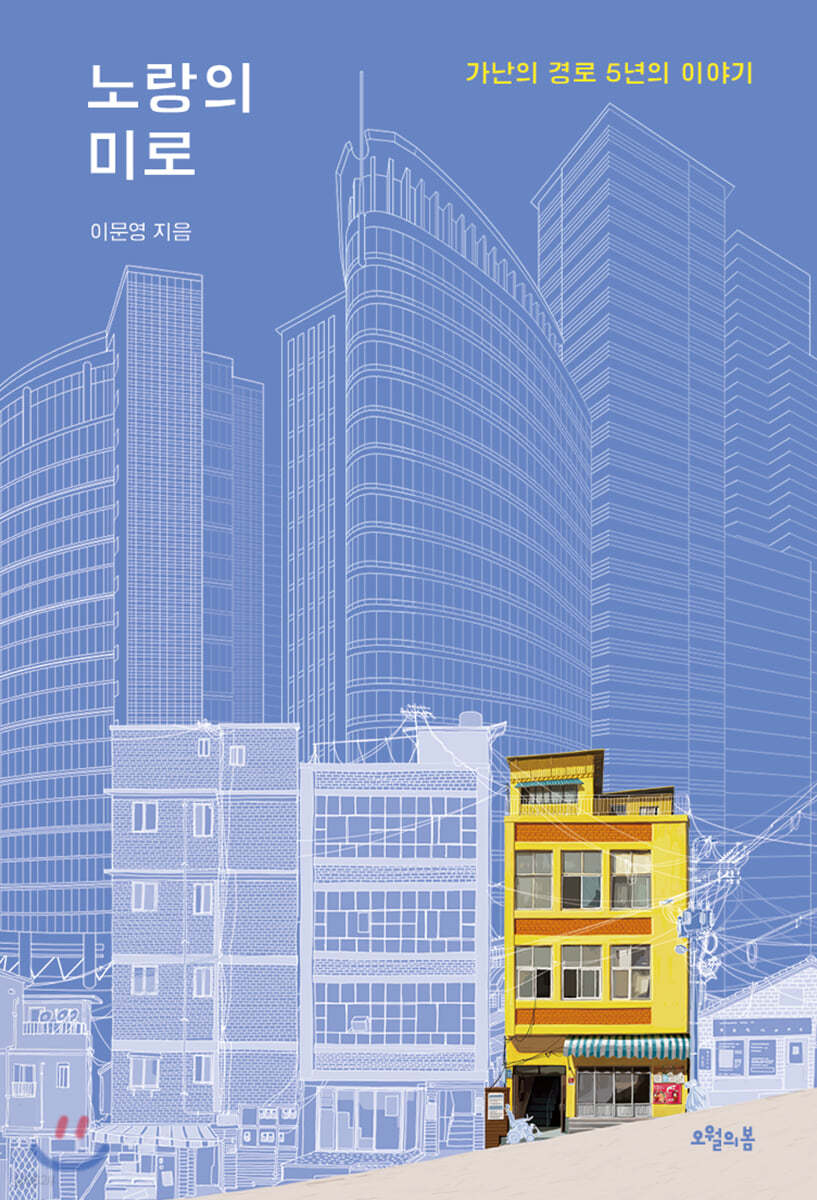 |
Description
Book Introduction
- A word from MD
- In a capitalist society, migration is a duty rather than a right for the poor.
If the building owner asks you to leave, you should leave.
A sudden forced eviction for 45 people living in a boarding house building.
This book follows the lives of 45 people over five years after their forced eviction, documenting what poverty looks like in Korea.
- Son Min-gyu, Social and Political MD
This book was inspired by author Lee Mun-young's serialized work "The Path to Poverty" published in [Hankyoreh 21] from April 2015 to May 2016.
An 'incident' occurred where the owner of a building that was trying to remodel a boarding house into a guesthouse for foreign travelers notified the people who occupied the rooms to vacate.
After that, the building owner's repeated construction attempts, resistance from residents, power outages and water cuts, demolition, relocation, legal battles, construction halts, patching up the yellow house, and returning home followed.
After the court accepted the residents' request for an injunction to halt construction, some of the people who were evicted returned to the building, but many did not return.
At the time, the author followed the entire process of the incident and reported on the ‘aftermath’ of the incident for a year.
An 'incident' occurred where the owner of a building that was trying to remodel a boarding house into a guesthouse for foreign travelers notified the people who occupied the rooms to vacate.
After that, the building owner's repeated construction attempts, resistance from residents, power outages and water cuts, demolition, relocation, legal battles, construction halts, patching up the yellow house, and returning home followed.
After the court accepted the residents' request for an injunction to halt construction, some of the people who were evicted returned to the building, but many did not return.
At the time, the author followed the entire process of the incident and reported on the ‘aftermath’ of the incident for a year.
- You can preview some of the book's contents.
Preview
index
0 Entrance _9
1 bug _10
2 Cod _15
3 Smokeless _23
4 Amen _34
5 Doctors _43
6 Lightning _58
7 Shiva _59
Agent 8_69
9 Main _80
10 Heaven _83
11 Memory _109
12 History _111
13 Emergency _121
14 Furry _129
15 Suspicions _141
16 Handsome Man _151
17 Uproar _166
18 Powder _175
19 Doctor _177
20 Battles _181
21 Green _197
22 Maro _205
23 Route _211
24 Defeat _212
25 Maze _216
26 None _221
27 Director _229
28 Congestion _243
29 Warriors _245
30 Demolition _254
31 Enemy _260
32 Service _269
33 Sedimentation _276
34 Celebrities _284
35 Shooter _299
36 Auxiliary _307
37 Danjeon _317
38 Black Dragon _327
39 Items _338
40 Hammer _345
41 That Gnome _352
42 Who _369
43 Best Friend _379
44 Poppy _386
45 Kwang Kwang _393
46 Pilgrimage _400
47 Smile _418
48 Committee Members _426
49 Reversal _433
50 Tinkering _445
51 Sword Line _447
52 Twins _451
53 Hanyang _464
54 Diary _474
55 Vampire _483
56 Completed _486
57 Ghost _495
58 Returning Home _498
59 hundred meters _508
60. _511
61 Ten Days _525
62 Prophecy _533
63 Black _541
64 Yellow _544
65 Five Years _545
66 Dead _546
67 Again _570
∞ Entrance _573
1 bug _10
2 Cod _15
3 Smokeless _23
4 Amen _34
5 Doctors _43
6 Lightning _58
7 Shiva _59
Agent 8_69
9 Main _80
10 Heaven _83
11 Memory _109
12 History _111
13 Emergency _121
14 Furry _129
15 Suspicions _141
16 Handsome Man _151
17 Uproar _166
18 Powder _175
19 Doctor _177
20 Battles _181
21 Green _197
22 Maro _205
23 Route _211
24 Defeat _212
25 Maze _216
26 None _221
27 Director _229
28 Congestion _243
29 Warriors _245
30 Demolition _254
31 Enemy _260
32 Service _269
33 Sedimentation _276
34 Celebrities _284
35 Shooter _299
36 Auxiliary _307
37 Danjeon _317
38 Black Dragon _327
39 Items _338
40 Hammer _345
41 That Gnome _352
42 Who _369
43 Best Friend _379
44 Poppy _386
45 Kwang Kwang _393
46 Pilgrimage _400
47 Smile _418
48 Committee Members _426
49 Reversal _433
50 Tinkering _445
51 Sword Line _447
52 Twins _451
53 Hanyang _464
54 Diary _474
55 Vampire _483
56 Completed _486
57 Ghost _495
58 Returning Home _498
59 hundred meters _508
60. _511
61 Ten Days _525
62 Prophecy _533
63 Black _541
64 Yellow _544
65 Five Years _545
66 Dead _546
67 Again _570
∞ Entrance _573
Into the book
Poverty is everywhere, but it is concentrated somewhere.
Some poverty is diffuse, while some poverty is concentrated.
Poverty is invisible because it is hidden and covered.
The story of poverty was in the yellow house.
--- p.9
The maggots grew shiny and fleshy as they devoured the immobile man.
The creatures born from eating the disappearing humans wriggled fiercely and fiercely.
--- p.11
Food was for the living.
The living filled their hungry bellies with the food prepared by those who died of hunger.
Hungry pigeons dug their beaks into the park ground in search of food.
--- p.17
Summoned to a time when the king was removed, the great king saw a world where a piece of paper engraved with him sat on the throne instead of his own bloodline.
The wise king knew that he was not a king because he was a king, but because he had money.
The great king realized only after he became rich that the king was not a noble official but a strict figure only to the poor people.
To those who had kings in abundance, he was a piece of paper, but to those who were saddened by not having a king, he was treated as a king.
--- p.21~22
Everyone had to run to avoid starving.
Some people run with hotteok, some run with corn, and some run with humanity.
All kinds of curses flying from all over the place followed me around all day.
Living was sometimes about eating each other's insides.
--- p.48
That was the main point.
Buildings that could not be main anywhere else were main in that neighborhood.
Poverty was the main problem in that neighborhood.
In a neighborhood where poor rooms make up the main building, the most abundant thing was poverty.
People who had never been main characters opened their locked voices in the main alley of Dongja-dong.
--- p.82
There was a time when a space that was looked down upon because it was poor became a space that was needed because it was poor.
At the end of the year, the heads of large corporations would show up in the neighborhood with 'donations of love'.
He walked through the alleys with dozens of attendants and photographers.
As the chairman climbed up into the cramped room and looked down at the residents, a photographer who had been waiting in the room took a picture of him (and the residents lying face down on the floor) in one shot.
When it was time for the presidential election, the current president's wife and the ruling and opposition party presidential candidates came and took the microphone, and during the local elections, candidates for mayor, district head, and city/provincial council members came and took the microphone.
They declared during every election season that they would 'take care of you first', and as soon as the election was over, they were the first to forget about 'you'.
--- p.90
Whenever times become violent, history throws up the broken on street corners like spoiled food.
--- p.111
This world, which had hoped that optimism would reverse pessimism even just once, has spit him out into the ring of "fate" and "effort," judging him with a bystander's gaze, saying, "The results are your responsibility." (p. 182)
Proverbs were the worldview of those who used language.
In that world, misfortune was only the lot of the unfortunate.
The life of the speechless people took full responsibility in their proverbs.
--- p.183
And that's what I thought.
Survive, whether on the battlefield or in the desert.
Survive, whether at sea or on the farm.
Whether in a restaurant or a bar, survive.
Clean up shit, fuck, survive.
Sell your body or sell your heart, survive.
Let's survive.
Even if it's dirty and shabby, let's survive.
He who survives is the hero.
Survival is revenge.
It is a pledge made as if casting a spell.
--- p.252
Poverty that has once accumulated will accumulate again even after it has dispersed.
People who bore the scars of the road on their bodies lived together as neighbors at the end of the road, then scattered, and then gathered again.
They were like drops of water in a puddle.
The water droplets that bounced off the rocks didn't fly far and flowed back into the puddle.
Poverty gathers because there is nowhere to go.
--- p.278
Choi Yong-gu was Choi Yong-gu, but he wasn't Choi Yong-gu.
Choi Yong-gu was Choi Yong-gu, but he was not the Choi Yong-gu the police should be holding accountable.
Among the mails that flew in front of Choi Yong-gu, there were many Choi Yong-gu.
Because of the Choi Yong-gu(s) who stole Choi Yong-gu, Choi Yong-gu has been living while running away from the name Choi Yong-gu.
--- p.353
As I came out of the station, a long line stretched out before my eyes.
The procession created by poverty was visual.
Some roads exposed someone's poverty just by the fact that they were on them.
One person's invisible circumstances were made visible by the procession he belonged to.
The procession flowed down the road, between apartment buildings, and across the park.
As the number of watching eyes increased, the gaps between them became wider.
“The length of the gap was each person’s self-esteem (of not wanting to belong to the line).”
It was a fierce pilgrimage to confront hunger, which was more frightening than shame, even by displaying one's poverty.
--- p.413
Nothing changed even though the black magic marker-scribbled sign had been replaced with a plastic sign and the stylish alphabet (Wash!) was twisted around in front of the communal bathroom door.
In the face of the interrupted remodeling, poverty was neither remodeled nor repaired.
--- p.446
A bright and clear city could not exist on its own.
There must be a land where dark things are driven out, so that a clean and splendid city without them can be completed.
If that unclean land were to disappear, the pure city would not be able to survive.
Like a stain that cannot be wiped away, dozens, hundreds, and thousands of twin lives would live on, buried in the city.
--- p.460
Bloodsuckers and blood-suckers were usually on the same path.
--- p.485
The attic was a place to rest, but it wasn't a place you had to return to.
The poor, after being scattered by even a small shock, returned not to that room but 'around that room'.
The way the poor were scattered was that no matter what happened, there was no original place to return to.
The way the poor gathered was that there was no reason to go back, but they could not completely leave.
The poor, like satellites, hovered around their poor rooms, unable to escape poverty.
--- p.506
Ten days after returning home, he became a corpse and left home again.
He died from an unknown misstep.
Poverty was not a cause of death at the autopsy.
--- p.532
Poverty was felt with all five senses.
There was a city where poverty stimulated the five senses and people flocked in.
The neighborhood was located in a land where the city had driven poverty, and the stories of people who had been driven out because of poverty filled each room of the yellow house even after they were re-inhabited.
The walls and doors of the building were covered in yellow, but within the yellow, pitch-black poverty still filled the place.
--- p.542~543
The path of poverty that passed through the yellow house was extending again to ‘yellow houses across the country.’
It was an uninterrupted road.
Some poverty is diffuse, while some poverty is concentrated.
Poverty is invisible because it is hidden and covered.
The story of poverty was in the yellow house.
--- p.9
The maggots grew shiny and fleshy as they devoured the immobile man.
The creatures born from eating the disappearing humans wriggled fiercely and fiercely.
--- p.11
Food was for the living.
The living filled their hungry bellies with the food prepared by those who died of hunger.
Hungry pigeons dug their beaks into the park ground in search of food.
--- p.17
Summoned to a time when the king was removed, the great king saw a world where a piece of paper engraved with him sat on the throne instead of his own bloodline.
The wise king knew that he was not a king because he was a king, but because he had money.
The great king realized only after he became rich that the king was not a noble official but a strict figure only to the poor people.
To those who had kings in abundance, he was a piece of paper, but to those who were saddened by not having a king, he was treated as a king.
--- p.21~22
Everyone had to run to avoid starving.
Some people run with hotteok, some run with corn, and some run with humanity.
All kinds of curses flying from all over the place followed me around all day.
Living was sometimes about eating each other's insides.
--- p.48
That was the main point.
Buildings that could not be main anywhere else were main in that neighborhood.
Poverty was the main problem in that neighborhood.
In a neighborhood where poor rooms make up the main building, the most abundant thing was poverty.
People who had never been main characters opened their locked voices in the main alley of Dongja-dong.
--- p.82
There was a time when a space that was looked down upon because it was poor became a space that was needed because it was poor.
At the end of the year, the heads of large corporations would show up in the neighborhood with 'donations of love'.
He walked through the alleys with dozens of attendants and photographers.
As the chairman climbed up into the cramped room and looked down at the residents, a photographer who had been waiting in the room took a picture of him (and the residents lying face down on the floor) in one shot.
When it was time for the presidential election, the current president's wife and the ruling and opposition party presidential candidates came and took the microphone, and during the local elections, candidates for mayor, district head, and city/provincial council members came and took the microphone.
They declared during every election season that they would 'take care of you first', and as soon as the election was over, they were the first to forget about 'you'.
--- p.90
Whenever times become violent, history throws up the broken on street corners like spoiled food.
--- p.111
This world, which had hoped that optimism would reverse pessimism even just once, has spit him out into the ring of "fate" and "effort," judging him with a bystander's gaze, saying, "The results are your responsibility." (p. 182)
Proverbs were the worldview of those who used language.
In that world, misfortune was only the lot of the unfortunate.
The life of the speechless people took full responsibility in their proverbs.
--- p.183
And that's what I thought.
Survive, whether on the battlefield or in the desert.
Survive, whether at sea or on the farm.
Whether in a restaurant or a bar, survive.
Clean up shit, fuck, survive.
Sell your body or sell your heart, survive.
Let's survive.
Even if it's dirty and shabby, let's survive.
He who survives is the hero.
Survival is revenge.
It is a pledge made as if casting a spell.
--- p.252
Poverty that has once accumulated will accumulate again even after it has dispersed.
People who bore the scars of the road on their bodies lived together as neighbors at the end of the road, then scattered, and then gathered again.
They were like drops of water in a puddle.
The water droplets that bounced off the rocks didn't fly far and flowed back into the puddle.
Poverty gathers because there is nowhere to go.
--- p.278
Choi Yong-gu was Choi Yong-gu, but he wasn't Choi Yong-gu.
Choi Yong-gu was Choi Yong-gu, but he was not the Choi Yong-gu the police should be holding accountable.
Among the mails that flew in front of Choi Yong-gu, there were many Choi Yong-gu.
Because of the Choi Yong-gu(s) who stole Choi Yong-gu, Choi Yong-gu has been living while running away from the name Choi Yong-gu.
--- p.353
As I came out of the station, a long line stretched out before my eyes.
The procession created by poverty was visual.
Some roads exposed someone's poverty just by the fact that they were on them.
One person's invisible circumstances were made visible by the procession he belonged to.
The procession flowed down the road, between apartment buildings, and across the park.
As the number of watching eyes increased, the gaps between them became wider.
“The length of the gap was each person’s self-esteem (of not wanting to belong to the line).”
It was a fierce pilgrimage to confront hunger, which was more frightening than shame, even by displaying one's poverty.
--- p.413
Nothing changed even though the black magic marker-scribbled sign had been replaced with a plastic sign and the stylish alphabet (Wash!) was twisted around in front of the communal bathroom door.
In the face of the interrupted remodeling, poverty was neither remodeled nor repaired.
--- p.446
A bright and clear city could not exist on its own.
There must be a land where dark things are driven out, so that a clean and splendid city without them can be completed.
If that unclean land were to disappear, the pure city would not be able to survive.
Like a stain that cannot be wiped away, dozens, hundreds, and thousands of twin lives would live on, buried in the city.
--- p.460
Bloodsuckers and blood-suckers were usually on the same path.
--- p.485
The attic was a place to rest, but it wasn't a place you had to return to.
The poor, after being scattered by even a small shock, returned not to that room but 'around that room'.
The way the poor were scattered was that no matter what happened, there was no original place to return to.
The way the poor gathered was that there was no reason to go back, but they could not completely leave.
The poor, like satellites, hovered around their poor rooms, unable to escape poverty.
--- p.506
Ten days after returning home, he became a corpse and left home again.
He died from an unknown misstep.
Poverty was not a cause of death at the autopsy.
--- p.532
Poverty was felt with all five senses.
There was a city where poverty stimulated the five senses and people flocked in.
The neighborhood was located in a land where the city had driven poverty, and the stories of people who had been driven out because of poverty filled each room of the yellow house even after they were re-inhabited.
The walls and doors of the building were covered in yellow, but within the yellow, pitch-black poverty still filled the place.
--- p.542~543
The path of poverty that passed through the yellow house was extending again to ‘yellow houses across the country.’
It was an uninterrupted road.
--- p.572
Publisher's Review
Tracing the "Path of Poverty" of Displaced People for Five Years
"The Yellow Labyrinth" is based on a "forced eviction incident" that occurred in one of the poorest neighborhoods in Korea.
In February 2015, yellow tags were placed on each of the 45 rooms in a building in Dongja-dong, Yongsan-gu, Seoul.
The building owner unilaterally notified everyone to vacate the rooms, giving them one month and ten days to do so.
In the building, which was completed in 1968, 45 poor people lived in each room, which was less than one pyeong in size.
Some people had lived there for 18 years, and most were in their 60s or older.
“The world of forty-five residents was struck by lightning.
The eviction notice was posted without warning.
When they woke up like yesterday, ate like yesterday, got some sun like yesterday, drank soju like yesterday, slept like yesterday, and opened their eyes, the residents had a different today than yesterday.
“When I opened the door to the room I had lived in for over 20 years and closed it, there was a yellow color above the door that was so bright it made my eyes ache.” (Page 59)
A few months later, a village of 45 people, made up of slums, was transformed into a desolate shantytown.
Rooms were smashed by hammers, and electricity and water were cut off.
Residents who had been visiting administrative offices to appeal to avoid being evicted were eventually forced to leave their rooms one by one, and those who held out to the end coexisted with the ruins in the cold, dark, and waterless rooms of the building.
This book was inspired by author Lee Mun-young's series "The Path of Poverty," which was serialized in the Hankyoreh 21 from April 2015 to May 2016.
An 'incident' occurred where the owner of a building that was trying to remodel a boarding house into a guesthouse for foreign travelers notified the people who occupied the rooms to vacate.
After that, the building owner's repeated construction attempts, resistance from residents, power outages and water cuts, demolition, relocation, legal battles, construction halts, patching up the yellow house, and returning home followed.
After the court accepted the residents' request for an injunction to halt construction, some of the people who were evicted returned to the building, but many did not return.
At the time, the author followed the entire process of the incident and reported on the ‘aftermath’ of the incident for a year.
Being kicked out by the poor was a daily occurrence.
The 'situation' in which poverty became unshakably solid and entrenched was in the 'daily life after the incident'.
Some people became poor by being kicked out and kicked out again, and some people made money by kicking them out and kicking them out again.
Poverty was not a 'moment of an incident', but rather an accumulation of 'daily life that became a situation after an incident', and it was a structure that isolated, consolidated, and profited from that daily life.
The author traced where, how, and how far the displaced people moved, and what stories were created over that time.
The 'path to poverty' of those who were driven out was depicted.
And again, the 'poor daily life' continued.
Five years have passed since the incident, but the poor people's daily lives continue as if nothing happened.
After the serialization of "The Path of Poverty" ended, the author continued to follow the changes over the next four years, accumulating time.
I added and revised the stories from that time to the story of the first year of forced eviction, and rewrote most of it.
We followed the stories of 45 people over a period of five years.
Five years later, nine of the 45 people had died, leaving 36 alive.
The three characteristics of this book
1) Investigation after investigation that traces the daily life after the incident
"Yellow Labyrinth" is a collection of stories built on investigative reporting.
'The Path of Poverty', which follows the lives of displaced people for five years, reveals how this world confines and isolates the poor.
The author followed the migration routes of the forcibly evicted residents and measured the distance they moved one by one.
Thirty out of 45 residents (66.6 percent) moved within 100 meters of the original location.
It felt like I had a 100-meter rope tied around my body and was hovering within the distance the rope allowed.
Most of the residents moved within Dongja-dong.
That was exactly the distance they were allowed to move.
There was one person (2.2 percent) who moved more than 100 meters but less than 1 kilometer.
There were 5 residents (11.1 percent) who moved 1 to 5 kilometers and 5 to 20 kilometers (those who moved to purchased rental housing, those who died and were buried in an unclaimed columbarium, and those who were incarcerated in prison).
Only one person (2.2 percent) went 20 kilometers outside the home (homeless care facility in Eumseong, North Chungcheong Province).
For 3 people (6.6 percent), the area of migration was not confirmed.
The new room they went to after being kicked out of the small room was still a small room.
31 people (68.8 percent) moved to a small room.
“For the poor, there were places they could go and places they could not go.
“An invisible barrier stood in their way.” (p. 508) It was confirmed that the freedom of residence and movement guaranteed by the Constitution was a freedom granted only to those who had the money to purchase freedom.
They were kicked out of a building in the same neighborhood, but they met again in another building in the same neighborhood and became neighbors again.
With extremely limited travel distances, they parted ways and met again.
It was a poverty that could not flow but was sedimented.
Five years have passed.
"The Yellow Labyrinth" continues the "exploration after the exploration" by following the time after the forced eviction incident ended (until February 2020).
Nine of the 45 people died during this period.
One in five residents who were swept away by forced evictions were no longer alive within five years.
The only way out of their path of poverty was death.
"The Yellow Labyrinth" chronicles the "final hours" between their forced eviction and their passing, told through the voices of the dead, unable to leave their homes. (p. 546)
2) History outside of history as seen through unrecorded memories
“The roots of poverty lie not in the places where we live, but in the paths that lead us there, and in the sharp stones that pierce those paths.” (p. 211)
The path of poverty is the path that people who are evicted from a particular building take as they move to find new housing, but it is also the path that people who were born at different times and lived in different places arrive in the same building and become neighbors.
"Yellow Maze" restores the process of being poor not because they live in a poor neighborhood, but because they are poor, and thus had no choice but to come to a poor neighborhood, through their voices.
Those who followed that path and found themselves in the 'smallest room in the world' have suffered the hardships of modern Korean history more painfully than anyone else.
Their stories vividly demonstrate that the more unjust politics and society become, the more the poor suffer first.
The book asks:
“Whose memory is history?” (p. 109)
The voices restored in 『Yellow Labyrinth』 contain ‘memories shed by history.’
“History is a perspective, a position, and an attitude.
History is the perspective of the power that records it, the position from which power writes, and the attitude of power that selects and excludes facts.
Depending on the distance and proximity of the gaze, the high and low of the position, and the stubbornness and flexibility of the attitude, history takes on dozens or hundreds of different forms between objective and subjective memory.
Beyond the perspectives, positions, and attitudes that have not been recognized by history, there are perspectives, positions, and attitudes that have supported each person's life.
When the powers that record 'inside' argue over which memories are true, they ask people 'outside' whether 'inside's memories' are also true for them.
The history of those who were unable to leave records has been replaced by the memories of those who dominate the records.
To them, history may be the memory of the Republic of Korea, but it may not be my memory.
For the missing individuals, history is much more real and vivid in their distorted and biased bodily memories, rather than in verified and authenticated history books.
“In their unauthorized memories, justice and injustice are perceived in entirely different ways.” (Footnote on page 110)
"The Yellow Labyrinth" listens to the memories that history has discarded and uses those memories to write a "history outside of history."
“Their stories blur the line between fact and fiction.
The place where fact and fiction stand back to back is not the only place where truth resides.
This book remembers the 'outside story' that the 'inside history' does not remember, and writes about the outside story that the inside history does not acknowledge.
“Rather than verifying the truth of their memories, I simply want to convey the ‘other history’ they have experienced through their bodies.” (Footnote on page 110)
The life of a child shattered and thrown onto the streets during the Korean War, the hell he experienced on the island (Seongam Island) where he was taken after being 'furigari' (Japanese crackdown) while living on the streets, the 'era where power and gangsters are indistinguishable' observed while serving politicians and gangsters who seek 'loyalty' while locked in a fairy, the political engineering that uses the fear of war to suppress the internal affairs and consolidate power, the inside of the special forces (North Korea's Kim Shin-jo Unit and South Korea's HID) created by the North and South, who coexist through hostility, aiming at each other, the collapse of the symbol of corruption and shoddy construction (Wau Apartment) in the democratic republic era when there was neither democracy nor republic, the tragedy of words that became polluted when unclean power became the subject of 'social purification', the powerless people who were cleaned up and swept away under that tragedy and taken to the Samcheong Education Corps, the country that sent poor citizens to the battlefield to earn dollars, build buildings, and raise economic indicators, and from that country, the 'industrial force' and Although they were called 'the warriors of reversal', the other side of the growth that was solely left to those 'warriors' and 'warriors', the other side of construction capitalism that grew by destroying someone's house, and the 'unfulfilled dreams' of the demolition workers who got blood on their hands in their place, the memories of 45 people who lived through those times finally came to a building in Dongja-dong and laid down their tired bodies.
Because I was poor, the memories of poverty that accumulated after coming to that building.
"The Yellow Labyrinth" writes history through their memories.
The time of a resident born in that year is also superimposed on the time of the building that was approved for use in 1968 (page 83, 'Heaven').
If you follow that time, you will see the changes in the neighborhood that gave birth to that building, the stories of the poor who have moved into that land since liberation, the city's desire to 'reorganize', 'purify', 'develop' and 'redevelop' them by removing them, the gaze of 'us' who look at the poor while being tamed by that desire, the system of increasing wealth by driving out the poor, and the heart of this world that calls that bloody cycle 'development'.
3) Literature beside literature that questions the place and boundaries of literature.
In his previous work, Crouching Words (Humanitas, 2017), which was evaluated as the “2017 version of Nanso-gong” for revealing the resentment that the Republic of Korea had hidden through slang, coined words, and profanity that the “standard” excluded, Lee Mun-young wrote the following.
“The journalism of the unspoken was a story.
When the language of the dynasty monopolized the status of 'Sillok', the language of the people was abandoned and wandered as 'Unofficial History'.
When the Korean language of those who had the opportunity to speak gained a channel of speech and was recorded, the Korean language of those who did not have the power to speak was omitted and leaked out without being recorded.
While the records of those in power took the place of the true history, the non-history of those without power was spread as ‘stories.’
Stories are a means for people who do not have the power to record their lives.
The path of poverty is also the path of stories created by poor people.
This book is intertwined with many characters and events, so you don't lose track of the story's flow. As each major character appears, the location of his next appearance is marked.
You can follow the character's story path by following the indicated page numbers.
"The Yellow Labyrinth" writes these stories in the language of literature.
Lee Mun-yeong's writing style, which writes facts in a calm manner but condenses intense emotions into simple sentences, makes "The Yellow Maze" read like a full-length novel.
His writing, which crosses the lines between fiction and non-fiction, shakes the distinction between literary and non-literary, and questions the place and boundaries of literature, simply contemplates and experiments with what should be written and said.
He believes that there are people and stories that cannot be written without writing them.
Keywords for reading books
yellow
It symbolizes poverty that cannot be improved by coloring.
The building, which had been remodeled after residents were evicted, will be repurposed as a boarding house after the court accepted an injunction to halt construction.
The exterior walls and doors of the gray building, struck by yellow lightning (eviction notices), were painted yellow, but the poor lives inside did not change.
The book defines yellow as follows:
"yellow.
Color of the visible spectrum 576–580 nanometers.
The most prominent primary color.
A bolt from the blue, with a notice of forced eviction posted at every visit.
A new, worn-out outfit worn by an ashen building after renovation.
A building that stands out alone in a neighborhood full of colorless colors.
The result of poor remodeling and patching.
Being becomes non-being, more becomes less, up becomes down, inside becomes outside, this world's attitude toward those who have been driven out.
The 'path of poverty' that cannot be escaped even if one tries to escape.
A chaos of stories that get tangled and tied up again even when cut and severed.
There is something that is not there inside the brightly painted building.
The daunting illusion that a simple touch of paint can bring us closer to a splendid world.
A shell that will soon fall off.
A bitter black trick.
“The Yellow Maze.” (p. 544)
maze
It symbolizes poverty with no exit.
The displaced residents are confined to a 100-meter straight-line distance and cannot escape the invisible walls of poverty.
Poverty is trapped in a maze that is easy to enter but difficult to escape.
It means a maze of stories.
As you follow the path of the forcibly evicted residents, you become entangled in the stories they tell.
The residents, each the protagonists of their own stories, become entangled in each other's stories, creating a maze of stories.
Historical events that shook Korean history are intertwined with their stories and connected to other stories.
“The unfinished story of poverty is trapped in a labyrinth of poverty from which one cannot escape.” (p. 573)
The endless track of forced evictions
The forced eviction that befell the residents of the yellow house was not an unusual event.
It was a common occurrence for poor people in poor neighborhoods.
For the poor, evictions and demolitions were like a magnet.
“Someone gets kicked out.
People who have been driven out from other places flow in and fill the places of those who were driven out before.
Someone who was kicked out is kicked out again from the space they barely settled in and returns to the place they were kicked out from in the past.
A person who has been kicked out once will be kicked out again in the same situation from where he was kicked out for the same reason.
A majority of residents in 9-2× have experienced repeated forced evictions.
Seo Hye-ja, who was forcibly evicted from room 5 in the basement 10 years ago and came to 9-2×, was evicted from that room again 10 years later and returned to the building that had kicked her out.
The forced eviction that occurred in 9-2× was the third forced eviction that Jo Man-su of Unit 109 had experienced in his life.
Park Ki-taek, who was kicked out of room 205 in 9-2×, receives an eviction notice in the building he moved into for the same reason as in 9-2×.
The argument for 'safety maintenance' has been repeatedly invoked as a logic of those who profit by driving out the poor.
Poverty was adding to the purity in the endless cycle of demolition and forced eviction.”
45 people
The residents of 'Yellow House', without exception, have lived with their own incredible stories.
It's hard to believe how so many people, each with their own extraordinary life stories, could possibly have gathered in one building, occupying the 45 rooms of the Yellow House.
It was as if God had singled them out, picked them up with giant tweezers, and carried them to that building.
The stories of characters more dramatic than those in any drama or movie lead the story in 『Yellow Labyrinth』.
-B4, where he dragged his feet 10 centimeters at a time, ate at a free cafeteria hundreds of meters away, and then returned to his room, where he discovered 'some death'.
-Basement 7 is where the rooms of people who died alone in a boarding house are cleaned, traces of death are wiped away, and the remaining belongings in the rooms are collected and sold as scrap.
-Basement 8, where there were rumors that he was a former prosecutor, as he erased his past records and lived in seclusion in a small room, but he could recite legal provisions and provide legal response logic during evictions.
- When I was young, I was a houseboy for a US military base, when I was young, I served political powerhouses Kim Du-han and Lee Jung-jae, when I was old, I sold goldfish, and the most bitter thing was collecting money for drinks while my peers were studying, Basement 10.
-No. 201, a former undertaker who cleans and cleans his small, poor room every day, preparing the 'last place' cleanly, while cursing at people by calling them "enemies" and taking care of the sick and those dying alone.
- No. 204 is a kind, sharing neighbor during the day, but at night, he dreams of being trampled by black sunglasses and secretly recites a certain rule engraved in his head whenever he has a severe convulsion.
- Room 301, the 'King of Inventors' who won awards at international invention competitions, the 'Don Quixote of the attic', the 'Baek Doraji', and the 'Kim Ganada', dreams of an energy revolution with his 'Electric Volcano' while asking his neighbors 'Do you know?'
-Room 303, who earned his rent by evicting people from the slums as a leader of a notorious demolition company in his youth, is now in a position to be evicted like the slums themselves.
-Room 307, where you can make green fields with green makgeolli bottles in your room and dream of the green rice paddies you've never had in your life, and cry "Mommy, Mommy, Mommy" along with the yellow cow that cries "Ummuuuuuu."
- No. 311, who was taken to Samcheong Training Corps because of the black tattoo on his arm that was either a dragon, a snake, or a leech, and was beaten in a cage with a tiger, a leopard, a fox, a raccoon dog, and a badger.
-No. 401, who returned alive from the battlefields of the Middle East but was sent back to the battlefields of the sea, is blaming himself for his misfortune.
-Maro, a dog who runs around the alley where forced evictions are taking place, burying his nose in the ground and pricking his ears, seeing things that people cannot see and hearing things that people cannot hear.
In the midst of poverty
A part of the 'insides of poverty' that everyone thinks they know but no one knows about is revealed in 'The Yellow Maze'.
That guy
- No. 403, who was chased by debt collection agencies until he died, after being forced to eat a bowl of noodles while homeless and having his identity stolen, and then shouldering the burden of debt and illegal activities that multiplied like cockroach eggs.
The truth about the "persistent blood sucking" of the countless "those guys" who impersonated him, from the "first one" to the countless "those guys" who hatched their own children, passing countless types of illegality and wrongdoings on to 403, sucking them until they can. (Page 352~)
pilgrimage
The 'Jjaljjal' road (the act of going to relief organizations to receive free meals and small amounts of money) that No. 109 climbs every dawn.
A short course built over many years by poor people who walked in search of food since an unknown time.
A path that has been passed down to future generations, with slight changes over the decades depending on the circumstances of the time, the circumstances of the institutions, and their own needs.
A fierce pilgrimage to confront hunger, a fear more terrifying than shame, even if it means walking that path and displaying poverty. (Page 400~)
Hanyang
The territory of people without a family origin or a family lineage.
A non-existent land given by the state as an example to those who have lived without the paperwork to become 'official Koreans'.
A virtual space visited by people without family, affiliation, or origin.
The city of the poorest. (p. 464~)
twins
Two people who live across the street from Dongja-dong in Namdaemun-ro 5-ga, but have never seen each other in their entire lives.
Although they had a 22-year age difference, they lived like twins.
A "diamond in the rough," a child taken away and imprisoned, assaulted, and embroiled in some incident, all with the state's tacit approval or encouragement. He spent his youth in prison, and then one day, after seeing an eviction notice posted on his door, he was kicked out of his room and moved to the outskirts. (p. 451)
entrance
Poverty where there is an entrance but no easy way out.
The story of entering the building's entrance wanders through the maze inside, trapped in the daily life of the past.
Even after 『Yellow Labyrinth』 ends, their story, unable to escape, still lingers in front of the entrance.
shame
In concluding the book, the author wrote that “The Yellow Labyrinth” is “a record of failure.”
“I am embarrassed.
I cannot confidently say that this book has overcome the gaze that has consumed and objectified poverty.
By only 'scratching the surface of poverty', we may have reinforced our prejudices.
Five years have passed since the incident.
Of the forty-five residents who were forced to evict during that time, nine (20 percent) died.
The surviving residents are unchangingly poor.
This book, which merely observes that poverty without being able to find fault with it, is therefore a record of failure.
“The 'insides of poverty' that this world wants to believe it has eradicated, but will never disappear, must continue to be explored, despite this shameful record.” (p. 579)
"The Yellow Labyrinth" is based on a "forced eviction incident" that occurred in one of the poorest neighborhoods in Korea.
In February 2015, yellow tags were placed on each of the 45 rooms in a building in Dongja-dong, Yongsan-gu, Seoul.
The building owner unilaterally notified everyone to vacate the rooms, giving them one month and ten days to do so.
In the building, which was completed in 1968, 45 poor people lived in each room, which was less than one pyeong in size.
Some people had lived there for 18 years, and most were in their 60s or older.
“The world of forty-five residents was struck by lightning.
The eviction notice was posted without warning.
When they woke up like yesterday, ate like yesterday, got some sun like yesterday, drank soju like yesterday, slept like yesterday, and opened their eyes, the residents had a different today than yesterday.
“When I opened the door to the room I had lived in for over 20 years and closed it, there was a yellow color above the door that was so bright it made my eyes ache.” (Page 59)
A few months later, a village of 45 people, made up of slums, was transformed into a desolate shantytown.
Rooms were smashed by hammers, and electricity and water were cut off.
Residents who had been visiting administrative offices to appeal to avoid being evicted were eventually forced to leave their rooms one by one, and those who held out to the end coexisted with the ruins in the cold, dark, and waterless rooms of the building.
This book was inspired by author Lee Mun-young's series "The Path of Poverty," which was serialized in the Hankyoreh 21 from April 2015 to May 2016.
An 'incident' occurred where the owner of a building that was trying to remodel a boarding house into a guesthouse for foreign travelers notified the people who occupied the rooms to vacate.
After that, the building owner's repeated construction attempts, resistance from residents, power outages and water cuts, demolition, relocation, legal battles, construction halts, patching up the yellow house, and returning home followed.
After the court accepted the residents' request for an injunction to halt construction, some of the people who were evicted returned to the building, but many did not return.
At the time, the author followed the entire process of the incident and reported on the ‘aftermath’ of the incident for a year.
Being kicked out by the poor was a daily occurrence.
The 'situation' in which poverty became unshakably solid and entrenched was in the 'daily life after the incident'.
Some people became poor by being kicked out and kicked out again, and some people made money by kicking them out and kicking them out again.
Poverty was not a 'moment of an incident', but rather an accumulation of 'daily life that became a situation after an incident', and it was a structure that isolated, consolidated, and profited from that daily life.
The author traced where, how, and how far the displaced people moved, and what stories were created over that time.
The 'path to poverty' of those who were driven out was depicted.
And again, the 'poor daily life' continued.
Five years have passed since the incident, but the poor people's daily lives continue as if nothing happened.
After the serialization of "The Path of Poverty" ended, the author continued to follow the changes over the next four years, accumulating time.
I added and revised the stories from that time to the story of the first year of forced eviction, and rewrote most of it.
We followed the stories of 45 people over a period of five years.
Five years later, nine of the 45 people had died, leaving 36 alive.
The three characteristics of this book
1) Investigation after investigation that traces the daily life after the incident
"Yellow Labyrinth" is a collection of stories built on investigative reporting.
'The Path of Poverty', which follows the lives of displaced people for five years, reveals how this world confines and isolates the poor.
The author followed the migration routes of the forcibly evicted residents and measured the distance they moved one by one.
Thirty out of 45 residents (66.6 percent) moved within 100 meters of the original location.
It felt like I had a 100-meter rope tied around my body and was hovering within the distance the rope allowed.
Most of the residents moved within Dongja-dong.
That was exactly the distance they were allowed to move.
There was one person (2.2 percent) who moved more than 100 meters but less than 1 kilometer.
There were 5 residents (11.1 percent) who moved 1 to 5 kilometers and 5 to 20 kilometers (those who moved to purchased rental housing, those who died and were buried in an unclaimed columbarium, and those who were incarcerated in prison).
Only one person (2.2 percent) went 20 kilometers outside the home (homeless care facility in Eumseong, North Chungcheong Province).
For 3 people (6.6 percent), the area of migration was not confirmed.
The new room they went to after being kicked out of the small room was still a small room.
31 people (68.8 percent) moved to a small room.
“For the poor, there were places they could go and places they could not go.
“An invisible barrier stood in their way.” (p. 508) It was confirmed that the freedom of residence and movement guaranteed by the Constitution was a freedom granted only to those who had the money to purchase freedom.
They were kicked out of a building in the same neighborhood, but they met again in another building in the same neighborhood and became neighbors again.
With extremely limited travel distances, they parted ways and met again.
It was a poverty that could not flow but was sedimented.
Five years have passed.
"The Yellow Labyrinth" continues the "exploration after the exploration" by following the time after the forced eviction incident ended (until February 2020).
Nine of the 45 people died during this period.
One in five residents who were swept away by forced evictions were no longer alive within five years.
The only way out of their path of poverty was death.
"The Yellow Labyrinth" chronicles the "final hours" between their forced eviction and their passing, told through the voices of the dead, unable to leave their homes. (p. 546)
2) History outside of history as seen through unrecorded memories
“The roots of poverty lie not in the places where we live, but in the paths that lead us there, and in the sharp stones that pierce those paths.” (p. 211)
The path of poverty is the path that people who are evicted from a particular building take as they move to find new housing, but it is also the path that people who were born at different times and lived in different places arrive in the same building and become neighbors.
"Yellow Maze" restores the process of being poor not because they live in a poor neighborhood, but because they are poor, and thus had no choice but to come to a poor neighborhood, through their voices.
Those who followed that path and found themselves in the 'smallest room in the world' have suffered the hardships of modern Korean history more painfully than anyone else.
Their stories vividly demonstrate that the more unjust politics and society become, the more the poor suffer first.
The book asks:
“Whose memory is history?” (p. 109)
The voices restored in 『Yellow Labyrinth』 contain ‘memories shed by history.’
“History is a perspective, a position, and an attitude.
History is the perspective of the power that records it, the position from which power writes, and the attitude of power that selects and excludes facts.
Depending on the distance and proximity of the gaze, the high and low of the position, and the stubbornness and flexibility of the attitude, history takes on dozens or hundreds of different forms between objective and subjective memory.
Beyond the perspectives, positions, and attitudes that have not been recognized by history, there are perspectives, positions, and attitudes that have supported each person's life.
When the powers that record 'inside' argue over which memories are true, they ask people 'outside' whether 'inside's memories' are also true for them.
The history of those who were unable to leave records has been replaced by the memories of those who dominate the records.
To them, history may be the memory of the Republic of Korea, but it may not be my memory.
For the missing individuals, history is much more real and vivid in their distorted and biased bodily memories, rather than in verified and authenticated history books.
“In their unauthorized memories, justice and injustice are perceived in entirely different ways.” (Footnote on page 110)
"The Yellow Labyrinth" listens to the memories that history has discarded and uses those memories to write a "history outside of history."
“Their stories blur the line between fact and fiction.
The place where fact and fiction stand back to back is not the only place where truth resides.
This book remembers the 'outside story' that the 'inside history' does not remember, and writes about the outside story that the inside history does not acknowledge.
“Rather than verifying the truth of their memories, I simply want to convey the ‘other history’ they have experienced through their bodies.” (Footnote on page 110)
The life of a child shattered and thrown onto the streets during the Korean War, the hell he experienced on the island (Seongam Island) where he was taken after being 'furigari' (Japanese crackdown) while living on the streets, the 'era where power and gangsters are indistinguishable' observed while serving politicians and gangsters who seek 'loyalty' while locked in a fairy, the political engineering that uses the fear of war to suppress the internal affairs and consolidate power, the inside of the special forces (North Korea's Kim Shin-jo Unit and South Korea's HID) created by the North and South, who coexist through hostility, aiming at each other, the collapse of the symbol of corruption and shoddy construction (Wau Apartment) in the democratic republic era when there was neither democracy nor republic, the tragedy of words that became polluted when unclean power became the subject of 'social purification', the powerless people who were cleaned up and swept away under that tragedy and taken to the Samcheong Education Corps, the country that sent poor citizens to the battlefield to earn dollars, build buildings, and raise economic indicators, and from that country, the 'industrial force' and Although they were called 'the warriors of reversal', the other side of the growth that was solely left to those 'warriors' and 'warriors', the other side of construction capitalism that grew by destroying someone's house, and the 'unfulfilled dreams' of the demolition workers who got blood on their hands in their place, the memories of 45 people who lived through those times finally came to a building in Dongja-dong and laid down their tired bodies.
Because I was poor, the memories of poverty that accumulated after coming to that building.
"The Yellow Labyrinth" writes history through their memories.
The time of a resident born in that year is also superimposed on the time of the building that was approved for use in 1968 (page 83, 'Heaven').
If you follow that time, you will see the changes in the neighborhood that gave birth to that building, the stories of the poor who have moved into that land since liberation, the city's desire to 'reorganize', 'purify', 'develop' and 'redevelop' them by removing them, the gaze of 'us' who look at the poor while being tamed by that desire, the system of increasing wealth by driving out the poor, and the heart of this world that calls that bloody cycle 'development'.
3) Literature beside literature that questions the place and boundaries of literature.
In his previous work, Crouching Words (Humanitas, 2017), which was evaluated as the “2017 version of Nanso-gong” for revealing the resentment that the Republic of Korea had hidden through slang, coined words, and profanity that the “standard” excluded, Lee Mun-young wrote the following.
“The journalism of the unspoken was a story.
When the language of the dynasty monopolized the status of 'Sillok', the language of the people was abandoned and wandered as 'Unofficial History'.
When the Korean language of those who had the opportunity to speak gained a channel of speech and was recorded, the Korean language of those who did not have the power to speak was omitted and leaked out without being recorded.
While the records of those in power took the place of the true history, the non-history of those without power was spread as ‘stories.’
Stories are a means for people who do not have the power to record their lives.
The path of poverty is also the path of stories created by poor people.
This book is intertwined with many characters and events, so you don't lose track of the story's flow. As each major character appears, the location of his next appearance is marked.
You can follow the character's story path by following the indicated page numbers.
"The Yellow Labyrinth" writes these stories in the language of literature.
Lee Mun-yeong's writing style, which writes facts in a calm manner but condenses intense emotions into simple sentences, makes "The Yellow Maze" read like a full-length novel.
His writing, which crosses the lines between fiction and non-fiction, shakes the distinction between literary and non-literary, and questions the place and boundaries of literature, simply contemplates and experiments with what should be written and said.
He believes that there are people and stories that cannot be written without writing them.
Keywords for reading books
yellow
It symbolizes poverty that cannot be improved by coloring.
The building, which had been remodeled after residents were evicted, will be repurposed as a boarding house after the court accepted an injunction to halt construction.
The exterior walls and doors of the gray building, struck by yellow lightning (eviction notices), were painted yellow, but the poor lives inside did not change.
The book defines yellow as follows:
"yellow.
Color of the visible spectrum 576–580 nanometers.
The most prominent primary color.
A bolt from the blue, with a notice of forced eviction posted at every visit.
A new, worn-out outfit worn by an ashen building after renovation.
A building that stands out alone in a neighborhood full of colorless colors.
The result of poor remodeling and patching.
Being becomes non-being, more becomes less, up becomes down, inside becomes outside, this world's attitude toward those who have been driven out.
The 'path of poverty' that cannot be escaped even if one tries to escape.
A chaos of stories that get tangled and tied up again even when cut and severed.
There is something that is not there inside the brightly painted building.
The daunting illusion that a simple touch of paint can bring us closer to a splendid world.
A shell that will soon fall off.
A bitter black trick.
“The Yellow Maze.” (p. 544)
maze
It symbolizes poverty with no exit.
The displaced residents are confined to a 100-meter straight-line distance and cannot escape the invisible walls of poverty.
Poverty is trapped in a maze that is easy to enter but difficult to escape.
It means a maze of stories.
As you follow the path of the forcibly evicted residents, you become entangled in the stories they tell.
The residents, each the protagonists of their own stories, become entangled in each other's stories, creating a maze of stories.
Historical events that shook Korean history are intertwined with their stories and connected to other stories.
“The unfinished story of poverty is trapped in a labyrinth of poverty from which one cannot escape.” (p. 573)
The endless track of forced evictions
The forced eviction that befell the residents of the yellow house was not an unusual event.
It was a common occurrence for poor people in poor neighborhoods.
For the poor, evictions and demolitions were like a magnet.
“Someone gets kicked out.
People who have been driven out from other places flow in and fill the places of those who were driven out before.
Someone who was kicked out is kicked out again from the space they barely settled in and returns to the place they were kicked out from in the past.
A person who has been kicked out once will be kicked out again in the same situation from where he was kicked out for the same reason.
A majority of residents in 9-2× have experienced repeated forced evictions.
Seo Hye-ja, who was forcibly evicted from room 5 in the basement 10 years ago and came to 9-2×, was evicted from that room again 10 years later and returned to the building that had kicked her out.
The forced eviction that occurred in 9-2× was the third forced eviction that Jo Man-su of Unit 109 had experienced in his life.
Park Ki-taek, who was kicked out of room 205 in 9-2×, receives an eviction notice in the building he moved into for the same reason as in 9-2×.
The argument for 'safety maintenance' has been repeatedly invoked as a logic of those who profit by driving out the poor.
Poverty was adding to the purity in the endless cycle of demolition and forced eviction.”
45 people
The residents of 'Yellow House', without exception, have lived with their own incredible stories.
It's hard to believe how so many people, each with their own extraordinary life stories, could possibly have gathered in one building, occupying the 45 rooms of the Yellow House.
It was as if God had singled them out, picked them up with giant tweezers, and carried them to that building.
The stories of characters more dramatic than those in any drama or movie lead the story in 『Yellow Labyrinth』.
-B4, where he dragged his feet 10 centimeters at a time, ate at a free cafeteria hundreds of meters away, and then returned to his room, where he discovered 'some death'.
-Basement 7 is where the rooms of people who died alone in a boarding house are cleaned, traces of death are wiped away, and the remaining belongings in the rooms are collected and sold as scrap.
-Basement 8, where there were rumors that he was a former prosecutor, as he erased his past records and lived in seclusion in a small room, but he could recite legal provisions and provide legal response logic during evictions.
- When I was young, I was a houseboy for a US military base, when I was young, I served political powerhouses Kim Du-han and Lee Jung-jae, when I was old, I sold goldfish, and the most bitter thing was collecting money for drinks while my peers were studying, Basement 10.
-No. 201, a former undertaker who cleans and cleans his small, poor room every day, preparing the 'last place' cleanly, while cursing at people by calling them "enemies" and taking care of the sick and those dying alone.
- No. 204 is a kind, sharing neighbor during the day, but at night, he dreams of being trampled by black sunglasses and secretly recites a certain rule engraved in his head whenever he has a severe convulsion.
- Room 301, the 'King of Inventors' who won awards at international invention competitions, the 'Don Quixote of the attic', the 'Baek Doraji', and the 'Kim Ganada', dreams of an energy revolution with his 'Electric Volcano' while asking his neighbors 'Do you know?'
-Room 303, who earned his rent by evicting people from the slums as a leader of a notorious demolition company in his youth, is now in a position to be evicted like the slums themselves.
-Room 307, where you can make green fields with green makgeolli bottles in your room and dream of the green rice paddies you've never had in your life, and cry "Mommy, Mommy, Mommy" along with the yellow cow that cries "Ummuuuuuu."
- No. 311, who was taken to Samcheong Training Corps because of the black tattoo on his arm that was either a dragon, a snake, or a leech, and was beaten in a cage with a tiger, a leopard, a fox, a raccoon dog, and a badger.
-No. 401, who returned alive from the battlefields of the Middle East but was sent back to the battlefields of the sea, is blaming himself for his misfortune.
-Maro, a dog who runs around the alley where forced evictions are taking place, burying his nose in the ground and pricking his ears, seeing things that people cannot see and hearing things that people cannot hear.
In the midst of poverty
A part of the 'insides of poverty' that everyone thinks they know but no one knows about is revealed in 'The Yellow Maze'.
That guy
- No. 403, who was chased by debt collection agencies until he died, after being forced to eat a bowl of noodles while homeless and having his identity stolen, and then shouldering the burden of debt and illegal activities that multiplied like cockroach eggs.
The truth about the "persistent blood sucking" of the countless "those guys" who impersonated him, from the "first one" to the countless "those guys" who hatched their own children, passing countless types of illegality and wrongdoings on to 403, sucking them until they can. (Page 352~)
pilgrimage
The 'Jjaljjal' road (the act of going to relief organizations to receive free meals and small amounts of money) that No. 109 climbs every dawn.
A short course built over many years by poor people who walked in search of food since an unknown time.
A path that has been passed down to future generations, with slight changes over the decades depending on the circumstances of the time, the circumstances of the institutions, and their own needs.
A fierce pilgrimage to confront hunger, a fear more terrifying than shame, even if it means walking that path and displaying poverty. (Page 400~)
Hanyang
The territory of people without a family origin or a family lineage.
A non-existent land given by the state as an example to those who have lived without the paperwork to become 'official Koreans'.
A virtual space visited by people without family, affiliation, or origin.
The city of the poorest. (p. 464~)
twins
Two people who live across the street from Dongja-dong in Namdaemun-ro 5-ga, but have never seen each other in their entire lives.
Although they had a 22-year age difference, they lived like twins.
A "diamond in the rough," a child taken away and imprisoned, assaulted, and embroiled in some incident, all with the state's tacit approval or encouragement. He spent his youth in prison, and then one day, after seeing an eviction notice posted on his door, he was kicked out of his room and moved to the outskirts. (p. 451)
entrance
Poverty where there is an entrance but no easy way out.
The story of entering the building's entrance wanders through the maze inside, trapped in the daily life of the past.
Even after 『Yellow Labyrinth』 ends, their story, unable to escape, still lingers in front of the entrance.
shame
In concluding the book, the author wrote that “The Yellow Labyrinth” is “a record of failure.”
“I am embarrassed.
I cannot confidently say that this book has overcome the gaze that has consumed and objectified poverty.
By only 'scratching the surface of poverty', we may have reinforced our prejudices.
Five years have passed since the incident.
Of the forty-five residents who were forced to evict during that time, nine (20 percent) died.
The surviving residents are unchangingly poor.
This book, which merely observes that poverty without being able to find fault with it, is therefore a record of failure.
“The 'insides of poverty' that this world wants to believe it has eradicated, but will never disappear, must continue to be explored, despite this shameful record.” (p. 579)
GOODS SPECIFICS
- Date of issue: May 18, 2020
- Page count, weight, size: 580 pages | 520g | 128*188*35mm
- ISBN13: 9791190422307
- ISBN10: 1190422301
You may also like
카테고리
korean


korean

![GQ KOREA Mark (Monthly): December [2025]](http://librairie.coreenne.fr/cdn/shop/files/8ef265dbbfbf186523ed75ba7319009d.jpg?v=1765340328&width=3840)


