

virtual human
 |
Description
Book Introduction
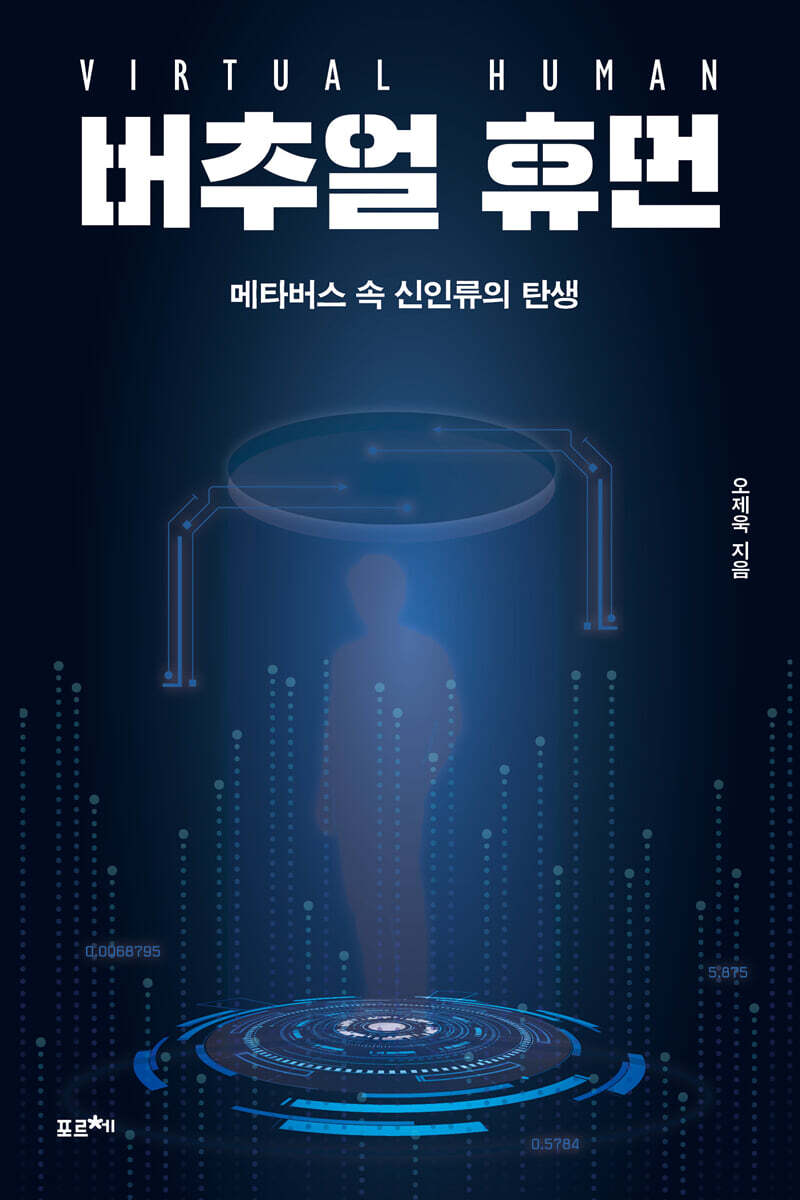
Digital Earth, the final destination of the metaverse journey! Pay attention to the new ecosystem, the birth of a new human race, 'virtual humans'! For readers who wonder what the connection between AI, blockchain, VR/AR, robotics, and the metaverse is, "Virtual Human," a business model leveraging the metaverse, has been published. In the first episode of [Alive], a recently popular video (released by the domestic online video service (OTT) Tving), the late Lim Yoon-taek of Ulala Session was revived by digital technology and appeared on stage, moving many viewers. The production team spent over a year incorporating artificial intelligence (AI) and extended reality (XR) technologies into the video to bring him to the stage. Lim Yoon-taek's voice was restored by Supertone, a company that created voice AI, and his appearance when he was healthy was restored by Diovis Studio, the company that created virtual YouTuber 'Louis'. Viewers were thrilled to be able to meet their long-lost singers thanks to AI restoration technology. This book guides us through how the third tech revolution, represented by AI and the metaverse, is being utilized in real businesses and shows the future of "virtual humans." Through this book, readers can get a glimpse into the emergence of a new human race in the metaverse world and gain useful insights and guidance on how to apply and utilize it in their own businesses. |
- You can preview some of the book's contents.
Preview
index
Prologue: My Sub-Character in the Digital World: Creating "Good" Deepfakes 4
Universe 1 Metaverse: Another world more fascinating than reality
The MZ Generation's New Ecosystem 16
The Future Brought by Generation MZ's Aspirations 19
Generation MZ is 'seriously' interested in the metaverse.
The metaverse is virtual, but it's not fake. 33
How far does the metaverse extend? 37
The Era of My Life Logging Becoming an Asset 46
Humans Communicating with Avatars 53
Universe 2 Virtual Humans: New Humans in the Virtual World
The Golden Age of Virtual Humans 70
A virtual human without a personality is a data swarm 73
80 Virtual Humans More Human Than Humans
AI 92 was real to some
99 Selling Points of Virtual Humans
You are my ideal type 101
They're perfect for our brand! 104
It's okay to draw 'aggro' 109
They do whatever you tell them to do 111
I want to follow those hot guys and play 115
I want to be a creator while protecting my privacy. 118
124 for a virtual human to exist that doesn't exist in the world
Our imagination becomes reality 126
Producers who meticulously create CG 132
How Virtual Humans Overcome Dislike 138
Clever Storytelling That Brings Life to Life 146
Universe 3 Multi-Persona: Another Identity Within Me
For all the 'sub-characters' in the world 156
In this age of charm exploration, what's your sub-character? 158
162 Things Yoo San-seul and Louis Have in Common
Finding a Few Enthusiastic Supporters 166
Virtual Face Distribution Center 170, which creates digital sub-characters
172 years of experience as a CEO launches a virtual face startup.
I want to live like Pengsoo, who is true to his own self-expression. 174
'Virtual Face Distribution Center', Diovis Studio 180
Diovis Studio's first virtual human, 'Louis' (185)
Louis 189: A Virtual Influencer in the Metaverse Era
Why a Singing YouTuber? 191
Louis's Persona 197
Louis of the Present and Louis of the Future 203
Dreaming of a Korean Wave in the Virtual Human World 208
Louis, Hippo, and Another Virtual Human 213
Migration to a Digital Earth with Virtual Humans 217
Reference 225
Universe 1 Metaverse: Another world more fascinating than reality
The MZ Generation's New Ecosystem 16
The Future Brought by Generation MZ's Aspirations 19
Generation MZ is 'seriously' interested in the metaverse.
The metaverse is virtual, but it's not fake. 33
How far does the metaverse extend? 37
The Era of My Life Logging Becoming an Asset 46
Humans Communicating with Avatars 53
Universe 2 Virtual Humans: New Humans in the Virtual World
The Golden Age of Virtual Humans 70
A virtual human without a personality is a data swarm 73
80 Virtual Humans More Human Than Humans
AI 92 was real to some
99 Selling Points of Virtual Humans
You are my ideal type 101
They're perfect for our brand! 104
It's okay to draw 'aggro' 109
They do whatever you tell them to do 111
I want to follow those hot guys and play 115
I want to be a creator while protecting my privacy. 118
124 for a virtual human to exist that doesn't exist in the world
Our imagination becomes reality 126
Producers who meticulously create CG 132
How Virtual Humans Overcome Dislike 138
Clever Storytelling That Brings Life to Life 146
Universe 3 Multi-Persona: Another Identity Within Me
For all the 'sub-characters' in the world 156
In this age of charm exploration, what's your sub-character? 158
162 Things Yoo San-seul and Louis Have in Common
Finding a Few Enthusiastic Supporters 166
Virtual Face Distribution Center 170, which creates digital sub-characters
172 years of experience as a CEO launches a virtual face startup.
I want to live like Pengsoo, who is true to his own self-expression. 174
'Virtual Face Distribution Center', Diovis Studio 180
Diovis Studio's first virtual human, 'Louis' (185)
Louis 189: A Virtual Influencer in the Metaverse Era
Why a Singing YouTuber? 191
Louis's Persona 197
Louis of the Present and Louis of the Future 203
Dreaming of a Korean Wave in the Virtual Human World 208
Louis, Hippo, and Another Virtual Human 213
Migration to a Digital Earth with Virtual Humans 217
Reference 225
Detailed image

Into the book
As humanity continues to dwell on the digital Earth and more activities become possible in the metaverse, virtual human technology will rapidly advance, and the number of virtual humans that can be perfectly implemented by a small number of people will increase.
Somewhere along this journey of change, a time will arrive when an individual, leveraging the power of advanced technology, will be able to easily create and operate a virtual human.
In that era, the number of digital side characters and virtual humans will explode.
If we stretch our imagination a little further, the journey's final destination might be a reality straight out of a science fiction movie, where one user can control multiple virtual humans as if they were playing a game.
---From the "Prologue"
Among the many videos that have recently come up on my YouTube algorithm, the ones I've found particularly interesting are the "Squid Game" videos made by the MZ generation using Roblox.
Roblox is a representative metaverse platform based on games.
It is gaining phenomenal popularity because users can engage in creative and economic activities within the platform.
Even as someone working in the AI industry, it was impressive to see the set in "Squid Game" realistically implemented with computer graphics (CG), the game rules created directly, and each user participating as an avatar and running around.
Among them, videos showing avatars wearing green training suits playing in a stadium with large doll robots, stopping and jumping repeatedly while the Korean phrase "The Rose of Sharon has bloomed" was played, received a lot of attention and recorded a lot of views.
As the games played in "Squid Game" were created as content by Roblox users and became popular, reactions followed that they were able to experience how the metaverse, a concept that was difficult to understand at first, works.
In this way, various metaverse platforms in the digital age are opening up new fields of communication and experience.
--- p.18~19
It has been over a year since Sidus Studio X's virtual humans, Rosie and Diovis Studio's Louie, were launched in succession.
While virtual influencers like Lil Miquela have been prominent overseas for years, it wasn't until 2021 that virtual humans gained traction in Korea, thanks to characters like Louie and Rosie.
In particular, it started to gain popularity on social media, especially among the MZ generation, and became known to the public through word of mouth.
These virtual humans are now actively engaged in various business fields, including advertising, public relations, and entertainment. As the MZ generation becomes a key trend-setter, virtual humans and virtual worlds are also becoming important industrial entities.
--- p.24
Lifelogging literally means 'recording one's life'.
However, it seems insufficient to view this as simply an act of self-expression and personal self-reflection.
We need to look more closely into human nature.
Humans have a desire to show themselves to others, and through this, to connect with others and expand relationships.
It means that humans inherently have a desire to engage in social networking.
According to social psychologists, humans have an evolutionary tendency toward 'groupishness'.
This is because the environment in which our ancestors lived from time immemorial required them to form groups and cooperate with each other, and to be able to distinguish between friend and foe, which would have been advantageous for survival.
What's interesting is that when humans form relationships with others, they want to feel a little more influential.
It means that people want others to pay attention to them and listen to their voices.
Whether they are politicians, celebrities, influencers, or ordinary people, they all have that desire.
The desire to influence others to expand relationships and solidify our group is a natural instinct imprinted in our DNA, linked to the competitive behavior of survival.
--- p.46~47
In short, the crucial difference between digital characters and virtual humans lies not in the creator's perspective, but in whether the user recognizes the character as a person or perceives it as a personal object with which to interact.
If we interpret this from a different perspective, if virtual humans become recognized as individuals by users, it could be seen as not much different from forming relationships with real people.
Already, numerous digital characters are being reborn as virtual humans, creating enormous added value for the industry.
Of course, there have been cases in the past where digital characters were reproduced as additional products and used as memes, but they failed to continue the character's own storytelling and form an interaction with the public within that storytelling.
But now, digital characters are becoming influencers and celebrities through social networking with the public.
--- p.79
Another reason to create virtual humans is that it allows companies to create the optimal model to represent their brand.
Typically, when a company selects an advertising model, they select the celebrity or influencer who best fits their brand.
However, as humans are not perfect, sometimes a company's model causes controversy, such as drunk driving or bullying, and when past problems such as school violence, bullying, gambling, and debt controversies are revealed, the company's image is greatly damaged.
Even if that weren't the problem, celebrities face the difficulty of having to find a new model after a certain contract period ends due to high portrait rights fees.
Not only do you have to pay for the portrait rights, but you also have to pay for the cost of producing the advertisement, and it costs a lot of money to distribute the advertisement to show it to a large number of people.
From a corporate standpoint, developing a single virtual human that perfectly fits their brand can help them avoid these ethical risks and significantly reduce advertising costs, which is why companies are increasingly showing interest in creating virtual humans.
--- p.104
A representative example of a virtual human that has attracted public attention with its strong and provocative character is the 'FN Mecha'. The FN Mecha, which is like a cyborg with a flashy style straight out of a science fiction movie, has a
The mere appearance itself is groundbreaking. FN Mecca is an AI robot rapper who once declared, "I am not accepted on this planet." FN Mecca has actually released a single and is active as a rapper. FN Mecca is known for posting provocative meme content, which often features violence, flaunting luxury brands, or sending sarcastic messages about specific people or brands.
If a real person had created this content, they would have been criticized or banned from doing anything.
However, because their identity as virtual humans is inherently free and unconventional, they are free from the harsh gaze of the public and social standards. FN Mecca primarily expresses themselves through short content posted on TikTok, where they have amassed approximately 10 million followers.
He has about 190,000 followers on Instagram.
This is a truly incredibly popular influencer.
--- p.110
If there's one expression that could most accurately describe our Diovis Studio's Louis, culturally and content-wise, it would be 'digital sub-character.'
Recently, the term 'bu-chae' has become very popular in Korea.
Originally, sub-character was an abbreviation for a newly created sub-character in addition to the main character used in an online game.
However, recently, the term "alt character" has been used to refer to a character seen outside of the game, that is, a character with a new look that is different from one's usual self.
If we were to express the word 'sub-character' in English, it could be expressed as 'sub-character' or 'alter ego', but it does not seem sufficient to convey the meaning of the multi-persona mentioned above.
The term "bu-chae" became widely recognized among the public in Korea when Yoo Jae-suk garnered attention by transforming into various characters such as Yoo San-seul, Jimmy Yoo, and Yoo Ya-ho on the MBC entertainment program "What Do You Do When You Play?"
Now, there are so many popular sub-characters of Yoo Jae-suk that there is even a term called 'YOONIVERSE'.
Although all the faces are the same, Yoo Jae-suk's, the series of interesting content is continuously produced with various characters with completely different personalities, expanding into one huge worldview.
--- p.162~163
In the early days of Diovis Studio's business, while researching the factors behind Pengsoo's success, we concluded that the secret to Pengsoo's success was the charm of his true self, the 'real character' hidden within his mask.
This is because Pengsoo's main character is outgoing, non-authoritarian, and well-liked by people.
I think the public found it more relatable and entertaining as the main character was caricatured as Pengsoo's comical image and presented as an entertaining episode.
Of course, this explanation of Pengsoo's body is not intended to infringe on Pengsoo's worldview.
I also think that Pengsoo is not a person wearing a penguin costume, but just Pengsoo himself.
It's an anecdote, but I wanted to know the secret to Pengsoo's success in detail, so I followed around and listened to the lectures of the PD who planned and produced 'Giant Peng TV'.
According to the lecture, EBS has actually planned and experimented with numerous content over a long period of time. It was truly remarkable that a legacy media company like EBS, especially one that produces educational broadcasts, would invest so much and take so much time to try something new in the new media realm.
In a way, EBS has been serious about 'digital transformation' from the beginning.
I also found the EBS management to be highly respectable for not avoiding change, which could only be perceived as threatening by legacy media, but rather for challenging it.
--- p.175~176
In 2021, I created not only Louis but also my sub-character, 'Hippo (@halmanhama).'
The full name of the virtual human 'Hippo' is 'Halman Hama', which means 'I have a lot to do, so I'll do it all' and 'I have a lot to say, so I'll do it all'.
This is a character who pursues self-realization and wants to do as many things as he wants, and at the same time, he is a refreshing character who speaks freely when he has something to say.
We have also created and provided virtual human content to several other companies.
Diovis Studio's BM is a 'virtual face distribution center'.
energy
When business customers access our company's B2B site (dobengine.co.kr), they can simply 'log in with a new face' with just a few clicks.
Our clients have used our Virtual Face Center service to create virtual influencers representing their companies and produce promotional videos to screen at global trade shows.
We also restored and broadcast the portrait of the deceased who became a star in the sky.
In this way, Diovis Studio creates a new virtual face that has never existed before, and our corporate clients are creating new content and business models that have never existed before.
Somewhere along this journey of change, a time will arrive when an individual, leveraging the power of advanced technology, will be able to easily create and operate a virtual human.
In that era, the number of digital side characters and virtual humans will explode.
If we stretch our imagination a little further, the journey's final destination might be a reality straight out of a science fiction movie, where one user can control multiple virtual humans as if they were playing a game.
---From the "Prologue"
Among the many videos that have recently come up on my YouTube algorithm, the ones I've found particularly interesting are the "Squid Game" videos made by the MZ generation using Roblox.
Roblox is a representative metaverse platform based on games.
It is gaining phenomenal popularity because users can engage in creative and economic activities within the platform.
Even as someone working in the AI industry, it was impressive to see the set in "Squid Game" realistically implemented with computer graphics (CG), the game rules created directly, and each user participating as an avatar and running around.
Among them, videos showing avatars wearing green training suits playing in a stadium with large doll robots, stopping and jumping repeatedly while the Korean phrase "The Rose of Sharon has bloomed" was played, received a lot of attention and recorded a lot of views.
As the games played in "Squid Game" were created as content by Roblox users and became popular, reactions followed that they were able to experience how the metaverse, a concept that was difficult to understand at first, works.
In this way, various metaverse platforms in the digital age are opening up new fields of communication and experience.
--- p.18~19
It has been over a year since Sidus Studio X's virtual humans, Rosie and Diovis Studio's Louie, were launched in succession.
While virtual influencers like Lil Miquela have been prominent overseas for years, it wasn't until 2021 that virtual humans gained traction in Korea, thanks to characters like Louie and Rosie.
In particular, it started to gain popularity on social media, especially among the MZ generation, and became known to the public through word of mouth.
These virtual humans are now actively engaged in various business fields, including advertising, public relations, and entertainment. As the MZ generation becomes a key trend-setter, virtual humans and virtual worlds are also becoming important industrial entities.
--- p.24
Lifelogging literally means 'recording one's life'.
However, it seems insufficient to view this as simply an act of self-expression and personal self-reflection.
We need to look more closely into human nature.
Humans have a desire to show themselves to others, and through this, to connect with others and expand relationships.
It means that humans inherently have a desire to engage in social networking.
According to social psychologists, humans have an evolutionary tendency toward 'groupishness'.
This is because the environment in which our ancestors lived from time immemorial required them to form groups and cooperate with each other, and to be able to distinguish between friend and foe, which would have been advantageous for survival.
What's interesting is that when humans form relationships with others, they want to feel a little more influential.
It means that people want others to pay attention to them and listen to their voices.
Whether they are politicians, celebrities, influencers, or ordinary people, they all have that desire.
The desire to influence others to expand relationships and solidify our group is a natural instinct imprinted in our DNA, linked to the competitive behavior of survival.
--- p.46~47
In short, the crucial difference between digital characters and virtual humans lies not in the creator's perspective, but in whether the user recognizes the character as a person or perceives it as a personal object with which to interact.
If we interpret this from a different perspective, if virtual humans become recognized as individuals by users, it could be seen as not much different from forming relationships with real people.
Already, numerous digital characters are being reborn as virtual humans, creating enormous added value for the industry.
Of course, there have been cases in the past where digital characters were reproduced as additional products and used as memes, but they failed to continue the character's own storytelling and form an interaction with the public within that storytelling.
But now, digital characters are becoming influencers and celebrities through social networking with the public.
--- p.79
Another reason to create virtual humans is that it allows companies to create the optimal model to represent their brand.
Typically, when a company selects an advertising model, they select the celebrity or influencer who best fits their brand.
However, as humans are not perfect, sometimes a company's model causes controversy, such as drunk driving or bullying, and when past problems such as school violence, bullying, gambling, and debt controversies are revealed, the company's image is greatly damaged.
Even if that weren't the problem, celebrities face the difficulty of having to find a new model after a certain contract period ends due to high portrait rights fees.
Not only do you have to pay for the portrait rights, but you also have to pay for the cost of producing the advertisement, and it costs a lot of money to distribute the advertisement to show it to a large number of people.
From a corporate standpoint, developing a single virtual human that perfectly fits their brand can help them avoid these ethical risks and significantly reduce advertising costs, which is why companies are increasingly showing interest in creating virtual humans.
--- p.104
A representative example of a virtual human that has attracted public attention with its strong and provocative character is the 'FN Mecha'. The FN Mecha, which is like a cyborg with a flashy style straight out of a science fiction movie, has a
The mere appearance itself is groundbreaking. FN Mecca is an AI robot rapper who once declared, "I am not accepted on this planet." FN Mecca has actually released a single and is active as a rapper. FN Mecca is known for posting provocative meme content, which often features violence, flaunting luxury brands, or sending sarcastic messages about specific people or brands.
If a real person had created this content, they would have been criticized or banned from doing anything.
However, because their identity as virtual humans is inherently free and unconventional, they are free from the harsh gaze of the public and social standards. FN Mecca primarily expresses themselves through short content posted on TikTok, where they have amassed approximately 10 million followers.
He has about 190,000 followers on Instagram.
This is a truly incredibly popular influencer.
--- p.110
If there's one expression that could most accurately describe our Diovis Studio's Louis, culturally and content-wise, it would be 'digital sub-character.'
Recently, the term 'bu-chae' has become very popular in Korea.
Originally, sub-character was an abbreviation for a newly created sub-character in addition to the main character used in an online game.
However, recently, the term "alt character" has been used to refer to a character seen outside of the game, that is, a character with a new look that is different from one's usual self.
If we were to express the word 'sub-character' in English, it could be expressed as 'sub-character' or 'alter ego', but it does not seem sufficient to convey the meaning of the multi-persona mentioned above.
The term "bu-chae" became widely recognized among the public in Korea when Yoo Jae-suk garnered attention by transforming into various characters such as Yoo San-seul, Jimmy Yoo, and Yoo Ya-ho on the MBC entertainment program "What Do You Do When You Play?"
Now, there are so many popular sub-characters of Yoo Jae-suk that there is even a term called 'YOONIVERSE'.
Although all the faces are the same, Yoo Jae-suk's, the series of interesting content is continuously produced with various characters with completely different personalities, expanding into one huge worldview.
--- p.162~163
In the early days of Diovis Studio's business, while researching the factors behind Pengsoo's success, we concluded that the secret to Pengsoo's success was the charm of his true self, the 'real character' hidden within his mask.
This is because Pengsoo's main character is outgoing, non-authoritarian, and well-liked by people.
I think the public found it more relatable and entertaining as the main character was caricatured as Pengsoo's comical image and presented as an entertaining episode.
Of course, this explanation of Pengsoo's body is not intended to infringe on Pengsoo's worldview.
I also think that Pengsoo is not a person wearing a penguin costume, but just Pengsoo himself.
It's an anecdote, but I wanted to know the secret to Pengsoo's success in detail, so I followed around and listened to the lectures of the PD who planned and produced 'Giant Peng TV'.
According to the lecture, EBS has actually planned and experimented with numerous content over a long period of time. It was truly remarkable that a legacy media company like EBS, especially one that produces educational broadcasts, would invest so much and take so much time to try something new in the new media realm.
In a way, EBS has been serious about 'digital transformation' from the beginning.
I also found the EBS management to be highly respectable for not avoiding change, which could only be perceived as threatening by legacy media, but rather for challenging it.
--- p.175~176
In 2021, I created not only Louis but also my sub-character, 'Hippo (@halmanhama).'
The full name of the virtual human 'Hippo' is 'Halman Hama', which means 'I have a lot to do, so I'll do it all' and 'I have a lot to say, so I'll do it all'.
This is a character who pursues self-realization and wants to do as many things as he wants, and at the same time, he is a refreshing character who speaks freely when he has something to say.
We have also created and provided virtual human content to several other companies.
Diovis Studio's BM is a 'virtual face distribution center'.
energy
When business customers access our company's B2B site (dobengine.co.kr), they can simply 'log in with a new face' with just a few clicks.
Our clients have used our Virtual Face Center service to create virtual influencers representing their companies and produce promotional videos to screen at global trade shows.
We also restored and broadcast the portrait of the deceased who became a star in the sky.
In this way, Diovis Studio creates a new virtual face that has never existed before, and our corporate clients are creating new content and business models that have never existed before.
--- p.180~181
Publisher's Review
“I thought you were a person, but you’re a virtual human?”
Virtual humans that are more real than the real thing
'Virtual humans' are coming, riding the metaverse!
Recently, 'virtual humans' that are more real than real people, such as Rosie, Louie, Sua, and Raea, have been sweeping the advertising market and are active everywhere.
This is the golden age of virtual influencers.
These virtual humans are expanding their awareness by showing their activities through various social media channels and communicating with the public in real time.
The popularity of virtual humans is growing day by day, as they can communicate with people around the world at any time without the constraints of time and space, and companies can easily transform them into the image they want.
The author of this book, Oh Je-wook, CEO of dob Studio, which creates virtual humans, says that the metaverse is gaining attention as a next-generation social platform in the era of non-face-to-face interaction, and that as an extension of this, the number of companies jumping into virtual reality will increase.
Above all, the author emphasizes that virtual humans, which are my avatars and other selves in the virtual world of the metaverse, will play an important role as a medium of communication.
He also says that with the rapid development of virtual face technology such as Diovi Engine, an era will come in which anyone, even if they are not a famous celebrity, can easily create a 'sub-character' to discover new opportunities and dream of a life completely different from before.
This book will serve as a friendly guide to answering questions about virtual humans not only for businesspeople and entrepreneurs who want to create virtual humans, but also for curious metaverse explorers who want to live as digital avatars themselves.
Why is Generation MZ so crazy about virtual humans?
Virtual Humans: A New Generation of Humans Entering Our Daily Lives
Use virtual humans to connect with Generation MZ.
As the non-face-to-face environment continues where real life is replaced by online interactions due to COVID-19, a new word, "Zoom fatigue," has emerged.
Zoom fatigue refers to the stress that occurs as meetings and classes through video conferencing platforms like Zoom become more frequent.
When lockdowns were implemented in countries like the UK and the US due to the COVID-19 pandemic, plastic surgeons reportedly saw a surge in inquiries about "face modifications."
I felt uncomfortable when I was in a situation where my face was compared to other people's faces on the screen.
Ironically, in the COVID-19 era, when people are less likely to meet others, the desire to make their faces more beautiful is increasing.
Business can be seen as fulfilling a customer's needs or healing a painful point, and receiving compensation accordingly.
The author states that the demand for retouching one's face as it appears in the diverse world of multi-channel social media is growing, and this demand is expanding beyond individuals to the industry, naturally leading to the "virtual human" business.
In fact, many people already use various methods (Photoshop, photo editing apps, cosmetic procedures, plastic surgery, etc.) to enhance their images and use them to connect with others.
The author explains that the virtual face technology that creates virtual humans is also a technology that satisfies the basic human desire to appear pretty and attractive to others.
In this 'metaverse era' where interaction between reality and the virtual world becomes more commonplace, the desire to express oneself in various ways in the virtual world will become a natural need.
The author explains that the virtual human industry is gaining more attention, especially as the MZ generation becomes the main generation leading trends.
Furthermore, he emphasizes that for Generation MZ, interacting with non-human characters in the digital world is perfectly acceptable. He explains that Generation MZ doesn't necessarily seek to know the other person's true identity beyond the screen, and that they only care about whether they can "communicate" with him or have a horizontal relationship.
The author emphasizes that regardless of how the metaverse meets people's needs, it will undoubtedly be another virtual space where people meet characters, another Earth, and within that world, there will be "virtual humans."
In this age of exploring charm, what will your sub-character be?
Another Me in the Digital World: Creating "Good" Deepfakes
The era of "digital sub-characters"—logging in with a new face—is coming.
Diovis Studio, run by CEO Oh Je-wook, is a company that creates virtual faces using a neural network that learns human facial images using artificial intelligence deep learning technology.
Diovis Studio's business model can be defined as a so-called 'virtual face distribution center' service.
In fact, when corporate customers access Diovis Studio's B2B site (dobengine.co.kr), they can log in with a new face with just a few clicks.
Diovis Studio is creating a new virtual face that has never existed before using this virtual face technology.
'Rui', currently considered a unique success story of hyperrealistic virtual faces, is the first virtual human presented by Diovis Studio.
Louis' eyes, nose, and mouth are virtual faces created by combining facial data from many people using artificial intelligence technology.
Louis is a virtual YouTuber who mainly covers trendy pop and K-pop, and is much loved by people.
Louis is known as a digital sidekick with a bright and kind personality, and in addition to advertising for companies, he also serves as a public relations ambassador for various organizations and events.
The author emphasizes that the biggest difference between Louis and existing virtual humans is the way the characters are set up.
Typically, when designing virtual humans, marketers or designers establish the character's identity and settings, and hope that the public will react to and take interest in the character's identity and settings.
However, unless it is a large-scale drama, movie, or game that is likely to be interesting, it is difficult to expect the public to respond to storytelling that is artificially set up.
So, when creating the character Louis, he said that he didn't try to artificially set anything in detail from the beginning.
By observing and interviewing the actual charm of Louis' body, we worked to discover his 'persona' by inducing the hidden charm and individuality of the person in question to be naturally expressed when he was active with a virtual face.
Also, inspired by EBS's 'Pengsoo' character, we wanted to help provide opportunities for people who want to protect their privacy and are reluctant to be directly evaluated by others to work as creators using a virtual face.
In this way, Diovis Studio's deepfake technology can be said to be a technology that helps self-realization by creating a sub-character and finding another true self.
The author explains that the ultimate goal is for each virtual human, like Louis, to enjoy a "second life" and become happier as they roam the metaverse that will be created and operated in the future.
GOODS SPECIFICS
- Publication date: February 23, 2022
- Page count, weight, size: 232 pages | 130*200*20mm
- ISBN13: 9791191393590
- ISBN10: 1191393593
You may also like
카테고리
korean


korean

![ELLE 엘르 스페셜 에디션 A형 : 12월 [2025]](http://librairie.coreenne.fr/cdn/shop/files/b8e27a3de6c9538896439686c6b0e8fb.jpg?v=1766436872&width=3840)


