

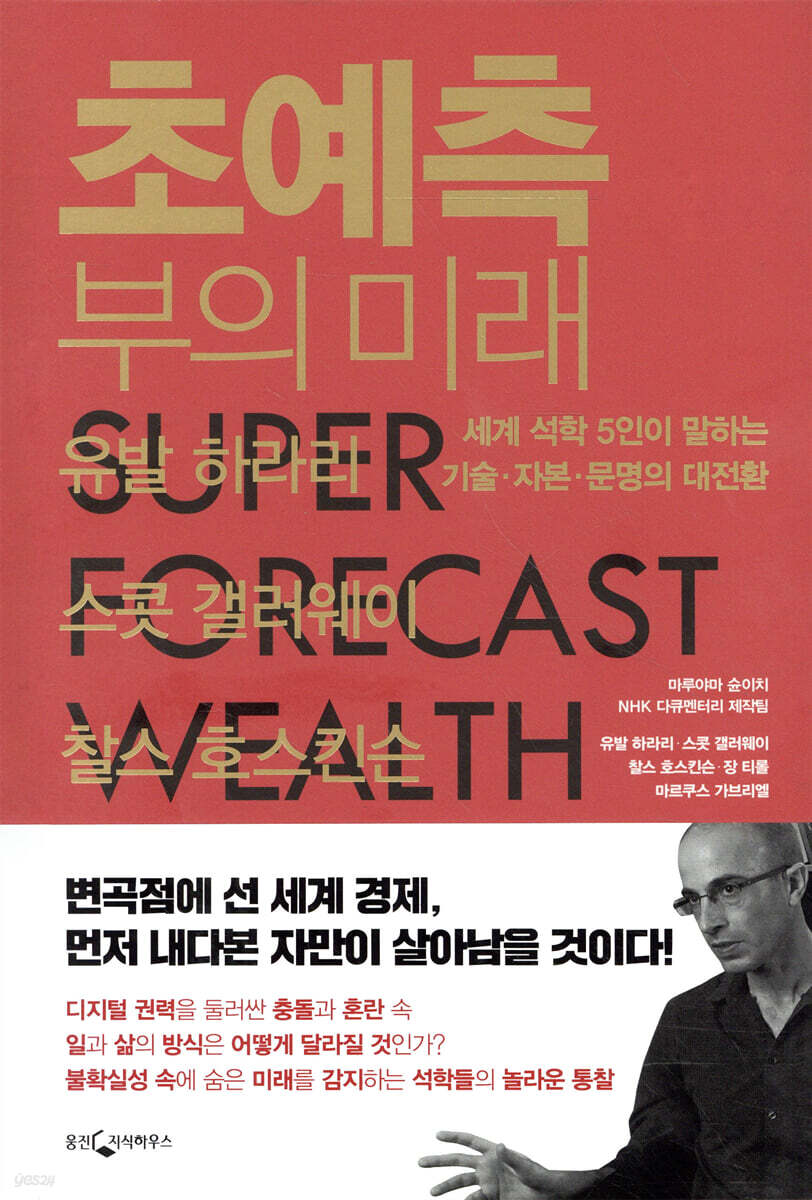
Hyperforecasting, the future of wealth
 |
Description
Book Introduction
Where will the world's wealth and power flow?
Amazing insights from world-renowned scholars who detect the future hidden in uncertainty.
What future awaits modern capitalism? - Yuval Harari, author of Sapiens
How will digital giants change the world? - Scott Galloway, author of "The Future of Platform Empires"
How Cryptocurrency Unleashes Dormant Wealth - Cryptocurrency Developer Charles Hoskinson
What is the new economics that creates a good society? - Jean Tirole, Nobel Prize winner in economics
How to Overcome the Crisis of Values in a Post-Truth Era - Marcus Gabriel, the Brilliant Philosopher
"Superforecasting, the Future of Wealth: The Great Transformation of Technology, Capital, and Civilization as Told by Five World-Class Scholars" is a book that answers the questions humanity is asking about the future as it faces a global crisis, with the perspectives and insights of five world-class scholars.
This volume contains interviews with some of the greatest minds of our time, including Yuval Harari, author of Sapiens and historian.
As the world grapples with unprecedented political and economic turmoil, "Superforecasting: The Future of Wealth" offers insights that uncover the hidden future amidst uncertainty, empowering readers to turn crisis into opportunity.
Amazing insights from world-renowned scholars who detect the future hidden in uncertainty.
What future awaits modern capitalism? - Yuval Harari, author of Sapiens
How will digital giants change the world? - Scott Galloway, author of "The Future of Platform Empires"
How Cryptocurrency Unleashes Dormant Wealth - Cryptocurrency Developer Charles Hoskinson
What is the new economics that creates a good society? - Jean Tirole, Nobel Prize winner in economics
How to Overcome the Crisis of Values in a Post-Truth Era - Marcus Gabriel, the Brilliant Philosopher
"Superforecasting, the Future of Wealth: The Great Transformation of Technology, Capital, and Civilization as Told by Five World-Class Scholars" is a book that answers the questions humanity is asking about the future as it faces a global crisis, with the perspectives and insights of five world-class scholars.
This volume contains interviews with some of the greatest minds of our time, including Yuval Harari, author of Sapiens and historian.
As the world grapples with unprecedented political and economic turmoil, "Superforecasting: The Future of Wealth" offers insights that uncover the hidden future amidst uncertainty, empowering readers to turn crisis into opportunity.
- You can preview some of the book's contents.
Preview
index
prolog
Chapter 1: What Future Awaits Modern Capitalism - Yuval Harari
Chapter 2: How Digital Giants Will Change the World - Scott Galloway
Chapter 3: How Cryptocurrencies Awaken Dormant Wealth - Charles Hoskinson
Chapter 4: What is the New Economics of Creating a Good Society? - Jean Tirole
Chapter 5: How to Overcome the Crisis of Values in a Post-Truth Era - Marcus Gabriel
Epilogue
Chapter 1: What Future Awaits Modern Capitalism - Yuval Harari
Chapter 2: How Digital Giants Will Change the World - Scott Galloway
Chapter 3: How Cryptocurrencies Awaken Dormant Wealth - Charles Hoskinson
Chapter 4: What is the New Economics of Creating a Good Society? - Jean Tirole
Chapter 5: How to Overcome the Crisis of Values in a Post-Truth Era - Marcus Gabriel
Epilogue
Detailed image

Into the book
Centralized systems operate differently from the free market of capitalism, which seeks to decentralize power.
While decentralized systems clearly had the upper hand in the 20th century, new technologies may make centralized systems more dominant in the 21st century.
--- p.29
I don't think we should protect human jobs against artificial intelligence.
I don't mind losing my cashier job to a robot.
Rather, when such an era comes, what we must protect is not ‘work’ but ‘humanity.’
--- p.31
Cutting-edge science and new technologies, such as artificial intelligence, biotechnology, and nanotechnology, which are in the spotlight today, will dramatically change the world in the coming decades.
This is an inevitable trend.
--- p.34
The question of "how to regulate data ownership" has recently emerged as a new political agenda.
Because in the 21st century, data will emerge as the world's most important asset.
Politics, economy, and society will all change depending on who controls data, the source of wealth and power.
--- p.35~36
GAFA has now become "too big." It has built a vast empire by championing lofty visions, tapping into human instincts, defying the law, and crushing its competitors with its financial might.
--- p.49
Traditional jobs are being eaten alive by new technological occupations.
In reality, GAFA is not a job creator but rather a job destroyer.
--- p.51
Government funding is flowing to GAFA, not startups.
It's like saying 'Congratulations' to someone who won the lottery.
It's like saying, 'I'll double your winnings.'
We are hurtling towards a society in which 350 million serfs are subordinate to 3 million lords.
--- p.66
It is said that there are currently 3 billion people around the world who cannot access the market because they do not have a bank account or credit card.
But cryptocurrencies help them all get on the same playing field.
For the first time in human history, the door is open for anyone to become a Bill Gates or Jeff Bezos.
--- p.80~81
Developers like me believe that the purpose of cryptocurrencies and blockchain technology lies in creating a market that provides people with "different" options.
We need to move beyond the dichotomy of whether to block or strengthen regulations and recreate the 'rules' of the market based on Darwin's law of survival of the fittest.
Such a system would be fairer than any system that has ever existed.
--- p.101~102
While it is important to design markets to minimize flaws from the outset, it is also crucial for government administration to intervene in a timely manner when problems arise.
The market is functioning well, but it could certainly function better with some modification.
--- p.117
What economists consider most important is the public interest.
The market has value as a means of contributing to the public good.
Therefore, it is right that regulations should be implemented in markets that are detrimental to the public interest.
--- p.137
The "labor" of reading news online or sending emails is being used by some unseen "someone" behind the scenes to put journalism at risk, and we all happily pretend to be well-informed, oblivious to the fact.
This structure is endangering modern society.
--- p.156
The 'value of knowledge' should never be attacked.
If that happens, you'll lose everything.
Truth is essential for democracy to function, and without knowledge it is impossible to verify and understand truth.
--- p.159
Philosophy changes reality by changing the way we think.
In particular, we must learn how to view and understand the same phenomenon from different angles.
If you perceive reality as you see it and hear it, you will end up becoming a victim of the ideologies floating around in the world.
While decentralized systems clearly had the upper hand in the 20th century, new technologies may make centralized systems more dominant in the 21st century.
--- p.29
I don't think we should protect human jobs against artificial intelligence.
I don't mind losing my cashier job to a robot.
Rather, when such an era comes, what we must protect is not ‘work’ but ‘humanity.’
--- p.31
Cutting-edge science and new technologies, such as artificial intelligence, biotechnology, and nanotechnology, which are in the spotlight today, will dramatically change the world in the coming decades.
This is an inevitable trend.
--- p.34
The question of "how to regulate data ownership" has recently emerged as a new political agenda.
Because in the 21st century, data will emerge as the world's most important asset.
Politics, economy, and society will all change depending on who controls data, the source of wealth and power.
--- p.35~36
GAFA has now become "too big." It has built a vast empire by championing lofty visions, tapping into human instincts, defying the law, and crushing its competitors with its financial might.
--- p.49
Traditional jobs are being eaten alive by new technological occupations.
In reality, GAFA is not a job creator but rather a job destroyer.
--- p.51
Government funding is flowing to GAFA, not startups.
It's like saying 'Congratulations' to someone who won the lottery.
It's like saying, 'I'll double your winnings.'
We are hurtling towards a society in which 350 million serfs are subordinate to 3 million lords.
--- p.66
It is said that there are currently 3 billion people around the world who cannot access the market because they do not have a bank account or credit card.
But cryptocurrencies help them all get on the same playing field.
For the first time in human history, the door is open for anyone to become a Bill Gates or Jeff Bezos.
--- p.80~81
Developers like me believe that the purpose of cryptocurrencies and blockchain technology lies in creating a market that provides people with "different" options.
We need to move beyond the dichotomy of whether to block or strengthen regulations and recreate the 'rules' of the market based on Darwin's law of survival of the fittest.
Such a system would be fairer than any system that has ever existed.
--- p.101~102
While it is important to design markets to minimize flaws from the outset, it is also crucial for government administration to intervene in a timely manner when problems arise.
The market is functioning well, but it could certainly function better with some modification.
--- p.117
What economists consider most important is the public interest.
The market has value as a means of contributing to the public good.
Therefore, it is right that regulations should be implemented in markets that are detrimental to the public interest.
--- p.137
The "labor" of reading news online or sending emails is being used by some unseen "someone" behind the scenes to put journalism at risk, and we all happily pretend to be well-informed, oblivious to the fact.
This structure is endangering modern society.
--- p.156
The 'value of knowledge' should never be attacked.
If that happens, you'll lose everything.
Truth is essential for democracy to function, and without knowledge it is impossible to verify and understand truth.
--- p.159
Philosophy changes reality by changing the way we think.
In particular, we must learn how to view and understand the same phenomenon from different angles.
If you perceive reality as you see it and hear it, you will end up becoming a victim of the ideologies floating around in the world.
--- p.167~168
Publisher's Review
COVID-19, cryptocurrency, fake news,
Reading about the future that will unfold after the current crisis
With the COVID-19 pandemic sweeping the globe and projected to bring about the worst recession since the Great Depression of the 1930s, how will the global economy change in the future? What is it about cryptocurrencies that not only fueled the Bitcoin bubble, but also became a breeding ground for horrific digital crime? What is the nature of the fake news that spreads whenever sensitive social issues like pandemics, terrorism, and elections erupt?
"Superforecasting, the Future of Wealth: The Great Transformation of Technology, Capital, and Civilization as Told by Five World-Class Scholars" is a book that answers the questions humanity is asking about the future as it faces a global crisis, with the perspectives and insights of five world-class scholars.
This book is a compilation of interviews conducted for the NHK documentary [Capitalism of Desire 2019] with Yuval Harari, author of the international bestseller 『Sapiens』 and historian; Scott Galloway, author of 『The Future of Platform Empires』 and professor at New York University Stern School of Business; Charles Hoskinson, a cryptocurrency pioneer and developer of Cardano, the third generation following Bitcoin and Ethereum; Jean Tirole, one of the world's most influential economists and winner of the 2014 Nobel Prize in Economics; and Markus Gabriel, a genius philosopher who was appointed professor at the University of Bonn in Germany at the age of 28.
New risks will continue to emerge in the future.
With economies interconnected, famine, epidemics, and war can easily spread across borders to other countries.
Each time, we will face unprecedented challenges.
But with the right perspective, a crisis can become an opportunity.
The 2008 financial crisis devastated the global economy, but the cracks created the opportunity for sharing economy platforms like Uber and Airbnb, as well as innovative experiments with cryptocurrencies.
Even the current crisis could be an opportunity for someone to start anew.
In this context, "Superforecasting: The Future of Wealth" empowers us to actively think about the future, discerning the new flow of wealth and power without being swayed by short-term predictions and local outlooks.
Science and technology and large digital companies
How to change the world economy
What will the future of the global economy look like? Yuval Harari predicts the advent of "surveillance capitalism," where big data will eliminate free markets and commodify people.
Thanks to science and technology that can rapidly analyze and process large amounts of information, the economy will be reorganized around data.
Moreover, because algorithms improve as more information becomes available for analysis, a society with centralized control will operate much more efficiently than one that respects the free will of individuals.
Therefore, the combination of data capital and central power may be highlighted as a powerful system that can replace the existing order.
In the past, too much information and power concentrated in one place led to inefficiencies, but new technologies like big data and artificial intelligence make centralized systems far more efficient than decentralized ones.
Therefore, in the era of surveillance capitalism, an authoritarian system may actually be advantageous.
(Page 30)
The harm caused by the monopoly of data and technology is already being felt everywhere.
Representative digital companies such as Google, Apple, Facebook, and Amazon (sometimes abbreviated as "GAFA") are revered as icons of innovation, but in reality, they are amassing enormous wealth by leveraging user data from around the world.
Management expert Scott Galloway exposes the dirty truth behind these IT companies, often portrayed as "good Google, cool Apple."
The owners of GAFA are among the wealthiest in the world, yet they squeeze workers with exorbitantly low wages, all the while scrambling to secure subsidies and tax breaks for their own profits.
Yet, they are still hailed as some of the world's greatest innovators.
(Page 49)
The regulatory issue of data ownership will shape the future.
We need to find a sweet spot between leaving it to private companies and creating a horrific surveillance society.
While many ideas will be discussed in the future, as Harari says, the most important thing to keep in mind is not to create a world where technology dominates humans, but a world where technology protects humans.
In the 21st century, data will emerge as the world's most important asset.
Politics, economy, and society will all change depending on who controls data, the source of wealth and power.
(Page 36)
Cryptocurrency: Will it Fail?
Or will it create new wealth?
The recent revelations that cryptocurrencies have been used for criminal purposes have brought the debate surrounding their pros and cons to the forefront.
As if he had foreseen this development, Nobel laureate in economics Jean Tirole has declared that cryptocurrencies will fail and, moreover, are detrimental to society.
The argument is that cryptocurrencies could not only be misused for illegal activities, but would also significantly undermine national policies that promote economic stimulus through the issuance of currency.
Cryptocurrencies can be misused for money laundering, tax evasion, and black market transactions.
However, the government currently lacks the institutional, legal, and technological foundations to control such illegal activities.
(Page 131)
Current cryptocurrencies are highly unstable due to their lack of connection to the real economy and the resulting premature expectations.
(Page 133)
Meanwhile, cryptocurrency developer Charles Hoskinson sees a different future.
Today, there are 3 billion people on Earth who live in poverty, either because they lack access to bank accounts or credit cards, or because market systems are weak due to corruption and conflict, resulting in trillions of dollars of dormant wealth.
Hoskinson says cryptocurrencies and blockchain technology will unite financial markets, currently divided into currencies like the dollar, yen, euro, and pound, creating an environment where everyone can engage in economic activities on equal terms.
The truly amazing thing about Bitcoin, or cryptocurrency, is that it allows people with diverse abilities, ideas, knowledge, and skills to compete on an equal footing in the marketplace.
(Page 80)
Blockchain technology is a tool that will create a more prosperous world and implement a more perfect capitalist system.
(Page 96)
According to Harari, technology does not decide things, but rather gives us choices.
Looking back at the 20th century, many countries used the same technologies, such as trains and electricity, but a variety of societies emerged, from fascist regimes to communist dictatorships to liberal democracies.
Likewise, as cryptocurrencies may become the reserve currency of the black market or the seed of a self-evolving and resilient economic ecosystem, we must take responsibility for our choices and strive to make wiser decisions.
There are many future social scenarios made possible by new knowledge and technologies.
But just because it's possible doesn't mean it should be.
We have many choices before us.
(Page 35)
Fake news and post-truth
Will it destroy modern society?
Amidst the unexpected pandemic, fake news is also causing serious social problems.
False information and false facts about confirmed cases, treatment methods, and infection routes are rapidly spreading through social media and YouTube, increasing people's anxiety and causing a waste of administrative power and medical services.
Markus Gabriel warns that modern civilization could collapse due to the post-truth brought about by fake news.
He defines post-truth as a kind of deception that obscures the essence by appealing to subjective emotions rather than objective facts.
And he argues that the illusion that you know everything by clicking on a few Internet articles has led to post-truth.
The "labor" of reading news online or sending emails is being used by "someone" behind the scenes to put journalism at risk, and we're all happy to be informed, oblivious to the fact.
This structure is endangering modern society.
(Page 156)
Gabriel expresses his sense of crisis, saying that if things continue this way, the question of right and wrong will be pushed to the back burner and a state of "war of all against all" will arrive, in which each individual pursues only their own interests.
To curb the social media, internet companies, and governments that exploit the amplification and reproduction of fake news, we must pay more attention and concern to the real world beyond sensational rhetoric and data figures.
A starting point for designing a better future
It's not that you don't know what you're getting into trouble for.
It's because of the illusion of knowing for sure.
_ Mark Twain
This message, which appears in the opening scene of The Big Short, a film about the 2008 financial crisis, reminds us that in a rapidly changing environment, nothing is more dangerous than false confidence.
Yuval Harari also says that no one can perfectly predict the future.
Therefore, we must humbly accept that it is no longer possible to remain in the current state and prepare for various possibilities.
The situation we find ourselves in today, in particular, starkly demonstrates how fragile modern civilization is.
"Superforecasting: The Future of Wealth" will provide an intellectual foundation for reflecting on the nature of the crisis at a crossroads of great transformation and seeking a better future.
Cutting-edge science and new technologies, such as artificial intelligence, biotechnology, and nanotechnology, will dramatically transform the world in the coming decades.
This is an inevitable trend.
But nothing has been decided.
All we know is that it is no longer possible to remain as we are.
(Page 34)
Reading about the future that will unfold after the current crisis
With the COVID-19 pandemic sweeping the globe and projected to bring about the worst recession since the Great Depression of the 1930s, how will the global economy change in the future? What is it about cryptocurrencies that not only fueled the Bitcoin bubble, but also became a breeding ground for horrific digital crime? What is the nature of the fake news that spreads whenever sensitive social issues like pandemics, terrorism, and elections erupt?
"Superforecasting, the Future of Wealth: The Great Transformation of Technology, Capital, and Civilization as Told by Five World-Class Scholars" is a book that answers the questions humanity is asking about the future as it faces a global crisis, with the perspectives and insights of five world-class scholars.
This book is a compilation of interviews conducted for the NHK documentary [Capitalism of Desire 2019] with Yuval Harari, author of the international bestseller 『Sapiens』 and historian; Scott Galloway, author of 『The Future of Platform Empires』 and professor at New York University Stern School of Business; Charles Hoskinson, a cryptocurrency pioneer and developer of Cardano, the third generation following Bitcoin and Ethereum; Jean Tirole, one of the world's most influential economists and winner of the 2014 Nobel Prize in Economics; and Markus Gabriel, a genius philosopher who was appointed professor at the University of Bonn in Germany at the age of 28.
New risks will continue to emerge in the future.
With economies interconnected, famine, epidemics, and war can easily spread across borders to other countries.
Each time, we will face unprecedented challenges.
But with the right perspective, a crisis can become an opportunity.
The 2008 financial crisis devastated the global economy, but the cracks created the opportunity for sharing economy platforms like Uber and Airbnb, as well as innovative experiments with cryptocurrencies.
Even the current crisis could be an opportunity for someone to start anew.
In this context, "Superforecasting: The Future of Wealth" empowers us to actively think about the future, discerning the new flow of wealth and power without being swayed by short-term predictions and local outlooks.
Science and technology and large digital companies
How to change the world economy
What will the future of the global economy look like? Yuval Harari predicts the advent of "surveillance capitalism," where big data will eliminate free markets and commodify people.
Thanks to science and technology that can rapidly analyze and process large amounts of information, the economy will be reorganized around data.
Moreover, because algorithms improve as more information becomes available for analysis, a society with centralized control will operate much more efficiently than one that respects the free will of individuals.
Therefore, the combination of data capital and central power may be highlighted as a powerful system that can replace the existing order.
In the past, too much information and power concentrated in one place led to inefficiencies, but new technologies like big data and artificial intelligence make centralized systems far more efficient than decentralized ones.
Therefore, in the era of surveillance capitalism, an authoritarian system may actually be advantageous.
(Page 30)
The harm caused by the monopoly of data and technology is already being felt everywhere.
Representative digital companies such as Google, Apple, Facebook, and Amazon (sometimes abbreviated as "GAFA") are revered as icons of innovation, but in reality, they are amassing enormous wealth by leveraging user data from around the world.
Management expert Scott Galloway exposes the dirty truth behind these IT companies, often portrayed as "good Google, cool Apple."
The owners of GAFA are among the wealthiest in the world, yet they squeeze workers with exorbitantly low wages, all the while scrambling to secure subsidies and tax breaks for their own profits.
Yet, they are still hailed as some of the world's greatest innovators.
(Page 49)
The regulatory issue of data ownership will shape the future.
We need to find a sweet spot between leaving it to private companies and creating a horrific surveillance society.
While many ideas will be discussed in the future, as Harari says, the most important thing to keep in mind is not to create a world where technology dominates humans, but a world where technology protects humans.
In the 21st century, data will emerge as the world's most important asset.
Politics, economy, and society will all change depending on who controls data, the source of wealth and power.
(Page 36)
Cryptocurrency: Will it Fail?
Or will it create new wealth?
The recent revelations that cryptocurrencies have been used for criminal purposes have brought the debate surrounding their pros and cons to the forefront.
As if he had foreseen this development, Nobel laureate in economics Jean Tirole has declared that cryptocurrencies will fail and, moreover, are detrimental to society.
The argument is that cryptocurrencies could not only be misused for illegal activities, but would also significantly undermine national policies that promote economic stimulus through the issuance of currency.
Cryptocurrencies can be misused for money laundering, tax evasion, and black market transactions.
However, the government currently lacks the institutional, legal, and technological foundations to control such illegal activities.
(Page 131)
Current cryptocurrencies are highly unstable due to their lack of connection to the real economy and the resulting premature expectations.
(Page 133)
Meanwhile, cryptocurrency developer Charles Hoskinson sees a different future.
Today, there are 3 billion people on Earth who live in poverty, either because they lack access to bank accounts or credit cards, or because market systems are weak due to corruption and conflict, resulting in trillions of dollars of dormant wealth.
Hoskinson says cryptocurrencies and blockchain technology will unite financial markets, currently divided into currencies like the dollar, yen, euro, and pound, creating an environment where everyone can engage in economic activities on equal terms.
The truly amazing thing about Bitcoin, or cryptocurrency, is that it allows people with diverse abilities, ideas, knowledge, and skills to compete on an equal footing in the marketplace.
(Page 80)
Blockchain technology is a tool that will create a more prosperous world and implement a more perfect capitalist system.
(Page 96)
According to Harari, technology does not decide things, but rather gives us choices.
Looking back at the 20th century, many countries used the same technologies, such as trains and electricity, but a variety of societies emerged, from fascist regimes to communist dictatorships to liberal democracies.
Likewise, as cryptocurrencies may become the reserve currency of the black market or the seed of a self-evolving and resilient economic ecosystem, we must take responsibility for our choices and strive to make wiser decisions.
There are many future social scenarios made possible by new knowledge and technologies.
But just because it's possible doesn't mean it should be.
We have many choices before us.
(Page 35)
Fake news and post-truth
Will it destroy modern society?
Amidst the unexpected pandemic, fake news is also causing serious social problems.
False information and false facts about confirmed cases, treatment methods, and infection routes are rapidly spreading through social media and YouTube, increasing people's anxiety and causing a waste of administrative power and medical services.
Markus Gabriel warns that modern civilization could collapse due to the post-truth brought about by fake news.
He defines post-truth as a kind of deception that obscures the essence by appealing to subjective emotions rather than objective facts.
And he argues that the illusion that you know everything by clicking on a few Internet articles has led to post-truth.
The "labor" of reading news online or sending emails is being used by "someone" behind the scenes to put journalism at risk, and we're all happy to be informed, oblivious to the fact.
This structure is endangering modern society.
(Page 156)
Gabriel expresses his sense of crisis, saying that if things continue this way, the question of right and wrong will be pushed to the back burner and a state of "war of all against all" will arrive, in which each individual pursues only their own interests.
To curb the social media, internet companies, and governments that exploit the amplification and reproduction of fake news, we must pay more attention and concern to the real world beyond sensational rhetoric and data figures.
A starting point for designing a better future
It's not that you don't know what you're getting into trouble for.
It's because of the illusion of knowing for sure.
_ Mark Twain
This message, which appears in the opening scene of The Big Short, a film about the 2008 financial crisis, reminds us that in a rapidly changing environment, nothing is more dangerous than false confidence.
Yuval Harari also says that no one can perfectly predict the future.
Therefore, we must humbly accept that it is no longer possible to remain in the current state and prepare for various possibilities.
The situation we find ourselves in today, in particular, starkly demonstrates how fragile modern civilization is.
"Superforecasting: The Future of Wealth" will provide an intellectual foundation for reflecting on the nature of the crisis at a crossroads of great transformation and seeking a better future.
Cutting-edge science and new technologies, such as artificial intelligence, biotechnology, and nanotechnology, will dramatically transform the world in the coming decades.
This is an inevitable trend.
But nothing has been decided.
All we know is that it is no longer possible to remain as we are.
(Page 34)
GOODS SPECIFICS
- Publication date: April 20, 2020
- Format: Hardcover book binding method guide
- Page count, weight, size: 200 pages | 424g | 145*210*20mm
- ISBN13: 9788901241814
- ISBN10: 8901241811
You may also like
카테고리
korean


korean

![GQ KOREA Mark (Monthly): December [2025]](http://librairie.coreenne.fr/cdn/shop/files/8ef265dbbfbf186523ed75ba7319009d.jpg?v=1765340328&width=3840)


