

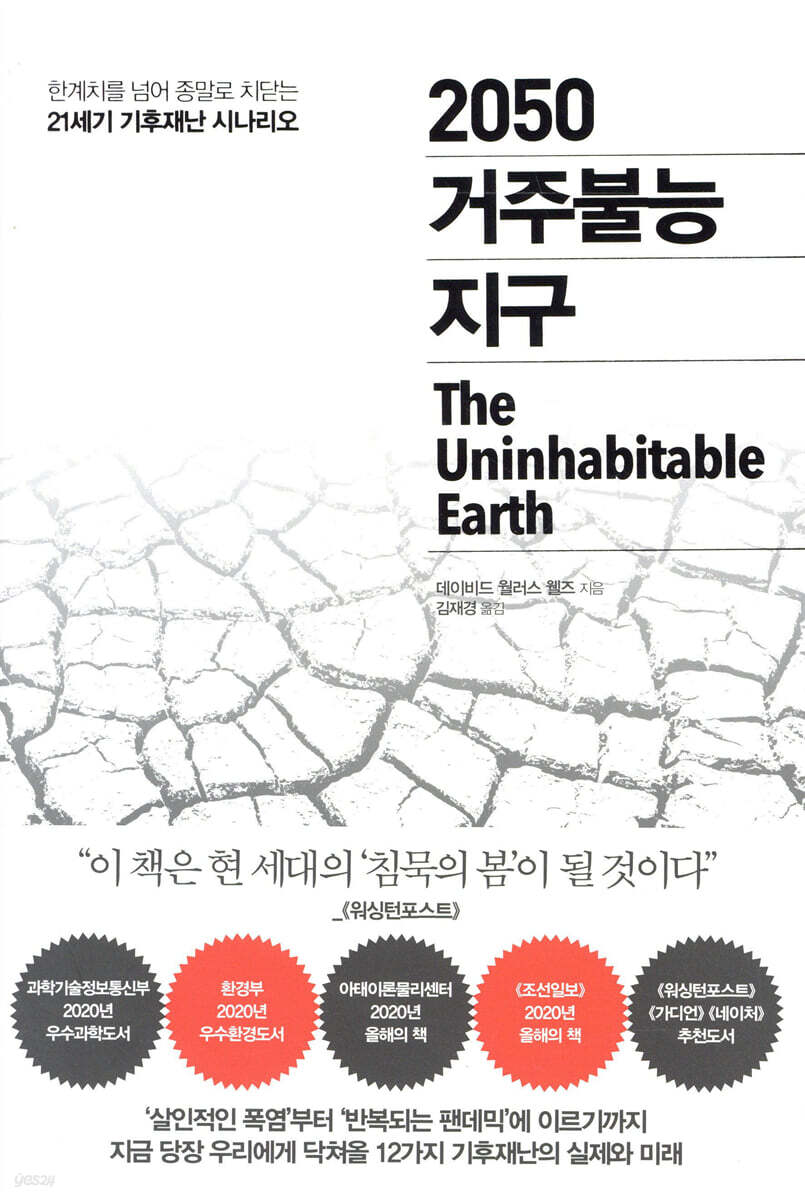
2050 Uninhabitable Earth
 |
Description
Book Introduction
- A word from MD
-
The price will be paid by humans.We perceive extreme temperatures, rising sea levels, and air pollution as natural disasters.
According to the author of this book, what we will face will not be a simple natural disaster, but a mass genocide.
Humanity does not have much time left.
By 2050, there may be no more land on Earth for humans to live on.
April 21, 2020. Social and Political PD Son Min-gyu
Published to mark the 50th anniversary of Earth Day, "Uninhabitable Earth 2050" presents the most credible future climate change scenarios based on the latest research and statistical evidence.
By critically synthesizing the various existing discussions on climate change, we present the real impacts and picture of global warming that will destroy our daily lives.
"The Uninhabitable Earth 2050," which identifies the enormous impact of climate change, which cannot be resolved through mere "environmental activism" or individual ethical awakening, is a climate disaster response manual and future report that human society, facing a total crisis such as an uncontrollable infectious disease, must refer to.
By critically synthesizing the various existing discussions on climate change, we present the real impacts and picture of global warming that will destroy our daily lives.
"The Uninhabitable Earth 2050," which identifies the enormous impact of climate change, which cannot be resolved through mere "environmental activism" or individual ethical awakening, is a climate disaster response manual and future report that human society, facing a total crisis such as an uncontrollable infectious disease, must refer to.
- You can preview some of the book's contents.
Preview
index
Part 1: This is not a 'natural disaster'
The Earth has already surpassed the carbon dioxide limit / The crisis of 'mass genocide' rather than 'natural disaster' / Useless agreements, empty words, and a hidden future / The reality of climate change that is far ahead of humans / A 'war machine' that will not stop unless caught / A huge, overwhelming, and omnipresent threat / A real disaster that will turn even the 'polar bear fable' into a fantasy / Is there any reason to be optimistic about the future? / The price will be paid not by animals but by 'humans'
Part 2: The Reality and Future of 12 Climate Disasters
Chapter 1: Murderous Heat Wave
It's getting hotter so fast that forecasts are useless / The most painful heatstroke epidemic
Chapter 2 Poverty and Hunger
The result of investing in "welfare" while exploiting the future of the Earth / The domination of the empire called "hunger"
Chapter 3: The Devouring Sea
Glaciers melting so fast they could change maps / 'Glacier bomb' that could turn Beijing into an 'underwater city'
Chapter 4: Rising Wildfires
The current fire will be a case of "playing with fire" / Carbon explosions are adding insult to injury
Chapter 5: Disasters That Will Become "Weather"
We're becoming accustomed to disasters that seem likely to happen "once in 500 years" / The increasingly hurdles of reconstruction and recovery
Chapter 6: Thirst and Drought
Individual savings alone won't solve the problem / A war of water plunder caused by the great drought
Chapter 7: The Sea of Corpses
Mass Extinctions Caused by Ocean Pollution / Collapse of the Massive Ocean Circulation System
Chapter 8: The Air You Can't Breathe
A Whole New Kind of Pollution / A Terrifying Link Between Aerosols and Global Temperature
Chapter 9: Transmission of Disease
The emergence of stronger and faster viruses and countless bacteria we never knew existed.
Chapter 10: The Collapsing Economy
A 'Great Crash' Beyond the Great Recession or the Great Depression / Mounting Costs and Rising Compound Interest
Chapter 11: Climate Disputes
Resource wars between densely populated populations on a barren Earth / Anger and violence between individuals
Chapter 12: The Collapse of the System
The moment inhumane living conditions become 'normal' / The shocking impact on human mental health
Part 3: How will climate change change society?
Chapter 1: A Story That Can't End with 'Apocalypse'
A story that cannot single out anyone as the villain / A sentimental attitude toward nature / Confining problems within a 'fable' / The core message of the 'Anthropocene' / Why no one listens to the story
Chapter 2: The Uncontrollable Crisis of Capitalism
A problem so massive and serious that we want to ignore it / The capitalist empire in the era of climate change / Evidence that the capitalist system is shaking / The price and responsibility for the system's survival / The enormous cost to be charged in the name of adaptation and mitigation
Chapter 3: When Technology Became Religion
The scale of technological innovation required to solve the problem of the promise of liberation from the world's suffering / The fantasy we spout almost unconsciously / The core doctrine taught by the religion of technology
Chapter 4: To Consume or to Politicize
Selective consumption is nothing more than an evasion of responsibility / The limits of neoliberal survival strategies / The political power that will emerge amid the shock of global warming
Chapter 5: The Collapse of the Belief That History Progresses
The True Face of History, Stripped of the Mask of "Progress" / Why We Can No Longer Hold the "Past" Responsible
Chapter 6: Nihilism at the End of Despair
The eschatology that undermines the very foundations of civilization / The evasion and asceticism that seek worldly comfort / The grim competition to create new terms / The possibility of moving towards 'resignation'
Part 4: The Human Principle: Thinking Like a "One Person"
The only civilization we know of / We can't choose our planet
Acknowledgements
annotation
The Earth has already surpassed the carbon dioxide limit / The crisis of 'mass genocide' rather than 'natural disaster' / Useless agreements, empty words, and a hidden future / The reality of climate change that is far ahead of humans / A 'war machine' that will not stop unless caught / A huge, overwhelming, and omnipresent threat / A real disaster that will turn even the 'polar bear fable' into a fantasy / Is there any reason to be optimistic about the future? / The price will be paid not by animals but by 'humans'
Part 2: The Reality and Future of 12 Climate Disasters
Chapter 1: Murderous Heat Wave
It's getting hotter so fast that forecasts are useless / The most painful heatstroke epidemic
Chapter 2 Poverty and Hunger
The result of investing in "welfare" while exploiting the future of the Earth / The domination of the empire called "hunger"
Chapter 3: The Devouring Sea
Glaciers melting so fast they could change maps / 'Glacier bomb' that could turn Beijing into an 'underwater city'
Chapter 4: Rising Wildfires
The current fire will be a case of "playing with fire" / Carbon explosions are adding insult to injury
Chapter 5: Disasters That Will Become "Weather"
We're becoming accustomed to disasters that seem likely to happen "once in 500 years" / The increasingly hurdles of reconstruction and recovery
Chapter 6: Thirst and Drought
Individual savings alone won't solve the problem / A war of water plunder caused by the great drought
Chapter 7: The Sea of Corpses
Mass Extinctions Caused by Ocean Pollution / Collapse of the Massive Ocean Circulation System
Chapter 8: The Air You Can't Breathe
A Whole New Kind of Pollution / A Terrifying Link Between Aerosols and Global Temperature
Chapter 9: Transmission of Disease
The emergence of stronger and faster viruses and countless bacteria we never knew existed.
Chapter 10: The Collapsing Economy
A 'Great Crash' Beyond the Great Recession or the Great Depression / Mounting Costs and Rising Compound Interest
Chapter 11: Climate Disputes
Resource wars between densely populated populations on a barren Earth / Anger and violence between individuals
Chapter 12: The Collapse of the System
The moment inhumane living conditions become 'normal' / The shocking impact on human mental health
Part 3: How will climate change change society?
Chapter 1: A Story That Can't End with 'Apocalypse'
A story that cannot single out anyone as the villain / A sentimental attitude toward nature / Confining problems within a 'fable' / The core message of the 'Anthropocene' / Why no one listens to the story
Chapter 2: The Uncontrollable Crisis of Capitalism
A problem so massive and serious that we want to ignore it / The capitalist empire in the era of climate change / Evidence that the capitalist system is shaking / The price and responsibility for the system's survival / The enormous cost to be charged in the name of adaptation and mitigation
Chapter 3: When Technology Became Religion
The scale of technological innovation required to solve the problem of the promise of liberation from the world's suffering / The fantasy we spout almost unconsciously / The core doctrine taught by the religion of technology
Chapter 4: To Consume or to Politicize
Selective consumption is nothing more than an evasion of responsibility / The limits of neoliberal survival strategies / The political power that will emerge amid the shock of global warming
Chapter 5: The Collapse of the Belief That History Progresses
The True Face of History, Stripped of the Mask of "Progress" / Why We Can No Longer Hold the "Past" Responsible
Chapter 6: Nihilism at the End of Despair
The eschatology that undermines the very foundations of civilization / The evasion and asceticism that seek worldly comfort / The grim competition to create new terms / The possibility of moving towards 'resignation'
Part 4: The Human Principle: Thinking Like a "One Person"
The only civilization we know of / We can't choose our planet
Acknowledgements
annotation
Detailed image
Into the book
But the reality is much more terrifying.
Everyday life itself will come to an end.
The everyday will no longer exist.
We have thrown away the environmental conditions that allowed humans to evolve in the first place, as if we were gambling without any certainty or plan for how far the human animal can endure.
The climate system, which nurtured humanity itself and all that we call culture and civilization, is now like a deceased parent.
So the climate system that has been pounding this land repeatedly, as we've observed over the past few years, is not a harbinger of a dark future ahead.
Rather, it is more accurate to understand it as a product of the previous climate system that is now only a memory in the trash can behind me.
There may be no more 'natural disasters', but the situation will only get worse.
Strictly speaking, the situation has already worsened.
Even if humanity were to miraculously stop emitting carbon, the amount we have already emitted would inevitably lead to further warming.
Moreover, given that global carbon emissions are still increasing, there is no way carbon emissions will stop, and consequently, climate change will not be delayed.
The disasters we see everywhere today are nothing short of a best-case scenario compared to the disasters that global warming will bring in the future.
--- p.39
Since the current best-case scenario projects a temperature rise of 2 to 2.5 degrees Celsius by 2100, the thickest part of the probability distribution curve, that is, the most likely scenario, is expected to result in a rise of about 3 degrees Celsius or slightly more by 2100.
Considering that carbon emissions are still increasing, even if we aim for a rise of around 3 degrees, we will need a huge level of negative emissions.
Moreover, there are risk factors arising from scientific uncertainty.
Because our understanding of the natural world is at best shallow, we may have underestimated the impact of the feedback nature can bring.
If natural feedback loops are triggered, temperatures could rise by 4 degrees Celsius by 2100, even if carbon emissions are significantly reduced over the next few decades.
As humanity's actions since the adoption of the Kyoto Protocol have revealed, predicting 'what will happen' regarding carbon emissions or global warming does not produce productive results due to the short-sighted nature of humans.
It's better to predict 'what might happen'.
And if we try to predict possibilities like that, the limits are endless.
---From "Chapter 1: Murderous Heat Wave"
If a given environment were to accommodate a population until it collapses or declines due to resource overuse, what is the maximum population it could support? However, calculating the maximum yield within a given site is a separate issue from assessing the degree to which the environmental system exerts control over achieving that yield.
The natural environment system is so vast and its variables are so intertwined that even a master wizard like Borlaug would have difficulty properly understanding and controlling it.
This means that global warming is not a single variable that can be plugged directly into a formula for calculating environmental carrying capacity.
Rather, it is closer to a set of conditions under which all kinds of experiments are conducted to increase our environmental capacity.
Therefore, the situation we face is not one where climate change is added to the already unresolved and recurring adversities on Earth, such as social conflict, war, and injustice.
Rather, it is a situation where all kinds of adversity are gathered together on the huge stage called climate change.
In other words, climate change is the global environment itself, containing all future problems and solutions.
---From "Chapter 2 Poverty and Hunger"
If the sea were to overflow to that extent, it would not be an exaggeration to say that the world would be discernible if we were to examine it closely, but in reality, it would be unrecognizable.
First of all, London, England, and even Montreal, Canada are almost completely submerged in water.
The United States is no exception.
If sea levels rose by just 50 meters, more than 97 percent of Florida would disappear, leaving only a few hills in the northwest.
… if we consider cities, New York, Philadelphia, Providence, Houston, Seattle, Virginia Beach, and even San Francisco and Sacramento will all sink beneath the sea.
…the situation is even more dire outside the United States.
…in Europe, in addition to London, Dublin, Brussels, Amsterdam, Copenhagen, Stockholm, Riga, Helsinki and St. Petersburg will be underwater.
…in Asia, coastal cities like Doha, Dubai, Karachi, Kolkata, and Mumbai may be forgotten, and now, from the desert-like Baghdad to Beijing, located 160 kilometers inland, you can discover the ruins of underwater cities.
---From "Chapter 3: The Sea that Swallows"
The damage caused by fire does not increase linearly or add purely independently.
Rather, it is more accurate to view it as a new feedback system being activated in the ecosystem.
As the weather gets drier in the coming months, California will likely see more dry brush and more severe fires, but scientists warn that this will also increase the likelihood of unprecedented rainfall.
Specifically, it is projected that disasters on the scale of the 1862 California flood will increase by three times.
---From "Chapter 4: Rising Wildfire"
The phrase "once in 500 years storm" also helps explain the resilience issue.
Even a community, however devastated by hardship, can endure a long recovery period if it is wealthy and politically stable, even if it has to rebuild once every 100 years, or even once every 50 years if it is too difficult.
But if a severe storm hits every 10 to 20 years and requires 10 years of rebuilding, it's a completely different problem, even in a country as wealthy as the United States or a region as prosperous as the Houston metropolitan area.
New Orleans is still reeling from the aftermath of Katrina more than a decade later, and neighborhoods like the Lower Ninth Ward have less than a third of their pre-Katrina population.
It doesn't help that the ocean has already swallowed up 5,000 square kilometers of Louisiana's coastline.
Louisiana is losing an area the size of a football field every hour.
In the Florida Keys, 240 kilometers of roads need to be raised to maintain elevation above sea level, at a cost of $4.1 million per kilometer, or $1 billion in total.
However, the 2018 road construction budget was only $25 million.
---From "Chapter 5: Disasters That Will Become 'Weather'"
Over the past century, most of the Earth's great lakes have begun to reveal their bottoms.
The Aral Sea in Central Asia was once the world's fourth largest lake, but its volume has shrunk by more than 90 percent in recent decades.
Lake Mead, which supplies a significant amount of water to Las Vegas, loses 1.5 billion cubic meters of water in one year alone.
Lake Popo was once the second largest lake in Bolivia, but has now completely disappeared.
Iran's Lake Urmia has lost more than 80 percent of its volume over the past 30 years.
Lake Chad in west-central Africa has also nearly dried up.
Of course, climate change is just one factor, but the problem is that its impact is unlikely to diminish in the future.
---From "Chapter 6 Thirst and Drought"
It's become quite commonplace today to say that humanity is living through the 21st Great Extinction, in which the rate at which species are disappearing from the Earth may have increased nearly 1,000-fold due to human activity.
Perhaps it would be more accurate to say that we live in an era of 'ocean anoxification'.
Over the past 50 years, the amount of ocean water devoid of oxygen has quadrupled worldwide, resulting in more than 400 "dead zones."
The oxygen-deficient area has increased by millions of square kilometers, an area equivalent to the size of all of Europe.
Hundreds of coastal cities now sit on stinking seas devoid of oxygen.
Global warming itself can be said to be partly the cause of anoxia, as the warmer the water, the less oxygen it can hold.
---From "Chapter 7: The Sea Where Corpses Piled Up"
But among the impacts of climate change on the air, carbon dioxide is the least of the problems.
In the future, the air on Earth will not only become hotter, but also dirtier, more stuffy, and less healthy.
Drought has a direct impact on air quality, leading to a phenomenon now called "dust exposure" and, during the US Dust Bowl, "dust pneumonia."
Additionally, if climate change causes new sandstorms in the Great Plains region where the Dust Bowl occurred, dust-related death rates could more than double and hospitalization rates could more than triple.
As the Earth gets hotter, more ozone is formed, and the National Institute of Atmospheric Research predicts that by the middle of the 21st century, the number of days Americans suffer from ozone smog will increase by 70 percent.
By the 2090s, two billion people worldwide will be breathing air that exceeds the World Health Organization's "safe" standards.
Even now, the number of people dying from air pollution reaches 10,000 every day.
The number of people who die in a single day is far greater than the total number of people affected by nuclear meltdowns to date.
---From "Chapter 8: The Air You Can't Breathe"
As the planet warms, yellow fever is not the only disease that will be spread by increasingly widespread mosquitoes.
This means that the epidemic is becoming globalized.
Although malaria is becoming increasingly common and already kills a million people each year, people living in Maine or France are not particularly concerned about it.
But if the tropics continue to move northward, bringing mosquitoes with them, there may be cause for concern.
As the 21st century progresses, more and more people will fall under the shadow of such epidemics.
In fact, even just a few years ago, the Zika virus wasn't really a cause for concern.
---From "Chapter 9: Transmission of Disease"
In 2018, Burke and his colleagues published a paper projecting economic growth trends based on a scenario more closely resembling our current situation.
The paper considered a plausible but somewhat optimistic scenario in which the world limits warming to 2.5 to 3 degrees Celsius, in line with the Paris Agreement.
Within the range of reasonable expectations, this is practically the most ideal scenario.
According to the researchers' estimates, in this scenario, global per capita economic output would decline by an average of 15 to 25 percent by the end of the 21st century compared to a no-temperature scenario.
Based on current carbon emissions trends, a 4-degree rise in temperature by the end of the 21st century would result in a decline in production of more than 30 percent, although this is an extremely low probability.
The 30 percent figure represents a low point twice as deep as the Great Depression, which deeply traumatized the older generation living in the 1930s and ultimately contributed to the wave of fascism, dictatorship, and genocide.
But the expression 'low point' is something that can only be uttered when you have escaped from that point and are looking back with relief after rising to a high point.
The catastrophe brought about by climate change may not even offer a chance to escape or find relief.
Of course, as always, there will be a small minority who find ways to profit from the economic downturn, but for the majority, the reality is no different from that of a miner buried in the bottom of a mine shaft indefinitely.
---From "Chapter 10: The Collapsing Economy"
From the military's perspective, climate change means more than just a great power struggle over a reshaped map.
Even those within the US military who believe that American dominance will last forever perceive climate change as a headache.
If crime rates double, it becomes even more difficult to be the world's police.
Moreover, climate change is not only contributing to conflict in Syria.
Some scholars speculate that the pressures of global warming may be a reflection of the escalating conflict in the Middle East in recent decades.
This hypothesis seems even more brutal when we consider that global warming began to accelerate as advanced industrial nations extracted and used oil from the Middle East.
Drought and crop failure are linked to extremist groups such as Boko Haram, the Islamic State, the Taliban, and Islamist militant groups in Pakistan, and the correlation may be even more pronounced in ethnic conflicts.
For example, a 2016 study reported that 23 percent of conflicts in ethnically diverse countries between 1980 and 2010 occurred during periods of climate disaster.
Another estimate finds that 32 countries with significant agricultural reliance, including Haiti, the Philippines, India and Cambodia, are "extremely likely" to experience conflict and unrest triggered by climate change over the next 30 years or so.
---From "Chapter 11: Climate Disputes"
For other wealthy nations that will begin to feel the pressure in earnest in the latter half of the 21st century, Australia, by far the wealthiest among those bearing the brunt of the warming impacts, offers a glimpse into how affluent societies might be crushed, succumbed, and rebuilt under the pressures of climate change.
Built with disregard for the local natural environment and the genocide of its indigenous population, modern Australia's ambitions have always been fraught with danger.
Despite being an ecologically harsh and demanding environment, they have amassed enormous wealth by exploiting it.
Ultimately, in Australia in 2011, a single heatwave caused mass coral die-offs, coral bleaching, vegetation deaths, population declines in native birds and certain insects, and altered marine and terrestrial ecosystems.
When the Australian government imposed a carbon tax, carbon emissions fell.
On the other hand, when the carbon tax was abolished due to political pressure, carbon emissions increased again.
In 2018, the Australian Parliament declared global warming a “current and real national security risk.”
But a few months later, the then Australian Prime Minister, who was aware of the climate change issue, was forced to resign for trying to implement the Paris Agreement.
Everyday life itself will come to an end.
The everyday will no longer exist.
We have thrown away the environmental conditions that allowed humans to evolve in the first place, as if we were gambling without any certainty or plan for how far the human animal can endure.
The climate system, which nurtured humanity itself and all that we call culture and civilization, is now like a deceased parent.
So the climate system that has been pounding this land repeatedly, as we've observed over the past few years, is not a harbinger of a dark future ahead.
Rather, it is more accurate to understand it as a product of the previous climate system that is now only a memory in the trash can behind me.
There may be no more 'natural disasters', but the situation will only get worse.
Strictly speaking, the situation has already worsened.
Even if humanity were to miraculously stop emitting carbon, the amount we have already emitted would inevitably lead to further warming.
Moreover, given that global carbon emissions are still increasing, there is no way carbon emissions will stop, and consequently, climate change will not be delayed.
The disasters we see everywhere today are nothing short of a best-case scenario compared to the disasters that global warming will bring in the future.
--- p.39
Since the current best-case scenario projects a temperature rise of 2 to 2.5 degrees Celsius by 2100, the thickest part of the probability distribution curve, that is, the most likely scenario, is expected to result in a rise of about 3 degrees Celsius or slightly more by 2100.
Considering that carbon emissions are still increasing, even if we aim for a rise of around 3 degrees, we will need a huge level of negative emissions.
Moreover, there are risk factors arising from scientific uncertainty.
Because our understanding of the natural world is at best shallow, we may have underestimated the impact of the feedback nature can bring.
If natural feedback loops are triggered, temperatures could rise by 4 degrees Celsius by 2100, even if carbon emissions are significantly reduced over the next few decades.
As humanity's actions since the adoption of the Kyoto Protocol have revealed, predicting 'what will happen' regarding carbon emissions or global warming does not produce productive results due to the short-sighted nature of humans.
It's better to predict 'what might happen'.
And if we try to predict possibilities like that, the limits are endless.
---From "Chapter 1: Murderous Heat Wave"
If a given environment were to accommodate a population until it collapses or declines due to resource overuse, what is the maximum population it could support? However, calculating the maximum yield within a given site is a separate issue from assessing the degree to which the environmental system exerts control over achieving that yield.
The natural environment system is so vast and its variables are so intertwined that even a master wizard like Borlaug would have difficulty properly understanding and controlling it.
This means that global warming is not a single variable that can be plugged directly into a formula for calculating environmental carrying capacity.
Rather, it is closer to a set of conditions under which all kinds of experiments are conducted to increase our environmental capacity.
Therefore, the situation we face is not one where climate change is added to the already unresolved and recurring adversities on Earth, such as social conflict, war, and injustice.
Rather, it is a situation where all kinds of adversity are gathered together on the huge stage called climate change.
In other words, climate change is the global environment itself, containing all future problems and solutions.
---From "Chapter 2 Poverty and Hunger"
If the sea were to overflow to that extent, it would not be an exaggeration to say that the world would be discernible if we were to examine it closely, but in reality, it would be unrecognizable.
First of all, London, England, and even Montreal, Canada are almost completely submerged in water.
The United States is no exception.
If sea levels rose by just 50 meters, more than 97 percent of Florida would disappear, leaving only a few hills in the northwest.
… if we consider cities, New York, Philadelphia, Providence, Houston, Seattle, Virginia Beach, and even San Francisco and Sacramento will all sink beneath the sea.
…the situation is even more dire outside the United States.
…in Europe, in addition to London, Dublin, Brussels, Amsterdam, Copenhagen, Stockholm, Riga, Helsinki and St. Petersburg will be underwater.
…in Asia, coastal cities like Doha, Dubai, Karachi, Kolkata, and Mumbai may be forgotten, and now, from the desert-like Baghdad to Beijing, located 160 kilometers inland, you can discover the ruins of underwater cities.
---From "Chapter 3: The Sea that Swallows"
The damage caused by fire does not increase linearly or add purely independently.
Rather, it is more accurate to view it as a new feedback system being activated in the ecosystem.
As the weather gets drier in the coming months, California will likely see more dry brush and more severe fires, but scientists warn that this will also increase the likelihood of unprecedented rainfall.
Specifically, it is projected that disasters on the scale of the 1862 California flood will increase by three times.
---From "Chapter 4: Rising Wildfire"
The phrase "once in 500 years storm" also helps explain the resilience issue.
Even a community, however devastated by hardship, can endure a long recovery period if it is wealthy and politically stable, even if it has to rebuild once every 100 years, or even once every 50 years if it is too difficult.
But if a severe storm hits every 10 to 20 years and requires 10 years of rebuilding, it's a completely different problem, even in a country as wealthy as the United States or a region as prosperous as the Houston metropolitan area.
New Orleans is still reeling from the aftermath of Katrina more than a decade later, and neighborhoods like the Lower Ninth Ward have less than a third of their pre-Katrina population.
It doesn't help that the ocean has already swallowed up 5,000 square kilometers of Louisiana's coastline.
Louisiana is losing an area the size of a football field every hour.
In the Florida Keys, 240 kilometers of roads need to be raised to maintain elevation above sea level, at a cost of $4.1 million per kilometer, or $1 billion in total.
However, the 2018 road construction budget was only $25 million.
---From "Chapter 5: Disasters That Will Become 'Weather'"
Over the past century, most of the Earth's great lakes have begun to reveal their bottoms.
The Aral Sea in Central Asia was once the world's fourth largest lake, but its volume has shrunk by more than 90 percent in recent decades.
Lake Mead, which supplies a significant amount of water to Las Vegas, loses 1.5 billion cubic meters of water in one year alone.
Lake Popo was once the second largest lake in Bolivia, but has now completely disappeared.
Iran's Lake Urmia has lost more than 80 percent of its volume over the past 30 years.
Lake Chad in west-central Africa has also nearly dried up.
Of course, climate change is just one factor, but the problem is that its impact is unlikely to diminish in the future.
---From "Chapter 6 Thirst and Drought"
It's become quite commonplace today to say that humanity is living through the 21st Great Extinction, in which the rate at which species are disappearing from the Earth may have increased nearly 1,000-fold due to human activity.
Perhaps it would be more accurate to say that we live in an era of 'ocean anoxification'.
Over the past 50 years, the amount of ocean water devoid of oxygen has quadrupled worldwide, resulting in more than 400 "dead zones."
The oxygen-deficient area has increased by millions of square kilometers, an area equivalent to the size of all of Europe.
Hundreds of coastal cities now sit on stinking seas devoid of oxygen.
Global warming itself can be said to be partly the cause of anoxia, as the warmer the water, the less oxygen it can hold.
---From "Chapter 7: The Sea Where Corpses Piled Up"
But among the impacts of climate change on the air, carbon dioxide is the least of the problems.
In the future, the air on Earth will not only become hotter, but also dirtier, more stuffy, and less healthy.
Drought has a direct impact on air quality, leading to a phenomenon now called "dust exposure" and, during the US Dust Bowl, "dust pneumonia."
Additionally, if climate change causes new sandstorms in the Great Plains region where the Dust Bowl occurred, dust-related death rates could more than double and hospitalization rates could more than triple.
As the Earth gets hotter, more ozone is formed, and the National Institute of Atmospheric Research predicts that by the middle of the 21st century, the number of days Americans suffer from ozone smog will increase by 70 percent.
By the 2090s, two billion people worldwide will be breathing air that exceeds the World Health Organization's "safe" standards.
Even now, the number of people dying from air pollution reaches 10,000 every day.
The number of people who die in a single day is far greater than the total number of people affected by nuclear meltdowns to date.
---From "Chapter 8: The Air You Can't Breathe"
As the planet warms, yellow fever is not the only disease that will be spread by increasingly widespread mosquitoes.
This means that the epidemic is becoming globalized.
Although malaria is becoming increasingly common and already kills a million people each year, people living in Maine or France are not particularly concerned about it.
But if the tropics continue to move northward, bringing mosquitoes with them, there may be cause for concern.
As the 21st century progresses, more and more people will fall under the shadow of such epidemics.
In fact, even just a few years ago, the Zika virus wasn't really a cause for concern.
---From "Chapter 9: Transmission of Disease"
In 2018, Burke and his colleagues published a paper projecting economic growth trends based on a scenario more closely resembling our current situation.
The paper considered a plausible but somewhat optimistic scenario in which the world limits warming to 2.5 to 3 degrees Celsius, in line with the Paris Agreement.
Within the range of reasonable expectations, this is practically the most ideal scenario.
According to the researchers' estimates, in this scenario, global per capita economic output would decline by an average of 15 to 25 percent by the end of the 21st century compared to a no-temperature scenario.
Based on current carbon emissions trends, a 4-degree rise in temperature by the end of the 21st century would result in a decline in production of more than 30 percent, although this is an extremely low probability.
The 30 percent figure represents a low point twice as deep as the Great Depression, which deeply traumatized the older generation living in the 1930s and ultimately contributed to the wave of fascism, dictatorship, and genocide.
But the expression 'low point' is something that can only be uttered when you have escaped from that point and are looking back with relief after rising to a high point.
The catastrophe brought about by climate change may not even offer a chance to escape or find relief.
Of course, as always, there will be a small minority who find ways to profit from the economic downturn, but for the majority, the reality is no different from that of a miner buried in the bottom of a mine shaft indefinitely.
---From "Chapter 10: The Collapsing Economy"
From the military's perspective, climate change means more than just a great power struggle over a reshaped map.
Even those within the US military who believe that American dominance will last forever perceive climate change as a headache.
If crime rates double, it becomes even more difficult to be the world's police.
Moreover, climate change is not only contributing to conflict in Syria.
Some scholars speculate that the pressures of global warming may be a reflection of the escalating conflict in the Middle East in recent decades.
This hypothesis seems even more brutal when we consider that global warming began to accelerate as advanced industrial nations extracted and used oil from the Middle East.
Drought and crop failure are linked to extremist groups such as Boko Haram, the Islamic State, the Taliban, and Islamist militant groups in Pakistan, and the correlation may be even more pronounced in ethnic conflicts.
For example, a 2016 study reported that 23 percent of conflicts in ethnically diverse countries between 1980 and 2010 occurred during periods of climate disaster.
Another estimate finds that 32 countries with significant agricultural reliance, including Haiti, the Philippines, India and Cambodia, are "extremely likely" to experience conflict and unrest triggered by climate change over the next 30 years or so.
---From "Chapter 11: Climate Disputes"
For other wealthy nations that will begin to feel the pressure in earnest in the latter half of the 21st century, Australia, by far the wealthiest among those bearing the brunt of the warming impacts, offers a glimpse into how affluent societies might be crushed, succumbed, and rebuilt under the pressures of climate change.
Built with disregard for the local natural environment and the genocide of its indigenous population, modern Australia's ambitions have always been fraught with danger.
Despite being an ecologically harsh and demanding environment, they have amassed enormous wealth by exploiting it.
Ultimately, in Australia in 2011, a single heatwave caused mass coral die-offs, coral bleaching, vegetation deaths, population declines in native birds and certain insects, and altered marine and terrestrial ecosystems.
When the Australian government imposed a carbon tax, carbon emissions fell.
On the other hand, when the carbon tax was abolished due to political pressure, carbon emissions increased again.
In 2018, the Australian Parliament declared global warming a “current and real national security risk.”
But a few months later, the then Australian Prime Minister, who was aware of the climate change issue, was forced to resign for trying to implement the Paris Agreement.
---From "Chapter 12: The Collapse of the System"
Publisher's Review
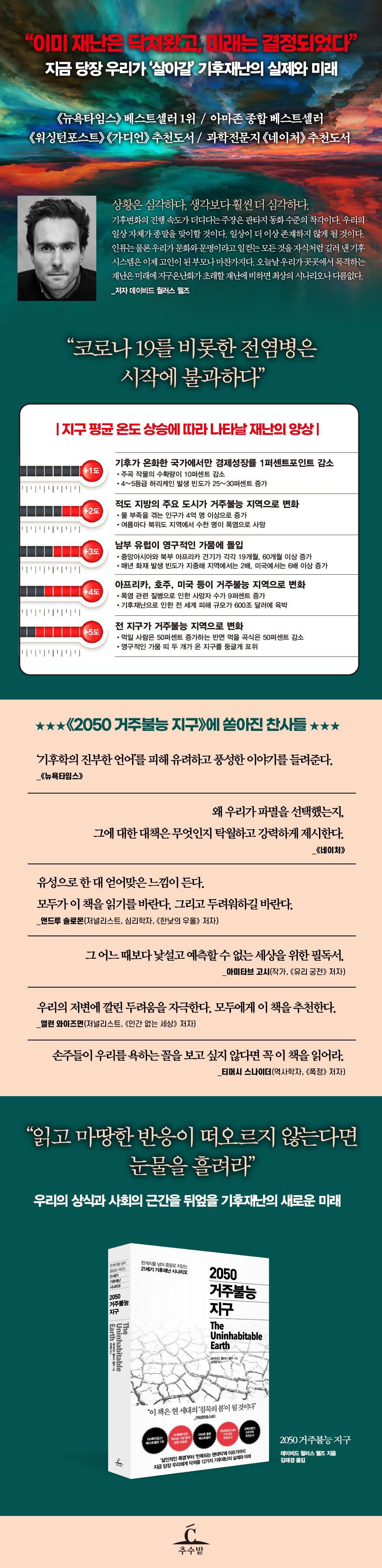
"The disaster has already struck, and the future is determined."
From 'killer heat waves' to 'recurring pandemics'
A future of climate disaster that will overturn our common sense and the very foundations of society.
“There is no time to despair.
The situation is much more serious than we thought.”
The Reality and Future of 12 Climate Disasters That Will Shake Human Society in the 21st Century
Published on April 22, 2020, to mark the 50th anniversary of Earth Day, "The Uninhabitable Earth 2050" is an expanded version of the 2017 report "The Uninhabitable Earth," which was the most widely read and talked about report in New York Magazine history.
Author David Wallace-Wells, who was neither an environmental activist nor had a particularly eco-friendly lifestyle, was commissioned to write a column on climate change and spent several years gathering the materials and stories he needed to write the piece.
And it is deeply concerning that climate change, despite reaching a point where it threatens the very survival of humanity, is still being addressed only within the context of the 'environmental movement.'
This book was written for that very reason.
"The Uninhabitable Earth 2050," which reveals the enormous impact of climate change that cannot be solved by individual ethical awakenings such as "not using plastic" or "being vegetarian," has risen to the top of Amazon's comprehensive bestseller list and has garnered global attention as a book that sounds an alarm to human society.
"Global warming is a lie, now that a record-breaking cold snap has arrived."
We are paying the price for those words now.
“Even an intelligent person like me doesn’t believe it,” said US President Trump, rejecting a climate change report submitted by scientists.
Trump, who withdrew from the Paris Agreement in 2017 and has become even more confident in his denial of climate change, ultimately took no action when Hurricane Maria struck Puerto Rico, killing over 3,000 people.
Of course, it's not just Trump who should be blamed.
This is because the entire world is currently suffering from various abnormal weather conditions and disasters caused by climate change while an unknown infectious disease is spreading, but no specific measures are being taken.
The Earth's carbon dioxide concentration has already exceeded the limit of 400 ppm, and the average temperature is breaking new records every year.
If we fail to prevent a 1.5 or 2 degree rise in global temperature by 2100, we will not be able to cope with the dire future that will arrive by 2050, or even earlier.
Of course, the possibility of a 3 degree or even 5 degree rise is greater than the possibility of preventing a 2 degree rise.
A real disaster that will turn even the 'polar bear danger' into a fantasy.
The crisis of "mass genocide" that makes the term "natural disaster" seem meaningless
Although it is said that a temperature rise of 3 to 5 degrees is an 'established fact,' this book is not a book that simply attempts to scientifically prove or report the consequences of a temperature rise.
"Uninhabitable Earth 2050" is a story about ourselves who are 'already' living the reality of climate change.
Therefore, there is no ‘preface’ in this book.
Because there is not enough time to even mention the disaster unfolding before our eyes.
Author David Wallace-Wells uses this structure to convey the urgency and urgency of the real disaster of climate change.
Moreover, as the title of Part 1 of this book suggests, “This (climate change) is not a ‘natural disaster.’”
Climate change can no longer be limited to a 'natural problem' such as melting Arctic ice and the disappearance of polar bears.
The emotional approach of animals being endangered in places far from human habitation has made it difficult to grasp the reality of climate change.
Many environmental books separate 'humans' and 'nature' and criticize human actions from the perspective of clean 'green nature'.
However, this book emphasizes that we are now facing the 'Anthropocene', an era in which we are entangled with nature and exert far-reaching influence, and clearly reveals that climate change is a 'suicidal act' that destroys human civilization and a 'mass genocide' that destroys the foundations of society.
Even the best-case scenario is catastrophic and painful.
The daily life of climate disaster that we must 'live' right now
"Uninhabitable Earth 2050" presents the most credible future climate change scenarios based on the latest research and statistical evidence.
By critically synthesizing the various existing discussions on climate change, we present the real impacts and picture of global warming that will destroy our daily lives.
Many people believe that global warming is a result of the Industrial Revolution long ago, but more than half of the carbon currently floating in the atmosphere has been emitted in just the past 30 years.
Climate change is no longer a subject for leisurely debate, but rather a survival project that requires humanity to devise ways to survive in a globally changing environment.
The entire world is now facing a crisis due to the uncontrollable pandemic caused by COVID-19.
As we are witnessing with our own eyes, disasters are no longer confined to certain regions but are rapidly spreading across the globe.
Most of the disasters featured in this book exist as part of a similar global "climate feedback" system.
Although categorized into 12 types, each disaster will not occur individually but will occur simultaneously with complex impacts.
I hope that, just by looking at the name of the disaster, you won't misunderstand this book as a social science book that exposes the reality of the gap between rich and poor.
The climate disaster that 『Uninhabitable Earth 2050』 shows will strike relentlessly regardless of whether it is developed, developing, or poor countries.
“No matter how confusing the scenario, we are ultimately the writers.”
A new future for climate change that will spur human action and change.
Climate change is not simply nature's revenge on humans, nor is it nature's punishment that humans cannot do anything about.
Just as bad as denying climate change is the despair and resignation that humans are powerless in the face of a disaster that has already arrived.
"Uninhabitable Earth 2050" warns against such premature apocalypticism and nihilism, and presents a new future of climate change that will completely change politics, economy, society, culture, and even our own lives and attitudes.
The author first criticizes other environmental movements that have consistently focused on market-oriented and consumerist attitudes, and calls for a fundamental change in the capitalist system that has been supported by fossil fuels.
In addition, he points out that the trend of trying to solve the problem with only capital and technology, such as 'carbon capture machines' or 'planetary migration plans', is close to a delusion, and seeks a democratic and cooperative response to the problem of climate change that cannot be left to a few smart people.
Finally, the author proposes the 'anthropic principle' as a means of promoting a change in thinking, and guides us beyond thinking from the perspective of 'Earth' and 'Nature' to a perspective that allows us to think of all of humanity and the Earth as 'one person.'
"Uninhabitable Earth 2050" is a climate change response manual and future report that human society, facing a total crisis, must refer to.
From 'killer heat waves' to 'recurring pandemics'
A future of climate disaster that will overturn our common sense and the very foundations of society.
“There is no time to despair.
The situation is much more serious than we thought.”
The Reality and Future of 12 Climate Disasters That Will Shake Human Society in the 21st Century
Published on April 22, 2020, to mark the 50th anniversary of Earth Day, "The Uninhabitable Earth 2050" is an expanded version of the 2017 report "The Uninhabitable Earth," which was the most widely read and talked about report in New York Magazine history.
Author David Wallace-Wells, who was neither an environmental activist nor had a particularly eco-friendly lifestyle, was commissioned to write a column on climate change and spent several years gathering the materials and stories he needed to write the piece.
And it is deeply concerning that climate change, despite reaching a point where it threatens the very survival of humanity, is still being addressed only within the context of the 'environmental movement.'
This book was written for that very reason.
"The Uninhabitable Earth 2050," which reveals the enormous impact of climate change that cannot be solved by individual ethical awakenings such as "not using plastic" or "being vegetarian," has risen to the top of Amazon's comprehensive bestseller list and has garnered global attention as a book that sounds an alarm to human society.
"Global warming is a lie, now that a record-breaking cold snap has arrived."
We are paying the price for those words now.
“Even an intelligent person like me doesn’t believe it,” said US President Trump, rejecting a climate change report submitted by scientists.
Trump, who withdrew from the Paris Agreement in 2017 and has become even more confident in his denial of climate change, ultimately took no action when Hurricane Maria struck Puerto Rico, killing over 3,000 people.
Of course, it's not just Trump who should be blamed.
This is because the entire world is currently suffering from various abnormal weather conditions and disasters caused by climate change while an unknown infectious disease is spreading, but no specific measures are being taken.
The Earth's carbon dioxide concentration has already exceeded the limit of 400 ppm, and the average temperature is breaking new records every year.
If we fail to prevent a 1.5 or 2 degree rise in global temperature by 2100, we will not be able to cope with the dire future that will arrive by 2050, or even earlier.
Of course, the possibility of a 3 degree or even 5 degree rise is greater than the possibility of preventing a 2 degree rise.
A real disaster that will turn even the 'polar bear danger' into a fantasy.
The crisis of "mass genocide" that makes the term "natural disaster" seem meaningless
Although it is said that a temperature rise of 3 to 5 degrees is an 'established fact,' this book is not a book that simply attempts to scientifically prove or report the consequences of a temperature rise.
"Uninhabitable Earth 2050" is a story about ourselves who are 'already' living the reality of climate change.
Therefore, there is no ‘preface’ in this book.
Because there is not enough time to even mention the disaster unfolding before our eyes.
Author David Wallace-Wells uses this structure to convey the urgency and urgency of the real disaster of climate change.
Moreover, as the title of Part 1 of this book suggests, “This (climate change) is not a ‘natural disaster.’”
Climate change can no longer be limited to a 'natural problem' such as melting Arctic ice and the disappearance of polar bears.
The emotional approach of animals being endangered in places far from human habitation has made it difficult to grasp the reality of climate change.
Many environmental books separate 'humans' and 'nature' and criticize human actions from the perspective of clean 'green nature'.
However, this book emphasizes that we are now facing the 'Anthropocene', an era in which we are entangled with nature and exert far-reaching influence, and clearly reveals that climate change is a 'suicidal act' that destroys human civilization and a 'mass genocide' that destroys the foundations of society.
Even the best-case scenario is catastrophic and painful.
The daily life of climate disaster that we must 'live' right now
"Uninhabitable Earth 2050" presents the most credible future climate change scenarios based on the latest research and statistical evidence.
By critically synthesizing the various existing discussions on climate change, we present the real impacts and picture of global warming that will destroy our daily lives.
Many people believe that global warming is a result of the Industrial Revolution long ago, but more than half of the carbon currently floating in the atmosphere has been emitted in just the past 30 years.
Climate change is no longer a subject for leisurely debate, but rather a survival project that requires humanity to devise ways to survive in a globally changing environment.
The entire world is now facing a crisis due to the uncontrollable pandemic caused by COVID-19.
As we are witnessing with our own eyes, disasters are no longer confined to certain regions but are rapidly spreading across the globe.
Most of the disasters featured in this book exist as part of a similar global "climate feedback" system.
Although categorized into 12 types, each disaster will not occur individually but will occur simultaneously with complex impacts.
I hope that, just by looking at the name of the disaster, you won't misunderstand this book as a social science book that exposes the reality of the gap between rich and poor.
The climate disaster that 『Uninhabitable Earth 2050』 shows will strike relentlessly regardless of whether it is developed, developing, or poor countries.
“No matter how confusing the scenario, we are ultimately the writers.”
A new future for climate change that will spur human action and change.
Climate change is not simply nature's revenge on humans, nor is it nature's punishment that humans cannot do anything about.
Just as bad as denying climate change is the despair and resignation that humans are powerless in the face of a disaster that has already arrived.
"Uninhabitable Earth 2050" warns against such premature apocalypticism and nihilism, and presents a new future of climate change that will completely change politics, economy, society, culture, and even our own lives and attitudes.
The author first criticizes other environmental movements that have consistently focused on market-oriented and consumerist attitudes, and calls for a fundamental change in the capitalist system that has been supported by fossil fuels.
In addition, he points out that the trend of trying to solve the problem with only capital and technology, such as 'carbon capture machines' or 'planetary migration plans', is close to a delusion, and seeks a democratic and cooperative response to the problem of climate change that cannot be left to a few smart people.
Finally, the author proposes the 'anthropic principle' as a means of promoting a change in thinking, and guides us beyond thinking from the perspective of 'Earth' and 'Nature' to a perspective that allows us to think of all of humanity and the Earth as 'one person.'
"Uninhabitable Earth 2050" is a climate change response manual and future report that human society, facing a total crisis, must refer to.
GOODS SPECIFICS
- Date of issue: April 22, 2020
- Page count, weight, size: 424 pages | 768g | 152*224*30mm
- ISBN13: 9791155401651
- ISBN10: 1155401654
You may also like
카테고리
korean


korean

![GQ KOREA Mark (Monthly): December [2025]](http://librairie.coreenne.fr/cdn/shop/files/8ef265dbbfbf186523ed75ba7319009d.jpg?v=1765340328&width=3840)


