

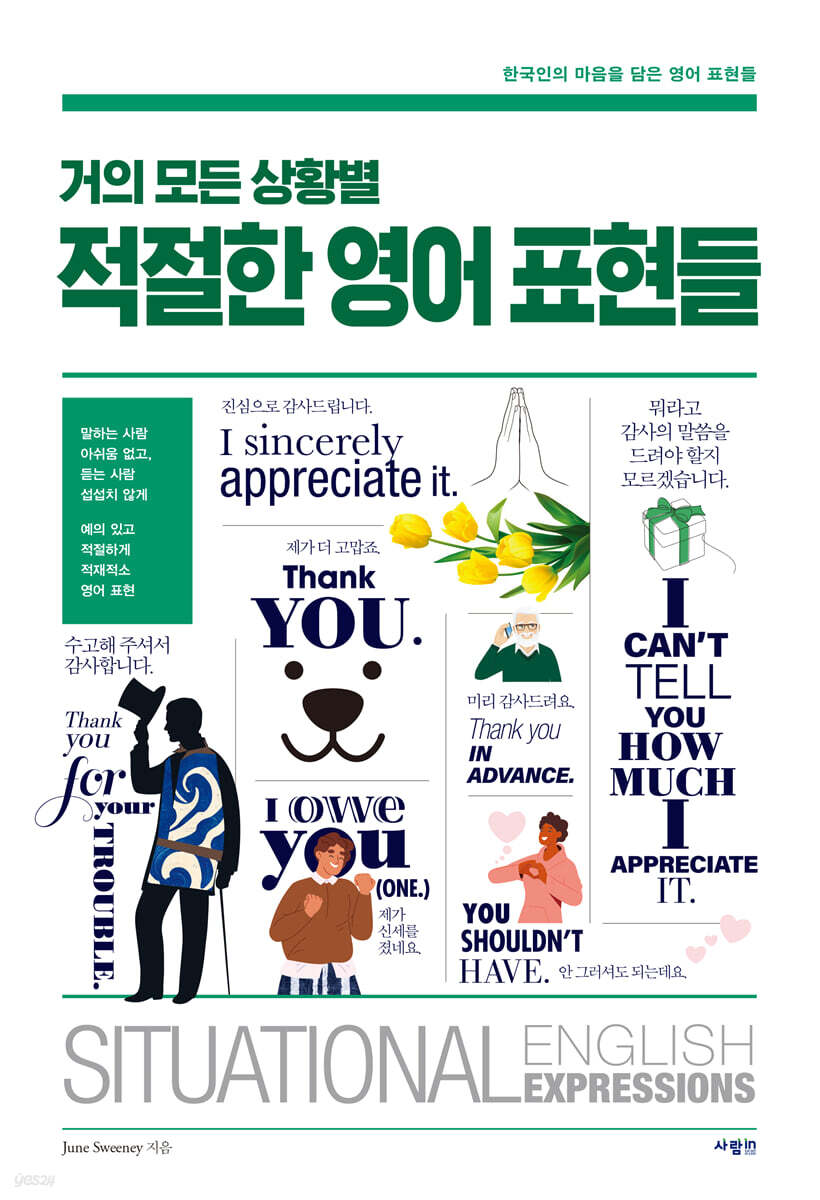
Appropriate English expressions for almost any situation
 |
Description
Book Introduction
An English book that captures the Korean heart's desire to express itself in a light or bold way, depending on the situation.
There are times when you should say "thank you" without feeling pressured, and times when you should say "I don't know what to say to thank you."
There are times when you should say, "Oh, I'm sorry," and times when you should say, "I'm so sorry, what should I do?"
There is no problem in Korean.
But when I try to say the same thing in English, the only expressions that come to mind are 'Thank you very much.' or 'So sorry.'
This is because I have never learned the appropriate expression to use in such situations.
This book identifies specific situations and presents appropriate expressions to help Koreans freely express what they originally wanted to say in English.
So the speaker doesn't feel sorry, and the listener doesn't feel sad either.
There are times when you should say "thank you" without feeling pressured, and times when you should say "I don't know what to say to thank you."
There are times when you should say, "Oh, I'm sorry," and times when you should say, "I'm so sorry, what should I do?"
There is no problem in Korean.
But when I try to say the same thing in English, the only expressions that come to mind are 'Thank you very much.' or 'So sorry.'
This is because I have never learned the appropriate expression to use in such situations.
This book identifies specific situations and presents appropriate expressions to help Koreans freely express what they originally wanted to say in English.
So the speaker doesn't feel sorry, and the listener doesn't feel sad either.
- You can preview some of the book's contents.
Preview
index
Author's Preface
Situational Selection? New Shineonseopan
Structure and Use of This Book
PART 1 Appropriate expressions for each situation
CHAPTER 1: Greetings When Meeting
UNIT 1 When you first greet someone you've just met
UNIT 2 When you finally meet and say hello to someone you've only heard of by name or word of mouth
UNIT 3 When greeting someone you haven't seen in a long time
UNIT 4 When asking about the well-being of a third party
UNIT 5: Commonly Used Greetings in Stores
CHAPTER 2 Saying Goodbye When Parting
UNIT 1 When parting ways after talking to someone you just met
UNIT 2 When parting ways after talking with an acquaintance
UNIT 3 When parting ways after talking with someone you see often
UNIT 4 When asking someone to send greetings to a third party
UNIT 5 When you say, "Have a good rest of your day"
UNIT 6 Greetings commonly used in stores, etc.
UNIT 7 Short but warm greetings according to the weather and the other person's situation
CHAPTER 3 Grateful
UNIT 1 When you want to emphasize your gratitude
Culture Column: American Gratitude Gifts/Gift Culture
UNIT 2 When you are so grateful that words cannot express it.
UNIT 3 When expressing gratitude without using "Thank you."
UNIT 4 When to Express Gratitude Publicly
UNIT 5 When expressing gratitude to someone who has helped you
UNIT 6 When to be grateful for quick work
UNIT 7 When to Thank for an Answer/Reply
UNIT 8 When to say thank you for receiving a gift or consideration
UNIT 9 When you expect someone to do you a favor and say thank you in advance
UNIT 10 When I Say I'm More Thankful
UNIT 11 When I say it's all thanks to you
CHAPTER 4 Asking for a favor
UNIT 1 When you want to ask for help in a subtle way
Culture Column: On Americans' Requests for Help
UNIT 2 When asking if you can do something
UNIT 3 When asking for something without feeling rushed
UNIT 4 When asking someone to hold your seat for you while you go to do some business
UNIT 5 When you ask for something you know is impossible, but you're asking for it anyway just in case.
CHAPTER 5 REFUSING
UNIT 1 When to decline an invitation
UNIT 2 When Rejecting an Offer/Invitation
UNIT 3 When to refuse a request for help
UNIT 4 When to refuse with the following in mind
UNIT 5 When refusing food/drinks offered by others
UNIT 6 When I refuse to do something, saying I will leave
CHAPTER 6 Apologizing
UNIT 1 When to apologize casually
UNIT 2 When to apologize politely
UNIT 3 When to Apologize for Something Unintentional
Culture Column: Americans' Apology Culture
UNIT 4 When to apologize for interrupting
UNIT 5 When apologizing for causing inconvenience/convenience
UNIT 6 When you apologize for taking up time
UNIT 7 When apologizing for someone else's mistake
CHAPTER 7 Making Excuses
UNIT 1 When making excuses by saying that you just did what you were told/asked
UNIT 2 When making excuses that you had no choice
UNIT 3 When making excuses for being late
UNIT 4 When making excuses for trying to do something
UNIT 5 When to make excuses instead
UNIT 6 When making excuses for forgetting something
UNIT 7 When making excuses for mistakes made out of ignorance
UNIT 8 When making excuses for canceling an appointment
UNIT 9 When there is no room for excuses
CHAPTER 8 Celebrating
UNIT 1 When casually celebrating with close friends
Culture Column American Celebration Culture
UNIT 2 When celebrating with envy
UNIT 3 When I celebrate with joy as if it were my own work
UNIT 4 When to Celebrate with Pride
UNIT 5 When celebrating something that seems like an obvious result
CHAPTER 9 Praising
UNIT 1 When giving praise that makes you feel a sense of accomplishment
UNIT 2 When giving praise that makes someone feel recognized
UNIT 3 When Complimenting Appearance
UNIT 4 When Complimenting Clothing/Accessories, etc.
UNIT 5 When conveying compliments to a third party
UNIT 6 When praising a younger person
CHAPTER 10 Encouragement/Comforting
UNIT 1 When you are doing well and are told to keep doing it
UNIT 2 When Encouraging Someone Who Is Discouraged/Insecure
UNIT 3 When you say you are cheering/supporting
Culture Column: A Culture of Support and Cheer
UNIT 4 When comforting/encouraging someone going through a difficult time
UNIT 5 When comforting/encouraging someone who has made a mistake
UNIT 6 When comforting a sick person
UNIT 7 Comforting Someone Difficult After Divorce/Separation
UNIT 8 When comforting someone who has been in trouble
UNIT 9 When comforting someone who keeps brooding over the past/who can't let go of their regrets
UNIT 10 When comforting someone who is in pain
CHAPTER 11 Making Appointments/Reservations
UNIT 1 When setting an appointment time
UNIT 2 When deciding on a meeting place
UNIT 3 When making a light promise between close friends
UNIT 4 When changing an appointment
UNIT 5 When to Cancel an Appointment
UNIT 6 When reserving a place (hotel, etc.)
UNIT 7 (hospitals, etc.) When making a face-to-face appointment
UNIT 8 Common expressions for making reservations at a location/face-to-face
CHAPTER 12 Urging a Reply
UNIT 1 When subtly urging a reply from the beginning by mixing in greetings of expectation/gratitude
UNIT 2 When you wait but don't get a reply
UNIT 3 When setting a deadline for a response and urging others to respond
UNIT 4 When you are in a hurry
CHAPTER 13 CHECKOUT
UNIT 1 When checking whether a requested task has been completed
UNIT 2 When checking whether the other person understands/agrees
UNIT 3 When checking whether the other party knows the facts
UNIT 4 When reminding and confirming reservations/event schedules, etc. with the other party
UNIT 5 When checking certainty/credibility
CHAPTER 14 Coordinating Opinions/Negotiating/Compromising
UNIT 1 When exploring possibilities
UNIT 2 When giving in half/compromising
UNIT 3 When Opinions Cannot Be Coordinated
UNIT 4 When Haggling/Negotiating Prices
CHAPTER 15 Inviting
UNIT 1 When Inviting Guests
UNIT 2 When accepting an invitation
UNIT 3 When to decline an invitation
When you ask and answer what you need to bring when attending UNIT 4
UNIT 5 When a guest brings a gift
UNIT 6 When welcoming guests
CHAPTER 16 Pointing Out
UNIT 1 When pointing out a fact that is incorrect
UNIT 2 When subtly suggesting to reconfirm
UNIT 3 When pointing out something that is too far from the truth
UNIT 4 When pointing out excessive or inappropriate clothing
UNIT 5 When you scold someone who is always nagging
UNIT 6 When pointing out mistakes without making the other person feel embarrassed
UNIT 7 When making a sharp point
CHAPTER 17 Giving Advice
UNIT 1 When to Ask for Advice
UNIT 2 When giving advice as if making a careful suggestion
UNIT 3 ~ When to advise not to do something
UNIT 4 When giving advice based on experience
UNIT 5 When giving advice based on personal opinion
CHAPTER 18 Expressing Regret
UNIT 1 When things don't go as expected and you feel disappointed
UNIT 2 When you feel regret for missing an opportunity
UNIT 3 When you feel sad that you can't be together
UNIT 4 When you regret something that never happened
UNIT 5 When to Give Up Cleanly, Even Though It's a Pity
CHAPTER 19: Guessing/Predicting
UNIT 1 Well-founded Conjecture vs.
unfounded speculation
UNIT 2 Weak Guessing vs.
Strong guess
UNIT 3 Best Case vs.
When expecting the worst
UNIT 4 When you hope your prediction is correct vs.
When you hope your expectations turn out to be wrong
UNIT 5 When I say my personal guess/expectation
CHAPTER 20: Giving Reassurance/Reassurance
UNIT 1 When reassuring someone who is hesitant to make a decision/attempt
UNIT 2 When I give confidence to the person who entrusted me with a task
UNIT 3 When you give confidence to the other person in a decision they have already made
UNIT 4 When reassuring someone who is worried about whether they will be able to receive good care
CHAPTER 21 Changing the Topic/Breaking the Conversation
UNIT 1 When there is no time
UNIT 2 When we say let's talk again next time
UNIT 3 Let's go back to what we were talking about earlier
UNIT 4 When you get sidetracked during a conversation
UNIT 5 by the way vs.
anyway
UNIT 6 When you continue to talk about something that is difficult to hear
UNIT 7 When you say you will talk about it when the time is right, not now
CHAPTER 22 Be careful with your words/Slips of the tongue
UNIT 1 When telling someone who speaks thoughtlessly or speaks rudely to be careful with their words
UNIT 2 When you unintentionally hurt someone's feelings with your words
UNIT 3 When you say something you shouldn't have said
UNIT 4 When I swore/swear in front of people
UNIT 5 When to take back what was said
UNIT 6 When you say something wrong
PART 2 Appropriate expressions by meaning
CHAPTER 23 Busy
UNIT 1 (Work) I'm busy with work
UNIT 2 Busy with housework
UNIT 3 I'm busy doing what I like/want to do.
UNIT 4 Busy taking care of people/pets
UNIT 5 I'm busy/in a hurry
CHAPTER 24 It's a shame
UNIT 1 It's a shame because it's too pretty or expensive
UNIT 2 It's a shame to lose the game
UNIT 3 Who is more pitiful?
UNIT 4 Food/Money/Time is a Waste
CHAPTER 25 Scary
UNIT 1 Scary thing that 90% of Koreans don't know
UNIT 2 Brutal and Bloody Horror
UNIT 3: Gloomy and Eerie Fear
UNIT 4 Bizarre and Supernatural Fear
CHAPTER 26 Endure
UNIT 1 Enduring Menstrual Phenomena
UNIT 2 Holding back emotions such as laughter and tears
UNIT 3 Enduring Pain/Pain
UNIT 4 Tolerating Things/People You Dislike
CHAPTER 27 It's tricky
UNIT 1: The personality is difficult
UNIT 2: Picky eating habits
UNIT 3 (Qualification) The conditions/procedures are strict.
UNIT 4 The problem/method is tricky
CHAPTER 28 Raising/Raising
UNIT 1 Raising a Child
UNIT 2 Raising Livestock
UNIT 3 Raising a Pet
UNIT 4 Growing Plants
UNIT 5 Growing Hair/Fingers/Toenails
CHAPTER 29 Solve
UNIT 1 Solving Math Problems, etc.
UNIT 2 Untie the thread/string/line
UNIT 3 Making up with someone you've fought with
UNIT 4 Episode/Relieve Stress
UNIT 5 Clearing Up Misunderstandings
UNIT 6 Solving Problems Through Dialogue
UNIT 7 Relaxing
UNIT 8 Blowing your nose
CHAPTER 30 Burden
UNIT 1 I don't want to be a burden to others by making requests/proposals/requests.
UNIT 2 I don't want to be a burden to the person receiving the suggestion/help.
UNIT 3 I feel burdened by someone's gaze
UNIT 4 Feeling pressured and burdened
UNIT 5 The price is burdensome
UNIT 6 Burden on body/health
CHAPTER 31 Take care
UNIT 1 Packing What to Take
UNIT 2 Take extra
UNIT 3 Taking care of people
Watch UNIT 4 broadcast
CHAPTER 32 PRICE/FEES/COSTS
UNIT 1 Product Price
UNIT 2 Fee
UNIT 3 Cost, Costing
UNIT 4 Payment, Charge/Impose
UNIT 5 Fees, Membership Fees, and Admission Fees
UNIT 6 Transportation Fares and Fares
UNIT 7 Quotation
UNIT 8 Baggage Fee
UNIT 9 Cheap vs.
cheap
CHAPTER 33 Comfortable
UNIT 1 Feeling at ease in body and mind
UNIT 2 Convenient
UNIT 3 The appointment time/place is convenient.
Culture Column: What Americans Find Uncomfortable
CHAPTER 34 Lack
UNIT 1 Sheep shortage
UNIT 2 Lack of Knowledge/Learning
UNIT 3 Lack of Qualifications/Skills
UNIT 4 Lack of Conditions
UNIT 5 Lack of Money
UNIT 6 Supply Shortages
UNIT 7 Deficiency, Lack
Situational Selection? New Shineonseopan
Structure and Use of This Book
PART 1 Appropriate expressions for each situation
CHAPTER 1: Greetings When Meeting
UNIT 1 When you first greet someone you've just met
UNIT 2 When you finally meet and say hello to someone you've only heard of by name or word of mouth
UNIT 3 When greeting someone you haven't seen in a long time
UNIT 4 When asking about the well-being of a third party
UNIT 5: Commonly Used Greetings in Stores
CHAPTER 2 Saying Goodbye When Parting
UNIT 1 When parting ways after talking to someone you just met
UNIT 2 When parting ways after talking with an acquaintance
UNIT 3 When parting ways after talking with someone you see often
UNIT 4 When asking someone to send greetings to a third party
UNIT 5 When you say, "Have a good rest of your day"
UNIT 6 Greetings commonly used in stores, etc.
UNIT 7 Short but warm greetings according to the weather and the other person's situation
CHAPTER 3 Grateful
UNIT 1 When you want to emphasize your gratitude
Culture Column: American Gratitude Gifts/Gift Culture
UNIT 2 When you are so grateful that words cannot express it.
UNIT 3 When expressing gratitude without using "Thank you."
UNIT 4 When to Express Gratitude Publicly
UNIT 5 When expressing gratitude to someone who has helped you
UNIT 6 When to be grateful for quick work
UNIT 7 When to Thank for an Answer/Reply
UNIT 8 When to say thank you for receiving a gift or consideration
UNIT 9 When you expect someone to do you a favor and say thank you in advance
UNIT 10 When I Say I'm More Thankful
UNIT 11 When I say it's all thanks to you
CHAPTER 4 Asking for a favor
UNIT 1 When you want to ask for help in a subtle way
Culture Column: On Americans' Requests for Help
UNIT 2 When asking if you can do something
UNIT 3 When asking for something without feeling rushed
UNIT 4 When asking someone to hold your seat for you while you go to do some business
UNIT 5 When you ask for something you know is impossible, but you're asking for it anyway just in case.
CHAPTER 5 REFUSING
UNIT 1 When to decline an invitation
UNIT 2 When Rejecting an Offer/Invitation
UNIT 3 When to refuse a request for help
UNIT 4 When to refuse with the following in mind
UNIT 5 When refusing food/drinks offered by others
UNIT 6 When I refuse to do something, saying I will leave
CHAPTER 6 Apologizing
UNIT 1 When to apologize casually
UNIT 2 When to apologize politely
UNIT 3 When to Apologize for Something Unintentional
Culture Column: Americans' Apology Culture
UNIT 4 When to apologize for interrupting
UNIT 5 When apologizing for causing inconvenience/convenience
UNIT 6 When you apologize for taking up time
UNIT 7 When apologizing for someone else's mistake
CHAPTER 7 Making Excuses
UNIT 1 When making excuses by saying that you just did what you were told/asked
UNIT 2 When making excuses that you had no choice
UNIT 3 When making excuses for being late
UNIT 4 When making excuses for trying to do something
UNIT 5 When to make excuses instead
UNIT 6 When making excuses for forgetting something
UNIT 7 When making excuses for mistakes made out of ignorance
UNIT 8 When making excuses for canceling an appointment
UNIT 9 When there is no room for excuses
CHAPTER 8 Celebrating
UNIT 1 When casually celebrating with close friends
Culture Column American Celebration Culture
UNIT 2 When celebrating with envy
UNIT 3 When I celebrate with joy as if it were my own work
UNIT 4 When to Celebrate with Pride
UNIT 5 When celebrating something that seems like an obvious result
CHAPTER 9 Praising
UNIT 1 When giving praise that makes you feel a sense of accomplishment
UNIT 2 When giving praise that makes someone feel recognized
UNIT 3 When Complimenting Appearance
UNIT 4 When Complimenting Clothing/Accessories, etc.
UNIT 5 When conveying compliments to a third party
UNIT 6 When praising a younger person
CHAPTER 10 Encouragement/Comforting
UNIT 1 When you are doing well and are told to keep doing it
UNIT 2 When Encouraging Someone Who Is Discouraged/Insecure
UNIT 3 When you say you are cheering/supporting
Culture Column: A Culture of Support and Cheer
UNIT 4 When comforting/encouraging someone going through a difficult time
UNIT 5 When comforting/encouraging someone who has made a mistake
UNIT 6 When comforting a sick person
UNIT 7 Comforting Someone Difficult After Divorce/Separation
UNIT 8 When comforting someone who has been in trouble
UNIT 9 When comforting someone who keeps brooding over the past/who can't let go of their regrets
UNIT 10 When comforting someone who is in pain
CHAPTER 11 Making Appointments/Reservations
UNIT 1 When setting an appointment time
UNIT 2 When deciding on a meeting place
UNIT 3 When making a light promise between close friends
UNIT 4 When changing an appointment
UNIT 5 When to Cancel an Appointment
UNIT 6 When reserving a place (hotel, etc.)
UNIT 7 (hospitals, etc.) When making a face-to-face appointment
UNIT 8 Common expressions for making reservations at a location/face-to-face
CHAPTER 12 Urging a Reply
UNIT 1 When subtly urging a reply from the beginning by mixing in greetings of expectation/gratitude
UNIT 2 When you wait but don't get a reply
UNIT 3 When setting a deadline for a response and urging others to respond
UNIT 4 When you are in a hurry
CHAPTER 13 CHECKOUT
UNIT 1 When checking whether a requested task has been completed
UNIT 2 When checking whether the other person understands/agrees
UNIT 3 When checking whether the other party knows the facts
UNIT 4 When reminding and confirming reservations/event schedules, etc. with the other party
UNIT 5 When checking certainty/credibility
CHAPTER 14 Coordinating Opinions/Negotiating/Compromising
UNIT 1 When exploring possibilities
UNIT 2 When giving in half/compromising
UNIT 3 When Opinions Cannot Be Coordinated
UNIT 4 When Haggling/Negotiating Prices
CHAPTER 15 Inviting
UNIT 1 When Inviting Guests
UNIT 2 When accepting an invitation
UNIT 3 When to decline an invitation
When you ask and answer what you need to bring when attending UNIT 4
UNIT 5 When a guest brings a gift
UNIT 6 When welcoming guests
CHAPTER 16 Pointing Out
UNIT 1 When pointing out a fact that is incorrect
UNIT 2 When subtly suggesting to reconfirm
UNIT 3 When pointing out something that is too far from the truth
UNIT 4 When pointing out excessive or inappropriate clothing
UNIT 5 When you scold someone who is always nagging
UNIT 6 When pointing out mistakes without making the other person feel embarrassed
UNIT 7 When making a sharp point
CHAPTER 17 Giving Advice
UNIT 1 When to Ask for Advice
UNIT 2 When giving advice as if making a careful suggestion
UNIT 3 ~ When to advise not to do something
UNIT 4 When giving advice based on experience
UNIT 5 When giving advice based on personal opinion
CHAPTER 18 Expressing Regret
UNIT 1 When things don't go as expected and you feel disappointed
UNIT 2 When you feel regret for missing an opportunity
UNIT 3 When you feel sad that you can't be together
UNIT 4 When you regret something that never happened
UNIT 5 When to Give Up Cleanly, Even Though It's a Pity
CHAPTER 19: Guessing/Predicting
UNIT 1 Well-founded Conjecture vs.
unfounded speculation
UNIT 2 Weak Guessing vs.
Strong guess
UNIT 3 Best Case vs.
When expecting the worst
UNIT 4 When you hope your prediction is correct vs.
When you hope your expectations turn out to be wrong
UNIT 5 When I say my personal guess/expectation
CHAPTER 20: Giving Reassurance/Reassurance
UNIT 1 When reassuring someone who is hesitant to make a decision/attempt
UNIT 2 When I give confidence to the person who entrusted me with a task
UNIT 3 When you give confidence to the other person in a decision they have already made
UNIT 4 When reassuring someone who is worried about whether they will be able to receive good care
CHAPTER 21 Changing the Topic/Breaking the Conversation
UNIT 1 When there is no time
UNIT 2 When we say let's talk again next time
UNIT 3 Let's go back to what we were talking about earlier
UNIT 4 When you get sidetracked during a conversation
UNIT 5 by the way vs.
anyway
UNIT 6 When you continue to talk about something that is difficult to hear
UNIT 7 When you say you will talk about it when the time is right, not now
CHAPTER 22 Be careful with your words/Slips of the tongue
UNIT 1 When telling someone who speaks thoughtlessly or speaks rudely to be careful with their words
UNIT 2 When you unintentionally hurt someone's feelings with your words
UNIT 3 When you say something you shouldn't have said
UNIT 4 When I swore/swear in front of people
UNIT 5 When to take back what was said
UNIT 6 When you say something wrong
PART 2 Appropriate expressions by meaning
CHAPTER 23 Busy
UNIT 1 (Work) I'm busy with work
UNIT 2 Busy with housework
UNIT 3 I'm busy doing what I like/want to do.
UNIT 4 Busy taking care of people/pets
UNIT 5 I'm busy/in a hurry
CHAPTER 24 It's a shame
UNIT 1 It's a shame because it's too pretty or expensive
UNIT 2 It's a shame to lose the game
UNIT 3 Who is more pitiful?
UNIT 4 Food/Money/Time is a Waste
CHAPTER 25 Scary
UNIT 1 Scary thing that 90% of Koreans don't know
UNIT 2 Brutal and Bloody Horror
UNIT 3: Gloomy and Eerie Fear
UNIT 4 Bizarre and Supernatural Fear
CHAPTER 26 Endure
UNIT 1 Enduring Menstrual Phenomena
UNIT 2 Holding back emotions such as laughter and tears
UNIT 3 Enduring Pain/Pain
UNIT 4 Tolerating Things/People You Dislike
CHAPTER 27 It's tricky
UNIT 1: The personality is difficult
UNIT 2: Picky eating habits
UNIT 3 (Qualification) The conditions/procedures are strict.
UNIT 4 The problem/method is tricky
CHAPTER 28 Raising/Raising
UNIT 1 Raising a Child
UNIT 2 Raising Livestock
UNIT 3 Raising a Pet
UNIT 4 Growing Plants
UNIT 5 Growing Hair/Fingers/Toenails
CHAPTER 29 Solve
UNIT 1 Solving Math Problems, etc.
UNIT 2 Untie the thread/string/line
UNIT 3 Making up with someone you've fought with
UNIT 4 Episode/Relieve Stress
UNIT 5 Clearing Up Misunderstandings
UNIT 6 Solving Problems Through Dialogue
UNIT 7 Relaxing
UNIT 8 Blowing your nose
CHAPTER 30 Burden
UNIT 1 I don't want to be a burden to others by making requests/proposals/requests.
UNIT 2 I don't want to be a burden to the person receiving the suggestion/help.
UNIT 3 I feel burdened by someone's gaze
UNIT 4 Feeling pressured and burdened
UNIT 5 The price is burdensome
UNIT 6 Burden on body/health
CHAPTER 31 Take care
UNIT 1 Packing What to Take
UNIT 2 Take extra
UNIT 3 Taking care of people
Watch UNIT 4 broadcast
CHAPTER 32 PRICE/FEES/COSTS
UNIT 1 Product Price
UNIT 2 Fee
UNIT 3 Cost, Costing
UNIT 4 Payment, Charge/Impose
UNIT 5 Fees, Membership Fees, and Admission Fees
UNIT 6 Transportation Fares and Fares
UNIT 7 Quotation
UNIT 8 Baggage Fee
UNIT 9 Cheap vs.
cheap
CHAPTER 33 Comfortable
UNIT 1 Feeling at ease in body and mind
UNIT 2 Convenient
UNIT 3 The appointment time/place is convenient.
Culture Column: What Americans Find Uncomfortable
CHAPTER 34 Lack
UNIT 1 Sheep shortage
UNIT 2 Lack of Knowledge/Learning
UNIT 3 Lack of Qualifications/Skills
UNIT 4 Lack of Conditions
UNIT 5 Lack of Money
UNIT 6 Supply Shortages
UNIT 7 Deficiency, Lack
Detailed image

Publisher's Review
The new standard for speaking English is to use appropriate expressions according to the situation and scene!
When making a request, "Please," when encouraging someone, "Cheer up!", when praising them, "Two thumbs up!", and when declining, "No thank you," come to mind, don't they? While these expressions aren't wrong, they have specific times and situations when they should be used.
That is, it cannot be used in all situations.
Unless you were born a native speaker, there is no other way than to learn appropriate expressions for each situation.
When we ignore such things and use only one expression for all different situations, misunderstandings arise and the gap widens.
To dispel these misunderstandings and help you express in English what you would naturally say in Korean, "Appropriate English Expressions for Almost Any Situation" has been created.
Unparalleled detailed situation classification
While the existing book ended with 'asking a favor,' this book categorizes it in detail, such as 'when you want help and ask subtly,' 'when you ask if it's okay to ask,' 'when you ask without feeling like you're rushing,' and 'when you know it's impossible but ask for something just in case.'
Learners can find situations they want to express and learn the corresponding expressions.
Witty explanations and vivid examples from the US
The author, who has studied Korean for over 20 years and lived with locals in the United States for over 20 years, points out the mistakes Koreans make and the things they are most curious about, and provides friendly information from the learner's perspective.
The book's highlights include humorous explanations, informative information, and conversational examples and sentences that can be applied to native speakers right away.
Presenting polysynonyms to prevent the overuse of Konglish.
In Korean, the words "solve" (풀다), meaning "to solve a problem," "to untangle a shoelace," "to untangle something," "to untangle a (bad) relationship," and "to blow one's nose" (풀다), can all be resolved by using the word "solve," which is the first word that comes to mind when thinking of "풀다" (풀다)? Surprisingly, the main culprit behind this absurd Konglish is expressing these polysemous expressions with a single English word.
We will organize all the essential polysemous English expressions that have been scattered in our heads so far, so that we do not produce any more Konglish.
Interesting stories about American culture
True communication requires both fluent language skills and cultural knowledge.
It is because you need to have cultural background knowledge to understand why the other person expresses themselves that way and to avoid misunderstandings.
It adds to the fun of reading by including cultural common sense that is difficult to access unless you are an American local.
When making a request, "Please," when encouraging someone, "Cheer up!", when praising them, "Two thumbs up!", and when declining, "No thank you," come to mind, don't they? While these expressions aren't wrong, they have specific times and situations when they should be used.
That is, it cannot be used in all situations.
Unless you were born a native speaker, there is no other way than to learn appropriate expressions for each situation.
When we ignore such things and use only one expression for all different situations, misunderstandings arise and the gap widens.
To dispel these misunderstandings and help you express in English what you would naturally say in Korean, "Appropriate English Expressions for Almost Any Situation" has been created.
Unparalleled detailed situation classification
While the existing book ended with 'asking a favor,' this book categorizes it in detail, such as 'when you want help and ask subtly,' 'when you ask if it's okay to ask,' 'when you ask without feeling like you're rushing,' and 'when you know it's impossible but ask for something just in case.'
Learners can find situations they want to express and learn the corresponding expressions.
Witty explanations and vivid examples from the US
The author, who has studied Korean for over 20 years and lived with locals in the United States for over 20 years, points out the mistakes Koreans make and the things they are most curious about, and provides friendly information from the learner's perspective.
The book's highlights include humorous explanations, informative information, and conversational examples and sentences that can be applied to native speakers right away.
Presenting polysynonyms to prevent the overuse of Konglish.
In Korean, the words "solve" (풀다), meaning "to solve a problem," "to untangle a shoelace," "to untangle something," "to untangle a (bad) relationship," and "to blow one's nose" (풀다), can all be resolved by using the word "solve," which is the first word that comes to mind when thinking of "풀다" (풀다)? Surprisingly, the main culprit behind this absurd Konglish is expressing these polysemous expressions with a single English word.
We will organize all the essential polysemous English expressions that have been scattered in our heads so far, so that we do not produce any more Konglish.
Interesting stories about American culture
True communication requires both fluent language skills and cultural knowledge.
It is because you need to have cultural background knowledge to understand why the other person expresses themselves that way and to avoid misunderstandings.
It adds to the fun of reading by including cultural common sense that is difficult to access unless you are an American local.
GOODS SPECIFICS
- Date of issue: August 16, 2024
- Page count, weight, size: 312 pages | 170*250*30mm
- ISBN13: 9791171010950
- ISBN10: 1171010958
You may also like
카테고리
korean


korean

![GQ KOREA Mark (Monthly): December [2025]](http://librairie.coreenne.fr/cdn/shop/files/8ef265dbbfbf186523ed75ba7319009d.jpg?v=1765340328&width=3840)


