

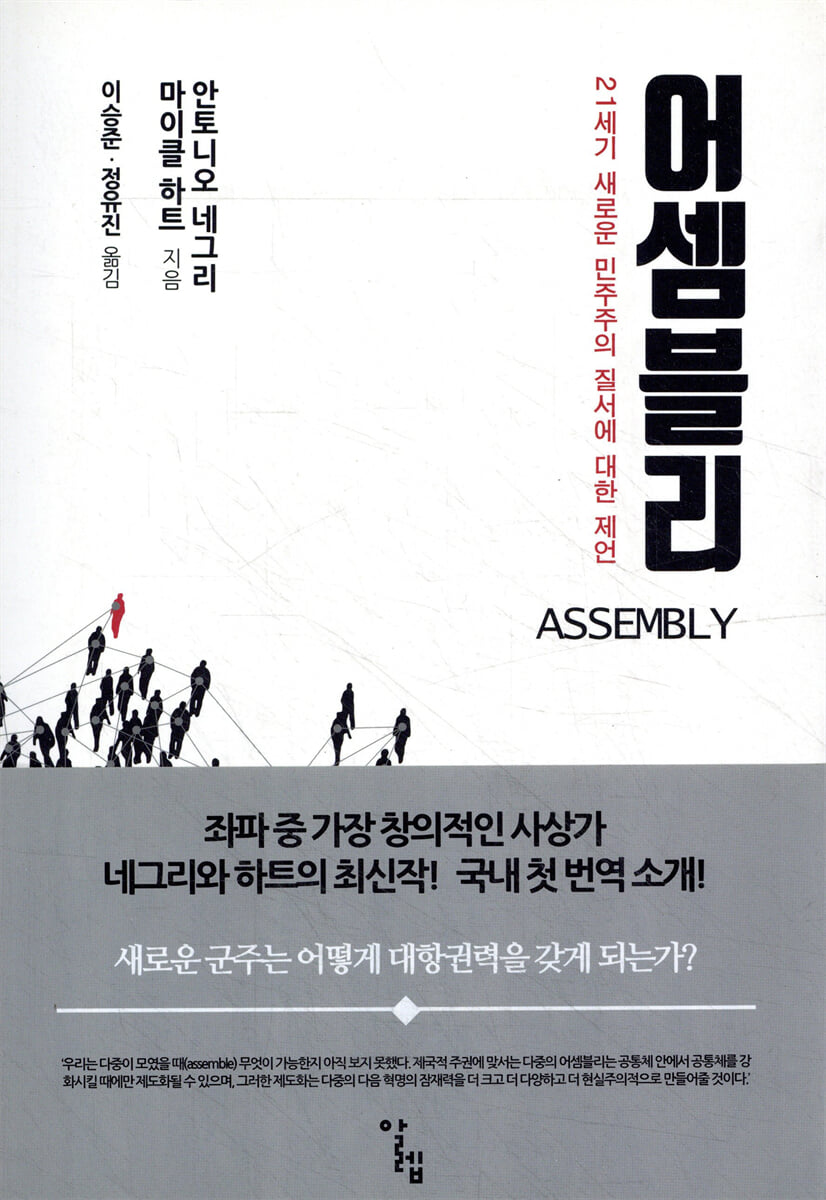
assembly
 |
Description
Book Introduction
New and important statements from two of the left's most creative thinkers.
Diagnosis of 21st Century Social Movements and a New Democratic Order
In recent years, a cycle of struggles of 'leaderless social movements' has taken place across the globe.
It is well known that these movements have produced impressive results, such as overthrowing authoritarian leaders, introducing progressive policies, and suppressing oppressive state power.
In their new book, Assembly, Negri and Hardt diagnose that these movements have not yet produced a lasting alternative, and argue that now is the time for a reversal of the roles of leaders and the multitude, and furthermore, for this to be institutionalized with a long-term perspective.
In other words, the multitude should lead the strategy, and leaders should take charge of the tactics.
“Strategy for movement, tactics for leadership!”
Suggests how social movements can be better utilized.
In doing so, it challenges the anachronistic assumption that social movements must return to traditional, centralized political leadership.
Furthermore, it offers a new analysis of the dominance of finance capital and money, exploring how to strip money of its ownership form and make it common, that is, to create a currency of cooperation and a currency of singularity.
And, in the direction of struggle and organization to realize it, it presents several successful cases of 'social unions' that combine economic struggle and political struggle in the traditional sense, and 'social strikes' as a form of struggle.
Diagnosis of 21st Century Social Movements and a New Democratic Order
In recent years, a cycle of struggles of 'leaderless social movements' has taken place across the globe.
It is well known that these movements have produced impressive results, such as overthrowing authoritarian leaders, introducing progressive policies, and suppressing oppressive state power.
In their new book, Assembly, Negri and Hardt diagnose that these movements have not yet produced a lasting alternative, and argue that now is the time for a reversal of the roles of leaders and the multitude, and furthermore, for this to be institutionalized with a long-term perspective.
In other words, the multitude should lead the strategy, and leaders should take charge of the tactics.
“Strategy for movement, tactics for leadership!”
Suggests how social movements can be better utilized.
In doing so, it challenges the anachronistic assumption that social movements must return to traditional, centralized political leadership.
Furthermore, it offers a new analysis of the dominance of finance capital and money, exploring how to strip money of its ownership form and make it common, that is, to create a currency of cooperation and a currency of singularity.
And, in the direction of struggle and organization to realize it, it presents several successful cases of 'social unions' that combine economic struggle and political struggle in the traditional sense, and 'social strikes' as a form of struggle.
- You can preview some of the book's contents.
Preview
index
introduction
Part I Leadership Issues
Chapter 1 Where Have All the Leaders Gone?
Chapter 2: Centaur Strategy and Tactics
Chapter 3 Against Rousseau, or for the End of Sovereignty
Chapter 4: The Dark Mirror of the Right-Wing Movement
Chapter 5: The Real Problem Lies Elsewhere
Part II Social Production
Chapter 6: How to Open Up Property to the Commons
Chapter 7: We, Mechanical Subjects
Chapter 8: Evangelizing Weber
Chapter 9: Multi-entrepreneurship
Part III: Financial Control and Neoliberal Collaboration
Chapter 10: Finance Captures Social Value
Chapter 11: Money Institutionalizes Social Relations
Chapter 12: Neoliberal Administration Disjointed at the Seams
Part IV The New Monarch
Chapter 13 Political Realism
Chapter 14 Impossible Reformism
Chapter 15 And now what?
Chapter 16 Portolano
Part I Leadership Issues
Chapter 1 Where Have All the Leaders Gone?
Chapter 2: Centaur Strategy and Tactics
Chapter 3 Against Rousseau, or for the End of Sovereignty
Chapter 4: The Dark Mirror of the Right-Wing Movement
Chapter 5: The Real Problem Lies Elsewhere
Part II Social Production
Chapter 6: How to Open Up Property to the Commons
Chapter 7: We, Mechanical Subjects
Chapter 8: Evangelizing Weber
Chapter 9: Multi-entrepreneurship
Part III: Financial Control and Neoliberal Collaboration
Chapter 10: Finance Captures Social Value
Chapter 11: Money Institutionalizes Social Relations
Chapter 12: Neoliberal Administration Disjointed at the Seams
Part IV The New Monarch
Chapter 13 Political Realism
Chapter 14 Impossible Reformism
Chapter 15 And now what?
Chapter 16 Portolano
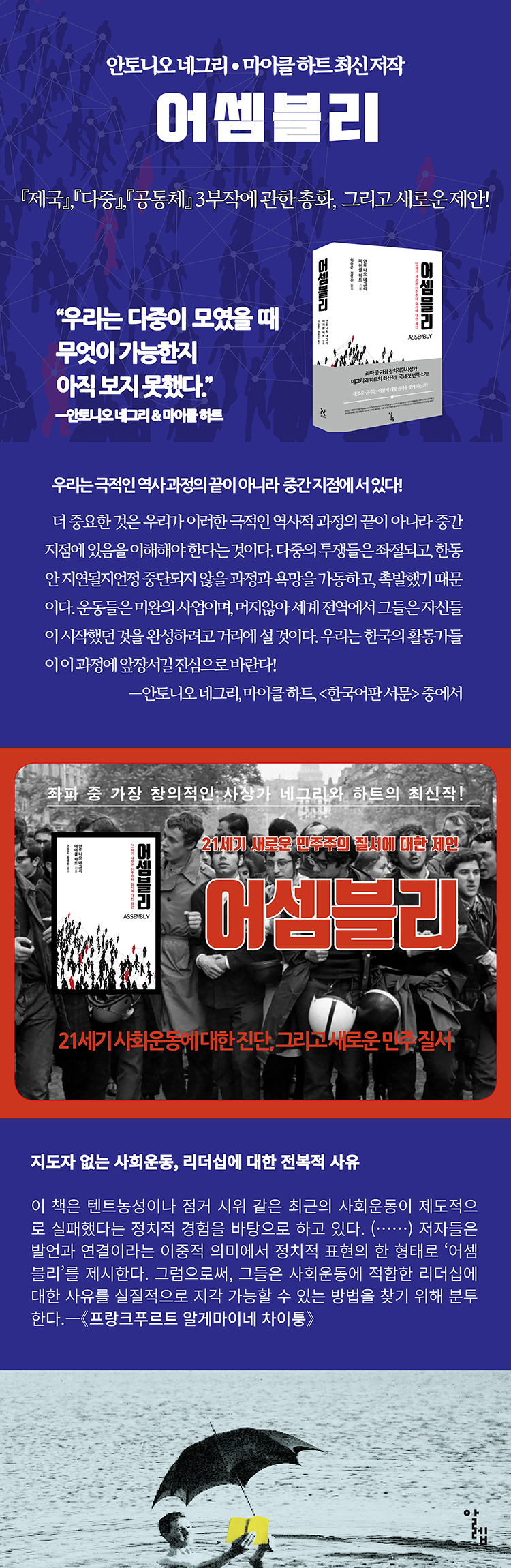
Detailed image
Publisher's Review
Assembly, what kind of book is it?
Michael Hardt and Antonio Negri, two of today's most creative (left-wing) thinkers, have published Assembly (2017), repeating and inheriting the work of Empire (2000 [Korean edition 2001]), Multitude (2004 [2008]), and Community (2009 [2014]), published every three to five years since 2000, while evolving it to fit new realities.
The five-part series, or 4+1 volumes, including the pamphlet 『Manifesto』 (2012[2012]), published in response to the urgent political situation of the 'Arab Spring' and 'Occupy Wall Street', has been published in a common project (but not yet completed).
『Assembly』 has been translated into English-speaking countries (assembly), German (assembly), Spanish (Asamblea), and Italian (Assemblea), and has been published in many countries around the world, including the United States, France, Germany, Spain, Italy, China, Japan, and Canada.
In Korea, more than 20 of their previous books have been published to date.
The German translation of 『assembly』 has the subtitle “A New Democratic Order,” and the Italian translation of 『assemblea』 describes it as “a basic guide to political and economic organization for grassroots movements of the present and future.”
These works could be given names such as 'A History of Empires from Below', 'The Project of Constituting Absolute Democracy in the 21st Century', and 'The Postmodern Communist Manifesto', because all five works share the materialism and concepts of Machiavelli, Spinoza, and Marx, the modern anomalies, as their foundation. (See the translator's note.) Although the 4+1 series deals with independent topics, a closer look reveals that they repeat, transform, and add to the issues raised in the preceding works within a new context.
In this book, the advocates of this commonism once again provide a critical analysis of the most problematic points in social development.
The central issue is why social movements that express the demands and desires of so many have failed to create a new, truly democratic and just society.
As with many of the propositions and concepts presented by the authors, the very line of questioning is already controversial.
According to the authors, we must confront the challenges of leadership and institutions, boldly imagine the entrepreneurship of the multitude, and appropriate old words and reverse their meaning.
Assembly, what does it mean?
A new monarch is emerging on the horizon.
This monarch was born of multiple passions.
It does not refer to any individual, or even to any party or assembly of leaders, but to a political union formed by the interconnectedness of different forms of resistance and struggle occurring in today's society.
Thus, this monarch appears as a swarm, a multitude, moving in a consistent arrangement and implicitly posing a threat.
The title of this book, 'Assembly', is intended to capture the power of coming together and acting in political unity.
Negri and Hardt approach this concept transversally, showing how it resonates with a wide network of political principles and practices.
From the assemblies institutionalized by contemporary social movements to the legislative assemblies of modern politics, from the freedom of assembly championed in legal traditions to the freedom of association central to labor organization, to the philosophical concept of machinic assemblage that constitutes new subjectivities in the diverse congregational forms of religious communities.
‘Gathering/Gathering’ is a lens through which we perceive new democratic political possibilities.
The assembly is becoming a constituent power.
It is becoming a mechanism for “seizing power differently”, for constructing social alternatives, and for seizing power through cooperation in social production.
Today, the assembly appears as a much more powerful form of constituent power than ever before.
This constituent power does not simply stop at establishing a constitution, but has the potential to move towards institutionalizing the current power (but differently from before) and reorganizing the meaning and content of freedom, equality, democracy, and wealth.
This institutionalization will be concretized as a combination of nature-human-machine ontology that can continuously renew a given form of subjectivity; as a combination of multiple and intersecting singularities that go beyond the possessive nature of identity in human form; as an activation of human-generated production and the production of life forms realized by cognitive and affective labor in the form of production; and as an establishment of common rights that delegate commons, common goods, and the common to the multitude in the form of law and rights.
Key Points
This book expands the overall project into a four-part series (or a five-part series, including the Declaration), following Empire, Multitude, and Community.
It contains a deeper and more concrete analysis of reality and conceptual refinement than the previous work, and also includes new proposals.
The main points are as follows:
First, Negri and Hardt criticize traditional centralized 'leadership'.
However, it should be emphasized that this should not lead to the abandonment of all political organizations and institutions, that is, the 'fetishization of horizontalism'.
Therefore, I propose a ‘transition of strategy and tactics.’
“Strategy to the movement, tactics to leadership!” This means that, unlike in the past when leadership was responsible for strategy and the masses for tactics, we must shift to a direction where the masses are responsible for strategy and leadership is responsible for tactics.
This kind of inversion is a common characteristic of the protests, uprisings, and rebellions that have emerged in the global cycle of struggles of the past few years, such as Taksim Square in Turkey, Occupy Wall Street and Black Lives Matter in the United States, the Arab Spring, the 15M movement in Spain, the Cacerolazo [pot-banging protests] in Brazil and Chile, the candlelight vigils in South Korea, and the Umbrella Movement in Hong Kong. It is also the future task of social movements that have been frustrated and weakened without fully realizing their potential in reality.
Second, Negri and Hardt have long used the concept of “constituent power” to distinguish it from “constituted power” or “constitutional power,” referring to the vitality of the resistance expressed through “revolutionary events” or the exceptional power from the legal order that establishes laws, norms, and institutions.
Surprisingly, they devote a section in Assembly to critically re-evaluate the concept of 'constitutive power'.
Because “some aspects of today’s capitalist globalization” “collapse the concept of constituent power.”
Of course, the criticism at this time is not intended to discard or reverse the concept, but rather to evolve and renew the concept, which has become outdated and discolored through the critiques of Derrida and Agamben, to fit the living revolutionary forces of reality.
For such renewal, it is proposed to leave modernity behind and speak of a "post-modern constituent power," to replace constituent power as a power exceptional to the law, absorbed into sovereignty and reduced to unity, with a constituent power combined with the cooperative and plural power of social production, and to re-plan constituent power, which is extinguished by being reduced to state violence, as a force of continuous revolution that accumulates new potential through continuous assembly.
Third, it criticizes the ‘autonomy of the political.’
"Assembly" confronts the "autonomy of the political," which often emerges as a leftist alternative when the voices of protest and rebellion are coopted by the logic of capital or neoliberalism, frustrated by the counterrevolution of existing powers, or weakened by the rise of conservatism that mimics social movements.
For those who argue that neoliberalism is destroying traditional sovereign power and that there is therefore no alternative to global capital, the "autonomy of the political" may seem like the only way out in an apocalyptic climate.
In that respect, a paradox exists today.
That is, the more protests and social movements advance democracy against the “autonomy of the political,” the more strongly some leftist intellectuals demand the “return of the political.” This is the paradox.
Negri and Hardt argue that the way to overcome this paradoxical situation is ultimately to empower the resistance's organization and its productive potential, thus enabling them to 'seize power' but 'seize it differently.'
In other words, rather than being absorbed or incorporated into sovereign power, it is necessary to 'make the masses seize power' so that they can invent non-sovereign institutions.
With this, one of the questions of autonomy, "Can we change the world through power (seizure)?", is re-proposed as "Let's change the world through a different way of seizing power!"
Fourth, the issues of finance and currency are analyzed in more detail in this book.
The reason for analyzing finance and currency in detail is not only for its aspect as capital, but also for the practical purpose of inventing a “money of the commons” by utilizing another aspect of money, namely its ability to “institutionalize social relations.”
Fifth, the opposition between the common and the public/private is presented more clearly and therefore more concisely.
It makes clear that the public has in fact emerged as a tool to conceal and protect the private.
And it reveals the 'sovereign' nature of private property.
Therefore, the opposition between the common and the public/private is nothing but the opposition between the common and private property. (“The common is not property”) The concept of the ‘common’ is presented more clearly throughout the book than before, and it is evaluated that the conceptualization has matured to that extent.
Sixth, regarding the form of social struggle, 'social unionism' is presented as a new type of organization, and as its weapon, the 'social strike', a new form of the previous general strike—a form suited to the era of biopolitical production—is presented.
Of course, these are all starting points and are not sufficient alternatives in themselves.
Seventh, the concept of 'entrepreneurship of the multitude' suggests that producers themselves can now autonomously combine the factors of production, a function that capitalists used to perform in the past—a function that capital, in the form of finance, is no longer performing, but which is distant from the production process.
Finally, Negri and Hardt reveal the path by which a new monarch gains countervailing power:
“Having affirmed that the composition of the multitude will build a counter-power, we must return to the present state of struggle.
In this situation, the play of opposing powers cannot be perceived as harmonious or linear.
Instead, the counter-power must always function antagonistically, seeking to overthrow capitalist sovereignty.
The subversion here is to shift the struggle, that is, to transform its perspective from the horizontal axis of social struggles to the vertical axis of the struggle for power.
Thus, the counter-power expressed by the multitude, which produces and reproduces (and ultimately acts as a new sovereign), develops a plan and expresses its power against it within the field of domination.
The power extends horizontally throughout society and jumps vertically in the form of commands.
The new monarch must (1) attack the vertical axis and empty the oppressive power.
(2) We must build a counter power that is formed on the horizontal axis of social production and reproduction against the vertical axis.
(3) Only when the establishment of counter power has been achieved can the new monarch begin the process of constituting power.” (From the text)
Michael Hardt and Antonio Negri, two of today's most creative (left-wing) thinkers, have published Assembly (2017), repeating and inheriting the work of Empire (2000 [Korean edition 2001]), Multitude (2004 [2008]), and Community (2009 [2014]), published every three to five years since 2000, while evolving it to fit new realities.
The five-part series, or 4+1 volumes, including the pamphlet 『Manifesto』 (2012[2012]), published in response to the urgent political situation of the 'Arab Spring' and 'Occupy Wall Street', has been published in a common project (but not yet completed).
『Assembly』 has been translated into English-speaking countries (assembly), German (assembly), Spanish (Asamblea), and Italian (Assemblea), and has been published in many countries around the world, including the United States, France, Germany, Spain, Italy, China, Japan, and Canada.
In Korea, more than 20 of their previous books have been published to date.
The German translation of 『assembly』 has the subtitle “A New Democratic Order,” and the Italian translation of 『assemblea』 describes it as “a basic guide to political and economic organization for grassroots movements of the present and future.”
These works could be given names such as 'A History of Empires from Below', 'The Project of Constituting Absolute Democracy in the 21st Century', and 'The Postmodern Communist Manifesto', because all five works share the materialism and concepts of Machiavelli, Spinoza, and Marx, the modern anomalies, as their foundation. (See the translator's note.) Although the 4+1 series deals with independent topics, a closer look reveals that they repeat, transform, and add to the issues raised in the preceding works within a new context.
In this book, the advocates of this commonism once again provide a critical analysis of the most problematic points in social development.
The central issue is why social movements that express the demands and desires of so many have failed to create a new, truly democratic and just society.
As with many of the propositions and concepts presented by the authors, the very line of questioning is already controversial.
According to the authors, we must confront the challenges of leadership and institutions, boldly imagine the entrepreneurship of the multitude, and appropriate old words and reverse their meaning.
Assembly, what does it mean?
A new monarch is emerging on the horizon.
This monarch was born of multiple passions.
It does not refer to any individual, or even to any party or assembly of leaders, but to a political union formed by the interconnectedness of different forms of resistance and struggle occurring in today's society.
Thus, this monarch appears as a swarm, a multitude, moving in a consistent arrangement and implicitly posing a threat.
The title of this book, 'Assembly', is intended to capture the power of coming together and acting in political unity.
Negri and Hardt approach this concept transversally, showing how it resonates with a wide network of political principles and practices.
From the assemblies institutionalized by contemporary social movements to the legislative assemblies of modern politics, from the freedom of assembly championed in legal traditions to the freedom of association central to labor organization, to the philosophical concept of machinic assemblage that constitutes new subjectivities in the diverse congregational forms of religious communities.
‘Gathering/Gathering’ is a lens through which we perceive new democratic political possibilities.
The assembly is becoming a constituent power.
It is becoming a mechanism for “seizing power differently”, for constructing social alternatives, and for seizing power through cooperation in social production.
Today, the assembly appears as a much more powerful form of constituent power than ever before.
This constituent power does not simply stop at establishing a constitution, but has the potential to move towards institutionalizing the current power (but differently from before) and reorganizing the meaning and content of freedom, equality, democracy, and wealth.
This institutionalization will be concretized as a combination of nature-human-machine ontology that can continuously renew a given form of subjectivity; as a combination of multiple and intersecting singularities that go beyond the possessive nature of identity in human form; as an activation of human-generated production and the production of life forms realized by cognitive and affective labor in the form of production; and as an establishment of common rights that delegate commons, common goods, and the common to the multitude in the form of law and rights.
Key Points
This book expands the overall project into a four-part series (or a five-part series, including the Declaration), following Empire, Multitude, and Community.
It contains a deeper and more concrete analysis of reality and conceptual refinement than the previous work, and also includes new proposals.
The main points are as follows:
First, Negri and Hardt criticize traditional centralized 'leadership'.
However, it should be emphasized that this should not lead to the abandonment of all political organizations and institutions, that is, the 'fetishization of horizontalism'.
Therefore, I propose a ‘transition of strategy and tactics.’
“Strategy to the movement, tactics to leadership!” This means that, unlike in the past when leadership was responsible for strategy and the masses for tactics, we must shift to a direction where the masses are responsible for strategy and leadership is responsible for tactics.
This kind of inversion is a common characteristic of the protests, uprisings, and rebellions that have emerged in the global cycle of struggles of the past few years, such as Taksim Square in Turkey, Occupy Wall Street and Black Lives Matter in the United States, the Arab Spring, the 15M movement in Spain, the Cacerolazo [pot-banging protests] in Brazil and Chile, the candlelight vigils in South Korea, and the Umbrella Movement in Hong Kong. It is also the future task of social movements that have been frustrated and weakened without fully realizing their potential in reality.
Second, Negri and Hardt have long used the concept of “constituent power” to distinguish it from “constituted power” or “constitutional power,” referring to the vitality of the resistance expressed through “revolutionary events” or the exceptional power from the legal order that establishes laws, norms, and institutions.
Surprisingly, they devote a section in Assembly to critically re-evaluate the concept of 'constitutive power'.
Because “some aspects of today’s capitalist globalization” “collapse the concept of constituent power.”
Of course, the criticism at this time is not intended to discard or reverse the concept, but rather to evolve and renew the concept, which has become outdated and discolored through the critiques of Derrida and Agamben, to fit the living revolutionary forces of reality.
For such renewal, it is proposed to leave modernity behind and speak of a "post-modern constituent power," to replace constituent power as a power exceptional to the law, absorbed into sovereignty and reduced to unity, with a constituent power combined with the cooperative and plural power of social production, and to re-plan constituent power, which is extinguished by being reduced to state violence, as a force of continuous revolution that accumulates new potential through continuous assembly.
Third, it criticizes the ‘autonomy of the political.’
"Assembly" confronts the "autonomy of the political," which often emerges as a leftist alternative when the voices of protest and rebellion are coopted by the logic of capital or neoliberalism, frustrated by the counterrevolution of existing powers, or weakened by the rise of conservatism that mimics social movements.
For those who argue that neoliberalism is destroying traditional sovereign power and that there is therefore no alternative to global capital, the "autonomy of the political" may seem like the only way out in an apocalyptic climate.
In that respect, a paradox exists today.
That is, the more protests and social movements advance democracy against the “autonomy of the political,” the more strongly some leftist intellectuals demand the “return of the political.” This is the paradox.
Negri and Hardt argue that the way to overcome this paradoxical situation is ultimately to empower the resistance's organization and its productive potential, thus enabling them to 'seize power' but 'seize it differently.'
In other words, rather than being absorbed or incorporated into sovereign power, it is necessary to 'make the masses seize power' so that they can invent non-sovereign institutions.
With this, one of the questions of autonomy, "Can we change the world through power (seizure)?", is re-proposed as "Let's change the world through a different way of seizing power!"
Fourth, the issues of finance and currency are analyzed in more detail in this book.
The reason for analyzing finance and currency in detail is not only for its aspect as capital, but also for the practical purpose of inventing a “money of the commons” by utilizing another aspect of money, namely its ability to “institutionalize social relations.”
Fifth, the opposition between the common and the public/private is presented more clearly and therefore more concisely.
It makes clear that the public has in fact emerged as a tool to conceal and protect the private.
And it reveals the 'sovereign' nature of private property.
Therefore, the opposition between the common and the public/private is nothing but the opposition between the common and private property. (“The common is not property”) The concept of the ‘common’ is presented more clearly throughout the book than before, and it is evaluated that the conceptualization has matured to that extent.
Sixth, regarding the form of social struggle, 'social unionism' is presented as a new type of organization, and as its weapon, the 'social strike', a new form of the previous general strike—a form suited to the era of biopolitical production—is presented.
Of course, these are all starting points and are not sufficient alternatives in themselves.
Seventh, the concept of 'entrepreneurship of the multitude' suggests that producers themselves can now autonomously combine the factors of production, a function that capitalists used to perform in the past—a function that capital, in the form of finance, is no longer performing, but which is distant from the production process.
Finally, Negri and Hardt reveal the path by which a new monarch gains countervailing power:
“Having affirmed that the composition of the multitude will build a counter-power, we must return to the present state of struggle.
In this situation, the play of opposing powers cannot be perceived as harmonious or linear.
Instead, the counter-power must always function antagonistically, seeking to overthrow capitalist sovereignty.
The subversion here is to shift the struggle, that is, to transform its perspective from the horizontal axis of social struggles to the vertical axis of the struggle for power.
Thus, the counter-power expressed by the multitude, which produces and reproduces (and ultimately acts as a new sovereign), develops a plan and expresses its power against it within the field of domination.
The power extends horizontally throughout society and jumps vertically in the form of commands.
The new monarch must (1) attack the vertical axis and empty the oppressive power.
(2) We must build a counter power that is formed on the horizontal axis of social production and reproduction against the vertical axis.
(3) Only when the establishment of counter power has been achieved can the new monarch begin the process of constituting power.” (From the text)
GOODS SPECIFICS
- Date of issue: April 1, 2020
- Format: Paperback book binding method guide
- Page count, weight, size: 584 pages | 846g | 148*210*35mm
- ISBN13: 9791189333225
- ISBN10: 1189333228
You may also like
카테고리
korean


korean

![GQ KOREA Mark (Monthly): December [2025]](http://librairie.coreenne.fr/cdn/shop/files/8ef265dbbfbf186523ed75ba7319009d.jpg?v=1765340328&width=3840)


