

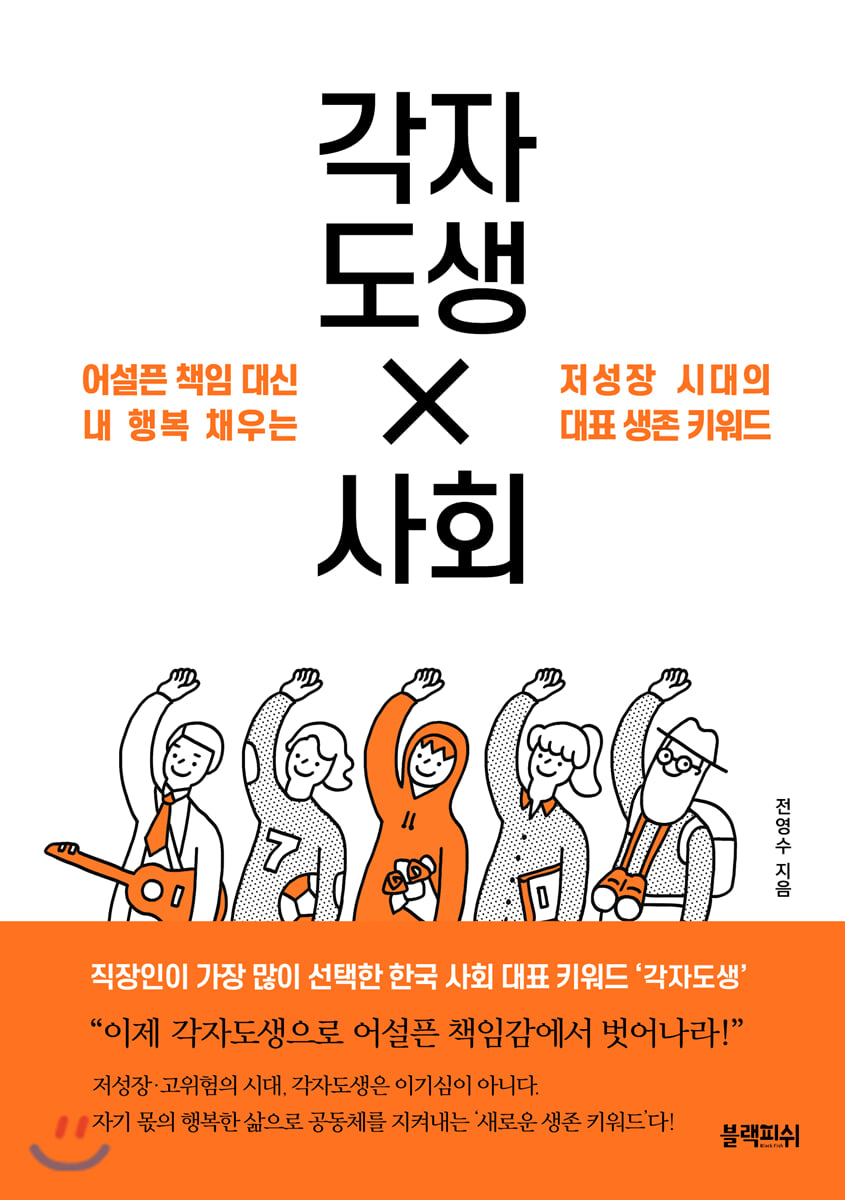
Each for himself society
 |
Description
Book Introduction
- A word from MD
-
How to Survive in a Low-Growth, High-Risk EraThe days when graduating from school, getting a job, getting married, and having children were the norm are coming to an end.
In this era of low growth and high risk, neither the state nor the family can protect individuals.
A crisis is also an opportunity.
Now is the time to find a way to be truly happy as an individual.
April 3, 2020. Social and Political PD Son Min-gyu
"Everyone for themselves" is the key word in this low-growth, high-risk era.
“Now, let’s each live for ourselves and break free from the awkward sense of responsibility!”
The essential sociology of survival in this age: protecting the community through the happiness of individuals.
In Korea's low-growth society, where retirement is earlier and life expectancy longer, a new wind of "everyone for themselves" is blowing! Socio-economist Jeon Young-soo's new book, "Each for Oneself Society," offers a uniquely positive perspective on the philosophy of each-for-one, previously considered a selfish way of life, and suggests an alternative way of life that fits this philosophy.
Author Jeon Young-soo, who has keenly diagnosed the crisis of Korean society through books such as “Korea is Disappearing” and “Poverty Report of a Retired Nation,” interpreting social changes through demographic and generational analysis, puts forward “Each person for himself” as the survival keyword that is absolutely necessary for South Korea today.
In a low-growth, high-risk Korean society where people are becoming increasingly poor despite working hard, the only way to escape the trap of welfare collapse and social costs is for each person to survive on their own.
In this book, the author argues that we should protect the community by living our own happy lives instead of feeling a flimsy sense of responsibility toward others, and presents a realistic vision of the future direction that Korean society, where individual lives are trapped in the flimsy shackles of "us," should take.
From young people who are breaking all the molds of the older generation from dating to marriage and childbirth, to middle-aged people who have declared graduation from parenting and started a second life, to the elderly who are different from the bone and refuse to be a burden to their children, the author says that it is time to discard outdated systems that keep pace with the times and establish new systems that will make society sustainable.
This book will serve as the first forum for that discussion.
“Now, let’s each live for ourselves and break free from the awkward sense of responsibility!”
The essential sociology of survival in this age: protecting the community through the happiness of individuals.
In Korea's low-growth society, where retirement is earlier and life expectancy longer, a new wind of "everyone for themselves" is blowing! Socio-economist Jeon Young-soo's new book, "Each for Oneself Society," offers a uniquely positive perspective on the philosophy of each-for-one, previously considered a selfish way of life, and suggests an alternative way of life that fits this philosophy.
Author Jeon Young-soo, who has keenly diagnosed the crisis of Korean society through books such as “Korea is Disappearing” and “Poverty Report of a Retired Nation,” interpreting social changes through demographic and generational analysis, puts forward “Each person for himself” as the survival keyword that is absolutely necessary for South Korea today.
In a low-growth, high-risk Korean society where people are becoming increasingly poor despite working hard, the only way to escape the trap of welfare collapse and social costs is for each person to survive on their own.
In this book, the author argues that we should protect the community by living our own happy lives instead of feeling a flimsy sense of responsibility toward others, and presents a realistic vision of the future direction that Korean society, where individual lives are trapped in the flimsy shackles of "us," should take.
From young people who are breaking all the molds of the older generation from dating to marriage and childbirth, to middle-aged people who have declared graduation from parenting and started a second life, to the elderly who are different from the bone and refuse to be a burden to their children, the author says that it is time to discard outdated systems that keep pace with the times and establish new systems that will make society sustainable.
This book will serve as the first forum for that discussion.
- You can preview some of the book's contents.
Preview
index
Prologue: Why has "everyone for himself" become the survival keyword in the low-growth era?
Part 1.
A society where one person's crisis becomes a crisis for all
A modern family on thin ice
The disintegration of the normal family: is it a breakdown or an evolution?
The message between 'working moms' and 'cooking dads'
A showdown between the lonely and the annoying family.
Part 2.
Individuals, regardless of generation, who want to escape from heavy responsibilities
Young man, you have neither the ability nor the will to buy a house!
Parents? Filial piety? "Oh, I don't know. I don't know."
The Dilemma of Family vs. Freedom: A Middle-Aged Choice
A new middle-aged challenge: What to do with my parents and siblings?
Parasite or Kangaroo? Family Refugee Escape
Part 3.
The emergence of a society where everyone takes responsibility for their own survival.
Marriage can never be the answer
What's wrong with living together?
Between Dreams and Reality: The Changing Future of Middle Age
Middle-aged singles: How they live
Now parenting is over!
It's never too late to start a new relationship.
A New Equation for Aging in the 100-Year Life Era
Part 4.
People who protect the community through individual happiness
Each family under one roof: The meaning of a share house
A company, colleagues can never be family!
The unfamiliar reality raised by the movie [A Family]
A new family experiment for middle-aged adults who have become more confident after divorce.
The Transformed Family Created by 'Together Yet Apart'
The last place I will live is decided in advance by my own hands.
Epilogue: Freeing Yourself from the Flimsy Sense of Responsibility and Fulfilling Personal Happiness
Part 1.
A society where one person's crisis becomes a crisis for all
A modern family on thin ice
The disintegration of the normal family: is it a breakdown or an evolution?
The message between 'working moms' and 'cooking dads'
A showdown between the lonely and the annoying family.
Part 2.
Individuals, regardless of generation, who want to escape from heavy responsibilities
Young man, you have neither the ability nor the will to buy a house!
Parents? Filial piety? "Oh, I don't know. I don't know."
The Dilemma of Family vs. Freedom: A Middle-Aged Choice
A new middle-aged challenge: What to do with my parents and siblings?
Parasite or Kangaroo? Family Refugee Escape
Part 3.
The emergence of a society where everyone takes responsibility for their own survival.
Marriage can never be the answer
What's wrong with living together?
Between Dreams and Reality: The Changing Future of Middle Age
Middle-aged singles: How they live
Now parenting is over!
It's never too late to start a new relationship.
A New Equation for Aging in the 100-Year Life Era
Part 4.
People who protect the community through individual happiness
Each family under one roof: The meaning of a share house
A company, colleagues can never be family!
The unfamiliar reality raised by the movie [A Family]
A new family experiment for middle-aged adults who have become more confident after divorce.
The Transformed Family Created by 'Together Yet Apart'
The last place I will live is decided in advance by my own hands.
Epilogue: Freeing Yourself from the Flimsy Sense of Responsibility and Fulfilling Personal Happiness
Detailed image

Into the book
The underlying factor driving the survival strategy of each for themselves is low growth.
For single young people, forming a family was originally a 'high-risk, high-reward' choice.
This is because in Korea's unique seniority-based wage system, the income of the younger generation hits rock bottom, while those in their 40s and older are compensated based on 'performance < salary'.
Even though I had nothing, I was sure that my salary would increase, so there was a certain rationality to the somewhat risky choice of having a family to support.
But no more.
Low growth has become entrenched, with even the potential growth rate hovering around 2%.
There is now less reason to take the risk of creating a family that will support future income.
It's hard enough being alone, so marriage and childbirth are out of the question.
Even existing families have no choice but to restructure their family functions in the face of low growth.
Settling into a dual-income household requires an equal order among individual members, not a fatherly or motherly one.
As traditional roles break down, family members find their own ways to be happy.
Gender roles and even age stereotypes crumble in the face of each person's struggle.
The standards of the past that were applied to ‘men, women, old, young’ no longer apply.
For example, young people reject love, middle-aged people reject sacrifice, and old people reject retirement.
---From the "Prologue"
The four-person family model was emphasized and expanded as the 'normal family ideology'.
The typical nuclear family with two children, where the father goes to work and the mother does the housework, was considered normal.
But the situation changed as the dark clouds of low growth rolled in.
It has become difficult for a standard family to even secure survival with just one income.
The housewife lost her ground.
The honor and value of being a mother and a housewife have fallen to the ground, like the reality of 'unpaid housework' where the honor and value of being a mother and a housewife is ignored.
This is the background to the emergence of working mothers.
On the other hand, low growth also put the brakes on my father's commute to work.
Constant restructuring forces middle-aged and older workers into irregular jobs on the periphery.
The pressure to retire is growing, and most people are left with the uncertainty of how long they will survive.
The normal family is now beginning to shake.
Traditional family roles are being discarded.
The end of the family economics realized through 'fatherhood' has accelerated the destruction of the normal family.
---From "Messages from 'Working Mom vs. Cooking Dad'"
Even if they are of similar middle age, middle age is differentiated depending on whether they have a family and the distance they live with that family.
The representative group of middle-aged people to keep an eye on at this time is the single group.
The number of middle-aged men and women living alone, which was once a very small number, has rapidly increased.
This is the result of the expansion of late marriage in people in their 30s into non-marriage in people in their 40s.
It's not that I've given up on marriage, but the barriers are getting higher and higher, so I'm left as a middle-aged single.
It's not that I decided to remain single for any special reason, but rather that social circumstances delayed my marriage.
While not mainstream, middle-aged singles are now readily available anytime, anywhere. TV shows that observe the daily lives of middle-aged singles in their 40s and 50s have long been a fixture. SBS's "My Little Old Boy" and "Burning Youth" have been airing for a long time and are among the most popular shows in their time slot.
With similar concepts emerging, the single life of middle-aged people in their forties, which would have been hidden in the past, is now a hot topic.
This means that middle-aged singles are starting to be accepted as a life model.
However, these middle-aged people have been marginalized in the consumer market.
This is because, despite being in the highest income bracket throughout life, middle-aged people's consumption behavior is focused solely on 'consumption for the family.'
But things will be different in the future.
As the size of the middle-aged group in the overall population grows, middle-aged people will emerge as a key player in production and consumption.
Middle-aged singles make spending decisions at a significantly different level than middle-aged people with families.
Instead of having a family, they are proactive in their own lives, aim to be glamorous singles even as they age, and prepare for the future early on as they will have to live alone for a long time.
Ultimately, the market has no choice but to focus on middle-aged singles.
Because they have a lot of money, they spend it well, and they are the main players who will lead consumption for a long time.
---From "Middle-aged Singles: How They Live"
Shared housing, where people share space, solves the dilemma of modern youth.
Because it is located at the point of compromise between a difficult family and unfamiliar strangers.
Rather than completely giving up the family function through marriage, one can expect appropriate utility by becoming part of another person's family.
It is especially suitable as an alternative family to a family because it is free and easy to disassemble and reassemble at any time.
The outlook for share houses is bright, as one-person households have become a major trend of the times.
In 2019, there were 5.99 million single-person households, and potential demand is also overflowing.
The number of share houses increased from 17 in 2013 to 1,020 in the first half of 2018.
While the traditional model of a blood-related family living under one roof is beginning to come to an end, the under-one-roof family is being absorbed as an alternative to each person living on their own.
A share house is a living community with others that is based on the premise of 'coming together'.
Nevertheless, it is essential to have some family functions.
In the past, it was focused on sharing space, but now it aims to share life as well.
It is developing into a form that deepens the usefulness of the family through ‘sharing → exchange.’
It appropriately fills the gap for young people who want a family but find it difficult to have one.
Young people are hesitant to get married, but their desire to be independent remains the same.
However, while in the past people lived with their parents and naturally created their own independent space after marriage, now there are many cases of people living independently but with a mate rather than a partner.
Living with a mate allows for bonding while saving money, which fits the growing demand for independence among millennials and Gen Z.
They are completing the share house by keeping a distance that allows them to feel warmth but does not interfere.
Set the relationship to 'more than friends, less than family'.
We pursue a lifestyle that is economically and emotionally connected, yet not tied down.
For single young people, forming a family was originally a 'high-risk, high-reward' choice.
This is because in Korea's unique seniority-based wage system, the income of the younger generation hits rock bottom, while those in their 40s and older are compensated based on 'performance < salary'.
Even though I had nothing, I was sure that my salary would increase, so there was a certain rationality to the somewhat risky choice of having a family to support.
But no more.
Low growth has become entrenched, with even the potential growth rate hovering around 2%.
There is now less reason to take the risk of creating a family that will support future income.
It's hard enough being alone, so marriage and childbirth are out of the question.
Even existing families have no choice but to restructure their family functions in the face of low growth.
Settling into a dual-income household requires an equal order among individual members, not a fatherly or motherly one.
As traditional roles break down, family members find their own ways to be happy.
Gender roles and even age stereotypes crumble in the face of each person's struggle.
The standards of the past that were applied to ‘men, women, old, young’ no longer apply.
For example, young people reject love, middle-aged people reject sacrifice, and old people reject retirement.
---From the "Prologue"
The four-person family model was emphasized and expanded as the 'normal family ideology'.
The typical nuclear family with two children, where the father goes to work and the mother does the housework, was considered normal.
But the situation changed as the dark clouds of low growth rolled in.
It has become difficult for a standard family to even secure survival with just one income.
The housewife lost her ground.
The honor and value of being a mother and a housewife have fallen to the ground, like the reality of 'unpaid housework' where the honor and value of being a mother and a housewife is ignored.
This is the background to the emergence of working mothers.
On the other hand, low growth also put the brakes on my father's commute to work.
Constant restructuring forces middle-aged and older workers into irregular jobs on the periphery.
The pressure to retire is growing, and most people are left with the uncertainty of how long they will survive.
The normal family is now beginning to shake.
Traditional family roles are being discarded.
The end of the family economics realized through 'fatherhood' has accelerated the destruction of the normal family.
---From "Messages from 'Working Mom vs. Cooking Dad'"
Even if they are of similar middle age, middle age is differentiated depending on whether they have a family and the distance they live with that family.
The representative group of middle-aged people to keep an eye on at this time is the single group.
The number of middle-aged men and women living alone, which was once a very small number, has rapidly increased.
This is the result of the expansion of late marriage in people in their 30s into non-marriage in people in their 40s.
It's not that I've given up on marriage, but the barriers are getting higher and higher, so I'm left as a middle-aged single.
It's not that I decided to remain single for any special reason, but rather that social circumstances delayed my marriage.
While not mainstream, middle-aged singles are now readily available anytime, anywhere. TV shows that observe the daily lives of middle-aged singles in their 40s and 50s have long been a fixture. SBS's "My Little Old Boy" and "Burning Youth" have been airing for a long time and are among the most popular shows in their time slot.
With similar concepts emerging, the single life of middle-aged people in their forties, which would have been hidden in the past, is now a hot topic.
This means that middle-aged singles are starting to be accepted as a life model.
However, these middle-aged people have been marginalized in the consumer market.
This is because, despite being in the highest income bracket throughout life, middle-aged people's consumption behavior is focused solely on 'consumption for the family.'
But things will be different in the future.
As the size of the middle-aged group in the overall population grows, middle-aged people will emerge as a key player in production and consumption.
Middle-aged singles make spending decisions at a significantly different level than middle-aged people with families.
Instead of having a family, they are proactive in their own lives, aim to be glamorous singles even as they age, and prepare for the future early on as they will have to live alone for a long time.
Ultimately, the market has no choice but to focus on middle-aged singles.
Because they have a lot of money, they spend it well, and they are the main players who will lead consumption for a long time.
---From "Middle-aged Singles: How They Live"
Shared housing, where people share space, solves the dilemma of modern youth.
Because it is located at the point of compromise between a difficult family and unfamiliar strangers.
Rather than completely giving up the family function through marriage, one can expect appropriate utility by becoming part of another person's family.
It is especially suitable as an alternative family to a family because it is free and easy to disassemble and reassemble at any time.
The outlook for share houses is bright, as one-person households have become a major trend of the times.
In 2019, there were 5.99 million single-person households, and potential demand is also overflowing.
The number of share houses increased from 17 in 2013 to 1,020 in the first half of 2018.
While the traditional model of a blood-related family living under one roof is beginning to come to an end, the under-one-roof family is being absorbed as an alternative to each person living on their own.
A share house is a living community with others that is based on the premise of 'coming together'.
Nevertheless, it is essential to have some family functions.
In the past, it was focused on sharing space, but now it aims to share life as well.
It is developing into a form that deepens the usefulness of the family through ‘sharing → exchange.’
It appropriately fills the gap for young people who want a family but find it difficult to have one.
Young people are hesitant to get married, but their desire to be independent remains the same.
However, while in the past people lived with their parents and naturally created their own independent space after marriage, now there are many cases of people living independently but with a mate rather than a partner.
Living with a mate allows for bonding while saving money, which fits the growing demand for independence among millennials and Gen Z.
They are completing the share house by keeping a distance that allows them to feel warmth but does not interfere.
Set the relationship to 'more than friends, less than family'.
We pursue a lifestyle that is economically and emotionally connected, yet not tied down.
---From "The Meaning of Share Houses: Each Family Under One Roof"
Publisher's Review
Raising and supporting children... the responsibility is heavy!
In an era of low growth, where retirement is earlier and life expectancy is longer,
“Each person for himself is an irresistible trend!”
“In the future, more and more Koreans will take the path of self-sufficiency, taking responsibility for their own retirement.”
_ Nobel Prize winner in economics Robert Merton, MIT professor
In Korean society, where the potential growth rate is only 2%, and where everyday life is fraught with uncertainty due to the employment cliff and restructuring, let alone the ability to draw on future income, each person has now become a reasonable outcome of social change.
It is not a selfish choice to live only for oneself, but a natural and inevitable flow.
For example, today's youth are the first generation to be poorer than their parents, and they have no will or ability to buy a home.
Because they find it difficult to maintain their own health, they are reluctant to form deep relationships with others, and give up on marriage and childbirth, which come with responsibilities.
It's better to be 'lonely alone' than 'annoying family', and I agree with my parents, "I'll live my own life, so you take care of my life after retirement."
What about middle age?
Middle-aged people today, burdened with the burden of supporting their parents, raising their children, and even having siblings, are practically in a sandwich situation.
If things continue like this, it's no different from giving up on this life.
Old age does not mean that the burden of support is reduced.
Young children who were kangaroos cannot leave their elderly parents' side even when they reach middle age and become 'parasitic children'.
Middle-aged and elderly people who want to escape the sacrificial life of living by straws all their lives are changing their perception to, "I don't know, I'll start by living well."
Given the circumstances, ‘everyone for themselves’ has now become a natural way of life.
From youth to middle age to old age, every generation builds a line of defense from the beginning to protect their lives.
Young people reject love and filial piety, middle-aged people reject sacrifice, and old people reject retirement.
We believe that the selflessness that protects the community is achieved when everyone, regardless of age or gender, lives well. To avoid unnecessary conflict, we constantly experiment with various lifestyles and seek alternatives.
In South Korea today, everything is changing, from individual lives to family structures and social structures.
An era where even if you work hard, you become poorer.
Each for himself is not selfishness, it is the 'new survival keyword'!
Social economist Jeon Young-soo's new book, "Each for himself," is a book that offers a uniquely positive perspective on the philosophy of each for himself, which has been considered a selfish way of life, and suggests an alternative way of life that fits this philosophy.
Author Jeon Young-soo, who has keenly diagnosed the crisis of Korean society through books such as “Korea is Disappearing” and “Poverty Report of a Retired Nation,” interpreting social changes through demographic and generational analysis, puts forward “Each person for himself” as the survival keyword that is absolutely necessary for South Korea today.
In a low-growth, high-risk Korean society where people are becoming increasingly poor despite working hard, the only way to escape the trap of welfare collapse and social costs is for each person to survive on their own.
In this book, the author argues that we should protect the community by living our own happy lives instead of feeling a shallow sense of responsibility toward others. He also presents a realistic vision of the future direction that Korean society, where individual lives are trapped in the shallow responsibility and shackles of "us," should take.
From young people who are breaking all the molds of the older generation, from dating to marriage and childbirth, to middle-aged people who have graduated from parenting and are starting a second life, to the new elderly who are different from the inside out and refuse to be a burden to their children, this book will allow you to meet the generation of each person living their own life, who are drawing a new society in a rapidly changing society.
An active life experiment by modern people seeking to find themselves!
A society where everyone lives for themselves and takes responsibility for their own lives
"Each for Himself Society" is a book that honestly analyzes the daily lives of modern people who actively put their lives on the test bench, with an unbiased perspective, and is composed of four parts.
Part 1.
In “A Society Where One Person’s Crisis Becomes a Crisis for All,” the book deals with the decline of family utility against the backdrop of low growth, the collapse of the traditional roles of “motherhood” and “fatherhood,” and the collapse of modern families on thin ice.
Meanwhile, it also sounds an alarm in the rigid and violent Korean society that has implied that families that deviate from the ideology of the "normal family" are incomplete, and delivers the message that there is no normal or abnormality in the family and that family disintegration is a natural survival instinct that comes with the changing times.
Part 2.
In "Individuals Who Want to Free themselves from Heavy Responsibilities, Regardless of Generation," the reality of young, middle-aged, and elderly people who cannot easily let go of the burden of family is addressed.
Based on the situation of Koreans who are entering an aging society and are increasingly becoming poor despite their hard work, this book explains the background to why each person has no choice but to seek their own way to survive.
Part 3.
The emergence of a ‘society of individual responsibility’ where each person lives for himself” and “Part 4.
In "People Who Protect the Community with Individual Happiness," the book introduces various experiments of modern people who are trying to live fully in their own share, from extended family structures such as share houses where people can easily gather together at any time and living separately but nearby, to middle-aged singles who are leading the consumer market and eighty-something youths who are out to find a new self.
The message the author is trying to convey in this book is not that difficult.
This is because we must accept and acknowledge the current trend of 'each for himself', and only by facing reality squarely rather than denying it can we come up with new solutions to respond to the crisis.
In Korean society, where the environment is rapidly changing and people are also evolving, the author says, “It is problematic if the system remains the same as before.”
Now is the time to abolish outdated systems that have lost their utility and establish new ones from scratch that will make society sustainable.
This book will serve as the first forum for that discussion.
In an era of low growth, where retirement is earlier and life expectancy is longer,
“Each person for himself is an irresistible trend!”
“In the future, more and more Koreans will take the path of self-sufficiency, taking responsibility for their own retirement.”
_ Nobel Prize winner in economics Robert Merton, MIT professor
In Korean society, where the potential growth rate is only 2%, and where everyday life is fraught with uncertainty due to the employment cliff and restructuring, let alone the ability to draw on future income, each person has now become a reasonable outcome of social change.
It is not a selfish choice to live only for oneself, but a natural and inevitable flow.
For example, today's youth are the first generation to be poorer than their parents, and they have no will or ability to buy a home.
Because they find it difficult to maintain their own health, they are reluctant to form deep relationships with others, and give up on marriage and childbirth, which come with responsibilities.
It's better to be 'lonely alone' than 'annoying family', and I agree with my parents, "I'll live my own life, so you take care of my life after retirement."
What about middle age?
Middle-aged people today, burdened with the burden of supporting their parents, raising their children, and even having siblings, are practically in a sandwich situation.
If things continue like this, it's no different from giving up on this life.
Old age does not mean that the burden of support is reduced.
Young children who were kangaroos cannot leave their elderly parents' side even when they reach middle age and become 'parasitic children'.
Middle-aged and elderly people who want to escape the sacrificial life of living by straws all their lives are changing their perception to, "I don't know, I'll start by living well."
Given the circumstances, ‘everyone for themselves’ has now become a natural way of life.
From youth to middle age to old age, every generation builds a line of defense from the beginning to protect their lives.
Young people reject love and filial piety, middle-aged people reject sacrifice, and old people reject retirement.
We believe that the selflessness that protects the community is achieved when everyone, regardless of age or gender, lives well. To avoid unnecessary conflict, we constantly experiment with various lifestyles and seek alternatives.
In South Korea today, everything is changing, from individual lives to family structures and social structures.
An era where even if you work hard, you become poorer.
Each for himself is not selfishness, it is the 'new survival keyword'!
Social economist Jeon Young-soo's new book, "Each for himself," is a book that offers a uniquely positive perspective on the philosophy of each for himself, which has been considered a selfish way of life, and suggests an alternative way of life that fits this philosophy.
Author Jeon Young-soo, who has keenly diagnosed the crisis of Korean society through books such as “Korea is Disappearing” and “Poverty Report of a Retired Nation,” interpreting social changes through demographic and generational analysis, puts forward “Each person for himself” as the survival keyword that is absolutely necessary for South Korea today.
In a low-growth, high-risk Korean society where people are becoming increasingly poor despite working hard, the only way to escape the trap of welfare collapse and social costs is for each person to survive on their own.
In this book, the author argues that we should protect the community by living our own happy lives instead of feeling a shallow sense of responsibility toward others. He also presents a realistic vision of the future direction that Korean society, where individual lives are trapped in the shallow responsibility and shackles of "us," should take.
From young people who are breaking all the molds of the older generation, from dating to marriage and childbirth, to middle-aged people who have graduated from parenting and are starting a second life, to the new elderly who are different from the inside out and refuse to be a burden to their children, this book will allow you to meet the generation of each person living their own life, who are drawing a new society in a rapidly changing society.
An active life experiment by modern people seeking to find themselves!
A society where everyone lives for themselves and takes responsibility for their own lives
"Each for Himself Society" is a book that honestly analyzes the daily lives of modern people who actively put their lives on the test bench, with an unbiased perspective, and is composed of four parts.
Part 1.
In “A Society Where One Person’s Crisis Becomes a Crisis for All,” the book deals with the decline of family utility against the backdrop of low growth, the collapse of the traditional roles of “motherhood” and “fatherhood,” and the collapse of modern families on thin ice.
Meanwhile, it also sounds an alarm in the rigid and violent Korean society that has implied that families that deviate from the ideology of the "normal family" are incomplete, and delivers the message that there is no normal or abnormality in the family and that family disintegration is a natural survival instinct that comes with the changing times.
Part 2.
In "Individuals Who Want to Free themselves from Heavy Responsibilities, Regardless of Generation," the reality of young, middle-aged, and elderly people who cannot easily let go of the burden of family is addressed.
Based on the situation of Koreans who are entering an aging society and are increasingly becoming poor despite their hard work, this book explains the background to why each person has no choice but to seek their own way to survive.
Part 3.
The emergence of a ‘society of individual responsibility’ where each person lives for himself” and “Part 4.
In "People Who Protect the Community with Individual Happiness," the book introduces various experiments of modern people who are trying to live fully in their own share, from extended family structures such as share houses where people can easily gather together at any time and living separately but nearby, to middle-aged singles who are leading the consumer market and eighty-something youths who are out to find a new self.
The message the author is trying to convey in this book is not that difficult.
This is because we must accept and acknowledge the current trend of 'each for himself', and only by facing reality squarely rather than denying it can we come up with new solutions to respond to the crisis.
In Korean society, where the environment is rapidly changing and people are also evolving, the author says, “It is problematic if the system remains the same as before.”
Now is the time to abolish outdated systems that have lost their utility and establish new ones from scratch that will make society sustainable.
This book will serve as the first forum for that discussion.
GOODS SPECIFICS
- Publication date: March 25, 2020
- Page count, weight, size: 232 pages | 334g | 148*210*20mm
- ISBN13: 9788968332531
- ISBN10: 8968332533
You may also like
카테고리
korean


korean

![GQ KOREA Mark (Monthly): December [2025]](http://librairie.coreenne.fr/cdn/shop/files/8ef265dbbfbf186523ed75ba7319009d.jpg?v=1765340328&width=3840)


