

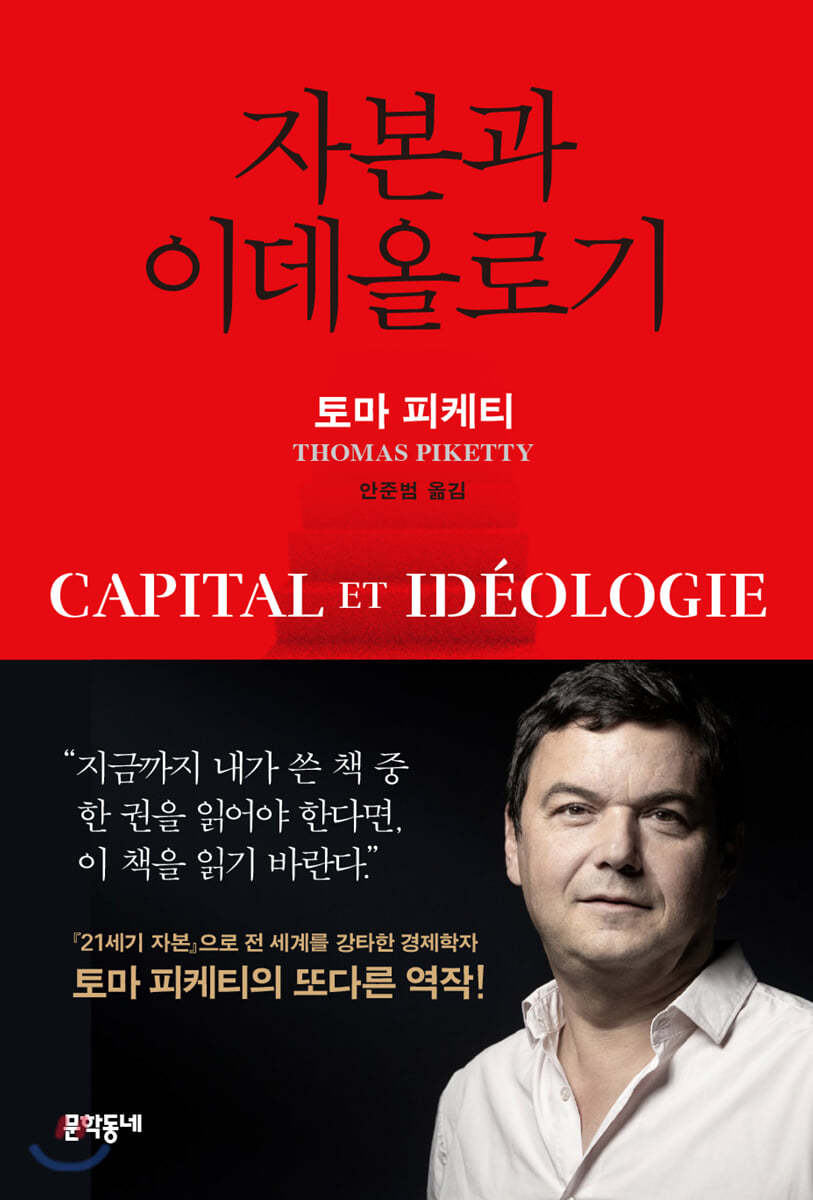
Capital and Ideology
 |
Description
Book Introduction
Thomas Piketty, the most influential economist of our time, is sending a message. An urgent and bold proposal to overcome the global economic crisis and deepening inequality! A history of world politics, economy, society, and ideology explored through the prism of inequality. And a persistent and extensive body of writing on ways to overcome current inequalities. The Korean edition of 『Capital and Ideology』, the much-talked-about new work by Thomas Piketty, who rose to stardom as a world-renowned economist with 『Capital in the Twenty-First Century』 (2013), has been published by Munhakdongne. It is based on the French original, and the total length is 1,300 pages, which is about 500 pages longer than Capital in the 21st Century. "Capital and Ideology" traces the roots of the deepening inequality facing the world in the 21st century through countless political, social, and economic historical materials and statistical data, and concludes by presenting alternatives for a more just future society. It is also an excellent social science analysis book that allows one to read the current trends of contemporary global politics and economy at a glance. Economist Lee Jeong-woo said in the introduction, “The thought that comes to mind as I read and close this book is the power of the literary world. “This book provides readers with historical insights that are usually hard to find in professional and technical writings by economists,” he said. This book, which describes with remarkable detail the political-ideological conflicts within a society or between nations, their impact on the (global) economy, and conversely, the power of the economy to influence the political-ideological structure of society, explores in each chapter the various trajectories and potential branches along which the system and history we currently belong to could evolve toward greater equality. This extensive description of the political and economic crisis in the European Union, the American nativism symbolized by Trump, the hyper-centralized oligarchy of Russia and China and their collusion with capitalism, the possibility of India and Brazil evolving into better democratic societies, and the political and economic chaos of Eastern European countries after the fall of communism demonstrates the maximum capacity and scale of social science, dynamically moving between the past and the future from the present perspective. |
- You can preview some of the book's contents.
Preview
index
Before we begin: Notes and Acknowledgments
introduction
Part 1: Inequalitarian Regimes in History
Chapter 1: The Trifunctional Society: Trifunctional Inequality
Chapter 2: European Status Societies: Power and Property
Chapter 3: The Creation of a Society of Owners
Chapter 4: Ownership Society: The Case of France
Chapter 5: Ownership Society: The European Trajectory
Part 2: Slave Society and Colonial Society
Chapter 6: Slavery Society: Extreme Inequality
Chapter 7 Colonial Societies: Diversity and Domination
Chapter 8: Tripartite Society and Colonialism: The Case of India
Chapter 9: Tripartite Society and Colonialism: Eurasian Orbits
Part 3: The Great Transformation of the 20th Century
Chapter 10: The Crisis of the Ownership Society
Chapter 11 Social Democratic Societies: Incomplete Equality
Chapter 12 Communist and Post-Communist Societies
Chapter 13 Hypercapitalism: Between Modernity and Antiquity
Part 4: Rethinking the Dimensions of Political Conflict
Chapter 14: Boundaries and Property: Building Equality
Chapter 15: The Brahmin Left: The New Crack in America and Europe
Chapter 16: Social Indigenism: The Trap of Postcolonial Identitarianism
Chapter 17: Elements for 21st Century Participatory Socialism
conclusion
main
Charts and Tables
Detailed Table of Contents
introduction
Part 1: Inequalitarian Regimes in History
Chapter 1: The Trifunctional Society: Trifunctional Inequality
Chapter 2: European Status Societies: Power and Property
Chapter 3: The Creation of a Society of Owners
Chapter 4: Ownership Society: The Case of France
Chapter 5: Ownership Society: The European Trajectory
Part 2: Slave Society and Colonial Society
Chapter 6: Slavery Society: Extreme Inequality
Chapter 7 Colonial Societies: Diversity and Domination
Chapter 8: Tripartite Society and Colonialism: The Case of India
Chapter 9: Tripartite Society and Colonialism: Eurasian Orbits
Part 3: The Great Transformation of the 20th Century
Chapter 10: The Crisis of the Ownership Society
Chapter 11 Social Democratic Societies: Incomplete Equality
Chapter 12 Communist and Post-Communist Societies
Chapter 13 Hypercapitalism: Between Modernity and Antiquity
Part 4: Rethinking the Dimensions of Political Conflict
Chapter 14: Boundaries and Property: Building Equality
Chapter 15: The Brahmin Left: The New Crack in America and Europe
Chapter 16: Social Indigenism: The Trap of Postcolonial Identitarianism
Chapter 17: Elements for 21st Century Participatory Socialism
conclusion
main
Charts and Tables
Detailed Table of Contents
Into the book
The characteristics of the inequality system defined in this study are a set of discourses and institutional devices through which economic inequality, social inequality, and political inequality in the society are justified and structured.
Any system has its own weaknesses, and it can only survive by continually redefining itself—sometimes through conflict and violence—and by basing itself on shared experiences and perceptions.
The subject of this book is the history and future of the inequality system.
By gathering historical data on societies that are very distant from each other, often ignorant of each other, and resistant to comparison, I hope to contribute to a better understanding of the ongoing transformations from a global and transnational perspective.
--- p.13~14
We will see that the problems of the political system and the problems of the ownership system have been inextricably linked and have in fact been constantly linked.
From the traditional triune society and slave society to modern post-colonial and hypercapitalist societies.
In between, there are the owner-centered society and the communist and social democratic societies that emerged as a reaction to the inequality and identity crisis that the owner-centered society brought about.
This is precisely why I propose to analyze these historical transitions through the concept of an 'inequality system'.
This concept encompasses the concepts of political system and ownership system (or even the concepts of education system and taxation system), and allows us to better perceive the consistency of these systems.
--- p.18
In this study, I define propertyism as a political ideology whose core project is the absolute protection of private property (a universal right that is, in principle, considered separate from traditional status inequalities).
--- p.188
According to all the historical data available to us today, these three forms of overcoming private property are complementary.
In other words, capitalism can be overcome realistically and sustainably only through a mix of public ownership, social ownership, and temporary ownership.
--- p.551
The problem with the proportional carbon tax is that it is too unfair both domestically and internationally.
In fact, many low- and middle-income households, especially those without public transportation or living in isolated areas, are forced to spend a larger portion of their income on transportation and heating compared to wealthier households.
The best solution is to tax carbon emissions at a higher rate.
--- p.729
The neo-proprietorship ideology of the early 21st century rests on grand narratives and robust institutions, including a system of free capital movement without regulation, information sharing, or common taxation, a rejection of the "Pandora's box" of property redistribution, and the failure of communism.
However, it is also necessary to particularly emphasize the various weaknesses of this political-ideological system.
These weaknesses are also the driving force for change and overcoming.
Financial opacity and rising inequality make tackling climate challenges significantly more challenging and, more generally, lead to social discontent.
Unless we allow the growing identitarian tensions to intensify, the solution to that social discontent lies in greater transparency and greater redistribution.
Like all inequalitarian systems, this one is unstable and constantly evolving.
--- p.766~767
The political force that formed the workers' party after the war gradually became a party of highly educated people in the late 20th century and early 21st century.
The most natural explanation is that less educated voters—who increasingly shifted their attention and priorities to the winners of the education system and, to some extent, to the winners of globalization—felt abandoned by these parties.
This political-ideological shift is crucial to our study.
--- p.1059
Since the mid-20th century, the political system of Western societies has often been considered to have reached a kind of unsurpassable perfection under the form of parliamentary electoral democracy.
In fact, this model may be remarkably perfect, but it is still increasingly controversial.
The most obvious of these limitations is our inability to address the current rise in inequality.
--- p.1067
Based on the experiences analyzed in this book, I am convinced that it is possible to establish a just society based on participatory socialism and social federalism, beyond capitalism and private ownership.
Any system has its own weaknesses, and it can only survive by continually redefining itself—sometimes through conflict and violence—and by basing itself on shared experiences and perceptions.
The subject of this book is the history and future of the inequality system.
By gathering historical data on societies that are very distant from each other, often ignorant of each other, and resistant to comparison, I hope to contribute to a better understanding of the ongoing transformations from a global and transnational perspective.
--- p.13~14
We will see that the problems of the political system and the problems of the ownership system have been inextricably linked and have in fact been constantly linked.
From the traditional triune society and slave society to modern post-colonial and hypercapitalist societies.
In between, there are the owner-centered society and the communist and social democratic societies that emerged as a reaction to the inequality and identity crisis that the owner-centered society brought about.
This is precisely why I propose to analyze these historical transitions through the concept of an 'inequality system'.
This concept encompasses the concepts of political system and ownership system (or even the concepts of education system and taxation system), and allows us to better perceive the consistency of these systems.
--- p.18
In this study, I define propertyism as a political ideology whose core project is the absolute protection of private property (a universal right that is, in principle, considered separate from traditional status inequalities).
--- p.188
According to all the historical data available to us today, these three forms of overcoming private property are complementary.
In other words, capitalism can be overcome realistically and sustainably only through a mix of public ownership, social ownership, and temporary ownership.
--- p.551
The problem with the proportional carbon tax is that it is too unfair both domestically and internationally.
In fact, many low- and middle-income households, especially those without public transportation or living in isolated areas, are forced to spend a larger portion of their income on transportation and heating compared to wealthier households.
The best solution is to tax carbon emissions at a higher rate.
--- p.729
The neo-proprietorship ideology of the early 21st century rests on grand narratives and robust institutions, including a system of free capital movement without regulation, information sharing, or common taxation, a rejection of the "Pandora's box" of property redistribution, and the failure of communism.
However, it is also necessary to particularly emphasize the various weaknesses of this political-ideological system.
These weaknesses are also the driving force for change and overcoming.
Financial opacity and rising inequality make tackling climate challenges significantly more challenging and, more generally, lead to social discontent.
Unless we allow the growing identitarian tensions to intensify, the solution to that social discontent lies in greater transparency and greater redistribution.
Like all inequalitarian systems, this one is unstable and constantly evolving.
--- p.766~767
The political force that formed the workers' party after the war gradually became a party of highly educated people in the late 20th century and early 21st century.
The most natural explanation is that less educated voters—who increasingly shifted their attention and priorities to the winners of the education system and, to some extent, to the winners of globalization—felt abandoned by these parties.
This political-ideological shift is crucial to our study.
--- p.1059
Since the mid-20th century, the political system of Western societies has often been considered to have reached a kind of unsurpassable perfection under the form of parliamentary electoral democracy.
In fact, this model may be remarkably perfect, but it is still increasingly controversial.
The most obvious of these limitations is our inability to address the current rise in inequality.
--- p.1067
Based on the experiences analyzed in this book, I am convinced that it is possible to establish a just society based on participatory socialism and social federalism, beyond capitalism and private ownership.
--- p.1087
Publisher's Review
Thomas Piketty, the most influential economist of our time, is sending a message.
An urgent and bold proposal to overcome the global economic crisis and deepening inequality!
A history of world politics, economy, society, and ideology explored through the prism of inequality.
And a persistent and extensive writing on ways to overcome current inequalities.
The Korean edition of 『Capital and Ideology』, the much-talked-about new work by Thomas Piketty, who rose to stardom as a world-renowned economist with 『Capital in the Twenty-First Century』 (2013), has been published by Munhakdongne.
It is based on the French original, and the total length is 1,300 pages, which is about 500 pages longer than Capital in the 21st Century.
"Capital and Ideology" traces the roots of the deepening inequality facing the world in the 21st century through countless political, social, and economic historical materials and statistical data, and concludes by presenting alternatives for a more just future society.
It is also an excellent social science analysis book that allows one to read the current trends of contemporary global politics and economy at a glance.
Economist Lee Jeong-woo said in the introduction, “The thought that comes to mind as I read and close this book is the power of the literary world.
“This book provides readers with historical insights that are usually hard to find in professional and technical writings by economists,” he said.
This book, which describes with remarkable detail the political-ideological conflicts within a society or between nations, their impact on the (global) economy, and conversely, the power of the economy to influence the political-ideological structure of society, explores in each chapter the various trajectories and potential branches along which the system and history we currently belong to could evolve toward greater equality.
This extensive description of the political and economic crisis in the European Union, the American nativism symbolized by Trump, the hyper-centralized oligarchy of Russia and China and their collusion with capitalism, the possibility of India and Brazil evolving into better democratic societies, and the political and economic chaos of Eastern European countries after the fall of communism demonstrates the maximum capacity and scale of social science, dynamically moving between the past and the future from the present perspective.
Every society throughout history has justified its own inequalities:
Historical inequality, the New Deal and progressive taxation of the 20th century, and the new ownership of the 21st century
If 『Capital in the 21st Century』 analyzes the economic dynamics of inequality inherent in capitalism, 『Capital and Ideology』 analyzes the political and ideological dynamics that justify or 'naturalize' social inequality.
To this end, Piketty uses historical and statistical data to examine various societies throughout history, focusing on two key concepts: "inequality system" and "ownership ideology." Ultimately, he seeks to demonstrate that the extreme concentration of wealth and inequality in modern times cannot be fixed and unchangeable.
Piketty believes that the inequality of the 21st century, which has increased since the 1980s, has deepened to the point where it can be compared to the inequality of the Belle Époque period (1880-1914), which peaked just before the outbreak of World War I, and that it has reached a point where it is difficult to justify it in the name of the common good.
That is, after the mid-20th century, when the New Deal policy and strong progressive taxes on income and assets alleviated inequality and led to economic prosperity, the ideology of the owner based on the absolute sanctification of private property emerged powerfully again through the 'conservative revolution' symbolized by Reagan and Thatcher.
However, history, although not linear, has progressed towards the advancement of humanity.
Piketty demonstrates, through historical and economic research, that while inequality in a society is sometimes justified and entrenched through the society's politics and ideology, it also serves as a force that transforms society into a different form.
Inequality is ideological and political: the sacralization of private property and the naturalization of inequality.
In his introduction, Piketty writes, “Inequality is neither economic nor technological.
Rather, it is ideological and political.
This is clearly the clear conclusion of the historical research presented in this book” (p. 19).
Piketty, who criticizes that "Capital in the Twenty-First Century" has the limitation of treating the political and ideological evolution surrounding inequality and redistribution as a kind of black box, seeks to address this head-on in "Capital and Ideology."
Therefore, what this book seeks to show is that inequality is not an inevitable consequence of economic logic, but rather has evolved in different forms according to the dominant ideology and political balance of power in society.
Part 1 of the book deals with the origins of social inequality and its justification.
In particular, it describes the process by which the pre-modern tripartite class society consisting of warriors (nobility), priests (intellectuals), and the third estate (workers and peasants) transformed into the owner-occupier society that flourished in 19th-century Western Europe through the rupture of the French Revolution.
Part 2 describes how inequality unfolded within and across societies through the imperial colonialism of European powers, emphasizing that in the end of colonial rule, the thing European countries put the most effort into was not reparations for the colonial slaves, but reparations for European slave owners.
The historical process in which the political system and the ownership system were inextricably linked is what led to the perfection of 'private property' as an inviolable and sacred right.
Brahmin Left and Merchant Right: A Form of Party Politics Driven by the Inheritance of Wealth and Widening Educational Inequality
『Capital and Ideology』 continues to show that, although global inequality reached its historically lowest level in the 20th century with the Bolshevik Revolution, the two World Wars, and the emergence of social democratic societies in Europe, inequality has been increasing explosively again in the 21st century with the Cold War, the rightward shift in the United States and Western Europe since the 1980s, and the collapse of the Soviet Union and communism.
Parts 3 and 4 of the book address the contemporary era, where redistribution is becoming increasingly difficult both within countries and globally due to the globalization and hyper-concentration of financial capital and the opacity symbolized by tax havens.
This analysis, along with the phenomenon of wealth inequality being passed down through generations and becoming more concentrated, the price paid by European social democratic politics for giving up their redistributive ambitions, the oligarchic rule and fiscal opacity of the rulers of former communist countries, and the deepening income inequality due to elite-centered educational inequality, all lead to the disappearance of the class politics that had achieved relative equality in the mid-20th century.
The chapters that prove that the current party politics, in which left-wing parties, once the parties of workers, are transforming into parties of the highly educated (high-income earners), and conservative parties, traditionally the parties of the wealthy, are attracting the poor 50% through social nativism, are a global phenomenon, are the highlight of this book.
The 'Brahmin Left' aims for the accumulation of academic qualifications, knowledge, and human capital.
The 'merchant right' relies above all on the accumulation of monetary and financial capital.
They may have conflicts at certain points.
The 'Brahminical Left' may, for example, prefer higher taxes than the 'Merchant Right' to finance high schools, grandes écoles, and the literary institutions to which they are attached.
But both camps share a strong attachment to the current economic system and to the current pattern of globalization, which is in fact very beneficial to the intellectual elite as much as to the economic and financial elite.
(…) The ‘Brahminical Left’ and the ‘Merchant Right’ in fact embody two forms of ruling legitimacy.
This multi-elite system represents a kind of return to the deep logic of the old trifunctional society based on the division of roles between intellectual elites and warrior elites.
The only difference is that the warrior elite has been replaced by a merchant elite (due to the fact that goods and security are now guaranteed by a centralized state).
The 'Brahmin Left' and the 'Merchant Right' could alternate in power, or they could rule together in a coalition that brings together different elites.
_Main text, pages 831-832
For just ownership and permanent redistribution of wealth: Social federalism and universal capital support
What are the solutions to the inheritance of wealth and hyper-concentration?
The final 17 chapters of Part 4 of this book contain Piketty's answers to these questions and a kind of thought experiment on the realization of the participatory socialism he advocates.
Among the several proposals Piketty proposes, presupposing open discussion, the core ones are ‘social temporary ownership’ and social federalism.
Social temporary ownership is a plan to promote the concept of "private ownership as a social relationship" by integrating all taxes levied on private ownership, such as property tax and land tax, into a progressive ownership tax to prevent individual inheritance of wealth and realize social inheritance.
The progressive property tax is exemplified by the provision of €120,000 (approximately 160 million won) as capital to be paid to young people turning 25, equivalent to 60% of the average wealth of European adults.
The concept of temporary ownership implemented by the progressive property tax is an extension of the form of temporary ownership already included in the progressive inheritance tax and progressive income tax that were tested in the 20th century.
Typically, these institutional arrangements are based on the view that ownership is a social relation and therefore must be regulated.
(…) The accumulation of goods is always the fruit of a social process, which depends on the public system (especially the legal, tax, and educational systems), the social division of labor, and the knowledge accumulated by humanity over centuries.
Under these conditions, if the logic is strictly followed, those who have accumulated enormous assets should return a portion of them to the community every year, thereby making their ownership no longer permanent but temporary.
_Page 1043
In addition to this expansion of ownership, social federalism is presented as a way to bind together the fractures surrounding borders, immigration, ethnicity, religion, etc., and the resulting tragedies, through egalitarian solidarity.
The social federalism proposed by Piketty is based on criticism and reflection on the left wing of the European Social Democratic Party and the American Democratic Party, which fail to develop supranational regulation and intervention of capital and instead favor the academic elite while compromising with the asset elite. It advocates the material interests of the popular class while simultaneously embodying this direction in the form of a supranational federal system.
This could be a strategic response from the left to social nativism, which can be implemented particularly by the far right.
Thomas Piketty's diagnosis of the current situation in which the divisions of the popular class and the alliance of the ruling class are intertwined with the global economy and amplifying inequality reminds us of the inseparable relationship between politics and economics.
Drawing a picture of the past, present, and future where politics and economics, or capital and ideology, are intertwined is also a fundamental task of social science.
An urgent and bold proposal to overcome the global economic crisis and deepening inequality!
A history of world politics, economy, society, and ideology explored through the prism of inequality.
And a persistent and extensive writing on ways to overcome current inequalities.
The Korean edition of 『Capital and Ideology』, the much-talked-about new work by Thomas Piketty, who rose to stardom as a world-renowned economist with 『Capital in the Twenty-First Century』 (2013), has been published by Munhakdongne.
It is based on the French original, and the total length is 1,300 pages, which is about 500 pages longer than Capital in the 21st Century.
"Capital and Ideology" traces the roots of the deepening inequality facing the world in the 21st century through countless political, social, and economic historical materials and statistical data, and concludes by presenting alternatives for a more just future society.
It is also an excellent social science analysis book that allows one to read the current trends of contemporary global politics and economy at a glance.
Economist Lee Jeong-woo said in the introduction, “The thought that comes to mind as I read and close this book is the power of the literary world.
“This book provides readers with historical insights that are usually hard to find in professional and technical writings by economists,” he said.
This book, which describes with remarkable detail the political-ideological conflicts within a society or between nations, their impact on the (global) economy, and conversely, the power of the economy to influence the political-ideological structure of society, explores in each chapter the various trajectories and potential branches along which the system and history we currently belong to could evolve toward greater equality.
This extensive description of the political and economic crisis in the European Union, the American nativism symbolized by Trump, the hyper-centralized oligarchy of Russia and China and their collusion with capitalism, the possibility of India and Brazil evolving into better democratic societies, and the political and economic chaos of Eastern European countries after the fall of communism demonstrates the maximum capacity and scale of social science, dynamically moving between the past and the future from the present perspective.
Every society throughout history has justified its own inequalities:
Historical inequality, the New Deal and progressive taxation of the 20th century, and the new ownership of the 21st century
If 『Capital in the 21st Century』 analyzes the economic dynamics of inequality inherent in capitalism, 『Capital and Ideology』 analyzes the political and ideological dynamics that justify or 'naturalize' social inequality.
To this end, Piketty uses historical and statistical data to examine various societies throughout history, focusing on two key concepts: "inequality system" and "ownership ideology." Ultimately, he seeks to demonstrate that the extreme concentration of wealth and inequality in modern times cannot be fixed and unchangeable.
Piketty believes that the inequality of the 21st century, which has increased since the 1980s, has deepened to the point where it can be compared to the inequality of the Belle Époque period (1880-1914), which peaked just before the outbreak of World War I, and that it has reached a point where it is difficult to justify it in the name of the common good.
That is, after the mid-20th century, when the New Deal policy and strong progressive taxes on income and assets alleviated inequality and led to economic prosperity, the ideology of the owner based on the absolute sanctification of private property emerged powerfully again through the 'conservative revolution' symbolized by Reagan and Thatcher.
However, history, although not linear, has progressed towards the advancement of humanity.
Piketty demonstrates, through historical and economic research, that while inequality in a society is sometimes justified and entrenched through the society's politics and ideology, it also serves as a force that transforms society into a different form.
Inequality is ideological and political: the sacralization of private property and the naturalization of inequality.
In his introduction, Piketty writes, “Inequality is neither economic nor technological.
Rather, it is ideological and political.
This is clearly the clear conclusion of the historical research presented in this book” (p. 19).
Piketty, who criticizes that "Capital in the Twenty-First Century" has the limitation of treating the political and ideological evolution surrounding inequality and redistribution as a kind of black box, seeks to address this head-on in "Capital and Ideology."
Therefore, what this book seeks to show is that inequality is not an inevitable consequence of economic logic, but rather has evolved in different forms according to the dominant ideology and political balance of power in society.
Part 1 of the book deals with the origins of social inequality and its justification.
In particular, it describes the process by which the pre-modern tripartite class society consisting of warriors (nobility), priests (intellectuals), and the third estate (workers and peasants) transformed into the owner-occupier society that flourished in 19th-century Western Europe through the rupture of the French Revolution.
Part 2 describes how inequality unfolded within and across societies through the imperial colonialism of European powers, emphasizing that in the end of colonial rule, the thing European countries put the most effort into was not reparations for the colonial slaves, but reparations for European slave owners.
The historical process in which the political system and the ownership system were inextricably linked is what led to the perfection of 'private property' as an inviolable and sacred right.
Brahmin Left and Merchant Right: A Form of Party Politics Driven by the Inheritance of Wealth and Widening Educational Inequality
『Capital and Ideology』 continues to show that, although global inequality reached its historically lowest level in the 20th century with the Bolshevik Revolution, the two World Wars, and the emergence of social democratic societies in Europe, inequality has been increasing explosively again in the 21st century with the Cold War, the rightward shift in the United States and Western Europe since the 1980s, and the collapse of the Soviet Union and communism.
Parts 3 and 4 of the book address the contemporary era, where redistribution is becoming increasingly difficult both within countries and globally due to the globalization and hyper-concentration of financial capital and the opacity symbolized by tax havens.
This analysis, along with the phenomenon of wealth inequality being passed down through generations and becoming more concentrated, the price paid by European social democratic politics for giving up their redistributive ambitions, the oligarchic rule and fiscal opacity of the rulers of former communist countries, and the deepening income inequality due to elite-centered educational inequality, all lead to the disappearance of the class politics that had achieved relative equality in the mid-20th century.
The chapters that prove that the current party politics, in which left-wing parties, once the parties of workers, are transforming into parties of the highly educated (high-income earners), and conservative parties, traditionally the parties of the wealthy, are attracting the poor 50% through social nativism, are a global phenomenon, are the highlight of this book.
The 'Brahmin Left' aims for the accumulation of academic qualifications, knowledge, and human capital.
The 'merchant right' relies above all on the accumulation of monetary and financial capital.
They may have conflicts at certain points.
The 'Brahminical Left' may, for example, prefer higher taxes than the 'Merchant Right' to finance high schools, grandes écoles, and the literary institutions to which they are attached.
But both camps share a strong attachment to the current economic system and to the current pattern of globalization, which is in fact very beneficial to the intellectual elite as much as to the economic and financial elite.
(…) The ‘Brahminical Left’ and the ‘Merchant Right’ in fact embody two forms of ruling legitimacy.
This multi-elite system represents a kind of return to the deep logic of the old trifunctional society based on the division of roles between intellectual elites and warrior elites.
The only difference is that the warrior elite has been replaced by a merchant elite (due to the fact that goods and security are now guaranteed by a centralized state).
The 'Brahmin Left' and the 'Merchant Right' could alternate in power, or they could rule together in a coalition that brings together different elites.
_Main text, pages 831-832
For just ownership and permanent redistribution of wealth: Social federalism and universal capital support
What are the solutions to the inheritance of wealth and hyper-concentration?
The final 17 chapters of Part 4 of this book contain Piketty's answers to these questions and a kind of thought experiment on the realization of the participatory socialism he advocates.
Among the several proposals Piketty proposes, presupposing open discussion, the core ones are ‘social temporary ownership’ and social federalism.
Social temporary ownership is a plan to promote the concept of "private ownership as a social relationship" by integrating all taxes levied on private ownership, such as property tax and land tax, into a progressive ownership tax to prevent individual inheritance of wealth and realize social inheritance.
The progressive property tax is exemplified by the provision of €120,000 (approximately 160 million won) as capital to be paid to young people turning 25, equivalent to 60% of the average wealth of European adults.
The concept of temporary ownership implemented by the progressive property tax is an extension of the form of temporary ownership already included in the progressive inheritance tax and progressive income tax that were tested in the 20th century.
Typically, these institutional arrangements are based on the view that ownership is a social relation and therefore must be regulated.
(…) The accumulation of goods is always the fruit of a social process, which depends on the public system (especially the legal, tax, and educational systems), the social division of labor, and the knowledge accumulated by humanity over centuries.
Under these conditions, if the logic is strictly followed, those who have accumulated enormous assets should return a portion of them to the community every year, thereby making their ownership no longer permanent but temporary.
_Page 1043
In addition to this expansion of ownership, social federalism is presented as a way to bind together the fractures surrounding borders, immigration, ethnicity, religion, etc., and the resulting tragedies, through egalitarian solidarity.
The social federalism proposed by Piketty is based on criticism and reflection on the left wing of the European Social Democratic Party and the American Democratic Party, which fail to develop supranational regulation and intervention of capital and instead favor the academic elite while compromising with the asset elite. It advocates the material interests of the popular class while simultaneously embodying this direction in the form of a supranational federal system.
This could be a strategic response from the left to social nativism, which can be implemented particularly by the far right.
Thomas Piketty's diagnosis of the current situation in which the divisions of the popular class and the alliance of the ruling class are intertwined with the global economy and amplifying inequality reminds us of the inseparable relationship between politics and economics.
Drawing a picture of the past, present, and future where politics and economics, or capital and ideology, are intertwined is also a fundamental task of social science.
GOODS SPECIFICS
- Date of issue: May 29, 2020
- Format: Hardcover book binding method guide
- Page count, weight, size: 1,300 pages | 1,712g | 153*225*60mm
- ISBN13: 9788954671064
- ISBN10: 8954671063
You may also like
카테고리
korean


korean

![GQ KOREA Mark (Monthly): December [2025]](http://librairie.coreenne.fr/cdn/shop/files/8ef265dbbfbf186523ed75ba7319009d.jpg?v=1765340328&width=3840)


