

Get on the money flow
 |
Description
Book Introduction
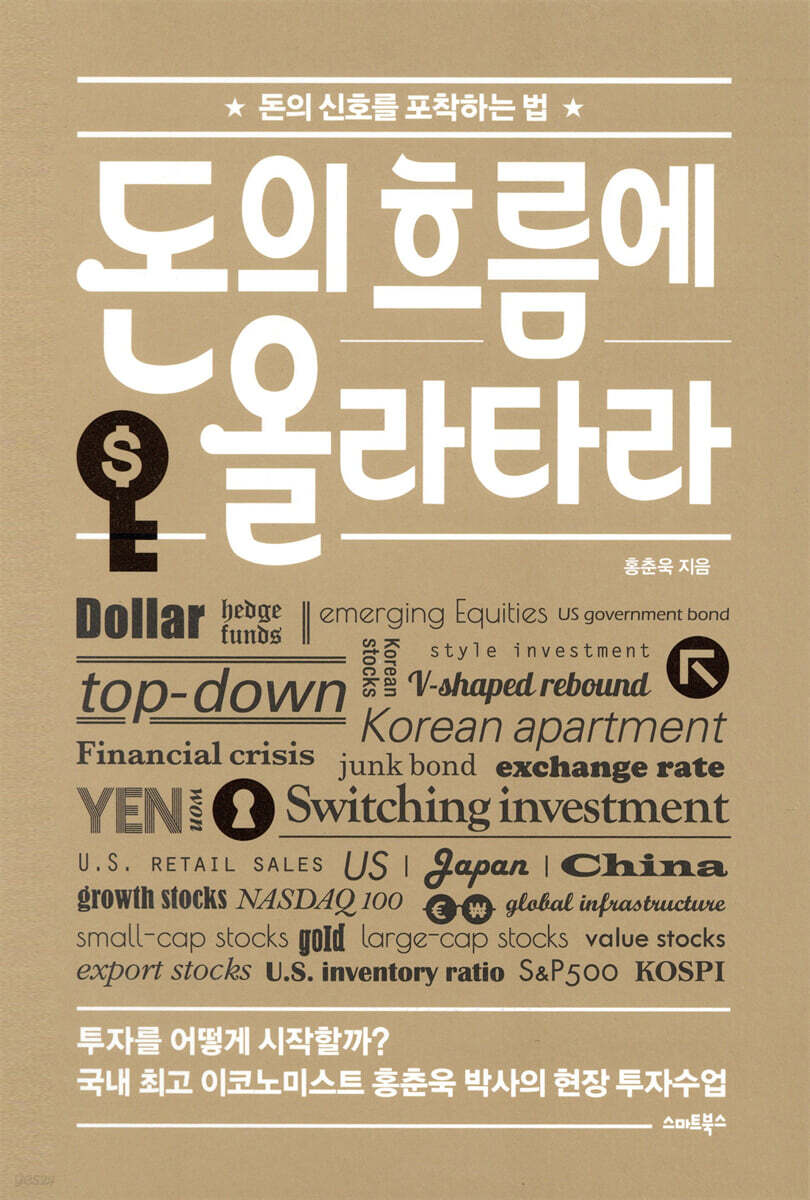
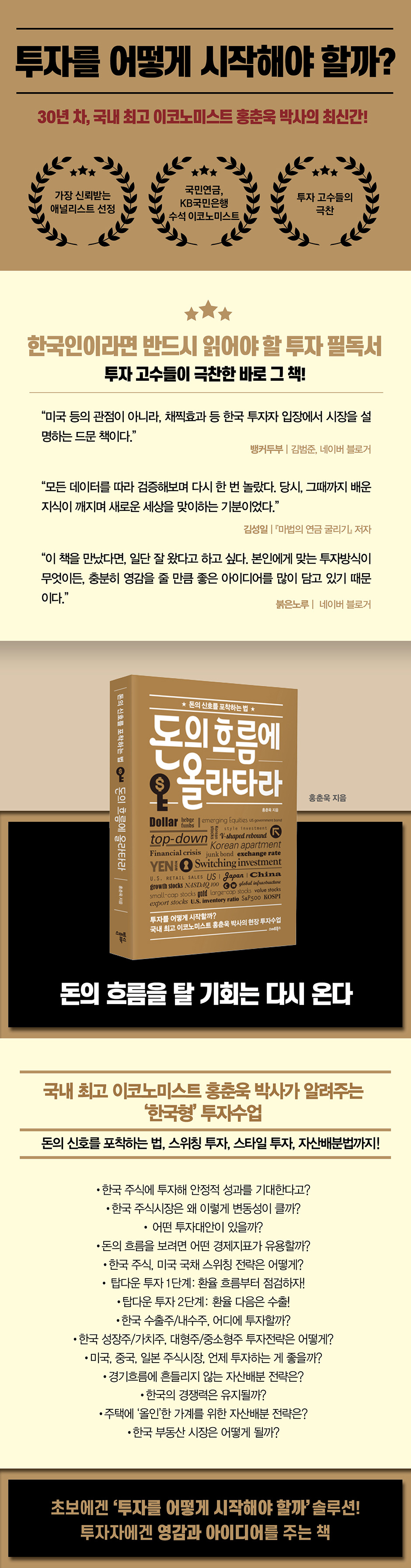
How to start investing? A Korean-style investment class by Dr. Hong Chun-wook, Korea's top economist. “Korean stocks are too hard to invest in, so why not just go all-in on US stocks?”, “I don’t know how to start investing.” 『Get on the Money Flow』 was created by Dr. Hong Chun-wook, Korea’s leading economist, to answer the countless questions he receives daily through email and on his YouTube channel. This guide will walk you through a few steps to successfully investing in Korean stocks, answering various questions that arise along the way. This will provide answers to those who wonder, "How should I start investing?" In particular, [Stage 3] introduces various asset allocation strategies tailored to investment tendencies, and the part that explains the basics of asset allocation strategies suitable for Koreans is the best part. It clearly explains the economic realities of Korea that Korean investors must know, such as the bullwhip effect, and logically explains investment methods that fit the situation based on data. The process of validating and upgrading investment strategies to provide better perspectives and more grounded analysis is incredibly exciting. You'll see why investment experts rave about this book. This book, written by a highly trusted analyst and an economic expert with 30 years of experience at the National Pension Service, banks, and securities firms, is a must-read for all Koreans, including those in their 20s and 30s who are saving seed money and those in their 40s and 50s who need to manage their assets. |
- You can preview some of the book's contents.
Preview
index
[Recommendation] The Book That Provided Solutions to My Investment Concerns: Banker Tofu (Kim Beom-jun, Naver Blogger)
[PROLOG] Finding the Royal Road to Investment
Chapter 1: The Realities of the Korean Stock Market: What You Need to Know Before Investing
Are you expecting stable performance by investing in Korean stocks?
Why is the Korean stock market so volatile?
Why are Korean companies so stingy with dividends?
What impact does the low dividend yield have on the Korean stock market?
What investment alternatives are there?
Wouldn't top-down investing be an attractive investment alternative in the Korean economy?
--------------------------------------------------------------------
STAGE 1: Stock-Bond Switching Strategy Using Economic Indicators
--------------------------------------------------------------------
Chapter 2: Top-Down Investing Step 1: Let's start by checking the exchange rate flow!
How to Switch Dollar Investments - Korean Stocks, Foreign Currency Deposits
Is there a way to improve the performance of dollar-switching investments? - Korean stocks, US Treasuries
[MONEY BOX] What are the pros and cons of foreign currency deposits and exchange-traded funds (ETFs)?
Chapter 3: Top-Down Investing Step 2: Exchange Rates Next, Exports!
Korean investors should pay attention to export indicators!
What is the US inventory-to-sales ratio?
[MONEY BOX] How to Find U.S. Inventory-to-Sales Ratio Statistics
Chapter 4 Retail Sales Switching Strategy: Pay Attention to the Bullwhip Effect!
Just a slight shake of the whip handle will cause the tip to shake!
The decline in retail sales has a greater impact on manufacturing.
Declining U.S. manufacturing production has a significant impact on Korean exports.
Testing Your Retail Switching Strategy!
Retail switching strategies aren't perfect either!
[MONEY BOX] Which ETF Should I Use for Switching Between Korean Stocks and US Treasury Bonds?
Chapter 5 Dual Switching Strategy 1: Utilize U.S. Retail Sales and Housing Market Index!
What are the leading variables for US consumer spending?
When real estate prices fall, a 'credit crunch' occurs!
How to Predict the Real Estate Market: Pay Attention to Interest Rates and Housing Supply!
To judge the real estate market, use the National Association of Home Builders (NAHB) Housing Market Index!
Dual Switching Strategy 1 Test!
[MONEY BOX] Why I Invested in US REITs in February 2021
Chapter 6: Dual Switching Strategy 2: Utilize U.S. Retail Sales and Manufacturing Index!
Another factor that determines consumer spending: changes in income outlook.
What is the outlook for US corporate performance?
Dual Switching Strategy 2 Tested!
[MONEY BOX] How to Check the Institute for Supply Management (ISM) Manufacturing Price Index
--------------------------------------------------------------------
STAGE 2_Style Investment Strategy Using Economic Indicators
--------------------------------------------------------------------
Chapter 7: Where Should I Invest: Korean Export-Oriented Stocks or Domestic Demand-Oriented Stocks?
As US retail sales pick up, which industries stand to gain?
Why are Korean export stocks so volatile?
Let's compare the performance of export and domestic demand stocks.
The performance of the export/domestic stock switching strategy is fantastic!
[MONEY BOX] Which ETF Should I Use for Switching Between Export and Domestic Stocks?
Chapter 8: Korean Growth Stocks/Value Stocks, Large-Cap Stocks/Small-Cap Stocks: Where Should I Invest?
What is an investment style?
When do growth stocks show strength?
When do value stocks show strength?
How to switch between growth and value stocks?
How about a large-cap/small-cap switching strategy?
[MONEY BOX] Which ETFs are best for switching between growth and value stocks?
[MONEY BOX] Which ETFs are best for switching between large-cap and small-cap stocks?
Chapter 9: When is it best to invest in foreign stocks?
Let's turn our eyes to the west!
Couldn't a strategy that works well in Korea also be applied in China?
How about a 'Chinese stock/US Treasury bond' switching strategy?
What if I implement a switching strategy with US Nasdaq stocks?
What if I implement a switching strategy with Japanese stocks?
[MONEY BOX] Which ETF Should I Use for Switching Between Chinese Stocks and US Treasuries?
MONEY BOX | Which ETFs are used for the Nasdaq 100 and Topix 100?
--------------------------------------------------------------------
STAGE3_Diverse Asset Allocation Strategies
--------------------------------------------------------------------
Chapter 10: Is Switching Strategy a Cure?
Why not just look at the OECD leading economic indicators?
Did the 2008 OECD Leading Economic Index Really Predict a Recession?
Why are the forecasts from economic forecasting agencies so similar?
Chapter 11: Let's look at the basics of asset allocation!
What are the benefits of asset allocation?
The magic of rebalancing after asset allocation!
What is the optimal asset allocation ratio?
[MONEY BOX] What is the performance of the Codex 200 US Treasury Bond ETF?
Chapter 12: Enter the world of full-fledged asset allocation!
Find asset pairs that move in opposite directions!
What assets move in the opposite direction and also have high returns?
Growth asset allocation
Stable asset allocation
Neutral asset allocation
Regular rebalancing yields better returns
How should I do periodic rebalancing?
Should individuals also delve into this?
[MONEY BOX] Asset allocation and rebalancing all in one go with the RichGo app!
Chapter 13: How to allocate assets using overseas ETFs?
If you are an 'all-weather' style investor who finds domestic listed ETFs disappointing,
If you are a stable investor preparing for retirement,
For investors who want to hedge against the risk of falling Korean housing prices,
Asset Allocation Strategy for Households All-In on Housing
[MONEY BOX] Why Invest in SPDR Gold Shares?
--------------------------------------------------------------------
APPENDIX_Economic Facts to Know When Investing
--------------------------------------------------------------------
[A.1] Why focus on U.S. Treasury bonds?
Why were U.S. Treasury bonds selected as the target for switching?
Why do U.S. Treasury bonds and Korean stocks move in opposite directions? The exchange rate!
Remember the recession-resistant nature of U.S. Treasury bonds.
[A.2] Can the whiplash effect persist?
Is it impossible to achieve growth driven by domestic demand rather than exports?
Can Korea maintain its competitiveness?
Will China's advance continue?
What are the effects of China's "Made in China 2025" initiative?
Why is China's semiconductor industry struggling?
Can a latecomer never catch up?
[A.3] Can Chinese government bonds become a safe asset?
Can China Replace the United States?
How does the financial repression policy work?
Anti-corruption campaign likely to limit domestic growth
Why are big tech companies struggling?
The whip effect will continue!
[A.4] What do you think about the Korean real estate market?
Seoul apartments reach their most expensive levels in history
Why have housing prices skyrocketed?
Unprecedentedly low interest rates are also a factor in rising housing prices.
Is there any chance that the rapid rise in housing prices will be stopped?
My Investment Story: 10 Years After "Let's Make Money"
The Book That Changed My Investing Life_Kim Seong-il (Author of "Magic Pension Management")
A book packed tightly like a lunchbox packed by a mother_Red Deer (Naver blogger)
EPILOG
Detailed image
Into the book
Published in 2021, "The History of Money Repeats Itself" received overwhelming love, but it didn't seem to immediately quench the thirst of its readers.
My email and YouTube channel are flooded with questions like, "I understand the message to invest in dollar assets, but I don't know where to start," or, "Korean stocks are too difficult to invest in. Why not go all-in on US stocks?"
The book you're reading today, "Get on the Money Flow," was created to answer this question.
This article will walk you through several steps to successfully investing in Korean stocks, answering various questions that arise along the way. It will hopefully provide some answers to those who wonder, "How should I start investing?"
In particular, [Stage 3] introduces various asset allocation strategies tailored to your investment style, so I hope you make good use of them.
---From the "Prologue"
Several years ago, when I was working at a certain organization, I was called before the 'Risk Management Committee'.
The chief investment officer responsible for making investment decisions asked:
"Why did you buy this stock? The price keeps falling."
To this he replied as follows:
“Because this company pays stable dividends, the dividend yield increases as the stock price falls.
As a long-term investment institution, I believe it is right to buy when the stock prices of quality companies that consistently pay dividends plummet.”
After hearing this, my boss didn't bring up the issue any further, and as time passed, I remember the company's stock price rising significantly, contributing to the improved performance of the domestic stock division.
Even among domestic stock managers, there was talk among themselves that “stocks that have been brought up to the risk management committee must be purchased additionally.”
But what would have happened if this company hadn't paid dividends at all, or had frequently suspended them? Perhaps the managers would have taken responsibility for the investment failure and responded to the unusual plunge in the stock price by cutting losses—selling.
This is the power of dividends.
In particular, long-term investment institutions such as pension funds do not pay dividend income tax, so they have an incentive to make long-term investments in companies that pay dividends and enjoy compound returns by reinvesting the dividends.
---From "Chapter 1: The Reality of the Korean Stock Market: What You Need to Know Before Starting to Invest"
The reason top-down investment strategies offer an alternative that alleviates the challenges of bottom-up investing is that they assess how the economy is performing, invest in industries expected to benefit from economic fluctuations, and shift to growth or value stocks in response to changes in market interest rates and sentiment. This strategy is well-suited to countries like Korea, where the economy fluctuates wildly.
While basic knowledge of top-down investing is necessary, there's relatively less risk of being bogged down in complex accounting books like with bottom-up investing.
Furthermore, the recent launch of various types of listed index funds (ETFs) has made it easier to invest in U.S. Treasury bonds as well as Korean value and growth stocks, which is also a factor that alleviates the difficulties of top-down investing.
Of course, top-down investing doesn't always guarantee success.
However, for those who invest by appropriately gathering various information like a 'fox', I think top-down investing is an investment alternative with a fairly high probability of success.
---From "Chapter 1: The Reality of the Korean Stock Market: What You Need to Know Before Starting to Invest"
So, how can we determine whether the high dollar/won exchange rate is a good time to buy Korean stocks, or whether the low exchange rate is a good time to buy dollars?
There are several methods, but I like the 'year-over-year growth rate' statistic.
If it is now December 2021, we are checking whether the exchange rate has risen or fallen compared to December of last year.
And if the exchange rate has risen compared to last year, you buy Korean stocks, and conversely, if the exchange rate has fallen compared to the same period last year, you buy dollars.
Of course, judging the right time to buy or sell after just one month is risky, so I recommend taking action when the exchange rate has been moving in the same direction for at least three months.
---From "Chapter 2: Top-Down Investment, Step 1: Let's Check the Exchange Rate Flow!"
The first person to discover the bullwhip effect was an executive in charge of baby diaper logistics at Procter & Gamble (P&G), a global consumer goods manufacturer.
He discovered something interesting while analyzing the fluctuations in demand for baby diapers.
Due to the nature of baby diapers as a product, consumer demand is always constant, but order demand from retailers and wholesalers fluctuates.
And these order fluctuations increase the further away from the end consumer you go in the so-called supply chain, which runs from 'end consumer-retailer-wholesale store-manufacturer-raw material supplier.'
It is nicknamed the "whip effect" because it is similar to the phenomenon in which, when swinging a whip, even a small wave at the handle increases the wave toward the end of the whip.
The bullwhip effect can be said to be the cause of the economic downturn in East Asian industrialized countries, such as Korea and China, even when there is a small shock to the consumer markets of developed countries.
Let me explain how the bullwhip effect manifests itself using the example of 2008.
---From "Chapter 4 Retail Sales Switching Strategy: Pay Attention to the Bullwhip Effect!"
The difference between 'Dual Switching Strategy 1' and 'Dual Switching Strategy 2' is that it utilizes U.S. retail sales and the National Association of Home Builders (NAHB) housing market index, while 'Dual Switching Strategy 2' utilizes U.S. retail sales and the Institute for Supply Management (ISM) manufacturing price index.
To summarize the backtest results, the cumulative performance of Korean stocks was only 348%, while the 'Dual Switching Strategy 2' achieved a performance of 1,071% since 2000.
Not only that, but the volatility was lower and the standard deviation of returns was also superior.
---From "Chapter 6 Dual Switching Strategy 2: Utilize U.S. Retail Sales and Manufacturing Index!"
If the 2000s were an era of domestic demand, the early 2010s ushered in an era of export-oriented growth.
It is particularly noteworthy that domestic demand stocks showed relative strength during periods of uncertain export prospects, such as the 2008 global financial crisis and the 2020 COVID-19 shock.
I think Korea's export-oriented and domestic-demand stocks are an ideal pairing, as they move in opposite directions and outperform U.S. Treasuries by a significant margin.
(Omitted) The reason why the Korean export/domestic demand stock switching strategy records high returns is because export and domestic demand stocks are complementary to each other, which suppresses the decrease in the investment principal.
(Omitted) The reason this phenomenon occurs is because if a loss occurs once in the principal, it takes twice the profit to recover.
Therefore, a good investment strategy can be said to be one that not only achieves absolute performance but also minimizes losses.
---From "Chapter 7: Korean Export Stocks and Domestic Demand Stocks: Where Should I Invest?"
Classifying stocks by 'factor' rather than 'sector' is called 'investment style'.
The most representative investment styles are value and growth, which we just mentioned.
Value investors prefer companies with solid assets but whose current businesses are boring, i.e., companies with low price-to-earnings ratios (PERs).
Growth investors invest in companies with promising futures but higher price-to-earnings ratios than the market average.
For reference, I am an omnivore.
In boom times, value stocks are preferred, and in recessions when corporate performance is poor, growth stocks are preferred.
The reason for this tendency is simple.
It's because of its rarity.
It is very rare to find a tree laden with apples in a snow-covered winter field.
Therefore, this tree is very rare and there will be a long line of people willing to pay a high price to buy it.
[Chapter 8: Korean Growth Stocks/Value Stocks, Large-Cap Stocks/Small-Cap Stocks, Where Should I Invest?]
Asset allocation refers to investing in various assets (US stocks, Korean stocks, US Treasury bonds, etc.) that are the target of a 'switching strategy' by dividing them into certain proportions.
Of course, you can't just invest in any asset; two conditions must be met.
First, they must have the property of moving in opposite directions, and second, they must be assets with an upward trend.
The pair that best satisfies this condition is 'Korean stocks/US Treasury bonds'.
The following chart shows the performance of Korean stocks and U.S. Treasury bonds since 2000.
You can see that both Korean stocks and U.S. Treasury bonds are trending upward, but their movements are moving in different directions.
When investors interested in asset allocation find such a match, they feel as if they have discovered a gold mine.
---From "Chapter 11: Let's Look at the Basics of Asset Allocation!"
I believe that there will be investors who, upon seeing the above analysis, feel that “there is such a world.”
Having managed assets ranging from hundreds of billions to trillions of won, I have a thorough understanding of asset management.
Since I left my job in 2019, I've only rebalanced about twice a year when asset prices fluctuate sharply, but I can't bring myself to rebalance with machine-like precision.
It's extremely difficult for individual investors to do things that even I, who have worked in the asset management industry for decades, cannot thoroughly do.
So I would like to suggest two alternatives.
The first is that operating in a haphazard manner like I do is not a bad strategy.
Just by allocating assets, you are already in possession of a very attractive investment vehicle, and it will also require less investment than trading using the 'top-down' strategy learned in [Stage 1].
Another alternative is to leverage financial institutions and mobile apps.
One way to achieve a simple "Korean stock/US Treasury diversification" is to purchase products like the Codex 200 US Treasury Bond Mix (284430) developed by Samsung Asset Management. Another option is to utilize the "Richigo App," which I also participated in developing, to provide a service that informs you of the timing of rebalancing.
Moreover, I am eagerly hoping that in the future, more convenient methods for asset allocation and rebalancing will be developed.
---From "Chapter 12: Into the World of Full-Fledged Asset Allocation!"
The lesson from the collapse of Japan's semiconductor industry is clear.
When disruptive innovation takes hold, companies that cling to existing customers and outdated technologies will not survive.
We must not forget that even Korean memory semiconductor companies, which currently hold the world's top spot, could face a crisis at any time.
So, where will disruptive innovation begin now? Scholars may have differing opinions, but I believe the automobile industry is on the brink of disruptive innovation.
In the past, automobiles were the darling of the mechanical industry, but now it seems that the moment has come when they will change to something like home appliances.
Companies that adapt well to the trends of electric vehicles and autonomous driving will survive, but I suspect that many existing automakers will disappear after the winds of disruptive innovation blow.
My email and YouTube channel are flooded with questions like, "I understand the message to invest in dollar assets, but I don't know where to start," or, "Korean stocks are too difficult to invest in. Why not go all-in on US stocks?"
The book you're reading today, "Get on the Money Flow," was created to answer this question.
This article will walk you through several steps to successfully investing in Korean stocks, answering various questions that arise along the way. It will hopefully provide some answers to those who wonder, "How should I start investing?"
In particular, [Stage 3] introduces various asset allocation strategies tailored to your investment style, so I hope you make good use of them.
---From the "Prologue"
Several years ago, when I was working at a certain organization, I was called before the 'Risk Management Committee'.
The chief investment officer responsible for making investment decisions asked:
"Why did you buy this stock? The price keeps falling."
To this he replied as follows:
“Because this company pays stable dividends, the dividend yield increases as the stock price falls.
As a long-term investment institution, I believe it is right to buy when the stock prices of quality companies that consistently pay dividends plummet.”
After hearing this, my boss didn't bring up the issue any further, and as time passed, I remember the company's stock price rising significantly, contributing to the improved performance of the domestic stock division.
Even among domestic stock managers, there was talk among themselves that “stocks that have been brought up to the risk management committee must be purchased additionally.”
But what would have happened if this company hadn't paid dividends at all, or had frequently suspended them? Perhaps the managers would have taken responsibility for the investment failure and responded to the unusual plunge in the stock price by cutting losses—selling.
This is the power of dividends.
In particular, long-term investment institutions such as pension funds do not pay dividend income tax, so they have an incentive to make long-term investments in companies that pay dividends and enjoy compound returns by reinvesting the dividends.
---From "Chapter 1: The Reality of the Korean Stock Market: What You Need to Know Before Starting to Invest"
The reason top-down investment strategies offer an alternative that alleviates the challenges of bottom-up investing is that they assess how the economy is performing, invest in industries expected to benefit from economic fluctuations, and shift to growth or value stocks in response to changes in market interest rates and sentiment. This strategy is well-suited to countries like Korea, where the economy fluctuates wildly.
While basic knowledge of top-down investing is necessary, there's relatively less risk of being bogged down in complex accounting books like with bottom-up investing.
Furthermore, the recent launch of various types of listed index funds (ETFs) has made it easier to invest in U.S. Treasury bonds as well as Korean value and growth stocks, which is also a factor that alleviates the difficulties of top-down investing.
Of course, top-down investing doesn't always guarantee success.
However, for those who invest by appropriately gathering various information like a 'fox', I think top-down investing is an investment alternative with a fairly high probability of success.
---From "Chapter 1: The Reality of the Korean Stock Market: What You Need to Know Before Starting to Invest"
So, how can we determine whether the high dollar/won exchange rate is a good time to buy Korean stocks, or whether the low exchange rate is a good time to buy dollars?
There are several methods, but I like the 'year-over-year growth rate' statistic.
If it is now December 2021, we are checking whether the exchange rate has risen or fallen compared to December of last year.
And if the exchange rate has risen compared to last year, you buy Korean stocks, and conversely, if the exchange rate has fallen compared to the same period last year, you buy dollars.
Of course, judging the right time to buy or sell after just one month is risky, so I recommend taking action when the exchange rate has been moving in the same direction for at least three months.
---From "Chapter 2: Top-Down Investment, Step 1: Let's Check the Exchange Rate Flow!"
The first person to discover the bullwhip effect was an executive in charge of baby diaper logistics at Procter & Gamble (P&G), a global consumer goods manufacturer.
He discovered something interesting while analyzing the fluctuations in demand for baby diapers.
Due to the nature of baby diapers as a product, consumer demand is always constant, but order demand from retailers and wholesalers fluctuates.
And these order fluctuations increase the further away from the end consumer you go in the so-called supply chain, which runs from 'end consumer-retailer-wholesale store-manufacturer-raw material supplier.'
It is nicknamed the "whip effect" because it is similar to the phenomenon in which, when swinging a whip, even a small wave at the handle increases the wave toward the end of the whip.
The bullwhip effect can be said to be the cause of the economic downturn in East Asian industrialized countries, such as Korea and China, even when there is a small shock to the consumer markets of developed countries.
Let me explain how the bullwhip effect manifests itself using the example of 2008.
---From "Chapter 4 Retail Sales Switching Strategy: Pay Attention to the Bullwhip Effect!"
The difference between 'Dual Switching Strategy 1' and 'Dual Switching Strategy 2' is that it utilizes U.S. retail sales and the National Association of Home Builders (NAHB) housing market index, while 'Dual Switching Strategy 2' utilizes U.S. retail sales and the Institute for Supply Management (ISM) manufacturing price index.
To summarize the backtest results, the cumulative performance of Korean stocks was only 348%, while the 'Dual Switching Strategy 2' achieved a performance of 1,071% since 2000.
Not only that, but the volatility was lower and the standard deviation of returns was also superior.
---From "Chapter 6 Dual Switching Strategy 2: Utilize U.S. Retail Sales and Manufacturing Index!"
If the 2000s were an era of domestic demand, the early 2010s ushered in an era of export-oriented growth.
It is particularly noteworthy that domestic demand stocks showed relative strength during periods of uncertain export prospects, such as the 2008 global financial crisis and the 2020 COVID-19 shock.
I think Korea's export-oriented and domestic-demand stocks are an ideal pairing, as they move in opposite directions and outperform U.S. Treasuries by a significant margin.
(Omitted) The reason why the Korean export/domestic demand stock switching strategy records high returns is because export and domestic demand stocks are complementary to each other, which suppresses the decrease in the investment principal.
(Omitted) The reason this phenomenon occurs is because if a loss occurs once in the principal, it takes twice the profit to recover.
Therefore, a good investment strategy can be said to be one that not only achieves absolute performance but also minimizes losses.
---From "Chapter 7: Korean Export Stocks and Domestic Demand Stocks: Where Should I Invest?"
Classifying stocks by 'factor' rather than 'sector' is called 'investment style'.
The most representative investment styles are value and growth, which we just mentioned.
Value investors prefer companies with solid assets but whose current businesses are boring, i.e., companies with low price-to-earnings ratios (PERs).
Growth investors invest in companies with promising futures but higher price-to-earnings ratios than the market average.
For reference, I am an omnivore.
In boom times, value stocks are preferred, and in recessions when corporate performance is poor, growth stocks are preferred.
The reason for this tendency is simple.
It's because of its rarity.
It is very rare to find a tree laden with apples in a snow-covered winter field.
Therefore, this tree is very rare and there will be a long line of people willing to pay a high price to buy it.
[Chapter 8: Korean Growth Stocks/Value Stocks, Large-Cap Stocks/Small-Cap Stocks, Where Should I Invest?]
Asset allocation refers to investing in various assets (US stocks, Korean stocks, US Treasury bonds, etc.) that are the target of a 'switching strategy' by dividing them into certain proportions.
Of course, you can't just invest in any asset; two conditions must be met.
First, they must have the property of moving in opposite directions, and second, they must be assets with an upward trend.
The pair that best satisfies this condition is 'Korean stocks/US Treasury bonds'.
The following chart shows the performance of Korean stocks and U.S. Treasury bonds since 2000.
You can see that both Korean stocks and U.S. Treasury bonds are trending upward, but their movements are moving in different directions.
When investors interested in asset allocation find such a match, they feel as if they have discovered a gold mine.
---From "Chapter 11: Let's Look at the Basics of Asset Allocation!"
I believe that there will be investors who, upon seeing the above analysis, feel that “there is such a world.”
Having managed assets ranging from hundreds of billions to trillions of won, I have a thorough understanding of asset management.
Since I left my job in 2019, I've only rebalanced about twice a year when asset prices fluctuate sharply, but I can't bring myself to rebalance with machine-like precision.
It's extremely difficult for individual investors to do things that even I, who have worked in the asset management industry for decades, cannot thoroughly do.
So I would like to suggest two alternatives.
The first is that operating in a haphazard manner like I do is not a bad strategy.
Just by allocating assets, you are already in possession of a very attractive investment vehicle, and it will also require less investment than trading using the 'top-down' strategy learned in [Stage 1].
Another alternative is to leverage financial institutions and mobile apps.
One way to achieve a simple "Korean stock/US Treasury diversification" is to purchase products like the Codex 200 US Treasury Bond Mix (284430) developed by Samsung Asset Management. Another option is to utilize the "Richigo App," which I also participated in developing, to provide a service that informs you of the timing of rebalancing.
Moreover, I am eagerly hoping that in the future, more convenient methods for asset allocation and rebalancing will be developed.
---From "Chapter 12: Into the World of Full-Fledged Asset Allocation!"
The lesson from the collapse of Japan's semiconductor industry is clear.
When disruptive innovation takes hold, companies that cling to existing customers and outdated technologies will not survive.
We must not forget that even Korean memory semiconductor companies, which currently hold the world's top spot, could face a crisis at any time.
So, where will disruptive innovation begin now? Scholars may have differing opinions, but I believe the automobile industry is on the brink of disruptive innovation.
In the past, automobiles were the darling of the mechanical industry, but now it seems that the moment has come when they will change to something like home appliances.
Companies that adapt well to the trends of electric vehicles and autonomous driving will survive, but I suspect that many existing automakers will disappear after the winds of disruptive innovation blow.
---From "A.2 Will the whip effect last?"
Publisher's Review
What if you only know about savings, Korean stocks, or are all-in on apartments?
In an era of changing money flows, studying money is essential!
Dr. Hong Chun-wook's Korean-style investment class, unwavering in the face of economic trends.
During this period, real estate and stock markets rose significantly due to ultra-low interest rates.
Some people took advantage of this opportunity and made a fortune, while others missed it and suffered a sense of loss.
It must have been so bad that the term ‘sudden beggar’ even came into existence.
Reading or not reading the flow of money has a huge impact on my bank account and assets.
This is not an era where you can protect your assets just by receiving your salary and saving it.
You have to study the 'flow of money'.
The Realities of the Korean Economy You Should Know Before Starting an Investment
What investment alternatives are there?
Investing in Korean stocks and expecting stable returns? Why is the Korean stock market so volatile? Going all-in on Korean real estate? The author concisely and clearly explains the characteristics of the Korean economy, using the "bullwhip effect" as a foundation for investing.
The Korean economy, which is export-oriented, is greatly shaken by even a small shock to the consumer markets of advanced countries such as the United States.
It is similar to the phenomenon where, when swinging a whip, even if you shake the handle slightly, the waves become larger as they get closer to the tip of the whip.
The author explains that for novice investors, "top-down" investing, which involves assessing how the economy is performing and investing in industries expected to benefit from economic fluctuations, can be an attractive investment alternative in the current Korean economy, where the economy is experiencing rapid economic fluctuations.
Economic indicators that read the flow of money
Korean stocks and US Treasury bonds switching strategy
“Korean stocks are too difficult to invest in. Why not go all-in on US stocks?”
This is a question the author often hears.
During the 2008 financial crisis, Korean stock and real estate markets plummeted, but those who held dollar assets saw huge profits as the exchange rate soared.
Korean investors should hold a portion of their assets in dollars, along with Korean assets, to secure stable returns and protect their assets.
In this book, the author tracks appropriate economic indicators that can predict Korea's economic trends and tests investment strategies, which is quite interesting and exciting.
"Why not just deposit dollars instead of US Treasury bonds?"
We provide answers to questions readers may have through actual test results.
It will also be very helpful as it explains in detail how to utilize key economic indicators such as US retail sales or the inventory-to-sales ratio.
"I understand the message to invest in dollar assets, but I don't know where to start." This book provides a very specific and helpful explanation of how to implement a strategy of switching between Korean stocks and U.S. Treasury bonds.
Style investment strategies using economic indicators
Focus on characteristics, not industry
Where should I invest: Korean export stocks or domestic demand stocks? When do growth stocks outperform, and when do value stocks outperform? What about large-cap and small-cap stocks? What about overseas markets like the US Nasdaq, Japan, and China? What switching strategies are available for more stable returns?
This is an area where you can break the vague, conventional investment knowledge and upgrade your level of money knowledge.
It is very interesting to see the results of investing in the US NASDAQ market, which is dominated by Apple, Google, etc., and the Korean stock market together.
It will be of great help as it goes beyond the 'domestic stock/US Treasury bond' switching strategy and covers various investment styles.
From the 2030 generation to the 4050 generation
What is a high-yield, stable Korean asset allocation strategy?
It covers asset allocation strategies that are not affected by economic fluctuations.
The part that covers the basics of asset allocation is particularly excellent.
We explain why Korean investors should hold asset pairs that move in opposite directions, and what asset pairs move in opposite directions and offer high returns.
For example, the asset pairs with the highest negative correlation coefficients, which have moved in opposite directions for approximately 22 years since 2000, are 'Korean apartments/US stocks' (-0.62) and 'Korean stocks/US Treasury bonds' (-0.61).
This is something that Korean investors must know, and it is a part where the author's insight, with 30 years of experience studying money, stands out.
It will be of great help, covering everything from simple strategies like diversifying investments between Korean stocks and US Treasury bonds to differentiated asset allocation strategies based on risk preference.
In particular, it will be a valuable reference as it thoroughly introduces various listed index funds (ETFs) that allow for easy investment in U.S. Treasury bonds, Korean export/domestic stocks, value/growth stocks, overseas stock markets, infrastructure funds, and gold.
Economic facts to know when investing
What do you think about the Korean real estate market?
When investing, questions like, "Will Korea be able to survive as an exporter in the future?" or "Shouldn't we be buying Chinese government bonds instead of U.S. Treasury bonds?" often surface, even though they don't directly contribute to the investment, but they leave you feeling uneasy.
The [Appendix] of this book neatly answers this question.
I will be able to upgrade my money studies to the next level and improve my economic perspective.
Additionally, the section titled "What do you think of the Korean real estate market?" will be helpful to many people considering housing.
This book, "Get on the Money Flow," is a compilation of the know-how learned from real-world experience by the author, who has 30 years of experience studying money.
For beginner investors who don't know how to start investing, this book will provide specific guidance, while for experienced investors, it will provide inspiration and ideas.
In an era of changing money flows, studying money is essential!
Dr. Hong Chun-wook's Korean-style investment class, unwavering in the face of economic trends.
During this period, real estate and stock markets rose significantly due to ultra-low interest rates.
Some people took advantage of this opportunity and made a fortune, while others missed it and suffered a sense of loss.
It must have been so bad that the term ‘sudden beggar’ even came into existence.
Reading or not reading the flow of money has a huge impact on my bank account and assets.
This is not an era where you can protect your assets just by receiving your salary and saving it.
You have to study the 'flow of money'.
The Realities of the Korean Economy You Should Know Before Starting an Investment
What investment alternatives are there?
Investing in Korean stocks and expecting stable returns? Why is the Korean stock market so volatile? Going all-in on Korean real estate? The author concisely and clearly explains the characteristics of the Korean economy, using the "bullwhip effect" as a foundation for investing.
The Korean economy, which is export-oriented, is greatly shaken by even a small shock to the consumer markets of advanced countries such as the United States.
It is similar to the phenomenon where, when swinging a whip, even if you shake the handle slightly, the waves become larger as they get closer to the tip of the whip.
The author explains that for novice investors, "top-down" investing, which involves assessing how the economy is performing and investing in industries expected to benefit from economic fluctuations, can be an attractive investment alternative in the current Korean economy, where the economy is experiencing rapid economic fluctuations.
Economic indicators that read the flow of money
Korean stocks and US Treasury bonds switching strategy
“Korean stocks are too difficult to invest in. Why not go all-in on US stocks?”
This is a question the author often hears.
During the 2008 financial crisis, Korean stock and real estate markets plummeted, but those who held dollar assets saw huge profits as the exchange rate soared.
Korean investors should hold a portion of their assets in dollars, along with Korean assets, to secure stable returns and protect their assets.
In this book, the author tracks appropriate economic indicators that can predict Korea's economic trends and tests investment strategies, which is quite interesting and exciting.
"Why not just deposit dollars instead of US Treasury bonds?"
We provide answers to questions readers may have through actual test results.
It will also be very helpful as it explains in detail how to utilize key economic indicators such as US retail sales or the inventory-to-sales ratio.
"I understand the message to invest in dollar assets, but I don't know where to start." This book provides a very specific and helpful explanation of how to implement a strategy of switching between Korean stocks and U.S. Treasury bonds.
Style investment strategies using economic indicators
Focus on characteristics, not industry
Where should I invest: Korean export stocks or domestic demand stocks? When do growth stocks outperform, and when do value stocks outperform? What about large-cap and small-cap stocks? What about overseas markets like the US Nasdaq, Japan, and China? What switching strategies are available for more stable returns?
This is an area where you can break the vague, conventional investment knowledge and upgrade your level of money knowledge.
It is very interesting to see the results of investing in the US NASDAQ market, which is dominated by Apple, Google, etc., and the Korean stock market together.
It will be of great help as it goes beyond the 'domestic stock/US Treasury bond' switching strategy and covers various investment styles.
From the 2030 generation to the 4050 generation
What is a high-yield, stable Korean asset allocation strategy?
It covers asset allocation strategies that are not affected by economic fluctuations.
The part that covers the basics of asset allocation is particularly excellent.
We explain why Korean investors should hold asset pairs that move in opposite directions, and what asset pairs move in opposite directions and offer high returns.
For example, the asset pairs with the highest negative correlation coefficients, which have moved in opposite directions for approximately 22 years since 2000, are 'Korean apartments/US stocks' (-0.62) and 'Korean stocks/US Treasury bonds' (-0.61).
This is something that Korean investors must know, and it is a part where the author's insight, with 30 years of experience studying money, stands out.
It will be of great help, covering everything from simple strategies like diversifying investments between Korean stocks and US Treasury bonds to differentiated asset allocation strategies based on risk preference.
In particular, it will be a valuable reference as it thoroughly introduces various listed index funds (ETFs) that allow for easy investment in U.S. Treasury bonds, Korean export/domestic stocks, value/growth stocks, overseas stock markets, infrastructure funds, and gold.
Economic facts to know when investing
What do you think about the Korean real estate market?
When investing, questions like, "Will Korea be able to survive as an exporter in the future?" or "Shouldn't we be buying Chinese government bonds instead of U.S. Treasury bonds?" often surface, even though they don't directly contribute to the investment, but they leave you feeling uneasy.
The [Appendix] of this book neatly answers this question.
I will be able to upgrade my money studies to the next level and improve my economic perspective.
Additionally, the section titled "What do you think of the Korean real estate market?" will be helpful to many people considering housing.
This book, "Get on the Money Flow," is a compilation of the know-how learned from real-world experience by the author, who has 30 years of experience studying money.
For beginner investors who don't know how to start investing, this book will provide specific guidance, while for experienced investors, it will provide inspiration and ideas.
GOODS SPECIFICS
- Date of issue: January 14, 2022
- Page count, weight, size: 308 pages | 540g | 152*225*30mm
- ISBN13: 9791190238762
- ISBN10: 1190238764
You may also like
카테고리
korean


korean

![ELLE 엘르 스페셜 에디션 A형 : 12월 [2025]](http://librairie.coreenne.fr/cdn/shop/files/b8e27a3de6c9538896439686c6b0e8fb.jpg?v=1766436872&width=3840)


