

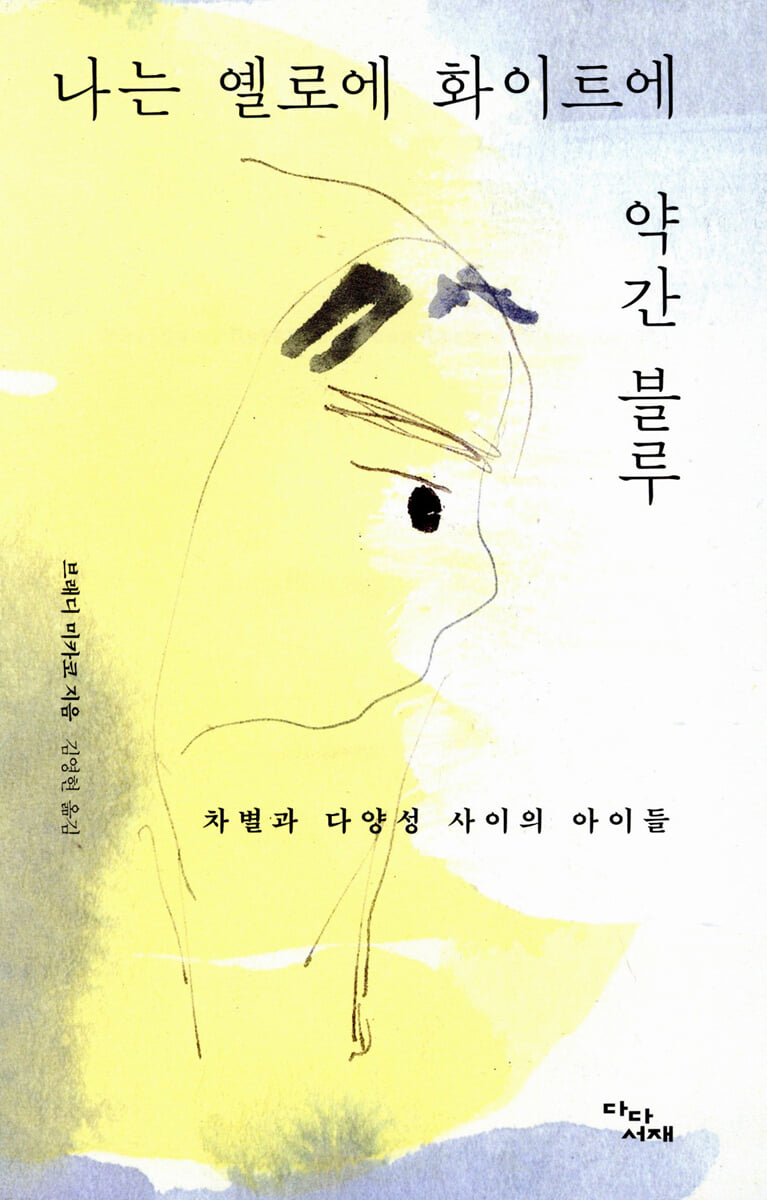
I have yellow, white and a little blue
 |
Description
Book Introduction
The latest work from childcare worker and columnist Brady Mikako.
A Japanese author who has lived in the UK for over 20 years has written about the vivid realities she experienced while raising a child at the bottom of British society, which is suffering from class disparity and multiculturalism.
This is a hot bestseller that swept various book awards, including the Bookstore Award last year, and was selected as the best book by readers, experts, bookstores, and librarians.
The author explores the sensitive issues of diversity and discrimination by observing the complex and nuanced experiences of a son who has just entered middle school meeting friends of different races, nationalities, and classes.
Set in a British society where division and conflict are deepening due to austerity and Brexit, the film deeply moves children as they struggle to overcome adult prejudices and grow.
A Japanese author who has lived in the UK for over 20 years has written about the vivid realities she experienced while raising a child at the bottom of British society, which is suffering from class disparity and multiculturalism.
This is a hot bestseller that swept various book awards, including the Bookstore Award last year, and was selected as the best book by readers, experts, bookstores, and librarians.
The author explores the sensitive issues of diversity and discrimination by observing the complex and nuanced experiences of a son who has just entered middle school meeting friends of different races, nationalities, and classes.
Set in a British society where division and conflict are deepening due to austerity and Brexit, the film deeply moves children as they struggle to overcome adult prejudices and grow.
- You can preview some of the book's contents.
Preview
index
Entering
The road to the 'old bottom middle school'
A whole new world
A Christmas filled with 'bad' rap
School Politics
Trying on someone's shoes
This side and that side of the pool
How to Give a School Uniform to a Friend
Nationalism that passed by coolly
A minefield of diverse world
In my mother's country
The future is in your hands
Again, somewhere
The relationship between bullying and attendance
I'm struggling with my identity right now
The unbearable gap between existences
I have yellow, white and a little green
The road to the 'old bottom middle school'
A whole new world
A Christmas filled with 'bad' rap
School Politics
Trying on someone's shoes
This side and that side of the pool
How to Give a School Uniform to a Friend
Nationalism that passed by coolly
A minefield of diverse world
In my mother's country
The future is in your hands
Again, somewhere
The relationship between bullying and attendance
I'm struggling with my identity right now
The unbearable gap between existences
I have yellow, white and a little green
Detailed image
.jpg)
Into the book
In the UK, parents can choose which primary and secondary schools their children will attend, even if they are public schools.
(…) As children approach school age, many people move near high-ranking schools.
When a popular school receives a surge of applicants and exceeds its capacity, local governments measure the distance from the school gate to the applicants' homes and approve admission in order of proximity.
As a result, housing prices near top schools are skyrocketing, and the residential areas of rich and poor are becoming increasingly segregated.
This is a social problem that has recently emerged and is called 'social apartheid'.
--- p.14
As society becomes more diverse, the forms of racial discrimination have also increased and become more complex.
Even if we lump them all together under the single word 'immigrant', it includes all races and countries of origin.
Among immigrants, there are those who engage in racist language and actions, while others retaliate in kind.
The British who watch the battle take sides and discriminate against the other side.
I was concerned that my son might be discriminated against by white people when I decided to send him to a predominantly white British school.
But I honestly didn't expect to run into a racist immigrant child.
--- p.41
Sympathy is a feeling that arises naturally without any effort, as it is something we feel when we see someone pitiful, someone with a problem, or someone who shares our views.
But Empathy is different.
It is the ability to imagine what people who have different ideologies or beliefs than you, or who are not so pitiful, are thinking.
If sympathy is an emotional state, empathy can be described as an intellectual exercise. It's remarkable that eleven-year-olds are learning about empathy in Britain, a country where divisions and conflicts are increasingly severe—between Leavers and Remainers, immigrants and Britons, the gap between the upper and lower classes, the gap between the rich and the poor, the elderly and the young, and the countless layers between immigrants.
--- p.87
On this side of the pool, middle school students in swimsuits were standing close enough that their shoulders were brushing, crouching down.
(…) On the other hand, there was plenty of space on the other side of the pool, so students could do warm-up exercises by turning their waists, sit down and stretch their legs elegantly, or laugh and chat with each other.
If this side was the place for the common people, then that side seemed like a vacation spot for the privileged class.
This is by no means a metaphor.
In fact, the children of the common people and the privileged class were separated, so they couldn't even laugh.
--- p.108
Middle-class young people who smoke drugs in fancy clubs along the coast are oblivious to the risks that the kids in the public housing complex are taking to get them.
(…) The people in front do not know what is happening in the back and do not try to see it.
Some intellectuals, secretly satisfied with their clever remarks, argue that because politics does not redistribute wealth, wealth is transferred from middle-class youth to lower-class youth through drug sales.
But the redistribution at the bottom is stained with blood.
In this grassroots redistribution, it is always the poor youth and children who suffer the consequences.
(…) As children approach school age, many people move near high-ranking schools.
When a popular school receives a surge of applicants and exceeds its capacity, local governments measure the distance from the school gate to the applicants' homes and approve admission in order of proximity.
As a result, housing prices near top schools are skyrocketing, and the residential areas of rich and poor are becoming increasingly segregated.
This is a social problem that has recently emerged and is called 'social apartheid'.
--- p.14
As society becomes more diverse, the forms of racial discrimination have also increased and become more complex.
Even if we lump them all together under the single word 'immigrant', it includes all races and countries of origin.
Among immigrants, there are those who engage in racist language and actions, while others retaliate in kind.
The British who watch the battle take sides and discriminate against the other side.
I was concerned that my son might be discriminated against by white people when I decided to send him to a predominantly white British school.
But I honestly didn't expect to run into a racist immigrant child.
--- p.41
Sympathy is a feeling that arises naturally without any effort, as it is something we feel when we see someone pitiful, someone with a problem, or someone who shares our views.
But Empathy is different.
It is the ability to imagine what people who have different ideologies or beliefs than you, or who are not so pitiful, are thinking.
If sympathy is an emotional state, empathy can be described as an intellectual exercise. It's remarkable that eleven-year-olds are learning about empathy in Britain, a country where divisions and conflicts are increasingly severe—between Leavers and Remainers, immigrants and Britons, the gap between the upper and lower classes, the gap between the rich and the poor, the elderly and the young, and the countless layers between immigrants.
--- p.87
On this side of the pool, middle school students in swimsuits were standing close enough that their shoulders were brushing, crouching down.
(…) On the other hand, there was plenty of space on the other side of the pool, so students could do warm-up exercises by turning their waists, sit down and stretch their legs elegantly, or laugh and chat with each other.
If this side was the place for the common people, then that side seemed like a vacation spot for the privileged class.
This is by no means a metaphor.
In fact, the children of the common people and the privileged class were separated, so they couldn't even laugh.
--- p.108
Middle-class young people who smoke drugs in fancy clubs along the coast are oblivious to the risks that the kids in the public housing complex are taking to get them.
(…) The people in front do not know what is happening in the back and do not try to see it.
Some intellectuals, secretly satisfied with their clever remarks, argue that because politics does not redistribute wealth, wealth is transferred from middle-class youth to lower-class youth through drug sales.
But the redistribution at the bottom is stained with blood.
In this grassroots redistribution, it is always the poor youth and children who suffer the consequences.
--- p.269
Publisher's Review
#1 on Amazon Japan, bestseller with 300,000 copies sold
Winner of the 2019 Bookstore Awards, the best book chosen by experts and readers!
A model student of Asian descent who entered a white working-class British secondary school.
Children grow up in a world rife with discrimination and violence.
A Japanese author who has lived in the UK for over 20 years has written about the vivid realities she experienced while raising a child at the bottom of British society, which is suffering from class disparity and multiculturalism.
This is the hotly anticipated bestseller, "I Am Yellow, White, and a Little Blue," which swept various book awards, including the Bookstore Grand Prize, last year and was selected as the best book by readers, experts, bookstores, and librarians.
Brady Mikako, whose previous work, "Class Struggle: The Children of the World," told the story of free daycare in Britain during the austerity era, now explores the sensitive issues of diversity and discrimination by observing the complex and nuanced experiences of her son, who has just started middle school, with friends from different backgrounds.
The story begins when the author's son, who was attending a prestigious Catholic elementary school, suddenly announces that he will be enrolling in a local middle school.
The local middle school, which was called 'the lowest ranked public school in the lowest neighborhood', is a chaotic world rife with discrimination and violence.
The author worries that small Asian children might experience racism or violence in a predominantly white school.
But contrary to the parents' worries, the child bravely moves forward.
The “Yellow White” child grows up in a place where complex conflicts such as racial discrimination, the gap between the rich and the poor, anti-immigrant sentiment, and sexual minority issues are intertwined, clashing with, fighting with, and worrying about friends of different races, nationalities, and classes.
Discrimination has become more complex, violence has become more diverse, and class distinctions have become more rigid.
“This may be the near future of Korean society.”
A neighborhood in a British provincial city where public housing is concentrated.
On the surface, it looks like just a 'poor neighborhood', but in reality, it is a mix of people living in public housing, people who bought public housing, and people who remodeled their purchased public housing to fit the latest trends.
The middle school that the neighborhood's children attend is a mix of free lunch recipients, middle class, immigrants, indigenous people, whites, and people of color.
The author worried that the child would be discriminated against by white people or subjected to violence because of his small size, but the nature of discrimination and violence is much more complex.
Immigrants and people of color were ostracized by other immigrants, children who scolded their friends for stealing food from restaurants were punished with violence, and a child who made hateful remarks was bullied by a group for being "uncool."
They show prejudice disguised as kindness and concern for 'people different from themselves', and justify violence on the grounds of political correctness and freedom of taste.
The divisions and conflicts in society are already so deep-rooted that it is difficult to dismiss them as children's reckless behavior.
Amidst the fiercely divided public opinion surrounding Brexit, the dual attitudes toward immigrants, and the cold gaze of the middle class towards the lower classes, the children's battleground was already anticipated.
The sight of middle school swimming competitions, where even the poolsides of private and public schools are separated, vividly shows the class-based society of the 21st century.
Because schools are a mirror reflecting society, there are bound to always be gaps among students.
But in places where the gap was allowed to widen, there was no sense of warmth.
It was dark and stiff, and it didn't seem like anything new or fun would happen.
I think that's evidence that it's already starting to decline._Page 266
The author's gaze, which calmly observes what is happening around him and his son, sharply penetrates the dark side of British society, where the pride of 'civil society' is deeply rooted.
Beyond the schools rife with disparities, discrimination, and violence, what was revealed was a 'collapsed welfare state' and a 'multicultural society driven into a dead end' due to the conservative government's austerity policies.
The author sternly warns of the dangers of a society that doesn't know, or doesn't try to know, what's happening in public housing, poolside, or the back of the classroom.
“It’s natural for everyone to be different.”
Children living in the 'Age of Empathy'
Despite adults' concerns, children overcome the challenges of discrimination and diversity one by one in their own ways.
We reach out to friends who make hateful remarks, try to help poor friends without hurting their pride, and encourage friends who are struggling with their sexual identity by saying, “You just have to take your time and figure it out.”
Sometimes, they encounter problems that seem unsolvable, but the attitude of children who “boldly say, ‘Let’s leave it at this for now,’ and face it head-on, constantly encountering new things” gives great courage to adults of the same age who are burdened with the same concerns.
It may be a cliché, but the future lies in the hands of those children.
Some people say the world is regressing or moving in a terrible direction, but aren't they underestimating children?
Page 203
Racism still exists, bullying persists, and children are forced to wear tattered uniforms to school, but life goes on.
Even if they think differently from me, even if I don't understand them, and even if they sometimes hate me, I accept them and coexist with them.
The author points out that in a world where adults divide people into factions and confront each other over various issues, and cannot even tolerate the existence of opposing factions, children live by calmly accepting the reality that "there are people who are different from me."
The author emphasizes 'empathy' as the most important ability we must have to survive in a multicultural society.
The ability to understand the emotions and experiences of others is perhaps the most necessary virtue in our society, where divisions and conflicts are becoming increasingly severe, such as the gap between the rich and the poor, generational conflict, multiculturalism, and political strife.
'Empathy' is a profound concept that even adults find difficult to answer, but the author's son explains it very simply.
“It’s like putting yourself in someone else’s shoes.”
As the Asahi Shimbun commented, “A most promising writer who knows how to magically blend humor and subtlety while simultaneously attacking rotten politics with sharp and punk writing,” Brady Mikako’s writing, which humorously describes her son’s stormy school life while also exposing the dark side of society with a sharp perspective, resonates deeply with us living in this era.
Winner of the 2019 Bookstore Awards, the best book chosen by experts and readers!
A model student of Asian descent who entered a white working-class British secondary school.
Children grow up in a world rife with discrimination and violence.
A Japanese author who has lived in the UK for over 20 years has written about the vivid realities she experienced while raising a child at the bottom of British society, which is suffering from class disparity and multiculturalism.
This is the hotly anticipated bestseller, "I Am Yellow, White, and a Little Blue," which swept various book awards, including the Bookstore Grand Prize, last year and was selected as the best book by readers, experts, bookstores, and librarians.
Brady Mikako, whose previous work, "Class Struggle: The Children of the World," told the story of free daycare in Britain during the austerity era, now explores the sensitive issues of diversity and discrimination by observing the complex and nuanced experiences of her son, who has just started middle school, with friends from different backgrounds.
The story begins when the author's son, who was attending a prestigious Catholic elementary school, suddenly announces that he will be enrolling in a local middle school.
The local middle school, which was called 'the lowest ranked public school in the lowest neighborhood', is a chaotic world rife with discrimination and violence.
The author worries that small Asian children might experience racism or violence in a predominantly white school.
But contrary to the parents' worries, the child bravely moves forward.
The “Yellow White” child grows up in a place where complex conflicts such as racial discrimination, the gap between the rich and the poor, anti-immigrant sentiment, and sexual minority issues are intertwined, clashing with, fighting with, and worrying about friends of different races, nationalities, and classes.
Discrimination has become more complex, violence has become more diverse, and class distinctions have become more rigid.
“This may be the near future of Korean society.”
A neighborhood in a British provincial city where public housing is concentrated.
On the surface, it looks like just a 'poor neighborhood', but in reality, it is a mix of people living in public housing, people who bought public housing, and people who remodeled their purchased public housing to fit the latest trends.
The middle school that the neighborhood's children attend is a mix of free lunch recipients, middle class, immigrants, indigenous people, whites, and people of color.
The author worried that the child would be discriminated against by white people or subjected to violence because of his small size, but the nature of discrimination and violence is much more complex.
Immigrants and people of color were ostracized by other immigrants, children who scolded their friends for stealing food from restaurants were punished with violence, and a child who made hateful remarks was bullied by a group for being "uncool."
They show prejudice disguised as kindness and concern for 'people different from themselves', and justify violence on the grounds of political correctness and freedom of taste.
The divisions and conflicts in society are already so deep-rooted that it is difficult to dismiss them as children's reckless behavior.
Amidst the fiercely divided public opinion surrounding Brexit, the dual attitudes toward immigrants, and the cold gaze of the middle class towards the lower classes, the children's battleground was already anticipated.
The sight of middle school swimming competitions, where even the poolsides of private and public schools are separated, vividly shows the class-based society of the 21st century.
Because schools are a mirror reflecting society, there are bound to always be gaps among students.
But in places where the gap was allowed to widen, there was no sense of warmth.
It was dark and stiff, and it didn't seem like anything new or fun would happen.
I think that's evidence that it's already starting to decline._Page 266
The author's gaze, which calmly observes what is happening around him and his son, sharply penetrates the dark side of British society, where the pride of 'civil society' is deeply rooted.
Beyond the schools rife with disparities, discrimination, and violence, what was revealed was a 'collapsed welfare state' and a 'multicultural society driven into a dead end' due to the conservative government's austerity policies.
The author sternly warns of the dangers of a society that doesn't know, or doesn't try to know, what's happening in public housing, poolside, or the back of the classroom.
“It’s natural for everyone to be different.”
Children living in the 'Age of Empathy'
Despite adults' concerns, children overcome the challenges of discrimination and diversity one by one in their own ways.
We reach out to friends who make hateful remarks, try to help poor friends without hurting their pride, and encourage friends who are struggling with their sexual identity by saying, “You just have to take your time and figure it out.”
Sometimes, they encounter problems that seem unsolvable, but the attitude of children who “boldly say, ‘Let’s leave it at this for now,’ and face it head-on, constantly encountering new things” gives great courage to adults of the same age who are burdened with the same concerns.
It may be a cliché, but the future lies in the hands of those children.
Some people say the world is regressing or moving in a terrible direction, but aren't they underestimating children?
Page 203
Racism still exists, bullying persists, and children are forced to wear tattered uniforms to school, but life goes on.
Even if they think differently from me, even if I don't understand them, and even if they sometimes hate me, I accept them and coexist with them.
The author points out that in a world where adults divide people into factions and confront each other over various issues, and cannot even tolerate the existence of opposing factions, children live by calmly accepting the reality that "there are people who are different from me."
The author emphasizes 'empathy' as the most important ability we must have to survive in a multicultural society.
The ability to understand the emotions and experiences of others is perhaps the most necessary virtue in our society, where divisions and conflicts are becoming increasingly severe, such as the gap between the rich and the poor, generational conflict, multiculturalism, and political strife.
'Empathy' is a profound concept that even adults find difficult to answer, but the author's son explains it very simply.
“It’s like putting yourself in someone else’s shoes.”
As the Asahi Shimbun commented, “A most promising writer who knows how to magically blend humor and subtlety while simultaneously attacking rotten politics with sharp and punk writing,” Brady Mikako’s writing, which humorously describes her son’s stormy school life while also exposing the dark side of society with a sharp perspective, resonates deeply with us living in this era.
GOODS SPECIFICS
- Date of issue: March 20, 2020
- Page count, weight, size: 292 pages | 362g | 135*205*20mm
- ISBN13: 9791196820015
- ISBN10: 1196820015
You may also like
카테고리
korean


korean

![GQ KOREA Mark (Monthly): December [2025]](http://librairie.coreenne.fr/cdn/shop/files/8ef265dbbfbf186523ed75ba7319009d.jpg?v=1765340328&width=3840)


