

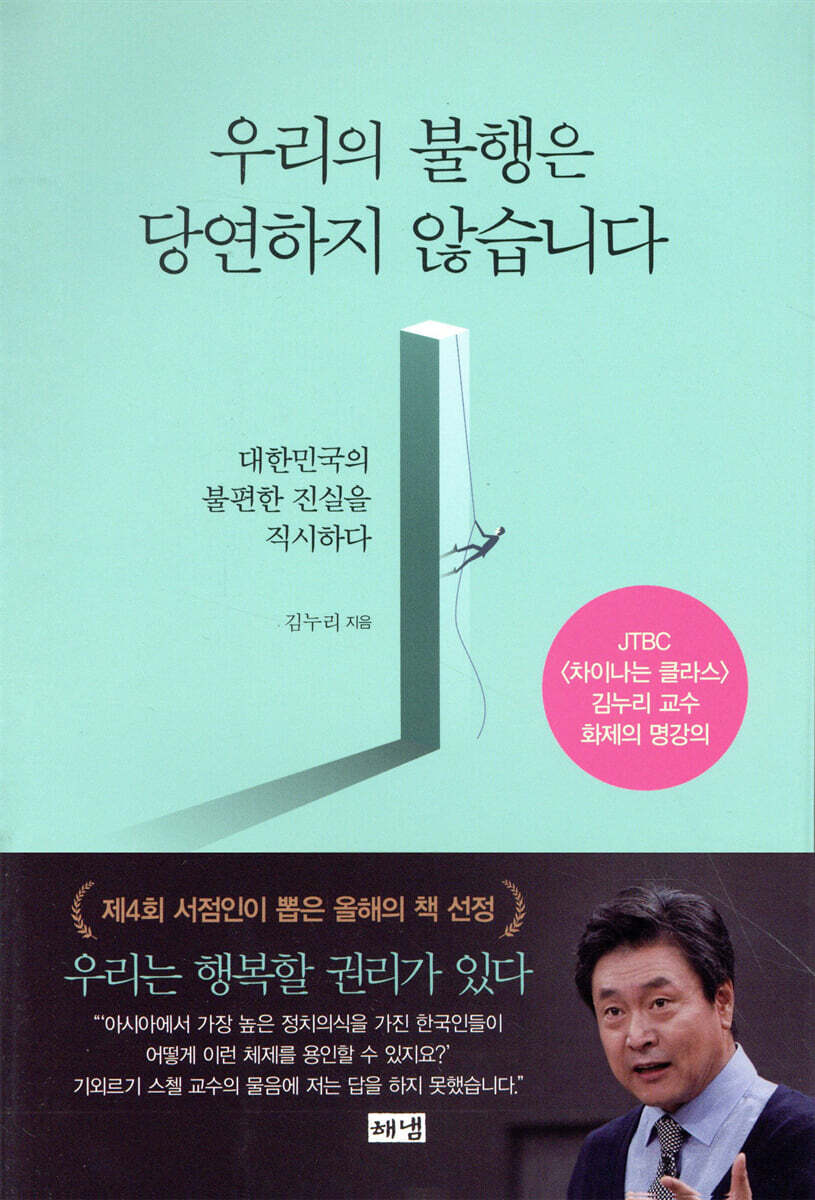
Our misfortune is not deserved
 |
Description
Book Introduction
We have the right to be happy JTBC [China Class] Professor Kim Nu-ri's Hot Topic Lecture In Germany, a country of past liquidation, welfare, and unification See our distorted self-portrait Professor Kim Nu-ri, a professor of German literature at Chung-Ang University and director of the German-European Studies Center, has published a book titled “Our Misfortune is Not Natural,” which delves into the uncomfortable truths of the “strange country” of South Korea. From the 'Germany 2-part' lecture on JTBC's [China Class] that caused an explosive response by rising to the real-time search rankings of major portal sites to the highly recommended episode of the popular podcast Jeong Yeong-jin and Choi Wook's [Maebul Show], Professor Kim Nu-ri's critical analysis and outlook that gave surprising insights and shocks to many people have been supplemented and compiled into this one book. |
- You can preview some of the book's contents.
Preview
index
Introduction: “We live in a strange land now.”
Prologue: Looking in the Mirror in a Sick Society
Chapter 1: Democracy without Democrats
1 Our revolution has not arrived. The Republic of Korea, the leading democratic nation/How great, how vulnerable/Plaza democracy and everyday democracy
2. A university where even assistant professors can become presidents to reclaim the rights of their owners who have been taken away / The secret to Germany's economic growth through the joint labor-management decision system / What "name to name" means / A provocation for a new life
The 68 Revolution, rejecting all forms of oppression and confronting the absurd world/The 68 Revolution that turned the world upside down/Liquidating the past and a cultured society/Auschwitz and critical education/Politics pursuing social justice
Chapter 2: The Giant Hole in South Korea
Why Didn't the '68 Revolution Occur in Korea? Why Didn't the 'Spring of Seoul' Come? / Studying the Void of the '68 Revolution / The Beginning and End of the Vietnam War / South Korea in 1968: Going Against the Flow of History
2 The Great and Dangerous 86 Generation: Who Are the 86 Generations of This Land? / The Achievements and Limitations of the 86 Generation / The Dangerous Illusion of Moral Superiority
3. Korean education trapped in the trap of competition: lack of human rights awareness and consumer awareness/Guilt about sex is the enemy of democracy/One-shot society and ten-shot society
4. Sick of self-exploitation and alienation. The slave overseer within me/Eat up by means/Strong gender barriers.
Chapter 3: Finding the Link in the Vicious Cycle
1. Anachronistic Self-Portrait of Hell Joseon: The "Big Country" of the Republic of Korea / People Keep Jumping / Unprecedentedly Unequal Society / Depressed Children and Machine-Working Adults / Academic Background: The Birth of a New Class
2. A society where beasts run rampant: Yeouido is suspicious/Beastly capitalism that has taken over South Korea
A change of government alone cannot change the situation. The lie of "conservatives vs. progressives"/a deceptive battle for vested interests/How was the conservative-conservative oligarchy possible?
4. 'Little America' More American Than the US: South Korea/USA Not the Global Standard
Chapter 4: We Will Laugh Together
1 Misconceptions and truths about German reunification Peace is urgent / German reunification from the East / The Berlin Wall falls / I want rapid reunification / 'Reunification Day' that left wounds on East Germans / The cost of reunification is not a loss / West Germany looking at East Germany, Korea looking at West Germany
2 South and North, how to hold hands without getting hurt / Even though they didn't dare to say the word 'unification' / South and North Korea, two sick people meet / Respecting each other's thoughts and history
3. For a mature and peaceful unification of the Korean Peninsula, the political future of the Korean Peninsula lies in the hands of the North Korean people/We will resolutely demand peace.
Epilogue: Be Confident in Front of the Mirror
Prologue: Looking in the Mirror in a Sick Society
Chapter 1: Democracy without Democrats
1 Our revolution has not arrived. The Republic of Korea, the leading democratic nation/How great, how vulnerable/Plaza democracy and everyday democracy
2. A university where even assistant professors can become presidents to reclaim the rights of their owners who have been taken away / The secret to Germany's economic growth through the joint labor-management decision system / What "name to name" means / A provocation for a new life
The 68 Revolution, rejecting all forms of oppression and confronting the absurd world/The 68 Revolution that turned the world upside down/Liquidating the past and a cultured society/Auschwitz and critical education/Politics pursuing social justice
Chapter 2: The Giant Hole in South Korea
Why Didn't the '68 Revolution Occur in Korea? Why Didn't the 'Spring of Seoul' Come? / Studying the Void of the '68 Revolution / The Beginning and End of the Vietnam War / South Korea in 1968: Going Against the Flow of History
2 The Great and Dangerous 86 Generation: Who Are the 86 Generations of This Land? / The Achievements and Limitations of the 86 Generation / The Dangerous Illusion of Moral Superiority
3. Korean education trapped in the trap of competition: lack of human rights awareness and consumer awareness/Guilt about sex is the enemy of democracy/One-shot society and ten-shot society
4. Sick of self-exploitation and alienation. The slave overseer within me/Eat up by means/Strong gender barriers.
Chapter 3: Finding the Link in the Vicious Cycle
1. Anachronistic Self-Portrait of Hell Joseon: The "Big Country" of the Republic of Korea / People Keep Jumping / Unprecedentedly Unequal Society / Depressed Children and Machine-Working Adults / Academic Background: The Birth of a New Class
2. A society where beasts run rampant: Yeouido is suspicious/Beastly capitalism that has taken over South Korea
A change of government alone cannot change the situation. The lie of "conservatives vs. progressives"/a deceptive battle for vested interests/How was the conservative-conservative oligarchy possible?
4. 'Little America' More American Than the US: South Korea/USA Not the Global Standard
Chapter 4: We Will Laugh Together
1 Misconceptions and truths about German reunification Peace is urgent / German reunification from the East / The Berlin Wall falls / I want rapid reunification / 'Reunification Day' that left wounds on East Germans / The cost of reunification is not a loss / West Germany looking at East Germany, Korea looking at West Germany
2 South and North, how to hold hands without getting hurt / Even though they didn't dare to say the word 'unification' / South and North Korea, two sick people meet / Respecting each other's thoughts and history
3. For a mature and peaceful unification of the Korean Peninsula, the political future of the Korean Peninsula lies in the hands of the North Korean people/We will resolutely demand peace.
Epilogue: Be Confident in Front of the Mirror
Detailed image

Into the book
“We live in a strange land now.”
Truly, we live in a very 'strange country'.
We have achieved political democracy that the world envies and economic growth that astonishes the world, yet our misfortunes are growing by the day.
South Korea has the highest suicide rate in the world, the longest working hours, the most unequal, and the highest rate of worker deaths.
And that's not all.
South Korea is the country with the most depressed children in the world, the country with the lowest birth rate, and the country where everyone distrusts everyone else the most.
At this point, it would not be an exaggeration to say that this is a hell where humans cannot live.
It is by no means a criticism that the younger generation coined the term 'Hell Joseon.'
In his book, The Spectacle of Death, Italian philosopher Franco Bifo Berardi identified four characteristics of Korean society.
'Endless competition, extreme individualism, desertification of daily life, and hyper-acceleration of the rhythm of life' are the things.
I find this creepy, like a list of things to do in hell.
Why have we come to this? Despite our tremendous political and economic achievements, why do we live in such misery? Why do we crawl in such miserable submission? Why do our children spend their supposedly happy childhood and adolescence in such melancholy? What, where did it all go wrong?
---From "Introductory Remarks"
An overwhelming insight that shocked and moved everyone
The question is, how can we practice democracy if we are not democrats?
Not long ago, I wrote a column in a newspaper titled “Democracy Without Democrats” in this vein.
If the people who gathered in Gwanghwamun and shouted for democracy at the top of their lungs were utterly patriarchal fathers at home, authoritarian teachers who bullied their children like rats at school the next day, or bosses who abused their power at work, where would democracy be? In other words, in this country, there's a disconnect between "square democracy" and "everyday democracy."
We are not yet democratic enough.
How does everyday democracy differ from public square democracy? How can we practice everyday democracy?
---From "Our Revolution Has Not Arrived"
Another important factor preventing Korean society from qualitatively transforming into a new society is the moral superiority of the 86 generation.
It is a clear fact that the 86 generation advanced Korean democracy to this extent through their moral determination and countless sacrifices.
Yet, they have never fought a true opponent.
I've never competed with anyone to their left.
I have never confronted progressives who claim to advocate for a truly free, just, and equal world.
Their opponents have always been conservatives who rely on foreign powers and opportunistically pursue only their own interests.
Because we have only ever competed with conservative forces whose moral flaws are so obvious, we have always had to be morally superior.
---From "The Great and Dangerous 86 Generation"
What is noteworthy is that in Germany, sex education is considered the most important political education.
To understand this, a little explanation is needed.
Theodor Adorno, who had a great influence on educational reform in Germany, said, “The greatest enemy of democracy is the weak ego.”
At a time when I was wondering why democracy was so weak in Korea, this quote from Adorno's essay gave me a shocking insight.
If this is true, then a community made up of people with weak egos cannot practice democracy.
In order to have a democracy, each and every member must become a mature citizen with a strong sense of self.
These words made me realize why Korean democracy is fragile.
How strong of an ego do Koreans really have?
---From "Korean Education Trapped in Competition"
The most important fact here is that of those 300 or so members of the National Assembly, about 290 support a free market economy.
Among the political parties currently in the National Assembly, the only one that opposes the free market economic system is the Justice Party.
All other political parties support, or at least do not oppose, a free market economy.
No other country in the world has such an extreme parliamentary composition.
There is no other country on earth where 98 percent of our members support a free market economy.
Even the United States, the paradise of free-market economics, is not this extreme.
Koreans don't quite understand what a free market economy is and how it affects their lives.
---From "A Society Where Beasts Run Wild"
This time, the government changed again and the Moon Jae-in government came into power.
But have things improved? Have any of the various political and social issues—inequality, unemployment, irregular employment, conglomerate reform, education reform—been properly addressed? The public is only now beginning to realize this.
'This isn't a question of regime change.
He said, 'There is some structural problem in Korean society.'
The problem is that South Korea's political landscape is one of the most conservative and extremely right-wing in the world.
In Germany, the most conservative party, the Christian Democratic Union, is implementing a social market economy, while in Korea, even the so-called progressive Democratic Party believes in a free market economy. This clearly explains why Korea is falling into Hell Joseon.
---From "Change of government alone cannot change"
We cannot help but look at the issue of unification from a new perspective.
In other words, unification of the Korean Peninsula would mean the merging of the most authoritarian socialist state among the various socialist experiments of the past century with the most predatory capitalist state among the numerous capitalist examples of the past century.
In this way, our unification is the unification of two countries suffering from chronic illnesses.
If two countries were sick, where would they go first? It would be a hospital, not a wedding hall.
Getting married doesn't cure illness, does it?
So, I believe that the unification of the Korean Peninsula must begin with the North and South curing their own chronic illnesses.
The social reality of unification must be to democratize North Korea's authoritarian socialism and simultaneously humanize South Korea's predatory capitalism.
Truly, we live in a very 'strange country'.
We have achieved political democracy that the world envies and economic growth that astonishes the world, yet our misfortunes are growing by the day.
South Korea has the highest suicide rate in the world, the longest working hours, the most unequal, and the highest rate of worker deaths.
And that's not all.
South Korea is the country with the most depressed children in the world, the country with the lowest birth rate, and the country where everyone distrusts everyone else the most.
At this point, it would not be an exaggeration to say that this is a hell where humans cannot live.
It is by no means a criticism that the younger generation coined the term 'Hell Joseon.'
In his book, The Spectacle of Death, Italian philosopher Franco Bifo Berardi identified four characteristics of Korean society.
'Endless competition, extreme individualism, desertification of daily life, and hyper-acceleration of the rhythm of life' are the things.
I find this creepy, like a list of things to do in hell.
Why have we come to this? Despite our tremendous political and economic achievements, why do we live in such misery? Why do we crawl in such miserable submission? Why do our children spend their supposedly happy childhood and adolescence in such melancholy? What, where did it all go wrong?
---From "Introductory Remarks"
An overwhelming insight that shocked and moved everyone
The question is, how can we practice democracy if we are not democrats?
Not long ago, I wrote a column in a newspaper titled “Democracy Without Democrats” in this vein.
If the people who gathered in Gwanghwamun and shouted for democracy at the top of their lungs were utterly patriarchal fathers at home, authoritarian teachers who bullied their children like rats at school the next day, or bosses who abused their power at work, where would democracy be? In other words, in this country, there's a disconnect between "square democracy" and "everyday democracy."
We are not yet democratic enough.
How does everyday democracy differ from public square democracy? How can we practice everyday democracy?
---From "Our Revolution Has Not Arrived"
Another important factor preventing Korean society from qualitatively transforming into a new society is the moral superiority of the 86 generation.
It is a clear fact that the 86 generation advanced Korean democracy to this extent through their moral determination and countless sacrifices.
Yet, they have never fought a true opponent.
I've never competed with anyone to their left.
I have never confronted progressives who claim to advocate for a truly free, just, and equal world.
Their opponents have always been conservatives who rely on foreign powers and opportunistically pursue only their own interests.
Because we have only ever competed with conservative forces whose moral flaws are so obvious, we have always had to be morally superior.
---From "The Great and Dangerous 86 Generation"
What is noteworthy is that in Germany, sex education is considered the most important political education.
To understand this, a little explanation is needed.
Theodor Adorno, who had a great influence on educational reform in Germany, said, “The greatest enemy of democracy is the weak ego.”
At a time when I was wondering why democracy was so weak in Korea, this quote from Adorno's essay gave me a shocking insight.
If this is true, then a community made up of people with weak egos cannot practice democracy.
In order to have a democracy, each and every member must become a mature citizen with a strong sense of self.
These words made me realize why Korean democracy is fragile.
How strong of an ego do Koreans really have?
---From "Korean Education Trapped in Competition"
The most important fact here is that of those 300 or so members of the National Assembly, about 290 support a free market economy.
Among the political parties currently in the National Assembly, the only one that opposes the free market economic system is the Justice Party.
All other political parties support, or at least do not oppose, a free market economy.
No other country in the world has such an extreme parliamentary composition.
There is no other country on earth where 98 percent of our members support a free market economy.
Even the United States, the paradise of free-market economics, is not this extreme.
Koreans don't quite understand what a free market economy is and how it affects their lives.
---From "A Society Where Beasts Run Wild"
This time, the government changed again and the Moon Jae-in government came into power.
But have things improved? Have any of the various political and social issues—inequality, unemployment, irregular employment, conglomerate reform, education reform—been properly addressed? The public is only now beginning to realize this.
'This isn't a question of regime change.
He said, 'There is some structural problem in Korean society.'
The problem is that South Korea's political landscape is one of the most conservative and extremely right-wing in the world.
In Germany, the most conservative party, the Christian Democratic Union, is implementing a social market economy, while in Korea, even the so-called progressive Democratic Party believes in a free market economy. This clearly explains why Korea is falling into Hell Joseon.
---From "Change of government alone cannot change"
We cannot help but look at the issue of unification from a new perspective.
In other words, unification of the Korean Peninsula would mean the merging of the most authoritarian socialist state among the various socialist experiments of the past century with the most predatory capitalist state among the numerous capitalist examples of the past century.
In this way, our unification is the unification of two countries suffering from chronic illnesses.
If two countries were sick, where would they go first? It would be a hospital, not a wedding hall.
Getting married doesn't cure illness, does it?
So, I believe that the unification of the Korean Peninsula must begin with the North and South curing their own chronic illnesses.
The social reality of unification must be to democratize North Korea's authoritarian socialism and simultaneously humanize South Korea's predatory capitalism.
---From "How to Hold Hands Without Getting Hurt"
Publisher's Review
Even if the square is filled with candles and the government changes,
Why Our Reality Is Stagnant
From the deceptive political landscape to the economy, education, and division system
Uncovering the Roots of Korea's "Unhappiness," a Huge Swamp
“We are living in a strange country now.” These words from the mother of the late Kim Yong-gyun, who lost her son to inhumane working conditions in 2018, hold a lot of meaning.
South Korea has now become wealthy enough to reach a per capita income of $30,000 and has even changed its government through a democratic candlelight revolution, but why do so many people still groan in pain?
Professor Kim Nu-ri, a professor of German literature at Chung-Ang University and director of the German-European Studies Center, has published a book titled “Our Misfortune is Not Natural,” which delves into the uncomfortable truths of the “strange country” of South Korea.
From the 'Germany 2-part' lecture on JTBC's [China Class] that caused an explosive response by rising to the real-time search rankings of major portal sites to the highly recommended episode of the popular podcast Jeong Yeong-jin and Choi Wook's [Maebul Show], Professor Kim Nu-ri's critical analysis and outlook that gave surprising insights and shocks to many people have been supplemented and compiled into this one book.
In particular, the author wanted to examine the abnormalities of our society through the mirror of 'Germany'.
Germany holds great significance as a country that shares the common denominators of war and division with us, has a similar population size after unification, and has achieved a balanced development of thorough resolution of the past, social welfare, and economic growth.
The author, who went to study abroad in Germany in 1989 and witnessed the fall of the Berlin Wall, confesses that in Germany he first encountered a culture of welfare policies and social justice that were unimaginable in Korea, such as schools without competition, universities with free tuition and living expenses, and companies where half of the board of directors were workers.
The author, who observed Germany solving problems 'sensibly' and felt that both he and Korea's culture and social system were 'strange,' carefully examines the history, education, politics, society, and culture of the two countries and gradually unravels the mystery of their abnormality.
The author traces the root causes of Korea's continued record of the highest suicide rate and lowest birth rate despite repeated regime changes, and its severe inequality, to the absence of the '68 Revolution, deceptive political structure, blind, beastly capitalism, and the division system.
First, he points out that while Germany and the rest of the world were socially realizing 'liberation from oppression' through the '68 Revolution, Korea fell into greater oppression under Park Chung-hee's dictatorship, resulting in a 'cultural lag' of about 50 years.
Next, he criticizes the fact that our current political landscape is mistakenly thought to be structured around the opposition between progressives and conservatives, but that it is actually so right-wing that when German conservative politicians come to Korea, they are branded as far-left.
In a structure where more than 96 percent of the National Assembly members support a free market economy, self-exploitation and alienation of individuals are, in a way, inevitable results. Underlying all of this is a system of division that provides a justification for the existence of conservative forces and drives the people into anxiety.
The author emphasizes that our misfortune will not end unless we address the deep-rooted problems of our society, including our education system and economic structure, and that before it is too late, Korea's 86 generation must do its part for the next generation and usher in a new era of welfare and peace.
The author, who was left speechless by a German sociologist's question about how Koreans, politically conscious enough to achieve a candlelight revolution, could tolerate such a system, reveals the author's painful reflections that expose the two faces of Korea's hypocrisy.
Can our reality change? The author offers meaningful answers from Germany, a country that overcame war and division.
There has been much discussion surrounding 'Hell Joseon'.
However, the new perspective and sharp criticism of a humanist who has studied German society for over 30 years and fundamentally reflected on the absurdities of Korean society make us reflect on our behavior of being trapped within ourselves and engaging in only minor political strife.
Furthermore, we will awaken the imagination and direction for fundamental transformation that is centered on common sense and people, by leveraging our exceptional potential.
Why Our Reality Is Stagnant
From the deceptive political landscape to the economy, education, and division system
Uncovering the Roots of Korea's "Unhappiness," a Huge Swamp
“We are living in a strange country now.” These words from the mother of the late Kim Yong-gyun, who lost her son to inhumane working conditions in 2018, hold a lot of meaning.
South Korea has now become wealthy enough to reach a per capita income of $30,000 and has even changed its government through a democratic candlelight revolution, but why do so many people still groan in pain?
Professor Kim Nu-ri, a professor of German literature at Chung-Ang University and director of the German-European Studies Center, has published a book titled “Our Misfortune is Not Natural,” which delves into the uncomfortable truths of the “strange country” of South Korea.
From the 'Germany 2-part' lecture on JTBC's [China Class] that caused an explosive response by rising to the real-time search rankings of major portal sites to the highly recommended episode of the popular podcast Jeong Yeong-jin and Choi Wook's [Maebul Show], Professor Kim Nu-ri's critical analysis and outlook that gave surprising insights and shocks to many people have been supplemented and compiled into this one book.
In particular, the author wanted to examine the abnormalities of our society through the mirror of 'Germany'.
Germany holds great significance as a country that shares the common denominators of war and division with us, has a similar population size after unification, and has achieved a balanced development of thorough resolution of the past, social welfare, and economic growth.
The author, who went to study abroad in Germany in 1989 and witnessed the fall of the Berlin Wall, confesses that in Germany he first encountered a culture of welfare policies and social justice that were unimaginable in Korea, such as schools without competition, universities with free tuition and living expenses, and companies where half of the board of directors were workers.
The author, who observed Germany solving problems 'sensibly' and felt that both he and Korea's culture and social system were 'strange,' carefully examines the history, education, politics, society, and culture of the two countries and gradually unravels the mystery of their abnormality.
The author traces the root causes of Korea's continued record of the highest suicide rate and lowest birth rate despite repeated regime changes, and its severe inequality, to the absence of the '68 Revolution, deceptive political structure, blind, beastly capitalism, and the division system.
First, he points out that while Germany and the rest of the world were socially realizing 'liberation from oppression' through the '68 Revolution, Korea fell into greater oppression under Park Chung-hee's dictatorship, resulting in a 'cultural lag' of about 50 years.
Next, he criticizes the fact that our current political landscape is mistakenly thought to be structured around the opposition between progressives and conservatives, but that it is actually so right-wing that when German conservative politicians come to Korea, they are branded as far-left.
In a structure where more than 96 percent of the National Assembly members support a free market economy, self-exploitation and alienation of individuals are, in a way, inevitable results. Underlying all of this is a system of division that provides a justification for the existence of conservative forces and drives the people into anxiety.
The author emphasizes that our misfortune will not end unless we address the deep-rooted problems of our society, including our education system and economic structure, and that before it is too late, Korea's 86 generation must do its part for the next generation and usher in a new era of welfare and peace.
The author, who was left speechless by a German sociologist's question about how Koreans, politically conscious enough to achieve a candlelight revolution, could tolerate such a system, reveals the author's painful reflections that expose the two faces of Korea's hypocrisy.
Can our reality change? The author offers meaningful answers from Germany, a country that overcame war and division.
There has been much discussion surrounding 'Hell Joseon'.
However, the new perspective and sharp criticism of a humanist who has studied German society for over 30 years and fundamentally reflected on the absurdities of Korean society make us reflect on our behavior of being trapped within ourselves and engaging in only minor political strife.
Furthermore, we will awaken the imagination and direction for fundamental transformation that is centered on common sense and people, by leveraging our exceptional potential.
GOODS SPECIFICS
- Date of issue: March 6, 2020
- Page count, weight, size: 260 pages | 392g | 140*207*20mm
- ISBN13: 9788965749899
- ISBN10: 8965749891
You may also like
카테고리
korean


korean

![GQ KOREA Mark (Monthly): December [2025]](http://librairie.coreenne.fr/cdn/shop/files/8ef265dbbfbf186523ed75ba7319009d.jpg?v=1765340328&width=3840)


