

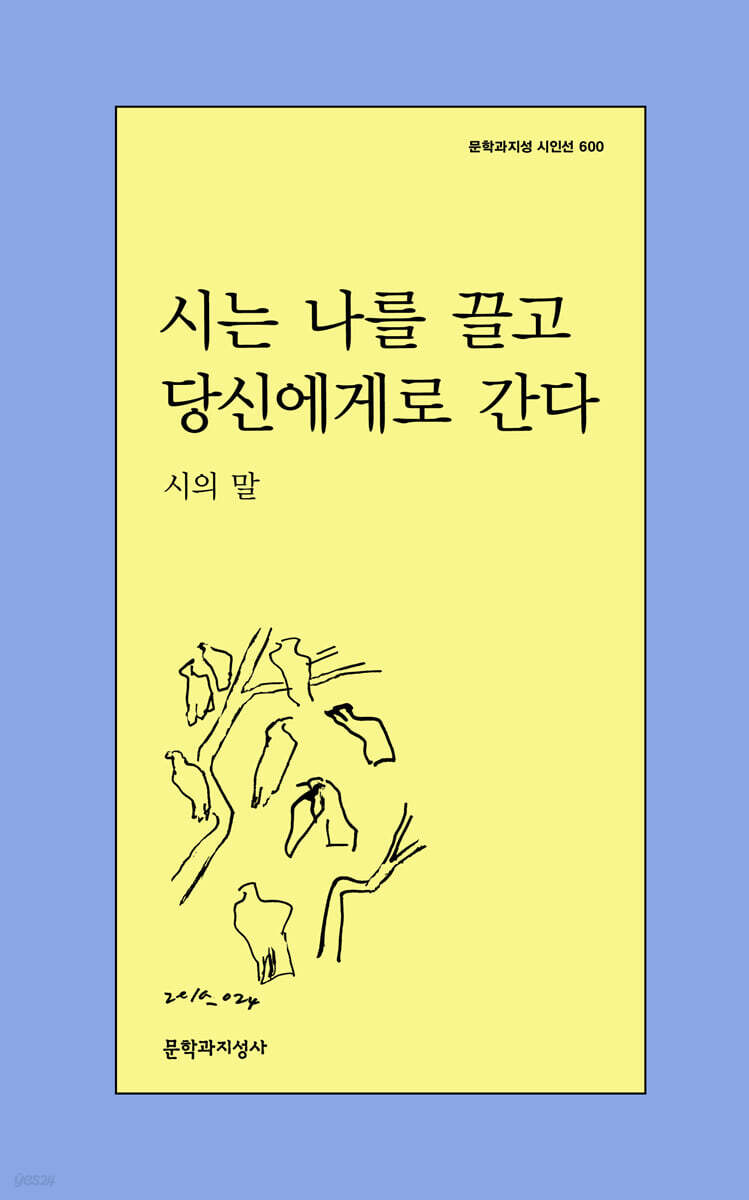
Poetry draws me to you
 |
Description
Book Introduction
- A word from MD
-
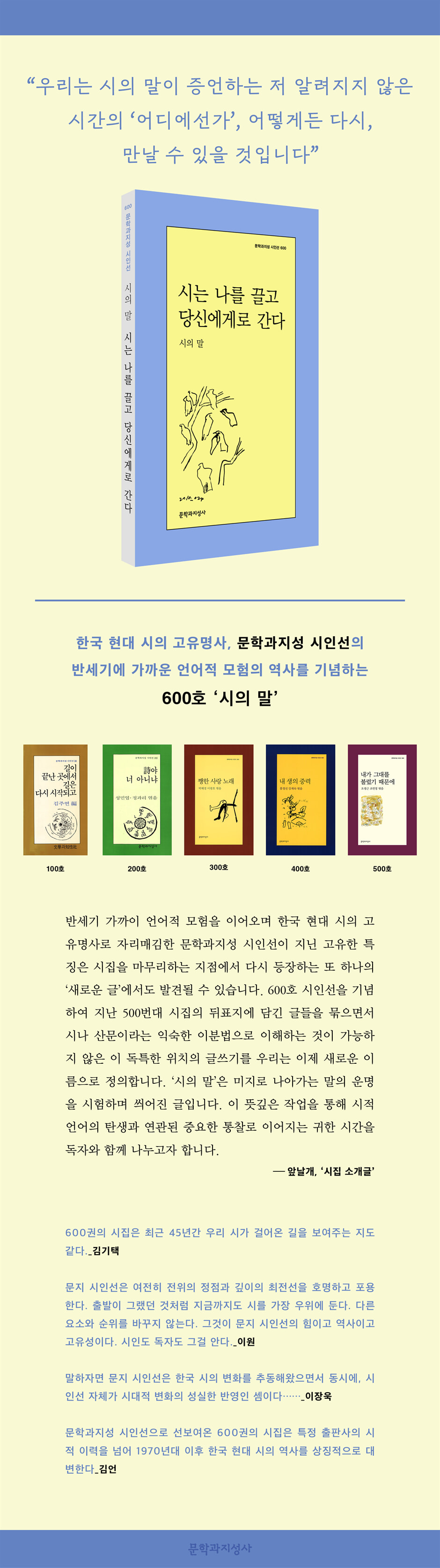
Into the 'Adventures of Korean Poetry' with the words of poetryInto the 'Adventure of Korean Poetry' with the words of poetry / Starting with Hwang Dong-gyu's 'When I See a Wheel, I Want to Roll It' in 1978, the Munhak-kwa-Jiseong poet selection has established itself as a proper noun of modern Korean poetry for 46 years.
This 600th issue compiles the 'Poetry Words' from the back covers of poetry collections 501 through 599, suggesting the uniqueness of Munji's poetic line and the unknown time in which his poetry was written.
April 12, 2024. Novel/Poetry PD Kim Yu-ri
“We are the ones who witness the unknown time of the poem.
Somewhere, somehow again,
“We will be able to meet”
Proper nouns of modern Korean poetry, selected by Literature and Intelligence Poet Selection
Celebrating nearly half a century of linguistic adventure
Issue 600 'Poetry's Words'
The unique characteristics of the Munhak-kwa-Jiseong poet line, which has established itself as a proper noun of modern Korean poetry through nearly half a century of linguistic adventure, can also be found in another 'new writing' that reappears at the end of the collection.
To commemorate the 600th issue of the Poetry Collection, we have compiled the writings from the back covers of past 500th poetry collections. We are now defining this unique form of writing, which defies the familiar dichotomy of poetry and prose, under a new name.
'The Words of Poetry' is a piece written to test the fate of words as they advance into the unknown.
Through this meaningful work, I hope to share with readers a precious moment that will lead to important insights related to the birth of poetic language.
―Apnalgae, 'Poetry Collection Introduction'
Somewhere, somehow again,
“We will be able to meet”
Proper nouns of modern Korean poetry, selected by Literature and Intelligence Poet Selection
Celebrating nearly half a century of linguistic adventure
Issue 600 'Poetry's Words'
The unique characteristics of the Munhak-kwa-Jiseong poet line, which has established itself as a proper noun of modern Korean poetry through nearly half a century of linguistic adventure, can also be found in another 'new writing' that reappears at the end of the collection.
To commemorate the 600th issue of the Poetry Collection, we have compiled the writings from the back covers of past 500th poetry collections. We are now defining this unique form of writing, which defies the familiar dichotomy of poetry and prose, under a new name.
'The Words of Poetry' is a piece written to test the fate of words as they advance into the unknown.
Through this meaningful work, I hope to share with readers a precious moment that will lead to important insights related to the birth of poetic language.
―Apnalgae, 'Poetry Collection Introduction'
- You can preview some of the book's contents.
Preview
index
501 | Lee Won | Love is Born
502 | Jang Su-jin | Love is like a swarm
503 | Lee Byeong-ryul | The sea is fine.
504 | Kim Eon | One sentence
505 | Choi Du-seok | Breathing Flower
506 | Hwang Hye-kyung | I Actively Become the Past
507 | Jo Eun | Footprints next to me
508 | Yoo Hee-kyung | He was a god to us for a while
509 | Jeonghana | Wolf Note
510 | Lee Su-myeong | Logistics Warehouse
511 | Kang Sung-eun | Lo-fi
512 | Lee Young-kwang | Endless Man
513 | Kim Jung-sik | I couldn't even cry
514 | Choi Seung-ho | A Country Where Preservatives Rot
515 | Kim Seon-jae | A Day on Jupiter
516 | Kim Myeong-in | From this branch to that shade
517 | Kwak Hyo-hwan | You
518 | Kihyuk | Sophia Loren's Time
519 | Park Jun | We might be able to see the rainy season together.
520 | Now | So the things that flowed
521 | Ryu In-seo | Playground
522 | Wi Seon-hwan | The Light That Begins
523 | Park Mi-ran | Who took my mouth?
524 | Im Ji-eun | Innocent and Soboro
525 | Song Jae-hak | Sad Full Gyeot-hye Isul
526 | Kim Hyung-young | Arrow Psalm
527 | Kim Hye-sun | Winged Fantasy
528 | Ha Jae-yeon | Cosmic Goodbye
529 | Yoon Byung-moo | You live my past, and I live your future.
530 | Seong Yun-seok | December 23, 2170
531 | Jang Seung-ri | Half-past
532 | Lee Young-joo | I hope you don't record any love.
533 | Lee Seol-bin | Song of the Fence
534 | Kim Seung-il | Quote up to here
535 | Shin Hae-wook | No Foot, No Eternity
536 | Kim Min-jeong | Your place is small, mine is big, so we are breaking up.
537 | Choi Jeong-jin | I think I know someone on the bus.
538 | Jo Yong-mi | Your Beauty
539 | Lee Ji-ah | Haute Couture
540 | Kang Hye-bin | Palette of the Night
541 | Jang Hyun | 22: Chae Mi Hee
542 | Heo Yeon | When will you become a song?
543 | Kim Haeng-suk | What errand are you running?
544 | Kim Yu-rim | Three or more models
545 | Ma Jong-gi | The Angel's Sigh
546 | Lee Gi-seong | Animal Autobiography
547 | Seung-Yu Lim | I came in winter, and you were in summer.
548 | Hwang Dong-gyu | Just for today
549 | Shin Young-bae | Water Goggles Moonlight
550 | Tae-Woon Ahn | To the walker
551 | Lee Seong-mi | Different Time, Different Arrangement
552 | Baek Eun-seon | Feeling Helped
553 | Lee Min-ha | Microclimate
554 | Yoon Ji-yang | Skid
555 | Kim Yong-taek | The Young Tree Where the Butterfly Hides
556 | Kim Kyung-hoo | I woke up to cry.
557 | Lee Hye-mi | Qualified as Light
558 | Yoon Eun-seong | Holding the address
559 | Ham Seong-ho | The Unburnt Tongue
560 | Lee Si-young | The Butterfly Has Returned
561 | Kwon Bak | Is it beautiful?
562 | Park Ji-il | Lip Sync Highway
563 | Im Ji-eun | Sometimes Kangaroo
564 | An Mi-rin | Ghost Theory in Dazzling Detail
565 | Kim Jung-il | If morning does not come in our poetry
566 | Lee Su-myeong | City Gas
567 | Kim Hye-soon | If the Earth dies, who will the moon orbit?
568 | Hwang Hye-kyung | The Middle of Time
569 | Kim Seon-o | Set
570 | Lee Ji-ah | So fluffy
571 | Kim Ri-yoon | Transparency Mixed Space
572 | Jin Eun-young | I love you like an old street
573 | Kim Ki-taek | The Sword Called Sickle
574 | Jeong Hyeon-jong | Tears originate from somewhere
575 | Hwang In-sook | The Pretty Calves of My Life
576 | Lee Woo-seong | I think I'm the reason
577 | Park Ra-yeon | The Do-Nothing Lover
578 | Leegiri | Wet scenery dries well
579 | Jo Si-hyun | Kids Time
580 | Kim Gwang-gyu | Email sent the day before yesterday
581 | Jacket | Unhesitatingly Introverted
582 | Lee So-ho | Home Sweet Home
583 | Lee Ha-seok | The Future of Memory
584 | Sim Ji-ah | Please be sure to brush the snow off your shoes.
585 | Oh Eun | A synonym for nothing
586 | Choi Du-seok | The Sleep of a Crane
587 | Kang Hye-bin | The Future Hums
588 | Kim Myeong-in | Today's progress is fast.
589 | Kim So-yeon | The Night That Promotes
590 | Irene | My Love Begins
591 | Kwak Hyo-hwan | The Man Who Cried Silently
592 | Seong Gi-wan | Light and Name
593 | Byun Hye-ji | How to Survive in a Destroyed World
594 | Park Se-mi | Today's Society Balcony
595 | Kim Jeong-hwan | Yellow Jesus 2
596 | Kim Ikang | Take the tram
597 | Kim An | Mazeppa
598 | Jang Su-jin | An Innocent Life
599 | Lee Jang-wook | Music Collection
Testimony to the Unknown: Kang Dong-ho
Introduction of the included poet
Literature and Intelligence Poet Selection 001-500
502 | Jang Su-jin | Love is like a swarm
503 | Lee Byeong-ryul | The sea is fine.
504 | Kim Eon | One sentence
505 | Choi Du-seok | Breathing Flower
506 | Hwang Hye-kyung | I Actively Become the Past
507 | Jo Eun | Footprints next to me
508 | Yoo Hee-kyung | He was a god to us for a while
509 | Jeonghana | Wolf Note
510 | Lee Su-myeong | Logistics Warehouse
511 | Kang Sung-eun | Lo-fi
512 | Lee Young-kwang | Endless Man
513 | Kim Jung-sik | I couldn't even cry
514 | Choi Seung-ho | A Country Where Preservatives Rot
515 | Kim Seon-jae | A Day on Jupiter
516 | Kim Myeong-in | From this branch to that shade
517 | Kwak Hyo-hwan | You
518 | Kihyuk | Sophia Loren's Time
519 | Park Jun | We might be able to see the rainy season together.
520 | Now | So the things that flowed
521 | Ryu In-seo | Playground
522 | Wi Seon-hwan | The Light That Begins
523 | Park Mi-ran | Who took my mouth?
524 | Im Ji-eun | Innocent and Soboro
525 | Song Jae-hak | Sad Full Gyeot-hye Isul
526 | Kim Hyung-young | Arrow Psalm
527 | Kim Hye-sun | Winged Fantasy
528 | Ha Jae-yeon | Cosmic Goodbye
529 | Yoon Byung-moo | You live my past, and I live your future.
530 | Seong Yun-seok | December 23, 2170
531 | Jang Seung-ri | Half-past
532 | Lee Young-joo | I hope you don't record any love.
533 | Lee Seol-bin | Song of the Fence
534 | Kim Seung-il | Quote up to here
535 | Shin Hae-wook | No Foot, No Eternity
536 | Kim Min-jeong | Your place is small, mine is big, so we are breaking up.
537 | Choi Jeong-jin | I think I know someone on the bus.
538 | Jo Yong-mi | Your Beauty
539 | Lee Ji-ah | Haute Couture
540 | Kang Hye-bin | Palette of the Night
541 | Jang Hyun | 22: Chae Mi Hee
542 | Heo Yeon | When will you become a song?
543 | Kim Haeng-suk | What errand are you running?
544 | Kim Yu-rim | Three or more models
545 | Ma Jong-gi | The Angel's Sigh
546 | Lee Gi-seong | Animal Autobiography
547 | Seung-Yu Lim | I came in winter, and you were in summer.
548 | Hwang Dong-gyu | Just for today
549 | Shin Young-bae | Water Goggles Moonlight
550 | Tae-Woon Ahn | To the walker
551 | Lee Seong-mi | Different Time, Different Arrangement
552 | Baek Eun-seon | Feeling Helped
553 | Lee Min-ha | Microclimate
554 | Yoon Ji-yang | Skid
555 | Kim Yong-taek | The Young Tree Where the Butterfly Hides
556 | Kim Kyung-hoo | I woke up to cry.
557 | Lee Hye-mi | Qualified as Light
558 | Yoon Eun-seong | Holding the address
559 | Ham Seong-ho | The Unburnt Tongue
560 | Lee Si-young | The Butterfly Has Returned
561 | Kwon Bak | Is it beautiful?
562 | Park Ji-il | Lip Sync Highway
563 | Im Ji-eun | Sometimes Kangaroo
564 | An Mi-rin | Ghost Theory in Dazzling Detail
565 | Kim Jung-il | If morning does not come in our poetry
566 | Lee Su-myeong | City Gas
567 | Kim Hye-soon | If the Earth dies, who will the moon orbit?
568 | Hwang Hye-kyung | The Middle of Time
569 | Kim Seon-o | Set
570 | Lee Ji-ah | So fluffy
571 | Kim Ri-yoon | Transparency Mixed Space
572 | Jin Eun-young | I love you like an old street
573 | Kim Ki-taek | The Sword Called Sickle
574 | Jeong Hyeon-jong | Tears originate from somewhere
575 | Hwang In-sook | The Pretty Calves of My Life
576 | Lee Woo-seong | I think I'm the reason
577 | Park Ra-yeon | The Do-Nothing Lover
578 | Leegiri | Wet scenery dries well
579 | Jo Si-hyun | Kids Time
580 | Kim Gwang-gyu | Email sent the day before yesterday
581 | Jacket | Unhesitatingly Introverted
582 | Lee So-ho | Home Sweet Home
583 | Lee Ha-seok | The Future of Memory
584 | Sim Ji-ah | Please be sure to brush the snow off your shoes.
585 | Oh Eun | A synonym for nothing
586 | Choi Du-seok | The Sleep of a Crane
587 | Kang Hye-bin | The Future Hums
588 | Kim Myeong-in | Today's progress is fast.
589 | Kim So-yeon | The Night That Promotes
590 | Irene | My Love Begins
591 | Kwak Hyo-hwan | The Man Who Cried Silently
592 | Seong Gi-wan | Light and Name
593 | Byun Hye-ji | How to Survive in a Destroyed World
594 | Park Se-mi | Today's Society Balcony
595 | Kim Jeong-hwan | Yellow Jesus 2
596 | Kim Ikang | Take the tram
597 | Kim An | Mazeppa
598 | Jang Su-jin | An Innocent Life
599 | Lee Jang-wook | Music Collection
Testimony to the Unknown: Kang Dong-ho
Introduction of the included poet
Literature and Intelligence Poet Selection 001-500
Detailed image
Into the book
Even when poetry speaks of the past or present, it already speaks to a future other that it does not even know about.
Because the unknown truth that poetry testifies to implies a future as an unknown time, a time that has not yet arrived.
When a poet surrenders control to his language and quietly watches where it leads, it expresses a firm affirmation and confidence that it can reach the lives of someone he has never met.
Therefore, the fact that our society has not abandoned poetry proves that there are still people who listen to the testimony of hope that poetry offers toward the future, and that faith in humanity has not yet been abandoned.
As long as the witnesses who trust in the truth of that testimony do not disappear, poetry, with its vision of the truth that its words urge, will lead us into the future.
And we will meet again, somehow, “somewhere” in that unknown time that the words of the poem testify to.
Because the unknown truth that poetry testifies to implies a future as an unknown time, a time that has not yet arrived.
When a poet surrenders control to his language and quietly watches where it leads, it expresses a firm affirmation and confidence that it can reach the lives of someone he has never met.
Therefore, the fact that our society has not abandoned poetry proves that there are still people who listen to the testimony of hope that poetry offers toward the future, and that faith in humanity has not yet been abandoned.
As long as the witnesses who trust in the truth of that testimony do not disappear, poetry, with its vision of the truth that its words urge, will lead us into the future.
And we will meet again, somehow, “somewhere” in that unknown time that the words of the poem testify to.
--- From "Kang Dong-ho's Preface - Testimony to the Unknown - What Poetry Says to Us"
Publisher's Review
Opening the 'first' and 'greatest' of Korean literature
A poetry collection series that stands at the 'best' position!
The Munhak-kwa-Jiseong Poet Selection publishes its 600th issue.
It has been 46 years since Hwang Dong-gyu published his first poetry collection, “When I See a Wheel, I Want to Roll It,” in 1978.
In 1990, 12 years after the publication of the first poetry collection, the Munhak-kwa-Jiseong Poets' Selection selected works by 60 poets from 99 volumes of poetry collections published up to that point, and published the 100th commemorative poetry collection, "The Road Begins Where the Road Ends" (edited by Kim Ju-yeon). Since then, commemorative poetry collections have been published every 6 to 8 years, signaling the start of a new 100th issue.
The 200th issue commemorative poetry collection 『Poetry, Isn't It You?』 (edited by Seong Min-yeop and Jeong Gwa-ri), published in 1997, is a collection of 98 poems in the nature of 'prologues' from poetry collections in their 100th issue. From this point on, the Munhak-kwa-Jiseong Poet Selection was already beginning its unique path as the 'largest' series of Korean poetry collections, the 'first' to surpass 200 volumes.
This achievement is significant not only in terms of quantity, but also in that it quickly captured the diverse poetic pursuits of contemporary poets and showed the trends of modern Korean poetry.
The 300th issue commemorative poetry collection 『A Bright Love Song』 (edited by Park Hye-kyung and Lee Gwang-ho), published in 2005, contains 99 poems that reinterpret 'love' from poetry collections in the 200s.
From this time on, we focused on improving readability by redesigning the font, size, letter spacing, line spacing, line length, and margins of the text.
Along with this, various opinions began to emerge regarding the cover design, and although there was deep consideration for a new attempt, the consensus was to continue the unique image of the Munhak-kwa-Jisung poet line.
Since then, through increasingly intense reflection on the flow of time, Munhak-kwa-Jiseong-sa has been steadily carrying on this precious tradition, while also seeking positive changes within it.
The 400th issue commemorative poetry collection 『Gravity of My Life』 (Hong Jeong-seon and Kang Gye-sook), published in 2011, is a collection of poems selected by poets from the 300th collection on the theme of ‘Portrait of a Poet.’
Literary critic Shin Hyeong-cheol wrote this in a column about this ‘first’ poetry collection series, which published 400 volumes over 33 years.
“This does not mean that no publishing company has given up on poetry for 33 years, but that Korean society has not given up on poetry.
“Compared to other countries, this is rather surprising” (Never give up on poetry, Hankyoreh 21, October 14, 2011).
But it was too early to be surprised.
The 'first' and 'greatest' of the Munhak-kwa-jisung poet line continues without end.
The 500th issue commemorative poetry collection, “Because I Called You” (edited by Oh Saeng-geun and Jo Yeon-jeong), published in 2017, was planned a little differently from previous poetry collections.
Unlike the 100th to 400th commemorative poetry collections that selected and bound one poem from each of the 99 previously published poetry collections, the 500th poetry collection selected 85 poetry collections that have been consistently loved by readers for 10 years since their first editions were published, and have updated their literary meaning without being bound by time. Two representative works were selected from each of the 65 poets who wrote the collections, for a total of 130 poems.
And in April 2024, less than seven years later, the Munhak-kwa-Jiseong Poet Selection will publish its 600th issue, which is a bit more special.
Unlike previous anthologies, this one has no editor and a new name has been added in its place.
It is not a ‘book of poems’ or a ‘collection of poems’, but ‘the words of poetry’.
This is a collection of back cover essays from 99 poetry collections, from the 501st to the 599th, titled 'Poetry's Words', which is a collection of poems that pull me towards you.
“The words of poetry are not known to the poet,
“The poet appears even more unaware.”
The poetry collection series currently being published by various publishers have a similar structure, including 'the poet's words,' 'poems,' 'commentaries,' or 'the poet's prose.'
Among these, the unique feature of the Munhak-kwa-Jiseong Poet Series that distinguishes it from other poetry collections is none other than the additional writing the poet writes on the back cover.
This 'new writing' has no set format, no specific requests to the poet, and is left entirely to the poet's discretion.
Thus, a unique style of writing was born that is both prose and poetry, that seems like poetry but is not poetry, that cannot be understood with the familiar dichotomy of poetry or prose, whether it is a single sentence, or it fills up the entire back cover, or it shows an image that cannot be read as text.
Opening the door to yet another new 100th edition, this project, which brings together the back covers of the past 99 poetry collections from volumes 501 to 599, will reaffirm the uniqueness of the Munhak-kwa-Jisung poets' line, while also providing a special opportunity to look at the poetry collections that have been with the Munhak-kwa-Jisung poets' line over the past period from a perspective other than poetry itself.
It was the words of poetry! It was the words of poetry.
It was poetry speaking without a poet.
It was just the words of poetry.
The moment poetry became a living thing, the moment poetry changed into a living thing, it was a word that fluttered there.
Now I know why I first read the sentence in the square on the back cover and why I stayed there quietly.
The words of a poem appear without the poem itself knowing, and even more without the poet knowing.
It exists without you even realizing it when you read it.
This exquisite placement captures the point precisely.
―Lee Won, “From Avant-Garde to Love: A Rare and Unique History of Modern Korean Poetry,” Literature and Society, Spring 2024, p.
352.
To understand why this book, which cannot be called a "poetry collection" or a "poetry anthology," came to be called "The Words of Poetry," we need to look at the writing of poet Lee Won, which was included in the special feature commemorating the 600th issue of the Literature and Society Poetry Anthology in the spring of 2024.
Through his writing about experiencing the weight of the words on the back cover as a reader and as a poet who wrote them himself, and realizing at some point that they were the words of poetry speaking without the poet, literary critic Kang Dong-ho, who wrote the foreword to this 600th issue, preaches that “if we pay attention to the ‘not knowing’ that poet Lee Won suggested like a hint, that “it appears without the poem knowing, and even more so without the poet knowing” and “it exists without the reader knowing”, we might be able to reach an important insight related to the birth of poetic language, surprisingly.”
“Poetry starts from the unknown and draws a trajectory toward the unknown, unifying the source, goal, and method of poetic language, and ultimately bringing even the subject of poetry to an unknown state.” In this way, “since one cannot predict where one’s own words will reach, the time of this adventure is once again brought to the forefront as an unknown time, and further, as oneself as the unknown.”
Kang Dong-ho also points out that “the fact that poetic words start from the unknown and head toward the unknown, and that they imply their own existence, emphasizes once again that poetry is difficult to explain as a clear statement and expression of something, or in short, as a language of confession,” and argues that “we may be able to rediscover the ‘words of poetry’ in a place where such an impossible testimony about oneself can be attempted exceptionally.”
The words of poetry are a testimony to the unknown, but at the same time, they are also a testimony to the future.
The prospective nature of poetic testimony implies that poetry simultaneously looks to the future within the limitations of the present.
[… … ] In its focus on an undefined time that has not yet been given a proper tense, poetry can speak to the future and bear witness to the future without predicting or foreseeing.
We could call the message of that testimony hope.
―Kang Dong-ho's preface, from "Testimony to the Unknown: What Poetry Says to Us"
Therefore, the reason why the “Words of Poetry” were placed here in commemoration of the 600th issue as a testimony to the unknown and to the future is not simply a celebration of the nearly half-century of time and the achievements of “first” and “greatest,” but rather, it is to find here again “the possibility of dreaming of a new world.”
This one volume contains only 99 poems from the 500th series, but the world it contains encompasses the depth of the poems that could not be fully contained in the previous 500 volumes.
This is why the title of this book, “Poetry Takes Me to You,” was taken from the back cover text of Heo Su-gyeong’s poetry collection, “Time of Bronze and Time of Potatoes,” published in Munhak-kwa-Jiseong Poet Selection No. 309.
Some people use words, some play with words, some make up words and get sick, and some are at peace with words.
The horse would take me somewhere and the horse would drag me to you.
Hot words and cold words, words of dreams and fire and darkness and war.
I wish the words that were spoken to me were there for, say, an Iraqi man who died in a bomb attack while standing in line at a checkpoint one fall in 2003, trying to feed his young daughter and elderly mother.
There are countless experiences of frustration in modern history where peace cannot be achieved through words, and there will be many in the future.
―Heo Su-gyeong, from the back cover of 『The Time of Bronze, the Time of Potatoes』 (Munhak-kwa-Jiseongsa, 2005)
Reading the testimony of the present in the 'words of poetry' written in the past by a poet who is no longer with us, and confirming the poetry that is always vividly alive with us, transcending time and space.
This is how it becomes possible to encounter “an unknown hope that can only be encountered through thorough and cold pessimism, another name for the truth that can never be extinguished” (Kang Dong-ho).
Readers will have the precious experience of discovering the belief that poetry will lead us and lead us towards the future together in the 600th volume of the Munhak-kwa-Jisung Poet Selection, “Poetry Leads Me to You.”
Beyond literary events, it is recorded as living history.
Past, Present, and Future of Modern Korean Poetry
The history of the literary and intellectual poets' linguistic adventure, which has continued for nearly half a century, is more passionate than ever and is ongoing.
13 years ago, Shin Hyeong-cheol said, “The territory of a country’s imagination is wider than its total land area.
“The land of imagination contained in these 400 volumes of poetry is at least larger than the area of South Korea,” he said, but now, with 600 volumes, the land of imagination contained in the Munhak-kwa-Jiseong Poet Collection is expanding beyond our country and into the world without hesitation.
Beginning with the publication in Germany of Hwang Ji-woo's "One Day I Will Be Sitting in a Cloudy Bar" (1998) in 2003, poetry collections by Hwang Dong-gyu, Jeong Hyeon-jong, Kim Gwang-gyu, Ma Jong-gi, Oh Gyu-won, Lee Seong-bok, Kim Hye-sun, Choi Seung-ja, Ki Hyeong-do, Lee Won, Song Chan-ho, Yu Ha, Kim Haeng-sook, Jin Eun-yeong, Lee Su-myeong, Kim Jung-sik, Lee Min-ha, Han Kang, Moon Tae-jun, Kang Jeong, Seo Jeong-hak, Shin Hae-wook, Lee Jang-wook, Kwak Hyo-hwan, Kim I-deum, Lee Yeong-ju, Sim Bo-seon, Ha Jae-yeon, Oh Eun, Yoo Hee-kyung, Lee Hye-mi, and Im Sol-a have been translated and published overseas or are scheduled to be published.
The language range is also diverse, with English being the most common, followed by Japanese, French, Thai, Chinese, Spanish, Persian, German, Russian, Mongolian, Arabic, and Czech.
The poetry collection that has been exported to the most languages as a single collection is Lee Seong-bok's "Ah, Things Without Mouths" (2003), which has been translated and published in four countries: Russia, the United States, Germany, and France. The poet who has published the most collections of poetry overseas is Kim Hye-sun, whose "Your First" (2008) was published in France in 2009, "Sad Toothpaste Mirror Cream" (2011) in the United States and France in 2011, "Bloom, Pig" (2016) in the United States in 2016, "A Glass of Red Mirror" (2004) in France in 2016 and in the United States in 2019, "Poor Love Machine" (1997) in the United States in 2016, and "Wing Fantasy Pain" (2019) in the United States in 2023 and in France (scheduled for publication in 2024).
In particular, 『Wing Fantasy Pain』, published by New Directions in the United States in May 2023, was selected as one of the New York Times' '5 Best Poetry Books of 2023' and the Washington Post's '11 Best Poetry Books of 2023', demonstrating an unrivaled streak, and last month (March 2024), it won the poetry category of the '2023 National Book Critics Circle Award', writing a new history in Korean literature.
In addition, Kim Yi-deum's "Hysteria" (2014) and Lee Young-ju's "Cold Candies" (2014) won the Lucien Stryk Translation Award hosted by the Literary Translators of America in 2019 and 2022, respectively.
Meanwhile, the Munhak-kwa-Jiseong Poet Line, which consists of designs by the late poet Oh Kyu-won and caricatures by the late poet Kim Young-tae and writer Lee Je-ha, has been changing the background color of the border for every 100th series in the following order: yellow (1-100), blue (101-199), green (200-299), bright copper (300-399), navy blue (400-499), and purple (500-599). The color for the 600th series was decided to be blue, an exquisite blend of sea blue and sky blue.
In particular, it is impressive that they boldly broke away from the glossy coating of art paper that had been maintained until now and adopted a matte coating method that preserves the texture of the paper.
In addition, the detailed arrangement of the cover, the font and size of the main text, the spacing between letters and lines, the length of the text, and the margins were also comprehensively revised.
The caricatures on the cover will continue to be drawn by artist Lee Je-ha unless there are individual requests from the poet.
The cover of the poet's book is something that I always think about fiercely, not just when I'm over 100.
The publication of limited edition recovered books at the Design Festival in 2000 and the Seoul International Book Fair in 2023 garnered positive responses from readers as a new challenge, and it is also true that there were specific suggestions for bold change and proactive attempts.
The reason we still maintain the same basic framework is not because better designs are not available, nor is it because we are deaf to the call for change.
At the very last moment, I still think that this is where the poem is taking me.
This is because I know that 46 years of time, more poets, more poetry collections, and above all, the hearts of more readers who live with the poetry of the Munhak-kwa-Jiseong poets are melted into one side.
And it is also an expression of Munhak-kwa-Jiseongsa's will to not forget that it is a valuable tradition of the Munhak-kwa-Jiseong poet line and to continue it steadfastly.
A poetry collection series that stands at the 'best' position!
The Munhak-kwa-Jiseong Poet Selection publishes its 600th issue.
It has been 46 years since Hwang Dong-gyu published his first poetry collection, “When I See a Wheel, I Want to Roll It,” in 1978.
In 1990, 12 years after the publication of the first poetry collection, the Munhak-kwa-Jiseong Poets' Selection selected works by 60 poets from 99 volumes of poetry collections published up to that point, and published the 100th commemorative poetry collection, "The Road Begins Where the Road Ends" (edited by Kim Ju-yeon). Since then, commemorative poetry collections have been published every 6 to 8 years, signaling the start of a new 100th issue.
The 200th issue commemorative poetry collection 『Poetry, Isn't It You?』 (edited by Seong Min-yeop and Jeong Gwa-ri), published in 1997, is a collection of 98 poems in the nature of 'prologues' from poetry collections in their 100th issue. From this point on, the Munhak-kwa-Jiseong Poet Selection was already beginning its unique path as the 'largest' series of Korean poetry collections, the 'first' to surpass 200 volumes.
This achievement is significant not only in terms of quantity, but also in that it quickly captured the diverse poetic pursuits of contemporary poets and showed the trends of modern Korean poetry.
The 300th issue commemorative poetry collection 『A Bright Love Song』 (edited by Park Hye-kyung and Lee Gwang-ho), published in 2005, contains 99 poems that reinterpret 'love' from poetry collections in the 200s.
From this time on, we focused on improving readability by redesigning the font, size, letter spacing, line spacing, line length, and margins of the text.
Along with this, various opinions began to emerge regarding the cover design, and although there was deep consideration for a new attempt, the consensus was to continue the unique image of the Munhak-kwa-Jisung poet line.
Since then, through increasingly intense reflection on the flow of time, Munhak-kwa-Jiseong-sa has been steadily carrying on this precious tradition, while also seeking positive changes within it.
The 400th issue commemorative poetry collection 『Gravity of My Life』 (Hong Jeong-seon and Kang Gye-sook), published in 2011, is a collection of poems selected by poets from the 300th collection on the theme of ‘Portrait of a Poet.’
Literary critic Shin Hyeong-cheol wrote this in a column about this ‘first’ poetry collection series, which published 400 volumes over 33 years.
“This does not mean that no publishing company has given up on poetry for 33 years, but that Korean society has not given up on poetry.
“Compared to other countries, this is rather surprising” (Never give up on poetry, Hankyoreh 21, October 14, 2011).
But it was too early to be surprised.
The 'first' and 'greatest' of the Munhak-kwa-jisung poet line continues without end.
The 500th issue commemorative poetry collection, “Because I Called You” (edited by Oh Saeng-geun and Jo Yeon-jeong), published in 2017, was planned a little differently from previous poetry collections.
Unlike the 100th to 400th commemorative poetry collections that selected and bound one poem from each of the 99 previously published poetry collections, the 500th poetry collection selected 85 poetry collections that have been consistently loved by readers for 10 years since their first editions were published, and have updated their literary meaning without being bound by time. Two representative works were selected from each of the 65 poets who wrote the collections, for a total of 130 poems.
And in April 2024, less than seven years later, the Munhak-kwa-Jiseong Poet Selection will publish its 600th issue, which is a bit more special.
Unlike previous anthologies, this one has no editor and a new name has been added in its place.
It is not a ‘book of poems’ or a ‘collection of poems’, but ‘the words of poetry’.
This is a collection of back cover essays from 99 poetry collections, from the 501st to the 599th, titled 'Poetry's Words', which is a collection of poems that pull me towards you.
“The words of poetry are not known to the poet,
“The poet appears even more unaware.”
The poetry collection series currently being published by various publishers have a similar structure, including 'the poet's words,' 'poems,' 'commentaries,' or 'the poet's prose.'
Among these, the unique feature of the Munhak-kwa-Jiseong Poet Series that distinguishes it from other poetry collections is none other than the additional writing the poet writes on the back cover.
This 'new writing' has no set format, no specific requests to the poet, and is left entirely to the poet's discretion.
Thus, a unique style of writing was born that is both prose and poetry, that seems like poetry but is not poetry, that cannot be understood with the familiar dichotomy of poetry or prose, whether it is a single sentence, or it fills up the entire back cover, or it shows an image that cannot be read as text.
Opening the door to yet another new 100th edition, this project, which brings together the back covers of the past 99 poetry collections from volumes 501 to 599, will reaffirm the uniqueness of the Munhak-kwa-Jisung poets' line, while also providing a special opportunity to look at the poetry collections that have been with the Munhak-kwa-Jisung poets' line over the past period from a perspective other than poetry itself.
It was the words of poetry! It was the words of poetry.
It was poetry speaking without a poet.
It was just the words of poetry.
The moment poetry became a living thing, the moment poetry changed into a living thing, it was a word that fluttered there.
Now I know why I first read the sentence in the square on the back cover and why I stayed there quietly.
The words of a poem appear without the poem itself knowing, and even more without the poet knowing.
It exists without you even realizing it when you read it.
This exquisite placement captures the point precisely.
―Lee Won, “From Avant-Garde to Love: A Rare and Unique History of Modern Korean Poetry,” Literature and Society, Spring 2024, p.
352.
To understand why this book, which cannot be called a "poetry collection" or a "poetry anthology," came to be called "The Words of Poetry," we need to look at the writing of poet Lee Won, which was included in the special feature commemorating the 600th issue of the Literature and Society Poetry Anthology in the spring of 2024.
Through his writing about experiencing the weight of the words on the back cover as a reader and as a poet who wrote them himself, and realizing at some point that they were the words of poetry speaking without the poet, literary critic Kang Dong-ho, who wrote the foreword to this 600th issue, preaches that “if we pay attention to the ‘not knowing’ that poet Lee Won suggested like a hint, that “it appears without the poem knowing, and even more so without the poet knowing” and “it exists without the reader knowing”, we might be able to reach an important insight related to the birth of poetic language, surprisingly.”
“Poetry starts from the unknown and draws a trajectory toward the unknown, unifying the source, goal, and method of poetic language, and ultimately bringing even the subject of poetry to an unknown state.” In this way, “since one cannot predict where one’s own words will reach, the time of this adventure is once again brought to the forefront as an unknown time, and further, as oneself as the unknown.”
Kang Dong-ho also points out that “the fact that poetic words start from the unknown and head toward the unknown, and that they imply their own existence, emphasizes once again that poetry is difficult to explain as a clear statement and expression of something, or in short, as a language of confession,” and argues that “we may be able to rediscover the ‘words of poetry’ in a place where such an impossible testimony about oneself can be attempted exceptionally.”
The words of poetry are a testimony to the unknown, but at the same time, they are also a testimony to the future.
The prospective nature of poetic testimony implies that poetry simultaneously looks to the future within the limitations of the present.
[… … ] In its focus on an undefined time that has not yet been given a proper tense, poetry can speak to the future and bear witness to the future without predicting or foreseeing.
We could call the message of that testimony hope.
―Kang Dong-ho's preface, from "Testimony to the Unknown: What Poetry Says to Us"
Therefore, the reason why the “Words of Poetry” were placed here in commemoration of the 600th issue as a testimony to the unknown and to the future is not simply a celebration of the nearly half-century of time and the achievements of “first” and “greatest,” but rather, it is to find here again “the possibility of dreaming of a new world.”
This one volume contains only 99 poems from the 500th series, but the world it contains encompasses the depth of the poems that could not be fully contained in the previous 500 volumes.
This is why the title of this book, “Poetry Takes Me to You,” was taken from the back cover text of Heo Su-gyeong’s poetry collection, “Time of Bronze and Time of Potatoes,” published in Munhak-kwa-Jiseong Poet Selection No. 309.
Some people use words, some play with words, some make up words and get sick, and some are at peace with words.
The horse would take me somewhere and the horse would drag me to you.
Hot words and cold words, words of dreams and fire and darkness and war.
I wish the words that were spoken to me were there for, say, an Iraqi man who died in a bomb attack while standing in line at a checkpoint one fall in 2003, trying to feed his young daughter and elderly mother.
There are countless experiences of frustration in modern history where peace cannot be achieved through words, and there will be many in the future.
―Heo Su-gyeong, from the back cover of 『The Time of Bronze, the Time of Potatoes』 (Munhak-kwa-Jiseongsa, 2005)
Reading the testimony of the present in the 'words of poetry' written in the past by a poet who is no longer with us, and confirming the poetry that is always vividly alive with us, transcending time and space.
This is how it becomes possible to encounter “an unknown hope that can only be encountered through thorough and cold pessimism, another name for the truth that can never be extinguished” (Kang Dong-ho).
Readers will have the precious experience of discovering the belief that poetry will lead us and lead us towards the future together in the 600th volume of the Munhak-kwa-Jisung Poet Selection, “Poetry Leads Me to You.”
Beyond literary events, it is recorded as living history.
Past, Present, and Future of Modern Korean Poetry
The history of the literary and intellectual poets' linguistic adventure, which has continued for nearly half a century, is more passionate than ever and is ongoing.
13 years ago, Shin Hyeong-cheol said, “The territory of a country’s imagination is wider than its total land area.
“The land of imagination contained in these 400 volumes of poetry is at least larger than the area of South Korea,” he said, but now, with 600 volumes, the land of imagination contained in the Munhak-kwa-Jiseong Poet Collection is expanding beyond our country and into the world without hesitation.
Beginning with the publication in Germany of Hwang Ji-woo's "One Day I Will Be Sitting in a Cloudy Bar" (1998) in 2003, poetry collections by Hwang Dong-gyu, Jeong Hyeon-jong, Kim Gwang-gyu, Ma Jong-gi, Oh Gyu-won, Lee Seong-bok, Kim Hye-sun, Choi Seung-ja, Ki Hyeong-do, Lee Won, Song Chan-ho, Yu Ha, Kim Haeng-sook, Jin Eun-yeong, Lee Su-myeong, Kim Jung-sik, Lee Min-ha, Han Kang, Moon Tae-jun, Kang Jeong, Seo Jeong-hak, Shin Hae-wook, Lee Jang-wook, Kwak Hyo-hwan, Kim I-deum, Lee Yeong-ju, Sim Bo-seon, Ha Jae-yeon, Oh Eun, Yoo Hee-kyung, Lee Hye-mi, and Im Sol-a have been translated and published overseas or are scheduled to be published.
The language range is also diverse, with English being the most common, followed by Japanese, French, Thai, Chinese, Spanish, Persian, German, Russian, Mongolian, Arabic, and Czech.
The poetry collection that has been exported to the most languages as a single collection is Lee Seong-bok's "Ah, Things Without Mouths" (2003), which has been translated and published in four countries: Russia, the United States, Germany, and France. The poet who has published the most collections of poetry overseas is Kim Hye-sun, whose "Your First" (2008) was published in France in 2009, "Sad Toothpaste Mirror Cream" (2011) in the United States and France in 2011, "Bloom, Pig" (2016) in the United States in 2016, "A Glass of Red Mirror" (2004) in France in 2016 and in the United States in 2019, "Poor Love Machine" (1997) in the United States in 2016, and "Wing Fantasy Pain" (2019) in the United States in 2023 and in France (scheduled for publication in 2024).
In particular, 『Wing Fantasy Pain』, published by New Directions in the United States in May 2023, was selected as one of the New York Times' '5 Best Poetry Books of 2023' and the Washington Post's '11 Best Poetry Books of 2023', demonstrating an unrivaled streak, and last month (March 2024), it won the poetry category of the '2023 National Book Critics Circle Award', writing a new history in Korean literature.
In addition, Kim Yi-deum's "Hysteria" (2014) and Lee Young-ju's "Cold Candies" (2014) won the Lucien Stryk Translation Award hosted by the Literary Translators of America in 2019 and 2022, respectively.
Meanwhile, the Munhak-kwa-Jiseong Poet Line, which consists of designs by the late poet Oh Kyu-won and caricatures by the late poet Kim Young-tae and writer Lee Je-ha, has been changing the background color of the border for every 100th series in the following order: yellow (1-100), blue (101-199), green (200-299), bright copper (300-399), navy blue (400-499), and purple (500-599). The color for the 600th series was decided to be blue, an exquisite blend of sea blue and sky blue.
In particular, it is impressive that they boldly broke away from the glossy coating of art paper that had been maintained until now and adopted a matte coating method that preserves the texture of the paper.
In addition, the detailed arrangement of the cover, the font and size of the main text, the spacing between letters and lines, the length of the text, and the margins were also comprehensively revised.
The caricatures on the cover will continue to be drawn by artist Lee Je-ha unless there are individual requests from the poet.
The cover of the poet's book is something that I always think about fiercely, not just when I'm over 100.
The publication of limited edition recovered books at the Design Festival in 2000 and the Seoul International Book Fair in 2023 garnered positive responses from readers as a new challenge, and it is also true that there were specific suggestions for bold change and proactive attempts.
The reason we still maintain the same basic framework is not because better designs are not available, nor is it because we are deaf to the call for change.
At the very last moment, I still think that this is where the poem is taking me.
This is because I know that 46 years of time, more poets, more poetry collections, and above all, the hearts of more readers who live with the poetry of the Munhak-kwa-Jiseong poets are melted into one side.
And it is also an expression of Munhak-kwa-Jiseongsa's will to not forget that it is a valuable tradition of the Munhak-kwa-Jiseong poet line and to continue it steadfastly.
GOODS SPECIFICS
- Date of issue: April 3, 2024
- Page count, weight, size: 180 pages | 364g | 128*205*20mm
- ISBN13: 9788932042701
- ISBN10: 8932042705
You may also like
카테고리
korean


korean

![GQ KOREA Mark (Monthly): December [2025]](http://librairie.coreenne.fr/cdn/shop/files/8ef265dbbfbf186523ed75ba7319009d.jpg?v=1765340328&width=3840)


