

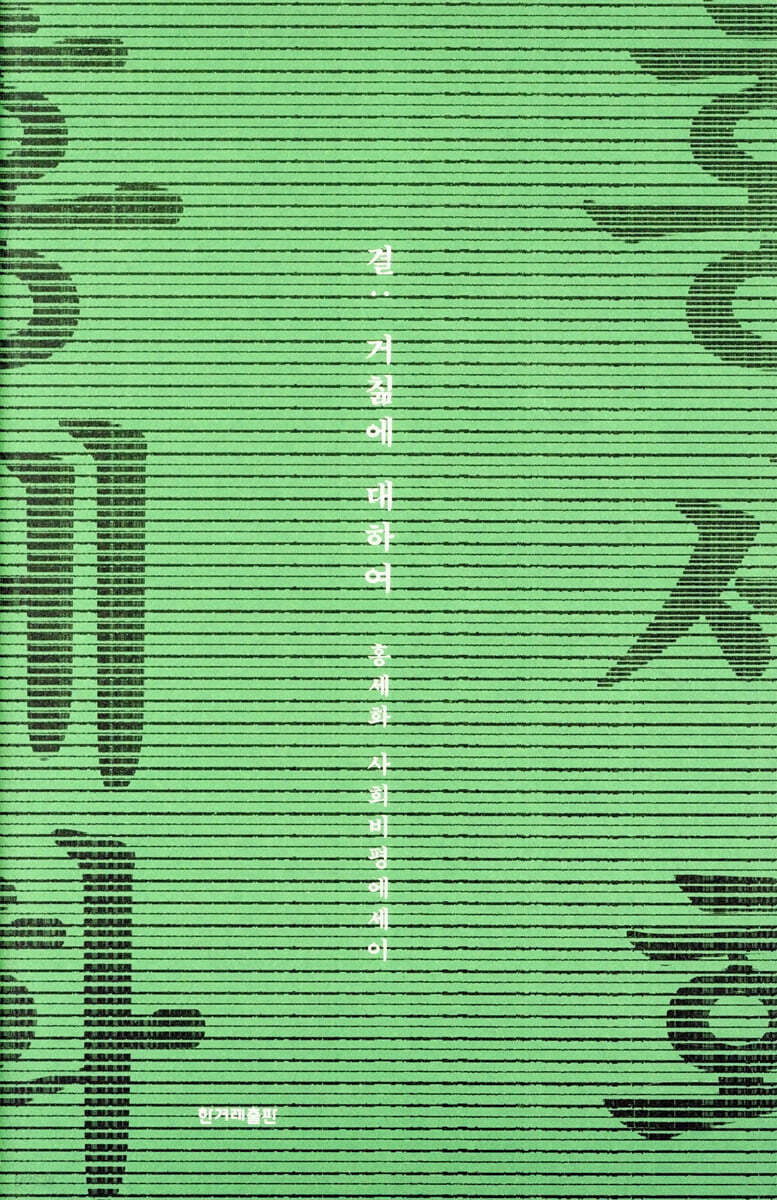
Conclusion: About the rough
 |
Description
Book Introduction
- A word from MD
-
Hong Se-hwa's Freedom, Truth, and JusticeHong Se-hwa's first solo book in 11 years.
Diagnosed the current state of Korean society.
As the book says, "Freedom is sad in this land," and "truth and justice, unlike power and money, have no power in themselves."
The author does not offer an alternative.
Instead, say this:
Let's become free people who are better at losing.
March 6, 2020. Social and Political PD Son Min-gyu
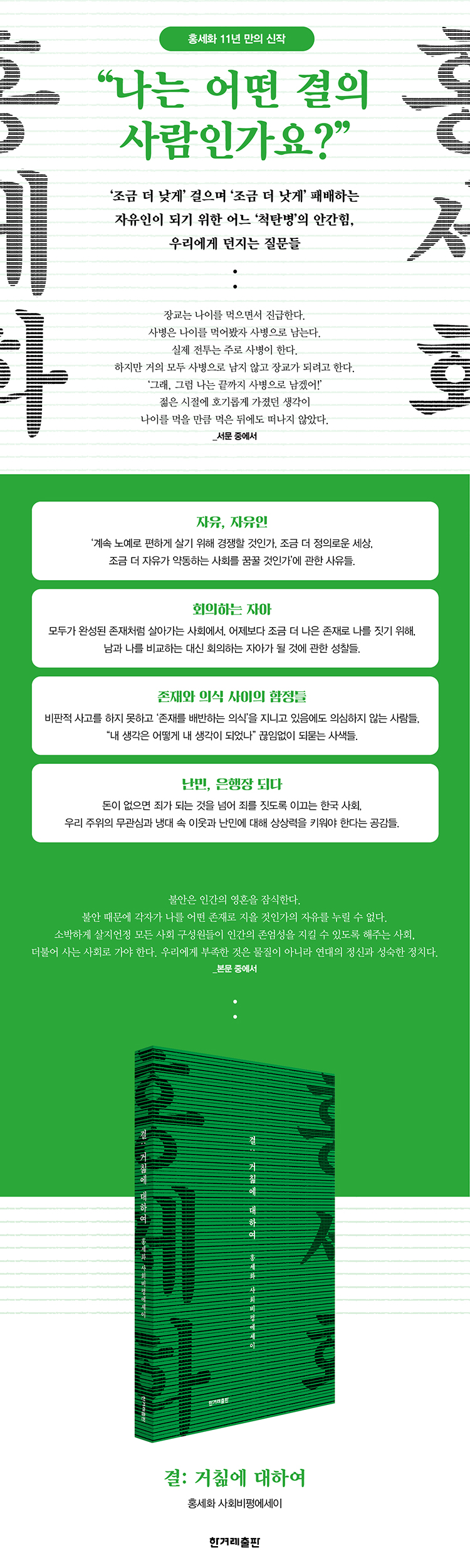
“What kind of resolution am I?”
Hong Se-hwa's first new work in 11 years,
To become a free man who loses 'a little better'
The struggles of a "grenadier" and the questions it raises for us.
Hong Se-hwa, a godfather of progressive intellectuals who has raised painful yet clear questions about our times in works such as “I am a Taxi Driver in Paris,” “The Seine Divides Left and Right, and the Han River Divides North and South,” and “Coordinates of Thought,” has published a new work after 11 years.
Even when the rough textures of the world crash against the waves and he is sometimes swept away by the great texture without being able to control himself, his thoughts, which have always maintained their center, serve as a compass to regain center in a world torn apart by division, and make us look back on the direction and texture of life.
People, human relationships, and society are all rough and not delicate or gentle.
In this unrefined society, where those who embrace hospitality, consideration, and humility are the weak, we have become 'comfortable' only by being sharp and rough rather than rounded.
Although we are certainly living in a freer era than in the past, we are living an oppressed life without even realizing it within the structure of neoliberalism.
The places where this was fully implemented were 'school' and 'military', and we were secretly trained as slaves within this 'normal' system.
The powerless, unable to say “no” to state violence, are now forced to “voluntarily submit,” cleverly manipulated by the false discourse created by capitalists and the agenda-setting of politicians.
The author speaks of a world where one must turn a blind eye to injustice to enjoy a comfortable and easy life, and where one must give up one's humanity and become rough in order to survive.
Let us come down from the mountain called Korean society and walk 'a little lower', becoming free people who fight against domination and submission, and become free people who defeat 'a little better'.
This book is the result of such efforts.
Even if only a very small number of people want to live like human beings and enjoy true freedom, let's unite and walk that path together.
Hong Se-hwa's first new work in 11 years,
To become a free man who loses 'a little better'
The struggles of a "grenadier" and the questions it raises for us.
Hong Se-hwa, a godfather of progressive intellectuals who has raised painful yet clear questions about our times in works such as “I am a Taxi Driver in Paris,” “The Seine Divides Left and Right, and the Han River Divides North and South,” and “Coordinates of Thought,” has published a new work after 11 years.
Even when the rough textures of the world crash against the waves and he is sometimes swept away by the great texture without being able to control himself, his thoughts, which have always maintained their center, serve as a compass to regain center in a world torn apart by division, and make us look back on the direction and texture of life.
People, human relationships, and society are all rough and not delicate or gentle.
In this unrefined society, where those who embrace hospitality, consideration, and humility are the weak, we have become 'comfortable' only by being sharp and rough rather than rounded.
Although we are certainly living in a freer era than in the past, we are living an oppressed life without even realizing it within the structure of neoliberalism.
The places where this was fully implemented were 'school' and 'military', and we were secretly trained as slaves within this 'normal' system.
The powerless, unable to say “no” to state violence, are now forced to “voluntarily submit,” cleverly manipulated by the false discourse created by capitalists and the agenda-setting of politicians.
The author speaks of a world where one must turn a blind eye to injustice to enjoy a comfortable and easy life, and where one must give up one's humanity and become rough in order to survive.
Let us come down from the mountain called Korean society and walk 'a little lower', becoming free people who fight against domination and submission, and become free people who defeat 'a little better'.
This book is the result of such efforts.
Even if only a very small number of people want to live like human beings and enjoy true freedom, let's unite and walk that path together.
- You can preview some of the book's contents.
Preview
index
Preface: A Clumsy Writing: For Freedom
Part 1: Freedom, Free People
Freedom to build myself
The freedom to build myself noble
A simple free man
Deprived freedom, abandoned freedom
freedom of the body
“You own your body”
Part 2: The Meeting Self
People who have reached the completion stage
The difficulty of persuasion
The daily life of a skeptical self
Thinking person?
Unthoughtful Thought 1: Assumption
Unthoughtful Thought 2: School
French Baccalaureate philosophy thesis
Part 3: Traps Between Existence and Consciousness
Land reform and basic capital
The Teachings of 'Three Dog Poops'
Empathy and empathy
symbolic violence
We are Syrians!
Globalization and 20:80
Which party did you vote for?
Germany's Beutelsbach Agreement
Incitement to riot
Labor, the status of workers
Division of labor
Neoliberalism and the Politics of the '20s
Part 4: A Refugee Becomes a Bank President
Refugees, why did they have to come to Korea?
Ministry of Foreign Affairs: Ministry of Justice
Imagination about neighbors
The birth of Jean Valjean Bank
On the border between law and lawlessness
The number '43,199'
Jean Valjean's Silver Candlestick
Private sharing and public distribution
Human dignity and universal welfare
Part 1: Freedom, Free People
Freedom to build myself
The freedom to build myself noble
A simple free man
Deprived freedom, abandoned freedom
freedom of the body
“You own your body”
Part 2: The Meeting Self
People who have reached the completion stage
The difficulty of persuasion
The daily life of a skeptical self
Thinking person?
Unthoughtful Thought 1: Assumption
Unthoughtful Thought 2: School
French Baccalaureate philosophy thesis
Part 3: Traps Between Existence and Consciousness
Land reform and basic capital
The Teachings of 'Three Dog Poops'
Empathy and empathy
symbolic violence
We are Syrians!
Globalization and 20:80
Which party did you vote for?
Germany's Beutelsbach Agreement
Incitement to riot
Labor, the status of workers
Division of labor
Neoliberalism and the Politics of the '20s
Part 4: A Refugee Becomes a Bank President
Refugees, why did they have to come to Korea?
Ministry of Foreign Affairs: Ministry of Justice
Imagination about neighbors
The birth of Jean Valjean Bank
On the border between law and lawlessness
The number '43,199'
Jean Valjean's Silver Candlestick
Private sharing and public distribution
Human dignity and universal welfare
Detailed image
Into the book
“The night rain is whispering outside the window/ This six-mat room is a foreign country,” I used to repeat.
It was like a refrain of my daily life, unable to escape from anxiety, and when I finally stopped it, my childhood will to remain a private was completely revived.
Officers are promoted as they age.
A private soldier remains a private soldier no matter how old he gets.
The actual fighting is mainly done by private soldiers.
But almost all of them do not remain privates but try to become officers.
'Okay, then I'll stay a private until the end!' That thought, which I had excitedly had in my youth, never left me even after I grew old enough.
--- p.12
In an age like today, where power and materialism proclaim victory, a free person who stands against domination and submission can be a contradictory being.
To remain free, one must become a loser in secular society.
In human history, anti-dominantists (anarchists) can be said to be the epitome of free people, but they have walked the path of defeat almost as if it were their fate.
They will not accept, for example, Mao Zedong's statement that "power comes from the barrel of a gun" as an emotion rather than an ideology.
They too took up arms, but it was to resist tyranny, not to seize power and rule.
Because they are anti-dominantists.
--- p.16
I am both the subject that builds myself and the object that I build.
The fact that I, a human being, am both a subject and an object, is inherently a free being, yet a lonely being, stems from this.
Because I am free, I am lonely, and because I am lonely, I am free.
The sight of a human being, gazing at the crescent moon in a quiet twilight, suddenly overcome with a baseless sadness welling up from the depths of his heart, or filled with boundless joy at still being alive, is a tearful sight of a being that is both free and lonely, lonely and free.
In this way, humans are lonely beings who enjoy the freedom to create themselves and the freedom to form themselves.
--- p.24
Just as we failed to say “No!” or “Stop!” to state violence, we diligently followed the ruling class’s competitive supremacy and materialism instead of saying “No!” or “Stop!”
In a society ruled by money, when the majority voluntarily submits to it and lives without any sense of problem, the minority only consoles themselves for their daily lives, unable to escape the dominance of materialism, by occasionally making cynical remarks toward a society rife with materialism.
The dominance of materialism was not shaken in the least.
We, who had to submit to the physical force of dictatorial power, are now voluntarily submitting to the material rule mediated by desire.
--- p.49
Kindness, consideration, hospitality, and humility have become detrimental, signs of self-recognition as weak, defeated, and inferior.
The same goes for concessions.
Everywhere people meet and encounter each other is a scene of a battle of wits.
“I’ve already suffered enough at work, why do I have to suffer again?” These feelings clash.
Most of the sudden violence or retaliatory driving that occurs on the street or at taxi stands is caused by the perception that yielding means defeat or loss.
--- p.58
Korean society is full of people who have reached the stage of perfection.
Almost none of us live with a skeptical self.
The most important reason why free people who enjoy the freedom to build themselves are a rare species in our society is not so much the anxiety about the lack of material conditions that can protect them as the fact that people who live as "doubting selves" are extremely rare.
The freedom to build myself is something only a skeptical self can enjoy.
I must give my world of thought wings of freedom so that I can reflectively look into it, approach more accurate truths, and make correct judgments, and so that I can keep away from prejudice and error.
--- p.68
The contradictions we face are the most complex in the world, encompassing class contradictions, division contradictions, regional contradictions, gender, and ecological issues.
It may be because the contradictions are so sharp, but the way they operate and their claims are also rough and not gentle.
If each person asserts their own radicalism, there is a risk that they will all eventually become extremists.
We all need humility.
Let us change and mature ourselves by becoming self-reflective.
I also have to persuade my family, neighbors, and colleagues under the condition that I am persuaded from time to time.
Free yourself from the consciousness that betrays your existence! There is no magic bullet that can change the world overnight.
--- p.113
The reason I ask questions so persistently is simple and clear.
Unless the ruling powers of this land ask what source of their power allows them to continue to rule while ignoring the absolute majority of the people, and unless they bring about fundamental changes to the “tilted playing field” that is absolutely advantageous to them, the outrage of Gangjeong and Miryang, the tragedy of the Sewol Ferry and humidifier disasters, and the pain and misery of workers forced into submission and obedience will not disappear.
This is also because the lives of young people who have difficulty planning for the future are unlikely to change.
--- p.154
For us, the opposite of freedom is not oppression, but insecurity.
The ruling powers trampled on basic human rights, including freedom of the body, in the name of protecting the free world, and to achieve this, they instilled a sense of 'fear' and 'anxiety' about North Korea.
Because the protection of freedom is invisible, the opposite of freedom is not oppression but insecurity.
The purpose of the conservative media's instigation of chaos is to touch on the security and order awareness that has become ingrained in the DNA of members of society, leading them to oppose and criticize the striking workers.
--- p.162
How difficult it is to know a human being.
How difficult it would be to know the story of this stranger.
Since every human being is a social being and a historical being, we can only truly know a person by knowing the society he belongs to, the history of that society, and even the geopolitics of the land he lived in.
But how do they treat foreigners seeking refuge in Korea because they are at risk of persecution and the loss of their lives?
--- p.200
The living conditions of Jean Valjean, who cannot escape from a state of poverty even for a moment, constantly force them to face limitations and remain on the border between law and lawlessness.
It means that it is precariously on the border of ‘livelihood crime.’
The meaning of the phrase 'guilty until proven innocent, guilty until proven guilty', which we often use, should be expanded by using the character '誘' (entice).
Because if you don't have money, it doesn't just stop at being a sin, it leads you to commit a sin.
--- p.210
Recognition, the affection that flows between people, its starting point is the ability to empathize with the pain and misfortune of others and compassion.
No matter how tightly the system is built, there are bound to be gaps.
It is human nature to look after those who are still struggling and marginalized and to act as a glue to fill the gaps in the already fragile social safety net.
Such recognition is disappearing due to victim mentality and self-interest.
The human relationships that were so dry that it seemed as if they could no longer be strained not only eliminated the loss, but also the life that warmed my heart.
--- p.222
Anxiety eats away at the human soul.
Because of anxiety, each person cannot enjoy the freedom to decide what kind of being they want to be.
Ultimately, to overcome the problem of anxiety that undermines humanity, it is absolutely necessary to expand universal welfare through public distribution.
We must move toward a society where all members of society can maintain their human dignity, a society where we all live together in harmony, a society where social solidarity is alive, a society where everyone lives simply but maintains at least a minimum level of human dignity.
What we lack is not material things, but the spirit of solidarity and mature politics.
It was like a refrain of my daily life, unable to escape from anxiety, and when I finally stopped it, my childhood will to remain a private was completely revived.
Officers are promoted as they age.
A private soldier remains a private soldier no matter how old he gets.
The actual fighting is mainly done by private soldiers.
But almost all of them do not remain privates but try to become officers.
'Okay, then I'll stay a private until the end!' That thought, which I had excitedly had in my youth, never left me even after I grew old enough.
--- p.12
In an age like today, where power and materialism proclaim victory, a free person who stands against domination and submission can be a contradictory being.
To remain free, one must become a loser in secular society.
In human history, anti-dominantists (anarchists) can be said to be the epitome of free people, but they have walked the path of defeat almost as if it were their fate.
They will not accept, for example, Mao Zedong's statement that "power comes from the barrel of a gun" as an emotion rather than an ideology.
They too took up arms, but it was to resist tyranny, not to seize power and rule.
Because they are anti-dominantists.
--- p.16
I am both the subject that builds myself and the object that I build.
The fact that I, a human being, am both a subject and an object, is inherently a free being, yet a lonely being, stems from this.
Because I am free, I am lonely, and because I am lonely, I am free.
The sight of a human being, gazing at the crescent moon in a quiet twilight, suddenly overcome with a baseless sadness welling up from the depths of his heart, or filled with boundless joy at still being alive, is a tearful sight of a being that is both free and lonely, lonely and free.
In this way, humans are lonely beings who enjoy the freedom to create themselves and the freedom to form themselves.
--- p.24
Just as we failed to say “No!” or “Stop!” to state violence, we diligently followed the ruling class’s competitive supremacy and materialism instead of saying “No!” or “Stop!”
In a society ruled by money, when the majority voluntarily submits to it and lives without any sense of problem, the minority only consoles themselves for their daily lives, unable to escape the dominance of materialism, by occasionally making cynical remarks toward a society rife with materialism.
The dominance of materialism was not shaken in the least.
We, who had to submit to the physical force of dictatorial power, are now voluntarily submitting to the material rule mediated by desire.
--- p.49
Kindness, consideration, hospitality, and humility have become detrimental, signs of self-recognition as weak, defeated, and inferior.
The same goes for concessions.
Everywhere people meet and encounter each other is a scene of a battle of wits.
“I’ve already suffered enough at work, why do I have to suffer again?” These feelings clash.
Most of the sudden violence or retaliatory driving that occurs on the street or at taxi stands is caused by the perception that yielding means defeat or loss.
--- p.58
Korean society is full of people who have reached the stage of perfection.
Almost none of us live with a skeptical self.
The most important reason why free people who enjoy the freedom to build themselves are a rare species in our society is not so much the anxiety about the lack of material conditions that can protect them as the fact that people who live as "doubting selves" are extremely rare.
The freedom to build myself is something only a skeptical self can enjoy.
I must give my world of thought wings of freedom so that I can reflectively look into it, approach more accurate truths, and make correct judgments, and so that I can keep away from prejudice and error.
--- p.68
The contradictions we face are the most complex in the world, encompassing class contradictions, division contradictions, regional contradictions, gender, and ecological issues.
It may be because the contradictions are so sharp, but the way they operate and their claims are also rough and not gentle.
If each person asserts their own radicalism, there is a risk that they will all eventually become extremists.
We all need humility.
Let us change and mature ourselves by becoming self-reflective.
I also have to persuade my family, neighbors, and colleagues under the condition that I am persuaded from time to time.
Free yourself from the consciousness that betrays your existence! There is no magic bullet that can change the world overnight.
--- p.113
The reason I ask questions so persistently is simple and clear.
Unless the ruling powers of this land ask what source of their power allows them to continue to rule while ignoring the absolute majority of the people, and unless they bring about fundamental changes to the “tilted playing field” that is absolutely advantageous to them, the outrage of Gangjeong and Miryang, the tragedy of the Sewol Ferry and humidifier disasters, and the pain and misery of workers forced into submission and obedience will not disappear.
This is also because the lives of young people who have difficulty planning for the future are unlikely to change.
--- p.154
For us, the opposite of freedom is not oppression, but insecurity.
The ruling powers trampled on basic human rights, including freedom of the body, in the name of protecting the free world, and to achieve this, they instilled a sense of 'fear' and 'anxiety' about North Korea.
Because the protection of freedom is invisible, the opposite of freedom is not oppression but insecurity.
The purpose of the conservative media's instigation of chaos is to touch on the security and order awareness that has become ingrained in the DNA of members of society, leading them to oppose and criticize the striking workers.
--- p.162
How difficult it is to know a human being.
How difficult it would be to know the story of this stranger.
Since every human being is a social being and a historical being, we can only truly know a person by knowing the society he belongs to, the history of that society, and even the geopolitics of the land he lived in.
But how do they treat foreigners seeking refuge in Korea because they are at risk of persecution and the loss of their lives?
--- p.200
The living conditions of Jean Valjean, who cannot escape from a state of poverty even for a moment, constantly force them to face limitations and remain on the border between law and lawlessness.
It means that it is precariously on the border of ‘livelihood crime.’
The meaning of the phrase 'guilty until proven innocent, guilty until proven guilty', which we often use, should be expanded by using the character '誘' (entice).
Because if you don't have money, it doesn't just stop at being a sin, it leads you to commit a sin.
--- p.210
Recognition, the affection that flows between people, its starting point is the ability to empathize with the pain and misfortune of others and compassion.
No matter how tightly the system is built, there are bound to be gaps.
It is human nature to look after those who are still struggling and marginalized and to act as a glue to fill the gaps in the already fragile social safety net.
Such recognition is disappearing due to victim mentality and self-interest.
The human relationships that were so dry that it seemed as if they could no longer be strained not only eliminated the loss, but also the life that warmed my heart.
--- p.222
Anxiety eats away at the human soul.
Because of anxiety, each person cannot enjoy the freedom to decide what kind of being they want to be.
Ultimately, to overcome the problem of anxiety that undermines humanity, it is absolutely necessary to expand universal welfare through public distribution.
We must move toward a society where all members of society can maintain their human dignity, a society where we all live together in harmony, a society where social solidarity is alive, a society where everyone lives simply but maintains at least a minimum level of human dignity.
What we lack is not material things, but the spirit of solidarity and mature politics.
--- p.229~230
Publisher's Review
“If you are good, you will suffer losses.
But you still have to be a good person.”
Will we continue to compete to live comfortably as slaves?
Do you dream of a world that is a little more just, a society where freedom thrives?
On living comfortably and living humanely
There are more and more people who throw away their freedom to form themselves rather than enjoying freedom and 'building myself'.
In the past, a small number of slaves fought bravely for their freedom, but today, most slaves in the 'brave new world' are competing to live as 'comfortable slaves.'
In this world, Hong Se-hwa's writing crosses between a humanistic and socially critical perspective.
He does not compromise with the world, and sometimes he is harsh and sharp.
First, in Part 1, “Freedom, Free Man,” I think about becoming a loser in secular society in order to build myself and remain a free man in an era where power and materialism are touted as victories.
In a society where everyone wants to be an officer, he emphasizes that it is better to remain a private and dream of a more just world, a society where freedom thrives more.
To become free, one must pay the price of loneliness and anxiety, but those who have built up their inner strength and know how to exercise self-control are better able to overcome this.
In Part 2, 'The Doubting Self', in a society where everyone lives as if they are complete beings, instead of comparing myself to others to build myself up to be a little better than yesterday, I reflect on becoming a doubting self.
A free man who enjoys the freedom to build himself strives for nobility.
Here, nobility is not the product of victory in competition with others, but of an endless battle with oneself.
I encourage you to reflect on your own world of thought so that you can get closer to a more accurate truth and stay away from prejudice and errors.
In Part 3, “Traps Between Being and Consciousness,” we reflect on the need for those who do not doubt that they possess a “consciousness that betrays existence” to constantly ask themselves, “How did my thoughts become my thoughts?”
The class, division, region, gender, and ecological issues we face are very complex.
However, if each person asserts his or her own radicalism, there is a risk that everyone will eventually become extremist.
I tell myself to always be humble and skeptical, and to persuade my family, neighbors, and colleagues under the condition that I myself can be persuaded by others.
Part 4, "Refugees Become Bank Presidents," discusses the need to cultivate imagination about our neighbors and refugees amidst the indifference and coldness around us in a Korean society where not having money is not only a sin but also leads us to commit sin.
We must create a society where all members of society live simply, but where social solidarity is alive and a society that protects at least a minimum level of human dignity.
This can only be guaranteed when citizens themselves actively unite and engage in proper political participation.
"Can the memories of the losers never fade?"
Jean Valjean and the Silver Candlestick,
People who stand on the border between law and lawlessness
The Birth of the 'World's Poorest Bank President'
The affection and recognition that flows between people.
The starting point would be the ability to empathize with the pain and misfortune of others and compassion.
It is empathy that looks into the difficult and marginalized and acts as a glue to fill the gaps in the social safety net that is so weak.
But even at this very moment, there are countless Jean Valjeans around us who are unable to enjoy human dignity.
These include people who are sick but cannot go to the hospital and are lying in shabby houses, people who are in absolute poverty and become thieves by stealing a piece of bread, and people with poor living conditions, including the homeless.
The survival conditions of these 21st-century Jean Valjeans, who cannot escape a state of poverty even for a moment, constantly force them to face limitations and remain on the border between law and lawlessness.
Author Hong Se-hwa says that society's indifference and cold treatment of these socially vulnerable people is causing the government to impose fines without hesitation, pushing them further into poverty.
From some point on, we have learned that no one, not even the country or society, will help us.
Anxiety has become increasingly severe, and in a world where it is difficult to take care of oneself and one's family, the idea that helping others will lead to being trampled upon has become a societal norm.
Author Hong Se-hwa says that members of this society will never be able to enjoy 'today'.
He says that society must step forward and help poor and struggling citizens so that they can maintain their human dignity.
Even if we become losers in the process, we think about restoring the virtues of kindness, consideration, hospitality, and humility.
The Jean Valjean Bank is just one small seed of such a society, and it is said that by realizing this "invisible social solidarity," it will be possible to rekindle the spark of hope when questions and criticism for humanity rise to the surface.
I repeatedly emphasize that the power of a few will be sufficient to ensure that the memory of these losers does not fade.
Hong Se-hwa speaks about Hong Se-hwa
He is the president of Jangbaljang Bank.
After working as a company employee, tour guide, and taxi driver, he became a newspaper reporter, the leader of a minority progressive party, and eventually even held the title of bank president.
He must be the poorest banker in the world, with no stocks or stock options.
There were two coincidences.
One fell on French soil.
Another thing is that I didn't have the capital to run a bean pancake business in Paris.
My wife and I went around quite a bit, thinking that we could rent a corner of any cafe and start selling bindaetteok.
If I had some money on hand back then, I might be busy making bindaetteok right now.
Actually, I'm really good at making bindaetteok.
Instead of "I'm a taxi driver in Paris," "I'm a pancake vendor in Paris"? Well, I don't know.
Anyway, two coincidences, some inevitability, and the fact that I graduated from Seoul National University all came together to make me who I am today.
I refuse to grow old, even though I'm not the boy in "The Tin Drum."
I know it's foolish to refuse to grow old.
However, I don't think it is a useless trick.
Officers are promoted as they age.
A private soldier remains a private soldier no matter how old he gets.
The actual fighting is mainly done by private soldiers.
But almost everyone doesn't want to remain a private.
'Okay, then I'll stay a private until the end.' It's a thought I've had for a long time.
So I have narcissism.
In my opinion, I try to self-regulate by objectifying it.
Then why do we fight? Because we have to survive.
I want to be the fertilizer that produces even small fruits through love, participation, solidarity, and fight in this barren land.
There is no need for self-control in wanting to be a manure collector.
Desire dances.
Yes, that's right.
I want to be a happy 'outsider' living.
I want to be a grenadier with a flowing beard until I die.
But you still have to be a good person.”
Will we continue to compete to live comfortably as slaves?
Do you dream of a world that is a little more just, a society where freedom thrives?
On living comfortably and living humanely
There are more and more people who throw away their freedom to form themselves rather than enjoying freedom and 'building myself'.
In the past, a small number of slaves fought bravely for their freedom, but today, most slaves in the 'brave new world' are competing to live as 'comfortable slaves.'
In this world, Hong Se-hwa's writing crosses between a humanistic and socially critical perspective.
He does not compromise with the world, and sometimes he is harsh and sharp.
First, in Part 1, “Freedom, Free Man,” I think about becoming a loser in secular society in order to build myself and remain a free man in an era where power and materialism are touted as victories.
In a society where everyone wants to be an officer, he emphasizes that it is better to remain a private and dream of a more just world, a society where freedom thrives more.
To become free, one must pay the price of loneliness and anxiety, but those who have built up their inner strength and know how to exercise self-control are better able to overcome this.
In Part 2, 'The Doubting Self', in a society where everyone lives as if they are complete beings, instead of comparing myself to others to build myself up to be a little better than yesterday, I reflect on becoming a doubting self.
A free man who enjoys the freedom to build himself strives for nobility.
Here, nobility is not the product of victory in competition with others, but of an endless battle with oneself.
I encourage you to reflect on your own world of thought so that you can get closer to a more accurate truth and stay away from prejudice and errors.
In Part 3, “Traps Between Being and Consciousness,” we reflect on the need for those who do not doubt that they possess a “consciousness that betrays existence” to constantly ask themselves, “How did my thoughts become my thoughts?”
The class, division, region, gender, and ecological issues we face are very complex.
However, if each person asserts his or her own radicalism, there is a risk that everyone will eventually become extremist.
I tell myself to always be humble and skeptical, and to persuade my family, neighbors, and colleagues under the condition that I myself can be persuaded by others.
Part 4, "Refugees Become Bank Presidents," discusses the need to cultivate imagination about our neighbors and refugees amidst the indifference and coldness around us in a Korean society where not having money is not only a sin but also leads us to commit sin.
We must create a society where all members of society live simply, but where social solidarity is alive and a society that protects at least a minimum level of human dignity.
This can only be guaranteed when citizens themselves actively unite and engage in proper political participation.
"Can the memories of the losers never fade?"
Jean Valjean and the Silver Candlestick,
People who stand on the border between law and lawlessness
The Birth of the 'World's Poorest Bank President'
The affection and recognition that flows between people.
The starting point would be the ability to empathize with the pain and misfortune of others and compassion.
It is empathy that looks into the difficult and marginalized and acts as a glue to fill the gaps in the social safety net that is so weak.
But even at this very moment, there are countless Jean Valjeans around us who are unable to enjoy human dignity.
These include people who are sick but cannot go to the hospital and are lying in shabby houses, people who are in absolute poverty and become thieves by stealing a piece of bread, and people with poor living conditions, including the homeless.
The survival conditions of these 21st-century Jean Valjeans, who cannot escape a state of poverty even for a moment, constantly force them to face limitations and remain on the border between law and lawlessness.
Author Hong Se-hwa says that society's indifference and cold treatment of these socially vulnerable people is causing the government to impose fines without hesitation, pushing them further into poverty.
From some point on, we have learned that no one, not even the country or society, will help us.
Anxiety has become increasingly severe, and in a world where it is difficult to take care of oneself and one's family, the idea that helping others will lead to being trampled upon has become a societal norm.
Author Hong Se-hwa says that members of this society will never be able to enjoy 'today'.
He says that society must step forward and help poor and struggling citizens so that they can maintain their human dignity.
Even if we become losers in the process, we think about restoring the virtues of kindness, consideration, hospitality, and humility.
The Jean Valjean Bank is just one small seed of such a society, and it is said that by realizing this "invisible social solidarity," it will be possible to rekindle the spark of hope when questions and criticism for humanity rise to the surface.
I repeatedly emphasize that the power of a few will be sufficient to ensure that the memory of these losers does not fade.
Hong Se-hwa speaks about Hong Se-hwa
He is the president of Jangbaljang Bank.
After working as a company employee, tour guide, and taxi driver, he became a newspaper reporter, the leader of a minority progressive party, and eventually even held the title of bank president.
He must be the poorest banker in the world, with no stocks or stock options.
There were two coincidences.
One fell on French soil.
Another thing is that I didn't have the capital to run a bean pancake business in Paris.
My wife and I went around quite a bit, thinking that we could rent a corner of any cafe and start selling bindaetteok.
If I had some money on hand back then, I might be busy making bindaetteok right now.
Actually, I'm really good at making bindaetteok.
Instead of "I'm a taxi driver in Paris," "I'm a pancake vendor in Paris"? Well, I don't know.
Anyway, two coincidences, some inevitability, and the fact that I graduated from Seoul National University all came together to make me who I am today.
I refuse to grow old, even though I'm not the boy in "The Tin Drum."
I know it's foolish to refuse to grow old.
However, I don't think it is a useless trick.
Officers are promoted as they age.
A private soldier remains a private soldier no matter how old he gets.
The actual fighting is mainly done by private soldiers.
But almost everyone doesn't want to remain a private.
'Okay, then I'll stay a private until the end.' It's a thought I've had for a long time.
So I have narcissism.
In my opinion, I try to self-regulate by objectifying it.
Then why do we fight? Because we have to survive.
I want to be the fertilizer that produces even small fruits through love, participation, solidarity, and fight in this barren land.
There is no need for self-control in wanting to be a manure collector.
Desire dances.
Yes, that's right.
I want to be a happy 'outsider' living.
I want to be a grenadier with a flowing beard until I die.
GOODS SPECIFICS
- Publication date: February 27, 2020
- Page count, weight, size: 232 pages | 380g | 138*215*20mm
- ISBN13: 9791160403657
- ISBN10: 1160403651
You may also like
카테고리
korean


korean

![GQ KOREA Mark (Monthly): December [2025]](http://librairie.coreenne.fr/cdn/shop/files/8ef265dbbfbf186523ed75ba7319009d.jpg?v=1765340328&width=3840)


